
Key takeaways
- P0014 is a camshaft timing code on Bank 1. On Kia and GM cars, the B camshaft is the exhaust cam.
- Causes differ by car: low or dirty oil, a solenoid valve that sticks, a chain or cam part installed wrong, wiring or software.
- A scan with P0014 may show other cam timing codes too.
P0014 is a camshaft timing code on Bank 1, so what fixes it depends on the car. A shop reads every stored code before it tests a part.
What does the P0014 code mean?
P0014 is the engine computer's code for the B camshaft on Bank 1 running outside its timing. Its full name is "B Camshaft Position - Timing Over-Advanced or System Performance, Bank 1," and on Kia cars B is the exhaust cam.
The engine computer sets it when the B camshaft's timing is off. Where Bank 1 sits depends on the engine, and on some GM 3.0L and 3.6L V6 engines it is the right side. A shop decides what to test from all the stored check engine light codes.
B camshaft timing, over-advanced
B Camshaft Position - Timing Over-Advanced or System Performance, Bank 1
What the computer saw
The B camshaft on bank 1 running outside its timing.
- Code
- P0014
- System
- Powertrain
- Area
- Camshaft timing
- Checks
- The timing of the bank 1 B camshaft
What it doesn't prove
It doesn't name the part. It says the timing is off, not why.
Can you drive with a P0014 code?
It depends on the symptoms. If the check engine light stays on but doesn't flash, have the car checked as soon as you can.
If any of these shows up:
- Stop: The check engine light flashes. Ease off the throttle and pull over where it's safe.
- Stop: The car loses drive or stalls while moving. Steer to a safe spot, stop and call for help. A stall, lurch or power loss can follow an auto stop and restart, with several cam codes set at once, as on some GM V6 cars.
- Caution: The light flashes again after the engine has rested. Drive slowly and gently to the nearest shop.
On an interference engine the valves and pistons move through the same space at different moments, so they can touch if a chain jumps teeth. P0014 is a timing performance code, and the code alone doesn't say that has happened.
What are the symptoms of P0014?
The check engine light comes on, and what else you notice depends on the car. Each of these belongs to its own cars:
- Check engine light. It comes on with the code, and on some GM V6 cars it may come on by itself.
- A stall, lurch, stumble, hesitation or power loss after a restart. It follows an auto stop and restart, as on the Cadillac CT6.
- Lack of power, a Reduced Power message or a rough idle. A chafed harness can cause them, on the Chevrolet Colorado.
- Rough running, hesitation, a hard start or a stall. A failed solenoid valve can cause them, on the 2.4L Chevrolet Equinox.
A code with none of these can still be real. A shop reads it with a scan tool and checks what else is stored, and it asks when the last oil change was done, because a low oil level can set the code on some engines.

What causes P0014?
Three sit in the system itself: the oil, the solenoid valve or actuator, and a cam part or chain installed wrong. Two more show up only on cars named in maker bulletins: engine computer software, and a failed magnet or a chafed harness.
The cause differs by car, and the code doesn't say which one it is on yours. A shop finds which cause it is by testing, not by replacing a part.
1. Oil that is low, dirty or short of pressure
The cam actuator works on oil pressure, so the oil level, the oil condition and the pressure all matter. Oil condition has a major effect on the system. A low oil level can set P0014, and the engine may need an oil change, as on the 2011 Saab 9-5 with the 2.0L.
Debris in the oil can interfere with the solenoid and the mechanical actuator, so the shop looks for dirty or degraded oil and asks when the last oil change was done. Debris and sludge can clog the filter in the solenoid's oil feed or make the solenoid seize, and oil of the wrong viscosity makes low pressure worse.
P0014 can also point to metal in the engine oil, and the shop then checks an oil sample first, as on some Cadillac cars with the 2.0L turbo. The oil and solenoid checks are in P0011 Code.
2. A solenoid or actuator that doesn't move
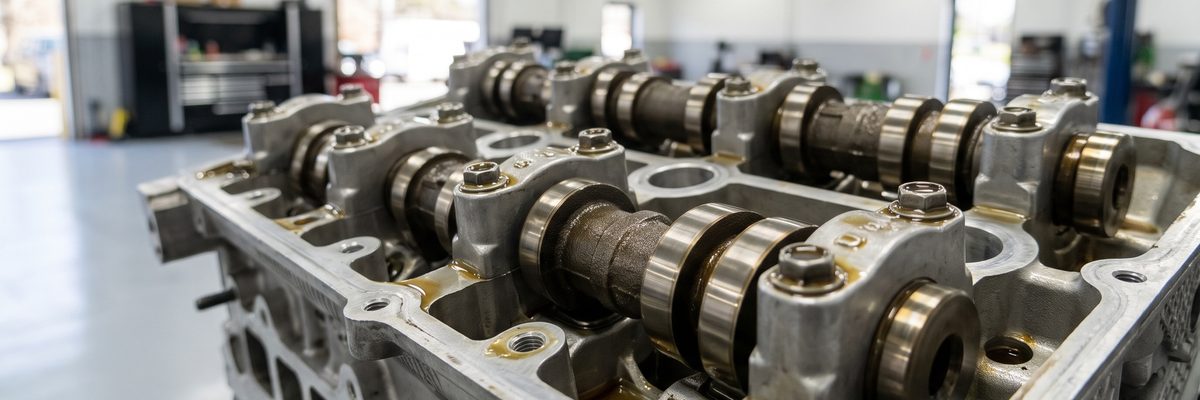
Variable valve timing, which some makers call VCT, moves the cam with engine oil. A solenoid valve, driven by the engine computer, lets oil into the cam actuator on the sprocket, and that pressure moves the cam ahead or back. If the valve sticks, the cam doesn't reach the position the computer asks for and P0014 sets.
On some engines the repair is to replace both the intake and the exhaust solenoid valves, as on the 2.4L Chevrolet Equinox. The computer can't command the actuator while a crank or cam sensor code is stored on some engines, so the shop sorts those codes out before it blames the valve.
3. A cam part or the chain installed wrong
An incorrectly installed camshaft, cam actuator or timing chain can set P0014, and so can a chain tensioner that isn't holding the chain tight, because a failed tensioner lets slack build up and raises the risk of a skipped tooth. A rattle from the front of the engine, with or without the check engine light, can come from a tensioner that is stuck or collapsed.
The shop takes off the lower front cover, checks the tensioner for an air gap and replaces it and any worn guides, as on the 2019 Cadillac XT4 with the 2.0L. A hydraulic tensioner needs engine oil pressure to work, and poor lubrication wears the chain, so a chain fault sends the shop back to the oil.
A wrongly set wheel on the cam can do the same. After an engine replacement, the toothed wheel the cam sensor reads, called the reluctor wheel, may sit in the wrong position at top dead center, where piston 1 is at the top of its stroke.
The shop sets the engine to top dead center and checks the wheel. A wheel set wrong after an engine job shows up as a cam timing code, as on the Kia Soul.
4. Engine computer software
After an auto stop and restart, a software fault can set several cam codes at once as history codes, as on the Cadillac ATS. The cause is a software anomaly that is still under investigation, and if nothing else is found the shop clears the codes, so history codes alone aren't a reason to replace a part.
On some engines the repair is a reprogram, and the engine computer itself isn't replaced, as on the Toyota Crown. Ask whether a bulletin or software update was checked before you pay for parts.
5. A failed magnet or a chafed harness
A failed actuator magnet can set the code on some engines. The shop checks the wiring first, then replaces the magnet for the code that set, as on the Silverado 1500 with the 2.7L turbo.
A chafed engine harness can set it too. The shop looks for a harness that rubs on the edge of the camshaft cover or the cylinder head, as on the Chevrolet Colorado.
What to say to the shop
When you have a P0014 quote or a repair order, ask:
- Was a bulletin or a software update checked for my car before parts?
- Which solenoid, wiring or sensor was tested, and what did it show?
- Does the quote say who pays if the fix is a reprogram under warranty?
“My car set P0014. Can you tell me what you tested, whether a bulletin or software update covers my car and who pays if it's a reprogram?”
A good answer: the test that was run, the fault it points to and a bulletin check for your car, before any part is ordered.

Use this image
Free to republish under CC BY 4.0: credit Oil & Miles and link to this page. The snippet does both.
<a href="https://oilandmiles.com/articles/p0014-code"><img src="https://oilandmiles.com/assets/img/diagrams/p0014-code-bench-flow-1200.svg" alt="A pale gray V engine drawn see-through, with a cam phaser and an oil control solenoid in blue at the front of the head." width="1200" height="706"></a> <p>Diagram: <a href="https://oilandmiles.com/articles/p0014-code">Oil & Miles</a>, CC BY 4.0</p>How does a shop diagnose P0014?
The computer sets P0014 when the cam stays away from the position it asks for. A shop works through it in this order:
- Read every stored code. The shop starts with a scan tool.
- Check the oil. Before the shop tests the actuator it checks the oil level and the oil pressure, because both are critical to the actuator.
- Fix any crank or cam sensor code. A stored crank or cam sensor code is fixed first, because the computer can't command the actuator with one set.
- Move the actuator. With the engine idling, the shop moves the cam actuator through its range with the scan tool and watches how closely the cam follows.
- Drive the car. The shop finishes by driving the car under the conditions that set the code, to see whether it resets.
These readings belong to one engine only, the 2.0L in the 2011 Saab 9-5. Other engines have their own numbers, so the Car column in the table shows which car each reading is from.
| Check | Reading | Car |
|---|---|---|
| When the code sets | The cam is more than 6 degrees off for more than 10 seconds. | 2011 Saab 9-5, 2.0L |
| Actuator test | The actuator moves from 0 to 20 degrees and back to zero. | 2011 Saab 9-5, 2.0L |
| Passing result | The cam position varies by less than 2 degrees in each state. | 2011 Saab 9-5, 2.0L |
How much does it cost to fix P0014?
The cost depends on the car and on which part the repair needs. Diagnosis isn't priced here, and labor is priced only where a carmaker labor time is available. The repairs priced here are the solenoid valves, the cam phasers and the timing chain tensioner, each on the car it was priced for.
Priced on the 4 cars below, not every model and year. Yours may cost more or less.
P0014 parts cost
$63–$175 Part only
P0014 parts cost Part only $63–$175
Estimated price of the part tied to P0014 on four cars. Labor is priced only where a carmaker labor time is available. Yours may cost more or less.
| Car | Independent shop |
|---|---|
| 2012 Chevrolet Equinox 2.4L | $63–$175 |
| Both solenoid valves, intake and exhaust | |
| 2012 GMC Terrain 2.4L | $63–$175 |
| Both solenoid valves, intake and exhaust | |
| 2012 Nissan Maxima 3.5L | $1,752–$2,006 |
| VVT sprocket (cam phaser) x2 · not in the range above | |
Buying the part yourself, known brands from one large online catalog: $39–$1,180, part only.
Labor, Maxima and XT4 Labor only $120–$620
The carmakers book 1.2 hours for the Maxima and 2.2 to 3.6 hours for the XT4, priced at shop rates.
| Car | Parts | Labor | Total |
|---|---|---|---|
| 2012 Nissan Maxima 3.5L | – | 1.2 h | $120–$210 |
| Nissan NTB12-116a p.6 | |||
| 2019 Cadillac XT4 2.0L | – | 2.2 to 3.6 h | $220–$620 |
| GM PIP5652A p.2-3 | |||
Not priced Labor only No figure
The XT4 tensioner isn't priced as a part, because the catalog lists only a bolt and an unnamed part for it. Labor on the Equinox and Terrain isn't priced, because no carmaker labor time is available for it. A chain kit isn't priced, because the repairs priced here are the ones tied to this code on these cars. A bigger repair, cam phasers, costs more than this range, as on the Nissan Maxima. Ask for the hours, the rate and whether the quote names the part that failed.
Set by each shop, may be waived if you approve the repair or it's covered. Ask for it in writing first.
Notes
Prices read November 17, 2026. Not included: tax, shop fees and diagnosis.
What other codes show up with P0014?
P0014 can set with other cam timing codes, such as P0011, P0016, P0017, P0021 and P0024, and a shop reads every stored code together. The oil and solenoid checks are in P0011 Code, and the cam and crank signal checks are in P0016 Code.
P0010, P0013, P0016, P0017, P0335, P0336, P0340, P0341, P0365 and P0366 have to be clear before the shop goes on with P0014, as on the 2011 Saab 9-5 with the 2.0L. A stored cam or crank sensor code comes first for that reason.
From the carmakers
What do the carmakers' documents say about P0014?
Carmakers have published 59 bulletins that name P0014, from 16 makes. NHTSA lists 147 complaints that name it, and owners type P0017 (34) next to it most, then P0011 (19) and P0024 (16). Nine of the bulletins are below.
Service bulletin GM PIP5568E
"…a stall, lurch, stumble, hesitation or power loss after an auto stop/restart event…"
Service bulletin GM PIP6047A
"Potential metal debris in engine oil."
Service bulletin GM 17-NA-098
"…replace both the intake and exhaust camshaft position actuator solenoid valves…"
Service bulletin GM 18-NA-307
"…may be caused by the engine wiring harness chaffing on the edge of the camshaft cover…"
Service bulletin Toyota T-SB-0034-24
"…The ECM (PCM) should NOT be replaced as part of the Repair Procedure."
Service bulletin Subaru 09-98-22R
"…new reprograming files for the Engine Control Module (ECM) developed to remedy the following DTCs: … P0014…"
Service bulletin GM PIP5855
"…replace the Camshaft Position Actuator Magnet for the code that has set and retest."
Service bulletin Ford SSM 54366
"…Pinpoint test HK in the Powertrain Control and Emissions Diagnosis (PC/ED) or in Section 303-14 of the Workshop Manual (WSM) has been updated."
Service bulletin Kia PS731
"…the camshaft reluctor wheel (also called pulse wheel) may not be in the correct position when engine is at Top Dead Center…"
Conclusion
What to do next about a P0014 code
If the car stalls or loses drive, stop where it's safe and call for help. Then have the shop read the stored cam codes together and ask whether a bulletin or a software update covers your car, and if a quote starts with a part, ask which test pointed to it.
Oil & Miles checks each step here against carmakers' bulletins and service manuals, and parts makers' technical pages.
Common questions
Asked most often
Is P0014 the intake or the exhaust cam?
On Kia and GM cars, the exhaust cam. P0014 is a "B" camshaft code on Bank 1, and those makers call B the exhaust cam.
Is P0014 the timing chain?
Not by itself. Oil, a solenoid valve, wiring and software can all set it, and for the chain itself see bad timing chain symptoms.
Is P0014 covered by warranty?
Toyota covers the Crown reprogram under its federal emission warranty for 96 months or 80,000 miles from the in-service date. For any other car, ask the dealer whether a bulletin covers it.
Does an oil change fix a P0014 code?
It can, when low or dirty oil is the cause. A low oil level can set P0014 on some engines, and a shop checks the oil level and pressure before it tests a part, with the oil and solenoid checks in P0011 Code.
Sources
- GM service bulletins PIP5568E (February 2019), PIP5855 (May 2022), PIP6047A (March 2025), 17-NA-098 (version 2, September 2019), 18-NA-307, PIP5096C and PIP5652A, for the software, magnet, oil, solenoid, harness and chain tensioner causes and the bank labels. GM, read November 16, 2026
- Toyota service bulletin T-SB-0034-24, April 15, 2024, for the reprogram and its emission warranty. Toyota, read November 16, 2026
- Ford service bulletin SSM 54366, for the updated pinpoint test. Ford, read November 16, 2026
- Kia service bulletin PS731 (May 2022), for the reluctor wheel after an engine replacement. Kia, read November 16, 2026
- Subaru service bulletin 09-98-22R, revised August 31, 2026, for the reprogram. Subaru, read November 16, 2026
- Saab Workshop Information System, "DTC P0011 or P0014," 9-5 (9650) 2011, 2.0 l gasoline, for how a shop diagnoses the code, the oil checks and the mechanical causes. Saab, read November 17, 2026
- Gates TechZone, "Comprehensive Guide to Timing Chain Replacement" (June 5, 2025), for the chain symptoms, the oil and the tensioner. Gates, read November 17, 2026
- Standard Motor Products, "A Closer Look: Variable Valve Timing" (April 21, 2026), for how the solenoid and sprocket work. Standard Motor Products, read November 17, 2026
- Gates, "The VVT system and the solenoid valve" (November 4, 2021), for oil debris and pressure. Gates, read November 17, 2026
The repair steps and the causes come from the carmakers' own bulletins and service text, and the complaint counts come from NHTSA's public files.
Illustration by Oil & Miles
This article is general information, not advice about your specific vehicle. See the disclaimer.