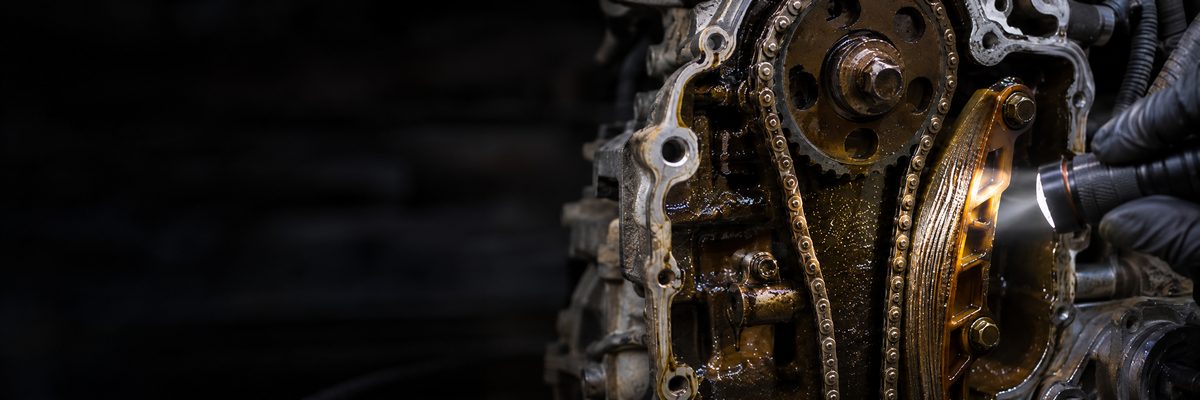

A rattle that stays, a cam timing code or rough running are the usual signs of a bad timing chain, but the parts around it can cause the same ones. The chain itself is the metal chain inside the engine that keeps the camshafts in step with the crankshaft.
Not every engine has one, since some run a rubber belt in its place, dry or in oil. Our guide to wet belts, timing chains and dry belts shows which yours has.
Is it safe to drive with a bad timing chain?
No, not once the rattle stays, because nobody can tell you how many miles are left. A tow is the safest way to the shop, since it costs far less than an engine, and stop now if it also runs rough, misfires or stalls.
Lost timing is what does the damage, and Ford says it could lead to internal engine damage on the Mustang GT500 and GT350. Many engines are built so the valves and pistons share the same space, which mechanics call an interference engine, and lost timing can let them hit.
An oil warning light means stop as soon as it's safe and switch off. A flashing check engine light can mean a misfire, as our flashing check engine light guide explains, so pull over when it's safe and have it checked, with a tow if the rattle is there too.
A short rattle at cold start, with no light and a smooth engine, isn't the same emergency. Book a diagnosis soon, and don't wait for it to get louder.

A tow beats a lost engine
What are the symptoms of a bad timing chain?
A bad timing chain shows up as a rattle that stays, a check engine light with cam timing codes, rough running, metal in the oil and, at the worst, an engine that won't start. Parts next to the chain can cause several of the same signs.
1. A rattle from the timing chain end that stays
You'll hear a metallic rattle from the timing chain end of the engine, the front on most engines and the back on some, such as Audi's 2011–2014 3.0 TFSI. It comes at start or at idle and doesn't fade after the first few seconds, and a stretched chain has slack that can let it slap its guides.
A rattle of a couple of seconds at cold start is a different case, and the section on sounds covers it. Other noises have their own guides, for engine ticking and for a rattling noise when accelerating.
2. A check engine light with cam timing codes
You'll see the check engine light, and a code reader shows a cam timing code such as P0016. That code means the engine computer sees the camshaft out of step with the crankshaft.
The same code can come from a smaller part, so treat it as a lead and not as proof. The section on codes explains why.
3. Rough running or misfires
You'll feel the engine shake, stumble or misfire. Lost timing can do this, as Ford notes on the Mustang GT500 and GT350.
Misfires have plenty of other causes, which our guides to a P0300 misfire code and a car that shakes at idle cover. So on most engines this sign alone doesn't point at the chain, but a misfire still needs a diagnosis soon.
4. Metal in the oil
A shop may find metal or debris when it drains the oil. Abnormal debris in the oil is one sign of a loose cam actuator on GM's 2.7L pickups, a part that sits beside the chain.
Have the engine inspected before you run it further. On those trucks, GM recommends a new engine and turbocharger if the debris came from a damaged cam carrier, the housing the camshafts sit in.
5. An engine that cranks but won't start
The engine turns over and never catches. On the same GM 2.7L Silverado and Sierra pickups it can be a crank with no start and no compression because of damaged timing components.
Stop cranking and have it towed, because each turn can add to the damage. Our guide to a car that won't start covers the other causes.
What does a bad timing chain sound like?
A bad timing chain sounds like a metallic rattle from the timing chain end of the engine, and how long it lasts is your first clue. That end is the front on most engines and the back on some, and carmakers describe several noises from there that aren't the chain itself, so these are the timing chain sounds worth telling apart:
- A loud rattle for about 2 seconds at cold start. Honda traces this on some Accord, CR-V and Fit engines to the VTC actuator, the part that shifts the cam timing. On some later Accord and CR-V engines it gave no repair at all.
- A tick or rattle for a few seconds after long parking. Ford traces this on some F-150 3.5L engines to worn cam timing units.
- A knock at warm idle. Ford's programs 21N03 and 21B10 name this as the second noise those worn cam timing units, also called cam phasers, make on that same engine.
- A chirp at warm or hot idle. On some Ford 5.0L engines this passes for a belt, and the cause is a valve in the chain tensioner.
- A rattle that stays, with rough running or a light. Treat this one as serious, the chain or a part beside it, until a shop finds the cause.
Each of those notes covers its own engine and sets no rule for yours. We'd record the noise on a phone at a cold start, because it may not happen on the day you visit the shop.

Where the shop listens
Will a bad timing chain throw a code?
Yes, a bad timing chain can throw a code, and the codes point at cam timing rather than at the chain. Stretched chains on some GM V6 engines set P0008, P0009 and P0016–P0019, all codes for cam timing out of step, and a worn primary chain on some F-150 3.5L engines sets P0016.
A cam timing code alone doesn't settle it, because GM's 2.7L pickups can set P0011 and P0016 with a loose cam actuator. Our P0011 code guide covers cam timing and its solenoids.
How do you tell if a timing chain needs replacing?
You tell from the code, a live cam timing reading and a look at the parts, because the noise alone can't prove it. A shop checks them in this order:
- Read the code. A cam timing code such as P0016 is a lead and not proof.
- Watch the live cam reading. On some 2011–2014 F-150 3.5L engines, Ford's bulletin calls for a new primary chain when the intake cam reading on the scan tool shows +6 degrees or more with the engine running.
- Look at the parts. On its 2.7L pickups, GM has technicians take off the upper chain cover and inspect the cam actuator.
The chain may turn out to be fine, and carmakers name the parts in their own repair instructions. These parts can cause the same noise or codes as a bad timing chain:
- The cam actuator or phaser. It shifts the cam timing, and a worn one can rattle at start.
- The chain tensioner. It takes up the slack, and Ford's fix for that 5.0L chirp is a new pair of tensioners.
The size of the job is why this matters. An actuator is a short job on some engines, while a worn primary chain on others takes a full day of labor.
It can run the other way too. GM told technicians on its V6 engines that guides, idlers and cam actuators were being replaced unnecessarily when a stretched chain was the fault, so a cheap repair can also miss the cause.
What to say to the shop
“Please show me what points to the chain, and check for bulletins on my VIN before you quote it.”
Before you pay, run your VIN, the 17-character number on the dash at the base of the windshield or on the driver's door jamb, through our free VIN checker for the bulletins on your model year. A bulletin that matches your noise gives the shop something specific to check.
How much does it cost to replace a timing chain?
A timing chain job runs about $1,269–$2,006 on a 2013 Ford F-150 3.5L and $1,266 on a 2012 Chevrolet Equinox 3.0L at an independent shop, parts and labor. A VTC actuator alone, the part beside the chain, runs $404–$517 on a 2010 Honda Accord 2.4L.
Oil, coolant and any damage found with the engine open are extra. Our guide on how to read a repair estimate shows what to look for.
Get the quote in writing before any work starts. Ask for the test result, the hours and the rate on the written quote, and whether the diagnosis fee comes off if you approve the repair.
Do timing chains need replacing?
No, most timing chains have no replacement interval. The owner's manual maintenance schedules we read list no timing chain replacement, but that doesn't promise a chain lasts the life of the car.
Oil is the part you control: GM told owners of some V6 cars that extended oil change intervals could wear the chain early, so don't stretch oil changes. GM's fix set its oil life monitor to call for them more often, and you can check when your oil change is due.
From the carmakers
Is a timing chain covered by warranty or a recall?
A warranty can cover it, within the term your booklet gives, but a recall rarely does. GM's chain bulletin lists 5 years or 100,000 miles and Honda's actuator bulletin lists 5 years or 60,000 miles, each for its own cars, while GM's extended coverage for 2007–2009 2.8L and 3.6L V6 models (10 years or 120,000 miles) has ended.
A few recalls since 2010 name parts beside the chain, such as a tensioner, so run your VIN. Most of the documents below blame a part beside the chain, with the chain faults last.
Bulletin 09-010 v5
At cold start-up, the engine rattles loudly for about 2 seconds.
Bulletin 23-2143
To correct the condition, follow the Service Procedure to replace the VCT units.
Preliminary information PIP5921B
Also, in some cases the vehicle could be a crank no start and have no compression due to damaged timing components.
Bulletin 17-0026
This concern may be due to a worn primary timing chain.
Bulletin 12-06-01-009F
Idler gears, camshaft actuators, crankshaft driven gears and timing chain guides are being replaced unnecessarily and are not worn and should not be replaced.
Each card shows who pays, and all five are information only. The VIN check above shows the bulletins for your model year.
Conclusion
What to do next about a timing chain noise
If the rattle stays, a tow is the safest way to the shop. If it's short, have the code read and ask what points to the chain before you pay.
Oil & Miles checks each step here against the carmakers' bulletins and manuals.
Common questions
Asked most often
Is it a timing chain or a timing belt?
A chain is metal and runs inside the engine in oil, and a belt is toothed rubber. If your engine has a belt, our guide to timing belt symptoms is the one you need.
Can you replace just the tensioner?
Sometimes, when the tensioner is the fault, as with the chirp on some Ford 5.0L engines that a new pair of tensioners fixes. GM warned that on its V6 engines parts beside the chain were replaced for nothing when the chain itself had stretched, so ask what the test showed.
Is a 2-second rattle at cold start the timing chain?
Not necessarily. Honda traced it on some Accord, CR-V and Fit engines to the VTC actuator beside the chain, so ask for a diagnosis before a chain quote.
What people ask next

Sources
- Ford program 21B26, for what lost timing can do on the 2020 Mustang GT500 and GT350. Ford via NHTSA, read October 31, 2026
- GM preliminary information PIP5921B, for the noise, debris in the oil, the codes and a no start with no compression on its 2.7L engine. GM via NHTSA, read October 31, 2026
- GM bulletin 12-06-01-009F, for stretched chains, their codes, the parts replaced unnecessarily, the hours and the warranty term. GM via NHTSA, read October 31, 2026
- GM bulletin 10287B, for extended oil change intervals and chain wear. GM via NHTSA, read October 31, 2026
- Ford TSB 17-0026, for P0016, the +6 degree cam reading, a worn primary chain and the hours. Ford via NHTSA, read October 31, 2026
- Honda documents: bulletin 09-010, bulletin 16-012, bulletin 16-088 and service news A18010F, for the cold rattle, the VTC actuator, the hours and the warranty terms. Honda via NHTSA, read October 31, 2026
- Ford bulletins: 23-2143 for the VCT units, the latest after 20-2191, and 19-2140 for the tensioner chirp. Ford via NHTSA, read October 31, 2026
- Ford programs: 21N03 and 21B10, for the knock at warm idle. Ford via NHTSA, read November 5, 2026
- Audi TSB 2039995/1, for the timing chains at the back of the 2011–2014 V6 3.0 TFSI. Audi via NHTSA, read November 5, 2026
- GM special coverage 11340C, for the ended 10-year or 120,000-mile chain coverage on 2007–2009 2.8L and 3.6L V6 models. GM via NHTSA, read November 5, 2026
- Owner's manuals: 2018 Nissan Altima, 2015 Ford F-150, 2014 Chevrolet Silverado 1500, 2017 Honda CR-V, 2018 Toyota Camry and 2019 Toyota RAV4, for schedules that list no timing chain replacement. Nissan, Ford, GM, Honda and Toyota, read October 31, 2026
- NHTSA's recall file, a phrase search of the post-2010 records for timing chain, and recalls for parts beside the chain: 14V-176 and 23V-707 (BMW), 13V-395 (Lexus), 14V-762 and 15V-351 (Mercedes-Benz). NHTSA, read October 31, 2026, recalls read November 2, 2026
- Ford's dashboard warning lights guide, for what to do when the oil light comes on and what a flashing light can mean. Ford, read November 2, 2026
- Repair guides and shops: Chico Car Care, GreatWater 360 and PartCatalog, on the rattle and metal in the oil. Read October 31, 2026
AI illustration by Oil & Miles
How this was compiled
The faults, codes and hours come from the carmakers' bulletins and programs on NHTSA's site, and the labor is those hours at our independent shop rate. Parts are known brands from one large online catalog, with the carmaker's list price at a dealer. Repair guides and shops are used only where two or more agreed, for what you notice.
What we didn't do
We didn't measure a chain ourselves, and we didn't read every carmaker's bulletins, so your car's own service information has the last word. This page prices three common jobs only, and your engine and fault decide the rest.
Compiled in November 2026 for the US market. This article is general information, not advice about your specific vehicle. See the disclaimer.