
Key takeaways
- Safety: If the car loses drive or stalls while moving, steer to a safe spot, stop and call for help.
- The same signs come from other parts, so a code or a symptom isn't proof the sensor is bad.
- Ice and software updates are two documented reasons a MAP sensor is fine.
- Recalls and carmaker fixes exist for some models, so check your VIN before you pay.
MAP sensor symptoms overlap with many other engine problems. The sensor tells the engine computer how much pressure is in the intake, and carmakers have documented wrong readings with other causes: ice, a software update, bad wiring or the wrong part.
What are the symptoms of a bad MAP sensor?
A failing MAP sensor can cause these signs. Behind each one is a wrong pressure reading reaching the engine computer, and this is what you may notice:
- Rough or uneven idle. The engine gets the wrong amount of fuel and spark while it idles, so it shakes or stumbles instead of running smoothly.
- Weak or hesitant acceleration. When you press the pedal, the computer works from the wrong reading, so the engine answers slowly or feels flat.
- Worse fuel economy. The fuel the computer sets no longer matches what the engine needs, so you burn more gas for the same drive.
- Misfires. Wrong fuel and spark timing can make a cylinder fire badly, which you feel as a jerk or a stumble.
- Check engine light. The computer sees a pressure reading that doesn't make sense and sets a code that a shop scan can read.
None of these signs proves the sensor is bad, so they tell you where to start looking, not what to replace. A shop scan that reads the stored code is the next step, and the code together with the signs narrows it down.
Is it safe to drive with a bad MAP sensor?
It depends on what the car does. A MAP fault that cuts power or stalls the engine is the one carmakers document as a crash risk, so start at the top:
- Stop: The car loses drive or stalls while moving. Steer to a safe spot, stop and call for help. Bad sensor wiring or ice on the sensor can cut power or stall the engine, and Ford's recall says a stall increases the risk of a crash. Carmakers document it on some cars, such as the 2013–2014 Escape for wiring.
- Stop: The check engine light flashes. Ease off the throttle and pull over where it's safe. A failing MAP sensor can cause misfires, and carmakers such as Honda flash the light when the engine misfires.
- Caution: The check engine light stays on but doesn't flash. Have the car checked as soon as you can. GM and Honda warn that driving on with the light on can damage the engine or the emission system.
In each stall or power-loss case the carmakers document, the fix wasn't a new sensor. Ice melts with idling, Ford replaces the wiring splices free under the recall, and the Escape hybrid got a software update. After a stall, tell the shop whether it was below freezing and ask it to check your VIN for a recall first.
What does a MAP sensor do?
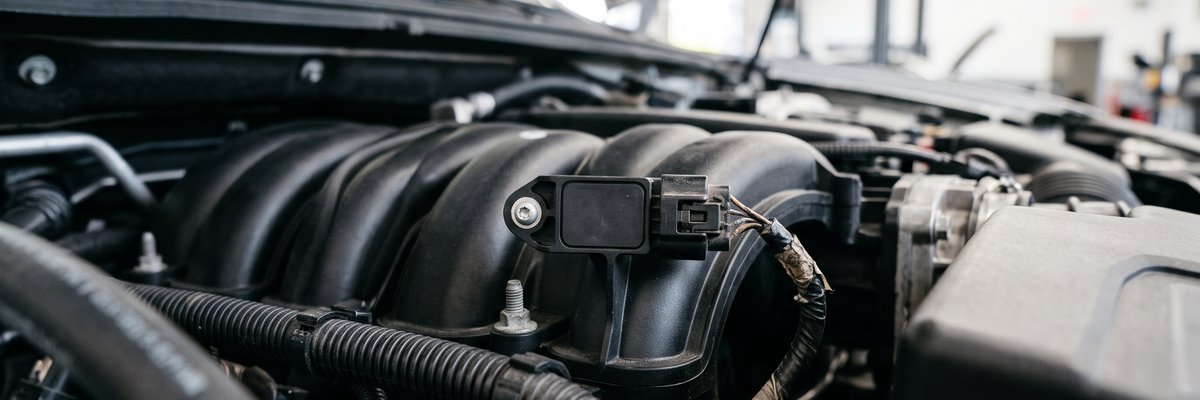
MAP stands for manifold absolute pressure. The sensor reads the pressure in the intake manifold so the engine computer can set fuel and spark timing.

Use this image
Free to republish under CC BY 4.0: credit Oil & Miles and link to this page. The snippet does both.
<a href="https://oilandmiles.com/articles/map-sensor-symptoms"><img src="https://oilandmiles.com/assets/img/diagrams/map-sensor-symptoms-bench-flow-1200.svg" alt="A pale gray SUV with its hood open, the MAP sensor in blue on the intake manifold on top of the engine." width="1200" height="660"></a> <p>Diagram: <a href="https://oilandmiles.com/articles/map-sensor-symptoms">Oil & Miles</a>, CC BY 4.0</p>When the reading is wrong, the computer sets fuel and spark from the wrong information, and the engine can run rough, hesitate or set a check engine light. That's also why the same signs can come from a sensor that is fine.

The MAP sensor on the intake
What makes a MAP sensor read wrong?
A wrong reading can come from more than a dead sensor. Four other causes are documented, and each is explained below with what a shop checks.
On some cars, ice and a software update are the two a shop rules out first. Ask whether that was done, and what it checked instead, before it replaces the sensor.
1. Ice
Below freezing, ice can form on the sensor and cut engine power. MAP sensors are sensitive to contamination, and the hose to the sensor can become clogged or leak, so the sensor can't read pressure changes.
Idling melts the ice, the power should come back, and the check engine light can stay on, as on the 2017–2022 Chevrolet Silverado heavy-duty. A shop looks inside the sensor hose for contamination.
2. Software
Engine software that is too sensitive can set P0106 by mistake, and the condition doesn't affect how the car drives. The fix is a software update before anyone tests or replaces the throttle valve or the MAP sensor, as on some 2011–2014 Volkswagen models with the 2.5L engine.
The computer works out air density and the engine's air mass flow from the MAP reading together with the intake air temperature, coolant temperature, barometric reading and engine speed, so a wrong value in any of them shifts the result. A shop tests the sensor to confirm it is faulty before it replaces it.
3. The wrong part
A P0106 code that appears after the intake manifold was replaced can mean the new manifold came with the wrong sensor, as on the 2020 Jeep Wrangler with the 3.0L engine. This cause shows up on some engines only.
A shop compares the part number and the sensor type with the car's application. It also checks the signal, ground and reference voltage against the carmaker's service information before it condemns anything.
4. Bad wiring
Poorly crimped wiring splices to the sensor can send wrong signals, so the engine may hesitate or stall, as on some 2013–2014 Escape and Focus ST models with the 2.0L engine. Ford replaces the splices free on vehicles built in the recall's dates.
Connectors can also melt or crack from the heat close to the engine, and vibration can loosen connections. A shop checks the connector and wiring for melted or cracked wires and loose connections, and unplugs the sensor to make sure the pins are straight, clean and free of corrosion.

A frosted pickup on a cold morning
Is it the MAP sensor or something else?
Rough idle and a check engine light can also come from worn spark plugs, a weak ignition coil or a vacuum leak. That's why the MAP sensor is one place to look, not the only one.
The stored code and what the shop rules out first narrow it down. Ask which of these were checked before you pay for a sensor.
What is the difference between a MAP sensor and a MAF sensor?
A MAF sensor measures the air flowing into the engine, while a MAP sensor reads the pressure in the intake manifold. An engine can use one or the other, or both.
Engines without a MAF sensor work out the airflow from the MAP reading, the engine speed and other readings. The MAF sensor has its own codes, such as P0101, and other faults can set those codes too.
Which trouble codes does a bad MAP sensor set?
A bad MAP sensor, or the wiring to it, makes the engine computer store one of five codes. Each one names what the computer saw in the sensor's signal:
- P0105. Something is wrong in the sensor's circuit, the wiring and connection the signal travels through.
- P0106. The signal arrives, but the pressure it reports doesn't fit what the engine is doing.
- P0107. The signal is lower than a working sensor should send.
- P0108. The signal is higher than a working sensor should send.
- P0109. The signal keeps dropping out and coming back.
None of the five codes proves on its own that the sensor itself is bad. Bad wiring splices can send wrong signals to the engine computer, ice can set P0106 and the code stays after the ice melts, and engine software has set P0106 by mistake, so the code tells the shop where to start, not what to replace.
The federal complaint file holds more than 600,000 owner complaints for model years 2010–2025, and only a few dozen name a MAP code. P0106 is the one owners name most, more than 30 times, and the other four only a handful of times each.
One 2013 Ford Escape owner wrote that the engine kept shutting off in traffic and once lost all power on a highway when the car ahead slowed, while the owner was told nothing was wrong. The sensor finally set a P0106 code and was replaced, the car ran fine for a day and then stalled again, which the owner blamed on the wiring.
A P2074 code on some Hyundais with the 2.5L engine built in the US (VIN starting 5NP or 5NM), such as the 2020–2022 Sonata, means the airflow, pressure and throttle readings don't agree. Hyundai fixes it with an engine computer software update, not a new part.
What does the fix look like?
Among the 28 carmaker bulletins whose subject is the MAP sensor or a MAP code, more than 10 tell shops to update the engine software and 2 name a new sensor. The rest repair wiring, replace another part or give a procedure only.
What carmaker bulletins about the MAP sensor tell shops to do
Carmaker bulletins whose subject is the MAP sensor or a MAP code, 28 in all
The software count is rounded down, and the others are exact.
Use this image
Free to republish under CC BY 4.0: credit Oil & Miles and link to this page. The snippet does both.
<a href="https://oilandmiles.com/articles/map-sensor-symptoms"><img src="https://oilandmiles.com/assets/img/charts/map-bulletin-fix-card.svg" alt="Lollipop chart of what 28 carmaker bulletins about the MAP sensor tell shops to do: update or reprogram the engine software more than 10, repair wiring, connector or splices 5, information or procedure only 5, repair or replace another part 3, replace the MAP sensor 2" width="1000" height="640"></a> <p>Chart: <a href="https://oilandmiles.com/articles/map-sensor-symptoms">Oil & Miles</a>, CC BY 4.0</p>Several carmakers fix these cases without a new sensor. On the GM pickups, a clean, dry sensor is left in place after the ice melts. Ford, Hyundai and Volkswagen each name a software update, and the Ford wiring splices are replaced free on the vehicles the recall covers.
Some cases do end with a different sensor, such as a wrong sensor that came with a replacement manifold. Some makers do name the sensor as the cause, and the fix is a new sensor, as on the Ford F-150 with the 2.7L EcoBoost.
Some heavy-duty pickups call for no chemical cleaner, water or compressed air on the MAP sensor and no attempt to clean soot off it, as on the 2017–2022 Chevrolet Silverado heavy-duty. Ask the shop what it checked before it replaces anything.
What to say to the shop
When a quote names a new MAP sensor before any test has run:
“I have these codes stored: [codes]. Before you replace the MAP sensor, can you check my VIN for bulletins, recalls and software updates, check the intake for a leak, and tell me which test showed the sensor reading was wrong?”
A good answer: the VIN check, the software and the leak check come first, and the shop names the test that showed the reading was wrong.
From the carmakers
What the carmakers say about MAP sensors and which is a free fix
Each of these covers only the cars and model years it names. Check the model years against your car before you rely on one.
Safety recall 14V-495
The incorrect signals could cause the vehicle to hesitate or the engine to stall, increasing the risk of a crash.
Customer satisfaction program 21B68
These codes may lead to the PCM disabling the engine and a “Stop Safely Now” message appearing in the instrument cluster.
Technical bulletin 2034012
DO NOT diagnose or replace the throttle valve or MAP sensor before performing the update function as explained in this bulletin.
Service bulletin 20-NA-043
During a 1-2 hour drive in below freezing temperatures, ice may form on the MAP sensor.
STAR record S2609000009
Technician may find that DTC P0106 is setting after replacing the intake manifold.
Conclusion
What to do next about a bad MAP sensor
Treat a rough idle or a light as a reason to get the car scanned, not as proof the sensor is bad. Ask for the stored code, whether ice, software or a recall applies to your VIN and what the shop checked.
Oil & Miles checks the carmaker cases here against their own bulletins and recalls.
Common questions
Asked most often
Can a bad MAP sensor cause limp mode?
Ice on the sensor can cut engine power, as on the Chevrolet Silverado heavy-duty. If the car loses drive or stalls while moving, steer to a safe spot, stop and call for help.
What does a MAP sensor detect?
The pressure in the intake manifold, which the engine computer uses to set fuel and spark timing.
Are the MAP and MAF sensors the same part?
A MAF sensor measures the air flowing in and a MAP sensor reads the pressure in the manifold. An engine can have just one of them or both.
Sources
- GM informational bulletin 20NA043, version of January 2022, for ice on the MAP sensor and the cleaner warning. GM via NHTSA, read November 11, 2026
- Ford customer satisfaction program 21B68 and supplement 21B68-S1, for the iced sensor on the Escape hybrid. Ford via NHTSA, read November 11, 2026
- Volkswagen technical bulletin 2034012, for the engine software update with a P0106 code. Volkswagen via NHTSA, read November 11, 2026
- Stellantis STAR record S2609000009, for the wrong sensor on a new intake manifold. Stellantis via NHTSA, read November 11, 2026
- Ford recalls 14V495000 (14S17) and 15V813000 (14S17-S1), for the wiring splices. NHTSA recall file, read November 11, 2026
- Carmaker bulletins whose subject is the MAP sensor or a MAP code, for the 28 counted in the chart. Carmaker bulletins via NHTSA, read November 11, 2026
- Ford bulletin 21-2084, for the MAP sensor replacement on the 2.7L EcoBoost F-150. Ford via NHTSA, read November 11, 2026
- GM preliminary bulletin PIP6119, for the combined MAP and intake air temperature sensor on the 3.0L Silverado and Sierra 1500. GM via NHTSA, read November 11, 2026
- Hyundai bulletin 22-01-018H, for the P2074 software update. Hyundai via NHTSA, read November 11, 2026
- NHTSA complaint files, for the complaints that name P0105 to P0109, exact counts by code kept in the data file. NHTSA, read November 11, 2026
- NGK SPARK PLUG, "Part 8: MAF & MAP sensors" (December 2022), for the symptoms of a faulty MAP sensor. Parts maker, read November 17, 2026
- Delphi, Samarins and UTI on MAP and MAF sensors, for the symptoms, what the sensor does and the difference from a MAF sensor. Parts maker and training-school articles, read November 11, 2026
- Delphi, Samarins, CarWhere and RepairPal code definitions, for the names of the five MAP codes. Code references, read November 11, 2026
- Delphi, Making sense of your sensors: MAP sensor, for what contaminates or loosens a MAP sensor, how the computer uses the reading and how a shop checks it. Delphi, read November 18, 2026
Hero image: illustration by Oil & Miles
What we didn't do
- We didn't test a sensor or a car ourselves.
- The MAP-sensor bulletins here come from GM, Ford, Volkswagen, Stellantis and Hyundai. That list says nothing either way about Honda, Toyota or Nissan cars.
This article is general information, not advice about your specific vehicle. See the disclaimer.