
Key takeaways
- Safety: Stop and get it checked if the car stalls at idle, loses power with a message or the light flashes.
- A second code stored beside P0101, such as P1682 or P0171, points at a different fix.
- Check the filter, the air box and the duct after the sensor before anyone orders a new sensor.
- Run the VIN first, because some P0101 fixes are free dealer software updates or campaigns.
A P0101 code is the OBD-II engine code, or diagnostic trouble code (DTC), for a mass air flow (MAF) sensor reading that is out of range or doesn't make sense. You meet it as a check engine light, which can come with a rough idle, a hesitation or a stall.
The sensor may be reporting exactly the air it sees. The carmakers' own P0101 fixes point at the air path, the wiring and the software before the part.
What does P0101 mean?
P0101 means the mass air flow sensor's reading doesn't fit what the engine computer expects. Honda's bulletin calls it a MAF sensor circuit range/performance problem, and that last word is the point: the sensor answers, but the computer doesn't trust the answer. A MAP sensor measures something different, the pressure in the intake.
An airflow number the computer doubts
Mass Air Flow Circuit Range/Performance
What the computer saw
The sensor answered, but its airflow number fell outside what the computer accepts.
- Code
- P0101
- System
- Powertrain
- Area
- Fuel and air metering
- Standard
- Generic OBD-II
- Checks
- Whether the airflow reading fits what the engine computer expects
What it doesn't prove
It doesn't prove the sensor failed. Air, wiring or software can set it.
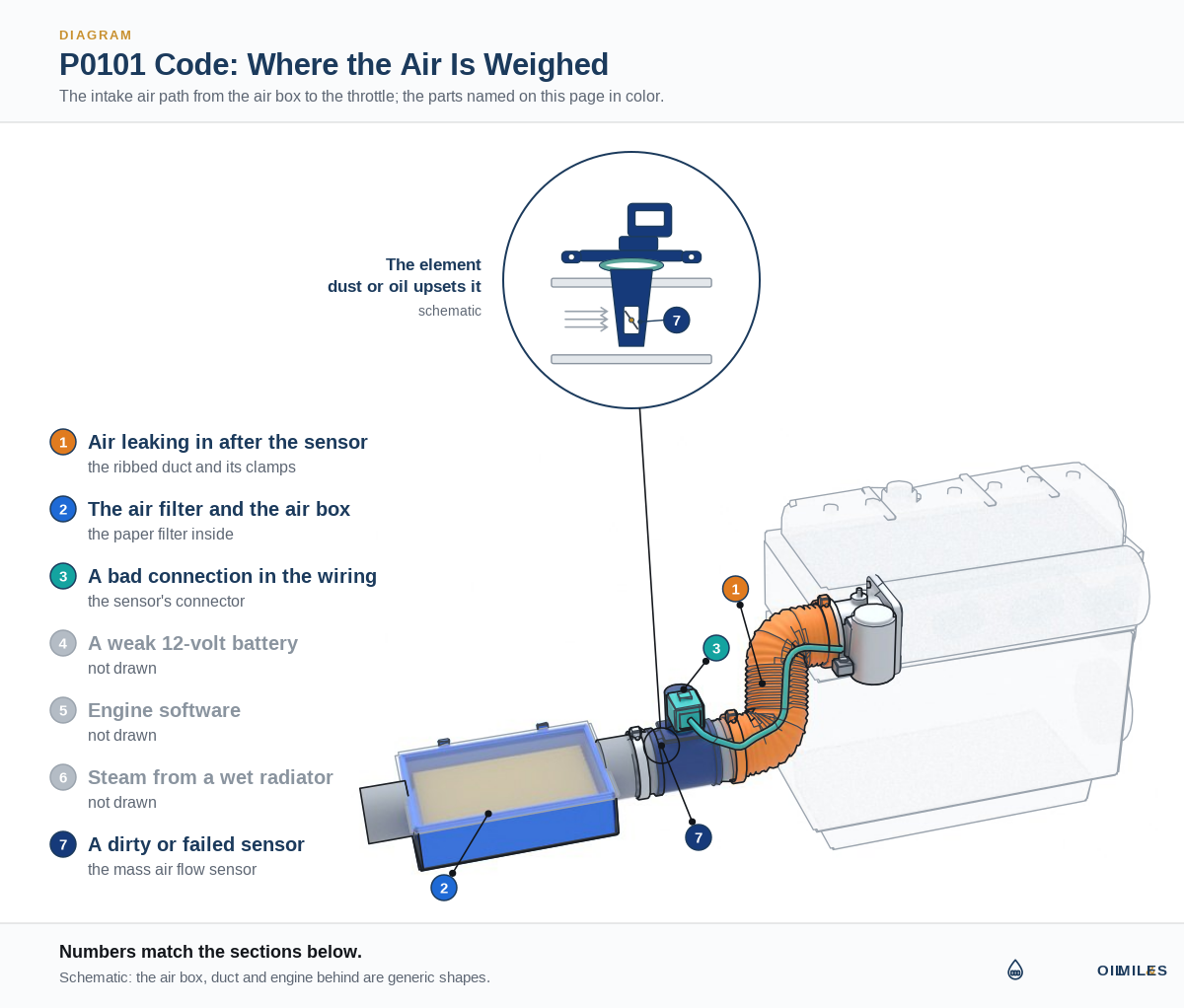
The sensor sits in the intake duct between the air filter and the throttle, and it weighs the air on its way in. The engine computer uses that number to decide how much fuel to spray. When the reading falls outside what it accepts, it stores P0101 and turns on the light, which says the number is suspect but not why.
So a good sensor can still set the code: air that slips in after the sensor never gets weighed, so the sensor takes the blame for air it never saw. Standard Motor Products, which makes these sensors, says the engine's true airflow is then unknown.
Nissan's bulletins print it as P0101 (MAF SEN/CIRCUIT-B1), and some owners type PO101 with a letter O or P101 with a zero dropped. Both are misreadings of P0101, and the check engine light codes page explains how the code families fit together.
Use this image
Free to republish under CC BY 4.0: credit Oil & Miles and link to this page. The snippet does both.
<a href="https://oilandmiles.com/articles/p0101-code"><img src="https://oilandmiles.com/assets/img/diagrams/p0101-code-air-bench.svg" alt="P0101 code air path: an air box with its paper filter and two latch clips, the mass air flow sensor in color where the air is weighed with a round zoom of its element, its connector and harness running along a ribbed rubber duct with its clamps where outside air can slip in uncounted, and the throttle body on a ghosted engine" width="1200" height="675"></a> <p>Diagram: <a href="https://oilandmiles.com/articles/p0101-code">Oil & Miles</a>, CC BY 4.0</p>Can you drive with a P0101 code?
Yes, gently and not for long, as long as the engine idles smoothly and pulls normally. Nissan's Sentra bulletin describes P0101 with no drivability issues, and that's the light-only case.
Stop and get it checked before more driving if any of these is true, because each one makes it more serious than a light:
- It stalls at idle or low speed. GM's turbo recall and Toyota's RAV4 campaign both name a stall, and a car that shuts off while driving covers what to do when it happens.
- Power drops with a message on the dash. On GM's 1.5-liter turbo that is the intake tube off its joint, and the cause is worth finding before more miles.
- The check engine light flashes. A flashing light usually means a misfire, which can damage the catalytic converter. The flashing check engine light page explains why.
The light also matters at inspection time. Federal inspection rules fail a car whose check engine light is on for any code, so P0101 with the light lit fails an OBD emissions test in states that run one.
What are the symptoms of a P0101 code?
It can be nothing but the light. When the airflow number is far enough off, the fuel follows it, and a bad MAF sensor reading shows up as these symptoms, roughly from mild to serious:
- The check engine light, and nothing else. The mildest case, and the one where you've time to check things yourself.
- A rough idle or hesitation. The engine gets the wrong amount of fuel for the air it really has, so it shakes at a stop or stumbles when you press the gas.
- Worse fuel economy. CRC, which makes MAF cleaner, lists it first among the signs of a dirty sensor.
- Black smoke. General repair guides list black smoke from the exhaust: too much fuel for the air burns dirty, and our black smoke page covers it.
- Reduced power. GM's turbo engines cut power when the intake tube comes off, with a message on the dash that engine power reduced covers.
- Stalling at idle or low speed. The most serious sign, and the carmakers' recalls and campaigns name it too.
Owners who name the mass air flow sensor in federal complaints report stalling far more often than lost power. That fits the carmakers' warnings about low speed and idle.
What causes a P0101 code?
Anything that makes the airflow number and the engine disagree: air that skips the sensor, a bad signal on its way to the computer, or software that misreads it. A dirty or failed sensor is on the list too, but it's the last of seven in the carmakers' bulletins, not the first.
P0101 alone confirms none of them, because the code says the airflow number is suspect, not why, and a second code stored with it can change which cause comes first. The first four are quick to check, and the carmakers fixed each of them without a new sensor.
1. Air leaking in after the sensor
The duct between the sensor and the engine has to be sealed, because every bit of air that enters through a crack or a loose joint goes uncounted. The engine burns air the computer never heard about, so its fuel math starts from too little air.
GM has issued three separate fixes for exactly this. They're a cracked duct on one small car and an intake tube that pops off on its 1.5-liter turbo when boost builds. On that turbo, GM says the sensor and throttle body should be replaced only if they're damaged or proven to be the cause.
Look along the duct from the sensor to the engine. Check for a split, a hose clamp you can turn by hand or a joint that has slid apart.
A shop can also smoke-test the intake, which finds leaks you can't see. A lean code stored beside P0101 is a hint in the same direction (the P0171 page explains lean codes, and vacuum leaks covers the leaks themselves).
2. The air filter and the air box
The filter sits right in front of the sensor, so anything wrong with it reaches the sensor first. A cotton, steel-mesh or cone filter can upset the reading, so Volkswagen tells technicians on its diesels to use factory filters only, and Standard Motor Products adds that an over-oiled filter can contaminate the sensor.
Nissan has a bulletin for a Rogue that lost power in heavy snow, with snow packed inside the air cleaner case and P0101 stored. Check that your filter is the right one, seated square and not soaked, and that nothing is sitting in the air box after the last service.
3. A bad connection in the wiring
The sensor also depends on connectors and a fuse block, and on GM's full-size pickups a bad crimp inside the underhood fuse block sets P0101 and P1682 together while the sensor is fine. GM's bulletin notes that some of these trucks had already had a new sensor for the same code, and it tells technicians, in capitals, not to replace the sensor.
Read every stored code: P1682 beside P0101 on a 2019–21 GM pickup points at that crimp. A shop repairs it at the fuse block connector.
4. A weak 12-volt battery
The engine computer and its sensors all run on the car's 12-volt battery, so a weak one belongs on the list of P0101 checks. Nissan's bulletin for two of its small cars puts the battery test ahead of everything else, though it doesn't explain the link.
Nissan's order is to test the battery, charge or replace it if necessary, clear the codes, then run an idle relearn, which teaches the computer the engine's air at idle again. The battery or alternator page shows you how to tell which one is weak.
5. Engine software
The engine computer decides what airflow is believable, and when its logic misreads a good signal, the fix is a software update. It's done at the dealer, on the Kia and the Sentra with a cleaned throttle as well, and the update itself needs no new parts.
Honda wrote that its computer misinterprets the mass air flow sensor inputs on one Civic generation, and Kia and Nissan both pair new software with throttle cleaning. One Nissan update only changes how the code is stored, and Nissan says plainly that it's not a repair for the code.
6. Steam from a wet radiator
A cooling-system problem can fool the reading too. Toyota found that in wet weather after a long idle, water on a RAV4's radiator can make steam that causes an incorrect sensor reading.
The result is a warning light, a rough-running engine or a stall at idle or low speed, and the cure is a new air guide above the radiator, not a sensor. It's a free repair at a Toyota dealer, which checks by VIN whether your car is included.
7. A dirty or failed sensor
Sensors do get dirty and do fail, and CRC says dust, oil or grime on the element upsets the reading. Standard Motor Products adds that cleaning rarely restores full accuracy, and some sensors have damaged circuitry that only a new one fixes.
Where the maker allows it, clean it before you buy one: of the 26 owners whose P0101 complaints say a new sensor went in, 24 wrote that the code came back or never cleared. People write when a fix fails, so read that as a warning, not a failure rate.

Unplug it by the body
What owners report
A 2019 Kicks owner bought a sensor from the dealer and wrote that the warning light went off for one day before it came back on. A 2020 Kicks owner who had lived with P0101 for years put it more briefly: Cleaning the MAF sensor does nothing.
How do you fix a P0101 code?
By ruling out the free and cheap causes before the costly one. Go in this order:
- Read and save every code. Write down P0101 and anything stored beside it, because P1682, P0507, P0171 or P0299 each points at a different fix.
- Run the VIN. A dealer checks bulletins, software updates and campaigns by your VIN, the vehicle identification number, and our free VIN checker lists the recall campaigns for your model year first. The RAV4 fix is a Toyota Special Service Campaign, not a safety recall, so ask the dealer to check it by VIN. Toyota says reimbursement for an earlier paid repair is explained in its owner letter.
- Check the filter and the air box. The filter should be the right factory-style one, seated square, dry and not packed with debris or snow.
- Check the duct from the sensor to the engine. Look for a split, a loose clamp or a joint that has slid apart, and on a turbo engine check that the intake tube is locked to the throttle body.
- Test the battery. Charge or replace it if it's weak, then have the shop run the idle relearn from cause 4.
- Clean the sensor, then decide. Use MAF cleaner only, clear the code and drive. If it returns, ask for a live sensor reading and a smoke test before you approve a new sensor.
Steps 3 and 4 are looks, not tests, so a crack you can't see can still get past them. A shop's smoke test is the step that finds it.
If the VIN shows no bulletin or campaign and the battery passes, ask for the live sensor reading before anything is replaced, and if the shop still wants a new sensor, ask which test showed it was wrong. Reading a repair estimate shows what else to ask.
What to say to the shop
When a quote names a part before any test has run:
“I have P0101 and these other codes stored: [codes]. Before you replace the mass air flow sensor, can you check my VIN for bulletins, software updates and campaigns, show me the live sensor reading, smoke-test the intake, and tell me which test showed the sensor was wrong?”
A good answer: the live reading and the smoke test come first, because a new sensor may not clear the code.
How do you diagnose a P0101 code?
By ruling out what the carmakers fix before what owners buy: the air path, the battery and wiring, the software, then the sensor. The early checks cost little or nothing.
A shop can watch the sensor's live reading on a scan tool and smoke-test the intake for leaks you can't see. That's the evidence to ask for before a sensor is ordered.
Should you clean the MAF sensor?
Yes, before you buy one, and only with a cleaner made for it. CRC, which makes MAF cleaner, calls it a beginner job of 15–30 minutes with one can from the parts counter, and here are the rules for cleaning a MAF sensor without killing it:
- Read the can's label first. CRC's own label says not to use it on a Karman-Vortex air flow sensor, and names Toyota Supra Turbos, Mitsubishis and most Lexus models.
- Engine off, sensor out. Unplug the connector by its body, not the wires, and lift the sensor out by its plastic housing.
- Spray, never touch. Short bursts of MAF cleaner on the wires or film, from 4–6 inches away, with no swab, cloth or straw on the element.
- No other solvent. Carburetor cleaner, brake cleaner and household solvents leave residue or damage the sensor.
- Let it dry by itself. No compressed air or hair dryer, and refit it only when it's completely dry.
If the code comes back after a careful cleaning, the dirt wasn't the whole problem. The causes above, the sensor itself among them, are the next stop.
How much does it cost to fix P0101?
It can cost nothing: the RAV4's air guide is free at a Toyota dealer, one of the carmaker fixes in what GM, Nissan and Toyota say, so have the VIN checked first. Past that, the carmakers try the cheaper fixes first, from an air filter to a PCV valve, with a battery only if it fails its test.
A new mass air flow sensor is the costly end, parts and labor, and this page doesn't price one. A shop also charges to find the cause, as the cost of a code diagnosis explains. Ask for the test result, the hours and the rate on the written quote, and whether the diagnosis fee comes off if you approve the repair.
Will a P0101 code go away on its own?
Not for good: the light can go out by itself, but that doesn't mean the cause is gone. Nissan's bulletin for the Kicks and Versa tests the battery first, erases the codes, idles the engine 20 minutes and then runs the idle air volume learning, so clearing isn't the repair.
Clearing or resetting the code turns the light off, not the fault. A GM bulletin for its pickups describes a lamp that was on and went off while its wiring code, and possibly P0101, stayed stored in history, and CRC notes that some cars need a tool to clear the light after a cleaning.
Which codes come with P0101?
The codes stored beside P0101 in the carmakers' bulletins are P1682, P0507, P0171 or P0174, P0299 or P1101, and P0106, and each points at a different fix. Here's what a second code next to P0101 points at, from the carmakers' bulletins:
- P1682 beside it, on a GM truck. The fuse block crimp from cause 3, a wiring repair.
- P0507 beside it, on a Kicks or Versa. The battery test and idle relearn from cause 4.
- P0171 or P0174 beside it. The engine is running lean, which unmeasured air can cause, and GM's duct bulletin for the Chevy Sonic pairs P0171 with P0101. The P0174 page covers the second bank.
- P0299 or P1101 beside it, on a turbo. GM's 1.5-liter turbo bulletin lists both with P0101 when the intake tube comes off. The P0299 page covers low boost.
- P0106 beside it, on a 2019–20 Kia Forte. The manifold pressure (MAP) sensor's range code, and Kia's software update covers both.
The other mass air flow codes are close relatives, and each one reports something different. Here's how P0101 differs from the other mass air flow codes, by what each one reports:
- P0100, circuit. The computer sees a fault in the sensor's circuit itself.
- P0101, range or performance. The sensor answers, but the computer judges its number out of range.
- P0102, circuit low. The computer sees a low signal in the sensor's circuit.
- P0103, circuit high. The computer sees a high signal in the sensor's circuit.
A circuit code such as P0102 or P0103 points at the circuit, so ask the shop to check the wiring and connector as well as the sensor. A lean code such as P0171 can come from the same unmeasured air, and the P0171 page covers it.
Which cars get a P0101 code most?
Any engine with a mass air flow sensor can set P0101, but Nissan models fill 72 of the 83 federal complaints that name the code. Among Nissan P0101 complaints, the Kicks and Sentra lead, and both have a Nissan bulletin behind them.
The pattern isn't proof that Nissan sensors fail more. The counts sit where Nissan's own bulletins found a battery, software or throttle cause, and where owners wrote after a new sensor didn't help.

Use this image
Free to republish under CC BY 4.0: credit Oil & Miles and link to this page. The snippet does both.
<a href="https://oilandmiles.com/articles/p0101-code"><img src="https://oilandmiles.com/assets/img/diagrams/p0101-code-checklist.jpg" alt="P0101 code checklist: save every code, run the VIN, check the air filter, the duct and clamps, the turbo intake tube and the battery. Stop driving if it stalls, loses power with a dash message or the light flashes. Ask the shop to check the wiring, smoke-test the intake and show the live sensor reading. Clean the sensor with MAF cleaner only and buy a new one last." width="1200" height="1570"></a> <p>Infographic: <a href="https://oilandmiles.com/articles/p0101-code">Oil & Miles</a>, CC BY 4.0</p>From the carmakers
What GM, Nissan and Toyota say
GM blames a crimp and a loose tube, Nissan a battery, and Toyota steam. None of the three fixes a wrong airflow reading with a new sensor.
Special service campaign 26TC03
This can lead to a warning light, a rough-running engine, or a potential engine stall while idling or operating at low speeds.
Technical bulletin NTB21-049
Test the vehicle’s 12 volt battery using the Midtronics DSS-5000. Recharge or replace the battery if necessary.
Service bulletin 21-NA-032
If you encounter a vehicle with the above DTC’s DO NOT replace the MAF sensor.
- GM 16139, 2012–14 Sonic 1.8L. P0171 or P0101 from a cracked air cleaner outlet duct, fixed with a new duct. Special coverage ran 10 years or 120,000 miles from the date the car was first put in service and has ended.
- GM 22-NA-224, 2018–22 Equinox, Terrain, Malibu 1.5L. Reduced power with P0101, P0172, P0299, P0506 or P1101 when the charge air cooler outlet tube separates from the throttle body, fixed with a retainer kit. The throttle body and sensor "should only be replaced if they are damaged or found to be the cause of the code."
- GM N192271200, 2019 Equinox, Terrain, Malibu 1.5L. The same tube can come off under boost, with reduced power, rough running and a possible stall. Dealers fix it at no charge under this emission recall.
- GM PIP4932D, 2007–16 6.6L Duramax. Uses airflow readings to locate intake and boost leaks for P0101, with no changes allowed to the intake or the sensor during the test.
- GM 21-NA-032, pickups. The lamp is on, or was on and went off, with P1682 active or in history and P0101 possibly stored too.
- Volkswagen TT 26-13-03, 2008–14 TDI. Aftermarket cotton, steel-mesh or cone filters can make the sensor read inaccurately, so technicians use factory filters only.
- Nissan NTB15-026b, 2014–16 Rogue. Reduced power in extremely heavy snowfall, with snow inside the air cleaner case and P0101 possibly stored.
- Honda 14-031, 2012–13 Civic and Acura ILX. The computer misinterprets the sensor's inputs while driving with constant throttle movement, fixed with a software update.
- Kia FUE 047, 2019–20 Forte 2.0L. P0101, P0106 or P0068, fixed with better engine computer logic and a cleaned electronic throttle.
- Nissan NTB16-027d, 2013–18 Sentra 1.8L. P0101 with no drivability issues. The fix replaces an orange PCV valve on 2013–14, cleans the throttle chamber on 2013–16 and reprograms the computer.
- Nissan NTB12-051k, 2011–12 Altima, Maxima, cube and others. "MIL ON with DTC P0101" and no drivability concerns, fixed with a reprogram.
- Nissan NTB19-045b, 2015–19 Altima, Kicks, Maxima and others. The reprogram changes how the permanent code is stored and "is not a repair for the DTC."
- Owners who fitted a sensor. Of the complaints naming P0101, 26 say a new sensor went in, 24 of those say the code or light returned or never went out, 1 says it fixed the car and 1 had a transmission fault behind the symptoms.
- GM's own count. The Malibu leads GM's sensor complaints with 28, and 9 of them are 2018 models.
- Sentra years. Of the Sentra's 20 complaints, 13 are 2014–15 models.
- RAV4. Of the 2022–25 models, 6 complaints name the sensor.
- Book times. Honda 14-031, 0.3 hours. GM 22-NA-224, 0.4 hours, plus 0.6 for the tube on Equinox and Terrain or 2.2 on Malibu. Nissan NTB16-027d, 0.5 hours. Nissan NTB21-049, 0.6 hours. Kia FUE 047, 0.7 hours.
Conclusion
What to do next about a P0101 code
P0101 means the airflow number and the engine disagree, and the carmakers' bulletins find the fault outside the sensor. Read every code first, check the filter, air box, duct and clamps yourself, and run the VIN for software updates and campaigns.
Make the sensor the last part, not the first. Oil & Miles checks each step here against the carmakers' own bulletins.
Common questions
Asked most often
Can a dirty air filter cause a P0101 code?
It can, mainly when the filter is the wrong type, badly seated or full of debris. Volkswagen warns its diesel technicians that cotton, steel-mesh and cone filters can make the sensor read wrong, and Nissan found snow packed in a Rogue's air box behind one P0101.
Is it better to clean or replace a MAF sensor?
Clean it first, with MAF cleaner only, and replace it only when a test shows it is wrong. GM tells technicians to replace the sensor only if it's damaged or proven to be the cause.
Will a faulty MAF sensor throw a P0101 code?
Yes, a dirty or failed sensor can set it, and some damaged sensors need replacing. Clean it first and ask for a live sensor reading, because 24 of the 26 owner complaints that mention a new sensor wrote that the code came back or never cleared.
How do you reset the MAF sensor on a Nissan?
Nissan's bulletins don't reset the sensor itself. After the battery test they erase the codes and run Idle Air Volume Learning with Nissan's scan tool, after a 20-minute idle with the hood closed and the accessories off.
Sources
- Toyota 26TC03 technical instructions, August 17, 2026 update, for the August 2026 update, which drops the software step from the work flowchart. Toyota, read November 2, 2026
- AutoZone, O'Reilly and Edmunds on P0101, for black smoke in the symptom lists. Repair guides, read November 2, 2026
- GM bulletin 21-NA-032, with special coverage 16139, bulletin 22-NA-224, emission recall N192271200 and PIP4932D. GM via NHTSA, read October 2, 2026
- Nissan bulletin NTB21-049, with NTB12-051k, NTB16-027d, NTB19-045b and NTB15-026b. Nissan via NHTSA, read October 2, 2026
- Toyota campaign 26TC03, remedy notice, technical instructions and their July 20, 2026 update. Toyota via NHTSA, read October 3, 2026
- Honda bulletin 14-031, with the matching Acura ILX bulletin. Honda via NHTSA, read October 2, 2026
- Kia bulletin FUE 047, for the Forte's software and throttle cleaning. Kia via NHTSA, read October 2, 2026
- Volkswagen Tech Tip TT 26-13-03, on aftermarket air filters. Volkswagen via NHTSA, read October 2, 2026
- Standard Motor Products MAF sensor FAQs, for unmetered air, oiled filters and cleaning a contaminated sensor. Standard Motor Products, read October 3, 2026
- 40 CFR 85.2222, EPA's on-board diagnostic inspection procedure, for a lit check engine light failing an OBD inspection. Cornell Legal Information Institute, read November 4, 2026
- CRC guide to cleaning a mass air flow sensor, revised April 13, 2026, for the cleaning rules and dirty-sensor signs. CRC Industries, read October 3, 2026
- NHTSA complaint files, the file dated August 25, 2026, for complaints naming P0101 or the mass air flow sensor, including complaints 11676333 and 11750705 quoted here. NHTSA, read October 3, 2026
Illustration by Oil & Miles
How this was compiled
We opened every carmaker document we could find that names P0101 or the mass air flow sensor and quoted only what they say.
The complaint counts match every form of the code and every way owners write the sensor's name, and all 83 complaints naming the code were read for a new sensor, which 26 of them report.
What we didn't do
We didn't test a car, a sensor or a cleaner ourselves, and we didn't read the paid SAE standard that defines the code names. The code definitions here are the generic ones every scan tool uses.
We found no bulletin written for P0102 or P0103 alone, and we couldn't match the part number of GM's intake tube retainer kit to a catalog listing, so it isn't priced. Toyota's RAV4 documents describe an incorrect sensor reading and don't print a code number. We found no carmaker document naming a restricted exhaust as a P0101 cause.
This article is general information, not advice about your specific vehicle. See the disclaimer.