
Short answer
A hiss, a rough idle or a lean code
A vacuum leak shows up as a hiss, a rough or high idle, or a check engine light with a lean code such as P0171. Parts cost $9.05 to $177 on the cars we priced, and five of the eight bulletins that trace these signs to a part blamed the PCV system, the engine's crankcase vent, not a cracked hose.
Your engine starts with a faint hiss, then the idle turns lumpy and the check engine light comes on. Those are the classic signs of a vacuum leak, outside air getting into the engine through a gap it was never meant to use.
Here's the surprise: the hiss you hear isn't always a leak. GM has told its dealers that the whistle from the crankcase vent on some V8 trucks is normal and that the part should stay on the truck.
The parts we priced are cheap, and finding the leak is what takes the time. So the order you check things in decides most of the bill.
What is your engine doing?
Just want the price? See what the parts cost.
What is a vacuum leak?
Your engine sucks air in through the air filter and throttle, and that suction is the vacuum. A vacuum leak is any gap after the airflow sensor that lets extra air in, air your car's computer never measured.
The computer adds fuel to match the air it measured, so the extra air leaves the mix lean: too little fuel for the air. Think of a front door with a counter and a side door without one: the computer counts everyone at the front and never sees who slipped in at the side.
Several parts share that suction, which is why a leak can hide in more than one place. These are the ones the carmakers' bulletins below point to:
- PCV systemThe positive crankcase ventilation valve and tubes pull fumes from inside the engine back into the intake. A torn valve or a loose tube lets air in.
- Vacuum hosesSmall rubber lines that run sensors, valves and the brake booster from intake suction. A crack or tear lets air in.
- Intake manifold and its gasketThe manifold carries air to each cylinder, and the gasket seals it to the engine. A cracked gasket or manifold leaks at the joint.
- Brake booster and EVAP (fuel vapor) purge lineBoth draw on intake suction, the booster for the brakes and the purge line for fuel vapor, so GM lists them among the lines to check.

Use this image
Free to republish under CC BY 4.0: credit Oil & Miles and link to this page. The snippet does both.
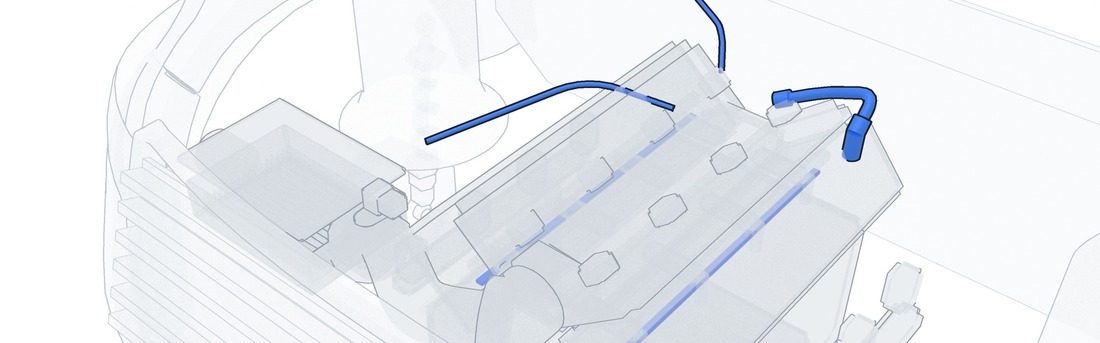
<a href="https://oilandmiles.com/articles/vacuum-leak"><img src="https://oilandmiles.com/assets/img/diagrams/vacuum-leak-engine-bench.svg" alt="The front of a small SUV with the hood off and a V8 underneath, with the places this page names in color and numbered to match its sections: 1 the PCV valve or valve cover, 2 the PCV tube or hose, 3 cracked vacuum hoses, 4 the intake manifold gasket, under the manifold. A leak code with no leak isn't drawn." width="1200" height="981"></a> <p>Diagram: <a href="https://oilandmiles.com/articles/vacuum-leak">Oil & Miles</a>, CC BY 4.0</p>Because the result is a lean mixture, it's one of the first things checked for lean codes. How the computer decides the mix is too lean is on our P0171 code page, and the twin code for the other side of a V engine is P0174.
What are the symptoms of a vacuum leak?
The vacuum leak symptoms carmakers describe are a hiss or rush of air from the engine bay, a rough or uneven idle and a check engine light. A bigger leak can make your engine stall, jerk or drop into a reduced-power mode.
Here's what carmakers list for the leaks they've documented, from the quietest sign you'd only hear to the ones that make the car hard to start or drive:
- Hiss, whistle or air-rush noiseGM's bulletins describe air leak noise from the PCV system, and some of that noise is normal, as the next section explains.
- Rough idle or lean runningThe engine shakes or hunts at a stop because it's getting more air than fuel.
- Check engine light with a lean codeP0171 and P0174 on most cars. Some Chrysler, Dodge, Jeep and Ram engines set P2172 or P2173 instead, codes that name a high airflow or air leak.
- Hard starting or no startOn the Prius, a line that came off set an "engine failed to start" code.
- Jerking, poor power or limp modeChrysler lists engine jerking and limp mode, a reduced-power mode, for an air leak on one turbo engine.
If you hear a hiss but the idle is smooth and no light is on, slow down before buying parts. That's the case GM's bulletins describe as normal crankcase vent noise, and the next section shows how to tell the two apart.
Symptoms in bulletins4 documents
- 2019 to 2020 Chevrolet Silverado, GMC Sierra 1500 5.3LDealers may see "a rough idle, lean running concern and/or air leak noise from the PCV system," GM PIP5686, October 2019, page 1.
- 2007 to 2016 GM V8 trucks and SUVsThe engine "runs and idles rough with P0171 and/or P0174," GM PIP5341, October 2015, page 1.
- 2010 to 2013 Toyota Prius, 2012 to 2013 Prius VP0A0F "Engine Failed to Start," P3190 "Poor Engine Power" and P0171 from a separated purge and PCV line, Toyota T-SB-0041-15, June 2015, page 1.
- 2017 to 2018 Jeep Renegade 1.4L turboOwners may describe "engine jerking or limp mode," with P2173 "Air Leakage In Manifold," FCA bulletin 09-010-20, July 2020, page 1.
Is a hissing sound always a vacuum leak?
No: a hiss from the engine bay can be ordinary airflow through the crankcase vent, such as a fixed-orifice PCV, a vent with a fixed hole instead of a moving valve. If your engine idles smoothly and no light is on, the noise alone doesn't prove a leak.
GM tested exactly this on two engines after owners complained, and found the tubes weren't leaking. It told dealers the noise "should be considered to be normal," which may be the cheapest repair advice on this page.
The test that separates the two is a smoke test, covered below under finding the leak. A real leak lets smoke escape, while normal vent noise doesn't, and GM's bulletins ask for that test before any part is replaced for noise alone.
Hiss GM calls normal2 documents
- 2019 Chevrolet Silverado, GMC Sierra 1500 5.3L and 6.2LThe whistle "is caused by the fixed orifice PCV"; the pipe "is not leaking and should not be replaced," GM PIP5587, September 2018, page 1.
- 2020 Chevrolet Corvette 6.2LA hiss "caused by normal air flow through the PCV tube"; if a true leak is suspected, smoke test the intake, GM PIP5723, April 2020, pages 1 to 2.
What causes a vacuum leak?
It's caused by any seal, valve or line between the airflow sensor and the engine that has torn, cracked or come loose. In the bulletins we read, PCV and crankcase vapor parts were blamed five times, a rubber hose once and the computer or its wiring twice.
Here are the causes carmakers and parts makers name, PCV parts first because they lead the bulletins we read, and a leak code with no leak last:
1. PCV valve or valve cover
The PCV valve meters fumes from inside the engine into the intake, and on some engines it's built into the valve cover. When its diaphragm tears, intake suction pulls unmeasured air through it, and a lean code follows.
GM documented this on its 1.4-liter turbo engines and tells dealers to prove the valve has failed before replacing the cover, because the cover is the only way to replace it. Dorman, a parts maker, says a failed PCV valve on this engine "can cause a cascade of problems," and its repair kit replaces the manifold, cover and PCV tube together.
You can ask the shop for the quick check GM uses: a tissue held at the valve's vent with the engine running. A tissue that flutters is normal, but one that stays sucked against the port means the diaphragm is torn.
2. PCV tube or hose
The PCV tubes carry those fumes across the top of the engine, with O-ring seals where they connect. A tube that's cracked, rubbed through or not snapped fully home lets air in at the joint.
GM found both kinds on its V8 trucks: an engine cover that wore a hole in the tube on older models, and tubes not clicked in on newer ones. Toyota found a purge and PCV line pulled off the throttle body on the Prius, which set a lean code and a no-start code.
If your engine was recently worked on, ask the shop to check that every tube clicks home and that each O-ring is intact. GM's fix for a tube that wasn't seated is to press it in until it clicks, then idle the engine and recheck for codes.
3. Cracked vacuum hoses
Vacuum hoses are the thin rubber lines that run valves and sensors off intake suction, and a tear or crack in one lets air straight in. A hose is cheap, but you may not see it if it sits under or behind something bigger.
Ford found torn or cracked intake manifold vacuum hoses on its Super Duty trucks with the 6.2-liter V8. It sells the hoses on their own, so the manifold they're attached to doesn't have to be replaced.
4. Intake manifold gasket
The intake manifold gasket seals the manifold to the cylinder head, and a leak there lets air in where the two meet. The gasket sits under the manifold, so expect the manifold to come off to replace it.
Fel-Pro, a gasket maker, says some GM V8 trucks and vans used a plastic-carrier gasket that heat and ethanol-blended fuel can crack. Chrysler also told dealers to look for cracks around the bolt holes of some Ram intake manifolds whenever one comes off.
5. A leak code with no leak
A code that names a leak can come from a bad sensor connection or the engine computer itself. That matters because a shop can smoke test your engine all day and find nothing.
Chrysler replaced the engine computer to fix P2172 "High Airflow/Vacuum Leak Detected" on some supercharged 6.2-liter cars and SUVs. On a Ram, it pointed to pushed-out pins in the manifold pressure sensor's connector for the same codes, so ask about both before paying for more leak hunting.
What the documents blame10 documents
- 2011 to 2019 GM 1.4L turbo: Cruze, Sonic, Trax, Encore, Volt, ELRTorn PCV diaphragm in the valve, "allowing un-metered air to enter the crankcase"; P0171; replace the camshaft cover, GM 19-NA-114, May 2019, pages 1 to 2.
- 2007 to 2016 GM V8 trucks and SUVsEngine cover rubs through the PCV dirty air tube at the left rear of the intake; replace it and add conduit, GM PIP5341, October 2015, page 1.
- 2019 to 2020 Chevrolet Silverado, GMC Sierra 1500 5.3LFoul air PCV tube installed wrong or damaged; reseat, check the O-rings, smoke test, GM PIP5686, October 2019, page 1.
- 2010 to 2013 Toyota Prius, 2012 to 2013 Prius VPurge VSV and PCV line separated from the throttle body; replace the purge valve and reprogram, Toyota T-SB-0041-15, June 2015, pages 1 to 2.
- 2017 to 2018 Jeep Renegade 1.4L turboP2173 "Air Leakage In Manifold"; install an oil vapor inlet tube kit, FCA bulletin 09-010-20, July 2020, pages 1 and 7.
- 2017 to 2019 Ford Super Duty 6.2LP2004 or P2005 from torn or cracked intake manifold vacuum hoses; hoses sold separately, base part 9E498, Ford SSM 48869, June 2020, page 1.
- 2020 Dodge Challenger, Charger, Jeep Grand Cherokee 6.2L superchargedP2172 "High Airflow/Vacuum Leak Detected"; replace and program the engine computer, FCA bulletin 18-041-20, April 2020, page 1.
- 2019 Ram, 5.7L exampleP2172 or P2173; inspect the manifold pressure sensor connector for pushed-out or spread terminals, FCA STAR S1808000282, April 2020, page 1.
- Fel-Pro, GM 4.8, 5.3 and 6.2L trucks and vans, 1999 to 2015A plastic-carrier intake gasket that heat and ethanol-blended fuel can crack.
- FCA GPOP 9004298, 2020 RamCheck the intake manifold for cracks around the bolt holes whenever it comes off, September 2020.
Can you drive with a vacuum leak?
You can drive to a shop with a small leak and a steady idle, but jerking, stalling or a reduced-power warning means get it checked before a long trip. None of the carmaker documents we read gives a safe number of miles.
A stall or a sudden loss of power in traffic is the real danger. The documents that describe more than a lean code describe exactly that: jerking and limp mode on the Renegade, and poor power and failed starts on the Prius.
A failing PCV valve can also show up as a visible change in the tailpipe exhaust. Subaru recalled some Ascent, Forester and Crosstrek Hybrid vehicles because the aluminum PCV valve could come apart, and it warned that driving on can lead to a loss of power.
A leak on the brake side behaves differently, because the brake booster loses its assist and the pedal gets hard and takes more effort to stop the car. If the pedal feels harder than usual or hisses when you press it, have the brakes checked before you drive on.
Recalls behind it 3 documents
- Kia recall 23V-410, 2023 SportageA misaligned booster diaphragm causes "an internal vacuum leak," and a loss of brake assist "can result in hard pedal feel and increased effort during pedal application," Part 573 report, June 2023, page 1.
- Ford program 13N02, 2010 to 2014 Edge and MKXA small tear in the booster diaphragm can bring "a hissing noise while depressing the pedal" and a spongy pedal, Supplement 3, February 2024, page 2.
- Subaru recall 19V-856, 2019 Ascent, Forester and Crosstrek Hybrid51,613 vehicles: the PCV valve may separate, changing the tailpipe exhaust, and separated parts can cause a loss of motive power, notice WUW-08, December 2019.
What the data says
Owners rarely write "vacuum leak" in federal complaints. We found 95 complaints that use the phrase for 2010 to 2025 models, and 48 of them were about the brakes or brake booster, not the engine.
Only 17 named an engine part such as the PCV valve, throttle body or purge valve, and 22 named no part at all. So the complaints tell you what owners call the problem, not how often each part fails.
NHTSA complaint file (FLAT_CMPL), dated August 25, 2026; model years 2010 to 2025, one count per complaint number, phrase "vacuum leak" (or "leak in the vacuum," "vacuum leaking") as whole words, not counting the EVAP part named "natural vacuum leak detection."
How do mechanics find a vacuum leak?
Mechanics find one with a smoke test, which pushes visible smoke into the sealed intake and watches where it escapes. A scan tool reading of fuel trim, the computer's fuel correction, helps narrow it down first.
One of GM's steps is one you can do yourself: if the problem began after an oil change, check that the oil filler cap and dipstick are seated. Either one left loose is a gap straight into the engine.
The popular trick of spraying carburetor cleaner around a running engine carries a warning from the people who make the cleaner. CRC's safety sheet calls its cleaner an extremely flammable aerosol and says "Do not apply while equipment is energized," so don't try it on your engine.
How GM finds leaks3 documents
- GM gasoline cars and trucks, 2000 to 2020Smoke or a leak detector into the brake booster hose or oil dipstick tube, throttle body sealed; ultrasonic tester or soapy water as options, GM 20-NA-065, March 2020, page 2.
- 2011 Buick LaCrosse, Regal, Chevrolet Equinox, GMC Terrain 2.4LCheck the oil cap and dipstick; at hot idle with long-term fuel trim in the mid-teens, plug the vacuum lines (brake booster, EVAP purge and others) and recheck; a trim that falls to 10% or less points to a part drawing unmetered air, GM PIP5028C, November 2012, page 1.
- CRC Carburetor and Choke Cleaner, safety data sheet"Extremely flammable aerosol"; "Do not apply while equipment is energized," CRC Industries, October 2017, page 1.
How much does it cost to fix a vacuum leak?
The parts cost $9.05 to $177 on the three vehicles we priced, from a plastic PCV tube to a whole intake manifold. Labor depends on which part leaked and how long the search took, so the book times below are per job.
What it costs
What this box shows
Prices for this repair, drawn from the sources named at the foot of the box. Each figure states whether it covers the part alone or parts and labor. The vehicles priced are models with a carmaker bulletin about these leaks that we could read and price.
Vacuum leak parts cost, by vehicle
One leaking part, part only, so no total. Labor is in the table below.
| Chevrolet Cruze 1.4L turboThe PCV valve is built into the valve cover; buy the cover.2012 Cruze, valve cover with PCV · $37 to $137, 2012 Cruze, PCV hose · $36 to $49, 2012 Cruze, intake manifold · $89 to $150, | $36 – $150Part only, at the counter |
|---|---|
| Chevrolet Silverado 1500 5.3LMatch the tube's position; the $177 top is an Ajusa set for the 2012.2012 Silverado 1500, PCV hose · $9.05 to $26, 2012 Silverado 1500, intake manifold gasket set · $21 to $177, 2019 Silverado 1500, PCV hose · $9.33 to $34, | $9.05 – $177Part only, at the counter |
Part prices are every listing RockAuto shows for each vehicle and part, read October 2, 2026. Left out: listings out of stock, kits (a Dorman manifold, cover and tube kit for the Cruze, a Gates hose kit for the 2019 Silverado), and 2019 Silverado intake gaskets, which are sold one port at a time.
Your labor is the carmaker's book time, the hours a dealer is paid for the job, times what an independent shop charges. Almost half of 752 US shops in a 2025 industry survey charged $120 to $159 an hour, so that's the rate used here.
| Job (car) | Hours | Labor |
|---|---|---|
| Test and reseat PCV tube (2019 to 2020 Silverado 1500) | 0.1 h | $12 – $16 |
| Vapor inlet tube kit (2017 to 2018 Renegade 1.4L) | 0.4 h | $48 – $64 |
| Engine computer, P2172 (2020 Challenger, Charger, Grand Cherokee) | 0.4 – 0.7 h | $48 – $111 |
| Purge valve and reprogram (2010 to 2013 Prius) | 0.8 h | $96 – $127 |
The cheapest fix on that list is a tube that wasn't clicked in, at six minutes of book time. The times don't include the search itself, and none of the bulletins we read prints a time for a smoke test, so ask the shop for its diagnostic charge before it starts.
A torn PCV valve inside a valve cover means buying the cover, and an intake gasket means taking the manifold off. Our car complaints lookup shows what other owners of your model have reported.
Where the hours come from4 documents
- GM PIP5686, 2019 to 2020 Silverado, Sierra 1500 5.3LPCV foul air tube test and repair, 0.1 hours, labor operation 4087208, page 2.
- FCA bulletin 09-010-20, 2017 to 2018 Jeep Renegade 1.4LInstall vapor inlet tube service kit, 0.4 hours, page 7.
- FCA bulletin 18-041-20, 2020 Challenger, Charger, Grand Cherokee 6.2LReplace and program the engine computer: 0.4 hours Challenger, 0.5 Charger, 0.7 Grand Cherokee, page 2.
- Toyota T-SB-0041-15, 2010 to 2013 PriusReplace purge VSV and reprogram the engine computer, 0.8 hours, page 2.
What should you do about a vacuum leak?
Prove the leak before you buy a part, because the cheapest fix in the bulletins is a tube that only needed clicking in. If you suspect a leak, work through the 6 steps below, in order:
- Check the oil filler cap and dipstick. If the trouble started after an oil change, make sure both are seated; GM lists a loose one as a gap straight into the engine.
- Listen with the idle in mind. A hiss with a smooth idle and no warning light can be normal crankcase vent noise, and GM tells dealers not to replace parts for that noise alone.
- Read the codes. A code reader or a shop shows whether there's a lean code such as P0171 or P0174, or P2172 or P2173 on some Chrysler, Dodge, Jeep and Ram engines.
- Ask for a smoke test. It shows where the air gets in, and it replaces spraying cleaner around a running engine, which the cleaner's maker warns against.
- Have the PCV system checked first. Five of the eight bulletins we read blamed a PCV valve, tube or vapor line, so ask for every tube to be clicked home and for GM's tissue check where it applies.
- Ask about the connector and the computer. If the code stays and the smoke test finds nothing, Chrysler traced the same codes to pushed-out connector pins and to an engine computer that needed replacing.
If the smoke test finds nothing and the code comes back, the documents point to wiring or the computer rather than another part. Ask the shop which bulletin covers your engine before it replaces anything else.
If the car stalls, jerks or drops into reduced power along the way, stop driving it and have it checked where it is. None of the documents we read gives a distance that's safe to drive in that state.
From the documents
What carmakers' bulletins say about vacuum leaks
Three bulletins settle the questions owners get wrong most: whether the hiss is a leak, which part to blame and whether a leak code means a leak. Each was written for particular models, so the details are examples.
GM PIP5587
There is not a correction for this noise and should be considered to be normal.General Motors, September 2018
GM bulletin 19-NA-114
Confirmation of the PCV valve performance must be done before replacing the camshaft cover.General Motors, May 2019
FCA bulletin 18-041-20
This bulletin involves replacing the Powertrain Control Module (PCM) and re-programming with the latest available software.FCA US, April 2020
We read all three as one message: prove the leak before you buy the part. Normal noise, a hidden valve or the computer itself can look just like one.
Conclusion
Find the leak before buying parts
The parts we priced are cheap, and the costly mistakes come from guessing which one failed. Here's what to take from this page about a vacuum leak:
- A hiss plus a rough idle or lean code is the sign.A hiss with a smooth idle and no light may be normal vent noise, as GM found on some V8s.
- Check the PCV system first.Five of the eight bulletins we read blamed a PCV valve, tube or vapor line, not a cracked hose.
- A small, steady leak is drivable to a shop.Jerking, stalling or reduced power is the point to stop and get it checked.
- Ask for a smoke test, not a parts swap.The smoke shows where the leak is, and spraying cleaner on a running engine goes against the cleaner's own label.
- Parts run $9.05 to $177 on the cars we priced.Labor runs from six minutes of book time for a loose tube to removing the manifold for a gasket.
So ask for the test, then buy the part it points to. Oil & Miles reads the carmakers' bulletins so you know what to ask the shop.
Common questions
Asked most often
Will a vacuum leak throw a code?
The leaks in the carmaker bulletins we read set a check engine light, most often with P0171 or P0174 for a lean mixture. Some Chrysler, Dodge, Jeep and Ram engines set P2172 or P2173 instead.
What does a vacuum leak sound like?
A steady hiss, whistle or rush of air from the engine bay. GM has documented that some trucks and the Corvette make that sound through a normal PCV tube, so a smoke test is what proves a leak.
Can a vacuum leak cause a misfire?
The carmaker bulletins we read list lean codes, rough idle and jerking for these leaks, not misfire codes. If you have a misfire code too, our P0300 page covers what else causes one.
How long can you drive with a vacuum leak?
No carmaker document we read gives a number of miles. A small leak with a steady idle is fine to drive to a shop, while jerking, stalling or limp mode means getting it checked first.
Can I fix a vacuum leak myself?
A cracked hose or a PCV tube that isn't clicked in is a simple swap once you've found it. Finding it is the hard part, and an intake gasket or valve cover is a bigger job.
Is a vacuum leak expensive to fix?
Not for the part: $9.05 to $177 on the vehicles we priced. The bill grows with the time spent finding the leak and when the intake manifold has to come off.
What people ask next
Sources
- GM bulletin 19-NA-114, May 2019, for the torn PCV diaphragm, the tissue test and the 1.4-liter models. NHTSA bulletin archive, read October 2, 2026
- GM PIP5587, September 2018, and GM PIP5723, April 2020, for the PCV noise GM calls normal. NHTSA bulletin archive, read October 2, 2026
- GM PIP5686, October 2019, for the unseated PCV tube and its 0.1-hour time, and GM PIP5341, October 2015, for the rubbed-through tube. NHTSA bulletin archive, read October 2, 2026
- GM bulletin 20-NA-065, March 2020, and GM PIP5028C, November 2012, for how dealers find a leak. NHTSA bulletin archive, read October 2, 2026
- Ford SSM 48869, June 2020, for the Super Duty vacuum hoses. NHTSA bulletin archive, read October 2, 2026
- FCA bulletin 18-041-20, April 2020, for the computer replacement and its times, and FCA STAR S1808000282, April 2020, for the Ram sensor connector (model years from NHTSA's vehicle listing). NHTSA bulletin archive, read October 2, 2026
- FCA bulletin 09-010-20, July 2020, for the Renegade symptoms and 0.4-hour time; FCA GPOP 9004298, September 2020, for the manifold bolt-hole cracks on 2020 Ram trucks (model years from NHTSA's vehicle listing). NHTSA bulletin archive, read October 2, 2026
- Toyota T-SB-0041-15, June 2015, for the Prius line, its codes and the 0.8-hour time. NHTSA bulletin archive, read October 2, 2026
- Subaru notice WUW-08, recall 19V-856, December 2019, for the PCV valve recall and the 51,613 vehicles, and NHTSA's recall record for the aluminum valve and the loss of power. NHTSA bulletin archive, read October 2, 2026
- Kia recall 23V-410, June 2023, and Ford program 13N02 Supplement 3, February 2024, for leaks on the brake side and the hard or hissing pedal. NHTSA, read October 2, 2026
- Fel-Pro, GM trucks intake manifold gasket issues, for the plastic-carrier gasket. Read October 2, 2026
- Dorman 615-380KIT, for the 1.4-liter PCV failure spreading to the manifold. Read October 2, 2026
- CRC Carburetor and Choke Cleaner safety data sheet, October 2017, for the flammability warning. Read October 2, 2026
- RockAuto, every listing for the parts and vehicles in the cost box. Read October 2, 2026
- NHTSA complaint file (FLAT_CMPL), for the 95 complaints that say "vacuum leak" and the 48 about brakes. File dated August 25, 2026
- PartsTech's 2025 survey of 752 US shops, as reported by MOTOR, for the $120 to $159 hourly rate. Read October 2, 2026
- Ford parts diagrams for the 2013 F-150 5.0L (air cleaner and outlet tube, crankcase tube and PCV valve) and the 2013 F-150 owner's manual, for the part positions in the drawing; the bank side, sensors, injectors and hoses are inferred. Read October 4, 2026
- Repair shop blogs, an auto parts retailer's Q&A and a car-buying guide, read to see what drivers are told; nothing in this article is taken from them. Read October 2, 2026
How this was compiled
The sections cover the symptoms, the hiss, the causes, driving and the cost. The vehicles priced are models with a carmaker bulletin about these leaks that we could read and price.
Every price is a part price at the counter, one listing at a time. Labor is the carmakers' book time from their bulletins, times a surveyed shop rate.
The eight bulletins are the maker documents we could open that name a part for a lean code or a vacuum leak. The GM noise and diagnosis documents, the Ram manifold note and the Subaru recall are listed but not counted among them.
What we didn't do
We didn't test a vehicle or smoke test an engine. The symptoms, causes, tests and times come from carmakers' bulletins, NHTSA's complaint files and parts makers' pages, and none of them gives a number of miles you can safely drive with a leak.
We read bulletins from GM, Ford, Chrysler, Toyota and Subaru, not the Honda, Nissan, Hyundai and Kia bulletins that NHTSA indexes for lean codes and vacuum leaks. We found only index summaries or unrelated bulletins for BMW, Audi and the Ford F-150, so they aren't priced here.
Other guides also name worse fuel economy, an EGR valve, a throttle body seal or the intake boot. We found no carmaker document tying those to this kind of leak, so they aren't listed as causes here.
We didn't price labor for the vehicles in the cost box, because their carmakers' times weren't in a bulletin we could read. Several more GM and Ford bulletins on these leaks were available only as NHTSA index summaries, so nothing here rests on them.
Prices are ranges compiled in October 2026 for the US market and vary by region, engine and shop rate. Prices from $10 up are rounded to the nearest dollar, so $14.13 reads as $14 and $14.52 as $15. Below $10 they're exact. This article is general information, not advice about your specific vehicle. See the disclaimer.
Valve cover with PCV
2012 Chevrolet Cruze 1.4L L4 Turbocharged
| Brand | Part | Price |
|---|---|---|
| SKP | SK510A05 | $37 |
| DORMAN | 264968 | $45 |
| APEX | VCS1198 | $52 |
| AUTOTECNICA | GM1416738 | $56 |
| VAICO | V402074 | $83 |
| GM GENUINE | 25209141 | $137 |
PCV hose
2012 Chevrolet Cruze 1.4L L4 Turbocharged
| Brand | Part | Price |
|---|---|---|
| GATES | EMH264 | $36 |
| REIN | ABV0293 | $37 |
| DORMAN | 46829 | $40 |
| STANDARD MOTOR PRODUCTS | V628 | $40 |
| GM GENUINE | 25193343 | $46 |
| VNE | 4014011 | $49 |
Intake manifold
2012 Chevrolet Cruze 1.4L L4 Turbocharged
| Brand | Part | Price |
|---|---|---|
| LARES | 33400 | $89 |
| VAICO | V510404 | $130 |
| AUTOTECNICA | GM1416586 | $140 |
| GM GENUINE | 28289977 | $147 |
| DORMAN | 615380 | $148 |
| ATP | 106090 | $150 |
PCV hose
2012 Chevrolet Silverado 1500 5.3L V8
| Brand | Part | Price |
|---|---|---|
| GATES | EMH144 | $9.05 |
| EMH095 | $26 | |
| STANDARD MOTOR PRODUCTS | V770 | $11 |
| V769 | $14 | |
| GM GENUINE | 12597774 | $13 |
| 12609373 | $15 |
Intake manifold gasket set
2012 Chevrolet Silverado 1500 5.3L V8
| Brand | Part | Price |
|---|---|---|
| APEX | AMS3891 | $21 |
| AMS3850 | $35 | |
| AMS3851P | $44 | |
| AMS3892 | $47 | |
| ULTRA-POWER | MS96587 | $21 |
| MS98016T | $43 | |
| ELRING | 759900 | $22 |
| SKP | SKMS96871 | $24 |
| ENGINETECH | IC293A | $26 |
| IC325A | $64 | |
| FEL-PRO | MS96857 | $30 |
| MS96587 | $48 | |
| MS98016T | $62 | |
| MS96871 | $68 | |
| MAHLE / CLEVITE | MS19501 | $32 |
| MS16340 | $43 | |
| MS20203 | $71 | |
| MS20135 | $75 | |
| VICTOR REINZ | 111032001 | $43 |
| 111063101 | $48 | |
| 111056401 | $69 | |
| 111054001 | $82 | |
| GM GENUINE | 89060413 | $82 |
| AJUSA | 77085400 | $177 |
PCV hose
2019 Chevrolet Silverado 1500 5.3L V8
| Brand | Part | Price |
|---|---|---|
| GATES | EMH708 | $9.33 |
| EMH703 | $11 | |
| EMH333 | $13 | |
| EMH096 | $31 | |
| EMH073 | $34 | |
| SKP | SKEMH096 | $9.52 |
| GM GENUINE | 12729666 | $10 |
| 12619982 | $15 | |
| 12670793 | $15 | |
| 12670791 | $15 | |
| STANDARD MOTOR PRODUCTS | V824 | $19 |
| V825 | $21 |