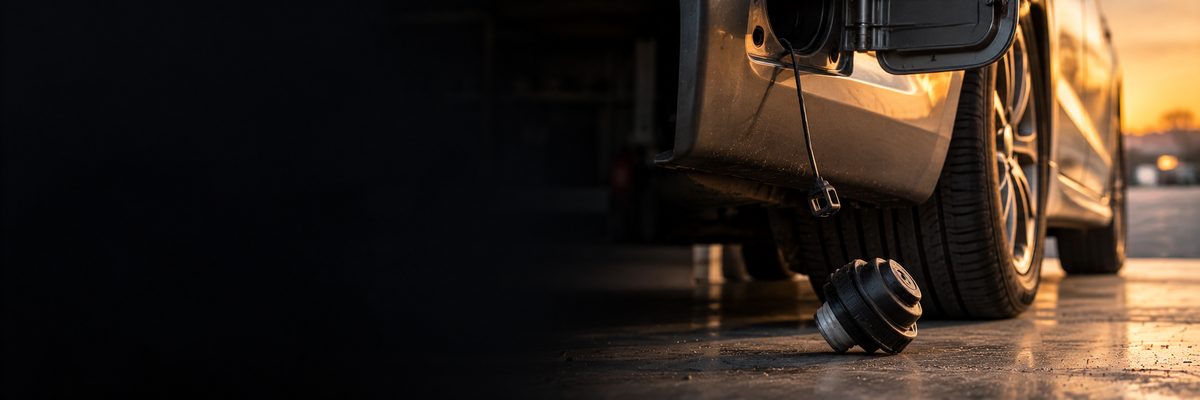

A P0455 code, which a scan tool prints as diagnostic trouble code (DTC) P0455 and some owners write as PO455, is the "large leak" code of the evaporative emission (EVAP) system. That's the sealed loop of tank, filler neck, cap, hoses, valves and a charcoal canister that keeps fuel vapor out of the air.
The usual advice is the gas cap, and here it's genuinely the right first move, because a large leak is the kind a cap left open makes. The light can stay on even after the right repair, because the leak test has to run and pass on its own before it goes off.
What does a P0455 code mean?
P0455 means the fuel vapor system leaked too much to pass its test, and carmakers' bulletins call it the EVAP system large leak. The car seals the loop, watches whether it holds, and stores P0455 when it can't hold at all.
Large leak in the fuel vapor system
EVAP System Large Leak
What the computer saw
The engine computer sealed the fuel vapor loop for its leak test, and the loop couldn't hold.
- Code
- P0455
- System
- Powertrain
- Area
- Auxiliary emission controls
- Standard
- Generic OBD-II
- Checks
- Whether the sealed loop of tank, cap, hoses, valves and canister holds during its test
What it doesn't prove
It doesn't prove which part leaks. A cap, filler neck, vapor line or vent valve can all set it.
Code name from Chrysler bulletin 25-002-15.
Any part of the loop can be the hole, which is why a cap and a canister set the same code. The smaller leaks cars must also detect, 0.040 and 0.020 inch, are covered on the P0442 and P0456 pages, and the whole family is mapped on the P0440 page.
Can you drive with a P0455 code?
Yes, unless one of the signs below shows up, because a vapor leak doesn't feed or stop the engine. You may fail an emissions test, and a stored code hides the next fault behind the same light.
The exceptions are signs of liquid fuel or a fault that reaches the engine. Leaking fuel is a fire risk, and a stall after filling up points to a line or valve fault, not a cap.
We'd stop driving and get it checked if:
- You smell gasoline. Especially inside the car. See car smells like gas.
- Fuel drips, pools or overflows at the filler. One owner reported fuel overflow at the filler neck.
- It stalls or won't start after a fill-up. A vapor line loose inside the tank can do this.
What are the symptoms of a P0455 code?
You may see only the check engine light, because the leak is vapor, not the fuel the engine runs on. Some cars also show a cap or fuel-fill message on the dash, which points you to the filler first.
Here's what owners describe in the federal complaints naming P0455:
- A fuel smell or vapors. Sometimes strong inside the car.
- A "check fuel fill inlet" message. On Ford-built cars.
- Trouble at or after a fill-up. A no-start or a hard start, or fuel overflowing at the filler neck.
- The light coming back after a repair. Including after a recall repair.
What causes a P0455 code?
Any opening in the loop big enough to stop it holding: the cap, the filler neck or fill pipe, a vapor line off its fitting, or a vent valve stuck open. Carmakers have filed fixes for all four, and several of their instructions say to find the leak before replacing anything. P0455 alone confirms none of them. Each has its own test to run before any part is bought.
| Cause | Test this first | Don't replace yet |
|---|---|---|
| Gas cap Left loose, not clicked, or with a seal gone hard or cracked. | Tighten it to the clicks printed on it and drive until the monitor reads ready. | A second cap: complaint owners who replaced one still saw the light come back. |
| Filler neck and fill pipe A capless filler, a cap that won't click, or a fuel-fill dash message. | A dealer VIN check for bulletins and warranty extensions, then a smoke test. | The fill pipe, before you ask about an extension or a flap unit. |
| A vapor line or hose Hose off or split, or a tank that won't fill past half. | A look with the hood up, then a smoke test for lines above the tank. | A canister or valve, when the fix can be a reconnected line. |
| Vent valve and canister P0446 beside it. | GM's large-leak tip: the connections, the vent valve, then the purge valve. | The canister, unless it fails a leak test or holds dirt or water (GM: some Silverado, Sierra). |
Here are the four places the leak turns up, starting with the cap you can check yourself:
Can a loose gas cap cause P0455?
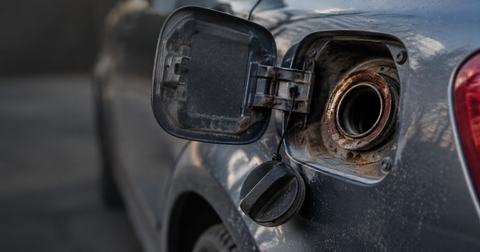
Yes. A cap left loose, not clicked, or with a seal gone hard or cracked leaves the loop open, and several bulletins name the cap or its seal.
Check it, but check it once. If tightening the cap fixed it, Nissan says not to replace the cap or any other EVAP part. Owners in the complaints who replaced a cap still saw the light come back.
The filler neck and fill pipe
The filler neck and fill pipe run from the cap down to the tank, and capless fillers have flaps inside that must close. Debris that holds a flap open, a pipe out of position or a disconnected vent hose at the filler leaves the loop open.
Some carmakers have extended the fill pipe warranty, and on some capless fillers the fix is a flap unit, not the whole pipe. If your car has a capless filler, ask about both before paying for a pipe.
A vapor line or hose
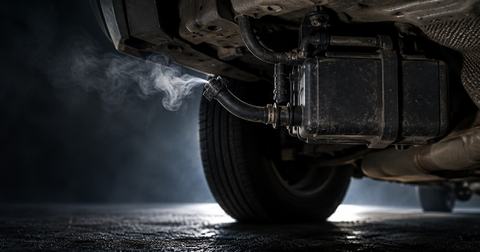
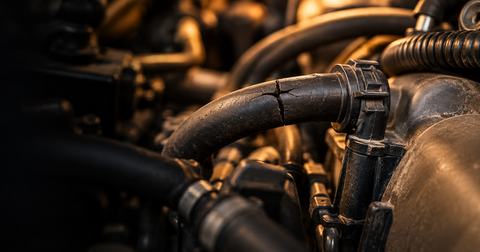
Rubber and plastic vapor lines join the tank, the canister and the purge valve, and one that splits, chafes or slips off its fitting is a large leak. Some are visible with the hood up. Others sit above the tank and need it lowered.
Carmakers have filed fixes for a split purge hose, a loose line under the hood and lines chafing near the tank. Some of those jobs mean lowering the tank, and some are a quick reconnection.
The vent valve and the canister
The vent valve closes the canister's fresh-air side so the loop can be tested, and a valve stuck open is a large leak. The purge valve lets fuel vapor into the engine to burn.
GM's own diagnostic tip for P0455 checks the vent valve, then the purge valve, which sets this code when it sticks closed. No parts are required for the procedure itself.
The canister can crack or clog too, and some carmakers have extended its warranty to 10 years or 120,000 miles, with other terms in salt-belt states. GM tells technicians not to replace a canister unless it fails the leak test or has taken in too much dirt, dust or water.

A cracked cap seal
How do you fix a P0455 code?
Work outward from the cheapest thing that can cause it, and let a smoke test find what you can't see. To fix a P0455 code, start at the gas cap, and the first three steps cost little or nothing:
- Tighten the cap to the clicks printed on it. Check the rubber seal for cracks or hardening, refit it, and drive normally until the readiness monitor reads ready.
- Read every code and run the VIN. A dealer checks bulletins and warranty extensions by VIN, the 17-character vehicle identification number, and our free VIN checker lists the recall campaigns for your car's model year.
- Follow the vapor lines you can see. With the hood up, look for a hose off its fitting or split at a bend.
- Ask for a smoke test. The shop's smoke machine pushes visible vapor into the sealed loop and shows where it escapes. Ask what it costs, as its own line on the estimate.
- Replace only what the test found, then clear and drive. Clear the code and drive with the tank about half to just under three-quarters full until the car's self-check, its readiness monitor, reads ready.
If the VIN check finds nothing, the smoke test still decides. If the smoke test finds nothing, ask whether the leak shows only with a full tank or after the car has sat.
If the light stays on after a repair, give the test a few days to rerun before buying a second part. Owners in the federal complaints saw it return, and Ford found that purge valves returned on several of its recent models tested fully functional.
What to say to the shop
When a quote names a part before any test has run, ask:
- Can you check my VIN for bulletins and warranty extensions first?
- Can you run a smoke test?
- Which test result points at the part you recommend?
“I have P0455 and these other codes stored: [codes]. Before you replace a gas cap, fill pipe, vent valve or canister, can you check my VIN for bulletins and warranty extensions and run a smoke test, and which test result points at the part you recommend?”
A good answer: a smoke test that shows where the vapor escapes, and a part only where the test points.
The cap check and the look at the vapor lines aren't tests, so a leak above the tank can get past them. A second new cap for a light that hasn't had time to clear is the cheapest wrong answer on this page, but it's still a wrong answer.

Use this image
Free to republish under CC BY 4.0: credit Oil & Miles and link to this page. The snippet does both.
<a href="https://oilandmiles.com/articles/p0455-code"><img src="https://oilandmiles.com/assets/img/diagrams/p0455-code-evap-bench.svg" alt="The EVAP system of a small SUV seen from below, with the parts this page names in color and numbered to match its sections: 1 the gas cap, 2 the filler neck and fill pipe, 3 a vapor line or hose, 4 the vent valve and the canister." width="1200" height="675"></a> <p>Diagram: <a href="https://oilandmiles.com/articles/p0455-code">Oil & Miles</a>, CC BY 4.0</p>How much does it cost to fix a P0455 code?
Often nothing, if the cap only needed tightening, and some carmakers pay for the fill pipe or the canister under an extended warranty. Run the VIN before you pay for a part.
Past the cap, a smoke test finds the leak, and independent shops charge a $100–$200 fee for one. A revised vent valve on a 2015 Silverado 1500 then runs $185–$342 at an independent shop, parts and labor, and a purge valve on a 2019 Honda Pilot $100–$160.
The vapor canister is the priciest part: with its purge valve on a 2014 Focus 5-door, it comes to $261–$545, parts and labor. A new gas cap is the small end of the bill, which is the whole reason to find the leak before buying.
The smoke test is billed first, because the shop has to find the leak before it fixes it. Ask for its result, the hours and the rate on the written quote.
Why is the light still on after a new gas cap?
Because the leak test has to run again and pass before the light goes out, and the car runs it only when its conditions are met. Fixing the leak doesn't turn the light off at once.
A stored or pending code can stop a monitor, one of the car's own self-tests, from finishing. So clear the code once the repair is done, then drive with the tank about half to just under three-quarters full.
Expect several days of mixed driving, not one trip, because the test runs only when its conditions are met. Clearing the code the day before an emissions test resets the monitors to "not ready", and a 2001 or newer car fails New York's inspection with more than one monitor in that state.
Will a P0455 code clear itself or fail an emissions test?
It can clear itself once the leak is fixed, and until then it can fail an emissions test. The light may go off after three drives in a row in which the leak test passes, and the stored code may be erased after 40 warm-ups without the fault.
If the car can tell the leak was a loose cap, the light may go off once it confirms the cap is fastened. A stored code can fail in states that read the computer, and so can a cleared one whose monitors still read "not ready".
Which codes come with P0455?
The code beside it narrows the search, so read every code stored with P0455 before anything is replaced:
- P0456 or P0442. The same leak test at smaller sizes. See P0456 and P0442.
- P0441. A purge flow fault as well. See P0441.
- P0446. The vent valve didn't respond, which can also leave the loop open. See P0446.
With P0446 or P0441 beside it, ask for the vent and purge valves to be checked too. GM's large-leak tip checks both after the connections.
Which cars get a P0455 code most?
Ford brands lead narrowly, with 9 Ford and Mercury complaints plus a Mazda Tribute against GM's 8. That's too few to rank makers, so the make alone tells you little.
For your car, the useful record is the bulletins. Some carmakers have extended the warranty on parts that cause it.
From the carmakers
Is there a warranty extension for a P0455 code?
Yes, on some Acura, Hyundai and Kia models, which pay for the fill pipe or the canister. GM's tip for a large leak needs no parts, and Nissan's says not to replace the cap or any EVAP part when the cap was only loose.
Warranty extension 26-023
to 10 years from the original date of purchase or 150,000 miles, whichever comes first
Warranty extension 17-FL-002
The canister warranty has been extended to 10 years from the date of original retail delivery or date of first use, or 120,000 miles…
Warranty extension SC135
from 5 years/60,000 miles to 10 years/120,000 miles
Diagnostic tip 21-NA-124
No parts are required for this repair.
Bulletin NTB13-097J
DO NOT REPLACE FUEL FILLER CAP OR ANY OTHER EVAP RELATED PARTS
- Complaints. Of the 37 complaints naming P0455, 2010–2025 models, 4 mention a fuel smell, 3 a “check fuel fill inlet” message, 2 a no-start or hard start, and 10 the light coming back, 3 of them after a recall repair.
- By maker. Ford and Mercury 9 plus a Mazda Tribute, GM 8 with 6 on a Chevy, Hyundai and Kia 7, Stellantis 6, Honda 3, Toyota 2, Subaru 1.
- Cap complaints. Chevrolet Suburban owners replaced a cap and the light stayed on, NHTSA complaints 11222496 and 11315633.
- Cap bulletins. Acura 14-006 inspects and replaces the cap on 2011–2013 Acuras, 0.3 hours. Chrysler 14-005-22 REV. B fits an updated cap on 2021 Jeep, Dodge and Ram models, 0.2 hours.
- A cap that won't click. Toyota T-SB-0086-16 adjusts the filler neck on the 2014–2016 Corolla, 0.8 hours. Ford SSM 51719 says to tighten to “at least one audible click” on 2021–2023 Super Duty and E-Series.
- Filler bulletins. Acura 21-007 replaces the fill pipe on the 2021–2022 TLX, 0.6 hours plus a 0.8-hour leak test. Honda ATS 170206 replaces the flap unit on the 2016 Pilot and 2017 Ridgeline, not the pipe.
- Filler vent hose. Chrysler 18-035-20 reconnects the vent hose on the 2020 Durango and Grand Cherokee, 0.3 or 0.4 hours.
- Vapor lines. Chrysler 25-002-15 covers a split purge hose on the 2015 Grand Cherokee and Durango, 0.3 hours. Ford 16-0132 reconnects a line on the 2017 Escape 1.5L, 0.3 hours.
- Lines at the tank. Ford 25-2308 covers a chafed canister line on the 2022–2024 Maverick, 2.1–2.7 hours. Ford 24-2199 covers a line loose inside the tank on the 2024 Edge 2.0L AWD, 4.9 hours.
- Valve and canister. Kia FUE040 replaces the canister close valve on the 2012–2017 Rio, 0.4 hours. GM 17-NA-383 replaces a canister with spiders in its fresh-air port on the 2012–2017 Sonic, 2013–2017 Trax and Encore.
- Fuel level for the test. One New York inspection page gives 35% to 85% for the EVAP drive cycle, and another gives 26% to 74%.
Conclusion
What to do next about a P0455 code
A P0455 code means a large leak in the sealed fuel vapor loop, and the cap is the right first check, not the only answer. Tighten and inspect it once, run the VIN for bulletins and warranty extensions, then pay for a smoke test and give the light several days of driving. A fuel smell, a drip or a stall after filling up means stop and get it checked.
So start with the cap, and let a test, not a guess, pick the next part. Oil & Miles checks each step here against the carmakers' own bulletins and NHTSA's complaint file.
Other OBD-II EVAP codes and what each one means
Common questions
Asked most often
What is the most common cause of a P0455 code?
Carmakers' bulletins name the cap, the filler neck and fill pipe, a vapor line off its fitting, and a vent valve stuck open. No document counts how often each one causes it, but the cap is the cheapest to check first.
Can you fix P0455 without replacing the EVAP canister?
Yes, because the canister is only one of the places the leak can be. On some Silverado and Sierra trucks, GM tells technicians not to replace it unless it fails the leak test or has taken in too much dirt, dust or water.
What is the difference between P0455 and P0456?
Size: P0455 is a large leak, the kind a loose cap or a hose off its fitting makes, and P0456 is a very small one of about 0.020 inch. The smaller the leak, the more a smoke test is needed to find it.
What people ask next
Sources
- California Code of Regulations, Title 13, section 1968.2, for the 0.040 and 0.020 inch leak sizes the rule makes cars detect, subsections (d)(2.2.2) to (d)(2.4) for when the light goes out and the code is erased, and (e)(4.4.2) for a leak the car traces to a loose cap. California Air Resources Board, read September 20, 2026
- GM bulletin 21-NA-124, December 2022, the large-leak diagnostic tip and "No parts are required for this repair". General Motors, read October 3, 2026
- GM bulletins 15-06-04-002 and 17-NA-383, 2015 and 2017, the vent valve on Silverado and Sierra, the spider-blocked canister on Sonic, Trax and Encore. General Motors, read October 3, 2026
- Nissan bulletin NTB13-097J, February 7, 2022, the loose-cap procedure and the instruction not to replace EVAP parts. Nissan, read October 3, 2026
- Acura warranty extension 26-023, September 25, 2026, the TLX fill pipe, 0.5 hours, 10 years or 150,000 miles. American Honda, read October 3, 2026
- Acura 21-007 and 14-006, Honda ATS 170206, the TLX flap unit, the Acura cap, and the Pilot and Ridgeline instruction not to replace the fill pipe. American Honda, read October 3, 2026
- Chrysler 25-002-15, 14-005-22 REV. B and 18-035-20, the split purge hose, the updated cap and the filler vent hose, with their hours. FCA US, read October 3, 2026
- Ford 16-0132, 25-2308, 24-2199 and special service messages 51719 and 50306, the vapor lines, the Maverick and Edge tank-line repairs, the cap-click note and the returned purge valves that tested fully functional (2018–2022 models), with their hours. Ford, read October 3, 2026
- Toyota T-SB-0086-16, July 28, 2016, the Corolla cap that won't click, 0.8 hours. Toyota, read October 3, 2026
- Hyundai 17-FL-002 and Kia SC135, FUE040, the canister warranty extensions to 10 years or 120,000 miles and the Rio canister close valve. Hyundai and Kia, read October 3, 2026
- New York State vehicle inspection program (NYVIP3), for readiness monitors, the EVAP drive cycle and the one-monitor fail threshold. Archived copies dated May 18 and June 12, 2026
- Parts and labor figures: GM bulletin 15-06-04-002 for the revised vent valve time on the 2015 Silverado 1500 5.3L, Honda 23-091 for the purge valve time on the 2019 Pilot, and Ford 24N07 for the purge valve and canister time on the 2014 Focus 5-door, with catalog part prices. GM, American Honda and Ford via NHTSA, read October 31 and November 1, 2026
- Smoke test prices, the published smoke-test prices of four independent shops in California, Kansas, New York and Colorado. Shop websites, read October 31, 2026
- NHTSA's consumer complaint database, 2010–2025 model years, for the 37 complaints naming P0455 and what owners reported. NHTSA, file through September 30, 2026
- RockAuto, for the part prices, part only: every brand listed for a 2015 Silverado 5.3L, 4Runner 4.0L, F-150 5.0L and Altima 2.5L. Read September 4 and 5 and October 31, 2026
AI illustration by Oil & Miles
How this was compiled
The part prices in Sources cover every brand a large online parts catalog lists in nine categories for each of four vehicles. The three fitted jobs use the carmaker's labor time from its bulletin. Every bulletin on this page prints P0455, checked in its text.
The complaint counts come from NHTSA's complaint files, 2010–2025 models.
What we didn't do
The smoke test price is what four independent shops in four states publish, not a national figure. The three fitted jobs are on cars with a carmaker labor time on file, so they don't cover every vehicle whose part prices are in Sources.
We didn't rank the causes by how often they fail, because no maker document counts them. We didn't test a cap, a valve or a canister ourselves, and we recommend no brand.
Prices are ranges compiled from September to November 2026 for the US market and vary by region, engine and shop rate. Prices from $10 up are rounded to the nearest dollar. Below $10 they're exact. This article is general information, not advice about your specific vehicle. See the disclaimer.