
- Drive?
- A short way. Climate and defogger off, keep the engine running, go straight to help.
- Time left
- Less at night. Headlights, wipers and the blower leave you less time.
- Check first
- No voltmeter? A parts store's free test reads the same numbers. Free checks
A battery light on your dash is a charging warning, not a gauge of how full the battery is, so it can glow over a battery that's a week old. Below, we cover how long the battery alone can carry you, the signs that mean you should pull over now and the four free checks.
Then come the seven causes behind the light, why it shows when the car runs fine or after a new battery, what a repair costs and what the light means. The answers come from owner's manuals, carmaker bulletins, recalls and owners' complaints to NHTSA, the federal safety agency.
What else is happening with your battery light?
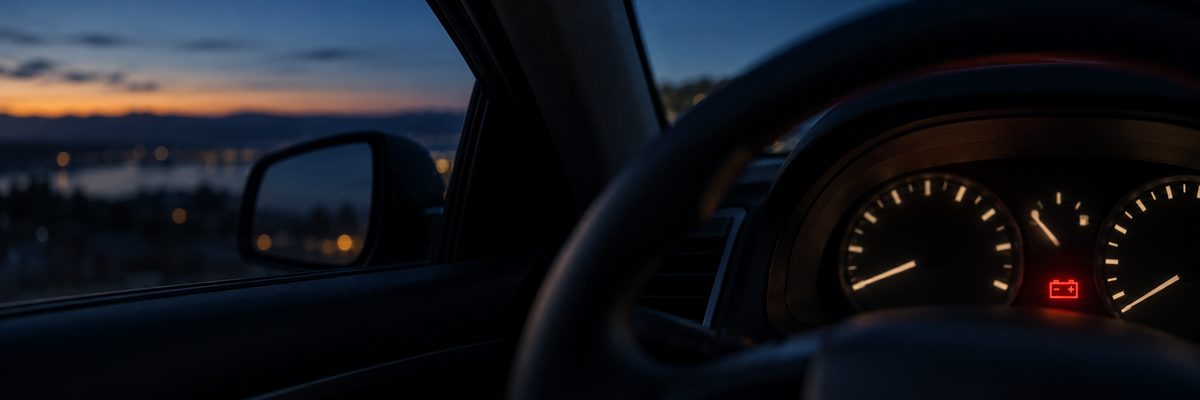
Can you drive with the battery light on?
You can drive a short way on the battery alone, but only until it runs down. After that the car can stall, and more than half of owners' complaints to NHTSA about the light describe the car stalling, dying, shutting off or losing power.
So head for a shop or home now, and make the battery's job light. Honda's manual says to switch off the climate control, rear defogger and other electrical systems, and to leave the engine running if you stop.
Five signs turn the light into a stop, and each comes with its reason below. Any one of them means you pull over now:
- The temperature gauge climbs. Where one belt drives both the alternator and the water pump, a broken belt stops the coolant too. Gates, a belt maker, lists the water pump among the parts the belt drives.
- The steering turns heavy. A belt-driven steering pump stops with the belt, on cars that have one. On electric steering, Ford's manual says steering takes more effort if the car loses electrical power.
- You smell burning or see smoke. One Chrysler recall covers alternators that can short-circuit, increasing the risk of a fire. Owners mention fire, smoke or a burning smell in about 1 in 8 complaints about the light.
- The engine stops while you're moving. GM's manual says the brakes may lose power assist, so press the pedal harder and steer to the shoulder.
- More warning lights come on, or the car loses power. That's the battery running low, so find a safe place to stop before the engine does. If it won't restart, our car won't start page picks up from there.
How long can you drive with the battery light on?
How long depends on how much the battery holds and how much the car pulls from it. Battery makers rate the first as reserve capacity: Optima defines it as the minutes a full battery can deliver 25 amps at 80°F before it drops to 10.5 volts.
Two of Optima's batteries are rated at 66 and 140 minutes, roughly one to two hours at that steady draw. The rating assumes a full battery on a mild day, so a low battery, or headlights, wipers and the blower at night, leave you less.
Drive straight to help. Ford's manual says the car may switch features off once the voltage stays low, which is the battery telling you it's nearly done.
We found no carmaker figure for how much current a running car draws from its battery. So treat the rated minutes as an upper limit.
What the data says
Of 2,356 owners' complaints to NHTSA that mention the battery or charging light, 1,322 (56%) describe the car stalling, dying, shutting off or losing power. 898 (38%) say it happened while driving.
632 (27%) mention the alternator, and 288 (12%) mention fire, smoke or a burning smell. One complaint can mention several of these.
From NHTSA complaints on 2010 to 2025 models, full hybrids and electric cars left out. Complaints are owners' words, not confirmed causes.
What owners report
Owners describe the light as the first sign before the car quit. One Escape owner was stopped at a red light when ALL OF A SUDDEN THE BATTERY LIGHT CAME ON, THEN OIL CAN LIGHT AND THEN THE CAR STALLED/SHUT OFF.
A Charger owner five miles from home THOUGHT IT WOULD BE OK TO DRIVE IT HOME in battery saver mode, until the power steering cut out on a corner. A Dart owner wrote, I AM ON BATTERY NUMBER THREE AND MY SECOND ALTERNATOR AND NOBODY CAN TELL ME WHAT IS WRONG WITH IT.
NHTSA complaints 10632348 (2012 Ford Escape), 10622495 (2012 Dodge Charger) and 11011793 (2012 Dodge Dart), in the owners' own words, read October 8, 2026.
What can you check yourself first?
Four checks cost a few minutes, and they show whether it's the belt, the battery or the alternator before a shop names a part. A cheap digital voltmeter is enough, so work through the 4 steps below, in order:
- Look at the belt with the engine off. It should sit on every pulley with no cracks or fraying. A missing or loose belt explains the light by itself.
- Check the battery terminals. Both clamps should be clean, free of corrosion and tight on their posts.
- Measure the battery before you start the engine. Interstate, a battery brand, puts a rested battery at about 12.5 volts, and Denso, an alternator maker, gives 12.0 to 12.6 volts with the ignition on and the engine not running. Below 12 points at a low battery, poor charging or bad wiring.
- Measure again with the engine running. Denso's window is 13.0 to 14.5 volts, and cause 2 says what a reading on either side of it points to.
Read the voltage, then follow your number
- Under 13 VNot charging enough. Check the belt, the alternator and the cables and grounds.
- 13.0 – 14.5 VCharging reads normal. If the light stays on, ask the shop to check the wiring and grounds.
- Over 14.5 VCharging too high. It points at the voltage regulator, a bad battery or a poor connection.
If step 1 finds the belt missing or broken, don't drive on. Where the same belt turns the water pump, the coolant stops too, as the stop list above explains.
Don't take a battery cable off with the engine running to test the alternator. GM's manual says to switch everything off, turn the ignition off and remove the key before you disconnect the negative cable, or someone could be hurt and the car damaged.
On cars that manage their own charging, the running voltage moves up and down by design, so one low reading isn't a verdict. GM's manual calls that normal and says very high loads can drain the battery even at idle, so the charging test decides.
Carmakers don't all use the same voltage limits, so let the shop test it against your carmaker's own figure. Denso's window above is a general guide.
Managed charging and ranges 2 documents
- GM PI0839 (October 2012). 2010–13 GM V6 crossovers and sedans: the charging system test specifies 12.6–15.0 V.
- 2020 Chevrolet Silverado, pages 171–172. Electric Power Management raises or lowers the voltage to suit the battery, and a voltmeter moving up or down is normal. Very high electrical loads can discharge the battery at idle.
Why is my battery light on?
Your battery light is on because the alternator's charge isn't reaching the battery, and the fault can sit anywhere from the belt to the cables. Seven causes are on record, and the diagram shows where six of them sit under the hood.

Use this image
Free to republish under CC BY 4.0: credit Oil & Miles and link to this page. The snippet does both.
<a href="https://oilandmiles.com/articles/battery-light-on"><img src="https://oilandmiles.com/assets/img/diagrams/battery-light-on-causes-bench.svg" alt="A four-cylinder engine with its belt drive and alternator, and the battery corner with its tray, cables, ground strap and under-hood fuse box, shows the parts behind a battery light on the dash: the drive belt or tensioner, the alternator, loose or corroded cables and grounds, a weak battery, a blown fuse or loose fuse terminal, and oil on the alternator." width="1200" height="972"></a> <p>Diagram: <a href="https://oilandmiles.com/articles/battery-light-on">Oil & Miles</a>, CC BY 4.0</p>Your car puts these parts in its own places, so look for the part, not the exact spot. For each cause, run the test in the middle column before you buy what the last column names:
| Cause and clue | Test this first | Don't replace yet |
|---|---|---|
| Drive belt or tensionerA squeal, a cracked belt, or the temperature climbing too. | Look at the belt with the engine off: on every pulley, no cracks, not loose. | The alternator. |
| Alternator or voltage regulatorRunning voltage under 13 or over 14.5 volts. | A charging-system test with the engine running. | The battery. |
| Loose or corroded cables and groundsLight at idle, or after recent work under the hood. | Clean, tight terminals, then a check of the ground straps. | The alternator. |
| Weak batteryLight under heavy electrical load, slow cranking. | Charge it fully, then test it. | The alternator. |
| Blown fuse or loose fuse terminalLight that flickers, or other electrical faults with it. | Check the fuses and fusible links in every fuse box. | The alternator or the battery. |
| Oil on the alternatorOily grime on it, a leak above it, or a recent top-off. | Look for oil on and above the alternator. | A new alternator before the leak is fixed. |
| Failed battery sensorCode P154A stored with the light. | Read the stored codes with a scan tool. | The alternator. |
Denso's guide tests the battery and its cables first, then the fuses and the belt, and only then the alternator. The carmakers' bulletins behind these causes are in the data list at the end of this section.
1. Drive belt or tensioner
The drive belt, also called the serpentine belt, spins the alternator off the engine, and a spring-loaded tensioner keeps it tight. Denso says a loose or worn belt slips on the pulley, so the alternator charges unevenly or not at all.
A broken belt shows itself fast, through the temperature gauge or heavy steering, while a slipping one can squeal first. Dayco, a belt maker, ranks low tension first among causes of squeal, so check a squealing belt first; a whining noise when accelerating has its own page.
2. Alternator or voltage regulator
The alternator is the engine-driven generator that recharges the battery, which is why some drivers call this the alternator warning light. Its regulator holds the output in a set window.
Denso puts that window at 13.0 to 14.5 volts with the engine running, and says a reading below 13.2 can mean a failed alternator or bad wiring. Above 14.5, Denso names a failed regulator, a bad battery or a poor connection.
Owners name the alternator in 27% of the complaints about the light, and two Chrysler recalls cover alternators that could fail without warning and stall the car. Ask for a charging test that shows the voltage before you pay for one, because cheaper causes light it too.
3. Loose or corroded cables and grounds
The charge reaches the battery through its cables and returns through ground straps, so one loose or corroded joint can starve it. Denso says bad wiring can light the lamp at idle, and Ford traced one truck's Check Charging System message to a network wire shorted to ground.

A corroded battery terminal
Look at both battery terminals for corrosion and make sure each clamp is tight on its post. Denso says ground points are often disturbed or not put back right after a repair, so tell the shop if the light started after other work under the hood.
4. A weak or failing battery
Denso says a weak battery can light the lamp under heavy electrical load. Its guide tests the battery first, fully charged to 12.6 volts, before it tests the charging system.
Interstate puts a healthy rested battery at about 12.5 volts with the engine off. Get it charged and tested before anyone sells you an alternator, because the two faults look alike from the driver's seat.
5. A blown fuse or a loose fuse terminal
Fuses and fusible links protect the charging circuit, and Denso says an open one can upset charging or cut power to what it feeds. A fuse with a loose terminal does the same some of the time, so the light comes and goes.
Your owner's manual shows where each fuse box is. Denso says an open fuse means a circuit problem, so a new fuse that blows again needs the short found, not a stronger fuse.
6. Oil on the alternator
Engine oil that reaches the alternator can damage it, and carmakers have written up two ways it gets there. One is oil spilled during a top-off or filter change, and the other is a leaking valve cover gasket above the alternator.
Look for wet, dark grime on the alternator and on the engine just above it. If you find it, fix the leak too: Hyundai's campaign adds an oil shield, and a new gasket where the joint leaks.
7. A failed battery sensor
Some cars carry a battery sensor, fitted where the negative cable meets the battery. Honda's bulletin traces a charging light with code P154A to an internal failure of that sensor, and the fix is a new sensor.
A scan tool reads that code, so ask for the stored codes before anyone quotes an alternator. Honda lists the swap at 0.4 hours under the normal warranty.
Carmakers' cause bulletins 5 bulletins
- GM, PI0839 (October 2012). 2010–13 Equinox, Traverse, Terrain, Acadia, LaCrosse, Enclave and SRX, 2012–13 Impala and Captiva Sport, 2013 XTS, V6 engines. Oil spilled on the generator can drop charging below GM's 12.6–15.0 V range.
- Hyundai, 24-01-026H (April 2024). 2007–09 Santa Fe 3.3L. A valve cover leak onto the alternator can light the charging lamp. Every car gets an oil shield, and a gasket only if the joint leaks. A new alternator goes in only if it tests under 14.0 V and oil has leaked.
- Ford, SSM 54629 (March 2026). 2021–23 Bronco: a charging lamp that lights intermittently, from a loose terminal on one high-current fuse; the fuse panel is replaced.
- Ford, SSM 50737 (May 2022). 2021–22 F-150 2.7L EcoBoost: a Check Charging System message from a network wire shorted to ground near the left engine mount bracket.
- Honda, 16-026 (March 2016). 2013–15 Accord, 2015–16 Fit and 2016 HR-V: the charging system indicator on with code P154A, from an internal failure of the battery sensor. A new sensor fixes it, under the normal warranty.
Why is the battery light on when the car runs fine?
Your battery light is on but the car runs fine because it's running on the battery, and it feels normal until the voltage drops. Feeling fine is the time to act, not a reason to wait, since GM warns that driving with the light on could drain the battery.
When a battery light comes on and off, or flashes, it points at a fault that works some of the time, which owners describe in about 5% of complaints. Denso names a slipping belt and loose or corroded wiring, and Ford traced one model's intermittent charging lamp to a loose fuse terminal.
If the battery and alternator both test good and the light stays on, look at what joins them: the cables, the grounds and the lamp circuit. Denso adds that a low idle can make the light glow dimly, and the rest are wiring checks to ask the shop for by name.
Why is the battery light on after a new battery?
A new battery doesn't fix a charging fault, so the light comes back when the alternator, belt or wiring was the real cause. Owners mention a new battery in 9% of complaints about the light.
Interstate says a running reading under 13 volts means a bad alternator or battery, so measure with the engine running once the new one is in. A low reading on a new battery points at the alternator, its belt or the cables.
Some cars also need time to learn the new battery. Ford's manual says its battery management system needs eight hours parked, locked and switched off to relearn the charge, and may switch some features off until then.
After a new battery 1 manual
- 2020 Ford Explorer, page 339. After a new battery, the battery management system needs eight hours parked, locked and switched off to relearn the charge. Its messages are notices, not an electrical fault.
How do you turn the battery light off?
The battery light goes off by itself once the charging is back in range, so the way to turn it off is the repair, not a reset. Ford's manual says the same of its message: once voltage recovers, the disabled features work again.
A light that goes out on its own isn't fixed either, if the cause is a slipping belt or a loose wire. Tape over the light turns it off too, and the battery runs down just as fast behind it.
Denso says those faults charge irregularly, so the light comes back with them. If the light never comes on when you first turn the key, have that checked too, since Denso says some charging systems won't work properly if that bulb has failed.
How much does it cost to fix the battery light?
Fixing a battery light costs $112 – $411 for an alternator or $180 – $312 for a battery, parts only, when one of those is the cause. Belts, cables and fuses aren't priced here yet, and the free checks above decide which part it is:
| Part | Price | What it covers |
|---|---|---|
| Alternator, rebuilt or new | $112 – $411 | Part only, mail order |
| Car battery, standard to AGM | $180 – $312 | Part only, at the counter |
| Fitting a battery | free – $20 | Labor only, where you bought it |
Alternator prices are every brand a large online parts catalog lists for three common cars, read September 25, 2026. Battery prices are one parts chain's own grades, read August 31, 2026, and alternator labor comes on top.
The breakdown by car and battery grade is on our bad alternator or battery page, and how long an alternator lasts is its own page. Two Chrysler recalls replace the alternator free on some models, listed in the documents panel below, so run your VIN, the car's serial number, first.
What to say to the shop
When a quote names an alternator or a battery before any test has run, ask:
- What did the charging test read with the engine running?
- Was the battery charged before it was tested?
- Did you check the belt, the cables and the grounds?
“Before I approve a part, can I see the charging test with the running voltage, and the battery test after a full charge?”
A good answer gives the running voltage as a number and says the battery was charged first, then tested. It also names what was found on the belt, cables and grounds, and an answer that names a part with no number is the one to question.
What does the battery light mean?
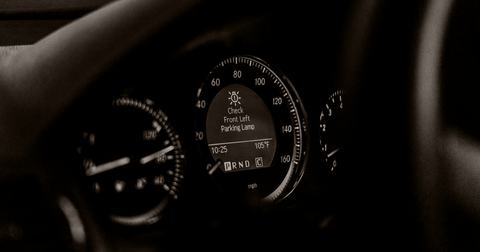
The battery light means the alternator isn't putting enough charge back into the battery, and Honda's manual draws the battery symbol as a small battery with minus and plus marks. GM's manual calls this battery warning light the charging system light, and Honda's says it comes on when the battery isn't being charged, unlike the check engine light.
The light comes on for a moment when you turn the key, as a bulb check, and it should go out once the engine starts. If it stays on, or comes on while you drive, GM says the charging system may have a problem.
Some cars add a message to the dashboard warning lights: GM's reads Service Battery Charging System, and Ford's reads Check Charging System. Ford words its meaning by model, from a long spell of low voltage that switches some features off to a charging system that needs servicing.
What the manuals say 4 manuals
- 2020 Chevrolet Silverado, page 135. A bulb check at ignition. If the light stays on or comes on while driving, have it checked, and driving with it on could drain the battery.
- 2018 Honda Odyssey, page 716. Comes on when the battery is not being charged. Turn off the climate control and rear defogger, contact a dealer, and don't turn off the engine if you stop.
- 2019 Ford Edge, page 114. Check Charging System means a long low-voltage spell. The car disables some features and asks you to turn off electrical loads.
- 2020 Ford Explorer, page 122. Check Charging System means the charging system needs servicing; see a dealer if it stays on or continues to come on.
Use this image
Free to republish under CC BY 4.0: credit Oil & Miles and link to this page. The snippet does both.
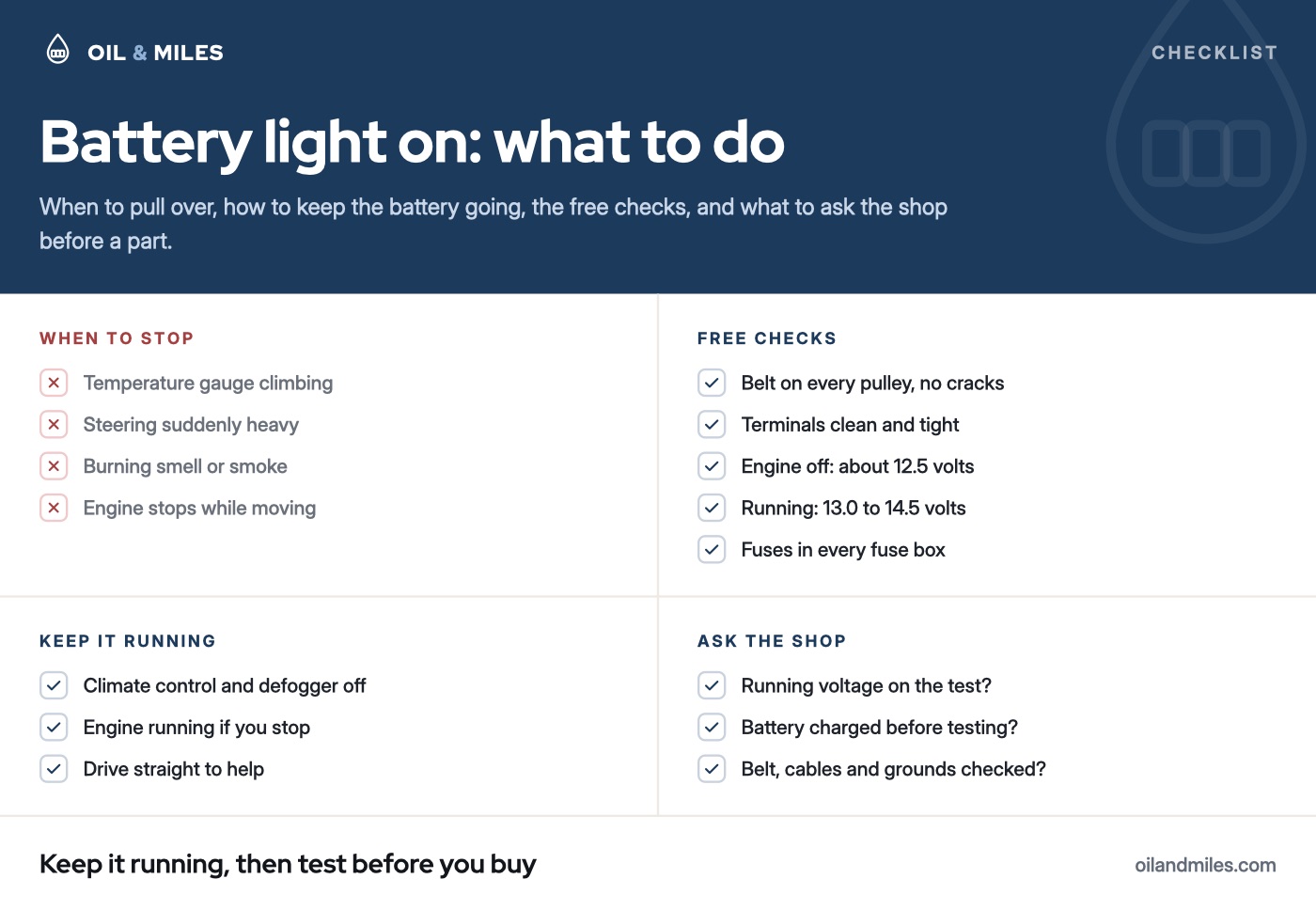
<a href="https://oilandmiles.com/articles/battery-light-on"><img src="https://oilandmiles.com/assets/img/diagrams/battery-light-on-checklist.jpg" alt="Battery light on checklist: pull over if the temperature gauge climbs, the steering turns heavy, you smell burning or see smoke, or the engine stops; otherwise switch off the climate control and rear defogger, keep the engine running and drive straight to help; then look at the belt and terminals, read about 12.5 volts engine off and 13.0 to 14.5 volts running, and check the fuses; ask the shop for the running voltage, a battery test after a full charge, and a check of the belt, cables and grounds." width="1200" height="830"></a> <p>Infographic: <a href="https://oilandmiles.com/articles/battery-light-on">Oil & Miles</a>, CC BY 4.0</p>From the carmakers
What the carmakers say about the battery light
Chrysler recalled alternators that can fail suddenly, and those recalls replace it free where needed. Hyundai, Ford, GM and Honda bulletins name causes a new alternator alone won't fix: oil on it, a loose fuse, a shorted wire and a failed battery sensor.
Each quote below was read in the carmaker's or NHTSA's own document. NHTSA's recall lookup shows by VIN whether a recall is still open.
Recall 17V-435 (T36)
There is also the possibility that the alternator may short circuit, increasing the risk of a fire.
Recall 14V-634 (P60)
If the alternator fails, the vehicle may stall without warning, increasing the risk of a crash.
Campaign bulletin 24-01-026H
Oil could damage the alternator resulting in illumination of the charging system warning lamp and disablement of the charging system.
Special service message SSM 54629
This may be due to a loose fuse terminal for the low voltage high current fuse (3A).
Service bulletin 16-026
The Charging System indicator is on with DTC P154A (battery sensor internal failure).
Special service message SSM 50737
Some 2021-2022 F-150 vehicles equipped with a 2.7L EcoBoost engine may experience a Check Charging System message displayed in the instrument panel cluster (IPC).
Preliminary information PI0839
This condition may be caused by engine oil previously being spilled on the generator
Conclusion
Keep it running, then test before you buy
A battery light on means the battery isn't being charged, and the car runs on what's left. This is what to do when the battery light comes on, drawn from the manuals, bulletins, recalls and complaints:
- Cut the loads and keep driving to help. Climate control, rear defogger and extras off, and leave the engine running if you stop.
- Stop if the engine heats up or the steering goes heavy. A broken belt can stop the water pump, and a fading battery can take the steering assist with it.
- Read the voltage. About 12.5 volts with the engine off, and 13.0 to 14.5 volts running.
- Check the cheap causes first. The belt, the terminals, the grounds and the fuses come before an alternator or a battery.
- Run the VIN. Some 2011–14 Chrysler, Dodge and Jeep models have alternator recalls, and the VIN shows whether yours is still open.
Keep the engine running, then let a test name the part. Oil & Miles reads the carmakers' own manuals and bulletins before it names a part.
Common questions
Asked most often
Is it safe to drive with the battery light on?
Only for a short way, straight to a shop or home, because the car runs on the battery and can stall when it runs down. Stop at once if the temperature gauge climbs or the steering goes heavy.
How long can you drive with the battery light on?
At best as long as the battery's reserve capacity allows, which on Optima's examples is 66 to 140 minutes at a steady 25 amps. Treat that as an upper limit, because headlights, wipers and the blower at night, or a battery that wasn't full, leave you less.
Why is my battery light on but my car runs fine?
The car is running on its battery, and it feels normal until the voltage drops. Measure the running voltage or get a free charging test soon, before the battery is flat.
Does the battery light mean a bad alternator?
It can, but a slipping belt, loose or corroded cables, a weak battery, a blown fuse or oil on the alternator can light it too. A running reading below 13 volts, with the belt and cables good, points at the alternator.
Can a bad battery cause the battery light?
Yes. Denso says a weak battery can light the lamp under heavy electrical load, which is why the battery is charged and tested before the charging system.
Will the battery light go off by itself?
It goes off when the charging voltage is back in range, which can happen on and off with a slipping belt or a loose wire. A light that went out hasn't been repaired, so the cause still needs finding.
Why is my battery light on after a new battery?
Because the battery wasn't the cause, or wasn't the only one. Measure the voltage with the engine running: under 13 volts with a new battery points at the alternator, its belt or the cables.
Is the battery light the same as the check engine light?
No. Honda's manual says the check engine light comes on for a problem with the engine emissions control system, while the battery light means the battery isn't being charged, and each light has its own causes.
What will cause the battery light to come on?
Anything that stops the alternator charging the battery: a broken or slipping belt, a failed alternator or regulator, loose or corroded cables and grounds, a weak battery, a blown fuse, or oil on the alternator.
Sources
- NHTSA recall 14V-634, Chrysler's P60 alternator recall, and recall 17V-435, its T36 alternator recall. NHTSA, read October 8, 2026
- Hyundai bulletin 24-01-026H, service campaign 976, superseding 23-01-076H-2. Hyundai via NHTSA, read October 8, 2026
- Honda service bulletin 16-026, the battery sensor. American Honda via NHTSA, read October 8, 2026
- Ford SSM 54629, with SSM 50737. Ford via NHTSA, read October 8, 2026
- GM preliminary information PI0839, oil on the generator. GM via NHTSA, read October 8, 2026
- Owner's manuals: 2020 Chevrolet Silverado pages 135, 171–172, 185 and 355, 2018 Honda Odyssey pages 87, 716 and 717, 2019 Ford Edge page 114, and 2020 Ford Explorer pages 122 and 339. GM, Honda and Ford, read October 8, 2026
- 2012 Ford F-150 owner's guide, page 299, on steering effort without electrical power (3rd printing, Wayback Machine capture of May 13, 2015). Ford, read October 8, 2026
- Denso, Charging System Diagnosis, for the charge lamp, the voltage windows, the belt, fuses and grounds. Denso, January 17, 2023, read October 8, 2026
- Optima Batteries, Battery Reserve Capacity, for the definition and the 66- and 140-minute examples. Optima, September 15, 2020, read October 8, 2026
- Interstate Batteries, How to Test a Battery Like a Pro, for the resting and running voltages. Interstate Batteries, undated, read October 8, 2026
- Gates, Protect the Ride, for the parts the accessory belt drives. Gates, undated, read October 8, 2026
- Dayco, How to Fix Serpentine Belt Noise, for low tension as a cause of squeal. Dayco, undated, read October 2, 2026
- NHTSA complaint file, every complaint that mentions the battery or charging light, 2010 to 2025 model years. NHTSA, file dated August 25, 2026
- RockAuto catalog and one parts chain's battery listings, for the prices, as published on our bad alternator or battery page. Read September 25 and August 31, 2026
How this was compiled
The sections follow what a driver needs once the light is on: whether to drive, what to check first, what causes it, what a repair costs and what the light means. The causes come from Denso's charging guide and the carmakers' bulletins, and the documents panel holds every recall and bulletin we read in full.
The complaint figures come from NHTSA's complaint file for 2010 to 2025 models: complaints whose text mentions the battery light, the charging light or a charging-system message. Full hybrids and electric cars are left out, because their battery light can mean the drive battery.
What we didn't do
We didn't test a car, and we haven't priced belts, tensioners, cables or alternator labor yet. We read one carmaker's relearn rule after a new battery, Ford's, and not the other makers' rules.
What people ask next
Prices are ranges compiled in August and September 2026 for the US market and vary by region, engine and shop rate. Prices from $10 up are rounded to the nearest dollar, so $14.13 reads as $14 and $14.52 as $15. Below $10 they're exact. This article is general information, not advice about your specific vehicle. See the disclaimer.