
Key takeaways
- Safety: If the car loses drive or stalls while moving, steer to a safe spot, stop and call for help. Stop and have it checked if the whine comes with harsh shifts or a battery light.
- A whine that follows engine speed points to a belt or pump, and one that follows road speed to the driveline.
- Rev it in Park to see whether the whine follows the engine or only the road.
- Ask for a road test with you in the car and the bearings checked before anything is opened.
- Check your VIN and ask the dealer by number, because two Toyota programs still pay for some whines.
A whine on the gas usually comes from a part that spins, and what its pitch follows, engine speed or road speed, points at the part. A slight whine can be normal on some transmissions, so the test is how yours compares with the same car.
Why is my car whining when I accelerate?
The main causes are the transmission, a CVT, the differential, a wheel bearing, the belt drive and the power steering pump. A part that spins or moves air is worn, loose or short of fluid, and pressing the gas loads it.
They split by what the whine follows. Engine speed points at the belt drive and the pumps, road speed at the transmission, the differential, the bearings and the tires, and the groups below follow that split.
Transmission, CVT or torque converter
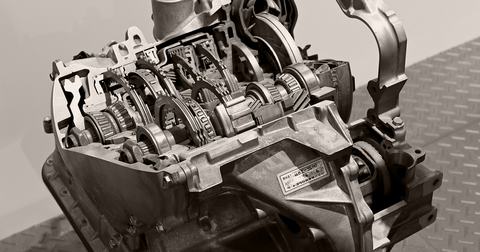
An automatic transmission’s gears and bearings whine under load when they wear. Low fluid can cause a whine too, so a shop checks the level first, and the transmission section shows how to tell a worn one from a normal whine.
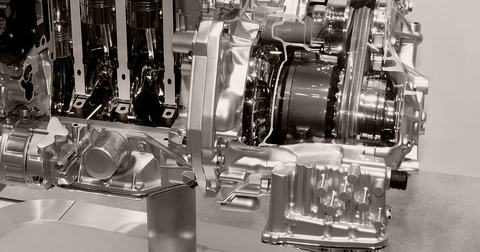
A CVT, or continuously variable transmission, runs a belt or chain between two pulleys instead of fixed gears, and worn bearings inside it can whine. The CVT section names the cars.
The torque converter couples the engine to an automatic transmission, and its whine fades at cruise, once the converter locks up and turns as one piece. Ford fixed this whine with a new converter and front pump seal, not a new transmission.
On a manual, a whine in only one or two gears comes from those gears or something touching them. Tell the shop which gears it whines in.
Differential, wheel bearing or tires
The differential is the last set of gears before the wheels, called the final drive on a front-drive car. Its whine follows road speed and changes between pulling and coasting.
On all-wheel-drive cars the transfer unit, which sends power to the rear wheels, can whine the same way. Ask for its fluid level to be checked before any differential is replaced.
A wheel bearing hums with road speed too, and Mazda warns its dealers that bearing noise gets mistaken for a differential or transmission. Our guide to a bad wheel bearing covers how far you can drive on one.
Worn or mismatched tires can make noise as well, Mazda tells its dealers. Audi says the air inside a tire can also hum at one pitch at any speed.

The fill plug on a rear differential
Belt drive, alternator or A/C compressor
The belt at the front of the engine turns the alternator and the A/C compressor, and a worn bearing in one of them, a pulley or the tensioner can whine with engine speed, even in Park. The tensioner is the spring-loaded arm that keeps the belt tight.
Dayco, a belt maker, says a tensioner that is noisy or stiff to turn by hand has a failing bearing. The alternator section covers the rest.
The A/C compressor is a belt-driven pump, so its whine changes as the A/C goes on and off. Denso lists a worn bearing and loose piping among the causes, and some carmakers fixed this without a new compressor, so ask what the shop found before it orders one.

Listening for the pulley that whines
Power steering pump
A hydraulic power steering pump runs off the belt, so its whine rises with engine speed and changes as you steer. Check the fluid level first, and whether your car has a hydraulic pump at all.
Air in the fluid makes the same whine, and cars with fully electric steering have no pump to whine. The turning section covers both.
Turbocharger or PCV system
A turbocharger is an exhaust-driven fan that spins very fast, and a damaged compressor wheel can whistle or screech on the gas, turbo maker Garrett says. Ask the shop what it found on the wheel, since GM’s bulletin for some diesel pickups and vans replaces the turbo only when a blade is bent.
The PCV system pulls fumes out of the engine’s crankcase, and a restriction in it can hum or whine near where the engine meets the transmission. On some GM V8 trucks, a noise that stops with the oil filler cap off sends the shop to the PCV system.
What doesn’t cause a whining noise?
A belt on its own usually chirps or squeals rather than whines, in Dayco’s guide. So a belt-drive whine most often comes from its pulleys or the parts they turn.
A rattle is a different noise as well, from something shaking loose or from engine knock. Our guide to rattling noise when accelerating covers it.

Use this image
Free to republish under CC BY 4.0: credit Oil & Miles and link to this page. The snippet does both.
<a href="https://oilandmiles.com/articles/whining-noise-when-accelerating"><img src="https://oilandmiles.com/assets/img/diagrams/whining-noise-follows.svg" alt="Whining noise when accelerating: a front-wheel-drive sedan seen from above with the hood off, and the twelve places a whine starts drawn around it, those that follow engine speed (belt drive, power steering pump, PCV system, turbocharger, A/C compressor) and those that follow road speed (transmission, final drive, wheel bearing) and those that follow neither (torque converter, tires)" width="1600" height="1592"></a> <p>Diagram: <a href="https://oilandmiles.com/articles/whining-noise-when-accelerating">Oil & Miles</a>, CC BY 4.0</p>Is it safe to drive a car that is whining?
It depends on what comes with it. A whine with nothing else wrong still needs a check, but these signs mean stop and have it looked at:
- Harsh shifts or lost power. Those are the signs carmakers pair with a failing transmission.
- A battery or transmission light. With a belt whine, the battery light means the battery isn’t charging.
- The car slows itself. A hot CVT’s protection mode does that, which matters in fast traffic.
- It loses drive. One recall covers a transmission pump that could seize and cut drive, raising the risk of a crash.
- A transmission-hot light or message. The fluid is too hot, and driving on can ruin the transmission. Pull over and let it cool the way your manual says, since GM, Ford and Chrysler each give their own steps.
- A hum in turns. A hum that grows in turns, with a wheel that feels loose, points at a failing wheel bearing.
Stopping means leaving the road as soon as it’s safe and turning on your hazard lights. If the warning comes back or the car won’t drive normally, call a dealer or a tow instead of driving on.
A transmission that also slips or flares between gears needs the same check. Our guides to transmission slipping and low transmission fluid symptoms cover what that adds.
Is a whining noise normal?
A slight whine can be. Ford tells its dealers a small whine is characteristic of its 10-speed, rising with engine speed even in Park and with no effect on durability, and CVTs sound louder on a shop lift than geared transmissions.
The test is how yours compares with the same car. Mazda tells its technicians to drive a like model on the same tires before calling a noise a fault, and a whine that is new, growing or comes with a warning light needs a check.
How do you tell which part is whining?
By what its pitch follows, since engine speed and road speed point at different parts. Test it in this order:
- Rev it in Park, from the driver’s seat. A whine that follows the revs with the car standing still points at the belt drive, the power steering pump or the transmission’s own pump, a transmission rebuilders’ magazine says.
- Watch road speed against engine speed. A whine that keeps climbing with road speed through a gear change points at the transmission, the differential, a wheel bearing or the tires.
- Ease off the gas at a steady speed. A whine that changes between pulling and coasting points at the differential gears, gear maker Yukon says, though a transmission can change the same way.
- Turn the wheel. A whine that changes as you steer points at a hydraulic power steering pump, and a hum that grows in a gentle turn at a wheel bearing, bearing maker Timken says.
None of the four proves the part, because a transmission pump whines in Park too. A shop confirms it before anything is replaced.
How do you tell a wheel bearing from the transmission?
Both follow road speed, so the turn is the tell. A bearing hum grows in a gentle turn, while a transmission whine fades when you lift off the gas and comes back when you press it.
Have the bearings checked before anything is opened, since a bearing costs far less than a transmission. A shop turns them by hand to feel for wear, and a road test with you in the car settles the rest.
Is the whine coming from the transmission?
Yes, if it climbs with road speed, fades when you lift off and comes back on the gas, and the differential, wheel bearings and tires check out. A failing transmission adds harsh shifts, a warning light or lost power, the signs carmakers pair with it.
Some whine is normal, though, as the section above explains. A whine that is new, or louder than on the same car, is the one to have checked.
A transmission rebuilders’ magazine gives shops a standing test. A whine that rises with the revs in Neutral points at the transmission’s pump, and one that shows only in gear with a little gas points at the torque converter.
Some owners who report a whine on the gas say no warning light or code came on, so a quiet dash doesn’t clear the transmission. The documents section counts those reports.
Why does a CVT whine when you accelerate?
Because a CVT can whine for two reasons: a worn bearing inside it, or a sound its maker calls normal. Nissan’s bulletins name a whine or grind on acceleration or at a steady highway speed, with no trouble codes.
Nissan tells its dealers that CVTs sound louder on a shop lift than geared transmissions, so noise there alone isn’t a reason for a new one. On some older cars, a CVT that runs hot after long climbs in great heat can slow the car with a whine or rattle, and our guide to CVT transmission problems covers the rest.
On certain 2018–2019 Toyota C-HRs, the whine is most noticeable at low speed, between 15 and 30 mph. Toyota’s program 26TE06 covers it with a new or remanufactured CVT, and a dealer checks your VIN.
Does a bad alternator whine when accelerating?
It can, because worn alternator bearings grind or whine from the front of the engine, rising and falling with engine speed. A tensioner or idler pulley bearing sounds much the same, and turning each one by hand tells them apart.
If the battery light comes on with it, the battery isn’t charging, as Honda’s manual puts it. Our guide to a bad alternator or battery covers the free test that settles the charging side.
Why does my car whine when I turn?
Because turning loads a hydraulic power steering pump, a whine that changes as you turn the wheel points at that pump, its fluid running low or air in the system. Cardone traces that whine to air trapped in the fluid, for example through a cracked return hose.
A car with fully electric steering has no hydraulic pump, so a whine there as you turn needs another explanation, and a wheel bearing is one to check. Our guide to a power steering fluid leak covers the hydraulic side.
How do you fix a whining noise when accelerating?
By pinning down what the whine follows before anyone orders a part, in this order:
- Record it. A phone recording with the speed and revs noted lets the shop hear what you hear, the comparison Mazda asks its own technicians to make.
- Check the lights. A battery, check engine or transmission light narrows it fast.
- Ask for a road test with you aboard. You point at the moment it starts, and the tech hears whether it follows road or engine speed.
- Rule out the wheel bearings and tires. Both can pass for a differential or transmission, as the bearing and tire causes above show.
- Get the diagnosis in writing. Which part, with parts and labor on separate lines, and whether a bulletin or program covers it.
If those checks don’t settle it, ask the shop to turn the pulleys and bearings by hand with the engine off. Then ask for a drive in a like car on the same tires, so a normal noise isn’t taken for a fault.
What to say to the shop
“The whine starts when I accelerate and follows [road speed or engine speed]. Before you quote a transmission, can you road-test it with me in the car, rule out the wheel bearings and tires, and check my VIN for bulletins and programs?”
How much does it cost to fix a whining noise?
Nothing if a carmaker program covers it, and otherwise the part that whines sets the bill. Two Toyota programs still pay for a whine fix, so check the documents section before anything else.
A belt tensioner runs $237–$290 on a 2016 Mazda CX-5 and a front wheel bearing $313–$464 on a 2015 Subaru Forester, both parts and labor. Both run from an independent shop to a dealer.
A transmission, a differential or a CVT is a much bigger bill, which is why the road test and the bearing check come first. Our wheel bearing replacement cost and serpentine belt replacement cost guides show each repair car by car.

Use this image
Free to republish under CC BY 4.0: credit Oil & Miles and link to this page. The snippet does both.
<a href="https://oilandmiles.com/articles/whining-noise-when-accelerating"><img src="https://oilandmiles.com/assets/img/diagrams/whining-noise-when-accelerating-checklist.jpg" alt="Whining noise when accelerating checklist: rev it in Park and note whether the whine follows road speed, engine speed, the gas pedal or the steering; stop with harsh shifts, lost power, lost drive or a battery light; check your VIN at NHTSA, with our decoder listing model-year recalls, and ask the dealer about programs by number; a slight whine can be normal, so compare a like car; ask for a road test and the diagnosis in writing." width="1200" height="1666"></a> <p>Infographic: <a href="https://oilandmiles.com/articles/whining-noise-when-accelerating">Oil & Miles</a>, CC BY 4.0</p>From the carmakers
Is a whining noise covered by a recall or warranty?
Sometimes. Two Toyota programs still pay for the fix, 26TE06 on the 2018–2019 C-HR’s CVT and ZJC on some 2017–2018 Highlanders and Siennas. Ask the dealer about each program by its number, because Toyota bars its dealers from marketing ZJC.
Check your VIN on NHTSA’s recall lookup, or use our free VIN decoder to see the recalls NHTSA lists for your model year. That lookup lists recalls, not these programs, which cover only the VINs they list.
Safety recall 16V-461
If the transmission loses hydraulic pressure, the vehicle may lose motive power, increasing the risk of a crash.
Customer support program 26TE06
…could lead to an abnormal whine noise being emitted from the CVT that is more noticeable between 15-30 mph…
Customer support program ZJC
…the Secondary Coverage is applicable for 10 years from the vehicle’s date of first use, regardless of mileage.
Service alert SA-020/25a
…warranty claims submitted for growling or bearing whine noise in differentials, transfer units and transmissions where the source of the noise was a wheel bearing.
Special service message 47812
A small amount of whine noise is considered to be characteristic of the 10R80 transmission…
Owners’ federal complaints show how a whine on the gas gets reported:
Conclusion
What to do next about a whining noise
If it follows road speed and fades off the gas, have the wheel bearings checked too. Do that before the transmission or differential is opened.
If it comes with harsh shifts, a warning light or lost drive, stop and have it checked. Then run your VIN for a program.
Oil & Miles checks each step here against the carmakers’ own bulletins and the parts makers’ guides, so each one names the document a shop can look up.
Common questions
Asked most often
Why is my car whining but driving fine?
A whine can come with no other symptom, and some owners report no warning light or code. It can still be a transmission, a bearing or the belt drive, so note what the pitch follows and have it checked.
Can low transmission fluid cause a whining noise?
Yes, it can: some carmakers’ bulletins for a final drive or transaxle whine have the shop check the fluid level first and stop there if correcting it cures the noise. Where your car has a dipstick, check it the way your manual says, don’t overfill, and have any leak found, as our low transmission fluid guide explains.
Why does my car whine at low speed?
A whine at low speed follows the same rule, so note whether it tracks road speed or engine speed. Some CVTs whine most at low speed, and Toyota covers that whine on some 2018–2019 C-HRs under a program.
What people ask next

Sources
- Toyota program ZJC (POL19-04), with bulletins T-SB-0160-18 Rev1, T-SB-0008-21, T-SB-0097-13 and T-SB-0069-14. Toyota via NHTSA, read October 20, 2026
- Toyota program 26TE06 and bulletin T-SB-0048-26, the 2018–2019 C-HR CVT. Toyota via NHTSA, read October 20, 2026
- Nissan bulletin NTB15-102b, with NTB16-090 and NTB16-098 on the CVT protection mode. Nissan via NHTSA, read October 20, 2026
- Nissan bulletin NTB16-109C, CVT noise that is normal. Nissan via NHTSA, read October 20, 2026
- Nissan CVT warranty extensions, the 2020, 2022, 2023 and October 2025 notices. Nissan via NHTSA, read October 20, 2026
- Ford SSM 47812, the 10R80 whine. Ford via NHTSA, read October 20, 2026
- GM bulletins PIE0804A, PIT4208D, PIP5612A and 17-NA-222, and program 13430. General Motors via NHTSA, read October 20, 2026
- Mazda service alert SA-020/25a, November 2025, wheel bearings and tires mistaken for drivetrain whine. Mazda via NHTSA, read October 20, 2026
- Chrysler recall 16V-461, the transmission pump that may seize. NHTSA recall record, read October 20, 2026
- Genesis bulletin 26-DS-001G, September 2026, the rear differential hum or whine. Genesis via NHTSA, read October 20, 2026
- Ford TSB 13-6-4, with Toyota T-SB-0186-17, Acura B17-032, Infiniti ITB13-021 and Audi 2079696. Carmakers via NHTSA, read October 20, 2026
- NHTSA’s consumer complaint database, every complaint that mentions a whine and acceleration together, 2010–2025 model years, files dated September 2 and October 2, 2026. NHTSA, read October 20, 2026
- Owner’s manuals: 2019 Toyota Camry, for its electric power steering, and 2018 Honda Accord page 84, for the charging system light, with 2012 Chevrolet Cruze page 5-34, 2017 Ford Escape page 102 and 2016 Dodge Grand Caravan page 322, for the transmission-hot warning. Toyota and Honda, read September 25, 2026, and GM, Ford and Chrysler, read October 21, 2026
- Timken, Dayco, Gates and Cardone guides: wheel bearing tech tip MDV17, the belt and tensioner guides, and ProTech tips PT20-0002 and PT20-0016 on pump whine. Read September 30, 2026
- GEARS, "The Sound of Silence", a transmission trade magazine, on telling pump, converter and gear noise apart. Dennis Madden, January 17, 2025, read September 30, 2026
- Yukon, Garrett and Denso guides: gear noise diagnosis, the turbo compressor wheel, and the A/C troubleshooting chart. Read September 30, 2026
AI illustration by Oil & Miles
This article is general information, not advice about your specific vehicle. Where anything here differs from your owner's manual or your carmaker's bulletins, follow the carmaker. See the disclaimer.