

Key takeaways
- Safety: A car that has stalled in traffic should be towed, and a warning light, heat or a knock means stop.
- Idle stalls often store no trouble code, so a clean scan doesn't clear the car.
- If it stalls at speed, shift to Neutral to restart where your manual permits, and never shift into Park.
- Many of these stalls are covered by a recall, so check your VIN for a free fix before you pay.
Your car shuts off at a red light, or worse, at 45 mph, and half the dashboard lights up at once. If it starts again, that's a relief and also the problem, because a fault that comes and goes is a hard thing to show a mechanic.
Carmakers have already written up these stalls, in recalls and bulletins anyone can read. Ford recalled more than a million Focus compacts for a purge valve that can stall the engine at speed, and Honda wrote a bulletin for Pilots whose start-stop fails to restart them.
What to do if your car shuts off while driving
Keep the car straight and stay calm, because a stalled engine doesn't take away your brakes or steering all at once. You keep some brake assist, but each press uses it up, and then the pedal gets much harder, and steering may get heavy depending on the car.
Owner's manuals from Hyundai, Nissan, Toyota, Honda and GM each cover part of it, and together they give the 4 steps below for when your car shuts off while driving:
- Turn on your hazard lights. Ease off the gas and slow down gradually in a straight line.
- Shift to Neutral and try a restart. Do it if traffic allows and your manual permits, as Nissan and Toyota manuals allow restarting in N while the car is still rolling. On a push-button car, press the start button. Never shift into Park while moving, as Hyundai's manual says in plain words.
- Brake steadily and steer with both hands. GM says to brake normally but not to pump the pedal, because the leftover assist gets used up with each press. Be ready for heavier steering: GM's 2010 Malibu keeps its electric assist until you stop, but Nissan says its assist is lost.
- Get to a safe place if it won't restart. Move off the road, keep the hazards on, and call for help.
If you have to stop a push-button engine yourself while moving, Honda's manual says to use both feet on the brake, because steering and braking take far more effort. On a push-button car the steering wheel won't lock. With a key, never turn it to Lock while the car is moving.

Off the road, hazards on
Is it safe to keep driving a car that stalls?
Not until the cause is found, because a car that shuts off in traffic raises the risk of a crash. The recalls for stalling fuel pumps and purge valves say so in those words.
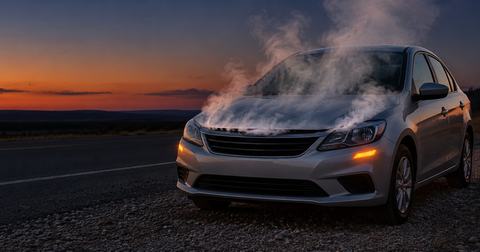
The danger is on the road, so if it has stalled in traffic, have it towed. A warning light, heat or a knock means stop, and the car stays parked until the cause is found.
The one exception is auto start-stop doing its job. An engine that rests at a light and wakes up when you lift off the brake is a feature, and it needs nothing but the occasional reminder that it's on purpose.
Why does my car shut off while driving?
A car shuts off at speed usually because something cut its fuel, its spark or the power that runs both. Carmakers' recalls call that a crash risk, which is why several of the causes below come with a free repair.
1. A failing fuel pump
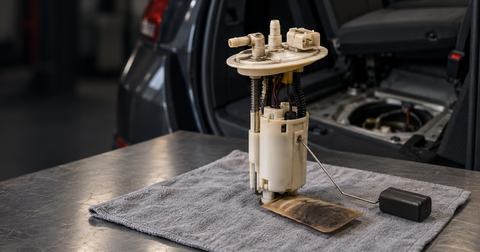
The fuel pump sits in the tank and pushes gasoline up to the engine, so when it weakens or seizes, the engine runs dry and dies. Carter, a fuel pump maker, warns the engine may shut down completely during sudden acceleration, and lists wiring faults among the causes.
Toyota and Honda have each recalled more than a million vehicles for in-tank pumps that can stall the engine while driving, and Ford about 850,000 trucks and SUVs, with the pump or its software fixed free. The recall section shows how to check yours.
2. A crankshaft position sensor
This sensor tells the engine computer where the crankshaft is, so it knows when to fire the spark plugs and the injectors. A faulty signal can stall the engine, and the sensor section says what to tell the shop.
Recalls on some Jeep, Dodge and Chrysler models fix the sensor's connector or software free. So run the recall check before you pay for a sensor.
3. Battery cables, grounds and relays
The engine's electronics run on the 12-volt system, so a loose battery cable, a bad ground or a failed relay can shut the engine off along with the lights and radio. GM lists that whole pattern on its full-size trucks and SUVs: the engine stalls, the steering goes heavy, and the gauges, radio or climate control go blank.
Ask the shop to check the cheap ones first, as GM's list does: a poor ground on the body computer, a starter cable rubbing on a heat shield, and loose or corroded battery cables. Recalls on Jeep, Dodge and Chrysler models add a fuel pump relay, an alternator and a power connector.
So a failing alternator belongs on this list too, since it feeds the whole 12-volt system once the engine runs. Our battery or alternator test is the free first step, before anyone replaces a part.
Ford found a related fault in a pickup's fuse box, where one overheating fuse can stall the engine or stop it from starting. That one is a bulletin, not a recall, so a recall search won't show it.
4. The ignition switch and a heavy key ring
On cars with a metal key, the key can slip out of RUN into ACCESSORY or OFF while you drive, which turns the engine off. Chrysler's interim advice in one recall was to remove everything from the key ring, so a lighter ring is a free precaution.
On push-button cars, an engine that "just shut off" can come from the button itself. Toyota, Honda, Nissan and Hyundai all stop a moving engine when you hold the button about two seconds or press it three times, which is a safety feature that can surprise you once.
5. A stuck purge valve
The purge valve lets fuel vapor from a charcoal canister into the engine to be burned. GM says a valve that doesn't fully close can make the engine stall at idle, and our P0443 page covers the codes it sets.
Ford's version is the big one: on the Focus compact, a stuck-open valve can stall the engine at speed without warning and without a restart. Ford found some first repairs were never installed correctly, so a second recall in 2026 calls those cars back even if they were recorded as fixed.
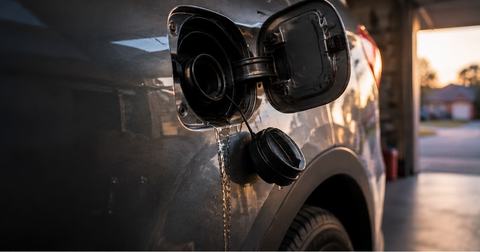
Chrysler traced a stall right after filling the tank to the same system: a valve in the tank let liquid fuel into the vapor lines on some older minivans and cars. If yours dies just after a fill-up, tell the shop, because that points at the vapor system rather than the pump.
Why does my car turn off when I stop?
On a car with auto start-stop that's normal, because the engine rests on purpose and restarts when you lift off the brake. Otherwise your car turns off when you stop because the idle can't hold.
At idle the engine runs on a small, steady trickle of air and fuel, and the computer trims it constantly. When something chokes the air it expects, upsets the computer's idle control, or drags on the engine as the car stops, the idle sinks until the engine quits.
1. Auto start-stop, which is normal
Some newer cars switch the engine off on purpose at a stop to save fuel, then restart it the moment you lift your foot off the brake. On a GM car the tachometer reads AUTO STOP while the engine rests, and Hyundai notes that a few warning lights may blink during the restart without meaning a fault.
So if the engine comes back by itself when you release the brake, nothing is broken. GM's manual adds one warning worth keeping: shift to Park before you get out, because the car is still on and can restart and move.
If the habit bothers you, some cars let you switch it off with a button. Hyundai labels its button ISG OFF, and GM notes that its trucks turn the feature back on every time you start the engine.
2. A dirty throttle body
The throttle body is the air valve between the air filter and the engine, a round plate that sits almost closed at idle. Carbon and gum build up around that plate, and the small gap it leaves at idle shrinks further, so the engine runs short of air just as you come to a stop.
Mazda and GM both describe it in bulletins: an unsteady idle or a stall right after the car stops, sometimes with no trouble code at all. Mazda traces it to carbon inside the throttle body, and GM, whose stalls came with the A/C on, has the shop clean it.
Ask the shop to clean it before anyone replaces it, and if it does get replaced, to run the idle relearn. SMP, a throttle body maker, warns that skipping the relearn after a replacement can leave idle drivability problems behind.

Use this image
Free to republish under CC BY 4.0: credit Oil & Miles and link to this page. The snippet does both.
<a href="https://oilandmiles.com/articles/car-shuts-off"><img src="https://oilandmiles.com/assets/img/diagrams/car-shuts-off-idle-air-bench.svg" alt="Car shuts off at idle, where the idle air goes: an electronic throttle body cut open, its round plate sitting almost closed at idle with carbon and gum built up around it, the mass airflow sensor on the duct ahead of it and a cracked hose behind the throttle; the duct, intake and hoses are drawn see-through." width="1200" height="675"></a> <p>Diagram: <a href="https://oilandmiles.com/articles/car-shuts-off">Oil & Miles</a>, CC BY 4.0</p>3. A torque converter that won't let go
In an automatic, the torque converter is the fluid coupling between the engine and the transmission, and at speed a clutch inside locks the two together. It has to unlock as you slow down, or the engine stays tied to wheels that are stopping.
The engine speed drops very low coming to a stop, like stopping a stick-shift car without pressing the clutch, as Subaru describes on some models with a CVT, a belt-type automatic. GM and Mazda name stuck or worn converters on other models.
So this one belongs with a transmission shop rather than a general garage, because the converter sits inside the transmission. Our CVT problems page covers the wider picture.
4. A/C load and idle software
Turning on the A/C adds a load at the exact moment the engine has the least to spare, so a weak idle can show itself first with the air conditioning running. Nissan and Subaru both fixed stalls coming to a stop with new engine computer software, one of them only with the A/C at full blast.
That makes a software update one of the cheapest fixes on this page, well under an hour of dealer time in the two bulletins that list one. Ask the dealer whether your car has an idle or stall update before anyone replaces a part.
5. Other causes of an idle stall
Parts makers and two carmaker documents name five more, and these can also make a car shut off at idle:
- Idle air control valve. A small motorized valve that meters idle air on many older engines. Parts makers list stalling when it sticks, above all in stop-and-go traffic.
- EGR valve stuck open. The exhaust gas recirculation valve feeds some exhaust back in. Delphi and Walker list rough idle or stalling when it sticks open.
- Mass airflow sensor. Measures the air coming in. HELLA and Delphi list stalls or rough idle when it misreads.
- Camshaft actuator solenoid. A valve that sets cam timing on some engines. A stuck one can cause a rough idle and stalling at low throttle, as GM's emission recall for some 2.4L engines lists, and a later bulletin replaces both.
- Vacuum leak. A cracked hose behind the throttle lets in air the airflow sensor never counted. One Jeep bulletin lists a vacuum leak code beside a stall at a stop, though Chrysler's fix was software. A real leak sets a lean code, covered on our P0171 page.
Spark plugs and coils, a clogged fuel filter, low oil and overheating can stall it too, at a stop or on the road. Ask the shop to check those as well.
Why does my car shut off but restart right away?
It shuts off and restarts because the fault comes and goes: idle air, a converter that lets go once stopped, a hot fuse or a loose cable. That makes a quick restart the first clue to give a mechanic.
A car that won't restart points somewhere else. The causes of a stall with no restart include a crank sensor, a stuck purge valve and an idle stop that fails.
The check engine light may stay off the whole time. Mazda, GM and Ford bulletins all describe idle stalls with no trouble code stored, so a clean scan doesn't clear the car.
On cars with start-stop, an engine that switches off and never comes back has a fix of its own. Honda tells owners of affected Pilots, Passports and Ridgelines to select Park and press the start button, and its later fix replaced the starter and its relays and adjusted the valves.
If your car starts and then dies within seconds, our guide to a car that starts, then dies picks it up from there. Before you call a shop, note these details, because they're what a mechanic needs to find why a car shuts off:
- Where it happened. At a stop, while slowing, while turning, or at speed.
- Whether it restarted. Right away, after a wait, or not at all.
- What came first. Flickering lights or a dark dashboard, a battery light, or nothing.
- What was running. The A/C on high, or a fill-up just before.
- Any warning light. A check engine light, a wrench, or AUTO STOP on the tachometer.
What sensor makes a car shut off?
The crankshaft position sensor, because without its signal the computer can't time spark or fuel. Chrysler recalls on some Jeep, Dodge and Chrysler models say a faulty one can stall the engine. A stall followed by a no-restart fits this sensor. Tell the shop about both, and ask for the stored codes.
Walker and Bosch, two sensor makers, list sudden stalling when it fails. HELLA and Delphi add the airflow sensor, whose misreading can bring stalls or a rough idle.
Can a recall fix a car that keeps shutting off?
Sometimes, yes, because a stall at speed is a safety defect, and safety recalls are repaired free at the dealer. Some idle stalls are covered too, but by bulletins and extended warranties that a recall search won't show.
Several of those extended warranties have closed, so don't count on one: Subaru's CVT coverage on older Outbacks and Ford's throttle body program are over. Honda's starter coverage for the Pilot runs 10 years from purchase, so the oldest Pilots are aging out of it.
Cheapest first, run these three checks for a free fix when your car shuts off:
- Paste your VIN, the 17-character vehicle ID, into our free VIN checker. It lists the NHTSA recall campaigns for your car's make, model and year, so you see what exists.
- Run your VIN at NHTSA. The NHTSA recall search shows which recalls are still open on your car, including a repeat recall like Ford's second one on the Focus.
- Ask a dealer about bulletins and extended coverage. These aren't recalls, so neither search shows them, and the dealer looks them up by VIN.
How do you fix a car that keeps stalling?
You fix it by finding the cause before you buy a part, checking for a free recall, then cleaning or replacing only what failed. A cleaning or a software update fixes many idle stalls, so ask about those before a part.
If the test names the fuel pump and no recall covers yours, a new pump runs $317–$368 on a front-wheel-drive 2022 Chevrolet Equinox 1.5T and $504–$555 on a 2019 Toyota Camry 2.5, parts and labor at an independent shop. On a 2020 Kia Sedona 3.3 the same job runs $645–$684, parts and labor. Our fuel pump replacement cost guide prices it on more cars, with the dealer price beside each one.
Get the quote in writing before any work starts. Ask for the test result, the hours and the rate on the written quote, and whether the diagnosis fee comes off if you approve the repair.

Use this image
Free to republish under CC BY 4.0: credit Oil & Miles and link to this page. The snippet does both.
<a href="https://oilandmiles.com/articles/car-shuts-off"><img src="https://oilandmiles.com/assets/img/diagrams/car-shuts-off-checklist.jpg" alt="Car shuts off checklist: if it dies while driving, turn on the hazards, shift to Neutral and try a restart, brake steadily without pumping and steer with both hands. Never shift into Park while moving and don't keep driving until the cause is found. Tell the shop where it happened, whether it restarted, what came first and whether the A/C was on or you had just filled up. Paste the VIN into our VIN checker, run the VIN at NHTSA and ask a dealer about bulletins and extended coverage." width="1200" height="1470"></a> <p>Infographic: <a href="https://oilandmiles.com/articles/car-shuts-off">Oil & Miles</a>, CC BY 4.0</p>From the carmakers
What carmakers say makes a car stall
Five documents show five different ways a car shuts off: a valve, a restart that fails, a converter, a cam solenoid and a fuse. Each was written for particular models, so read them as examples of what to ask about.
Recall 26V-369
This may result in an engine stall while driving without warning or without the ability to restart and can increase the risk of a crash.
Bulletin 23-009
Typically, the customer can immediately restart the vehicle by selecting Park and pressing the ENGINE START/STOP button.
Bulletin 16-90-13R
The condition is similar to coming to a stop in a manual transmission equipped vehicle without depressing the clutch pedal.
Bulletin 17-NA-098
Some customers may comment that the engine runs rough, hesitates, hard to start, and or stalls.
Bulletin 15-0137
Does the battery junction box (BJB) exhibit signs of excessive heat at fuse F27 (20 amp) terminal location?
- Fuel pump recalls. Toyota and Lexus 20V-012 and 20V-682 cover 2013–2020 models, Honda 23V-858 covers 2013–2023 models and Ford 25V-455 covers 2021–2023 models. Toyota and Honda dealers replace the pump free. Ford's fix is a new pump on Super Duty trucks and a software update on the rest, and it's arriving by model, so ask a Ford dealer whether yours is ready.
- Focus purge valve. Ford's 18V-735 and 19V-515 cover the 2012–2018 Focus 2.0L, and 26V-369 calls back cars repaired incorrectly under the first one.
- Crank sensor recalls. Chrysler 16V-907 covers the 2016 Journey, Compass and Patriot, and 18V-049 the 2017 Pacifica, for a sensor signal that can stall the engine.
- Power supply. GM PIT5405C lists a body control module ground, a starter cable and battery cables on 2014–2017 full-size trucks and SUVs. Chrysler 14V-530, 19V-813, 14V-634, 17V-435 and 15V-470 cover a fuel pump relay, an alternator and a power connector.
- Key and vapor system. Chrysler 14V-373 covers an ignition switch that can move out of RUN on 2008–2010 Chrysler and Dodge minivans and the 2009–2010 Journey. Chrysler 14-001-16 and 14-002-14 cover a stall right after a fill-up on 2004–2006 minivans and cars, and GM N222369620 a purge valve that won't close on the 2019 XTS and 2020 Impala.
- Throttle body. Mazda SB-01-007-09 covers 2003–2009 Mazda3, Mazda6 and others, and GM PIT3116B the 2002–2009 TrailBlazer, Envoy, Rainier and Bravada, often with no code stored.
- Idle software. Nissan NTB13-058b and PM945 reprogram the 2013–2014 Sentra and 2020 Kicks, and Subaru WTT-79R the 2017–2018 Impreza and 2018–2019 Crosstrek. Chrysler 1800822 does the same on the 2021 Renegade 1.3L.
- Torque converter. GM PIP4290A covers heavy-duty trucks with the Allison transmission, and Mazda SB-05-003-11 the 2005–2008 Tribute.
- Restart clues. Ford SSM 45922 finds a seized A/C compressor clutch on the 2013–2016 Escape 2.5L, with no codes stored. Honda 23-008 updates idle stop software on the Pilot, Passport and Ridgeline, and GM PIT5391 names the ignition run relay on 2014–2015 full-size trucks.
Conclusion
What to do next about a car that shuts off
A car that shuts off is giving you a clue, and the clue is where it happened. At a stop, think idle air first, and at speed think fuel, spark and power.
So write down where it shut off and whether it restarted, then run the VIN before you pay for a part. Oil & Miles checks each step here against the carmakers' own recalls and bulletins.
Common questions
Asked most often
Why does my car shut off when I stop but starts back up?
The carmakers' bulletins point at a dirty throttle body, a converter that won't unlock or idle software that lets the engine speed sink as you stop. On a newer car it can also be auto start-stop, which restarts by itself when you lift off the brake.
Why is my car shutting off randomly without a check engine light?
Because several stall causes set no code. Carmaker bulletins describe idle stalls from carbon in the throttle body, A/C load and a seized A/C clutch with no trouble code stored, so a clean scan doesn't clear the car.
Why will my car start but won't stay running?
If it dies within seconds of starting, the starter has done its job, so look at air, fuel or a sensor signal rather than the battery. Our car won't start guide covers that case.
What people ask next
Sources
- Ford dealer notice for recall 25S75, July 17, 2026, RCMN-25V455-2812, for the software remedy by model. Ford via NHTSA, read November 2, 2026
- NHTSA recall 25V-455 (Ford 25S75), received July 7, 2025, for the models. NHTSA recalls database, read October 2, 2026
- Ford recall 18V-735, 19V-515 and 26V-369 owner letter, for the Focus purge valve stall, the units and the repeat recall. NHTSA recall records, read October 1, 2026
- Ford program 24N07, for the 0.6-hour purge valve time. NHTSA bulletin archive, read October 1, 2026
- Ford bulletin 15-0137, September 2015, for the fuse F27 stall, the kit and the 0.6-hour time. NHTSA bulletin archive, read September 29, 2026
- Honda bulletin 23-008 and 23-009, January 2023, for the idle stop restart failure, the fix, the coverage and the 2.8-hour time. NHTSA bulletin archive, read October 1, 2026
- Honda Idle Stop class settlement, case 2:22-cv-04252 in the Central District of California, for the 18 extra months on 23-009 for 2016 Pilots. Court filing and CarComplaints.com, read November 3, 2026
- Honda recall 23V-858 and Toyota and Lexus recalls 20V-012 and 20V-682, for the fuel pump stalls and free pumps. NHTSA recall records, read September 29, 2026
- Subaru bulletin 16-90-13R, revised February 2018, for the converter that won't release and the book times, and Subaru 16-107-17R for the CVT coverage. NHTSA bulletin archive, read September 29, 2026
- GM emission recall 11195A and GM bulletin 17-NA-098, for the Equinox camshaft actuator solenoids. NHTSA bulletin archive, read September 29, 2026
- GM bulletin PIT5405C, PIT3116B, PIP4290A, PIT5391 and N222369620, for the power supply, throttle body, converter, run relay and purge valve stalls. NHTSA bulletin archive, read September 29, 2026
- Other carmaker bulletins: Mazda SB-01-007-09 and SB-05-003-11 and Ford SSM 45922 (index text only), Nissan NTB13-058b and PM945, Subaru WTT-79R, Chrysler 1800822, 14-001-16 and 14-002-14. NHTSA bulletin archive, read September 29, 2026
- Chrysler recalls 14V-530, 19V-813, 14V-634, 17V-435, 15V-470, 14V-373, 16V-907 and 18V-049, for the relay, alternator, connector, ignition switch and sensor stalls. NHTSA recall records, read September 29, 2026
- Ford program 13N03, for the expired throttle body coverage. NHTSA investigation and bulletin files, read September 29, 2026
- Owner's manuals: 2012 Chevrolet Cruze, 2010 Chevrolet Malibu, 2020 Chevrolet Equinox, 2019 Chevrolet Silverado 1500, 2023 Hyundai Sonata, 2013 and 2020 Nissan Altima, 2021 Toyota Avalon, 2018 Honda Accord. Carmakers' owner's manuals, read September 29, 2026
- Parts makers' guides: Walker, idle air control motors and crank sensors, Bosch, crank sensor, HELLA, idle speed controller, Delphi, crank sensor, Carter, fuel pump failure, SMP, electronic throttle bodies, also used for the drawing. Read September 29 to October 1, 2026
AI illustration by Oil & Miles
How this was compiled
The sections start with what to do and whether it's safe, then follow where it happens: while driving, at a stop and whether it restarts. The five cars in those documents are models with many stall complaints in NHTSA's complaint file, each at its peak model year, chosen because a carmaker document explains their stalls.
What we didn't do
We didn't test a car. The causes come from carmakers' recalls, bulletins and owner's manuals, NHTSA's files and parts makers' guides.
We didn't publish complaint counts, because our tally of stall complaints is a selection aid, not a count we can stand behind. We found no carmaker labor time for the fuel pump module, throttle body or crank sensor on the five cars, and we didn't price the Outback's torque converter or the F-150's fuse kit.
Prices are ranges compiled in November 2026 for the US market and vary by region, engine and shop rate. This article is general information, not advice about your specific vehicle. See the disclaimer.