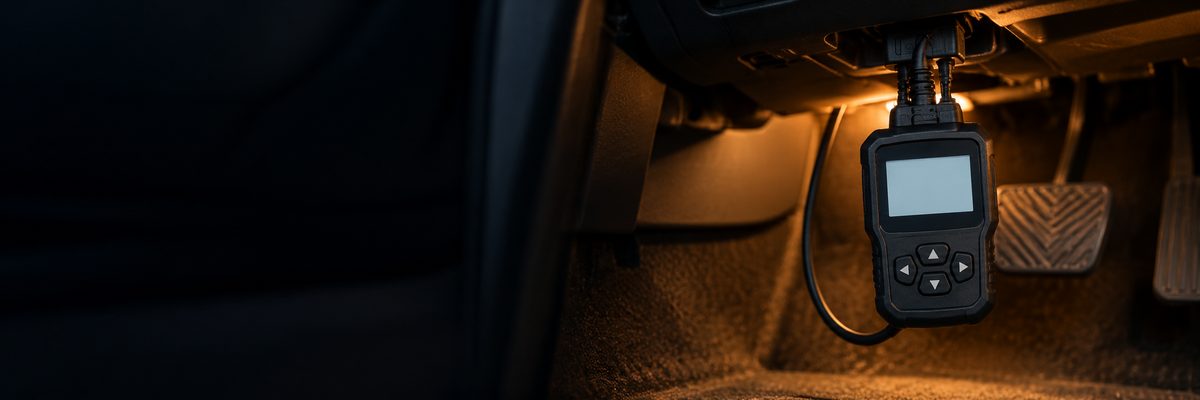

The lamp has a reputation for arriving out of nowhere, and it doesn't. For most faults, the moment it appears is the second time the car has seen it, and the gap between those two moments is usually a day or two of ordinary driving.
Whatever the car found, the lamp doesn't say which part, and that takes the code, which costs nothing to read at parts chains. If you aren't certain the lamp on your dash is this one, the symbol board has all 51 side by side.
What does a check engine light mean?
A steady lamp is a stored fault that can wait for an appointment soon, and a flashing one means a misfire bad enough to damage the converter, so slow down and park safely if it keeps flashing. A flashing lamp is the one you don't leave for later.
A steady lamp has one job: to report that an emissions-related self-test failed. It isn't telling you the engine is damaged, the car is unsafe, or that anything needs replacing today.
A monitor ran, a reading fell outside its limits, and the computer decided you should know. What it does before telling you is the useful part.
Regulation sets how a check engine light comes on and goes out, drive by drive:
- Drive one: nothing shown. A monitor fails its test. The car stores what is called a pending code and lights nothing, because one bad reading isn't evidence and a lamp that lit at every twitch would be ignored within a month.
- Drive two: the lamp lights. The same fault turns up again, and a confirmed code lands within ten seconds, which is why, for most faults, the lamp is late to a fault rather than early.
- Three clean drives: the lamp goes out. For most faults, nothing having been repaired. The car has stopped detecting it, which isn't the same event.
- After at least forty warm-up cycles without it: the code can be erased. Until then a scan tool reads it, which is weeks of ordinary driving after the lamp itself went dark.
So for most faults, a lamp that came on today doesn't mean the fault started today. A misfire bad enough to damage the converter is the exception, and it flashes the lamp right away.

One amber lamp
Is it okay to drive with the check engine light on?
With a steady lamp and no symptom, yes, until an appointment soon. Hyundai's own guide says to have the car inspected soon to avoid possible damage.
With a flashing lamp, slow down and avoid heavy acceleration, and park safely if it keeps flashing, as GM's manual says. Ford's says to avoid heavy acceleration and have it checked as soon as possible. Our guide to the flashing check engine light covers why.
Overheating, a loss of power, a smell or a new noise means you stop when it's safe and get it checked now, not at an appointment, whatever the lamp is doing. A lamp that comes and goes is covered in check engine light on and off.
What to do when the check engine light comes on
Go in this order, and the first three steps cost nothing:
- Check whether it's steady or flashing. A steady lamp is a stored fault and can wait for an appointment soon. A flashing one means damage can be happening now, and our guide to the flashing check engine light explains what it is counting down to.
- Look for a symptom, and stop if you find one. Overheating, a loss of power, a smell or a new noise means you stop when it's safe and get it checked now, not at an appointment, whatever the code turns out to say. With none of those, a steady lamp can wait. Our guide to dashboard warning lights covers which other lamps mean stop.
- Get the code read before doing anything else. It costs nothing at parts chains such as AutoZone and O'Reilly, and it's the only step that tells you which system failed and what it measured. If it reads P0455, a large EVAP leak, tighten the gas cap to the clicks first.
- Match the code to the repair, and only then to a price. The five characters name a measurement and a location, not the part that failed, which is why two cars with the same code can end at a cheap valve on one and a catalytic converter on the other. What each one means is in our guide to check engine light codes.
If the steps end at a shop, take the code with you, written down or on the printed report a parts chain hands over. It's where the technician starts.
Why is my check engine light on?
Because many different faults can light it, nobody can name yours without the code. A lit lamp can end at anything from a purge valve or an oxygen sensor to ignition coils, spark plugs or a catalytic converter, so any guess made without reading the code is a long shot.
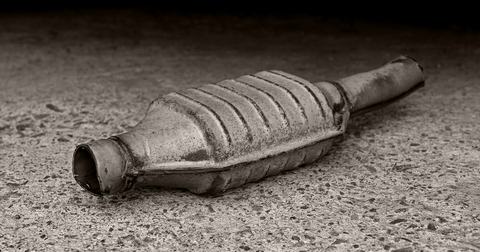
One ignition coil on a 2025 Chevrolet Silverado 1500 5.3L runs $88–$242 at an independent shop, parts and labor. A federal-grade catalytic converter runs $402–$1,846, parts and labor, on the cars our converter cost page prices.
The converter also carries the federal emissions warranty, 8 years or 80,000 miles. On a car inside it, ask the dealer before you pay for one.
The common codes and what each one costs are in our guide to check engine light codes. Which one is yours takes the code itself.
Why is the check engine light on when the car runs fine?
Most of what this lamp watches is emissions, not drivability, so a car with the light on can feel completely normal. A purge valve or an oxygen sensor changes what leaves the tailpipe long before it changes anything you can feel through the seat.
That's why it drives fine isn't evidence that nothing is wrong. A steady lamp on a car that runs normally can wait for an appointment soon, not indefinitely.
Can a check engine light turn itself off?
It can, and the number is three: for most faults, if the monitor runs on three sequential driving cycles and doesn't find the problem again, the car turns the lamp off. The regulation handles misfire, fuel system and evaporative faults separately.
This is where people get caught: the lamp going out and the fault being fixed are different events. The car has stopped detecting it, which can mean the loose gas cap you tightened has solved it, or can equally mean an intermittent fault happened not to show up on three particular trips.
And the code doesn't leave when the lamp does: it stays in memory for roughly forty warm-up cycles, which is weeks of ordinary use, and a scan tool reads it the whole time. So a light that came on, went off, and left you wondering is worth having the code read anyway, because the evidence is still sitting there.
How do you reset a check engine light?
You can, but don't before a repair or a test: resetting and clearing are the same act. A scan tool or a pulled battery turns the lamp off, but on newer cars a permanent code stays, because the rule lets only the car erase it once the test that set it has run and passed.
But it also wipes every readiness monitor, the self-tests that prove each emissions system works, back to not ready, which is worse than where you started. Delaware's inspection program says such a car can fail until days of mixed highway and city driving rerun them.
So a reset the night before a test is the worst timing, and a reset before a repair throws away the code the shop needs. The lamp goes out on its own once the fault is truly gone, as the section above says. If you clear it and it returns, nothing was fixed.
What does service engine soon mean?
The same thing as check engine, and so does the picture of an engine block with no words on it at all. The lamp has one official name, the malfunction indicator lamp, and the rule lets each carmaker choose between the words Check Engine or Service Engine Soon and the engine symbol.
Delaware's own inspection program puts it plainly: depending on the make, it will read something similar to Service Engine Soon or Check Engine. Three labels, one lamp, one meaning, and none of the three is more serious than the others.
The wording catches people because it sounds like a maintenance prompt, and it's not one: on most cars an oil change due shows on a different lamp with its own message. This one is reporting an emissions-related fault.
What does a check engine light look like?
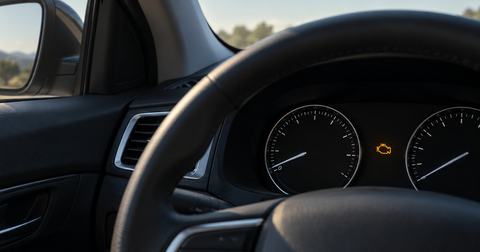
On many cars it is the outline of an engine block seen from the side, a shape that looks more like a lump with a bite out of it than an engine. The symbol is standardized, so the same outline means the same thing whatever badge is on the hood.
Older and some American cars print the words instead. That's why two people can describe the same warning and sound like they're talking about different cars.
It's amber, as the rule requires. A red lamp in that position is a different warning, and our guide to dashboard warning lights covers which colors mean stop.
How much does a check engine light repair cost?
The repair costs what the part behind the code costs, so it runs from about the price of one ignition coil to a catalytic converter, as the prices above show. Our check engine light codes page lists the common codes, each with its own price.
A free code reading isn't a diagnosis, because the code names a measurement and a location, not the part that failed. That's why a P0420 so often gets a converter fitted when the converter was the victim rather than the culprit. A shop's diagnostic charge buys the testing that closes that gap.
Two things should come with any check engine light diagnosis you pay for, one before and one after:
- The amount, before it's incurred. Diagnosis is a separate line from the repair, and a shop that won't name it in advance is asking you to sign a blank one.
- The findings, afterwards. You paid for testing, so the codes read, what was measured and what it showed are yours, whether or not you have the repair done there.
Our guide to reading a repair estimate sets out what else belongs on the paperwork: the test result, the hours, the rate and whether the diagnosis fee comes off if you approve the repair. Before you pay, run the VIN through our free VIN decoder and NHTSA's VIN search, since an open recall may cover it.
Will a check engine light fail an emissions test?
Usually, yes, and in Delaware a lit check engine light fails the test on its own, whatever the codes say, and no explanation is heard. Most OBD programs work this way, so check your state's.
The less obvious fail is the car with nothing lit at all. Clearing the codes shortly beforehand turns the lamp off and sets every readiness monitor back to not ready, so the test has nothing to read and fails you for that instead, which is what the section above is about.
The test reads the car's own self-tests, not your dashboard. So book it after the repair and after the driving, never after the reset.
Outside the US
In the UK, a check engine light that shows a fault, or doesn't light at all, fails the MOT as a Major defect under sections 8.2.1.2 and 8.2.2.2 of the GOV.UK MOT inspection manual. The check covers gas cars first used from July 1, 2003, and diesels first used from July 1, 2008.
What if reading the code doesn't settle it?
Take the next step for what the reader showed. Four things can happen after the check engine light code is read, and none of them leaves you stuck.
Each one has its own heading below, and the last heading is a note on which shop fits which code:
The code isn't in our code guide
OBD-II has thousands and our code guide links 26 of the common ones to a page of their own. An unfamiliar code still tells you which part of the car to talk about.
The reader shows nothing while the lamp is lit
That points at the tool first, not the car. A basic reader shows a manufacturer's P1 code too, but often without saying what it means, so a lit lamp with nothing on the reader points at the reader or its connection. Try a better scan tool before assuming there is nothing there.
Several codes at once
Work the one that can cause the others first. A lean code or a misfire can set a catalyst code, so a converter fitted first pays for the symptom and leaves the cause running. Each code's freeze frame shows what the engine was doing then, which separates cause from consequence.
The code names a system but not a part
That's the ordinary case rather than a failure, and it's exactly what a diagnostic charge buys. Expect to be told the amount before it is incurred and to be given the findings afterwards.
Which shop depends on the code and not the price
A generic P0 code means the same thing on every make, so any competent shop can work it. A manufacturer-specific P1 shows on any reader, but working it takes a tool and know-how for your make, which usually means a dealer or an independent who works on that badge.
If a service bulletin, a maker's fix for its dealers, covers your fault, ask a dealer first, as it's free there if the car is under warranty or a coverage extension. An independent can follow the same bulletin, and our P0430 guide has a case where that meant ten years of warranty.
Nobody can name the part without reading your code. Past that line the car has to be in front of somebody who can test it, and what you carry into that conversation is the difference between accepting a quote and being able to question it.
From the carmakers
What does your own manual tell you to do?
Read its warning-light section before you book, because it differs by who built the car. The lamp means the same thing on every make, but the instructions about it aren't standardized.
Warning lights guide Dashboard symbols
Have your vehicle inspected soon by your preferred Hyundai dealer to avoid possible damage.
Owner's manual 2024 F-150
Avoid heavy acceleration and deceleration, and have your vehicle checked as soon as possible.
Owner's manual 2024 Equinox
If the light continues to flash, find a safe place to park.
Conclusion
What to do next about a check engine light
A steady lamp reports a failed self-test, and a flashing one tells you to slow down and park safely if it keeps flashing. Neither names a part, and nobody who hasn't read your code can name one either, ourselves included.
So the code is the first thing to get rather than the last. Oil & Miles checks each step here against the regulation and the makers' own manuals.
Common questions
Asked most often
What is OBD, and what does DTC mean?
OBD is on-board diagnostics, the self-testing system every car sold in the United States since 1996 has to carry. DTC is a diagnostic trouble code, the five characters a scan tool reads out when a test fails.
Do you need your own scanner to read the code?
No, parts chains such as AutoZone and O'Reilly read it free, and that reading is the useful first move whether or not you own a tool. A basic reader gives the same five characters, and neither tells you which part failed.
Is a free code reading the same as a diagnosis?
No, because the free reading hands you the code. A diagnosis is the testing that decides which part failed, and it stops a converter being fitted when a cheap sensor upstream was the cause.
What people ask next
Sources
- AutoZone free parts testing, for the free check engine light reading. AutoZone, read November 2, 2026
- O'Reilly free check engine light testing, for the free reading with a printed report. O'Reilly Auto Parts, read November 2, 2026
- 13 CCR 1968.2, read at source for the whole lamp sequence, subsections (d)(2.2.2), (d)(2.3) and (d)(2.4), and for permanent codes (d)(2.5) and (g)(4.4.6)(C). The EPA accepts it in place of its own, so it describes cars sold anywhere in the United States. Cornell Legal Information Institute, read August 25, 2026
- Delaware Division of Motor Vehicles, its OBD-II inspection guidance, for the lamp reading Service Engine Soon or Check Engine depending on the make, and for what clearing codes does to the readiness monitors. Read September 5, 2026
- Three makers' own instructions on the lamp. Hyundai's Warning Lights guide and the 2024 Ford F-150 Owner's Manual, both read at source. The 2024 Chevrolet Equinox Owner's Manual, page 98, from a published copy because GM doesn't serve it. Read September 16, 2026
- MOT inspection manual, sections 8.2.1.2 and 8.2.2.2 (engine malfunction indicator lamp), for the UK MOT result on a lit or dead check engine light. GOV.UK, read November 4, 2026
AI illustration by Oil & Miles
How this was compiled
The lamp sequence came from the regulation rather than from a repair site, because the numbers in it are exact and the versions circulating secondhand aren't: three driving cycles and forty warm-up cycles are written down, and both change what a reader should do. Where the regulation lists exceptions, they're named here rather than smoothed over.
What we didn't do
We didn't work through the separate conditions the regulation sets for misfire, fuel system and evaporative faults. They exist, they differ from the three-cycle rule, and this page says so rather than pretending the simple version is universal. We didn't read the federal on-board diagnostic rule in full either, and what is above is the California regulation the EPA accepts in its place.
We give no ranking of the most common trouble codes, because no primary source ranks the codes themselves. We didn't survey emissions testing rules state by state. We read Delaware's, and it's the one this page cites, because whether a test exists at all varies by state and sometimes by county.
Prices are US figures and vary by region, engine and shop rate. This article is general information, not advice about your specific vehicle. See the disclaimer.