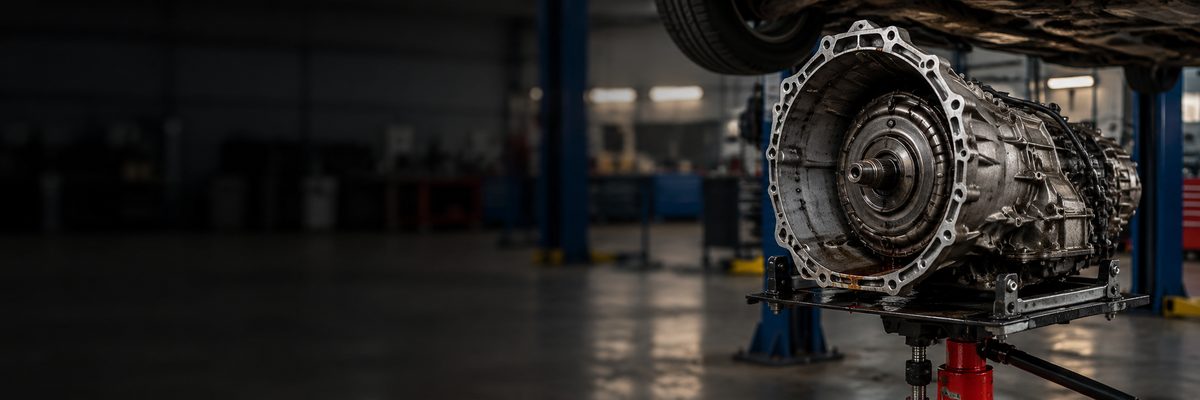

Something has changed in how the car pulls away, or how it holds a gear, and the word transmission has arrived in your head. Bad transmission symptoms are an expensive thing to guess at, and the transmission isn't always the part behind them.
The same few sensations come from causes that cost a quart of fluid and causes that cost a whole transmission, so the seven causes here run cheapest first. If what you feel is the engine racing while the car stays put, that's slipping, which has its own page.
What are the signs of a bad transmission?
The signs of a bad transmission are slipping, a pause into Drive, hard or late shifts, a stuck gear, a shudder, a clunk or other noise, a burning smell, a warning light, a leak and grit in the fluid. Most point at more than one cause, so start with the cheapest check.
| What you notice | Possible cause | What to check first | Why |
|---|---|---|---|
| Slipping: the revs rise but the car doesn't | Low fluid, or the torque converter | The fluid level, free on a car that still has a dipstick | The engine is turning but the drive isn't reaching the wheels, and a low level produces that as convincingly as internal damage. |
| A pause before it moves after you select Drive | Low fluid | The fluid level, the same free check | The same low level, arriving as a pause before the car takes up drive. |
| Shifts late, or shifts hard | A shift solenoid or the valve body | The fault code, because this fault usually sets one | A failing solenoid changes when or how firmly the gears engage. |
| Refuses one gear, or holds a single ratio | The same solenoid or valve body, now in limp mode | The fault code, and ask which gear it names | Limp mode holds one ratio deliberately, to protect the transmission from more damage. |
| A shudder at a steady speed | The torque converter | The fluid first, because it's free | The converter sits between engine and transmission and can lock and unlock repeatedly at a steady cruise. |
| A clunk as the car takes up drive | A broken mount, with nothing inside the transmission changed | A look at the mounts | A broken mount lets the whole unit move under load, which feels like a bad shift. |
| A sharp burning smell | Overheated fluid, or a leak onto something hot | The fluid level and its condition together | You're usually smelling overheated fluid, or fluid leaking onto something hot. |
| Whining, grinding, humming or another noise | No single cause, and a clunk can be a mount | The fluid level, then the mounts | Owners name noise in 20.8% of transmission complaints, and a whine alone doesn't name the part. |
| A warning light | Low fluid, a control fault or damage inside | The fault code, read free at most parts chains | Owners name a warning light in 28.9% of complaints, and P0700 only says the transmission computer asked for it. |
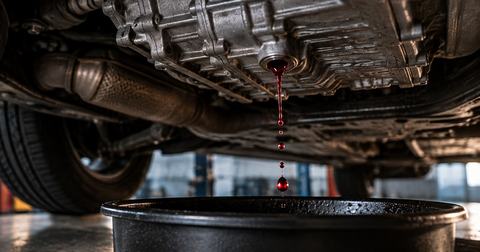
| Red or brown fluid under the car | A leak, and the low level that follows | The fluid level, then where it's coming from | A transmission doesn't consume fluid, so a low level usually means a leak to find. |
| Grit in the fluid, or more than fine metal on the pan magnet | Wear inside the unit itself | Have the shop feel the fluid once it has cooled, because a little fine material is normal and grit isn't | Grit you can feel points to wear inside the unit, and finding it needs no scan tool. |
Each symptom has a possible cause and the first check to make. A symptom can have more than one cause.
Most of those rows can still be fluid, a mount or a solenoid, which is why the causes below run by cost. Harsh, jerky, shuddering or clunking shifts are what owners report most, more than twice as often as slipping.
The signs your transmission is going out come in three different kinds, and slipping, a pause into gear, a shudder and a warning light can come from all three:
- Low on fluid. A maintenance problem. The level is checked first because it's the cheapest answer and it produces most of the same sensations.
- A control fault. A repair. A solenoid, the valve body or the transmission computer's software decides the shifts wrong, and it usually leaves a fault code.
- Damage inside. The one that costs thousands. Worn clutches or bearings leave debris in the fluid, and that debris is a strong tell.

What a transmission pan holds
Can you drive with a bad transmission?
Only a short distance to get it looked at, and not on the highway. If the car drops power at speed or refuses to move, stop driving it. Have it towed, because a car that stops accelerating in traffic is a safety problem before it is a repair bill.
Limp mode is the transmission protecting itself, so don't drive on. Heat from slipping turns a repair into a rebuild. If a transmission temperature light comes on, stop and idle in Park or Neutral until it goes out, as Ram's manual says, or the fluid can boil over and start a fire.
What could be mistaken for a bad transmission?
A broken mount, a driveshaft or the engine itself can be mistaken for a bad transmission, and none of them is inside it. Each one arrives through the same pedal and feels identical from the driver's seat, which is how mount and engine issues get read as a failing transmission:
- A broken mount. A clunk as the car takes up drive and a shudder under load. The torn rubber lets the whole unit move in its cradle while nothing inside it has changed. These are the bad transmission mount symptoms.
- A driveshaft. Vibration that comes up through the car under load, the same sensation a shudder from the transmission makes.
- The engine itself. Hesitation and jerking when you accelerate, which feels like a late or hard shift but starts before the power reaches the transmission.
What causes bad transmission symptoms?
Seven causes sit behind bad transmission symptoms, and they're numbered here from cheapest to reach to most expensive, not from most to least likely. The first three aren't failed parts inside the transmission: low fluid, old fluid and a torn mount are the ones to rule out before anyone quotes for the unit itself.

Use this image
Free to republish under CC BY 4.0: credit Oil & Miles and link to this page. The snippet does both.
<a href="https://oilandmiles.com/articles/bad-transmission-symptoms"><img src="https://oilandmiles.com/assets/img/diagrams/bad-transmission-symptoms-6r80-bench.svg" alt="Bad transmission symptoms: an automatic transmission with the seven causes numbered cheapest first, in blue from light to dark: 1. Low fluid level, 2. Fluid that was never changed, 3. A broken transmission mount, 4. A shift solenoid, or the software that drives it, 5. The valve body, 6. The torque converter, 7. Worn parts inside: the rebuild." width="1200" height="675"></a> <p>Diagram: <a href="https://oilandmiles.com/articles/bad-transmission-symptoms">Oil & Miles</a>, CC BY 4.0</p>1. Low fluid level
A low level produces slipping and a delay before the car takes up Drive, and both read exactly like internal damage. It's the first check because it's free on a car that still has a transmission dipstick, as long as it's read hot and level the way your manual says.
A transmission is a sealed system and doesn't consume fluid the way an engine can burn oil, so a low level is a leak until proven otherwise. Many newer cars have no dipstick, and checking without one is a job on a lift rather than in a driveway.
2. Fluid that was never changed
Fluid past the interval in your owner's manual is the second cheap cause, and the fix is a drain and refill with a new filter and pan gasket where the transmission has them. Ask the shop to quote the filter and the pan gasket with the job.
What the fluid looks like is a weaker signal than most people believe, and acting on its color is how unnecessary work gets sold, so a dark sample on its own isn't a reason to approve anything. The level, read the way your manual says, is the check that points to a cause.
3. A broken transmission mount
A mount is the rubber block that holds the transmission to the car's frame, and when the rubber tears the whole unit moves under load. You feel it as a clunk on take-up and a shudder under load, and from the driver's seat that passes for the gears.
Nothing inside the transmission has changed, which is why it's on this list at all. A look at the mounts costs nothing to ask for, and a mount is one of the cheaper parts on this list.
4. A shift solenoid, or the software that drives it
A shift solenoid is the valve the transmission computer works electrically to decide which clutches engage and when. When one fails the car shifts late, shifts hard, refuses a gear or drops into a limp mode that holds one gear, and it usually sets a fault code, which makes it a diagnosis rather than a guess.
Sometimes the part is fine and the fix is software: carmakers publish bulletins that reprogram the transmission computer for harsh or slipping upshifts, so ask about one before a part goes in. A P0700 code is the transmission computer asking for the light, not a fault of its own.
5. The valve body
The valve body is the block of passages and valves that routes fluid to each clutch, with the shift solenoids working through it. A worn or sticking one gives the same late, hard or missing shifts as a solenoid, so only the shop's diagnosis tells the two apart.
Its labor varies more than any other cause's, because on some transmissions valve body work is booked as a short job and on others it comes with the unit opened up. The bulletins in the record further down give the hours for each.
6. The torque converter
The torque converter is the fluid coupling between engine and automatic transmission, doing the job a clutch does on a manual. A failing one shudders, slips, or locks and unlocks repeatedly at a steady cruise.
The part isn't the expensive half. The labor is, because the transmission has to come out to reach it, and a maker's bulletin books the converter as one extra tenth of an hour on top of removing the transmission.
7. Worn parts inside: the rebuild
Mechanical damage inside the unit is what the word rebuild refers to: worn clutch packs, failed bearings, metal in the fluid. A strong tell that separates it from everything above is debris, grit in the cooled fluid between finger and thumb or more than fine metal on the pan magnet.
It's usually where the cheap explanations stop, and the work moves inside the unit. That's where the makers' booked hours in the record further down start to climb, before any part is bought.
What each cause costs from the cheapest up
The four cheap causes run from a quart of fluid to a solenoid. The last three are where the bill grows, because makers book hours rather than minutes to reach them.
A CVT that comes out and goes back in takes several booked hours, and a valve body overhaul with the transmission out runs to about two working days. No maker publishes hours for a fluid service, a mount or a solenoid on these cars, so ask the shop for its hours.
Sometimes the fix is software, so run the VIN and ask whether a carmaker bulletin reprograms the engine or transmission computer before a part goes in. An update, labor only, runs $20–$35 on a 2025 Ram 1500 3.6L, $30–$52 on a 2021 F-150 2.7L and $50–$87 on a 2024 Silverado 1500 2.7L.
Ask for the test result, the hours and the rate on the written quote, and whether the diagnosis fee comes off if you approve the repair. Our transmission slipping guide prices a worn clutch on the same Ram.
What to do about the signs
Start with the fluid level, then work down the causes in order rather than by what sounds most likely. Each one costs more than the one before it.
To act on bad transmission symptoms, start by checking the fluid level, in this order:
- Check the fluid level, or have it checked. Your manual says when the reading counts, at a set temperature with the car level. A check on a cold engine can show low on a transmission that is full.
- If the pan comes off, ask what was on its magnet. The pan comes off for a fluid and filter service, so ask then, and ask whether the fluid had grit in it. A little fine material is normal, GM says, but fluid that feels gritty, or more than that on the magnet, points to wear inside the unit. Clean fluid with no metal keeps the cheaper causes in play.
- Run your VIN before you pay. Our free VIN checker shows recalls and bulletins for your model year, and some carmakers publish software updates for harsh or slipping shifts.
- Get the diagnosis in writing before authorizing anything. Ask which of the seven causes was ruled out and how, and for the fault code if one was read. A quote that jumps to a rebuild without naming what else was checked is a price, not a diagnosis.
- Ask what a flush is meant to fix before agreeing to one. On a neglected high-mileage transmission that is a decision to understand first, and whether a flush is necessary sets out when it helps and when it doesn't.
Repair guides also list prevention: keep the transmission from overheating and change the fluid at your manual's interval. Ram's 2023 2500 and 3500 schedule lists that change for the diesel's 6-speed transmissions, with an extra one on the 68RFE for frequent trailer towing. The gas 8-speed has no scheduled change.
What if the fluid is clean and it still slips?
Then old fluid and a low level are out, if the level was read properly, and the next answer costs money to find. Somebody now has to measure what the transmission does, not guess at it.
If the steps above don't settle it, one of four situations applies, and each one leads to a different question for the shop:
- Clean fluid, no metal, and it still slips. A solenoid, the valve body or the software can still be behind it. Ask whether they can record the gear the computer asked for next to the gear the transmission actually used. If they can, you have a measurement rather than an opinion, and a transmission that is told to be in fourth and isn't is a different conversation from one nobody has looked at.
- The quote says rebuild and names nothing that was ruled out. Ask which of the seven causes was checked and how. If the answer is that none of them was, a second opinion is cheaper than a rebuild.
- It's a CVT and the only quote is a replacement. Before accepting that, ask two things: whether they rebuild CVTs in-house or send them out, and whether a remanufactured unit is available and what warranty comes with it. That's where the price moves.
- It only does it sometimes, and never on the test drive. Ask whether they can leave it recording between visits, and note the exact conditions yourself either way: cold or warm, which gear, uphill or level, and how many miles in. An intermittent fault nobody can reproduce isn't diagnosed, and paying for parts against a description is how a rebuild starts.
This is where the car has to be in front of somebody who can measure it. The four questions above are what you take with you.
Is it worth fixing?
Usually yes for the first four causes, whose parts are cheap next to a rebuild. Only a rebuild or replacement quote makes it arithmetic: that quote against the car's value today. A common rule says to repair under half the car's value, though no source for it is published.
Four things decide whether a transmission repair is worth it, and they move the decision further than the rule does:
- The car is otherwise sound. Leans toward repairing it, because the transmission is then the one big bill.
- High mileage, with other jobs already due. Leans against, because the transmission quote is only the first of several.
- You plan to keep it three more years. Leans toward repairing it, because the quote is spread over the months you keep driving it.
- A rebuild is quoted at the same price as a replacement. Stop and ask why before agreeing to either, and ask what warranty each one carries.
The factor most people leave out is time. Divide the quote by the months you'll keep the car and set it beside a monthly payment on whatever would replace it.

What the expensive answer looks like
How the signs differ by transmission
The signs differ because each type fails in its own way, and nearly every symptom list describes only a conventional automatic. If you drive something else, that list doesn't fit.
Here's how the signs of a bad transmission differ between an automatic, a CVT, a dual-clutch and a manual, and the one sign they share:
- A conventional automatic. Shifts harshly or late, or refuses a gear. This is the behavior most symptom lists describe.
- A CVT. Shudders and slips, with the revs climbing while the speed doesn't. It has no fixed gears to shift between, so a list written for an automatic misses it entirely.
- A dual-clutch automatic. Shudders as it pulls away from a stop, as one Focus owner reported on a forum in 2021. The Focus, which used one, also tops the federal complaint record.
- A manual. Its wearing part is the clutch, a wearing item with a service life, which is a different repair at a different price from the transmission itself. Repair guides list clutch slip as its main sign, with the revs rising and the speed not following.
- All of them. Produce the same acrid burning smell once the fluid overheats, which is the one sign that does carry across.
CVTs deserve a note of their own, because their record varies more between manufacturers than between technologies. The federal numbers behind that are set out in what the CVT complaint data shows.

Use this image
Free to republish under CC BY 4.0: credit Oil & Miles and link to this page. The snippet does both.
<a href="https://oilandmiles.com/articles/bad-transmission-symptoms"><img src="https://oilandmiles.com/assets/img/diagrams/bad-transmission-symptoms-checklist.jpg" alt="Bad transmission symptoms checklist: check the fluid hot and level or on a lift, treat a low level as a leak, drain and refill old fluid, ask for a look at the mounts. ask for the fault code, a software update, what was on the pan magnet and which causes were ruled out. stop driving if it drops power, and don't accept a rebuild quote that names nothing ruled out." width="1200" height="1520"></a> <p>Infographic: <a href="https://oilandmiles.com/articles/bad-transmission-symptoms">Oil & Miles</a>, CC BY 4.0</p>From the carmakers
What do carmakers and owners say about bad transmissions?
Carmakers tie a valid fluid reading to a set temperature and a level car, and owners complain most about harsh or clunking shifts. Each condition is quoted in the carmaker's own words, next to the complaint record and the booked hours.
Owner's manual Pages 361 and 362
It is best to check the fluid level when the transmission is at normal operating temperature (158–176°F / 70–80°C).
Service information 50130 EN
Fill the prescribed ZF LifeGuardFluid until it runs out of the filler hole.
- What owners name. Of 30,506 complaints for model years 2010–2025 that name the transmission and a symptom, harsh or clunking shifts hold 42.8%, a warning light 28.9%, noise 20.8%, a delay into gear 17.7% and slipping 15.9%.
- Less often. Won't move holds 6.7%, overheating 4.5% and limp mode 3.7%, with the shares adding past 100 because one complaint often names several.
- By make and model. Ford carries 11,045 of the 30,506, the Focus alone 3,476, ahead of the F-150 at 2,627 and the Jeep Cherokee at 1,429.
- Subaru 16-90-13, 2010–2012 Legacy and Outback CVT. Remove and refit the transmission 3.4 hours, 3.8 in the revision. Valve body 1.2 hours, torque converter 0.1 hours on top of removal and line pressure test 0.6 hours.
- Ford TSB 22-2411, 2022 Explorer, Aviator and Bronco 10R60 built on or before August 9, 2022. For a harsh 7–6 downshift. Replace the A-clutch and front support, 7.5–12.3 hours across its eleven operations.
- Ford TSB 26-2414, 2023–2025 Bronco Sport and Maverick 8F35. For no reverse with P0767 or P0765:7E. Replace a clutch part and overhaul the main control valve body, 14.4 hours on a 2023–2024 front-drive Maverick and 16.5 on a 2023–2025 all-wheel-drive one.
- FCA 21-054-26 and 21-055-26, 2023 and 2024 Ram 1500 TRX. A transmission computer software update for a harsh or slipping feeling during upshifts.
Conclusion
What to do next about bad transmission symptoms
The symptom doesn't name the part, and the order you rule causes out in decides the bill. Check the fluid first, ask for a look at the mounts and read the fault code, because grit you can feel is what usually ends the cheap list.
Make each step rule something out before the next one is paid for. Oil & Miles checks each cause here against the makers' bulletins and booked hours, across symptoms and repair costs.
Common questions
Asked most often
What are the first bad transmission symptoms?
The early signs of transmission problems are slipping, a delay before the car moves after selecting Drive, harsh or late shifts, and a burning smell. The first two are also produced by a low fluid level, which is why the level is checked first.
How much does it cost to fix a transmission?
From a quart of fluid to a remanufactured transmission plus its labor, which is why the list is ordered rather than averaged. Removing a transmission books 3.4–3.8 hours on one CVT before any part is bought.
Is it the transmission or the engine?
A rough split: engine faults change how the car sounds and pulls at a steady throttle, and transmission faults change what happens between speeds. Mounts fool both, which is why they're on the list.
What happens when your transmission goes out?
The warning signs above come first, and a transmission computer that reads something it doesn't trust can lock the car into one gear, called limp mode, to protect itself. At the end the car may refuse to move at all, what people call a blown transmission, and if it drops power at speed or won't move, stop driving it.
What does a bad transmission sound like?
Owners describe whining, grinding, humming or a clunk, and noise is named in about one in five transmission complaints in the federal record. A clunk as the car takes up drive can also be a broken mount, which costs far less.
What people ask next
Sources
- NHTSA's consumer complaint database, as of August 25, 2026, for the model year 2010–2025 complaints whose text names the transmission and a symptom. NHTSA, read October 2, 2026, US Eastern
- Subaru service bulletin 16-90-13 and its revision 16-90-13R, CVT, for the booked hours to remove the transmission, replace the valve body and the torque converter, and test line pressure. Subaru, via NHTSA, read October 2, 2026
- Ford TSB 22-2411 and TSB 26-2414, for the booked hours to replace a clutch pack on the 10R60 and overhaul the valve body on the 8F35. Ford Motor Company, via NHTSA, read September 7, 2026 and November 1, 2026
- FCA bulletins 21-054-26 and 21-055-26, for the transmission software update on harsh or slipping upshifts, and 21-058-26 for the Service Transmission message. FCA US, via NHTSA, read October 2, 2026
- Ram bulletin 21-011-25 Rev. B, Ford bulletin 26-2304 and GM bulletin 25-NA-091, for the software update on each car the update price names, and its labor time. Filed with NHTSA, read November 5, 2026
- 2022 Ram 2500 and 3500 Owner's Manual and ZF service information 50130 EN, for the fluid check conditions quoted in full above. Stellantis and ZF, read at source
- 2023 Ram 2500 and 3500 Owner's Manual, for the transmission temperature light and the fluid schedule. Stellantis, read November 2, 2026
- GM TechLink, Automatic Transmission Fluid Appearance and Color, September 26, 2025, for what its technicians are told about fine material and fluid that feels gritty. GM, read November 1, 2026
- PartsTech's September 2025 survey of about 700 US independent shops, as reported by Ratchet+Wrench (August 19, 2026), for the $100–$139 an hour that nearly half of them charge. Ratchet+Wrench, read October 17, 2026
- Focus Fanatics Forum, DPS6 thread, posts from 2021, for one owner's account of a shudder pulling away. Read September 16, 2026
AI illustration by Oil & Miles
How this was compiled
Parts are every brand a large online parts catalog lists for each car. Labor is a carmaker's booked time times $100–$139 an hour, the independent-shop rate used across this site, and it's shown only where a maker publishes the hours. We found none for a fluid service, a mount or a solenoid.
The complaint shares cover model years 2010–2025 and complaints that name the transmission and at least one symptom group, and one complaint can fall in several groups. The causes are listed cheapest to reach first, which is ordinary diagnostic order rather than a manufacturer procedure, and the half-the-value rule is described as a habit the industry repeats, because we couldn't trace it to a source.
What we didn't do
We didn't diagnose or repair any of these cars, and no figure here is a quote for yours. A range isn't an estimate, and the booked hours come from carmaker bulletins.
We give no mileage at which any of these symptoms appears, because the same symptom arrives at 60,000 miles on one car and never on another.
Prices are ranges compiled in September and October 2026 for the US market and vary by region, vehicle and shop rate. This article is general information, not advice about your specific vehicle. See the disclaimer.