

Short answer
Read it as three columns, not one total
A repair estimate splits into parts, labor and everything else, and each column has its own question to ask before you sign. Labor is a rate times a number of hours, and in a shop that bills flat rate those hours come from a published labor guide rather than a guess.
It's tempting to read a repair estimate the way you read a restaurant bill: glance at the total, decide it feels survivable, and hand over a card. Knowing how to read a repair estimate starts with knowing it isn't one number, because every line on it was built from a smaller figure you're allowed to ask about.
A garage's estimate for a mechanical repair is a different document from the one an insurer writes after a collision, with its deductible and paint hours. You don't need to know anything about cars to read the garage kind, only which questions each line answers.
Before anything else, get it in writing, because the Federal Trade Commission (FTC) tells drivers to ask for a written estimate before work starts. California requires one for most repairs and Florida for work over $150, as the law section below shows, and a verbal quote is hard to compare or hold anyone to.
How do you read a repair estimate line by line?
Read it as three columns: parts, labor, and everything else, such as fees and shop supplies. With the estimate in your hand you can check it against what the job usually costs, then ask one question per line.
Here's a sample estimate for a timing belt and water pump on a 2016 Honda Pilot, marked up the way you should read a real one. The only dollar figure is the kit's online price, because the hours and the rate belong to the shop in front of you:
| Line | What it should show | What to ask |
|---|---|---|
| Timing belt kit with water pump | A brand and part number. Five kits for this car that list a cost $180 to $243 online, parts only | Which brand, and is it new or rebuilt? |
| Timing belt labor | Hours times the shop's rate, with the hours named | Which labor guide are the hours from? |
| Water pump labor | Only the guide's additional time, if the pump comes out during the belt job | Has the pump labor been combined with the belt? |
| Coolant | The coolant your owner's manual names | Which coolant is going in? |
| Shop supplies | A stated charge, or no separate line at all in California | What does it cover, and how is it worked out? |
A sample like this has no total on purpose, since the labor depends on your shop's rate and its labor guide. On a real estimate, every line should name what it is and how it was worked out, and a line that can't do either is the one to ask about first.
The sample's figures 3 sources
- Kit price, 2016 Honda Pilot 3.5L V6Five timing belt kits whose listing says they include the water pump, GMB 34352329 at $179.79 to Gates TCKWP329A at $242.79, one unit before shipping and tax (RockAuto, October 2, 2026).
- Belt and pump together, Honda 3.5L V6A Gates water pump listing says "Timing belt driven", and a Dayco water pump listing says "Timing Belt Should be Replaced w/ Water Pump" (RockAuto, read on the 2014 Odyssey, which shares the engine, August 28, 2026).
- Shop supplies, CaliforniaThe state's repair regulator bans billing "shop supplies" as a separate invoice line (16 CCR 3356(g), read October 2, 2026).
Are the labor hours looked up or guessed?
In a shop that bills flat rate they're looked up, though the estimate may not say so. The FTC says some shops charge a flat rate from a published estimate of the time a repair needs, and others charge the time the technician actually spent.
The flat-rate figure is what mechanics call book time, the hours a labor guide gives for one job on one model. MOTOR, a labor guide publisher, describes each entry as an hour figure the shop multiplies by its own rate, so "3.2 hours" is a lookup and not an opinion.
So ask which way the shop bills, and if it's flat rate, which guide it uses and what the book time is. A shop reading from a guide can answer in the time it takes to turn the screen toward you.
Book time isn't a promise about the clock, since a quick technician may beat it and a seized bolt may blow past it. Under flat rate you pay the book figure either way, and under actual time you pay the clock, so the question to settle first is which one you agreed to.
How labor is priced 3 sources
- FTC, Auto Repair Basics"Some shops charge a flat rate for labor on auto repairs. This published rate is based on an independent or manufacturer's estimate of the time required to complete repairs." Others charge for the technician's actual time.
- MOTOR, Mechanic Labor Guide usage tipsEach entry "assigns a labor hour figure you can multiply by your shop's hourly labor rate."
- MOTOR, Estimated Work Times (2023)MOTOR builds its own times and says the method "does not use or rely on the warranty times published by OEMs", so a carmaker's warranty hours and an aftermarket guide's hours can differ.
What is the hourly rate doing to the total?
Every labor line is two figures multiplied together, and the rate is the one people compare when they phone around. In a 2025 survey of 752 shops, almost half charged between $120 and $159 an hour.
The trap is comparing rates instead of totals, because a cheap rate with extra hours can cost more than a pricier rate with book time. So compare the rate multiplied by the hours, on the same job, between shops.
Ask for the rate before any work starts, and ask whether diagnosis is billed at that rate or as a flat fee. The FTC's advice is to ask how the shop prices its work before any is done, which beats learning it from the invoice.
The hourly rate 1 source
- PartsTech 2025 survey, 752 shopsAlmost half of the "shops surveyed charge labor rates between $120 to $159 per hour" (as reported by MOTOR, July 1, 2025).
Are any of the jobs overlapping?
Sometimes, and you spot it by looking for two repairs in the same part of the engine, such as a water pump next to a timing belt. On the Pilot's V6 the belt drives the pump, and a pump maker's listing says to replace the two together.
Labor guides allow for work done this way. Mitchell 1, another guide publisher, lists additional labor times for tasks done along with the main job, so the second line can be a smaller add-on instead of a second full job.
So when two lines share a teardown, meaning the same parts come off to reach both, ask: "These two overlap, so has the labor been combined?" Sometimes the answer is a genuine no with a reason, and sometimes the estimate quietly gets shorter.
The same guides also list related operations a shop may add, and MOTOR warns shops that leaving them out means underbilling. An extra line isn't padding by itself, but you're entitled to hear what it is.
Combined jobs in the guides 2 sources
- Mitchell 1, Estimate Guide FAQsDescribes combination time as "additional labor times to be used when performing tasks which are directly related to the original operation and are conveniently done along with it."
- MOTOR, Mechanic Labor Guide usage tipsRelated operations "may be listed separately. Include them to avoid underbilling."
What are shop supplies charges?
A shop supplies line covers the small things a job uses up, like cleaners, rags and waste disposal, which nobody bills one by one. AAA says some shops charge a flat fee for them and others itemize, so both forms are ordinary.
The law treats the line differently from state to state. California bans a separate "shop supplies" line on an invoice, and Florida lets a shop charge it only with a set sentence on the estimate saying it covers supplies, waste disposal and profit.
We found no credible source for a typical percentage, so we don't print one, and the sample above leaves the amount blank. Ask what the line covers and how it was worked out, and if it's a share of the labor, ask whether it has a cap.
Shop supplies rules 3 sources
- California, 16 CCR 3356(g)"Separate billing in an invoice for items generically noted as shop supplies, miscellaneous parts ... and the like, is prohibited." (Bureau of Automotive Repair, Write It Right.)
- Florida, Statute 559.905(1)(h)A shop supplies or waste charge on the estimate must carry the statement: "This charge represents costs and profits to the motor vehicle repair facility for miscellaneous shop supplies or waste disposal."
- AAA, Understand Your Auto Repair Bill"Some repair shops charge a flat fee for shop supplies, while others itemize the fee."
What are you owed for a diagnostic fee?
Charging for diagnosis is normal, and the FTC notes that many repair shops do it. What you can expect is the amount before the work starts: California bars any charge before you authorize the work, and Florida's written estimate has to cover diagnostic work.
The FTC also suggests asking whether the diagnostic fee still applies if you take the repair elsewhere. Ask for the findings too, meaning the fault codes, the readings and what was tested, since that information is what the fee paid for.
We found no credible source for what a diagnostic fee normally costs, so we don't print a figure. The amount the shop quotes you before it starts is the one that counts.
An estimate whose diagnosis is a scan and nothing else deserves one more question. One code can have several causes, and a part replaced on the strength of the code alone may not be the one that failed.
"Code P0420, replace catalytic converter" skips every other reason that code appears, and our P0420 page lists them. The question to ask is "What did you test to confirm it's the part rather than the code?", and our guide to check engine light codes explains what the code itself is saying.
Diagnostic charges 2 sources
- FTC, Auto Repair Basics"Many repair shops charge for diagnostic time." It advises finding out "if there will be a diagnostic charge if you decide to have the work performed elsewhere."
- Florida, Statute 559.905(1)Above $150, the written estimate covers "the estimated cost of repair work, including diagnostic work, before effecting any diagnostic work or repair."
Which parts are on it, and marked up how much?
The estimate should name the parts, not just list them as "parts", because the FTC sorts replacement parts into three kinds that differ in price and in what they promise. The kinds are below, with what each one means on your bill:
- NewMade to the original maker's specifications, by the carmaker or by an independent company. Prices and quality vary, and some makers, like DENSO, supply both carmakers and the aftermarket.
- Remanufactured, rebuilt or reconditionedRestored to a sound working condition. The part may carry a warranty that doesn't cover the labor to fit it.
- SalvageA used part taken from another vehicle without changes. Sometimes it's the only source, but its reliability is seldom guaranteed.
Shops mark parts up, and shop-management software sold to garages publishes markup charts by part category. What isn't normal is refusing to say which brand is going on, because without it you can't compare the quote with anyone else's.
Part kinds and markup 3 sources
- FTC, Auto Repair BasicsNew, remanufactured and salvage parts, and "Your state may require repair shops to tell you if non-original equipment will be used in the repair."
- DENSO Auto PartsSupplies "the world's automakers with reliable OE parts" and develops "aftermarket replacement parts at or above spec."
- A shop-management software makerPublishes a parts markup chart with different markups by category, smaller parts marked up more than engines and transmissions.
Which four questions should you ask?
These four questions tell you if a repair quote is fair, and you ask them out loud at drop-off rather than at pick-up. None of them needs any mechanical knowledge, only the estimate in your hand:
1. What is the book time here, and which guide is it from?
This asks the shop to show where the hours came from. A shop that bills flat rate reads them from a labor guide, so it can name the guide and the figure without stopping to think.
If the shop bills actual time instead, the useful follow-up is an estimate of the hours and a call before it runs over. California and New York both bar charging above the estimate without your consent.
2. Are any of these jobs overlapping?
Two jobs that share a teardown can be priced with a guide's additional time rather than twice in full. Asking tells the shop you've read the lines, not only the total.
A shop that has already combined them will say so straight away. One that hasn't now has a reason to look again, and that may be the cheapest sentence you'll say all week.
3. Which parts, and what is the markup?
New, rebuilt and salvage parts differ in price and in what they promise, so the brand and the kind both belong on the estimate. The FTC notes that your state may require the shop to tell you when a part isn't original equipment.
The point of asking isn't the markup itself but making the line comparable. With a brand and part number you can check the price online, as we did for the Pilot's kit above.
4. Can I have the old parts back?
Say it when you hand over the keys, because California ties the right to the moment the work order is written. In New York the request has to be in writing.
The old part shows you the work was done and why it was needed. The shop's reaction tells you something too, since a good shop agrees without a pause.
When should you just pay it?
When the lines describe work the car needs and the hours and rate hold up to the questions above. A fair estimate isn't the same as a cheap one, and treating every shop as an adversary is a reliable way to end up with no shop at all.
If the hours come from a guide, the parts are named, somebody explained the diagnosis and the old parts came back in a box, you've found a shop worth going back to. That's worth more over the life of a car than winning an argument over a line on the bill.
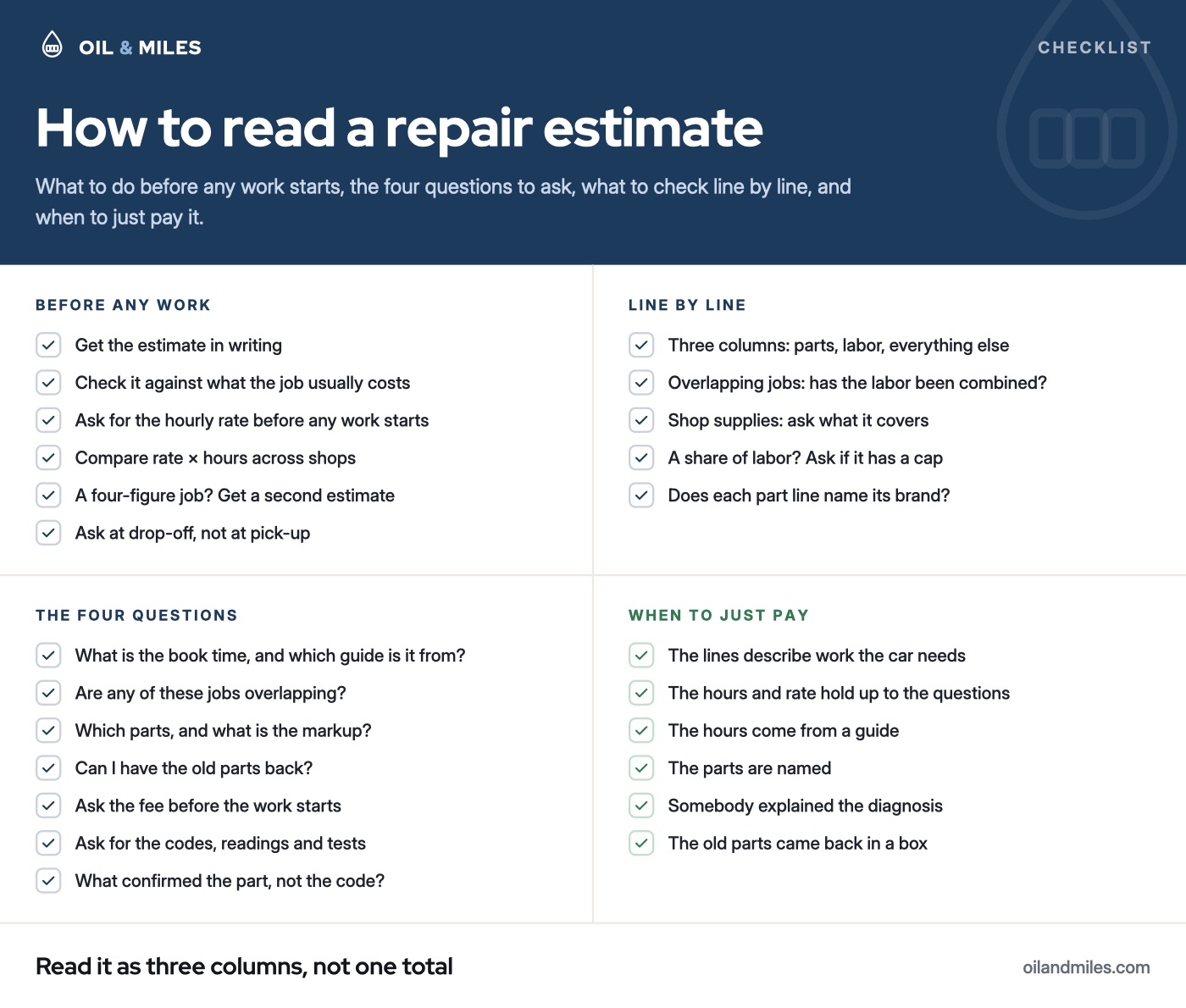
Use this image
Free to republish under CC BY 4.0: credit Oil & Miles and link to this page. The snippet does both.
<a href="https://oilandmiles.com/articles/how-to-read-a-repair-estimate"><img src="https://oilandmiles.com/assets/img/diagrams/how-to-read-a-repair-estimate-checklist.jpg" alt="Checklist: get the estimate in writing and the hourly rate before work starts; ask the four questions on book time, overlapping jobs, parts and old parts; check the diagnostic fee, shop supplies and part brands line by line; pay when the hours come from a guide and the parts are named." width="1200" height="1020"></a> <p>Infographic: <a href="https://oilandmiles.com/articles/how-to-read-a-repair-estimate">Oil & Miles</a>, CC BY 4.0</p>From the documents
Does the law require a written estimate?
In several states it does: California and Florida make the shop write the estimate for most repairs, and New York requires one when you ask. The FTC's advice covers every state: ask for a written estimate and keep a signed copy.
We opened each source at the government's own site, and every quote below is in its own words. Each card says what the rule or advice means at the counter.
California Business and Professions Code, section 9884.9
The automotive repair dealer shall give to the customer a written estimated price for labor and parts necessary for a specific job.Cal. Bus. & Prof. Code 9884.9 (a)
Florida Statutes, section 559.905
When any customer requests a motor vehicle repair shop to perform repair work on a motor vehicle, the cost of which repair work will exceed $150 to the customer, the shop shall prepare a written repair estimate, which is a form setting forth the estimated cost of repair work, including diagnostic work, before effecting any diagnostic work or repair.Fla. Stat. 559.905 (1)
Federal Trade Commission, Auto Repair Basics
It should identify the condition to be repaired, the parts needed, and the anticipated labor charge. Make sure you get a signed copy.FTC, consumer advice
Old parts follow the same pattern: California returns them if you ask when the work order is written, and New York on a timely written demand. The FTC simply says to ask for them, since state law may require it.
The warranty belongs on paper too. The FTC says there's no standard warranty on repairs and tells you to get yours in writing, and Florida's estimate has to state what, if anything, is guaranteed and for how long.
Other states have their own rules, and we didn't read them all. Your state attorney general's consumer office is the place to check before you rely on any of this.
Estimates, old parts and warranties 5 sources
- California, B&P Code 9884.9 and 9884.10A written estimated price for labor and parts, no charge above it without consent, and replaced parts returned if you ask "at the time the work order is taken"
- Florida, Statute 559.905A written estimate when the work will exceed $150, and a statement "allowing the customer to indicate whether replaced parts should be saved for inspection or return."
- New York, Vehicle and Traffic Law 398-dA written estimate on request, no charge above it without consent, and replaced parts made available "upon timely written demand", except exchange and warranty parts.
- Warranty in writing, FTC and Florida 559.905(1)(l)The FTC: "There is no 'standard warranty' on repairs." Florida's estimate must include "A statement indicating what, if anything, is guaranteed in connection with the repair work and the time and mileage period for which the guarantee is effective."
- FTC, Auto Repair Basics"Ask for all replaced parts. State law may require this."
Conclusion
What does a fair repair estimate look like?
A fair estimate is in writing and names every part, hour and fee, so each line can answer the four questions before any work starts. If a job runs to four figures, a second written estimate compared line by line will tell you more than any amount of reading.
Do the homework before you're standing at the counter. If a shop has quoted you for brakes, look up what a brake job costs first, and if it's a timing belt, read what a timing belt costs and what belongs in the kit.
That's why Oil & Miles prices common repairs from parts catalogs and published labor rates, so you can walk in already knowing the shape of the bill.
Common questions
Asked most often
How do I know if a repair quote is fair?
Read it as three columns, parts, labor and everything else, rather than one total. Then ask where the labor hours come from, whether any jobs overlap, which parts are going in and whether you can have the old ones back.
What is book time?
The hours a published labor guide gives for one job on one model. A shop that bills flat rate multiplies that figure by its hourly rate, whether the technician beats it or a seized bolt blows past it.
What should a repair estimate include?
The FTC says it should identify the condition to be repaired, the parts needed and the expected labor charge. It should also say the shop will call you for approval before going over a set amount.
Can I ask for my old parts back?
Yes in California and New York, where the law gives you that right, and Florida's estimate form must let you choose. In any state, ask when you drop the car off rather than at pick-up.
Is a shop supplies fee legal?
It depends on the state. California bans it as a separate invoice line, and Florida allows it with a set statement on the estimate, so ask what it covers and how it's worked out.
What people ask next

Sources
- Auto Repair Basics, for written estimates, flat-rate and actual-time labor, diagnostic charges, the three kinds of parts, warranties and asking for old parts. Federal Trade Commission, read October 2, 2026
- California Business and Professions Code 9884.9 and 9884.10, for the written estimate, consent before going over it, and returned parts. California Legislature, read October 2, 2026
- Write It Right, for 16 CCR 3356(g), the ban on a separate shop supplies line. California Bureau of Automotive Repair, read October 2, 2026
- Florida Statutes 559.905, for the $150 written estimate, the shop supplies statement, the warranty statement and the choice on replaced parts. Florida Senate, read October 2, 2026
- New York Vehicle and Traffic Law 398-d, for estimates on request, consent before going over, and parts on written demand. New York State Senate, read October 2, 2026
- Mechanic Labor Guide: Usage Tips, for labor hours times the shop's rate and related operations. MOTOR Information Systems, read October 2, 2026
- Behind the Scenes with MOTOR's Estimated Work Times, for times built without the carmakers' warranty hours. MOTOR, October 2023, read October 2, 2026
- Estimate Guide FAQs, for additional labor times on related tasks. Mitchell 1, read October 2, 2026
- The State of Auto Repair, reporting PartsTech's 2025 survey of 752 shops, for the $120 to $159 an hour almost half of them charge. MOTOR, July 1, 2025, read October 2, 2026
- Understand Your Auto Repair Bill, for flat-fee and itemized shop supplies. AAA Club Alliance, read October 2, 2026
- Why DENSO, for one maker supplying both carmakers and the aftermarket. DENSO Auto Parts, read October 2, 2026
- AutoLeap, auto parts markup chart, for markups set by part category. AutoLeap, read October 2, 2026
- RockAuto catalog, every timing belt kit listed for the 2016 Honda Pilot 3.5L V6, and the Gates and Dayco water pump listings for the same engine on the 2014 Odyssey. RockAuto, read October 2 and August 28, 2026
How this was compiled
We read the federal consumer advice, three states' laws at their own legislature sites, and the labor guide publishers' own descriptions of how their times are built and used. The sample estimate is built on one real car, with its kit price read from a parts catalog on the day.
What we didn't do
We didn't read every state's law, and Michigan's legislature site blocked us, so its rules aren't quoted here. Check your own state's consumer office before relying on any rule above.
We didn't put hours or a total on the sample, because the labor guides that hold book time are paid products and we couldn't read the Pilot's entry. We found no credible source for a typical shop supplies percentage or a coolant price for this car, so neither appears.
General information on reading repair estimates. Parts prices read October 2, 2026, for the US market. Rules on written estimates, old parts and shop supplies charges vary by state. Check the rules where you live. See the disclaimer.
Water pump
The pump that circulates coolant, driven by the timing belt or chain on most engines.
Catalytic converter
An exhaust component that converts carbon monoxide, unburned fuel and nitrogen oxides into less harmful gases, using platinum group metals as the catalyst.