
Short answer
Often the injectors, not the converter
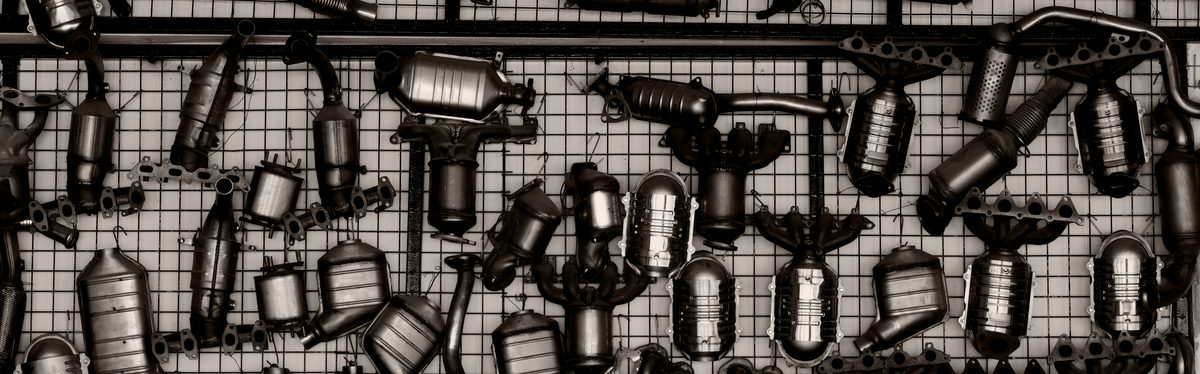
A P0430 code means the engine computer has decided the catalytic converter on bank 2 has stopped storing oxygen. Parts run $142 for a rear oxygen sensor to $1,257 for the converter itself.
On the vehicle that dominates the complaint record, the Honda Pilot, Honda's own service bulletin says the cause is the fuel injectors and extends their warranty to ten years or 150,000 miles.
OilAndMiles.com - Every OBD-II code that names a part invites you to buy that part. P0430 names the catalytic converter, and the converter is the most expensive thing in the exhaust, so the code reads like a bill before anyone has looked at the car.
It's worth slowing down, because the same pattern shows up twice in the public record. The complaints filed with the regulator point at one vehicle, and the manufacturer of that vehicle has already published what actually goes wrong with it. Neither of those documents says the converter.
What follows is the code, the side of the engine it points at, what the complaint record shows, and what each of the three plausible repairs costs at a parts counter.
What does a P0430 code mean?
A P0430 code means catalyst system efficiency below threshold on bank 2. The car isn't measuring the converter directly. It's comparing two oxygen sensors, one before the converter and one after it.
A healthy converter stores oxygen and releases it, so the rear sensor should read steady while the front one swings. When the rear sensor starts to copy the front, the computer concludes the catalyst has stopped doing that, and it sets the code.
That's the whole test, and it's why the code is honest but not specific. Four different faults all make the rear sensor mirror the front, and the code can't tell them apart:
- A tired converter. The catalyst has stopped storing oxygen, which is the one thing the code is named for.
- A lazy rear sensor. The sensor is slow rather than the converter being dead, and it's the cheapest of the four to rule out.
- An exhaust leak ahead of the sensor. Air drawn in through a crack reaches the sensor and reads as oxygen the catalyst failed to use.
- Fuel reaching the converter. Anything that lets fuel through unburned loads the catalyst with work it was never meant to do.
What the converter actually does explains the chemistry behind that comparison.
That second character is a digit and not a letter. In P0430 it is a zero, and on a scan tool display a zero and a capital O are drawn almost identically, which is why the screen above sets it with a slash through it.
People commonly type it into a search box as PO430, with a letter O, or as P430 with the zero dropped. Neither is a real code, and nothing corrects the slip: a parts catalog or a service database returns nothing at all, so a real code reads as though it doesn't exist.
Where is bank 2 on my engine?
Bank 2 is the side of the engine that doesn't contain cylinder 1. Its location moves from engine to engine, and it's not always the passenger side. On an inline four there's no bank 2 at all, which is why P0430 only appears on a V6, a V8 or a flat engine.
On the Honda J35 V6 in the Pilot, cylinders 1, 2 and 3 sit in the rear bank against the firewall. So bank 1 is the bank you can't see and bank 2 is the front one, facing the radiator, which is the accessible side. The other code that names this bank is P0174, a lean reading rather than a converter one, and it almost never arrives without its bank 1 twin.

Use this image
Free to republish under CC BY 4.0: credit Oil & Miles and link to this page. The snippet does both.
<a href="https://oilandmiles.com/articles/p0430-code"><img src="https://oilandmiles.com/assets/img/diagrams/p0430-which-bank.svg" alt="A transverse V6 drawn from above: bank 1 holds cylinders 1, 2 and 3 against the firewall with its converter behind the engine, bank 2 holds cylinders 4, 5 and 6 facing the radiator with its converter in front" width="1000" height="690"></a> <p>Diagram: <a href="https://oilandmiles.com/articles/p0430-code">Oil & Miles</a>, CC BY 4.0</p>Confirm this on your own engine before anyone orders a part. The converter for one bank doesn't fit the other, and on a Pilot that mistake is a four figure part sitting in a box.
Which vehicles get P0430 most?
Honda, and not by a small margin: 46 of the 91 complaints on file. We read every NHTSA complaint mentioning P0430 across model years 2010 to 2025 and counted unique complaints rather than lines.
Honda accounts for 46 of the 91. Ford accounts for 22. After that the numbers fall away: Jeep 4, Lincoln 4, Acura 4, Dodge 2.
Inside Honda, one model carries almost all of it:
VehicleComplaints naming P0430Where they cluster
- Honda Pilot40Model years 2016 to 2020, most on 2017 and 2019
- Ford F-150152011 to 2020, with 2018 the only year above three
- Honda Odyssey5The same V6 family as the Pilot
- Ford Explorer4No single model year stands out
- Everything else27Lincoln, Acura, Jeep, Dodge and the rest, none above 4
The Ford story is a different one. Of the 15 F-150 filings, four name a misfire and three name spark plugs or a coil, so the fuel reaching the converter arrives from the ignition side rather than from injectors, and they run from 2011 to 2020 rather than clustering the way the Pilot's do, though 2018 carries five.
Complaints count the people who wrote in, not the failure rate. A model that sells in large numbers files more of everything, which is why the Pilot sitting above the F-150 is worth a second look rather than a headline.
Why is the Honda Pilot almost half the record?
Because the Pilot's P0430 complaints aren't really about converters, and the owners writing them say so.
Of the 40 Pilot complaints naming P0430:
- 27 mention fuel injectors. Two thirds of them, in the owners' own words, on a code named for the converter.
- 12 name P219B and 8 name P219A. Those are the bank 2 and bank 1 cylinder balance codes.
- 4 mention a misfire code. P0300 to P0306, the same family Honda's bulletins are titled for.
- 16 mention a recall and 14 a warranty. Owners were already being told this was a known fault.
That's a specific shape rather than a scattering. A cylinder balance code on bank 2 sitting alongside a catalyst efficiency code on bank 2 describes one bank running badly and unburned fuel arriving at the converter behind it. The converter is downstream of the problem, and the complaints cluster on model years 2016 to 2020.

Use this image
Free to republish under CC BY 4.0: credit Oil & Miles and link to this page. The snippet does both.
<a href="https://oilandmiles.com/articles/p0430-code"><img src="https://oilandmiles.com/assets/img/diagrams/p0430-on-the-scanner.svg" alt="A tablet scan tool screen listing two stored codes: P0430, catalyst system efficiency below threshold on bank 2, and below it P219B, cylinder balance on bank 2, highlighted" width="1000" height="600"></a> <p>Diagram: <a href="https://oilandmiles.com/articles/p0430-code">Oil & Miles</a>, CC BY 4.0</p>What the data says
Across NHTSA complaints for model years 2010 to 2025, 91 unique complaints mention P0430, counting the code in every form owners write it, PO430 with a letter O included. Honda accounts for 46 and the Pilot alone for 40, spread over the 2016, 2017, 2018, 2019 and 2020 model years, with 2017 and 2019 carrying the most. Of those 40, 27 mention fuel injectors, 12 name P219B and 8 name P219A.
Source: NHTSA consumer complaints, bulk file FLAT_CMPL, read 2 September 2026. Counted as unique complaints by ODINO, because one complaint spans several lines in the file.
Is your Pilot still covered by Honda?
Possibly, and this is the first thing to check rather than the last. American Honda extended the warranty on the fuel injectors in these vehicles to ten years from the original date of purchase or 150,000 miles, whichever comes first.
A service bulletin is the written instruction a manufacturer sends its own dealers: what the fault is, what to replace, and who pays for it. It's not a recall, and nobody writes to you about one, which is why an owner can be covered and never find out. This one arrived in two announcements:
- 24 November 2020. Certain 2016 Pilots, pointing to service bulletin 20-100.
- 11 February 2021. Added certain 2017 to 2019 Pilots, 2018 to 2019 Odysseys and 2017 to 2019 Ridgelines, and added bulletin 21-010.
Both bulletins are titled for the codes themselves, and Honda's own wording is MIL comes on with DTC P0420 or P0430, with P0300 to P0306, P219A or P219B. A DTC is a diagnostic trouble code, which is all a P-number is, and the MIL is the check engine light. A dealer looking at the title alone can see it covers what your scanner is showing.
Honda's stated cause is worth reading closely, because it names three separate things:
- Injectors built out of specification. Honda says they may not have been manufactured to proper specifications.
- Debris inside them. From the high pressure pump or from the injector machining process, causing internal wear or clogging in one or more injectors.
- The software itself. The engine computer may misinterpret its sensor inputs as a deteriorated catalytic converter, which is the code being set by a reading rather than by a part.
The repair is new injectors, sometimes with a software update.
The clock is the problem in 2026. Ten years from purchase means a 2016 Pilot bought new in 2015 or 2016 is at or past the limit now, while a 2019 bought new in 2018 has until 2028. Coverage is decided per vehicle by VIN, so a dealer has to look it up.
Ask before you pay for anything.
What does a P0430 repair cost?
Three parts can end a P0430, and they're an order of magnitude apart. Prices below are genuine Honda parts for a 2017 Pilot, compared across the seller sites that list the same part number, cheapest to dearest. Labor is separate and varies by shop, and we couldn't source it: no flat rate guide we could read publishes a public time for this engine.
Fuel injectors: $234 to $247
Part 16010-RLV-315 is a set of six injectors with the o-rings, retainers and seals, not a single injector, which is the mistake that makes this look six times dearer than it is. If the warranty extension covers your VIN, this is the part Honda pays for.
Across six sellers the set runs $234 to $247, a $13 spread, against $161 on the converter. Every listing is the same Honda part number, so what moves between them is the seller, not the part.
Rear oxygen sensor: $142
Part 36542-5G0-A01, the sensor behind the converter. It is the cheapest thing that can set this code and the easiest to rule out, because a sensor reading lazily looks exactly like a converter that has stopped working.
Ruling it out need not cost the $142 at all. A shop can bench test the old sensor or swap it against a known good one, which puts no part on the bill, and fitting a new one blind is the cheapest way to be wrong on this page.
Catalytic converter: $1,096 to $1,257
Part 18180-5MJ-A00, the front primary converter, which is bank 2 on this engine. It comes as one piece with the exhaust manifold, and that's the whole reason for the price: you aren't buying a converter, you're buying the manifold it is welded to.
What a P0430 code costs in parts, one 2017 Pilot V6
A shop adds its own hours on top.
| Rear oxygen sensorHonda 36542-5G0-A01, listed at $142 against $202 list. One sensor | $142Part only, at the counter |
|---|---|
| Fuel injector setHonda 16010-RLV-315, six injectors with seals, $234 to $247 across six sellers against $352 list | $234 – $247Part only, at the counter |
| Catalytic converterThe bank 2 converter. Honda 18180-5MJ-A00, front primary, integrated with the exhaust manifold. $1,096 to $1,257 across six sellers against $1,675 list | $1,096 – $1,257Part only, at the counter |
Parts only, and you wouldn't buy all three. Labor isn't included because no flat rate guide we could read gives a public time for these jobs on this engine. A shop quote will add its own hours on top. Cheapest seller to dearest, and for that one engine: another vehicle gives another set of numbers.
Aftermarket direct fit converters exist for less, and the cheap listings you'll find are usually universal weld in units rather than a part that bolts to this engine. Those are a different product and a different job. What a converter costs to replace covers that split in full.
Can you drive with a P0430 code?
Usually yes, in the sense that the car will run and the light will stay steady rather than flashing. A steady light isn't the emergency a flashing one is, and what a flashing light means is worth knowing before you decide anything.
Two things make driving on it a bad idea anyway:
- It will fail an emissions test in any state that runs one, because the readiness monitor is exactly what the test reads.
- Every mile can be the damage. If the cause is fuel reaching the converter that should have burned in the cylinder, driving on it is what ruins the converter you're hoping not to buy.
That's the real cost of waiting on this particular code. A cheap problem becomes an expensive one by being ignored.
What if P0420 and P0430 appear together?
Two converters don't fail on the same morning. When both banks report the same fault, look upstream for something feeding both of them.
6 of the 40 Pilot complaints name P0420 alongside P0430, and Honda's own bulletins are titled for both codes together, which tells you the manufacturer expects to see the pair. Fuel, oil consumption, a coolant leak into the combustion chambers past a failed head gasket, and a software fault all reach both banks. A single failed converter can't.
Our P0420 article works through the bank 1 version of this and the chain of cheaper causes that sit behind it.
Worth knowing
A converter that has genuinely failed almost always failed because of something else, and that something else is still there after you fit the new one. Replacing the part without finding the cause buys you the same code again, usually within a year. This is the one argument in this article that we're making rather than sourcing.
How do you fix a P0430 code?
The work splits in two, and the half that is free comes first.
What you can check yourself, before anyone charges you
3 steps below, and you can work through all three before anyone charges you:
- Read the full code list, not just P0430. A cylinder balance or misfire code sitting next to it changes the whole diagnosis. Reading the codes yourself takes a scan tool and a few minutes.
- Check whether the vehicle is covered, whatever the badge. A warranty extension or a service bulletin can make this somebody else's bill, and nobody writes to tell you. Any dealer can check by VIN in a minute. On a 2016 to 2019 Pilot, a 2018 to 2019 Odyssey or a 2017 to 2019 Ridgeline that is the injector extension above, and ten years from purchase is running out during 2026 for the earliest of them.
- Ask to see both oxygen sensors on live data, warm. This is the test the code itself runs, so you can watch it happen. The front sensor should swing up and down; the rear one should stay comparatively flat. A rear sensor copying the front's swings is the converter. A rear sensor that barely moves at all is the sensor.
What the shop does, and in what order
The rest is shop work. 5 steps below, and the order is worth knowing even though you aren't doing it, because it's what a quote should follow:
- Freeze frame first. The scan tool stores the conditions the code set under. Speed, load and coolant temperature narrow the cause before anything is unbolted.
- Smoke or pressure test the exhaust ahead of the sensor. This is the cheapest fault on the list to find and to weld shut, and the test finds it without removing anything.
- Swap or bench test the downstream sensor. A lazy sensor produces the same comparison a dead converter does, and the two parts are $142 and $1,096.
- Read fuel trim and injector balance. This is where the Pilot's answer lives. Trims well off zero on one bank, or a cylinder balance code beside the catalyst code, name the fuel side rather than the exhaust.
- Only then the converter. And with whatever killed it fixed first, or the same code returns.
A quote that goes straight to step five without the four above it is quoting the most expensive answer to a question nobody asked.
Conclusion
The code names a measurement, not a part
What P0430 reports is one number: the rear sensor on bank 2 started copying the front one. That's a measurement, and it's the only thing the car is certain about. Which part broke is a separate question the code never answers.
That matters because the expensive part is usually the victim. An injector leaking fuel past the front sensor cooks the converter that then fails the test, and replacing the converter alone buys the same code again.
So take the cheap side first, in the order this page sets out, and make sure whatever killed the converter is fixed before anyone quotes you for one. Reading the measurement before buying the part is what Oil & Miles does on every repair page, and on this code it is the distance between $142 and $1,257.
Common questions
Asked most often
What does a P0430 code mean?
Catalyst system efficiency below threshold, bank 2. The computer compared the oxygen sensor ahead of the catalytic converter with the one behind it and found the two reading too much alike, which is what it expects when the catalyst has stopped storing oxygen. It's a measurement, not a diagnosis of which part failed.
Where is bank 2 on the engine?
Bank 2 is whichever side doesn't contain cylinder 1, so its location moves from engine to engine and isn't always the passenger side. An inline four has no bank 2 at all. On the Honda J35 V6, cylinders 1, 2 and 3 sit against the firewall, which makes the front bank bank 2. Confirm it before ordering a part.
Is the second character in P0430 a zero or a letter?
A zero. Only the first character is a letter; the four after it are digits. On a scan tool display a zero and a capital O look almost identical, so typing PO430 into a parts catalog is an easy slip. It returns nothing rather than correcting you, which makes a real code look as though it doesn't exist.
What is the difference between P0420 and P0430?
Nothing except which side of the engine. P0420 is bank 1, the bank containing cylinder 1, and P0430 is bank 2. Both report the same measured fault and both carry the same list of causes and the same prices. Seeing the pair at once points at something feeding both banks rather than two separate converter failures.
Can you drive with a P0430 code?
The car will run and the light stays steady rather than flashing, so it's not the emergency a flashing light is. It will still fail an emissions test in any state that runs one. And if the cause is unburned fuel reaching the converter, every mile is what damages the converter you're hoping not to buy.
Is P0430 upstream or downstream?
Neither sensor sets it on its own. The code is the comparison between them, the upstream sensor ahead of the converter and the downstream one behind it. In practice a downstream sensor reading slowly is the cheapest thing that produces the same comparison, which is why it is worth ruling out before the converter.
Will a P0430 code clear itself?
The light can clear itself if the fault stops recurring over several drive cycles, and the code then sits in memory as pending or stored. That isn't the problem being fixed. An intermittent cause, like an exhaust leak that only opens when cold, does exactly this. A cleaner won't restore a damaged catalyst, which our converter cleaner review covers.
Is P0430 always the catalytic converter?
No, and on the vehicle that dominates the complaint record it usually isn't. American Honda extended the warranty on the fuel injectors of certain 2016 to 2019 Pilots, 2018 to 2019 Odysseys and 2017 to 2019 Ridgelines specifically because this code was being set by injectors and by software reading its own sensors as a failed converter.
How do you fix a P0430 code?
In cost order, not the order the code suggests. Read every stored code first, because a cylinder balance or misfire code beside it names the cause. Check whether the vehicle is covered by a warranty extension. Then rule out the downstream oxygen sensor, an exhaust leak ahead of it, and fuel trim. The converter is last, not first.
What people ask next
- Do Catalytic Converter Cleaners Work? Two Cases of Six 12 min
- Catalytic Converter Theft: What Actually Stops It 13 min
- Catalytic Converter Replacement Cost: When It's $0 19 min
- What Is a Catalytic Converter? Three Metals and a Honeycomb 16 min
- Bad Catalytic Converter Symptoms: Two Failures, Two Answers 16 min
- P0420 Code: The Converter Is Usually the Victim 21 min
Sources
- The complaint counts in this article, from the regulator's own bulk file, model years 2010 to 2025, counted as unique complaints by ODINO because one complaint spans several rows. Counted a second time from the raw rows after a summary file disagreed by one. NHTSA FLAT_CMPL, read September 2, 2026
- American Honda, Warranty Extension: 2016 Pilot V6 Fuel Injector, 24 November 2020, naming service bulletin 20-100 and extending injector coverage to ten years or 150,000 miles. Bulletin as filed with NHTSA
- American Honda, update to the same warranty extension, 11 February 2021, adding certain 2017 to 2019 Pilot, 2018 to 2019 Odyssey and 2017 to 2019 Ridgeline, and naming bulletins 20-100 and 21-010. It's this document that states the cause. Bulletin as filed with NHTSA
- Parts prices, taken from seller listings for Honda part numbers 16010-RLV-315, 36542-5G0-A01 and 18180-5MJ-A00, each compared across six sites and quoted cheapest to dearest, with list price from the same listings. Read September 2, 2026
What we didn't do
- We didn't scan a car or clear a code for this article. Everything here comes from the complaint file, the manufacturer's own bulletins and parts counters.
- We didn't price the labor. No flat rate guide we could read publishes a public time for injector or converter replacement on this engine, and the estimator sites that quote whole job figures refuse automated access. The cost box is parts only and says so.
- We didn't test whether an aftermarket converter clears the code on this engine, because we haven't run one. Emissions rules on aftermarket converters also vary by state, which is a separate question.
- We give no figure for how often P0430 turns out to be the injectors rather than the converter. The complaint record shows 27 of 40 Pilot filings mentioning injectors, and that's a count of what owners wrote, not a failure rate.
Prices are ranges compiled in September 2026 for the US market and vary by region, engine and shop rate. Prices from $10 up are rounded to the nearest dollar, so $14.13 reads as $14 and $14.52 as $15. Below $10 they're exact. This article is general information, not advice about your specific vehicle, see the disclaimer.