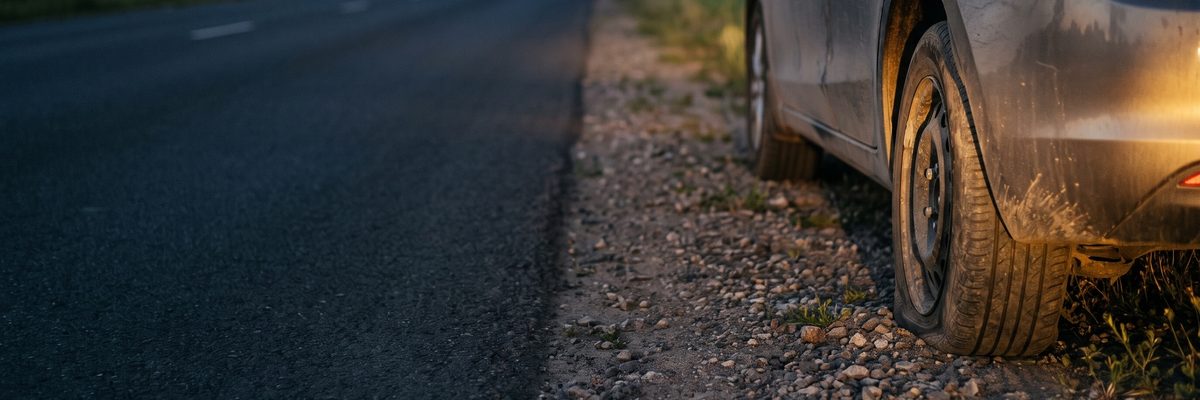

Key takeaways
- Safety: If a tire blows out or goes flat while you drive, hold the steering wheel firmly, slow down gradually and pull over where it's safe.
- Don't drive on a flat tire any farther than the nearest safe place to stop, because even a short distance can damage the tire and the wheel beyond repair.
- A tire driven flat has to be inspected inside before it is reused.
- A compact spare, a sealant kit and a run-flat each have a speed and distance limit in your owner's manual.
- Only a puncture in the tread can be repaired.
Without air, the tire no longer holds up the car, so the weight crushes it between the road and the rim. That's why a tire driven flat is damaged inside, even when it looks fine outside.
Can you drive on a flat tire?
Don't drive on a flat tire any farther than the nearest safe place to stop, because even a short distance can damage the tire and the wheel beyond repair. A flat tire also makes the car harder to handle.
A completely flat tire means stop. A run-flat tire has its own limit, and a compact spare or a sealant kit is for one short trip to a shop. Put the spare on, then go to a shop to have the tire seen to.
What should you do if a tire goes flat while you drive?
If a tire blows out or goes flat while you drive, hold the steering wheel firmly, slow down gradually and pull over where it's safe. Brake gently and keep the car pointed straight ahead while you slow down, and pull off the road once you're moving slowly enough to do it safely.
When a front tire blows out, take your foot off the accelerator, grip the wheel firmly, steer to hold your lane and brake gently to a stop, well off the road if possible. After a rear tire blows out, stop pressing the accelerator and steer to straighten the car, then brake gently. Avoid sharp braking and steering.
Once you're stopped, look at the tires, and don't drive on a tire that is flat or has a bulge, a cut or a crack. If the tire is any of those, put the spare on or call for help.
If you can't get well clear of traffic, stop where it's safe and call for help. Never work on the car in the traffic lanes of a public road, and never get under a car held up only by a jack.
Changing a tire can be dangerous, and the car can slip off the jack and roll over or fall, so find a level place. Before you change a tire, do these in order.
- Stop on a hard, level surface. A jack can slip on soft or sloping ground.
- Set the parking brake. It keeps the car from rolling while it's on the jack.
- Shift to Park. On a manual, select Reverse, so the gear holds the car as well as the brake.
- Stop the engine. Work on the car only with the engine off.
- Turn on the hazard flashers. They warn traffic that the car is stopped.
Use the jack only for changing the tire. The wheel nuts need checking again after the spare goes on, and the interval differs by maker. Check your own manual for your car's schedule.
How far can you drive on a flat tire?
No farther than the nearest safe place to stop, whether that's 100 feet, a mile or two miles. The weight of the car damages a flat tire, and the damage grows with the distance. On a Toyota, don't continue driving at all. On GM cars, go slowly to a level place well off the road, if possible, to avoid more tire and wheel damage.
On Ram and Jeep trucks, don't keep driving on a flat, because handling may be compromised. A tire running flat heats up as it flexes, and that heat can tear it apart.
Is the tire flat or just low?
A low tire still has some air and can be inflated, while a flat one has none and can't be driven on. A puncture in the tread can leave a tire flat, and a slow leak loses air over hours or days, so a tire that is flat in the morning may have been leaking overnight. A shop checks the pressure and takes the tire off the wheel to look inside it.
A lit tire pressure light is the warning for a low tire. A tire with no air at all has nothing holding the car up, so treat it as a flat.

A gauge tells flat from low
What does driving on a flat tire damage?
Three things: the tire, the rim and, on a longer drive, the suspension. The weight of the car does the damage when the tire has no air to carry it.
- The tire. The lining inside shreds and the sidewall cords chafe, and that damage may not show from outside.
- The rim. A steel rim bends at the lip and an alloy rim cracks or gets marked.
- The suspension and alignment. A longer drive can damage both, and the car can pull or vibrate afterward. It can also end in a blowout or the tire coming apart.
On GM cars, a tire that was driven on while flat is never re-inflated, because it can blow out. A dealer or a tire shop repairs or replaces it.

The damage is on the inside
I already drove on it. What do I check?
Have the tire inspected inside before anyone reuses it, because the damage doesn't show outside. A tire with a bulge, a cut or a crack deep enough to show fabric is replaced, and so is one that keeps going flat.
Only a puncture in the tread can be repaired, because the sidewall flexes too much to hold a repair. Check the wheel for cracks and a damaged edge too.
A pull or vibration after a flat can mean rim or suspension damage, so have the wheel and the alignment checked. Tell the shop you drove on the flat, so it looks inside the tire as well.
What to say to the shop
After you drove on a flat, ask:
- Was the inside of the tire inspected?
- Were the wheel and the alignment checked?
“I drove on a flat tire. Can you look inside the tire and check the wheel and the alignment?”
A good answer: the inside of the tire inspected, then the wheel and the alignment checked.
Can you drive on a run-flat tire?
Only within the maker's limit, and the limit differs by maker and tire. On Ram and Jeep trucks the limit is 50 miles at 50 mph after a rapid loss of pressure, and your owner's manual has the limit for your car.
If you hear unusual sounds or feel vibration on a punctured run-flat, pull off the road to a safe place and stop as soon as possible, because the tire may need replacing. A run-flat driven flat may not be repairable.
What if you have no spare?
With no spare, the ways out are a sealant and inflator kit, roadside help, a mobile tire service or a tow. A compact spare, if the car has one, is for short, temporary use, at no more than about 50 mph on the Toyota and Honda named in Sources.
| Maker | Run-flat tire | Sealant kit | Wheel-nut recheck |
|---|---|---|---|
| Ram | 50 miles at 50 mph. | Check your manual | Check your manual |
| Jeep | 50 miles at 50 mph. | Up to 100 miles at 50 mph. | Check your manual |
| Nissan | About 93 miles at up to 50 mph. | Up to 50 mph. | Check your manual |
| GM | Check your manual | Within 100 miles. | Check your manual |
| Ford | Check your manual | Up to 120 miles at 50 mph. | Within 100 miles. |
| Hyundai | Check your manual | Check your manual | About 30 miles, and again at about 600. |
A sealant and inflator kit is a temporary fix for a puncture in the tread, and the trip goes straight to a shop. The limits differ by kit, so check your own manual.
On GM cars, drive about 5 miles after sealing the tire, then stop somewhere safe and check the pressure. If it has dropped more than 10 psi below the recommended pressure, the tire is too damaged for the sealant, so stop driving and call for help.
From the carmakers
What do the carmakers say about driving on a flat tire?
Carmakers' owner's manuals cover a flat tire on specific models. None of them is a recall, and a manual line is general guidance for that model, not a diagnosis of your car. Your dealer can tell you what applies to your VIN.
Owner's manual If you have a flat tire
Driving even a short distance with a flat tire can damage the tire and the wheel beyond repair, which could result in an accident.
Owner's manual Tire blowout tips
Driving on a flat tire will cause permanent damage to the tire.
Owner's manual If a tire goes flat
If a tire goes flat while you are driving, apply the brakes gently and keep the vehicle pointed straight ahead while you slow down.
Owner's manual Flat tires
Do not continue driving with one or more flat tires as handling may be compromised.
Owner's manual Run-flat tires
Do not drive at speeds above 50 mph (80km/h) and do not drive more than approximately 93 miles (150 km) with a punctured run-flat tire.
Owner's manual Tire sealant kit
Only punctures located within the tire tread can be sealed with the kit.
Conclusion
What to do next about a flat tire
Once you've stopped, put the spare on or call for help, and have the tire inspected inside before anyone reuses it. Replace a tire with a bulge, a cut or a crack.
Oil & Miles checks each step here against carmakers' owner's manuals.
Common questions
Asked most often
What happens if I keep driving on a flat tire?
Don't drive on a flat tire any farther than the nearest safe place to stop, because even a short distance can damage the tire and the wheel beyond repair.
Will driving on a flat ruin the rim?
It can. A steel rim bends at the lip, and an alloy rim cracks or gets marked.
Can a tire be repaired after driving on it flat?
A tire driven flat has to be inspected inside first, and it may have to be replaced. Only a puncture in the tread can be repaired, and a tire with a bulge, a cut or a crack showing fabric is replaced.
Can you drive on a run-flat with no air?
Only within the maker's limit, such as 50 miles at 50 mph on Ram and Jeep trucks or about 93 miles at up to 50 mph on a Nissan Rogue. Check your owner's manual for your car.
What people ask next
Sources
- 2018 Toyota Yaris Hatchback Owner's Manual (US), PDF pages 371, 431 and 444, for the flat tire, replacing a damaged tire and the compact spare. Toyota, read November 10, 2026
- 2011 Chevrolet Traverse and 2022 Chevrolet Equinox Owner's Manuals (US), PDF pages 370 and 306, for the blowout steps, the damage and the hazard flashers. GM, read November 10, 2026
- 2016 Kia Sorento and 2019 Hyundai Tucson Owner's Manuals (US), PDF pages 358, 439, 442, 447, 504 and 515 for Kia and 308, 427 and 483 for Hyundai, for the flat steps, the repair rule and the wheel nuts. Kia, Hyundai, read November 10, 2026
- 2018 Ram 2500 and 2018 Jeep Wrangler JL Owner's Manuals (US), PDF pages 199, 211 and 584, for the flat tire and the run-flat limit. Ram, Jeep, read November 10, 2026
- 2018 Nissan Rogue and 2013 Nissan Murano Owner's Manuals (US), PDF pages 422 and 467, for the run-flat tire and the compact spare. Nissan, read November 10, 2026
- 2016 Ford Fusion and 2018 Ford Escape Owner's Guides (US), PDF pages 284 and 303, for the sealant kit and the wheel nuts. Ford, read November 10, 2026
- 2016 Honda Pilot Owner's Manual (US), PDF pages 588 and 610, for the bulges and the compact spare. Honda, read November 10, 2026
- 2018 Nissan Sentra Owner's Manual (US), PDF page 392, for the jack warning. Nissan, read November 10, 2026
The manuals are US editions.
AI illustration by Oil & Miles
This article is general information, not advice about your specific vehicle. See the disclaimer.