
The tire pressure warning light, also called the low tire pressure light, comes from the tire pressure monitoring system, TPMS for short, which cars and light trucks built on or after September 1, 2007 must have. It warns about low air and about its own faults, and our dashboard warning lights guide covers the other lights.
Can you drive with the tire pressure light on?
Yes, carefully, but stop somewhere safe first and gauge the tires. Drive on to air only if no tire is flat, damaged or far below the label pressure, and use the spare or roadside help for a flat, a bulge, a vibration or a pull.
Every carmaker prints the same federal advice in the manual: when the light comes on, stop and check your tires as soon as possible. A tire well below its pressure overheats, and that can lead to tire failure.
No carmaker or federal rule gives a safe distance. If the light blinks first and then stays on, the system may not be able to warn you about low pressure, so check all four tires with a gauge before you drive on.
Solid or blinking: what the tire pressure light is telling you
Your tire pressure light is on for one of two reasons: a solid light means low air, and a blinking one means a fault. By federal rule, the solid light must come on within 20 minutes once a tire is 25% or more below the pressure on the door label, or below the rule's own minimum for that tire if that's higher, so a tire can be low before the light comes on.
If your tire pressure light is blinking or flashing for 60–90 seconds after you start the car and then stays on, that's the malfunction warning, and it repeats at every start until the fault is fixed. Some cars show it on a separate lamp marked TPMS instead.
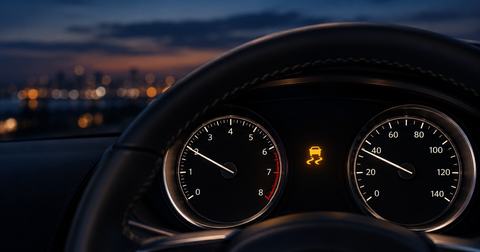
As for what the tire pressure light looks like, it's a tire outline, flat along the bottom with tread marks, with an exclamation mark inside, so it looks like a horseshoe. The two warnings are easy to mix up, so watch for the blink at start-up.

The lit warning
What the data says
About 46% of drivers with a low-pressure warning said it had been on for more than a week. About 47% of drivers with a malfunction warning thought it meant low pressure.
From NHTSA's federal study of tire pressure monitoring, DOT HS 813 617 (November 2024), which surveyed drivers and repair shops.
What to do when the tire pressure light comes on
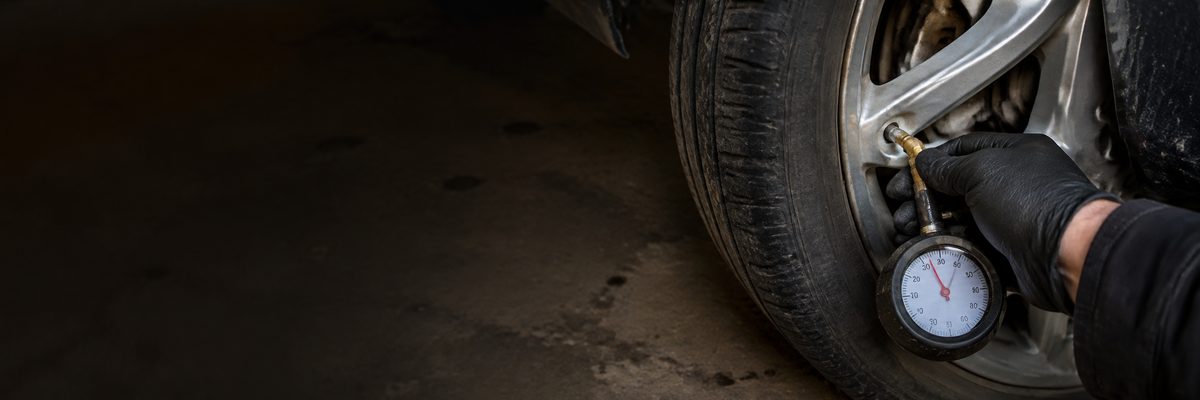
Check all four tires with a gauge, then fill them to the pressure on the door label. Work through the 5 steps below:
- Let the tires cool if you can. The recommended pressure is for a cold tire, one not driven on for at least three hours. If you can't wait, check now and add air to a tire that's low, but don't let air out of a warm tire. Check again once the tires are cold.
- Gauge every tire. Check the spare too, where the car has one, and give all of them a cold check once a month, not only when the light comes on.
- Fill to the label, not the sidewall. Use the pressure on the tire label in the door jamb, not the maximum printed on the tire.
- Look at the low one. If one tire was much lower than the rest, look for a nail or a damaged valve, and have it checked.
- Let the light update. Some cars clear it as you drive, and some need a reset.
Some cars help with the filling. On a 2025 Chevrolet Equinox with Tire Fill Alert, the horn sounds once when the tire reaches the right pressure.
Why is the tire pressure light on when the tires look fine?
Because a tire can be 25% low and still look normal, and only a gauge shows it. On a door label of 36 psi, a tire 25% low reads 27 psi, which doesn't look flat.
Cold weather is the other common reason the light keeps coming on: by GM's figures, the pressure drops about 1 psi for every 10°F the temperature falls. So the light can come on after a cold night and go off as the tires warm up, but the tire is still low, so add air.
Why is the tire pressure light still on after filling the tires?
Because the system hasn't updated yet, it needs a reset, or a tire is still low. Work down these in order:
- It hasn't updated yet. Cars with sensors in the wheels read the new pressure as you drive, and how long that takes differs by car.
- It needs a reset. On the 2018 Accord, a light that stays on after inflating means the system needs calibrating, and on the 2019 Camry the same step is initialization.
- A tire is still low. A slow leak brings the light back, so gauge the tires again the next morning.
- The spare is on. A compact spare can keep the light on, and the 2025 Equinox's spare has no sensor at all. A compact spare is for short use only, so check its label for the speed limit.
- It's a fault. If the light blinked for about a minute first, it's a system fault, and a tire can still be low, so gauge them yourself.
How do you reset the tire pressure light?
There's no single button to turn off the tire pressure light. Your owner's manual gives the steps for your car, and under the federal rule the light can stay on until it's reset the carmaker's way.
How TPMS works: direct or indirect
A direct system has a pressure sensor inside each wheel, while an indirect system has none and uses the wheel speed sensors the ABS already has. On a Honda, black rubber valve stems mean indirect and gray alloy stems mean direct, a tell from Honda's own guide that doesn't hold for other makes.
Honda's indirect system needs calibrating after any pressure change, tire rotation or tire replacement. On a GM direct system, the car instead has to match each sensor to its wheel again after a rotation.
Toyota: initialize the system
On the 2019 Camry, the reset is called initialization. It's needed after a tire rotation, a change of tire size or a pressure change for speed or load.
Park and stop the engine for 20 minutes or more, set each tire to its cold pressure, start the engine, then choose Set Pressure under TPWS in the meter's settings menu. Hold the button until the light blinks three times.
Honda: calibrate it
The 2018 Accord has no sensors in the wheels, so after you inflate, rotate or replace a tire, you calibrate it from TPMS Calibration in the vehicle settings menu. It finishes on its own after about 30 minutes of driving in total at 30–60 mph, and it can't calibrate with a compact spare fitted.
If the screen says the calibration failed to start, run the menu steps again. While it calibrates, the light can come on briefly if the car sits switched on for 45 seconds without moving, which is normal.
GM: let it learn or use the tool
The 2025 Equinox learns new sensor positions by itself: after a tire is fitted, it sits for about 20 minutes, then needs up to 10 minutes of driving at 12 mph or more. Until it finishes, the warning light and message stay on.
The 2020 Silverado needs a TPMS relearn tool at each wheel, in order: driver front, passenger front, passenger rear, driver rear. You have two minutes to match the first wheel and five minutes for all four.
What does Service Tire Monitor System mean?
It's GM's fault message for the tire pressure system, seen on Chevy and other GM models. When the system has a fault, the light blinks for about one minute and the message comes up, and until it's fixed, the system may not warn you about a low tire.
The 2025 Equinox manual names these causes:
- The spare is on. It has no sensor, so the warning stays until the road tire goes back on and the sensors are matched.
- The tires were rotated, and the sensor matching wasn't done or didn't finish.
- A sensor is missing or damaged, and the warning stays until it's replaced.
Sensor faults on direct systems
On a direct system, each wheel sensor runs on its own battery, so sensors wear out with age. On GM models, accessory wheels need the sensors relearned.
A failed sensor shows up as the same light blinking first, not as a separate tire pressure sensor light, unless the car has a TPMS lamp. Winter wheels without sensors can keep the fault light on, since the federal manual text names replacement or alternate wheels as one cause.

A sensor inside the wheel
What the data says
GM designs its sensors to last 10 years or 150,000 miles. Repair shops' median estimate is 5 years.
From GM bulletin 07-03-16-004E (February 2023) and NHTSA DOT HS 813 617 (November 2024). The shop figure is an estimate, not a test.
How much does a tire pressure sensor cost?
It depends on what failed and on your car's system. A car with an indirect system, such as the 2018 Accord, has no sensor to buy, while a sensor job is the part, taking the tire off the wheel and back on, and the relearn or programming so the car knows the new sensor.
Ask which sensor failed before you pay for four. GM also treats sensor reprogramming after a tire rotation as the owner's cost, and prices vary by car and by job.
From the carmakers
What do carmakers say about the tire pressure light?
The manuals agree on the basics: gauge the tires, fill them to the label, then let the system update or reset it. Every quote in the cards below is from the document itself.
The GM bulletin covers the Service Tire Monitor message, and the three manuals show a direct system, an indirect one and one that learns its sensors by itself. None of them is a free repair, so every card reads Info only.
Service bulletin 07-03-16-004E, tire pressure monitor information
The Tire Pressure Light will blink for about one minute and a Service Tire Monitor message will be displayed when a system malfunction occurs.
Owner's manual 2019 Camry, tire pressure warning system
Before performing initialization, make sure to adjust the inflation pressure of each tire to the specified level.
Owner's manual 2018 Accord, low tire pressure/TPMS indicator
Stays on after the tires are inflated to the recommended pressures - The system needs to be calibrated.
Owner's manual 2025 Equinox, TPMS malfunction light and message
The spare tire does not have a TPMS sensor.
Conclusion
What to do next about the tire pressure light
If the light stays solid after you've filled the tires cold, reset it the way your manual says, and if it comes back within days, have the tire checked for a slow leak. If it blinked for about a minute first, book a system check and gauge the tires yourself until it's fixed.
Oil & Miles checks each step here against the carmakers' manuals and bulletins, the federal rule and NHTSA's research.
Common questions
Asked most often
Will a TPMS light fail a state inspection?
It depends on your state, so ask your inspection station. NHTSA calls the state lists found online “apparently unverified and inaccurate”.
Does an overinflated tire turn on the TPMS light?
The federal rule only requires a warning for low pressure. Some cars also warn about high pressure, and your manual shows whether yours does.
Can other warning lights come on with the TPMS light?
Yes, on some cars: on several Hondas the tire warning runs through the stability system, and some Mazda CX-5s show the traction and tire lights together. Our VSA light page and traction control light page cover those pairs.
Can a shop turn the tire pressure system off?
No: under federal law, dealers and repair shops may not knowingly make inoperative equipment fitted to meet a safety standard, the tire pressure system included. The rule names those businesses, not owners.
Does nitrogen in the tires matter for the sensors?
No. GM's sensors work with nitrogen, and normal air is already 78% nitrogen.
What people ask next
Sources
- 49 CFR 571.138, Federal Motor Vehicle Safety Standard No. 138, Tire Pressure Monitoring Systems, for when the light must come on, the malfunction flash, the text every owner's manual carries and which vehicles must have the system. Legal Information Institute, read November 6, 2026
- NHTSA DOT HS 813 617 (November 2024), a federal study of tire pressure monitoring, for how drivers use the light, sensor life and state inspections. NHTSA, read November 6, 2026
- NHTSA on tires, for what a cold tire means. NHTSA, read November 6, 2026
- GM service bulletin 07-03-16-004E (February 2023), for the Service Tire Monitor message, cold weather, sensor design life, accessory wheels, who pays for reprogramming and nitrogen. General Motors via NHTSA, read November 6, 2026
- Honda job aid AJA05074, Indirect TPMS Calibration (September 2017), for indirect systems and the valve stem tell. Honda via NHTSA, read November 6, 2026
- 2019 Toyota Camry Owner's Manual (US), pages 446–447 and 449, and 2018 Honda Accord Owner's Manual (US), pages 93 and 497, for initialization and calibration. Toyota and Honda, read November 6, 2026
- 2025 Chevrolet Equinox Owner's Manual, pages 269–271, and 2020 Chevrolet Silverado Owner Manual, page 389, for the malfunction warning, Tire Fill Alert and the relearn. General Motors, read November 6, 2026
- 49 U.S.C. 30122, for repair shops making safety equipment inoperative. Legal Information Institute, read November 6, 2026
AI illustration by Oil & Miles
How this was compiled
The rule lines come from the federal standard itself, and the survey figures from NHTSA's own report. The reset steps come from each carmaker's US owner's manual, picked so the page covers a direct system, an indirect one and both ways GM relearns its sensors.
What we didn't do
We didn't run a test of our own for this page. We didn't price a sensor job, because no carmaker labor time for it on these cars was found, and we didn't list the states that check the light, because NHTSA calls the lists found online unverified.
This article is general information, not advice about your specific vehicle. See the disclaimer.