

Key takeaways
- Safety: If the red oil pressure light comes on while you drive, stop somewhere safe right away and switch the engine off.
- Your owner's manual sets the schedule, and a sticker on the windshield is only the shop's reminder.
- Miles and months both count, so change the oil when you reach the first of the two limits.
- Many cars let an oil-life monitor set the date, with a limit of one year.
- Reset the oil-life monitor only after the oil is changed, and change the oil when it says change soon.
How often to change oil depends on your car, because engine oil doesn't wear out at the same mileage on every engine. Your manual gives the answer as a mileage, a time limit or a monitor that decides for you.
Every 3,000 miles is an old rule, and newer cars go longer. Your own manual, or the maintenance guide it points to, has the real figure for your car.
How often should you change your oil?
Follow the schedule in your owner's manual, because it's the only number written for your engine. For many newer cars that works out to 5,000–7,500 miles, or once a year if you drive less.
The engine decides, even within one carmaker. A Toyota that needs 0W-20 synthetic oil can go 10,000 miles or 12 months, whichever comes first, while one where 0W-20 is only an option is on 5,000 miles or 6 months.
Where do you find your car's exact interval?
Look in the maintenance section of your owner's manual, or in the maintenance guide it points to. Use your car's exact model year, because the figures differ between years and markets.
- Find the engine oil line. Read what the schedule says for engine oil.
- Write down both limits. Note the mileage and the months, and change the oil at whichever you reach first. If an oil-life monitor decides, go by the monitor.
- Compare with your last change. Take the date and mileage from your last receipt, or let the oil change due calculator do the arithmetic.
A sticker on the windshield is the shop's reminder, not your car's schedule. If its number differs from your manual, ask the shop where it came from.
What to say to the shop
When a sticker gives a different interval than your manual, ask:
- Where did the number on the sticker come from?
- Does it match my owner's manual?
“The sticker says [number], and my owner’s manual says something else. Where did the sticker’s number come from?”
A good answer: the source of the sticker's number, and a match with the manual or a clear reason it differs.
Miles or months: which comes first?
Both limits count, and whichever you reach first sets the date. A car that's driven little still reaches the time limit, so plan on a change at least once a year.
Some schedules print the miles and the months side by side. Read the whole oil line before you decide, because the months can be the limit that catches a car that hardly moves.
Do you drive in severe conditions?
Short trips, stop-and-go traffic in hot weather, long idling, dusty, rough or salt-spread roads, towing and a car-top carrier all count as severe driving. If that sounds like your driving, service the car more often than the standard schedule.
Check the oil level before and during long trips, especially when you tow. Toyota sets its own cars back to 5,000 miles for towing, off-road driving, long idling and repeated short trips in freezing weather.
Does synthetic oil change the interval?
Putting synthetic oil in doesn't change your car's schedule on its own. Follow the manual's number for the oil it calls for.
A 10,000-mile figure for full synthetic is a general range, not your car's schedule. If you're not sure which oil your engine takes, check which grade it needs before you buy.
What does the oil-life monitor percentage mean?
The percentage is how much oil life is left as the oil wears out. When the car says change soon, book the change before the percentage reaches zero.
Reset the monitor only after the oil is changed. A monitor that stays on after a service just hasn't been reset, which is how the oil change light behaves too.
Should you check the oil between changes?
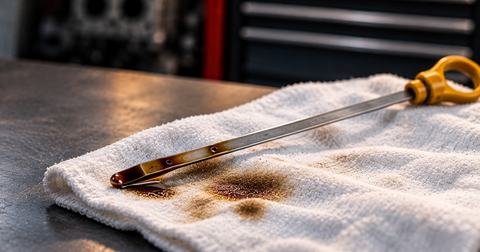
Yes, because the schedule covers the date, not the level. Pull the dipstick when you fill up, and look at where the oil sits between the two marks.
An engine that uses oil between changes, as some high-mileage cars do, needs the level checked more often. Don't wait for the next change to find out the level is low.

Two dipsticks, side by side
How far past the interval is too far?
On a Ford, change the oil within two weeks or 500 miles of the oil-change message, and never go past the one-year or 10,000-mile limit. Skipping oil changes can damage the engine, and the repair may not be covered by your warranty.
If the red oil pressure light comes on while you drive, stop somewhere safe right away and switch the engine off. That's an oil light problem and not a due date.

An oil warning light on the dash
From the documents
What do the carmakers' manuals say about oil change intervals?
Carmakers say it in different ways. Honda and Chevrolet leave the date to the oil-life monitor with a one-year limit, Ford's monitor runs up to one year or 10,000 miles, and Nissan's chart prints 5,000 miles or 6 months.
Owner's manual Maintenance schedule, footnote 1
If a Maintenance Minder message does not appear more than 12 months after the display is reset, change the engine oil every year.
Owner's manual Engine Oil Life System
The engine oil and filter must be changed at least once a year and the oil life system must be reset.
Owner's manual Scheduled Maintenance
Never exceed one year or 10,000 mi (16,000 km) between oil change intervals.
Owner's manual Maintenance schedule
Perform at number of miles, kilometers or months, whichever comes first.
Maker support page Oil change intervals using synthetic oil
Toyota vehicles requiring 0w-20 synthetic oil have oil change intervals of every 10,000-miles or 12-months, whichever comes first.
Conclusion
What to do next about changing your oil
Find the engine oil line in your manual and change the oil at its first limit, or when the monitor says change soon. If the manual points to a maintenance guide, read it.
Oil & Miles checks each interval here against the carmakers' owner's manuals.
Common questions
Asked most often
Is one year too long between oil changes?
It's the limit, not the target. Several carmakers set one year as the longest wait, and some cars need a change every 6 months, so check yours.
Can you go two years without changing the oil?
No. Change it at least once a year, even if the car sits. A car that is rarely driven still reaches the time limit.
Is it okay to go over 5,000 miles between oil changes?
It depends on your car's schedule or monitor. Some cars are set at 5,000 miles, and others let the monitor decide.
Should the oil filter be changed with the oil?
Yes, change the filter with the oil. Your manual may add its own note on the filter.
What people ask next

Sources
- 2018 Honda Accord Owner's Manual (US), the Maintenance Minder pages 603 to 609, the oil check page 614 and the Low Oil Pressure Warning page 677, for the oil life messages, the 12-month rule, checking the level at refuels and the oil pressure warning. Honda, read November 7, 2026
- 2022 Chevrolet Equinox Owner's Manual (US), pages 102, 262 to 264 and 327, for the Engine Oil Life System, the one-year limit, the 600-mile message, the reset and the full synthetic specification. Chevrolet, read November 7, 2026
- 2018 Nissan Altima Owner's Manual (US), maintenance section 9, pages 9-7, 9-8 and 9-12, for the 5,000 miles or 6 months interval and the severe driving list. Nissan, read November 7, 2026
- 2018 Ford F-150 Owner's Manual (US), Scheduled Maintenance, pages 561 to 565 and 568, for the Intelligent Oil-Life Monitor interval, the message rule, the fallback and the guideline table. Ford, read November 7, 2026
- Toyota Owners support article, "What are the oil change intervals using synthetic oil?", for the 10,000-mile and 12-month rule for 0W-20 synthetic oil, the 5,000-mile rule and the special operating conditions. Toyota, read November 8, 2026
- The US owner sites of Chevrolet, Ford, Toyota, Honda and Nissan, for where to find an owner's manual. Read November 7, 2026
- Three web guides on oil change intervals (AAA, Valvoline and Monro), for the 5,000 to 7,500 mile range and the longer synthetic ranges. Read November 7, 2026
AI illustration by Oil & Miles
This article is general information, not advice about your specific vehicle. See the disclaimer.