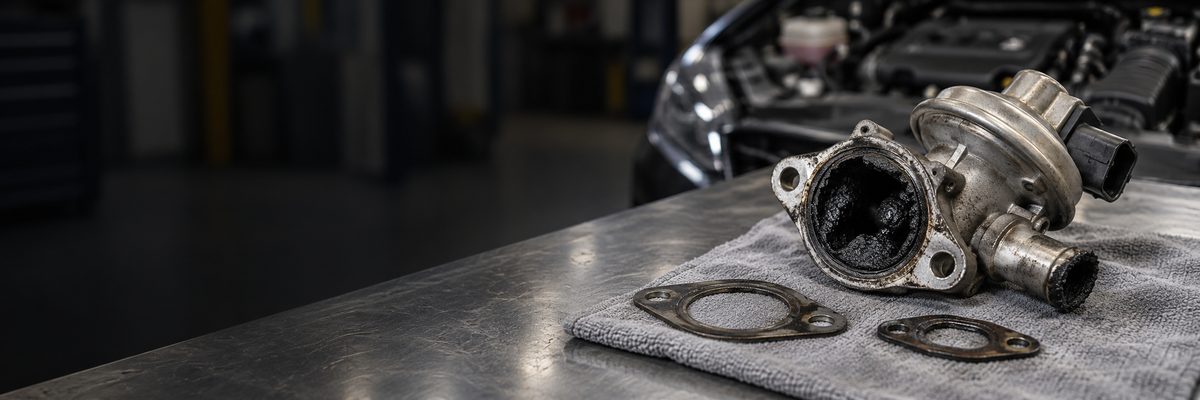

- Safe to drive?
- Yes, if it runs normally. If power drops, pull off safely. When to stop
- Check first
- Your VIN. Recalls and software updates come before any part. Step by step
- Emissions test
- It fails. A lit check engine light is enough to fail it.
The check engine light is on, a scan tool shows a P0401 code, and the quickest answer you'll find is a new EGR valve. The EGR system feeds a small, measured dose of exhaust back into the engine, which cools combustion and cuts the nitrogen oxides that make smog.
Carmakers' service bulletins describe 16 different P0401 problems on gas and hybrid cars. Half of them were fixed with a software update, and only three needed a new valve.
So a new valve can be the right buy, and it can also leave the light on. On the Chevrolet Volt, GM replaces the EGR cooler first, the small radiator that chills the exhaust gas, and the valve only if the code comes back, which can save you a second trip.
What's true about your P0401?
Other codes on the scan too? Every code we cover.
What does a P0401 code mean?
P0401 means the engine computer wanted exhaust gas to flow back into the engine and saw too little of it. GM's name for the code is “Exhaust Gas Recirculation (EGR) Flow Insufficient”, and other carmakers word it almost the same way.
Exhaust Gas Recirculation (EGR) Flow Insufficient
Whether exhaust gas flows back into the engine when the computer asks for it
Code layout per SAE J2012. Name: GM bulletin 18-NA-089. Related names: GM, Mitsubishi and FCA bulletins.
You may also see it written PO401, with a letter O, which is the same code. Kia's bulletins print it as P040100, with two extra digits on the end.
The computer opens the EGR valve when it wants flow, then checks for the change that flow should cause. Every car sold in the US since 1996 runs these self-tests.
California wrote the detailed rule for them and lets each carmaker choose how and when to check. So the test differs from one engine to the next.
The same rule asks for two separate EGR checks, one for too little flow and one for too much. P0401 is the “too little” result, and the code itself doesn't say which part caused it.
That gap matters for your wallet, because the valve has “EGR” in its name and gets blamed first. Yet the flow can also stop in the cooler, a passage or a fitting, or in the computer's idea of how much is enough.
The full list of codes, and how a family of codes works together, is on our check engine light codes page. It's the starting point if your scan shows more than one code.
The rule and the name 3 documents
- California Code of Regulations (13 CCR 1968.2), (e)(8.1). “The OBD II system shall monitor the EGR system on vehicles so-equipped for low and high flow rate malfunctions.”
- 13 CCR 1968.2 (e)(8.3.1). “Manufacturers shall define the monitoring conditions” for those malfunctions.
- GM bulletin 18-NA-089, March 2018. Names P0401 “Exhaust Gas Recirculation (EGR) Flow Insufficient”.
Can you drive with a P0401 code?
Yes, if the light is steady and the car drives normally. Two carmakers' bulletins for P0401 describe cars with the light on and no driving problem at all, and their fix is a software update.
A loss of power is different, and it's the one sign to take seriously. Some Chevrolet Volt owners describe a “propulsion power is reduced” message with P0401, and two carmakers have recalled EGR valves that can cut drive power.
If your car loses power, do these three things:
- Get off the road safely. One Volt owner had to leave the highway when the car slowed with this code. Treat a power warning as a reason to stop, not to push on.
- Check your VIN for recalls. Hyundai and Ford have recalled EGR valves that can fail and cut drive power. A dealer looks up your vehicle identification number (VIN) and does recall work free.
- Watch the temperature gauge. On some Ford 2.0-liter engines the cause is a leaking EGR cooler. On those engines, Ford lists the code alongside low coolant, white smoke and overheating warnings.
A steady light still costs you something: in states that test emissions, a lit check engine light fails the inspection. Our page on lights that come and go explains when the light turns itself off.
Power loss and recalls 6 documents
- 2016-2018 Mazda CX-9. Bulletin 01-017/18: P0401 “without any drivability issues”; the PCM is reprogrammed.
- 2020-2022 Nissan Sentra. Bulletins NTB22-067 and NTB22-067A: P0401, P0404 or both, with “no drivability concerns”; the ECM is reprogrammed.
- 2017 Chevrolet Volt. NHTSA complaint 11656896: “P0401 code caused the car to say 'propulsion power is reduced'. I was on the highway and had to pull off to find a safe place.”
- 2024 Hyundai Elantra, Kona and Venue. Recall 24V308: a short circuit in the EGR valve assembly can cause a loss of drive power.
- 2025 Ford and Lincoln models. Recall 26V122: the EGR valve may fail, with an unexpected loss of drive power, on certain Ranger, Nautilus, Mustang, Maverick, Explorer, Escape, Corsair, Bronco Sport and Bronco.
- 2019-2020 Ford Edge and Escape, Lincoln Nautilus and Corsair, 2.0L. Ford special service message (SSM) 48345: low coolant, white smoke, over-temperature warning and P0401 from an EGR cooler leaking coolant.
What are the symptoms of a P0401 code?
Often there's nothing but the light. The Mazda and Nissan bulletins above describe exactly that, and on those cars the software was too strict; no part had failed.
When there are symptoms, they point toward the cause, so they're worth noting before you see a shop. These are the ones the carmakers' documents and owners' complaints describe:
- A rough idle or a rattle at cold start. Toyota and Lexus describe this on hybrids whose EGR valve sticks from carbon, with the light and P0401.
- A loss of power. Volt owners report it with this code, and the Hyundai and Ford valve recalls cover it.
- Low coolant, white smoke or overheating. Ford ties these to a leaking or cracked EGR cooler on its 2.0-liter engines, and that's a cooler to inspect, not a valve.
- Other codes stored at the same time. A second code is a symptom too, and the codes listed with P0401 often say where to look.
A loss of power, a coolant problem or other codes all change the job, so mention them when you call the shop. A rough idle with no other code fits a sticking valve, while overheating or lost coolant points to the cooler.
Symptoms in the documents 3 documents
- 2010-2012 Toyota Prius, Prius v, Prius Plug-In. Toyota program ZF3: “rough idle and/or rattle noise from the transaxle at cold start due to a sticking Exhaust Gas Recirculation (EGR) Valve”, with P0401.
- 2011-2012 Lexus CT 200h. Bulletin L-SB-0015-16: rough idle, tapping at cold start, or both; “Due to excess carbon build-up at the valve assembly, the valve will stick”.
- 2024 Ford Edge, 2023 Lincoln Nautilus, 2.0L. TSB 24-2263: P0401 or P2457 with leaks, white smoke or over-temperature warnings.
What causes a P0401 code?
Anything that stops the flow can set P0401, and so can software that judges the flow too strictly. The drawing shows the part behind each of the five causes, numbered the same way as the list below.

Use this image
Free to republish under CC BY 4.0: credit Oil & Miles and link to this page. The snippet does both.
<a href="https://oilandmiles.com/articles/p0401-code"><img src="https://oilandmiles.com/assets/img/diagrams/p0401-code-causes-bench.svg" alt="Five numbered parts behind a P0401 code: 1 the engine computer, 2 an EGR valve, 3 an EGR cooler, 4 an EGR pipe and the fitting it enters, and 5 a fuse in the underhood fuse block with its wiring harness." width="1200" height="948"></a> <p>Diagram: <a href="https://oilandmiles.com/articles/p0401-code">Oil & Miles</a>, CC BY 4.0</p>The table below groups the 16 problems by how carmakers fixed them, most common fix first. Software updates top the list, well ahead of new valves and coolers.
| Fix the bulletin names | Problems | Where we found it |
|---|---|---|
| Software update | 8 | Mazda, Nissan, Mitsubishi, Hyundai, Kia, Jeep, Dodge and Ram |
| New EGR valve | 3 | Toyota and Lexus hybrids, Hyundai, Mazda |
| EGR cooler | 3 | Chevrolet Volt, two Ford 2.0-liter cases |
| Blocked fitting or duct | 1 | Nissan Rogue |
| Blown fuse or wiring | 1 | Chevrolet Volt |
One fix can fill several bulletins, so each number is a problem, not a document. Diesels are left out and covered further down.
These numbers come from carmaker bulletins, which cover known problems on specific models. They show what carmakers chose to fix, not how often each cause turns up at a shop.
Carbon in the valve and its passages is a real cause on older cars, and nobody has published a count of it. It stays on this list as a cause whose frequency isn't known, which isn't the same as rare.
| Cause | Test this first | Don't replace yet |
|---|---|---|
| Software that's too strict8 bulletin problems; the car can drive normally. | Ask the dealer whether an update covers your VIN. | The valve, before the software is checked. |
| A sticking or failed EGR valve3 bulletin problems, 2 name carbon; a cold-start rattle fits. | Have the valve inspected for carbon, as Mazda's alert does. | The cooler, when the valve shows heavy carbon. |
| A plugged or leaking EGR cooler3 bulletin problems; coolant loss or overheating fits. | A cooler flow check, or a pressure test if coolant is missing. | The valve on a Volt, before the cooler. |
| A blocked passage or fitting1 bulletin problem; the valve works but no gas arrives. | Look inside the fitting or duct the gas passes through. | The valve, if it opens and closes on command. |
| A blown fuse or wiring fault1 bulletin problem; other codes set at the same time. | Check the fuse and the harness for chafing. | The valve, before finding what blew the fuse. |
The order to test them in, cheapest check first, is in the fix steps below. The bulletins behind each row are listed at the end of this section.
1. Software that's too strict
Every P0401 test ends with the computer comparing what it measured against a threshold someone programmed. If that threshold is too tight, a healthy system fails its own exam, and the fix gets downloaded rather than bolted on.
For its CX-9, Mazda found the “detection logic for the DTC is too sensitive” and reprogrammed the computer. Seven other brands have done the same for P0401, so ask the dealer to check your VIN for an update before any part is ordered.
2. A sticking or failed EGR valve
The valve itself can stop opening far enough, and then too little gas gets through. The valve sits right in the path of exhaust soot, and two of the three valve bulletins name carbon that builds up until the valve sticks.
Mazda's alert sets the order: inspect the valve for carbon, and replace it only if carbon is found. Hyundai's Sonata bulletin replaces the valve without naming a cause.
Toyota went further on its 2010-2012 Prius hybrids and released an improved valve. If your car has had valve trouble before, ask whether a revised part number exists.
3. A plugged or leaking EGR cooler
Some engines, including the Volt's and Ford's 2.0-liter, cool the exhaust before it goes back in. They use a small radiator called the EGR cooler, and if soot plugs it, the flow comes up short even with the valve wide open.
GM tells technicians to replace the Volt's cooler first when P0401 is the only EGR code, and the valve only if the code returns. In Ford's 2.0-liter cases the cooler leaked or cracked, so a car losing coolant needs a cooler pressure test first.
4. A blocked passage or fitting
The gas also has to get through the pipes and fittings between the valve and the intake. A restriction there sets the same code as a stuck valve, because the computer only sees the missing flow.
Nissan found exactly that on its Rogue: a restriction in the EGR fitting on the intake air duct, fixed with a new duct. If the valve tests fine, ask the shop to look inside the passages before replacing it.
5. A blown fuse or wiring fault
An electric EGR valve needs power to move. If the fuse that feeds it blows, the valve stays where it is, and the computer reads no flow.
GM's Volt bulletin names a blown fuse first and lists nine other codes that can set with it. If your scan shows a pile of unrelated codes with P0401, put the fuse and the harness at the top of the list.
What doesn't cause P0401?
A valve stuck open doesn't: too much flow has its own code, P0402, because California's rule asks for a separate high-flow test. So if your scan shows P0402 rather than P0401, the causes on this page point the wrong way.
Bulletins by fix 16 problems
- 2016-2018 Mazda CX-9. Bulletin 01-017/18: software; built before January 8, 2018.
- 2020-2022 Nissan Sentra. NTB22-067 and NTB22-067A: software.
- 2019-2023 Mitsubishi Outlander Sport. TSB-23-13-004: software, P0401 and P0400.
- 2021-2022 Hyundai Santa Fe and Tucson hybrids and plug-ins. 22-FL-003H, 23-FL-001H and 23-EE-002H: software that revises the code logic.
- 2021-2023 Kia Sorento hybrid and plug-in. TSB ELE285: software.
- 2022 Jeep Grand Cherokee, 3.6L. 18-049-24 and 18-049-26: software, “CAUSE: PCM Software.”
- 2009-2011 Dodge Nitro, 2009-2012 Jeep Liberty. 18-092-16: software.
- 2014 Ram 2500 to 5500, 6.4L gasoline. 18-004-14 Rev. A, 18-042-15 and 18-096-16: software; P0401 “applies only to DJ/D2 vehicles”.
- 2010-2012 Toyota Prius, Prius v, Prius Plug-In; 2011-2012 Lexus CT 200h. T-SB-0075-13, program ZF3 and L-SB-0015-16: improved EGR valve.
- 2020-2021 Hyundai Sonata, 2.5L. 23-EE-009H: replace the EGR valve, 2.4 hours.
- 2016-2018 Mazda CX-9. Service alert SA-072/17: replace the valve if carbon is found.
- 2016-2019 Chevrolet Volt. 18-NA-089 and 24-NA-080: cooler first, then the valve if the code returns.
- 2019-2020 Ford and Lincoln, 2.0L EcoBoost. SSM 48345: EGR cooler leaking coolant.
- 2024 Ford Edge, 2023 Lincoln Nautilus, 2.0L. TSB 24-2263: a blocked coolant control valve can crack the EGR cooler; both are replaced.
- 2023 Nissan Rogue, 1.5L turbo. NTB23-015: restriction in the EGR fitting; replace the intake air duct.
- 2016-2019 Chevrolet Volt. 24-NA-080: a blown F3A fuse; check the engine harness.
How do you fix a P0401 code?
The first steps decide whether you need a part at all. To fix a P0401 code without paying for the wrong part, take the 5 steps below in order:
- Read every code and save the freeze frame. The freeze frame is the snapshot of engine data saved when the code set. A second EGR, fuse or coolant code changes where you look, so don't clear anything yet.
- Check your VIN for recalls and updates. A dealer looks up recalls, programs and software updates by VIN, and a free update may be the whole fix.
- Check the fuse and the wiring. On a car with an electric valve, a blown fuse stops it moving, so it's the cheapest thing to rule out.
- Have the valve tested, then inspected for carbon. A shop can open the valve with a scan tool and watch the engine respond. If it barely does, the valve comes off to be checked.
- Check the cooler and passages if the valve is clean. A plugged cooler or a blocked fitting stops flow through a valve that works. On a car losing coolant, the cooler gets a pressure test.
Where this can stall: a dealer may find no update for your VIN, and an independent shop may not have the carmaker's bulletins. Then ask which test showed the valve as the fault, and if the code returns after a new valve, go to step 5.
| Result | What it means | Next step |
|---|---|---|
| An update covers your VIN | The software may be too strict | Update, clear, and drive |
| Fuse blown, other codes too | The valve had no power | Find what blew it first |
| Valve barely changes the engine when opened | Little gas gets through | Inspect the valve for carbon |
| Valve clean, code returns | The blockage is further along | Check the cooler and fittings |
| Coolant missing, white smoke | The cooler may leak | Pressure-test the cooler |
What to say to the shop
When a quote names a new EGR valve before anything was tested, ask:
- Is there a software update for my VIN?
- What test showed the valve is the fault?
- Was the cooler or the passage checked?
“My car has P0401 and these other codes: [codes]. Can you check my VIN for recalls and updates first? And which test points to the valve rather than the cooler?”
A good answer: a VIN check first, then a result you can see, such as carbon on the valve or a cooler that fails its test.
How much does it cost to fix a P0401 code?
An EGR valve costs $127 to $306 as a part on the three cars whose bulletins name a new valve, and as little as $23 on an older Ford truck. On the Volt it's a dealer part, with a GM list price of $2,204.
An EGR cooler runs $67 to $255, but a software update under warranty costs nothing, so check your VIN first. Find your car below: the rows cover the cars carmakers' bulletins name for P0401, plus a 2003 Ford F-150, to show how low a valve price can go on an older engine.
| Vehicle | Part | Part price | Cheapest to priciest brand | Compare prices |
|---|---|---|---|---|
| 2010 Toyota Prius Hybrid1.8L | Valve | $142 – $257 | Delphi to Standard | |
| 2020 Hyundai Sonata2.5L | Valve | $127 | Standard, the only one listed | |
| 2016 Mazda CX-92.5L turbo | Valve | $306 | Standard, the only one listed | |
| 2017 Chevrolet Volt1.5L | Valve | $2,204 | GM Genuine, GM list price | Dealer only |
| Cooler | $255 | GM Genuine, the only one listed | ||
| 2024 Ford Edge2023 Lincoln Nautilus2.0L | Cooler | $67 | Standard, listed under Ford's number | |
| 2003 Ford F-1504.6L | Valve | $23 – $91 | Wells, two designs |
How we priced this: every EGR valve and cooler a large online parts catalog lists for each car, read October 14, 2026, closeouts left out. The catalog had no Volt valve, so that row shows GM's list price. Parts only, before tax, rounded to the nearest dollar from $10 up. How this was compiled.
Hyundai allows 2.4 hours of labor to replace the Sonata's valve, the only carmaker time we found for this job. Almost half of US shops charge $120 to $159 an hour, so that labor comes to $288 to $382.
Where the catalog listed only one brand for a car, that one price is all we have, and a dealer's part may cost more. The F-150's two Wells valves are different designs, one with a built-in solenoid, so match the part number to the one on your engine.
Parts and labor times 4 notes
- 2020-2021 Hyundai Sonata, 2.5L. Bulletin 23-EE-009H: “Replace EGR Valve”, op time 2.4 hours; “Normal warranty applies.”
- 2024 Ford Edge, 2023 Lincoln Nautilus, 2.0L. TSB 24-2263 lists EGR cooler K2GZ-9F464-B; the $67 Standard cooler is listed as that Ford number.
- 2010-2012 Toyota Prius. T-SB-0075-13: new valve 25620-37120 replaces 25620-37110.
- 2016-2019 Chevrolet Volt. GM's 24-NA-080 lists valve 19436521, and 2016 and 2017 cars get the later cooler design when it's replaced.
Will a P0401 code clear itself?
Not if the fault is still there. The computer runs the EGR test again on later drives, and it only passes when the flow is back where it should be.
That test runs only under the driving conditions each carmaker sets, so it can take a few drives to finish. Clearing the code switches the light off, but it also resets the self-tests, and an inspection station can send the car away until the tests finish.
So after a repair, ask how the shop confirmed it. GM's and Hyundai's procedures both end with the codes cleared and the car driven to check the code stays away, and that's the proof to ask for.
How is P0401 different from P0400, P0402 and P0404?
Each one names a different EGR check, so the code number alone tells you whether the problem is flow, wiring or the valve's position. Here are the neighbors, in the carmakers' own words:
| Code | Carmaker's name for it | What it means for you |
|---|---|---|
| P0400 | Exhaust Gas Recirculation System | A general EGR fault; Mitsubishi's update fixes it with P0401 |
| P0401 | EGR Flow Insufficient | Too little flow: this page |
| P0402 | EGR Flow Excessive Detected | Too much flow, the opposite test |
| P0403 | EGR Control Circuit Open | The wire to the valve, not the flow |
| P0404 | EGR Position Sensor Performance | The valve isn't where it was told to be |
| P0405 | EGR Position Sensor Circuit Low | The valve's position sensor wiring |
Names as printed in GM, Mitsubishi and FCA bulletins. Nissan calls P0404 “EGR A Control”, so wording varies by carmaker.
The other codes stored with P0401 in the bulletins also point to the cause. Coolant and temperature codes led Ford to the cooler, and a spread of unrelated codes led GM to a fuse.
On Hyundai and Kia hybrids, P0401 came with boost and turbo codes, and the fix was software. If your scan matches one of these patterns, mention it to the shop.
Which cars get a P0401 code most?
The Chevrolet Volt leads the complaints: 9 of the 28 owners who named P0401 in a federal complaint drove one. No other model reaches four, so read these as signals, not failure rates.
| Model | Complaints | Years named |
|---|---|---|
| Chevrolet Volt | 9 | 2016-2017 |
| Volkswagen Jetta | 3 | 2010, diesel |
| Toyota Prius | 2 | 2010 |
| Kia Niro | 2 | 2019, 2023 |
Every other model has one complaint. These are NHTSA complaints on 2010 to 2025 models, filed by owners and not confirmed by a shop.
Complaints show where owners noticed a problem, while bulletins show where a carmaker wrote a fix. For your make, the bulletin is the better guide, because it names the repair.
P0401 on a Chevrolet Volt
On a higher-mileage Volt with P0401 and no other EGR code, GM replaces the cooler first. The valve comes next only if the code returns after a test drive.
GM also says the 2016 and 2017 cars used an early cooler design, replaced with the later one when needed. Several Volt owners describe a “propulsion power is reduced” message with the code, so treat that message as a reason to stop.
P0401 on a Ford or Lincoln
On Ford's 2.0-liter EcoBoost engine, P0401 can come with a coolant problem, because both of Ford's documents trace it to the EGR cooler. One says the cooler can leak coolant into the intake and exhaust, and the other says a blocked coolant valve can crack it.
So on these engines, a low coolant level or white smoke matters more than the code. Ask for a cooler pressure test, and check your VIN, since a recall covers EGR valves on several newer Ford and Lincoln models.
P0401 on a Toyota Prius or Lexus CT 200h
Toyota's hybrids of the early 2010s had an EGR valve that could stick from carbon, with a rough idle or a rattle at cold start. Toyota and Lexus replaced it with an improved valve, and Toyota extended the warranty on it.
That extension ran ten years or 150,000 miles from first use, so a car sold new in 2012 lost that coverage in 2022. If your Prius has the original valve, the improved part number is the one to ask for.
P0401 on a Hyundai, Kia, Mazda or Nissan
These four carmakers have mostly fixed P0401 with software, on the Santa Fe, Tucson and Sorento hybrids, the CX-9 and the Sentra. Hyundai's Sonata is the exception, with a new valve under normal warranty.
Nissan's Rogue had a different cause: a restricted fitting on the air duct. For any of these cars, the dealer's VIN check is the first step, because the update, if it exists, costs less than any part.
P0401 on a Honda, Toyota Camry, Chevrolet Silverado or Jeep Wrangler
We found no carmaker bulletin naming P0401 on a Toyota Camry, a Chevrolet Silverado or a Jeep Wrangler. On those, the causes and the test order above are the whole guide, starting with the codes and a VIN check.
Honda's only P0401 document we found is old: a warranty extension for 1999 to 2003 Odyssey vans and the 2003 Pilot, for a contaminated EGR valve or a clogged EGR port. Its pages aren't public, so we can't give its terms or say whether any car is still covered.
P0401 on a diesel
Diesel engines have their own set of P0401 bulletins. GM's Duramax vans and Ford's 6.7-liter Super Duty had plugged or restricted EGR coolers, and Ram's diesel pickups carry dozens of software updates.
Volkswagen's TDI bulletins tie P0401 to high soot loads. If you drive a diesel, expect the cooler and the soot system to come up early in the diagnosis.
Make notes and diesel 8 documents
- 2016-2018 Chevrolet Volt. GM 18-NA-089: “On higher mileage vehicles that have DTC P0401 set and no other EGR DTC, it is recommended to replace the EGR cooler.”
- 2016-2019 Chevrolet Volt. GM 24-NA-080: “The 2016/17 MY used an early design EGR cooler.”
- 2010-2012 Toyota Prius family. Toyota POL16-04 (ZF3): secondary coverage “10 years from the date of first use or 150,000 miles”.
- 2010-2011 Chevrolet Express, GMC Savana, 6.6L diesel. GM special coverage 14370: plugged EGR cooler, 10 years or 150,000 miles.
- 2013-2014 Chevrolet Express, GMC Savana HD, 6.6L diesel. GM special coverage 18287: “Typically, DTC P0401 will be stored as the result of a plugged EGR cooler”; 10 years or 120,000 miles.
- 2011-2014 Ford Super Duty, 6.7L diesel. TSB 13-6-5 (restricted cooler core) and program 21M04: no-cost cooler repair for 11 years or 120,000 miles.
- 1999-2003 Honda Odyssey, 2003 Honda Pilot. Honda campaign 05-026 (2008), from NHTSA's index summary: a warranty extension because EGR valve contamination or EGR port clogging may cause P0401; the document's pages are withheld.
- 2009-2014 Volkswagen Golf, Jetta and Beetle TDI. TB011330 family: P0401 with high soot loads before regeneration.
What the data says
A 2023 Kia Niro owner wrote that the dealership found a plugged cooler, a valve to replace and “excessive buildup in emission tube”. The car had covered less than 35,000 miles.
NHTSA consumer complaints received through September 30, 2026.
Who pays for a P0401 repair?
On a newer car, the carmaker may. Hyundai's Sonata valve bulletin says normal warranty applies, and the Hyundai and Ford recalls on EGR valves are free at a dealer.
The older programs end by age or mileage: ten years for Toyota's Prius extension and GM's Duramax coverages, eleven for Ford's 6.7-liter program. Compare each limit with your own car's warranty start date.
So check your VIN at a dealer even if you plan to use an independent shop. A recall or an update costs you nothing, which makes that visit the cheapest check on this page.
From the carmakers
What the carmakers say about P0401
The carmakers' own documents are where the order of the repair comes from. These are their lines, quoted, with what each one means for your car.
Each card shows which cars it covers and who pays. A dealer can tell you in one VIN check whether any of them applies to yours.
Bulletin 24-NA-080
Vehicles that have DTC P0401 set and no other EGR DTC, it is recommended to replace the EGR cooler for this condition first and re-test.
Bulletin TSB 24-2263
This may be due to a transmission fluid heater coolant control valve restricting flow and possibly causing the EGR cooler to crack.
Bulletin 23-EE-009H
Use GDSM to verify DTC P0401 EGR Flow Insufficient. If DTC P0401 is present, proceed to replace the EGR Valve.
Bulletin 01-017/18
This concern may be caused by the detection logic for the DTC is too sensitive.
Conclusion
What should you do about a P0401 code?
Treat P0401 as a flow problem to find, not a valve to buy. Here's what to do about a P0401 code, based on the carmakers' documents:
- It measures flow, not a part. The computer saw too little exhaust gas come back, and the code doesn't say where it stopped.
- Drive on if the car runs normally. Stop if power drops, and check your VIN for the Hyundai and Ford valve recalls.
- Software comes up most. Eight of the 16 gasoline and hybrid problems in carmakers' bulletins are fixed with an update, against three with a new valve.
- Test in order. Codes and freeze frame, VIN check, fuse, valve, then cooler and passages.
- Know the part price. A new valve costs $127 to $306 on the Prius, Sonata and CX-9, and $2,204 from a GM dealer on the Volt. A cooler costs $67 to $255, and labor is extra.
Every step here traces to a carmaker's document you can open. Take the bulletin numbers on this page to the shop and ask whether any of them matches your VIN.
Common questions
Asked most often
What is the main cause of EGR failure?
Carbon, for the valve itself: Lexus and Mazda name carbon build-up on it, and GM names carbon plugging the cooler on its Duramax diesel vans. For the P0401 code as a whole, though, carmakers' bulletins name a software update more often than any failed part.
Can I clean the EGR valve instead of replacing it?
No carmaker document we read prescribes cleaning: Mazda's alert has the valve inspected for carbon and replaced only if carbon is found. If a shop offers cleaning, ask how it will confirm the code is gone afterward.
Will a bad EGR valve hurt my engine?
Carmakers' documents describe a rough idle, a cold-start rattle and, on some cars, a loss of power. None of them describes engine damage from P0401 alone, though a leaking cooler that loses coolant is a separate risk to fix quickly.
How long does a P0401 repair take?
Hyundai allows 2.4 hours to replace the valve on its Sonata. We found no carmaker time for a software update or a cooler.
Can I just unplug the EGR valve?
No. The light stays on, the car fails an emissions test, and the EGR system stops doing its job of cutting smog.
What people ask next
Sources
- California's OBD II rule, 13 CCR 1968.2, section (e)(8), for the EGR flow tests. California Air Resources Board, read October 14, 2026
- GM bulletins 18-NA-089 and 24-NA-080, for the Volt's repair order, fuse and parts. General Motors, filed with NHTSA, read October 14, 2026
- GM special coverages 18287 and 14370, for the Duramax van coolers and their limits. General Motors, filed with NHTSA, read October 14, 2026
- Ford TSB 24-2263, SSM 48345 and program 21M04, with TSB 13-6-5, for the 2.0-liter and 6.7-liter diesel coolers. Ford Motor Company, filed with NHTSA, read October 14, 2026
- Hyundai bulletin 23-EE-009H, with 22-FL-003H, 23-FL-001H and 23-EE-002H, for the Sonata valve and the hybrids' software. Hyundai Motor America, filed with NHTSA, read October 14, 2026
- Mazda bulletin 01-017/18 and service alert SA-072/17, for the CX-9 software and the carbon check. Mazda North American Operations, filed with NHTSA, read October 14, 2026
- Nissan bulletins NTB22-067, NTB22-067A and NTB23-015, for the Sentra software and the Rogue fitting, and Nissan's name for P0404. Nissan North America, filed with NHTSA, read October 14, 2026
- Toyota warranty program ZF3 (POL16-04), bulletin T-SB-0075-13 and Lexus L-SB-0015-16, for the sticking valve and its coverage. Toyota Motor Sales, filed with NHTSA, read October 14, 2026
- Mitsubishi TSB-23-13-004, Kia TSB ELE285, FCA 18-049-24 and 18-092-16, with 18-049-26, for the software updates. Filed with NHTSA, read October 14, 2026
- FCA bulletins 08-272-26 Rev. A, 18-061-24 and 18-040-17 Rev. A, for the names of P0402 to P0405. FCA US LLC, read October 14, 2026
- Volkswagen bulletin TB011330 family, for P0401 with high soot loads on TDI engines. Volkswagen of America, filed with NHTSA, read October 14, 2026
- 40 CFR 85.2222, for why a lit light or unfinished self-tests fail an emissions test. eCFR text, read on Cornell's Legal Information Institute, October 14, 2026
- Honda campaign 05-026, the Odyssey and Pilot EGR warranty extension; only NHTSA's summary is public. American Honda, filed with NHTSA in 2008, read October 14, 2026
- NHTSA recalls 24V308 and 26V122, for the EGR valves that can cut drive power. NHTSA recall file, read October 14, 2026
- NHTSA's consumer complaint database, for the 28 P0401 complaints and the owners quoted. NHTSA consumer complaints received through September 30, 2026
- Delphi's EGR valve page, for how EGR cuts combustion heat and nitrogen oxides. Delphi Technologies, read October 14, 2026
- GM list price for Volt EGR valve 19436521. General Motors, list price shown in a GM dealer parts catalog, read October 14, 2026
- RockAuto catalog, every brand listed as fitting each car, part types EGR Valve and EGR Cooler; closeouts and out-of-stock rows left out. RockAuto, read October 14, 2026
- PartsTech's 2025 survey of 752 US shops, as reported by MOTOR, for the $120 to $159 an hour that almost half of them charge. MOTOR, read September 27, 2026
How this was compiled
The source is NHTSA consumer complaints received through September 30, 2026, on 2010 to 2025 models. Of those complaints, 28 name P0401.
The bulletins were found by searching NHTSA's archive of manufacturer communications for P0401, then read in full; some name the code only inside the PDF. Some fixes run to several bulletins and revisions, so the tables list each fix as one problem.
The cars priced are the gasoline and hybrid cars whose bulletins name an EGR valve or cooler for P0401, plus one older Ford truck. Labor comes only from a carmaker's own warranty time.
What we didn't do
We didn't scan a car, test a valve or clean a cooler for this article. Everything here comes from the regulation, the carmakers' documents, the complaint file and a parts catalog, read at source.
We didn't read owner forums either, so the page has no owners' box, only owners' words from the federal complaint file. Forum advice about which part to buy first is exactly what this page tries to check.
We read Ram's diesel bulletins only for their engine and their fix, and we left out the heavy-truck makers' bulletins. We give no national average for the repair, because we found none we could trace, and no failure rate by make, because complaint counts aren't rates.
Prices are ranges compiled in October 2026 for the US market and vary by region, engine and shop rate. Prices from $10 up are rounded to the nearest dollar, so $14.13 reads as $14 and $14.52 as $15. Below $10 they're exact. This article is general information, not advice about your specific vehicle. See the disclaimer.