
A P0174 code points at one half of your engine, and that half is rarely the place to start. Most of the owners and bulletins that name it name the bank 1 code too.
So the useful question isn't what sits on bank 2. It's what both banks share: the air coming in, the fuel pressure, or the computer's own software, and carmakers have written down which of those they found.
What does a P0174 code mean?
It means fuel trim hit its limit on bank 2. The computer reads your exhaust and adds fuel when the mixture looks short, and once it has added all it's allowed to and the exhaust still reads lean, it stores P0174.
Bank 2 ran lean
System Too Lean Bank 2
What the computer saw
The computer added all the fuel it's allowed to on bank 2, and the exhaust still read lean.
- Code
- P0174
- System
- Powertrain
- Area
- Fuel and air metering
- Standard
- Generic OBD-II
- Checks
- Whether long term fuel trim on bank 2 has reached its limit
What it doesn't prove
It doesn't prove a part on bank 2 has failed. An air leak, the air flow sensor, fuel pressure or the computer's software can set it on both banks.
Code name from Toyota bulletin T-SB-0009-23.
Toyota's bulletins print this OBD-II code as System Too Lean Bank 2, and GM's as Fuel Trim System Lean Bank 2. If you've typed it as PO174 with a letter O, that's the same code, and Toyota's Tundra documents print it as P017400.
Which side is bank 2?
Bank 2 is the half of the engine that doesn't contain cylinder 1. On a V6 or V8 that's one cylinder head with its own oxygen sensor, and an inline four-cylinder has one bank and can't set this code at all.
It isn't necessarily the passenger side, because where the banks sit changes from engine to engine. Find cylinder 1 in your owner's manual or the firing order, and bank 2 is the other head.
On some transverse V6 engines that puts bank 2 at the front, the side you can reach. Our P0430 page draws one such engine from above.
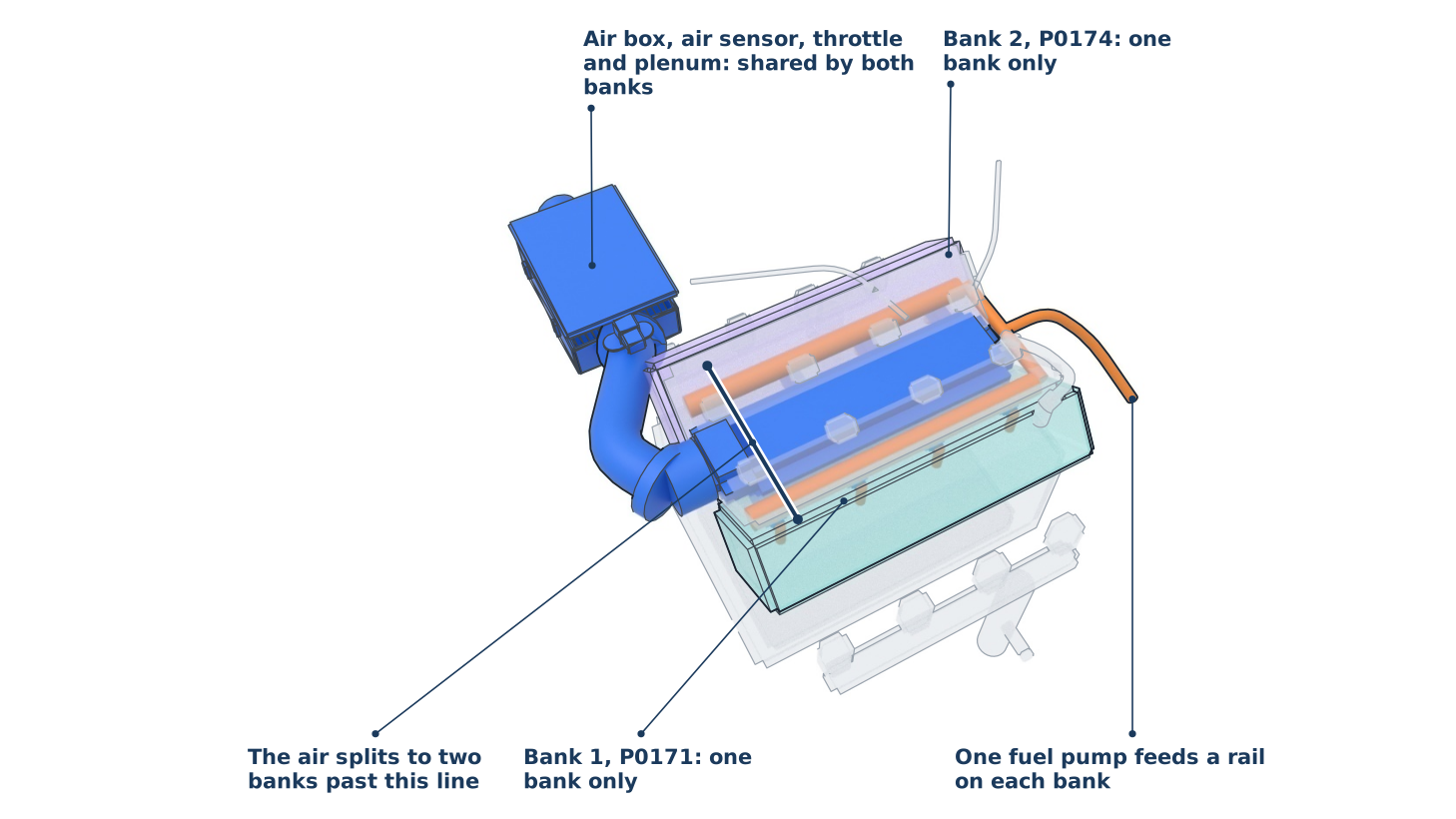
Use this image
Free to republish under CC BY 4.0: credit Oil & Miles and link to this page. The snippet does both.
<a href="https://oilandmiles.com/articles/p0174-code"><img src="https://oilandmiles.com/assets/img/diagrams/p0174-code-shared-air-bench.svg" alt="A V8 engine seen from above, front at the left. Air enters an air box, passes the air sensor and the throttle into one intake manifold, and only past a marked bar splits to two banks: bank 1 labeled P0171 and bank 2 labeled P0174. One fuel pump feeds a rail on each bank. Everything before the bar is shared by both banks" width="1200" height="675"></a> <p>Diagram: <a href="https://oilandmiles.com/articles/p0174-code">Oil & Miles</a>, CC BY 4.0</p>Can you drive with a P0174 code?
For a short while, but not indefinitely. Owners report stalling, so book the repair rather than keep driving. If the check engine light flashes or it misfires heavily, stop and have it towed, since a misfire can overheat the catalytic converter.
Toyota's fuel pump recalls name stalling while driving as the risk. One Toyota tech tip adds that a lean condition may damage the catalytic converter.
What are the symptoms of a P0174 code?
Sometimes the light is all you get, because the computer keeps correcting the mixture until it runs out of room. When you or other owners do feel it, these are the P0174 symptoms the complaints describe:
- Stalling. The most serious thing owners report, and the reason a lean code isn't a wait-and-see item.
- Rough idle, hesitation or lost power. Owners describe the engine running rough or pulling weakly.
- A failed emissions test. Some owners write that a state test caught it.
- Misfires. Air without enough fuel burns badly, and a misfire code such as P0300 can arrive with it.
None of these names the cause on its own. The fuel trim reading on both banks, step 2 of the fix below, is what narrows it.
Does a P0174 code always come with P0171?
Not on every car, but in owners' complaints and in carmaker bulletins it does more often than not. P0171 is the same measurement on bank 1, and when the cause is something the two banks share, both codes tend to set together.
So if your P0174 is on its own, with bank 1 reading normally, you're in the smaller group. Then the search does narrow to that side, which the last of the causes below covers.
What causes a P0174 code?
P0174 sets when something leaves bank 2 short of fuel for the air it gets. Four of the five causes below are shared by both banks, which is why most of the documents that name P0174 name P0171 with it.

Use this image
Free to republish under CC BY 4.0: credit Oil & Miles and link to this page. The snippet does both.
<a href="https://oilandmiles.com/articles/p0174-code"><img src="https://oilandmiles.com/assets/img/diagrams/p0174-code-engine-bench.svg" alt="The front of a small SUV with the hood off and a V8 underneath, with the parts this page names in color and numbered to match its sections: 1 an air leak both banks share, at the intake boot, PCV tube and intake, 2 an air flow sensor reading low, 3 fuel pressure both banks share, at both fuel rails, 5 something on bank 2 alone, the head without cylinder 1. The engine computer's software isn't drawn." width="1200" height="675"></a> <p>Diagram: <a href="https://oilandmiles.com/articles/p0174-code">Oil & Miles</a>, CC BY 4.0</p>1. An air leak both banks share
Air that slips in past the air flow sensor goes uncounted, and both banks get fuel for the smaller number. GM found exactly this behind a cracked rubber intake boot, and its fix is a new air cleaner outlet duct.
On older engines the complaints point lower down, to intake manifold and valve cover gaskets. Any of these is a vacuum leak, air the meter never counted, and step 3 of the fix below is how to ask for the smoke test that finds one.
2. An air flow sensor reading low
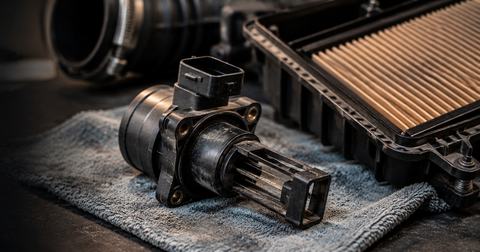
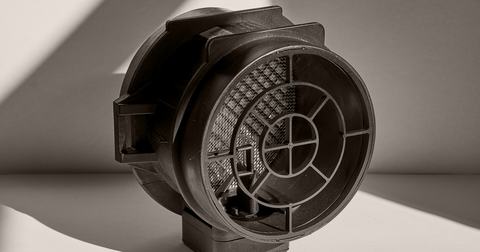
The mass air flow sensor is the one meter both banks are fueled from. If it reads less air than is really entering, the computer under-fuels both sides by the same share, and both codes can follow.
A sensor that fails outright sets its own codes, P0101 to P0103, so a lean pair with none of those codes doesn't rule the sensor out. On 2010–2013 Camaro SS and Corvette V8s, GM traced a skewed reading to a loose air cleaner pad, so the lid comes before the sensor.
3. Fuel pressure both banks share
One pump feeds both fuel rails, so a weak pump leaves both banks short of fuel for the air they get. Toyota's bulletin ties it to hard starts as well as the warning light.
Toyota wrote this down for a long list of its models: P0171 and P0174 with the low-pressure code P0087. It confirms the pressure with a gauge before replacing the pump.
4. The engine computer's software
Sometimes no part is at fault and the computer's own settings are what read lean. The fix is then a reprogram, a short job at a dealer with no part in the bill.
Ford wrote exactly that for 2019–2021 F-150s with the 5.0L V8, with P0171 and P0174 among the stored codes. Its labor time is a fraction of an hour.
5. Something on bank 2 alone
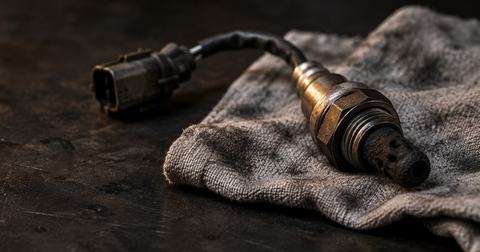
When bank 1 reads normally, the fault sits past the point where the intake splits. That leaves bank 2's own oxygen sensor, its injectors, and any vacuum line that feeds only those cylinders.
It's the smaller group in the record, because most complaints name P0171 too. Toyota has traced a bank 2 lean code to a blockage in that bank's own fuel rail, and a shop can tell you which group you're in from the two trim numbers before anything is unbolted.
How do you fix a P0174 code?
Find out whether bank 1 is lean too, before anything is replaced. To fix a P0174 code, start by reading every stored code, in this order:
- Read every stored code, not just this one. Any scan tool shows them. If P0171 is there as well, stop treating bank 2 as the place to look.
- Ask for long term fuel trim on both banks. Read at idle and again at a steady cruise. If both banks read lean, look at the parts they share. If only bank 2 does, look at bank 2.
- Ask for a leak check of the intake. Ask for a smoke test by name: it shows where a vacuum leak lets in air, and our vacuum leak guide covers how a shop runs it.
- Ask for a fuel pressure reading with a gauge. That's how Toyota's bulletin proves a weak pump before it replaces one.
- Check the recalls and bulletins. Run your VIN for Toyota's pump campaigns, and a dealer can tell you whether your car still needs the pump or Ford's software.
What to say to the shop
When a quote names a part before any test has run, ask:
“I have P0174 and these other codes stored: [codes]. Before you replace an air flow sensor, a gasket or a fuel pump, can you show me long term fuel trim on both banks, run a smoke test and a fuel pressure test, and tell me which result points at the part?”
A good answer: both trim numbers and the gauge reading behind the part it names, and a written quote with the part, the hours and the rate.
What does it cost to fix a P0174 code?
Often little: the first test is cheap, and on some Toyotas a recall replaces the pump free. A smoke test of the intake is a $100–$200 fee at independent shops, and an intake boot or an air flow sensor is the small end of the bill.
A fuel pump is the big one. When no recall or Toyota program covers it, a new pump runs $494–$584 on a 2019 Toyota Tundra 5.7L and $442–$973 on a 2019 Tacoma 3.5L at an independent shop, parts and labor.
Who pays for a P0174 repair?
Sometimes the carmaker does, through a recall or a bulletin. On some Toyotas, fuel pump recalls replace the pump free at a dealer.
A recall doesn't end when the warranty does, so the VIN, the 17-character number on your registration, decides it. Our free VIN checker lists the campaigns for your model year, and a dealer confirms whether yours is still open.
Will a P0174 code fail an emissions test?
It can, while the code is stored. In states that read the car's computer at inspection, owners describe the test catching it.
Clearing the code doesn't get it through. It sets the car's self-checks, the tests of each emissions system, to "not complete" until each has run again, as California's OBD-II rule requires. After the repair, the computer reruns those tests before it reports the system ready.
So fix the cause first and drive before the retest. Our P0442 page explains what an emissions station sees while those monitors still read not ready.
From the carmakers
What do the bulletins blame for P0174?
Air, fuel pressure or software on most cars, and a bank 2 part on one Toyota truck. General Motors names a cracked intake boot, Toyota a weak pump and Ford its own software.
Toyota's two pump recalls replace the pump free. Its Tundra tech tip traces a bank 2 lean code to debris in that bank's fuel pipe.
Recall 20V-012
The fuel pump can lose pressure, and the engine can stall while driving.
Recall 20V-682
The expanded fuel pump recall, with the same risk of stalling while driving.
Service bulletin 22-2393
This may be due to various software parameters within the PCMFord, Oct 2022
Bulletin 22-NA-171
This condition may be caused by possible cracked/failed rubber intake bootGM, Jan 2023
Tech Tip T-TT-0718-22
Debris in the bank 2 fuel delivery pipe sets P017400 and P043000, and a lean condition may damage the catalyst.
Owners' complaints show who reported, not how often a part fails. One minivan from around 2000, the Ford Windstar, has the most complaints by far.
- P0174 with P0171. Of the 14 complaints on 2010–2025 models, 11 name both codes, as do 58 of the 69 across every model year and 70 of the 82 bulletins that name P0174.
- Ford Windstar. The 1999–2003 Windstar has 23 of the 69 complaints, 8 of them describing gasket repairs.
- Other models. The F-150, Silverado 1500 and Highlander have 3 complaints each.
- Symptoms in complaints. Of the 69, 11 mention stalling, 10 rough running or lost power, 6 misfires and 4 a failed state test.
Conclusion
What to do next about a P0174 code
Read every stored code and fuel trim on both banks, and find out what the banks share before anyone looks at bank 2. Run your VIN for Toyota's pump recalls or Ford's software, and treat stalling as a reason to stop and have it checked, as what to do when the car shuts off explains.
Oil & Miles checks each step here against the carmakers' bulletins and recalls and NHTSA's complaint file.
Other OBD-II fuel trim codes and what each one means
Common questions
Asked most often
Is PO174 the same code?
Yes. PO174 with a letter O is a common way to type P0174, and a bulletin that prints P017400 means the same code.
What happens if I leave a P0174 code?
It can stall, and Toyota notes that a lean condition may damage the catalytic converter. Book the repair rather than keep driving.
Is a P0174 code a DIY fix?
Partly: any scan tool reads every stored code, and checking the VIN for Toyota's pump recalls is free. The smoke test of the intake and the fuel pressure reading with a gauge are what you ask a shop for.
Which cars get P0174 most?
In the federal record, the Ford Windstar from around 2000, with about a third of the complaints ever filed. No other vehicle has more than a few.
What people ask next
Sources
- General Motors Bulletin 22-NA-171, January 2023, Chevrolet Colorado and GMC Canyon 2017 to 2022, for a cracked intake boot setting P0171 and P0174. General Motors, read September 23, 2026
- Toyota Technical Service Bulletin T-SB-0009-23, February 9, 2023, 2014–2020 Toyota models, for a fuel pump losing pressure, its coverage of 60 months or 60,000 miles (7 years or 70,000 miles on some California-certified cars), and its wording of the code, "System Too Lean Bank 1/Bank 2" (page 3). Toyota Motor Sales, read September 23 and October 4, 2026
- Ford Technical Service Bulletin 22-2393, October 18, 2022, 2019–2021 F-150 with the 5.0L V8, for the reprogramming and its 0.3 hour labor time. Ford Motor Company, read September 23, 2026
- NHTSA's technical service bulletin index, for the 82 bulletin numbers naming P0174 and the 70 that also name P0171. NHTSA, read October 3, 2026
- NHTSA recall campaigns 20V012 and 20V682, for the Toyota fuel pump recalls, the vehicles on each list and the stalling consequence. NHTSA, read October 3, 2026
- PartsTech's September 2025 survey of about 700 US independent shops, as reported by Ratchet+Wrench (August 19, 2026), for the $100 to $139 an hour that nearly half of them charge. Ratchet+Wrench, read October 17, 2026
- NHTSA's consumer complaint database, every model year and 2010 to 2025, for the complaint counts, the symptoms and the Windstar concentration. NHTSA, data as of August 25, 2026
- Parts and labor figures: Toyota customer support program 23TE05, for the pump time on the 2019 Tundra 5.7L, and Toyota recall 20TA02 (NHTSA 20V-012), operation TA0214, for the 2019 Tacoma 3.5L, each with catalog part prices. Toyota via NHTSA, read October 16 and 17, 2026
- US shops' own price pages: Tedious Auto Repair (CA), S&K Auto (KS), Fix Service (NY), Motor Medicine (CO) and Front Line Auto (FL), for the smoke test price. Shop websites, read October 31, 2026
- General Motors bulletin PIP4813C, November 2014, 2010–2013 Camaro SS and Corvette, for the loose air cleaner pad that skews the air flow sensor's input. General Motors, read September 23, 2026
- 13 CCR 1968.2, sections (e)(7.1) and (f)(4.1), for the primary and secondary oxygen sensors and the readiness status that clearing the code resets to "not complete". California Air Resources Board, read October 3, 2026
- Toyota Tech Tip T-TT-0718-22, December 22, 2022, 2022 Tundra and Tundra hybrid, for debris in the bank 2 fuel delivery pipe and the note that a lean condition may damage the catalyst. Toyota Motor Sales via NHTSA, read October 4 and 6, 2026
- Toyota Technical Service Bulletin T-SB-0030-23 Rev2, May 23, 2024, 2022–2024 Tundra and Tundra hybrid and 2023–2024 Sequoia hybrid, for the bank 2 fuel rail restriction, its repair time and the code printed as P017400. Toyota Motor Sales via NHTSA, read November 2, 2026
AI illustration by Oil & Miles
How this was compiled
The complaint figures cover every form owners write the code, including PO174 with a letter O. The model figures cover every one of those complaints, not a sample.
What we didn't do
We didn't test a repair. Everything here is the federal record, the makers' own bulletins and parts prices, and the pump hours come from Toyota's own recall and support program.
Prices are ranges compiled in November 2026 for the US market and vary by region, engine and shop rate. Prices from $10 up are rounded to the nearest dollar, so $14.13 reads as $14 and $14.52 as $15. Below $10 they're exact. This article is general information, not advice about your specific vehicle. See the disclaimer.