
Short answer
A ceramic honeycomb, coated in three precious metals
It turns three pollutants into three harmless gases as the exhaust passes over it. The steel case costs very little. Rhodium, the metal that handles nitrogen oxides, averaged an estimated $5,800 a troy ounce in 2025, and nothing else does its job.
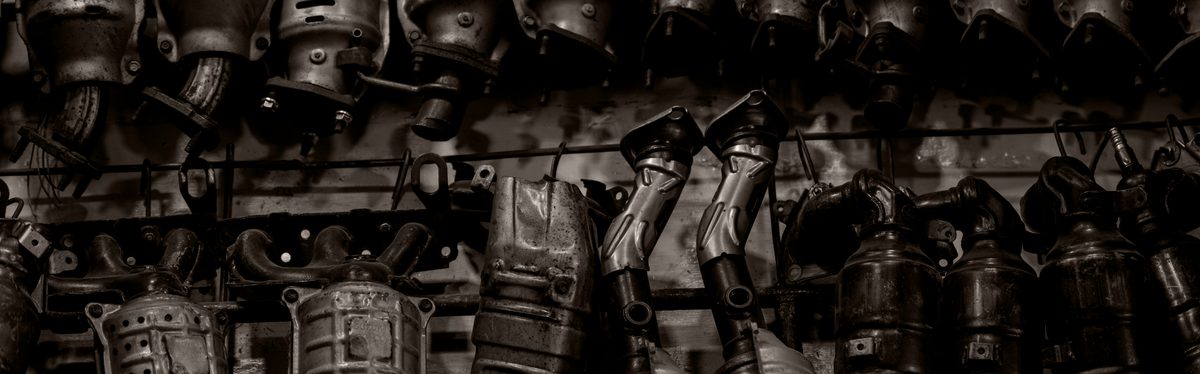
OilAndMiles.com - What a catalytic converter is, in one sentence: a metal box in the exhaust with a ceramic honeycomb inside it, and that honeycomb is coated with platinum, palladium and rhodium. Exhaust gas passes through thousands of tiny channels, meets those metals at temperature, and comes out the other side chemically different. Nothing moves and nothing is consumed: the converter is a chemistry set with no moving parts, bolted under a car.
That explains the two things people find hardest to believe about it. It can last the life of the car, because nothing wears out in the ordinary sense. And it can cost more than any other single part on the exhaust, and what a catalytic converter costs is set by what is painted inside it, because of what is painted on the inside.
Most explanations stop at "it reduces emissions". The useful version is the one that tells you which metal does what, why the price of the part moves without anything about your car changing, and why federal law won't let anybody simply take it off.
What does a catalytic converter actually do?
An engine that burns fuel perfectly would produce carbon dioxide and water. Real engines also produce carbon monoxide, unburnt hydrocarbons, and nitrogen oxides. The converter deals with all three, which is why the modern one is called a three-way converter.
Two of those jobs are oxidation: adding oxygen to carbon monoxide and to unburnt fuel so they leave as carbon dioxide and water. The third is reduction, and it works the other way, stripping oxygen back out of nitrogen oxides so they leave as plain nitrogen. Doing both at once, in the same box, is the trick, and it's why the mixture going into the engine has to be held so precisely.
It wasn't always this way. EPA's own account of the technology records that early converters were oxidation converters only, dealing with hydrocarbons and carbon monoxide and containing platinum, palladium or both.
In 1980 or 1981, earlier on some California vehicles, manufacturers began fitting converters that also reduced nitrogen oxides. Those needed rhodium, and they needed something else too: computer control and oxygen sensors, to hold the air to fuel ratio precisely enough for both reactions to happen together.
That's the part worth carrying away. The oxygen sensors on your car aren't there to watch the converter. They're there because the converter can't work without them.
Muffler vs catalytic converter: what's the difference?
Two cans in the same pipe doing two unrelated jobs. That is the whole reason the question gets asked, because from underneath they look like the same thing. What separates them:
- The converter changes what is in the gas. Carbon monoxide, unburnt fuel and nitrogen oxides go in and come out as carbon dioxide, water and nitrogen, which is the chemistry the section above describes.
- The muffler changes how loud it is. It is chambers and pipe, with no coating and no chemistry, and it leaves the gas exactly as it found it. A resonator is a third can doing the same kind of work on particular frequencies.
- They sit in different places, and for a reason. The converter is near the engine because it needs the heat to work at all. The muffler is at the back, where the gas has already been dealt with.
- Only one of them is regulated. The converter is an emission control component: Section 203 of the Clean Air Act makes bypassing one illegal, and the federal performance warranty runs 8 years or 80,000 miles on it. Neither rule is about a muffler.
- They fail differently, which is how you tell which one you have. A converter that has stopped converting is silent and sets a code, usually P0420. A failed muffler is loud and sets none. A converter that has broken up rattles, and that one can sound like a muffler until somebody looks.
The prices aren't in the same class either, and that's what makes the mix-up expensive: the converter is the one carrying rhodium.
Which of the three metals does what?
Platinum and palladium handle the oxidation. They do much the same job, and palladium has replaced most of the platinum in gasoline engines for a plain commercial reason: it used to be cheaper. The US Geological Survey notes that palladium substitutes for platinum in most gasoline-engine converters on exactly that basis, and that around 25% of the platinum in a diesel converter can routinely be swapped for palladium, sometimes as much as 50%.
Rhodium is the different one. It handles the nitrogen oxides, and there's no substitute for it. That single fact is behind almost everything strange about converter pricing.
| Metal | Per troy ounce, 2025 | What it does |
|---|---|---|
| Rhodium | $5,800 | Handles the nitrogen oxides, and there's no substitute for it. It's also why a converter's price moves without anything else changing |
| Platinum | $1,200 | Oxidizes carbon monoxide and unburned fuel. The United States imports 89% of what it uses |
| Palladium | $1,100 | Does platinum's job and replaced most of it in gasoline engines, because it used to be cheaper. Import reliance is 57% |
A converter is priced by what is painted onto the honeycomb, not by the steel around it. Prices are USGS Mineral Commodity Summaries estimates for 2025, published February 2026. We use USGS rather than a trading feed because it's the figure that stays quotable a year from now, and we would rather be checkable than current.
Why does a catalytic converter cost what it costs?
Look at what those metals have done recently, because it explains a price that moves on its own:
| Year | Rhodium, per troy ounce | What happened |
|---|---|---|
| 2021 | $20,254 | The peak. Converter theft rose with it, and so did the price of a replacement part |
| 2022 | $15,585 | Still four times what platinum cost in the same year |
| 2023 | $6,660 | A two-thirds fall in twelve months, with nothing about any car changing |
| 2024 | $4,660 | The floor, and 77% below the 2021 peak |
| 2025 | $5,800 | Estimated. USGS puts the 2025 rise at 24% over 2024 |
A converter holds grams of this rather than ounces, so none of those numbers is your bill. What they explain is why the same part carries a different price each year while the car it fits stays the same.
A converter contains grams of this, not ounces, and what a replacement costs follows from that. But the swing is large enough that the price of the same part for the same car can move substantially between one year and the next, with nothing about the car or the part having changed. If a quote today looks different from a figure somebody remembers from a few years ago, that's often the whole explanation.
Supply is the other half. The United States imported 89% of the platinum and 57% of the palladium it used, against 2025 estimates, and a single company in Montana accounts for domestic mine production. Production in South Africa, the leading producer, fell an estimated 9% in 2025.
Worth knowing
A converter has no wear parts, so it doesn't have a service life in the way a belt or a set of pads does. What ends one is almost always something else on the engine sending it fuel it shouldn't be burning, coolant it shouldn't be seeing, or heat it wasn't built for. Treat a dead converter as a symptom and go looking for the cause.
Why do catalytic converters get stolen?
Because the coating is recovered and resold by the tonne. The usual explanation, that they contain precious metals, is true and tells you nothing. The number that explains it is the recovery figure, and it's published.
That's an established recycling industry, and it's what puts a cash value on a part that can be cut off a parked car in under a minute. It also explains the timing of theft waves: they track the rhodium price rather than anything about cars, and what actually slows a theft down turns out to cost nothing.
How is the honeycomb built, and how does it die?
The ceramic monolith inside is extruded into a block of parallel channels, then coated with a rough washcoat that carries the precious metals and gives the gas an enormous surface area to touch. A converter you could hold in one hand has the internal surface area of a field.
Nothing about that arrangement wears. What it does badly is cope with liquids and with heat it wasn't designed for.
Raw fuel from a misfire burns inside the converter rather than in the cylinder and can melt the channels shut, which is what a flashing check engine light is warning about. Coolant from a failing head gasket coats the metals and stops them working, and oil does the same. Once the honeycomb has melted, broken up or filled in, it's finished, and the symptoms that follow depend on whether it stopped converting or stopped flowing.
| What kills it | The repair that prevents it | What that repair costs |
|---|---|---|
| A misfire | Unburned fuel burns inside the converter instead of the cylinder. This is what melts a honeycomb | $256 – $480 |
| Running rich or lean | A mixture persistently wrong overheats the catalyst. A mass air flow sensor is the common fix | $346 |
| An exhaust leak upstream | Fresh air reaches the sensor and reads as lean, so the computer corrects for a fault that isn't there | Varies |
| Coolant in the cylinder | A failing gasket poisons the catalyst on the way past. White smoke usually comes first | Head gasket money |
| The converter itself | Rank one on the national list, and normally the last step rather than the first | $1,511 |
Read that as a sequence rather than a menu. The first four are what a converter dies of, and all four cost less than the fifth. Figures from the CarMD Vehicle Health Index 2026.
What the data says
The scale of the trade is measured every year by a federal survey, rather than estimated by anybody who works in it.
In the United States in 2025, about 50,000 kilograms of palladium and 8,600 kilograms of platinum were recovered from automobile catalytic converters, part of roughly 140,000 kilograms recovered globally from all scrap.
Recovered, not mined: that tonnage comes out of parts that were already fitted to cars. It's the figure a scrapyard is pricing against when somebody arrives with one in a bag.
USGS Mineral Commodity Summaries, February 2026, platinum-group metals, read at source. Figures are 2025 estimates.
What are the two ways a converter fails?
They share a name and almost nothing else:
| The failure | What you notice | What has happened |
|---|---|---|
| It stops converting | No driving symptom at all | The honeycomb is intact and gas flows freely. What has gone is the chemistry, and the only thing that notices is the downstream sensor |
| It stops flowing | You feel this one | The honeycomb has broken up, melted or filled in. The engine breathes through a restriction, and it worsens the harder you work it |
| Both at once | The usual end state | A converter that melted stopped converting on the way. Whichever symptom you noticed first, expect the other |
Almost every list of symptoms treats these as one fault. They need different tests, they have different urgency, and only one of them changes how the car drives.
Why can't you simply remove it?
Because federal law forbids it, and not as a gray area. Taking a converter off, hollowing one out, or fitting a straight pipe in place of one is none of them permitted. Section 203 of the Clean Air Act makes it illegal to sell or install any part whose principal effect is to bypass, defeat or render inoperative an element of a vehicle's emission control system.
The rules on putting a new one on are tighter than most people expect too. EPA's aftermarket converter policy allows an aftermarket unit in three situations only: the converter is missing when the car arrives for exhaust work, a state or local inspection program has found the existing one lead poisoned or damaged, or the vehicle is past 8 years or 80,000 miles and a documented need exists. That last figure is the 1995-and-newer one; the policy sets 5 years or 50,000 miles for anything older.
A converter that is present and working properly can't be replaced with an aftermarket one at all.
| Metal | What it does | 2025 estimate, per troy ounce |
|---|---|---|
| Rhodium | Reduces nitrogen oxides. No substitute exists | $5,800 |
| Platinum | Oxidizes carbon monoxide and unburnt fuel | $1,200 |
| Palladium | The same job, and now most of it in gasoline engines | $1,100 |
What should you do about yours?
One thing we won't give you is a lifetime figure. Converters aren't sold with one and we couldn't trace a published average that survives checking, so what we can say is what kills them, which is the table above.
Four steps for reading a converter quote. Nothing here asks you to do anything to a healthy converter, because there's nothing useful to do to one. What the chemistry does change is how you read a quote. 4 steps below:
- Don't treat a converter as a maintenance item. It has no service interval and no wear parts. Anybody selling a preventive replacement is selling you something you don't need.
- Ask what the quote is made of. A new aftermarket converter must carry a 5 year or 50,000 mile warranty on the shell and pipes and 25,000 miles of emission performance. A used one carries no warranty requirement at all.
- Check the age and mileage first. Under 8 years and 80,000 miles on a 1995 or newer car, the converter is a major emission control component and the federal emissions warranty may still cover it.
- Fix what is feeding it. A misfire, a rich mixture or a coolant leak will do to the new one exactly what it did to the old one.
From the documents
What does the rule actually permit?
Three situations, and a working converter isn't one of them. The section above says removal is illegal; this is the other half, and it's the half that decides whether a shop will sell you a cheaper part at all:
EPA, Sale and Use of Aftermarket Catalytic Converters, question 6
Generally, there are only 3 situations when you can install an aftermarket converter. They are:
(1) if the converter is missing from the vehicle when brought in for exhaust system repair; or (2) if a State or local inspection program has determined the existing converter has been lead poisoned, damaged, or otherwise needs replacement; or (3) if the vehicle is more than 5 years old or has more than 50,000 miles (8 years/80,000 miles for 1995 and newer vehicles) and a legitimate need for replacement has been established and appropriately documented
EPA, Sale and Use of Aftermarket Catalytic Converters, opening
As of January 1, 1988, all persons engaged in the business of automotive service and repair, as well as other parties named in section 203(a)(3) of the Clean Air Act, are prohibited from installing or selling aftermarket catalytic converters which have not met the criteria of EPA's interim enforcement policy
Note the pre-1995 figure in the first quote. Most cars on the road now take the 8 year or 80,000 mile line, but the rule carries both, and a genuinely old car is on the shorter one.
Conclusion
The metals answer every question on this page
A ceramic honeycomb coated in three metals, and the coating explains the rest. Rhodium handles nitrogen oxides and has no substitute, which is why the price of the part moves on its own, why the part gets cut off parked cars, and why nothing cheaper has replaced it.
The rest follows from that. The steel case is worth almost nothing, an aftermarket unit may only be fitted in three situations EPA names, and Section 203 makes bypassing one illegal rather than inadvisable. A muffler shares the pipe and none of that.
Oil & Miles works from documents and counter prices rather than estimates, across repair costs and symptoms.
Common questions
Asked most often
How long does a catalytic converter last?
There's no interval, because nothing in it wears. Left alone by a healthy engine it can outlast the car. What shortens it is always something else: unburnt fuel, coolant or oil reaching it, or heat from a misfire.
What is inside a catalytic converter?
A ceramic block extruded into thousands of parallel channels, coated with a rough washcoat that carries platinum, palladium and rhodium. The channels give the exhaust an enormous surface to touch as it passes through.
Why are catalytic converters so expensive?
The precious metals. Rhodium alone averaged an estimated $5,800 a troy ounce in 2025, and it was three and a half times that in 2021. The steel case and the pipework are a small part of the bill.
Can a car run without a catalytic converter?
Mechanically, yes. Legally, no. Section 203 of the Clean Air Act prohibits selling or installing a part whose principal effect is to defeat an emission control device, and a missing converter fails an emissions test everywhere one is required.
What is the difference between a two-way and a three-way converter?
A two-way, or oxidation, converter handles carbon monoxide and unburnt fuel only, and that was the early generation. A three-way adds nitrogen oxides, which needs rhodium and needs the oxygen sensors and computer control that arrived with it around 1980.
Does a catalytic converter reduce power?
A working one costs a little back pressure and the engine is designed around it. A blocked one is a different matter entirely, and that shows up as a car that will not pull above about 45 mph.
What people ask next
- Do Catalytic Converter Cleaners Work? Two Cases of Six 12 min
- Catalytic Converter Theft: What Actually Stops It 13 min
- Catalytic Converter Replacement Cost: When It's $0 19 min
- P0430 Code: Bank 2 Location and What Actually Fails 18 min
- Bad Catalytic Converter Symptoms: Two Failures, Two Answers 16 min
- P0420 Code: The Converter Is Usually the Victim 21 min
Sources
- USGS Mineral Commodity Summaries, February 2026, platinum-group metals, read at source, for every price here, the recovery figures for converters scrapped in the United States, and the import reliance percentages. Prices are USGS estimates for 2025 and averages for earlier years. US Geological Survey, read August 26, 2026
- EPA, Sale and Use of Aftermarket Catalytic Converters, read at source, for the history of oxidation and three-way converters, the three conditions for fitting an aftermarket one, the warranty requirements, and the Section 203 prohibition. US Environmental Protection Agency, read August 26, 2026
- 40 CFR 85.2103, the federal emission performance warranty, read at source, for the 8 year or 80,000 mile coverage that applies to a catalytic converter as a major emission control component. Cornell Legal Information Institute, read August 26, 2026
How this was compiled
The article is built around the metals rather than around the chemistry, because the metals are what answer the question people are actually asking when they look this up: why does the part cost what it costs, and why does the figure move. The historical account of how converters changed around 1980 is taken from EPA's own description rather than from secondary summaries, because that document also explains why oxygen sensors arrived at the same time.
What we didn't do
- We didn't weigh the precious metal content of any converter. Loadings vary by engine, by market and by year, and a gram figure taken from one part would be wrong for almost every reader.
- We give no scrap value for a converter. That market prices individual part numbers, it moves weekly, and publishing a figure would be closer to a shopping guide for thieves than to anything a car owner needs.
- We didn't compile state emissions test rules, which vary and aren't federal.
Prices are ranges compiled in September 2026 for the US market and vary by region, engine and shop rate. Prices from $10 up are rounded to the nearest dollar, so $14.13 reads as $14 and $14.52 as $15. Below $10 they're exact. This article is general information, not advice about your specific vehicle, see the disclaimer.