
Short answer
It's sulfur. Where it smells strongest says why.
A rotten egg smell in a car is sulfur, and carmaker documents trace it to three places: the exhaust, the battery and the cabin. For the exhaust kind, which comes from sulfur in the gasoline, Mazda tells its dealers that a new catalytic converter won't cure it.
What to do now
- Only outside, at the tailpipe, no warning light: that fits fuel sulfur, which Mazda says isn't an engine concern. Where and when it smells
- Stop driving if anyone gets a headache or dizziness. For any smell inside, open the windows and get the exhaust checked soon; keep the hood down on a hot, swollen battery. When to stop
- Start at a different gas station, unless a warning light, the battery or a smell inside the car points somewhere else. The steps, in order
A rotten egg smell in a car names its own cause: it's sulfur, and that's the easy part. So the only real question is where in the car it's coming from, and what's giving it off.
It's tempting to blame the catalytic converter, the canister in the exhaust that cleans the gases. Mazda's bulletin to its dealers says a new one won't eliminate a smell that comes from sulfur in the gasoline, and that replacing it only stretches the time the smell takes to fade.
We counted 413 federal complaints that describe a sulfur smell, and the carmaker bulletins behind them point to five sources in three places. Where and when you notice it tells them apart.
Where and when do you notice it?
Already know the cause? What each fix costs.
Is it safe to drive with a rotten egg smell in your car?
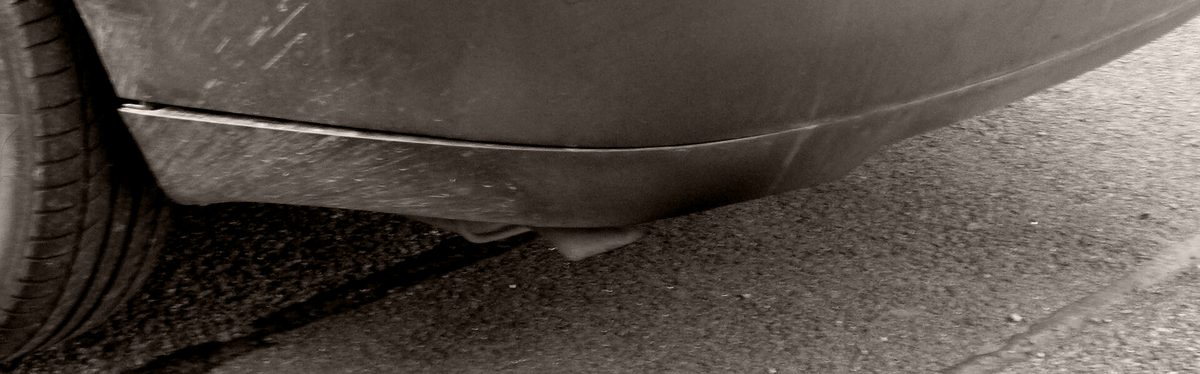
A sulfur smell you notice only outside, at the tailpipe after a cold start, fits the fuel kind, and Mazda's bulletin says it won't harm the engine or its emission parts. Inside the car is different, because the CDC warns that a small leak in the exhaust system can lead to a buildup of carbon monoxide inside the car.
Carbon monoxide has no smell, so the rotten egg smell can't tell you whether it's there. Any rotten egg smell inside the car means open the windows and get the exhaust checked soon, and we'd stop when it comes with any of these signs:
- It's strong with the windows shut. Pull over and air the car out, then get the exhaust and body seals checked before you drive on.
- Anyone feels a headache, dizziness or nausea. The CDC lists them among the symptoms of carbon monoxide poisoning, and its toxic substances agency among the effects of hydrogen sulfide. Get out of the car and into fresh air.
- The battery is hot, swollen or leaking. GM tells its technicians to let any smoke, spray or smell clear with the hood down, and to wait until the battery is below 95 °F before working on it.
The gas that smells of rotten eggs is hydrogen sulfide, and the same agency says the nose picks it up at about 0.5 parts per billion. That's about 40,000 times below the ceiling federal workplace rules set, so a faint whiff on its own doesn't mean a harmful dose of that gas.
The catch is that the nose stops noticing. NIOSH, the federal workplace safety institute, says the sense of smell tires quickly and can't be relied on to warn that the gas is still there.
Exhaust in the cabin is the other worry, because owners link it to carbon monoxide. In our count of federal complaints, 59 of 413 about a sulfur smell named carbon monoxide, and 120 named a headache, nausea or feeling sick.
The largest group of those complaints came from one SUV line, and it ended in a federal investigation that found no defect. That finding covers those SUVs only, so it isn't an all-clear for any other car with exhaust getting in.
Hydrogen sulfide and the cabin 5 documents
- ATSDR, hydrogen sulfide guidance. Rotten-egg odor detectable from 0.5 ppb; odor is not a reliable indicator, and over 100 ppm the sense of smell can fail within 2 to 15 minutes; 50 ppm irritates the nose and throat; moderate levels cause headache, dizziness, nausea and vomiting.
- NIOSH Pocket Guide, hydrogen sulfide. Sense of smell becomes rapidly fatigued; OSHA ceiling 20 ppm; immediately dangerous at 100 ppm.
- 2011 to 2017 Ford Explorer, NHTSA EA17-002. Closed January 17, 2023, after 6,517 complaints of exhaust odor: cabin carbon monoxide below accepted health standards, no defect identified.
- 2011 to 2017 Ford Explorer, Ford program 19N05. Climate control reprogrammed and liftgate drain valves replaced, 0.4 hours, free with no mileage limit; ended July 31, 2022.
- Federal complaints, 2010 to 2025 models. 413 describe a sulfur or rotten egg smell; 255 of them are Ford Explorers.
Why does my car smell like rotten eggs?
It's because something in the car is giving off sulfur, and carmaker documents name five sources for it in three places: the exhaust, the battery and the cabin. The table puts them in the order you can notice them, and each cause has a test to run before any part is replaced:
| Cause and clue | Test this first | Don't replace yet |
|---|---|---|
| High-sulfur fuelFrom the tailpipe after a cold start, idling or full throttle, no warning light. | Fill up at a different brand and drive at least 100 miles. | The catalytic converter. |
| Converter loaded with sulfurCheck engine light with code P0420 or P0430. | Ask whether the carmaker has a de-sulfation procedure or a warranty extension. | The converter, until both are checked. |
| Overcharged or damaged batteryNear the battery under the hood, case hot, swollen or leaking. | Below 95 °F: check the case for cracks or swelling, then test the battery and charging system. | The converter: this smell isn't from the exhaust. |
| Exhaust getting into the cabinInside the car, worse after hard acceleration, on hills or towing. | An exhaust and body seal inspection, and a recall check by VIN, the car's 17-character ID number. | Engine or exhaust parts: the bulletin's fix is body sealing. |
| A drain in the bodyStrongest when you open a car parked closed in the heat. | A check of the sunroof drain hoses. | Exhaust or engine parts. |
Each cause has its own section below, in the table's order. The first two come out of the exhaust, the third is the battery under the hood, and the last two reach the cabin.
1. High-sulfur fuel
Gasoline carries a little sulfur, and a batch with more than its share makes the smell as it passes through the catalytic converter. Mazda says the sulfur oxidizes in the converter and the odor fades with mileage and age, so on this one, time is on your side.
Federal rules since 2017 hold each refiner's gasoline to an average of 10 parts per million of sulfur over a year, with a cap of 80 on any one batch. So a single batch leaving the refinery can carry up to eight times the average and still be legal, which fits the bulletins that blame high sulfur in the fuel.
Mazda calls this smell no sign of an engine concern, and says it won't reduce driveability or harm the engine or its emission parts. Its first step costs nothing but a change of station: switch to a different brand of fuel and drive at least 100 miles.
2. A converter loaded with sulfur
Sulfur from the fuel can also build up on the converter itself, until the engine computer decides the converter isn't cleaning well enough. Ford says high sulfur in the fuel can turn on the check engine light with code P0420 or P0430, the codes for a converter whose efficiency reads low.
Ford's fix on some of its trucks and SUVs is a one-time de-sulfation procedure at the dealer, and a new converter only if the problem comes back. Mercedes extended the catalyst warranty on its 2011 to 2020 models with the M278 V8 because of sulfur contamination, as the key documents below show.
A converter can also fail for reasons that have nothing to do with fuel. Our bad catalytic converter symptoms guide covers the other signs to check before you agree to one.
3. An overcharged or damaged battery
A car battery holds acid, and GM's bulletin for its heavy-duty pickups says a second battery there can be run flat too often or overcharged. It lists a sulfur or acid smell while driving among the signs to check, next to leaking acid and a cracked or swollen case.
Overcharging means the charging system pushes in more than the battery can take. That's why we'd add a charging system test, which GM's bulletin doesn't list, and our alternator guide explains how the voltage regulator, the part that limits the charge, can fail that way.
GM replaces a battery whose case is damaged or that gives off the smell, once the smell has cleared and the battery is below 95 °F. One with neither sign goes on a handheld tester, and it's replaced if it fails.
4. Exhaust getting into the cabin
Exhaust can find its way into the car through body seams, vents or drains, and inside it can smell of sulfur. One carmaker's bulletin says owners may describe it that way, worse after hard acceleration, on hills or when towing, with the climate control on auto or recirculate.
That bulletin's fix is new air extractors, the vents at the back of the body that let cabin air out, plus seam sealer. Ford's program for one SUV line also changed the climate control to bring in fresh air under hard acceleration and replaced drain valves in the liftgate.
This is the cause to take most seriously, because it put carbon monoxide into a federal investigation. Keep the air on fresh and the windows cracked until a shop has checked the exhaust and the body seals.
5. A drain in the body
Not every sulfur smell in the cabin is exhaust. Infiniti found a strong sulfur-like odor coming from the sunroof drain hoses after the car sat in the heat with the doors and windows closed.
Its fix was new drain hoses, booked at 3.4 hours, plus a new cabin air filter, and an ozone treatment if the smell lingers. So a smell that greets you when you open a car parked in the sun points at the body before the engine or the exhaust.
Bulletins behind each cause 7 documents
- Mazda, 1995 to 2019 models, bulletin 01-004/19. January 2019: sulfur smell from the exhaust is caused by high sulfur in the gasoline; replacing the converter won't eliminate it; switch fuel brand and drive at least 100 miles.
- 40 CFR 80.1603, US gasoline from 2017. Refiner annual average 10 ppm sulfur; per-gallon cap 80 ppm.
- 2018 to 2020 Ford F-150 2.7L, 2020 to 2021 Expedition and Navigator, bulletin 22-2260. January 2023: P0420 or P0430 may be due to high sulfur in the fuel; de-sulfate the converters, one time only.
- 2011 to 2020 Mercedes-Benz V8 models (M278), warranty extension. May 2023: check engine light from sulfur contamination in the catalyst; catalyst warranty extended.
- 2020 to 2021 Chevrolet Silverado and GMC Sierra HD, bulletin 21-NA-062. March 2021: auxiliary battery deep cycling or overcharging; sulfur or acid smell, cracked or swollen case; test and replace.
- 2015 to 2018 Ford Edge, 2016 to 2018 Lincoln MKX, bulletin 18-2057. February 2018: exhaust or sulfur-like odor in the cabin in auto or recirculate mode; new rear air extractors and seam sealer.
- 2014 to 2015 Infiniti Q50 built before October 14, 2014, bulletin ITB14-039b. February 2015: strong sulfur-like odor from the moonroof drain hoses after a hot soak; new hoses, 3.4 hours.
What the data says
We counted 413 federal complaints on 2010 to 2025 models that describe a sulfur or rotten egg smell, 237 of them in the words "rotten egg". Owners named fuel or gas in 88, exhaust in the cabin in 85, the converter or its codes in 47 and the battery in 42.
Transmission fluid or gear oil came up in 6 of the 413. We found no carmaker document that links either one to a sulfur smell, so neither is on our list of causes.
NHTSA complaint files, model years 2010 to 2025, counted once per complaint by a word-match script on October 2, 2026. One complaint can name several things, so the counts overlap.
When and where does the rotten egg smell show up?
The place and the moment you notice the smell point to the cause, because the carmakers describe each cause that way. Note both each time, where it's strongest and what the car was doing just before:
- At the tailpipe after a cold start. Also at fast idle, after long idling and at full throttle, in Mazda's words. That's the fuel kind, and Mazda says it fades with mileage and age.
- With the check engine light on. A sulfur-loaded converter shows up as code P0420 or P0430 in Ford's bulletin. The light is the clue, more than the smell.
- Under the hood, near the battery. GM describes a sulfur or acid smell during driving, with acid leaking or the case swollen. Look at the battery before anything else.
- Inside the car after hard acceleration, hills or towing. That's how one carmaker's owners described exhaust getting into the cabin, with the air on recirculate.
- When you open a car parked in the heat. Infiniti traced that one to the sunroof drain hoses. It's a body problem, not an engine one.

Use this image
Free to republish under CC BY 4.0: credit Oil & Miles and link to this page. The snippet does both.
<a href="https://oilandmiles.com/articles/rotten-egg-smell-in-car"><img src="https://oilandmiles.com/assets/img/diagrams/rotten-egg-smell-in-car-sources-bench.svg" alt="Side view of an SUV drawn see-through, showing the places a carmaker names for a rotten egg smell: the catalytic converter under the floor and the tailpipe in orange, the 12-volt battery under the hood in red, the rear air extractors in the rear quarter in orange with a close-up, and the sunroof drain hose running down the windshield pillar in blue." width="1200" height="869"></a> <p>Diagram: <a href="https://oilandmiles.com/articles/rotten-egg-smell-in-car">Oil & Miles</a>, CC BY 4.0</p>A note on your phone with the place, the moment and any warning light is worth more to a shop than "it smells weird". It also stops a smell that comes and goes from vanishing just before the appointment.
How much does it cost to fix a rotten egg smell?
It runs from nothing to $1,450 for a converter part, from a change of gas station to the priciest part, depending on the cause. A battery sits in between, at $79 to $242 for the part alone from two sellers.
What it costs
What this box shows
Prices for this repair, drawn from the sources named at the foot of the box. Each figure states whether it covers the part alone or parts and labor.
Parts cost to fix a rotten egg smell
The parts alone, without labor. No total: each row is a different cause.
| Flooded batteryStandard lead-acid, by group size; only one of our two sellers lists it. | $79 – $160Part only, at the counter |
|---|---|
| AGM batterySealed type; one battery per car, performance grades left out.2016 Ford Explorer 3.5L · $155 to $242, 2015 Infiniti Q50 3.7L · $147 to $238, 2016 Mazda CX-5 2.5L · $145 to $238, 2018 Toyota Camry 2.5L · $125 to $202, 2020 Chevrolet Silverado 2500HD 6.6L gas · $126 to $242, | $125 – $242Part only, at the counter |
| Catalytic converterFederal-grade aftermarket to dealer part; only with a code, after the checks.2010 Honda Accord 2.4L · $123 to $306, ; dealer $1,4502012 Ford F-150 5.0L V8 · $161 to $500 a side, ; dealer $1,299 a side2013 Nissan Altima 2.5L · $107 to $412, ; dealer $1,140 | $107 – $1,450Part only, at the counter |
Battery prices are from two sellers, read October 6, 2026: every AGM battery RockAuto lists for the five cars above, and Walmart's EverStart range for the same group sizes, whose AGM is $189 for each car. Group sizes come from RockAuto's fitment list. Performance AGM batteries, up to $375, are left out, and so is the refundable core charge. We didn't verify a price for the auxiliary battery on Silverado HD trucks that carry one. Converter prices are from our catalytic converter replacement cost guide: every brand RockAuto lists and the dealer list price for a 2010 Honda Accord 2.4L, a 2012 Ford F-150 5.0L and a 2013 Nissan Altima 2.5L, read September 4, 2026, and the F-150 dealer price August 29. Ford's $500 core charge is left out.
The converter row is the part alone, and our catalytic converter replacement cost guide prices it car by car. The same guide gives a national average of $1,511 for the whole job, parts and labor, so ask about a bulletin or warranty first.
Labor depends on the cause. Infiniti booked 3.4 hours for its drain hoses, which at the $120 to $159 an hour almost half of US shops charge comes to about $408 to $541 of labor, an estimate.
Ford's de-sulfation and cabin-sealing bulletins list no fixed hours, because dealers claim the actual time under warranty. Off warranty, ask the shop for its hours up front.
How do you get rid of the rotten egg smell?
Start with the free checks and leave the expensive part for last. Work through the 5 steps below to get rid of a rotten egg smell in your car, in order:
- Write down where and when. Note the place (tailpipe, hood or cabin) and the moment: a cold start, idling, hard acceleration, hills, or opening a parked car.
- Check the battery first if the smell is under the hood. Let it clear with the hood down until the battery is below 95 °F, as GM instructs. GM replaces a battery that shows damage or the smell; otherwise have the battery and charging system tested.
- Change gas brands if it's only at the tailpipe, with no light. Mazda's first step is a different brand of fuel for at least 100 miles.
- Read the codes if the check engine light is on. Our check engine light codes list explains each one. With P0420 or P0430, ask whether your carmaker has a de-sulfation procedure or a warranty extension before quoting a converter.
- Check the cabin if the smell is inside. Look up open recalls by VIN on NHTSA's site, then have the exhaust, body seals and sunroof drains checked.
If the smell outlasts 100 miles on new fuel with no code set, the documents we read don't name a next step. Ask the shop to look at the converter and the exhaust.
If the battery passes but the smell comes back near it, have it tested again. GM recommends a battery test on those trucks at every oil change, or at most every 6 months.
What to say to the shop
When a quote names a new catalytic converter for the smell, ask these, and expect a code or bulletin number back:
- Is a code stored, and which one?
- Is there a bulletin or warranty extension for sulfur in the converter?
- Did you test the battery and charging system?
“Before we replace the converter, can you check for a stored code and a carmaker bulletin or warranty for sulfur, and test the battery? The smell could be the fuel or the battery.”
What other smells and symptoms come with it?
A sulfur smell can arrive with another sign, and that sign can have its own page here. A different smell, smoke or a warning light points to a different cause:
- A burning smell. Rubber, oil, brakes or wiring smell different from sulfur. Our car smells like burning guide sorts them.
- A raw gas smell. Fuel itself, not its exhaust, points at a leak or the fuel vapor system. See why a car smells like gas.
- Smoke from under the hood. Steam, oil or electrical smoke each mean something else, covered in car smoking under the hood.
- A rattle or lost power with the light on. Those are converter failure signs, in our catalytic converter symptoms guide.
- Dim lights or a slow start. A battery or alternator problem, sorted in bad alternator or battery.
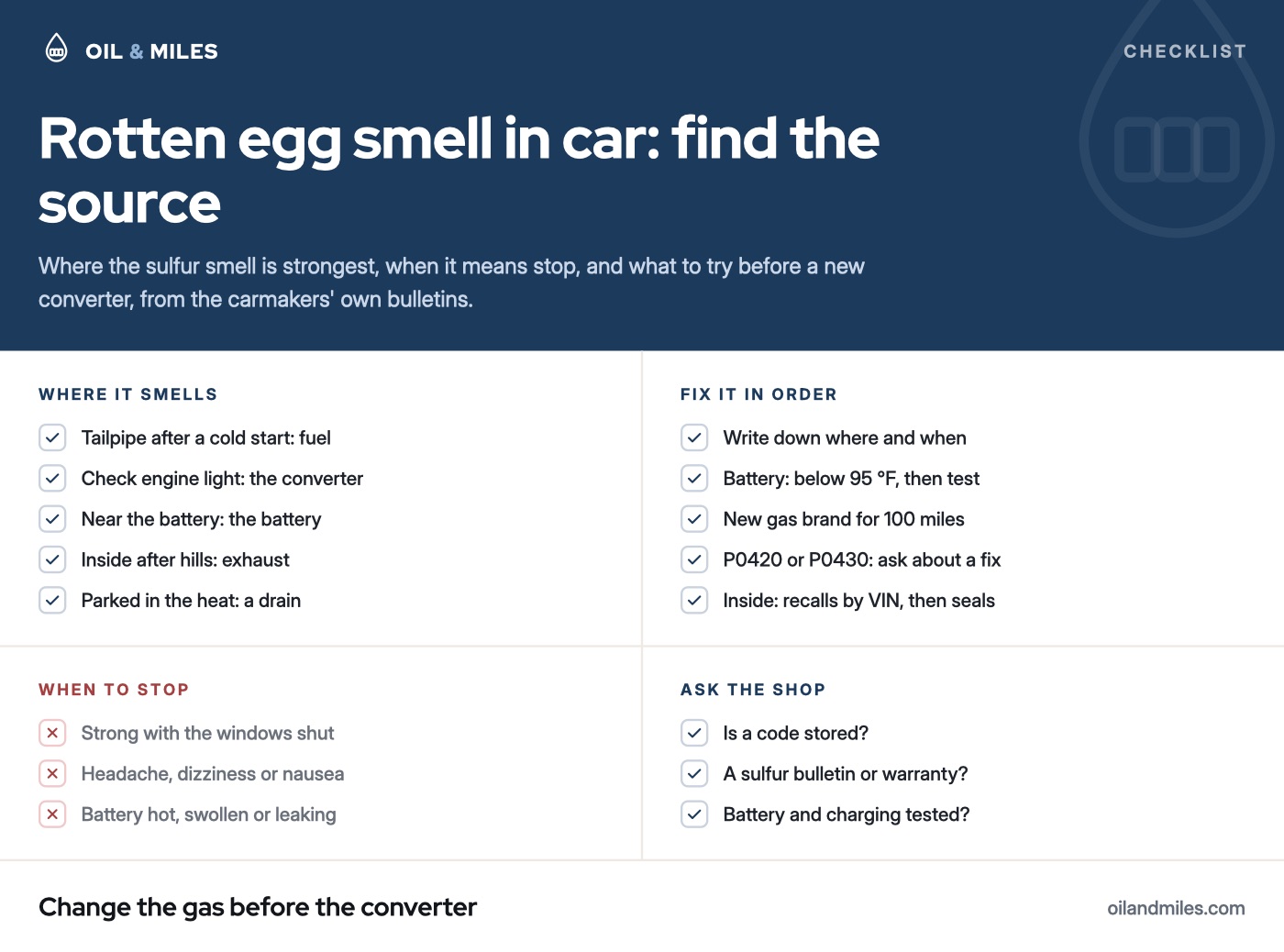
Use this image
Free to republish under CC BY 4.0: credit Oil & Miles and link to this page. The snippet does both.
<a href="https://oilandmiles.com/articles/rotten-egg-smell-in-car"><img src="https://oilandmiles.com/assets/img/diagrams/rotten-egg-smell-in-car-checklist.jpg" alt="Rotten egg smell in car checklist: at the tailpipe after a cold start points to fuel sulfur, a check engine light to the converter, near the battery to an overcharged battery, inside the car after hills to exhaust getting in, and a car parked in the heat to a drain hose; stop if it's strong with the windows shut, anyone feels a headache, dizziness or nausea, or the battery is hot, swollen or leaking; then write down where and when, check the battery, change gas brands for 100 miles, read the codes, and check the cabin; ask the shop about a stored code, a sulfur bulletin or warranty, and a battery and charging test." width="1200" height="890"></a> <p>Infographic: <a href="https://oilandmiles.com/articles/rotten-egg-smell-in-car">Oil & Miles</a>, CC BY 4.0</p>From the carmakers
Which rotten egg smells do carmakers fix for free?
One carmaker extended a warranty for sulfur in the converter, another ran a free program for exhaust getting into the cabin, and a third told its dealers a new converter won't eliminate the fuel kind, so switch fuel first. Check for a bulletin or warranty extension before you pay for a converter, because the fix may be a procedure, or free.
Ford's de-sulfation bulletin says the work is eligible under the new vehicle limited warranty and the emissions warranty, within their limits, so ask whether your car is still covered. Mercedes says owners who already paid for a covered converter repair may be eligible for reimbursement.
Warranty extension M278 catalyst
A check engine Malfunction Indicator Lamp (‘MIL’) may illuminate due to sulfur contamination in the catalyst.
Customer satisfaction program 19N05
This program will be in effect through July 31, 2022. There is no mileage limit for this program.
Service bulletin 01-004/19
Replacing the catalytic converter will not eliminate sulfur smell
Conclusion
Change the gas before the converter
The smell is sulfur, and where you notice it narrows the cause before anyone lifts the hood. Here's what to take from this page about a rotten egg smell in your car:
- Inside the car means windows open. Carbon monoxide has no smell, so air the car out and get the exhaust checked soon. A strong smell means stop.
- A hot or swollen battery comes first. Let it cool with the hood down, then test the battery and the charging system.
- A smell from the tailpipe with no light is fuel. Mazda says switch brands for 100 miles; a new converter won't cure it.
- A code means ask about a bulletin. Ford de-sulfates, and Mercedes extended its catalyst warranty.
So try 100 miles on a different brand of gas before you spend on a converter. Oil & Miles reads the carmakers' own bulletins before it tells you what a smell means.
Common questions
Asked most often
Can I drive my car if it smells like rotten eggs?
If you smell it only outside, at the tailpipe, with no warning light, Mazda's bulletin points at the fuel, and a different brand is the first step. If you smell it inside the car, open the windows and get the exhaust checked soon, and stop if it's strong, anyone gets a headache or dizziness, or the battery is hot or swollen.
How can I fix the rotten egg smell in my car?
Find where it's strongest first. A tailpipe smell with no light starts with a different brand of gas, a battery smell with a battery and charging test, and a cabin smell with an exhaust and body seal check.
Can a bad alternator smell like rotten eggs?
No document we read names the alternator itself, but a charging fault that overcharges the battery can make the battery give off a sulfur or acid smell, as GM's bulletin describes. Test the battery and the charging voltage together.
Why does my car smell like burning rotten eggs?
None of the documents we read describes a burning sulfur smell. A sulfur smell with a hot, swollen battery means stop, and a separate burning smell has its own causes, sorted in our burning smell guide.
Why does my car smell like rotten eggs when I accelerate?
Mazda lists full-throttle acceleration among the moments the fuel kind shows up at the tailpipe. If it's inside the car after hard acceleration, one carmaker traced that to exhaust getting into the cabin.
Why does my car smell like rotten eggs with the AC on?
One carmaker's bulletin describes a sulfur-like exhaust odor in the cabin with the climate control on auto or recirculate. Switch to fresh air and have the exhaust and body seals checked.
Why does my truck smell like rotten eggs?
The same causes apply, and two truck bulletins stand out. GM linked a sulfur or acid smell to overcharged batteries on some heavy-duty pickups, and Ford linked converter codes to high-sulfur fuel on some F-150s.
Is a rotten egg smell in a car dangerous?
A faint smell outside the car doesn't on its own point to a harmful dose, because the nose catches hydrogen sulfide about 40,000 times below the federal workplace ceiling. Inside the car, carbon monoxide has no smell, so open the windows and get the exhaust checked, and stop for a strong smell, a headache or dizziness, or a hot battery.
Does a blown head gasket smell like rotten eggs?
We found no carmaker document that ties a blown head gasket to a sulfur smell. The signs to look for are in our blown head gasket symptoms guide, such as white smoke and coolant that keeps disappearing.
Why does my car smell like rotten eggs and won't start?
None of the documents we read names that pair, but the battery is the one cause here that can do both. A battery too weak to start the car can also be the damaged one GM describes, so check it first, with the hood down until the smell clears.
What people ask next
Sources
- Mazda bulletin 01-004/19, January 9, 2019, for the fuel-sulfur smell, the converter caution and the 100-mile step. NHTSA bulletin archive, read October 2, 2026
- Ford bulletin 22-2260, January 23, 2023, for P0420 and P0430 from high-sulfur fuel and the de-sulfation procedure. NHTSA bulletin archive, read October 2, 2026
- Mercedes-Benz USA, M278 catalyst warranty extension, May 11, 2023, for sulfur contamination and the extended coverage. NHTSA bulletin archive, read October 2, 2026
- GM bulletin 21-NA-062, March 2021, for the battery's sulfur or acid smell, the 95 °F rule and the inspection interval. NHTSA bulletin archive, read October 2, 2026
- Ford bulletin 18-2057, February 16, 2018, for the sulfur-like exhaust odor in the cabin and its fix. NHTSA bulletin archive, read October 2, 2026
- Ford program 19N05, June 24, 2019, for the Explorer repair, its 0.4 hours and its end date. NHTSA bulletin archive, read October 2, 2026
- NHTSA investigation EA17-002, opening and closing resumes, for the 6,517 complaints and the carbon monoxide finding; the closing text was read from a copy of NHTSA's resume. NHTSA, read October 2, 2026
- Infiniti bulletin ITB14-039b, February 19, 2015, for the sunroof drain odor and its 3.4 hours. NHTSA bulletin archive, read October 2, 2026
- NHTSA complaint files, model years 2010 to 2025, for the 413 complaints and the words they name. NHTSA, counted October 2, 2026
- EPA, gasoline sulfur standards, and 40 CFR 80.1603, for the 10 ppm average and the 80 ppm per-gallon cap. EPA, read October 6, 2026
- CDC, Carbon Monoxide Poisoning Basics, page dated January 12, 2026, for carbon monoxide having no smell and for a small exhaust leak building it up inside the car. CDC, read October 6, 2026
- NIOSH Pocket Guide, hydrogen sulfide, for odor fatigue and the exposure limits. CDC, read October 6, 2026
- ATSDR, hydrogen sulfide, for the 0.5 ppb odor threshold and the effects by level. CDC, read October 6, 2026
- RockAuto catalog and Walmart, battery listings for the five cars in the cost box. Read October 6, 2026
- PartsTech's 2025 survey of 752 US shops, as reported by MOTOR, for the $120 to $159 an hour that almost half of them charge. MOTOR, read September 27, 2026
How this was compiled
The complaint counts come from a word-match script over NHTSA complaint files for 2010 to 2025 models, counted once per complaint, so one complaint can fall under several words. Battery prices are every AGM listing RockAuto shows for five cars plus Walmart's EverStart range for the same group sizes, and converter prices come from our catalytic converter cost guide.
What we didn't do
Some repair sites also blame the fuel system, such as a leaking injector or a faulty fuel pressure regulator. None of the carmaker bulletins we read links either to a sulfur smell, so neither is listed as a cause.
We found no carmaker document linking transmission fluid, gear oil or a moldy air conditioner to a sulfur smell, so this page doesn't list them as causes, although some repair sites do.
We priced batteries from two sellers only, because the big parts-store chains blocked our reads. We didn't verify a price for the auxiliary battery on Silverado HD trucks that carry one.
We didn't measure hydrogen sulfide in a car, and none of the health sources we read measured car exhaust. The exposure figures here are workplace limits, used only to show how far below them a faint smell sits.
Two Ford bulletins that may describe a sulfur odor on hybrid models couldn't be read as text, so they aren't cited.
Prices are ranges compiled in October 2026 for the US market and vary by region, engine and shop rate. Prices from $10 up are rounded to the nearest dollar, so $14.13 reads as $14 and $14.52 as $15. Below $10 they're exact. This article is general information, not advice about your specific vehicle. See the disclaimer.
AGM battery
2016 Ford Explorer 3.5L
| Brand | Part | Price |
|---|---|---|
| P1MAX | PMAGM65 | $155 |
| ACDelco | 65AGMHRC | $161 |
| Deka | 9A65 | $171 |
| FVP | P65AGM | $176 |
| Exide | MX65 | $183 |
| Bosch | S6551B | $242 |
AGM battery
2015 Infiniti Q50 3.7L
| Brand | Part | Price |
|---|---|---|
| Deka | 9A3585 | $147 |
| ACDelco | 35AGM | $170 |
| Exide | MX35 | $177 |
| FVP | P35AGM | $220 |
| Bosch | S6523B | $238 |
AGM battery
2016 Mazda CX-5 2.5L
| Brand | Part | Price |
|---|---|---|
| P1MAX | PMAGM35 | $145 |
| Deka | 9A3585 | $147 |
| ACDelco | 35AGM | $170 |
| Exide | MX35 | $177 |
| FVP | P35AGM | $220 |
| Bosch | S6523B | $238 |
AGM battery
2018 Toyota Camry 2.5L
| Brand | Part | Price |
|---|---|---|
| P1MAX | PMAGMH547 | $125 |
| PMAGMH648 | $143 | |
| Lucas | LBAGM004A | $143 |
| FVP | P47AGM | $158 |
| P48AGM | $202 | |
| Deka | 9A48 | $162 |
| ACDelco | 48AGM | $163 |
| Exide | MXH6L348 | $175 |
AGM battery
2020 Chevrolet Silverado 2500HD 6.6L gas V8
| Brand | Part | Price |
|---|---|---|
| FVP | P94RAGM | $126 |
| P48AGM | $202 | |
| Lucas | LBAGM004A | $143 |
| LBAGM006A | $234 | |
| P1MAX | PMAGMH648 | $143 |
| PMAGMH794R | $166 | |
| Deka | 9A48 | $162 |
| 9A94R | $172 | |
| ACDelco | 48AGM | $163 |
| 94RAGM | $175 | |
| Exide | MXH6L348 | $175 |
| MXH7L494R | $201 | |
| Bosch | S6587B | $242 |
Aftermarket converter, EPA grade
2010 Honda Accord 2.4L
| Brand | Part | Price |
|---|---|---|
| BlueFlow | 2021012Rear; K24Z2/K24Z3 | $123 |
| 2021301Front manifold; read TSBs before replacing | $168 | |
| Original Performance | OPCH9054Rear | $129 |
| OPCH9053Front manifold | $178 | |
| Davico | 17446Rear | $141 |
| 17327Front manifold | $184 | |
| 47446Rear; dealer alternative; 1 day delay | $206 | |
| 47327Front manifold; dealer alternative | $275 | |
| Walker | 16436Rear; federal/California system | $143 |
| 16590Front; federal/California system | $243 | |
| AP / Eastern | 642118Rear | $189 |
| 641499Front manifold | $232 | |
| Dorman | 674968Front manifold; automatic; w/ California emissions | $306 |
Aftermarket converter, EPA grade
2012 Ford F-150 5.0L V8
| Brand | Part | Price |
|---|---|---|
| BlueFlow | 653904Left | $161 |
| 625251Left | $208 | |
| Davico | 19450Left | $183 |
| 19455Right; 2 piece | $271 | |
| 49450Left; dealer alternative; 2 day delay | $360 | |
| 49455Right; dealer alternative; 2 piece; 2 day delay | $500 | |
| Original Performance | OPCF5111Left | $214 |
| OPCF5112Right | $236 | |
| AP / Eastern | 30576Left | $312 |
| 645251Left | $312 | |
| 645252Right | $369 | |
| 30577Right | $380 | |
| Walker | 53904Left; federal/California system | $332 |
| 50567Right; federal/California system | $359 |
Aftermarket converter, EPA grade
2013 Nissan Altima 2.5L
| Brand | Part | Price |
|---|---|---|
| BlueFlow | 2031316Rear | $107 |
| 2031324OEFront manifold | $224 | |
| AP / Eastern | 643090Rear | $112 |
| 641427Front manifold | $331 | |
| Walker | 54782S model; federal/California system | $125 |
| 16694Front manifold; sedan; federal/California system | $380 | |
| Davico | 18343Rear | $131 |
| 48343Rear; dealer alternative; 1 day delay | $222 | |
| 17462Front manifold | $246 | |
| 47462Front manifold; dealer alternative | $362 | |
| Original Performance | OPCN3044Rear | $140 |
| OPCN3074Front manifold; sedan, federal | $253 | |
| Dorman | 674933Front manifold; coupe | $403 |
| 674149Front manifold; sedan | $412 | |
| ATP | 101431Front manifold; coupe | $410 |