
Key takeaways
- Safety: Stop driving if a warning light comes on, a knock rises with the revs, the car loses power or you smell exhaust inside.
- A rattle that follows engine speed is the engine or exhaust, while one that follows road speed is the wheels.
- Check the oil level first for a cold-start rattle, because cam phasers run on oil pressure.
- Fill with the octane your manual names, and if the rattle goes, that points to knock.
- Ask a dealer to check your VIN, since Subaru and Nissan cover some of these rattle repairs free.
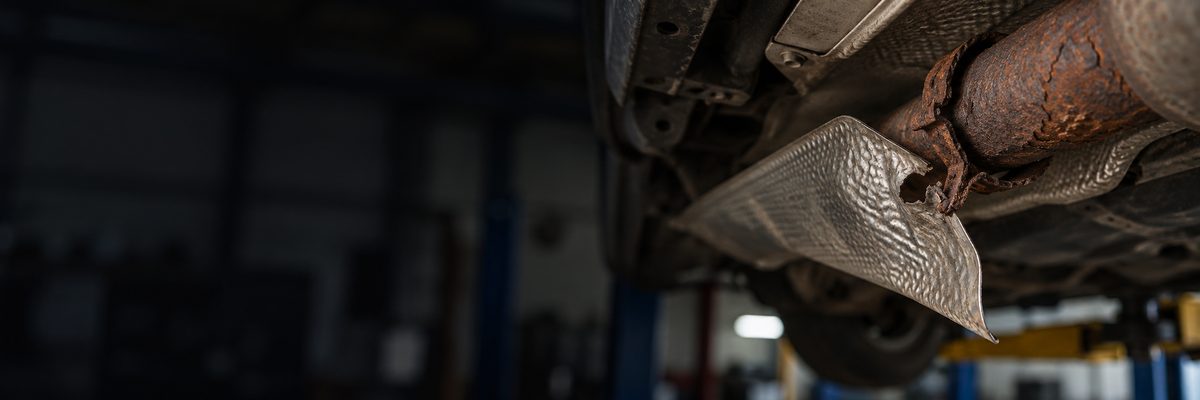
A rattling noise when accelerating is a buzz, a tinny clatter or a sound like marbles in a can that starts as you press the gas. It can be a heat shield, one of the thin metal sheets over the exhaust pipe, shaking loose at its clip.
What matters is when it happens, such as uphill on a hot day, at one engine speed or only after a cold start. Each moment points to a different part, and a warning light means you should stop driving.
Is it safe to drive with a rattle when accelerating?
Yes, a short trip to a shop, once you know it's a loose heat shield, but have it fixed soon. A shield that hangs loose can touch hot parts or fall into the road.
A warning light, lost power or a knock that gets faster with the revs means stop driving. Those point to the engine or transmission rather than a loose sheet of metal.
A misfire can overheat the catalytic converter enough to start a fire, and one owner's rattle that sounded like a loose heat shield came just before an engine fire. So we'd stop driving if:
- A warning light comes on. A flashing check engine light means a misfire, which can overheat the catalytic converter and the parts around it.
- The car loses power. That points past a loose shield to the engine or the transmission.
- The knock rises with the revs. Heavy knock that persists is what the owner's manuals call a problem, not the brief light kind.
- The oil light comes on. Turn the engine off. Our oil light guide covers what it means.
- It shudders or slips. That belongs with our guides to bad transmission symptoms and CVT problems (a CVT is a gearless automatic).
- You smell exhaust inside. The CDC warns that a small exhaust leak can build up carbon monoxide inside the car.
Why does my car rattle when I accelerate?
Because something metal is loose enough to shake when the engine works harder, or the engine itself is knocking. Pressing the gas raises the load and the engine speed, and a loose part has a speed where it buzzes.
So when a car is making a rattling noise as you press the gas, the question is what shook loose and where. A whine is a different noise, a steady high pitch from something that spins, and whining noise when accelerating covers it.
Here are ten places a rattle can start. Each has its own moment, which is the clue a driver actually has:
1. Loose heat shield
A tinny buzz or rattle from under the car while you drive is often a loose heat shield. That's a thin metal sheet over the exhaust that keeps its heat off the floor, the fuel lines and the ground.
Sometimes only the clip holding it has worked loose, or the shield is touching the body. So ask the shop which it is, because a clip is the cheaper fix. GM's own dealer fix for a loose clip on its trucks takes 0.3 hour.
2. Cracked exhaust pipe
A rattle or flutter from under the car as you accelerate can be a cracked exhaust pipe. The pipe carries the burnt gas to the tailpipe on rubber hangers and clamps, and a crack lets the gas pulse out.
A broken hanger, or the rubber mount that holds it, can also let the pipe touch the underside of the car. A shop's exhaust leak test finds any crack. On some Subaru Foresters a cracked front pipe falls under an extension of up to 15 years or 150,000 miles.

A torn exhaust hanger
3. Engine knock
A metallic rapping in gear under load, climbing a hill or on a hot day, can be engine knock. That's fuel burning at the wrong moment in the cylinder, and one owner's manual uses those words for the sound.
For a light ping with no warning light, the fuel test in the knock section below is the first thing to try. It costs only a tank of fuel.
4. Software or rocker arms
A rattle at one narrow engine or road speed can be one the carmaker fixes without a new part. Some fix it with an engine computer update, others with new rocker arms, the levers that open the valves.
A rattle that shows up at the same point every time is worth a bulletin search by VIN, your car's ID number, before anything is replaced. A bulletin is a carmaker's repair note to its dealers.
5. Cam phasers or chain
A rattle for the first seconds of a cold start points at the timing chain or the cam phasers. The chain turns the camshafts that open the valves, and the phasers shift their timing using engine oil pressure.
A worn chain rattles most at a cold start, when oil pressure is lowest, and may quiet as the oil warms. So check that the oil is the right type and grade before the shop looks at the chain and phasers.
6. Broken converter
A broken catalytic converter rattles from inside its shell, and a shop can hear it by tapping the shell with a rubber mallet. The catalytic converter is the can in the exhaust that cleans the gas, built around a fragile honeycomb that can break into loose pieces.
Heat, misfires, fuel faults and coolant leaks are what ruin one. So a broken catalytic converter can be a symptom of another fault, and our guide to bad catalytic converter symptoms covers what to fix first.
7. Torque converter or flexplate
A rattle from where the engine meets an automatic transmission can be the torque converter or the flexplate. The torque converter is the fluid coupling between the two, and the flexplate is the thin steel disc that bolts it to the engine.
Compare the noise at a stop in Park with the noise in Drive, with your foot on the brake. Both parts are hard to reach, so let a dealer check for a bulletin by VIN first.
8. Worn engine mount
A thump as you accelerate or brake can be a worn engine mount, the rubber and metal block that holds the engine to the car. A broken one lets the engine lift as you accelerate.
A tired mount and an exhaust rattle can show up together, so have the shop check both. It looks for rubber torn from the metal, cracks and leaking fluid-filled mounts, and one carmaker's free campaign covers a mount.
9. Air filter housing
A buzz from the front of the car at one engine speed can be the air filter housing, the plastic box that holds the engine's air filter. It sits on soft rubber grommets, and with one missing, the box can buzz or rattle.
Ask the shop to check the housing's grommets before anything bigger. A new grommet is a small, cheap fix, so it's worth ruling out before anyone looks at the engine.
10. Dash or front trim
Some rattles on the gas come from inside the car or its front trim, not the engine. Carmakers have traced some to loose clamps, cables or trim that buzz only at certain engine speeds.
They're small fixes once found, and a dealer can look up the bulletin for your car. Ride along on the road test and point at where you hear it.

Use this image
Free to republish under CC BY 4.0: credit Oil & Miles and link to this page. The snippet does both.
<a href="https://oilandmiles.com/articles/rattling-noise-when-accelerating"><img src="https://oilandmiles.com/assets/img/diagrams/rattling-noise-where.svg" alt="Where a rattling noise when accelerating comes from: an x-ray side view of the front half of a front-engine car with six numbered places a rattle can start, the air filter box, timing chain, engine, bellhousing, engine mounts and dash, each labeled with when it's heard" width="1600" height="900"></a> <p>Diagram: <a href="https://oilandmiles.com/articles/rattling-noise-when-accelerating">Oil & Miles</a>, CC BY 4.0</p>Is it a heat shield rattle or engine knock?
Listen for where it comes from. A loose shield rattles from under the car, while knock comes from the engine and changes with load and fuel. The two can sound alike, and the fuel test below can help tell them apart. Each kind of rattle points to a likely cause and has its own next step.
| What you hear, and when | Likely cause | What to do |
|---|---|---|
| A tinny buzz from under the car while driving | A loose heat shield or its clip | Soon. Ask whether it's the shield or only the clip |
| A rattle or flutter from under the car on the gas | A cracked exhaust pipe, broken hanger or loose joint | Get an exhaust leak test. Exhaust smell inside: stop |
| A metallic rapping under load, uphill or in heat | Engine knock | Fill with the octane your manual names |
| A rattle for the first seconds of a cold start | The timing chain or cam phasers | Check the oil level and grade first |
| A rattle at one narrow engine speed | Software, rocker arms or the air filter housing | Ask for a bulletin search by VIN |
| A rattle from between the engine and transmission | The torque converter or flexplate | Compare Park and Drive, then a dealer check |
| A metallic knock that rises with the revs | Heavy knock or a worn rod bearing | Stop driving |
Some knock is normal. Owner's manuals call brief, light knock normal when you accelerate or climb. Heavy knock that persists is a problem.
The cheap test is the fuel door: fill with the octane your manual names and see if the rattle goes. If it does, that points to knock, and you may have found the cheapest fix on this page for the price of a tank.
One carmaker ties an engine rattle on acceleration to fuel below the octane its car asks for. If better fuel doesn't stop it, ask for a bulletin search, because another carmaker fixed the same knock with an engine computer update.

Use this image
Free to republish under CC BY 4.0: credit Oil & Miles and link to this page. The snippet does both.
<a href="https://oilandmiles.com/articles/rattling-noise-when-accelerating"><img src="https://oilandmiles.com/assets/img/diagrams/rattling-noise-exhaust.svg" alt="The exhaust causes of a rattle, three parts drawn whole one above the other: a heat shield with its four bolts, the catalytic converter cut open, and a pipe section with a clamp and a rubber hanger, numbered 1, 6 and 2 to match the causes above" width="1600" height="900"></a> <p>Diagram: <a href="https://oilandmiles.com/articles/rattling-noise-when-accelerating">Oil & Miles</a>, CC BY 4.0</p>Why does my car rattle when accelerating at low speed?
Something shakes at one engine speed, and the engine passes that speed as you pull away. That's why a rattle can come only at low speed.
Carmakers have fixed this kind with software as well as with parts. Two driveway checks tell you which kind of rattle you have:
- It follows engine speed. If it comes and goes with the revs in any gear, look at the engine, the exhaust and anything bolted to them.
- It follows road speed. If it rises and falls with road speed whatever the gear, it's more likely something turning with the wheels, such as a wheel bearing.
Why does the engine rattle when accelerating?
Knock, or a timing part. A timing-part rattle is loudest at a cold start rather than on the gas, the same clue our timing belt symptoms guide gives for a worn chain. A rattle for 2–5 seconds after the car has sat for hours can be worn cam phasers.
If a scan tool shows code P0365 or P0369, two camshaft sensor codes, check the oil level first. Low oil can set them, and one carmaker tells its dealers to start there.
Two rarer causes are for a shop to find. Play at the wastegate, the valve that lets exhaust bypass the turbo, can rattle, and our P0299 guide covers what else a wastegate sets off.
A metallic, cyclic knock from deep in the engine can be a worn rod bearing, where a connecting rod meets the crankshaft. That one means stop, and a recall on some Hyundai Sonatas says the engine can fail and stall.
Can the transmission cause a rattle when accelerating?
Yes. A rattle from the bellhousing, where the engine meets the transmission, can come from the torque converter or a cracked flexplate. Carmakers have traced both in their bulletins.
If the car also slips or shudders, the fault may be in the transmission itself. Our guide to low transmission fluid symptoms covers what to check next.
How do you fix a rattling noise when accelerating?
By finding when it rattles before anyone replaces a part, because the cheap causes and the expensive ones overlap in sound. To fix a rattling noise when accelerating, work through the 6 steps below, in order:
- Check the oil level. For a cold-start rattle, on level ground with the engine off: cam phasers run on oil pressure, and it costs nothing to rule out.
- Note any warning light. A lit or flashing light, or lost power, means stop and have the codes read before driving on.
- Run the VIN. Check it for recalls and free fixes as the free-fix section explains, and ask a dealer to check bulletins by number for your car.
- Try the right fuel. Run a tank of the octane your manual names, as the fuel test above explains. If it still rattles, go on to the next step.
- Find where it lives. Note whether it follows engine speed or road speed, then, with the engine off and cold, move the exhaust by hand to find a loose hanger or contact.
- Get the fix quoted in parts. Ask for the part and the labor on separate lines, and for the clip alone if only the clip is loose.
A heat shield rattle can end at step 6 with a new clip. If the steps don't find it, ask the shop for three things:
- A road test with you in the car. Some rattles only show on the road, and you can point at the moment it starts.
- An exhaust leak test. It finds a cracked pipe or a leaking joint, the fault one carmaker's bulletin describes.
- A bulletin search by your VIN. Several rattles on this page are carmaker fixes, some of them free.
If it also jerks, the mounts may be part of it. Our guide to jerking when accelerating covers the clunk a worn mount makes.
What to say to the shop
When a quote names a part before anyone has found the rattle, ask:
- Can I ride along on the road test and show you when it rattles?
- Is it the heat shield or only its clip?
- Did you check my VIN for bulletins and free fixes?
“Before you replace anything, can I ride along and show you when it rattles, can you tell me whether it's the shield or only its clip, and have you checked my VIN for bulletins?”
How much does it cost to fix a rattle?
A loose clip or an exhaust clamp is a small part, so labor decides most of the bill. An engine mount or a set of cam phasers takes hours, and that's where a rattle gets expensive.
Check for a free fix before you pay, because Nissan's campaign covers the Rogue's left mount and Subaru's extension covers some Forester pipes. A broken catalytic converter is the big one, and both cars priced here may get it free if the VIN is on a recall or campaign.
Replacing it runs $402–$880 at an independent shop on a 2012 Dodge Journey 2.4, parts and labor. On a 2014 Kia Soul 1.6 it's $479–$1,846, parts and labor, from an independent shop to a dealer.
Ask for the test result, the hours and the rate on the written quote, and whether the diagnosis fee comes off if you approve the repair. Our catalytic converter replacement cost guide prices the converter on more cars.

Use this image
Free to republish under CC BY 4.0: credit Oil & Miles and link to this page. The snippet does both.
<a href="https://oilandmiles.com/articles/rattling-noise-when-accelerating"><img src="https://oilandmiles.com/assets/img/diagrams/rattling-noise-when-accelerating-checklist.jpg" alt="Checklist: check the oil level, note whether the rattle follows engine or road speed, and move the exhaust by hand with the engine off and cold. Fill with the octane your manual names to rule out knock. Run the VIN, ask the dealer about bulletins by number and whether it's the shield or only its clip. Stop driving on a warning light, lost power, a rising knock or the oil light." width="1200" height="1720"></a> <p>Infographic: <a href="https://oilandmiles.com/articles/rattling-noise-when-accelerating">Oil & Miles</a>, CC BY 4.0</p>From the carmakers
Is there a free fix for a rattle when accelerating?
Yes, a few, and one still runs on certain Subaru Foresters up to 15 years or 150,000 miles. Subaru extended the front exhaust pipe warranty that far, and its bulletin names the rattle or flutter during acceleration directly.
Nissan, GM and Mazda have programs of their own, some only while the car is under warranty. Ford's has ended, Hyundai's recall repair is still free by VIN, and each document gives its terms.
Run your VIN through our free VIN checker or NHTSA's recall lookup for recalls, and ask a dealer about extensions like Subaru's. A bulletin isn't a recall, so ask the dealer about one by its number. It costs nothing, and a free fix is the best kind of rattle to have.
What owners report
A 2017 F-150 owner said the rattle subsides by letting off gas pedal. A 2013 Rogue owner put it more plainly: every time I put my foot on the gas you can hear me coming.
Complaints 11541154 and 11013902 in NHTSA's consumer complaint database, in the owners' own words, read September 25, 2026.
Safety recall 15V-568
A worn rod bearing makes a metallic, cyclic knocking noise, and the engine can fail and stall.
Service campaign PC601
A failed left engine mount.
Service bulletin 09-84-22R
…a rattle-type noise or fluttering sound coming from the undercarriage, during acceleration.
Service bulletin 24-NA-175
GM's bulletin operation for engine mount replacement, which doesn't say one mount or both.
Service bulletin 01-013-24
Play at the wastegate arm rattles.
- A single report. One owner of a 2018 F-150 heard the rattle at 1,500–2,000 rpm.
Federal complaints show how often a rattle on the gas comes with a warning. Of 618 from 2010–2025 model years that mention a rattle and acceleration together, here's how often three things come up:
Conclusion
What to do next about a rattling noise when accelerating
Listen for when it rattles before anyone quotes a part: a buzz from underneath points at a heat shield, a rattle under load at knock, and the first seconds of a cold start at the timing chain. If a warning light comes on, power drops or the knock gets louder, stop driving and have the codes read.
Oil & Miles checks each step here against the carmakers' own bulletins.
Common questions
Asked most often
What does a heat shield rattle sound like?
A tinny buzz or a rattle from under the car while driving. One carmaker describes it as a rattle from under the vehicle while driving, from loose or missing clips.
Can low oil cause rattling when accelerating?
It can on engines whose timing parts depend on oil pressure: BorgWarner says traditional cam phasers typically use it, and Cloyes says a timing chain is loudest when oil pressure is lowest. One carmaker also tells its dealers to check the oil level first when one of its pickups sets codes P0365 or P0369.
Why does my car rattle when I let off the gas?
One carmaker names a metallic buzz like a heat shield rattle at 20–55 mph on one model, fixed with software. Otherwise, check the heat shields and the converter, whose shell Walker has shops tap to listen for loose pieces inside.
Why does my car rattle when I start it?
A rattle for the first few seconds after a cold start is the pattern one carmaker gives for worn cam phasers on a pickup, and Cloyes gives for a worn timing chain. It's a start-up noise rather than an acceleration one.
Why does my car rattle at highway speed?
One carmaker names a rattle on light acceleration or a steady 30–65 mph cruise on some of its V6 cars, from sticking rocker arms. A noise that follows road speed belongs to something turning with the wheels, such as a wheel bearing.
What people ask next
Sources
- GM bulletin PIT5926A, heat shield clips on 2021–2023 full-size trucks and SUVs (the clip for the 1500 pickups is part 11602886), with PIP5921B and PI1234C (a loose bracket near the catalytic converter on a Cadillac 3.6 twin turbo, tightened instead of replacing the turbo for a brief rattle). General Motors via NHTSA, read September 25, 2026. PIT5926A, PIP5921B and PI1234C re-read September 30, 2026
- Subaru bulletin 09-84-22R, the front exhaust pipe and its 15-year warranty extension. Subaru of America via NHTSA, read September 25, 2026
- GM bulletin PIP5233 and Toyota T-SB-0044-14, knock on acceleration. Via NHTSA, read September 25, 2026
- Ford bulletins 18-2354, 19-2358, 20-2212 and 23-2143, programs 21B10 (reflash cutoff February 28, 2022) and 21N03 (ended January 1, 2023), and SSM 47365. Ford via NHTSA, read September 25, 2026. Bulletins 19-2358, 20-2212 and 23-2143 re-read September 30, 2026. Program 21N03 supplement 4 read October 31, 2026
- Nissan campaign PC601 (Rev 1 of March 2, 2018, NHTSA MC-10133213, read November 4, 2026, gives the Smyrna build window, the repair bulletin lists 2016–2017 Rogues, and its FAQ says a failed mount can let the engine drop onto the suspension member and make an abnormal noise), Mazda 01-013-24 (a wave washer at the wastegate, built February 24–July 23, 2024), Honda ServiceNews A16060H and bulletin 19-021, Audi bulletin 26 14 23 (2012–2015 A4, a heat shield touching the body, sealer at the contact point), and Hyundai recall 15V-568 (the 2.0 or 2.4, a free inspection and a new engine where needed). Via NHTSA, read September 25, 2026
- Owner's manuals: 2020 Chevrolet Silverado pages 276 and 277, 2015 Nissan Altima and 2019 Toyota Camry on fuel and knock, and 2012 Ford F-150 page 13 on misfire. GM, Nissan, Toyota and Ford, read September 25, 2026
- NHTSA's consumer complaint database, every complaint that mentions a rattle and acceleration together, 2010–2025 model years, including a 2014 Hyundai Santa Fe owner who heard what sounded like a loose heat shield just before the engine fire. NHTSA, read September 25, 2026, re-read September 30, 2026
- RockAuto catalog, 2018 Ford F-150 5.0L, 2021 Chevrolet Silverado 1500 5.3L and 2016 Nissan Rogue 2.5L, for every clamp and mount price in the cost box, each brand and part number, and for the missing heat shield listings. Closeouts and out-of-stock rows are left out. The catalog lists no exhaust heat shield for any of the three cars, so a shield comes from elsewhere, such as a dealer. The Rogue's left mount is listed under transmission mounts, two listings there with no position are left out, and only the left mounts are shown, the side the campaign names. RockAuto, read September 25 and 26, 2026
- Converter row, from our catalytic converter replacement cost guide, for the four cars, their carmaker hours, recalls and campaign, and the prices. Oil & Miles price store, read October 29, 2026
- GM PIC6020, with Nissan NTB22-019, Ford SSM 48962 and Honda A18060H. GM, Nissan, Ford and Honda via NHTSA, read September 26, 2026, re-read September 30, 2026
- CDC, Carbon Monoxide Poisoning Basics, on an exhaust leak in a car. CDC, read September 26, 2026
- Walker Exhaust Systems tech tips: exhaust system inspection, excessive exhaust noise and catalytic converter problems, for hangers, joints and the converter check. Walker (Tenneco), undated, read September 30, 2026
- Anchor Industries, Why Mounts Fail, on what a broken engine mount does and how a shop inspects one. Anchor, undated, read September 30, 2026
- Cloyes, timing chain FAQ and BorgWarner, cam phasing release, on chain noise at a cold start and phasers moved by oil pressure. Cloyes undated, BorgWarner March 3, 2011, read September 30, 2026
- Gearstar, torque converter symptoms, a transmission builder, for the Park against Drive check. Gearstar, read September 30, 2026
- GM bulletin 24-NA-175, August 2024, page 6, operation 4087948, the Silverado mount time, and Nissan bulletin NTB18-002a, March 1, 2018, page 22, operation PC6012, the Rogue mount time with the inspections. Via NHTSA, read October 31, 2026
AI illustration by Oil & Miles
Prices are ranges compiled in November 2026 for the US market and vary by region, engine and shop rate. Prices from $10 up are rounded to the nearest dollar, so $14.13 reads as $14 and $14.52 as $15. Below $10 they're exact. This article is general information, not advice about your specific vehicle. See the disclaimer.