
Short answer
A timing belt job costs $450 to $1,562 installed.
A timing belt replacement costs $450 to $785 on a small car, $561 to $1,187 on a midsize car or crossover and $685 to $1,562 on a minivan or SUV, in published shop estimates for the years that have a belt. Ask what the quote includes.
Timing belt replacement cost only matters if your engine has a belt, so check that before anything else. Some engines use a timing chain instead, which is meant to last the life of the engine and isn't a scheduled service item.
If a shop quotes a timing belt for a car that has a chain, stop and get a second opinion. That's either a mistake or something worse.
Once you know it has a belt, three things decide the bill: the hours it takes to reach it, whether the water pump comes out with it, and which kit goes in. The rest of this page takes them in that order, then how to tell a belt from a chain and when yours is due.
Where are you with the timing belt?
A Honda or Acura? The 3.5 V6 has a belt; a recent Civic doesn't.
What does a timing belt replacement cost?
A timing belt replacement costs $450 to $1,562 installed, depending on the car and the shop, and almost none of that is the belt, a strip of reinforced rubber that some shops call a camshaft belt. Most of what you pay for is the hours to reach it, and the worn parts around it that a good shop replaces while the covers are off.
Split any timing belt quote into two halves: the parts and the hours. The box below is the whole job as a national estimator publishes it; the parts are priced kit by kit for seventeen cars further down.
Labor is the half that moves. Shop labor averaged $132 an hour in 2026, and the typical rate falls around $120 to $159.
What it costs
What this box shows
Prices for this repair, drawn from the sources named at the foot of the box. Each figure states whether it covers the part alone or parts and labor.
Installed cost of a timing belt
Whole job, parts and labor, belt only. No total: one job, three ways.
| Small carCivic and Corolla, on the years that have a belt; the cheapest here | $450 – $785Parts and labor, estimated |
|---|---|
| Midsize car or crossoverRAV4, Camry, CR-V and Accord, on the years that have a belt: heavier, less room up front | $561 – $1,187Parts and labor, estimated |
| Minivan or SUVHighlander, Sienna, Odyssey, Pilot, Ridgeline, on the years that have a belt; the Highlander starts lowest, the Hondas above $1,000 | $685 – $1,562Parts and labor, estimated |
All three rows are a national repair-cost estimator's published ranges for those models, last updated June 18, 2026 and read September 15 and 29, 2026 from archived copies, because the live pages couldn't be opened. They exclude tax and cover the belt alone, with pulleys, tensioners and the water pump extra; the estimator doesn't say which engines it priced, so read each row for the years that have a belt. Three ways one job lands, so there's no total.
What owners report
Three owners posted what their Honda V6 belt job cost on a Honda owners' forum. A Pilot owner's dealer bill came to about $1,110 in December 2019.
Another Pilot bill, in December 2023, came to $2,235, and it also covered a valve adjustment and three transmission drain-and-fills. An independent shop in Baltimore charged $975 for the belt, tensioner, water pump, coolant and a serpentine belt.
Three bills aren't a price survey, which is why they sit here and not in the box above. What they show is how far the extras on a bill can move it.
From owners' posts on a Honda owners' forum, read through the Internet Archive on September 26, 2026. Owner-reported, not ours.
How long does it take to replace a timing belt?
Not from a guide you can open. The books a US shop actually looks up are sold by subscription, and Mitchell 1 and Alldata both keep their hours behind one, which is why no row above carries labor hours.
The one public source is the carmakers' own service bulletins, the written instructions they send their dealers. The ones we read price timing belt work from 0.6 to 4.3 hours, the low single digits of hours, on a four and on a V6 alike.
Read those as a shape rather than as your quote: they're warranty times, what a carmaker pays its own dealers, and they leave out the belt, pump, idlers and coolant going in. That's the number to hold when you work out what a repair estimate says: which guide is the shop reading, and is its answer in the same world.
Hours in the carmakers' bulletins 2 entries
- Stellantis 09-014-24: 0.6 and 3.5 hoursLabor operation 09-10-02-91, “Timing Belt, Inspect, Remove and Install or Replace”, 3.5 hours, and 09-10-02-90, “Timing Belt, Inspect and Tighten Spacer”, 0.6 hours, on the 2.0-liter diesel four in the Jeep Compass and Meridian.
- Honda 16-054 and Acura 14-025: 2.6 to 4.3 hoursA chirp repair on the 3.5-liter V6 that orders the belt job's own teardown (wheel, undercover, drive belt, crankshaft pulley, covers, belt off and on): 2.6 hours on the Pilot, Odyssey, Passport, Ridgeline, MDX, RLX and TLX, 2.7 on the RDX, and 4.3 on the RLX Sport Hybrid.
How much of the bill is parts?
Usually the smaller share. The seventeen complete kits priced further down cost $25 to $431 at the counter, less than the cheapest installed job in the box above, $450.
The rest of the bill is mostly labor, plus what a shop charges for the parts it fits. So the brand you shop hard on moves the smallest part of the bill, and the rate you agree to moves the largest.
The same estimator splits its own figures the same way: on the Civic, labor is $329 to $482 against $122 to $205 in parts, and on the Accord $482 to $707 against $281 to $480. The exception is the top of the RAV4's range, where parts reach $527 against $483 of labor.
The estimator's range by model 5 entries
- Civic, Corolla$450–$687 and $458–$785.
- RAV4, Camry, CR-V, Accord$561–$1,010, $615–$1,078, $710–$1,026 and $763–$1,187.
- Highlander, Sienna$685–$1,198 and $910–$1,486.
- Odyssey, Pilot, Ridgeline$1,013–$1,523, $1,067–$1,541 and $1,158–$1,562.
- What every range coversThe belt alone; the estimator says pulleys, tensioners and the water pump aren't included. Estimates last updated June 18, 2026.
Worth knowing
The part that fails is almost never the belt. Belts come off looking serviceable, sometimes with the printing still legible. What turns up damaged is the tensioner or an idler pulley, a small sealed bearing that gets hot, dries out, and starts to howl or wobble; when one seizes it shreds a perfectly good belt in seconds.
That's the argument against a belt-only job in one sentence. The belt is the cheapest thing in the kit and the least likely to be the reason the car is back.
Timing belt and water pump replacement cost: why do they go in together?
Because where the timing belt drives the water pump, the pump sits behind the same covers, held on by the same bolts, reachable only after the same few hours of work getting there.
A water pump is $22 to $123 at the counter across the six cars priced brand by brand below. Fitting one on its own costs most of what the entire timing belt job costs, because the access work is identical.
That's why doing the pump with the belt costs barely more than the belt alone: expect the pump's price in parts and little or no extra labor, since the covers are already off.
Decline the pump to save its price today, and if it starts leaking months later you pay the full labor bill a second time. This time you also throw away the belt you just bought.

The cheapest part of a timing belt job
The exception is an engine where the accessory belt drives the pump out in the open, which makes it a separate, much cheaper job with no reason to bundle it. Ask which type yours is, because a shop that can't answer that quickly isn't the shop for this work.
What does a timing belt kit cost for my car?
Seventeen cars, priced kit by kit: every brand RockAuto lists for that engine, one unit each, read September 15, 2026. There's no labor column, because we couldn't read the book time for this job on any of them; the hours we could read are under the cost box above.
Check the engine, not the badge, before you read a row. At least three of these models were also sold with a chain engine, with nothing to replace and nothing to pay: the 2.4L four in the 2008 Accord, the 2.0L four in the 2004 Civic Si, and the 3.6L six in the 2011 Outback.
Three cars are missing on purpose. The 2017 Ford Escape 2.5L and the 2014 Chevrolet Cruze 1.4L turbo run chains, so there's no belt job to price.
The 2018 Volvo XC90 has a belt but no kit: the catalog carries one bare belt for it and nothing else, and a row in a kit column would be comparing a different thing.
| Your car | Parts, the kit |
|---|---|
| 2016 Honda Pilot 3.5L V6 | $83 – $302 |
| 2016 Honda Odyssey 3.5L V6 | $46 – $302 |
| 2008 Honda Accord 3.5L V6 | $46 – $302 |
| 2015 Acura MDX 3.5L V6 | $83 – $302 |
| 2006 Honda Ridgeline 3.5L V6 | $46 – $302 |
| 2012 Acura TL 3.5L V6 | $46 – $302 |
| 2003 Toyota 4Runner 4.7L V8 | $49 – $240 |
| 2005 Honda Civic 1.7L L4 | $28 – $195 |
| 1999 Audi A4 1.8L L4 | $72 – $300 |
| 2014 Volkswagen Jetta 2.0L TDI | $213 – $431 |
| 2000 Toyota Camry 3.0L V6 | $42 – $217 |
| 2006 Toyota Tundra 4.7L V8 | $49 – $266 |
| 2004 Toyota Sequoia 4.7L V8 | $49 – $240 |
| 2016 Acura RDX 3.5L V6 | $46 – $302 |
| 2011 Subaru Outback 2.5L H4 | $137 – $407 |
| 2010 Hyundai Elantra 2.0L L4 | $71 – $173 |
| 2000 Honda CR-V 2.0L L4 | $25 – $119 |
Five of the Hondas land on the same $46 to $302 because they're the same J35 V6 wearing different badges. The Pilot and the MDX start higher because their catalog pages don't list the cheapest brand, not because the part differs.
Six cars taken apart, brand by brand
The seventeen-car table above gives each car one range, cheapest brand to most expensive. This one does the opposite, and it's here because the range hides the argument: six cars taken apart, every brand and every price behind the figure, read from RockAuto on August 28, 2026, one unit each, before shipping and tax.
Where you buy moves the figure as much as which brand you pick: the AISIN water pump for the 2014 Odyssey is $68.79 here, and $134.99 at an AutoZone counter on September 1, 2026, or $171.99 with a longer warranty. Neither shop is overcharging, and the part is rarely what decides the bill; when it does, the counter you walk into decides it more than the badge on the box.
Treat them as a snapshot rather than a live price. What they are good for is the shape of the thing: how much room sits between the cheapest brand and the most expensive, and how small a share of the bill parts really are.
The 2015 WRX with the 2.0L engine is missing on purpose. It runs a chain, so there's no belt to price.
| Your car | The kit or pieces | Brands and prices |
|---|---|---|
| 2014 Honda Odyssey 3.5L V6 | from $94 (pieces only) | |
| 2018 Honda Odyssey 3.5L V6 | $82.79–$301.79 (kit) | |
| 2012 Honda Pilot 3.5L V6 | from $94 (pieces only) | |
| 2015 Subaru 2.5L Turbo | from $134 (pieces only) | |
| 2012 Volkswagen Passat 2.0L TDI | $141.79–$369.79 (kit) | |
| 2014 Volkswagen Jetta 2.0L TDI | $212.79–$430.79 (kit) |
How those figures add up
Three of those cars aren't sold as kits at all, so the figure is one of each part added up at the cheapest brand available. Taking one of each through a single premium brand instead passes $300 on the Honda.
We couldn't confirm how many idler pulleys those engines take, so read $94 and $134 as a floor rather than an estimate. The two Hondas land on the same $94 from their own listings: the Pilot page doesn't carry the cheapest idler the Odyssey page does, so it starts sixty-four cents higher and rounds to the same figure.
The tensioner on its own
On Honda's 3.5-liter V6 the tensioner is two parts: a hydraulic adjuster, and the tensioner it pushes against the belt. The parts catalog files both under one name, so a price for "the tensioner" can mean either.
| Part | 2016 Pilot | 2014 Odyssey | 2008 Accord V6 |
|---|---|---|---|
| Hydraulic adjuster | $21 – $109 | $21 – $249 | $21 – $249 |
| Tensioner, without the adjuster | $32 – $144 | $23 – $68 | $23 – $68 |
So ask which one a quote means, and whether the other is being replaced too. A tensioner line that names only one of them is a job left half done, and a kit that says it leaves out the hydraulic assembly has done exactly that.
Where the tensioner prices come from 4 notes
- Hydraulic adjusterListings that interchange with Honda 14520-RCA-A01, Honda's own part included ($249 on the Odyssey and Accord pages); SKF names its version “Hydraulic Adjuster Tensioner”. 7 listings on the Pilot, 8 on the Odyssey, 10 on the Accord.
- Tensioner, without the adjusterListings that interchange with Honda 14510-R9P-A01 or 14510-RCA-A01; Gates says its version “Does Not Include Cam. Tensioner Hydraulic Assembly”. Two listings on each car.
- Left out of both rowsListings that print no Honda number, so we couldn't say which part they are: 2 on the Pilot, 5 on the Odyssey, 9 on the Accord.
- ReadRockAuto, September 29, 2026, the Timing Belt Tensioner part type for each car's 3.5L V6.
Three traps in a parts listing
Price alone won't tell you what you're buying. On these pages the listing text does, and it's often one small line:
- The kit can cost less than the pieces.For the 2018 Odyssey, a Dayco kit holding the water pump, belt, hydraulic actuator, tensioner, idler, shim and bolt is $190.79. The cheapest pump, actuator and idler come to $68.95, and the only tensioner that year's page lists, a $143.79 Gates, takes the pieces past the kit before the belt is even counted.
- “Kit” isn't a promise.Gates sells a kit for that Odyssey at $144.99, and its own listing says “Does Not Include Cam. Tensioner Hydraulic Assembly”. Read the contents line; a listing that says nothing isn't a listing that includes everything.
- Look-alike parts differ by one line.For the 2015 Subaru, one brand sells a single-bearing idler at $13 and a double-bearing one at $13.52. For the 2014 Jetta, Continental's kits come with a plastic impeller at $274.79 or a metal one at $275.79, and Gates prices the same choice on the pump alone $51 apart.
Worth knowing
On both Volkswagens, searching that supplier for a water pump returns two completely different parts on one page. On the Jetta the one this job needs is the main pump, $21.79 to $122.79, turned by the timing belt itself, and the rest are marked "auxiliary", a separate electric pump with nothing to do with a belt, running to $228.79.
A filter at the top of the page marked "Mechanical" hides the auxiliary ones. If you're pricing your own parts, use it before you compare anything.
Does my car have a timing belt or a chain?
It depends on the engine, not the badge. The same model can be sold with a belt on one engine and a chain on another, and a chain has no scheduled replacement at all.
Honda shows it most clearly: its 3.5-liter V6 has a belt, and the Odyssey and Pilot share it down to the part number, so a parts price for one is a parts price for the other. What changes between cars with the same engine is the labor, because reaching the belt isn't the same afternoon in every body.
The Civic is the opposite case. It was never sold with that V6, and whether it has a belt depends on which four-cylinder it has: in 2004 the 1.7-liter had a belt and the Si's 2.0-liter a chain.
By 2012 every Civic engine ran a chain, so the answer to what a Civic timing belt costs is usually that yours doesn't have one. Your book says which, and the badge never will.
The owner's manuals we opened for other makers point the same way: where one book covers several engines, its timing belt line is limited to the belt engine, and books for chain engines carry no belt line at all. We couldn't check Hyundai or Kia, so on those the manual is the only answer.
What the owner's manuals list 6 entries
- 2008 Honda Accord“Replace timing belt and inspect water pump (V6 engine only)”: the 2.4L four runs a chain.
- 2004 Toyota Sienna“Timing Belt Replace every 90,000 miles”.
- Toyota, 2008 to 2017The Camry, Corolla, RAV4, 4Runner, Tundra, Tacoma and Highlander guides we read carry no belt line in their schedules.
- 2011 Subaru“Camshaft drive belt [Except 3.6L, 2.5L Forester N/A]”: the 3.6L runs a chain.
- 2014 Chevrolet Cruze“1.8L Engine Only: Replace timing belt”: the 1.4L turbo runs a chain.
- 2017 Ford EscapeThe belt line names the 1.6L engine only; the 2.5L runs a chain.
Which Hondas share the V6 belt 2 entries
- 2014 Odyssey against 2012 PilotNineteen listings for the belt and the water pump; not one differs by a cent (RockAuto, August 28, 2026).
- 2004 Civic1.7L: timing belt, tensioner and belt kit listed, no chain parts. 2.0L Si: chain, guides, tensioner and chain kit, no belt.
What is a wet belt?
Some recent small engines (Ford's 1.0 EcoBoost among them, and several Stellantis PureTech 1.2 engines, sold under Peugeot and Citroën badges outside the US) use a belt that runs inside the engine, bathed in oil. It's called a belt-in-oil or design.
When a wet belt breaks down, the shed material can block the oil pick-up screen, which starves the engine of oil and turns a belt failure into a bearing failure.
Which of the three your engine uses changes what the job is:
| Arrangement | Where it sits | When it's replaced | What oil does to it |
|---|---|---|---|
| Dry belt | Outside the engine | Whatever the engine's own book says: 60,000 to 130,000 miles in the five we read, or none at all | Nothing. It never touches oil |
| Timing chain | Inside, running in oil | No published interval. Normally never | Wears fast on neglected oil |
| Wet belt | Inside, submerged in oil | On schedule. Ford cut the 1.0 EcoBoost to 100,000 miles, or 6 years | The oil is its environment |
If you have one, the oil specification and the belt interval are both hard limits. Our guides cover how a wet belt works, which cars have one and which oil it needs.
When is a timing belt due?
When your engine's own service book says. For the five cars below, the figures online run from 80,000 to 105,000 miles, and not one matched the carmaker's own book when we opened it.
Getting the timing belt interval wrong costs money in both directions:
- Too early and you've paid hundreds of dollars for a part that was fine, and bought yourself the same bill again later.
- Too late and, on an interference engine, you can be buying an engine instead of a belt.
| Your car | What the internet says | What the carmaker's own book says |
|---|---|---|
| 2014 Honda Odyssey | 105,000 miles | No mileage at all. The car tells you when |
| 2018 Honda Odyssey | 105,000 miles | No mileage at all, four years later. Same answer |
| 2015 Subaru 2.5L Turbo | 105,000 miles or 7 years | 96,000 miles or 8 years. The 2.0L turbo runs a chain, as does every other 2015 Subaru |
| 2012 Volkswagen Passat | 80,000 miles | 130,000 miles, and only if it's the diesel (2.0L TDI) |
| 2014 Volkswagen Jetta | 80,000 miles | 130,000 miles, on the sheet VW prints for the diesel (2.0L TDI) |
None of those popular numbers is made up. Each one belongs to a different car, or a different engine, than the one in your driveway.
Each maker's book answers in its own way: Honda's newer books carry no belt mileage at all, because the car shows a code when the belt is due. Subaru's names two cars on one line, and Volkswagen prints a separate sheet for each engine, so the sheet itself answers the question.
What each service book says 5 entries
- 2004 Honda Odyssey105,000 miles or 7 years, whichever comes first; 60,000 miles if you drive regularly above 110°F or below −20°F. This is where the figure everyone repeats was born.
- 2014 and 2018 Honda OdysseyMaintenance code 4, “Replace timing belt and inspect water pump”, with no mileage: the car shows it when due. The same 60,000-mile footnote for heat and cold.
- 2015 SubaruOne line for the whole range, “Timing Belt (WRX/WRX STI)”, at 96,000 miles or 8 years. The 2015 WRX's 2.0L runs a chain, so in that year the line is about the STI's 2.5L turbo.
- 2014 Volkswagen JettaThe 2.0L TDI diesel sheet replaces the belt at 130,000 miles. The 2.0L MPI gasoline sheet checks it at 60,000 miles; if it isn't replaced then, it's checked every 20,000 miles until it is, and every 60,000 after that.
- 2012 Volkswagen Passat“Timing Belt: Replace (2.0L TDI only)”. The 2.5L and 3.6L gasoline engines on the same sheet run chains.

No belt mileage in the book
What all five books agree on
Two things about the timing belt interval hold true across all five books:
- The interval belongs to the engine, not the model. Two cars of the same year and badge can want different things.
- The mileage can come paired with a time limit, seven years in the 2004 Honda book and eight in the Subaru's. That's the half people forget.
That time limit is why a low-mileage car can be the more urgent case: the years can run out before the miles do. Our free timing belt interval calculator takes the figures off your manual and your dashboard and tells you which one runs out first.
The belt is rarely the only thing landing at that mileage. What else arrives with it, and what the whole year costs, is in the 100k mile maintenance cost breakdown.
Every number above is correct about some car, and that lesson is worth more than any single figure. Your only job is to find out whether it's correct about yours, and the book in your glove box is where that is written.
There's nothing to listen for while you wait, either. What people mistake for a timing belt symptom sets out what 4,315 federal complaints show, and the one noise that is worth stopping for.
What happens if a timing belt breaks?
It depends on the engine. In an interference engine, where the valves and pistons take turns in the same space, the pistons meet open valves at speed.
The damage is bent valves, damaged guides, sometimes a scored piston or a cracked head. We couldn't source a repair range we'd stand behind, but bent valves mean taking the cylinder head off, the same kind of job as a head gasket replacement, and on an old car that can be the end of the car.
In a non-interference engine, there's clearance: the belt breaks, the engine stops, and you pay for the tow and the belt job you were putting off. Annoying, not fatal.
Is my engine an interference engine?
Assume yes unless you've checked, because the cost of guessing wrong is an engine. In an interference engine, the valves and the pistons use the same space at different moments, and the timing belt is what keeps them taking turns.
We couldn't find a count of how many belt engines are interference designs that we'd stand behind. Whether yours is one changes the math completely: on an interference engine, the belt service is insurance against a head job, and skipping it to save money is a bet you only get to lose once.
Can you keep driving past the interval, or skip it on an old car?
You can drive, but you're driving on a part the carmaker no longer vouches for, and on an interference engine a snapped belt means taking the cylinder head off.
On an old car, set the belt job against what the car is worth. If a $450 to $1,562 job is more than the car, that's a decision about the car; if it isn't, the belt is the cheaper side of the bet.
What should you ask before agreeing to the quote?
Two parts do most of the arguing in a timing belt quote, and both spin on a sealed bearing that dries out with heat:
- The tensionerThe spring-loaded arm that keeps the belt tight.
- The idler pulleysThe small wheels the belt runs over on its way round.
Those two are why two fair quotes for the same car can be hundreds of dollars apart. One is quoting a belt.
The other is quoting the belt, the tensioner, the idler pulleys, the water pump, coolant and the front crank seal, done once, properly, which looks worse today and can cost less over five years.
Five questions, asked at the counter, will tell you more about a timing belt quote than any price comparison:
- Is this a kit or just the belt?You want the kit: belt, tensioner, idlers. If the estimate lists one line for "timing belt", ask what else is in it. A shop that can itemize the kit has priced the job; one that can't is quoting a part.
- Is the water pump belt-driven, and is it included?If it's belt-driven and not included, ask why not. A shop that knows the engine answers the first half straight away; there may be a good reason for the second, but you want to hear it.
- What brand of kit?The established belt makers, Gates, Continental/ContiTech, Aisin and INA, are all fine, as is the carmaker's own kit. Naming the brand is the answer; not knowing it means the kit was ordered by price. An unbranded kit on an interference engine isn't worth what it saves.
- Are the seals being checked?The crank seal is the ring that keeps oil in at the front of the engine. If it is leaking, it can contaminate a new belt within months. A shop that has looked will tell you whether it's dry; one that hasn't will say it's fine.
- Is coolant included?If the pump comes out, the system gets drained. A shop that has it right names the coolant type your manual calls for. See can you mix coolant colors before anyone tops it up with whatever is on the shelf.
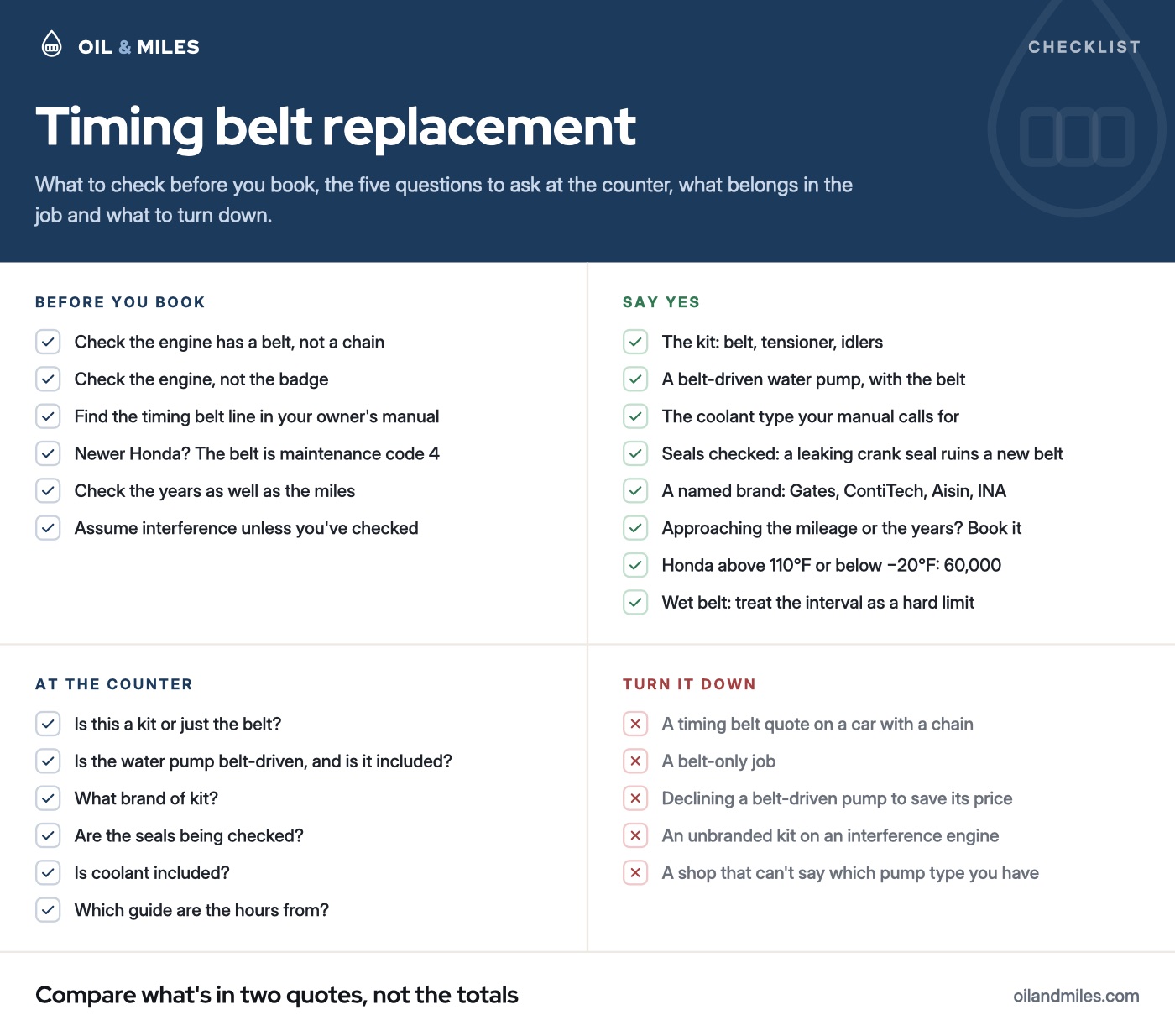
Use this image
Free to republish under CC BY 4.0: credit Oil & Miles and link to this page. The snippet does both.
<a href="https://oilandmiles.com/articles/timing-belt-replacement-cost"><img src="https://oilandmiles.com/assets/img/diagrams/timing-belt-replacement-cost-checklist.jpg" alt="Checklist: before you book, check the engine has a belt and find its interval in the service book; at the counter, ask the five questions on the kit, the water pump, the brand, the seals and the coolant; say yes to the full kit, a belt-driven water pump, the right coolant and checked seals; decline a belt-only job, an unbranded kit and a timing belt quote on a chain engine." width="1200" height="1058"></a> <p>Infographic: <a href="https://oilandmiles.com/articles/timing-belt-replacement-cost">Oil & Miles</a>, CC BY 4.0</p>From the documents
What the carmakers' own books say
Three carmakers, three different answers to when the belt is due, and none of them is the number online. These are the lines themselves.
The 2004 Odyssey book is where the 105,000 miles came from. The newer Honda books replaced it with a code the car shows when the belt is due.
Honda 2014 Odyssey owner's manual
Replace timing belt and inspect water pumpAmerican Honda Motor Co., maintenance code 4
Subaru 2015 Warranty and Maintenance Booklet
Timing Belt (WRX/WRX STI)Subaru of America, 2015 MY All Vehicles, Federal/California Specifications Vehicles
Volkswagen 2012 Passat maintenance schedule
Timing Belt: Replace (2.0L TDI only)Volkswagen of America, USA schedule
Conclusion
Book it, and compare what is in the quote
If your engine has a belt and you're approaching either the mileage or the years, book it. It isn't one of the services you don't need: it's the maintenance item with the worst consequences for being late.
Here's what to know before you pay for a timing belt replacement, from the books and quotes on this page:
- Check for a belt before anything else.A timing chain is meant to last the life of the engine and has no scheduled replacement. A quote for a belt job on a car with a chain is a mistake or something worse, so get a second opinion.
- Most of the bill is hours.Every complete kit priced here costs less at the counter than the cheapest installed job, $450. In the estimator's own split, labor outweighs parts on the Civic and the Accord, and only the top of the RAV4's range tips the other way.
- A belt-driven pump goes in with the belt.When the timing belt drives the water pump, both sit behind the same covers, so adding the pump costs its part price and little or no extra labor. Skip it and a leak months later means paying the full labor again and throwing away the new belt.
- The interval is in your engine's book.The books for five cars from three carmakers that we opened didn't match the 80,000 to 105,000 miles you'll find online for them. Some books pair the mileage with a time limit, seven years in Honda's 2004 book and eight in Subaru's 2015 one, so a low-mileage car can be the more urgent one.
- Compare what's in two quotes, not the totals.Ask whether it's a kit or just the belt, whether a belt-driven pump is included, which brand, whether the front crank seal was checked, and whether coolant is in it. A fuller quote looks worse today and can cost less over five years.
If you're buying a used car with a belt engine, ask for the receipt: "it has been done" without paperwork is worth nothing. Every interval we checked came out of the carmaker's own book and every figure from somebody who publishes one, which is what Oil & Miles does instead of averaging.
Common questions
Asked most often
How much does a timing belt replacement cost?
A timing belt replacement costs $450 to $785 on a small car, $561 to $1,187 on a midsize car or crossover and $685 to $1,562 on a minivan or SUV, in published shop estimates for the years that have a belt. Ask what the quote includes.
How often should a timing belt be replaced?
There's no single number, and that's the trap. We read the carmakers' own service books for five cars and got everything from no mileage at all to 130,000 miles, so look up your own engine rather than a range. Check the years as well as the miles, because some books pair the mileage with a time limit.
Should the water pump be replaced at the same time?
If it's belt-driven, yes. It sits behind the same covers, so fitting one later means paying the same labor twice and throwing away a new belt.
Will a broken timing belt ruin the engine?
On an interference engine the valves meet the pistons: bent valves, damaged guides, sometimes worse, and the repair means taking the cylinder head off. On a non-interference engine the car simply stops.
How do I know if my car has a belt or a chain?
Check the maintenance section of your owner's manual for a timing belt line. A line means a belt, even where it carries no mileage: newer Hondas list it as maintenance code 4. No entry points to a chain; a parts catalog for your engine will confirm it.
What people ask next
Sources
- Carmaker service books, for the intervals: the 2004, 2014 and 2018 Honda Odyssey owner's manuals, Subaru's 2015 Warranty and Maintenance Booklet, and Volkswagen's 2012 Passat and 2014 Jetta maintenance schedules, the Jetta's 2.0L MPI sheet re-read September 26, 2026. Honda, Subaru, Volkswagen, read August 28, 2026 and again September 24, 2026
- A national repair-cost estimator, for the three installed rows by car size and the range for each model. Estimates updated June 18, 2026, read from archived copies because the live pages block readers; no newer capture exists. RepairPal, via the Internet Archive, read September 15 and 29, 2026
- Owner's manuals and maintenance guides, for which engines carry a belt line: the 2008 Accord, 2004 and 2005 Civic, Toyota guides from 2004 and 2008 to 2017, Subaru's 2011 booklet, the 2014 Cruze and the 2017 Escape. Honda, Toyota, Subaru, Chevrolet, Ford, read September 29, 2026
- A marque forum, for the owners' box: Piloteers threads, read through the Internet Archive, with Pilot bills of $1,110 (2019) and $2,235 (2023) and an independent bill of $975. Piloteers, read September 26, 2026
- Average auto repair labor rates by state, 2026, for the $132 national average and the state averages from $100 in West Virginia to $161 in Alaska, aggregated from more than 10,000 shops. Tekmetric
- Automotive repair labor rates by state, for the typical $120 to $159 rate and the $140 benchmark, compiled from AAA, BLS and industry surveys, updated June 2026. AutoLeap
- Stellantis bulletin 09-014-24, Crank Gear Flange Dislocation, for labor operation 09-10-02-91, "Timing Belt, Inspect, Remove and Install or Replace", at 3.5 hours on a 2.0-liter four, the one published time we found for the job itself. FCA US LLC, filed with NHTSA, read September 15, 2026
- Honda bulletin 16-054, Timing Belt Chirps, with Acura 14-025 for the same repair on four more models, for the 2.6 and 2.7 hours, the 4.3 on the RLX Sport Hybrid, and the teardown both order. American Honda Motor Co., filed with NHTSA, read September 15, 2026
- RockAuto catalog, for the per-car tables, one unit each, before shipping and tax: the six-car brand lists on August 28, 2026 and the seventeen-car kit table on September 15. RockAuto, read August 28 and September 15, 2026
- RockAuto catalog, timing belt tensioner, for the two tensioner parts on the 2016 Pilot, 2014 Odyssey and 2008 Accord V6. RockAuto, read September 29, 2026
- AutoZone listing, for the water pump price comparison. AutoZone, read September 1, 2026
How this was compiled
Intervals are stated as ranges because they belong to the engine rather than to the model, and two cars of the same year and badge can differ; your own service schedule is the authority. No labor figure here is a book time we could read, and the manufacturer times we found are named where they're used rather than spread across the page.
What we didn't do
We didn't strip an engine. Nothing here was checked on a bench: the intervals come from the carmakers' own service books, which we opened, and the prices from seller listings we read.
We didn't compute the installed figures ourselves. The labor guides a shop looks up are sold by subscription, so the labor times we quote come from manufacturers' own bulletins and cover only the cars those bulletins name. Everything in the installed box is published by somebody else, and the seventeen-car table prices parts and stops there.
We couldn't confirm how many idler pulleys the three cars sold without a kit actually take, which is why $94 and $134 are floors rather than estimates. We give no figure for how many belt-driven engines are interference designs. It's commonly stated and we couldn't source a number we'd stand behind, which is why the page says assume yours is one.
Prices are ranges compiled in August and September 2026 for the US market and vary by region, engine and shop rate. In the cost boxes and the seventeen-car table, prices from $10 up are rounded to the nearest dollar, so $14.13 reads as $14 and $14.52 as $15, and below $10 they're exact. Where a single listing is quoted, it's to the cent. This article is general information, not advice about your specific vehicle. See the disclaimer.
Book time
The published number of hours a repair is deemed to take, from an industry labor guide.
Water pump
The pump that circulates coolant, driven by the timing belt or chain on most engines.
Interference engine
An engine in which the valves and pistons occupy the same space at different moments.
Wet belt
A toothed drive belt that runs submerged in engine oil rather than in dry air.