
Short answer
Look it up by engine, not by model
Your service schedule is the first place to check: a timing belt interval means you have a belt, no interval usually means a chain. If it's a belt, whether it runs in oil depends on the engine, and two identical-looking cars can differ.
vs timing chain is a question about the engine, not the badge on the back. Every four-stroke engine needs the camshafts to turn in step with the crankshaft.
Three common arrangements do that job, and from the driver's seat they're indistinguishable. From the invoice they aren't: over ten years the difference between them can be several thousand dollars.
Worse, you can't work it out from the car's name. Manufacturers changed designs mid-production, fitted different engines to the same model in different markets, and moved from one arrangement to another between facelifts.
A 2019 car and a 2022 car wearing the same badge can be built completely differently.
What's turning your camshafts
A belt or a chain. Which one your engine got was decided at the factory, and nothing you do now changes it.
What it changes is the bill, and when it lands. Here's what each one is, and what it asks of you.
Dry belt, the traditional one
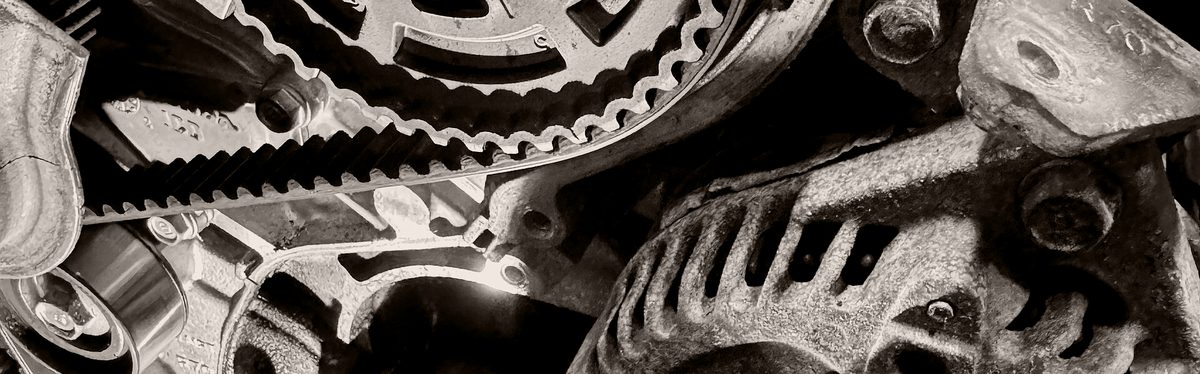
A toothed rubber belt on the front of the engine, behind a plastic cover, in the open air. Quiet, cheap to make, and a known service item: you replace it at a published interval, typically somewhere between 60,000 and 105,000 miles or seven to ten years, whichever comes first.
The failure is abrupt and well understood: it snaps, and on an the valves meet the pistons. Expensive, but the maintenance that prevents it is routine and every workshop can do it.
That job is covered in detail in what a timing belt replacement should cost, and what a failing one actually sounds like.
Timing chain, the one people assume is free
A metal chain running inside the engine, lubricated by engine oil, usually designed to last the life of the engine with no scheduled replacement.
"No scheduled replacement" isn't the same as "no possible problem." Chains stretch, and the tensioners and guides that keep them tight are wearing parts; a stretched chain throws valve timing off and typically announces itself as a rattle on -up.
It's rarer than belt trouble, but when a chain job does arrive it's a big one, because the chain is inside the engine.
What matters for planning is this: a chain has no line in your maintenance budget until something goes wrong.
Wet belt, a rubber belt inside, in the oil
The belt sits inside the engine, submerged in oil. It was adopted for friction, noise and packaging reasons, and it has produced the most expensive maintenance surprise of the three.
It's a service item like a dry belt, so it has an interval and a bill. But it's also inside the engine, so the job takes much longer, and it fails differently: the belt sheds material into the oil, the debris can blind the oil pump pick-up screen, and the engine can be damaged through lack of lubrication.
Most cars on the road now run a chain, because that's what makers fitted through the last fifteen years. A dry belt usually means an older car, and a wet belt a small modern engine built for economy.
A chain doesn't rule out a wet belt either. Ford's revised 1.0 EcoBoost turns its camshafts on a chain and still drives its oil pump with a wet belt.
Wet belt vs timing chain vs dry belt, side by side
The row that decides everything is the last one. A dry belt failure bends valves; a wet belt failure can take the whole engine, because the debris reaches the oil pump before anyone hears a noise.
Read the oil row with it. On a dry belt the oil is irrelevant to the belt, and on a wet belt it is the belt's environment.
| Dry belt | Timing chain | Wet belt | |
|---|---|---|---|
| Where it lives | Outside, behind a cover | Inside, in oil | Inside, in oil |
| Scheduled replacement | Yes | Normally none | Yes |
| Typical interval | 60k–105k miles, or 7–10 years | none published | Varies; Ford cut the 1.0 EcoBoost to 100k miles or 6 years in 2026 |
| Warning before failure | Often a tensioner whine | Rattle on cold start | Usually none |
| How much the oil matters | Not at all to the belt | A lot; chains wear fast on neglected oil | Decisively; the oil is the belt's environment |
| Worst realistic outcome | Bent valves | Timing out, possible valve damage | Oil starvation, possible replacement engine |
Is a timing chain better than a wet belt?
Yes, on cost of ownership, and it isn't close. Side by side, our own published figures show the chain costing least and the wet belt most over ten years:
- Chain: nothing scheduled. No line in the budget until something goes wrong, and on most engines nothing ever does.
- Dry belt: $450 to $1,800 a time, at an interval usually between 60,000 and 105,000 miles or seven to ten years. Most owners meet it once.
- Wet belt: $1,201 to $1,280 a time, in labor alone, before the belt kit, and Ford now sets six years on the 1.0 EcoBoost. On that clock a ten-year owner meets it twice.
That's where the several thousand dollars in the opening comes from. Two wet belt jobs against one dry belt job against none is the spread, on the same ten years of the same car.
We'd still stop short of calling the chain the better engineering. A chain is heavier, and when one does go it is a bigger job than either belt.
What we can say is narrower and more useful: of the three, the wet belt is the one that costs you most for the least warning.
How to find out what you've got
Four ways tell you if your car has a belt or chain, and you only need one of them to work. The first two settle it for almost everybody, and the fourth is a guess worth making only when the others are closed to you:
- Your service schedule. Open the maintenance section of the owner's manual and look for a timing belt entry. An interval means a belt. No entry usually means a chain. This costs nothing and takes two minutes.
- Ask a dealer to check the VIN. The most reliable answer, because it's about your specific car rather than a model. They can also tell you about open recalls and campaigns while they're in there. Our free VIN checker shows open recalls before you go.
- Find the engine code, on the registration document or stamped on the block, and look that up rather than the model name. This is what defeats the mid-production-change problem.
- Look at the front of the engine. A large plastic cover on the end usually means a dry belt. No cover, and a metal case that's part of the engine, points to a chain or a wet belt. Least reliable, but free.
Worth knowing
The question is almost always framed as “does a [model] have a chain or a belt?”, and it's the wrong question, because the answer belongs to the engine rather than the car. Two cars with the same badge, same year and same trim can have different arrangements if they left the factory with different engines.
That's also why a confident forum answer is worth so little here. The person answering is describing their own car accurately, and it may not be yours. Nobody is careless; the question can't be answered at the level it was asked.
The engine code turns a guess into a fact. It's on your registration document. Use that, not the model name.
What this means when you're buying
Belt, chain or wet belt, the arrangement changes what a service history is worth:
- Dry belt: ask for the belt receipt. If it's due and undone, that's a straightforward negotiating point with a known price.
- Chain: listen on a genuinely cold start. A rattle for the first second or two is worth investigating before you buy, not after.
- Wet belt: the receipt matters more than on any other car, and so does what oil was used. Here's the full checklist.
Conclusion
What to do about your engine
Find out which of the three you have, once, and write it in the back of the service book along with the interval. It takes an afternoon at most and it changes how you plan for the car.
Then act on it: a dry belt goes in the calendar, a chain goes on the listening list, and a wet belt gets the correct oil specification and an interval you treat as a limit rather than a target, which is its own subject.
We couldn't find a way to answer this from the badge, and we stopped trying: every figure here is filed against an engine instead. That's what Oil & Miles does when the tidy answer turns out to be the wrong one.
Common questions
Asked most often
How do I know if my car has a timing belt or a chain?
Open the maintenance section of the owner's manual and look for a timing belt entry. An interval means a belt; no entry usually means a chain. A dealer can confirm from the VIN in minutes.
Is a timing chain better than a belt?
A chain normally has no scheduled replacement, so it has no line in your maintenance budget. It's not maintenance-free though. Chains, tensioners and guides wear, and neglected oil wears them faster.
Do timing chains ever need replacing?
Yes, though far less often than a belt. A stretched chain usually announces itself as a rattle in the first seconds after a cold start, and the job is a large one because the chain sits inside the engine.
Can I tell by looking at the engine?
Sometimes. A large plastic cover on the end of the engine usually means a dry belt, and a metal case that's part of the engine points to a chain or a wet belt. It's the least reliable method of the four.
What people ask next
Sources
- NHTSA opening resume for EA26004, for Ford's reduction of the 1.0 EcoBoost belt interval to 100,000 miles or six years, reported to ODI on June 2, 2026, the opening date, July 31, 2026, and PE25020 as what prompted it. NHTSA ODI, Engineering Analysis EA26004, read September 18, 2026
- Ford Safety Recall 23S64 technical instructions, for the oil pump belt inspection procedure on the 2018-2021 EcoSport, 2016-2018 Focus and 2017-2021 Fiesta with the 1.0L EcoBoost and automatic transmission. Ford Motor Company / NHTSA, read September 18, 2026
How this was compiled
That neglected oil wears chains, tensioners and guides faster is established practice rather than a figure we measured, and it's offered as the former. The Ford recall instructions were re-opened and checked against the article.
What we didn't do
We didn't settle which engines use which drive on this page. That's a list of its own, and even there the answer runs by engine code and build date rather than by model name.
We didn't quantify chain wear.
Intervals vary by engine, market and model year, and manufacturers revise them (always follow your own vehicle's service schedule. General information, not advice about a specific vehicle). See the disclaimer.
Wet belt
A toothed drive belt that runs submerged in engine oil rather than in dry air.
Interference engine
An engine in which the valves and pistons occupy the same space at different moments.
Cold start
The first minutes after the engine has sat long enough to cool all the way down, usually overnight.