
Key takeaways
- Safety: If the car loses drive or stalls while moving, steer to a safe spot, stop and call for help.
- Only the 2.0 and 2.4 direct injection Theta II cars are in the class, so check the engine and not just the model name.
- Run your VIN on the maker's campaign page to see whether the KSDS update is done and which recalls are open.
- The lifetime short block cover is for owners who finished the KSDS update, and the 15 year cover is for different Hyundai engines.
- Get the KSDS update done, because the lifetime cover depends on it, and keep your maintenance records.
Hyundai and Kia fitted the Theta II direct injection engine to cars sold in the US from the 2011 model year. Recalls, a federal investigation and two class settlements followed, and each one covers a different list of cars.
Other Hyundai engines sit under the same KSDS update but a different warranty. The 15 year Hyundai warranty covers those other engines, and the lifetime cover covers the Theta II direct injection cars.
Which cars have a Theta II engine?
The Theta II direct injection cars are the ones in the court class, which are the Hyundai and Kia models in the first table with a 2.0 or 2.4 gasoline direct injection engine. A car of the same name can carry a different engine, so check the engine, not just the model name.
Hyundai's class notice limits its list to engines it calls genuine Theta II within factory specifications, and for 2019 to cars built before the knock sensor update went into production. Kia's class list names the 2.0 and 2.4 direct injection engines of the Optima, Sorento and Sportage, and for 2019 only certain cars. Our Kia pages carry the year detail.
| Car | Years | Engine |
|---|---|---|
| Hyundai Sonata | 2011–2019 | 2.0 or 2.4 direct injection |
| Hyundai Santa Fe Sport | 2013–2019 | 2.0 or 2.4 direct injection |
| Hyundai Tucson | 2014–2015 and 2018–2019 | 2.4 direct injection |
| Kia Optima | 2011–2019 | 2.0 or 2.4 direct injection |
| Kia Sorento | 2012–2019 | 2.0 or 2.4 direct injection |
| Kia Sportage | 2011–2019 | 2.0 or 2.4 direct injection |
The 2019 model year is only partly in the class, because the later cars were built with the update already installed. The 2.0 liter Tucson is a different engine, a Nu, and so are the cars in the next table, which sit under the same Hyundai update but a different warranty.
| Engine | Cars |
|---|---|
| Theta II 2.4 multiport | Hyundai Santa Fe 2010–2012, Tucson 2010–2013, Sonata Hybrid 2011–2015 |
| Nu 2.0 direct injection | Hyundai Tucson 2014–2021, Elantra 2014–2016, Elantra Coupe 2014, Elantra GT 2014–2020, Sonata Hybrid and Plug-In Hybrid 2016–2019 |
| Gamma 1.6 direct injection | Hyundai Veloster 2012–2017 |
| Kia Engine II settlement | Certain 2010–2020 Kia cars with other engines, under a second settlement |
Hyundai's own VIN decoding guide shows how the two engines split on one model, with a 2.4 direct injection as a Theta II and a 2.0 as a Nu, as on the 2019 Tucson. So the same Tucson name can mean either engine.

The Theta II engine
Does my car have a Theta II? How to check
The maker's VIN lookup answers it for your own car. Enter the VIN at HyundaiUSA.com/Campaign for a Hyundai, or use Kia's own VIN lookup for a Kia, and read the open and completed campaigns. Our page on where the VIN is shows where to find the number.
The lookup lists campaigns and not the engine name, so compare your model and year with the tables above. A completed KSDS campaign means the update is in, and an open recall means a dealer still has to inspect the engine.
Hyundai's VIN decoding guides put the engine in the eighth character of the VIN, but the letter differs by model and year, so no single letter marks a Theta II. In one guide L stands for the 2.4 Theta II and 4 for the 2.0 Nu, as on the 2019 Tucson.
Can you drive a car with a Theta II engine problem?
It depends on the sign. Stop for the red oil light, a stall, smoke or a blinking check engine light, and have a dealer inspect a knock right away. A worn connecting rod bearing can fail, and the recall text names a stall as the result, which raises the risk of a crash. A metallic knock that rises with engine speed is the sign Hyundai's recall letters give for it.
If any of these shows up:
- Stop: The red oil pressure light comes on while you drive. Stop somewhere safe right away and switch the engine off. Check the oil level once the engine is off, and if the light stays on, don't drive on until it's repaired.
- Stop: The car loses drive or stalls while moving. Steer to a safe spot, stop and call for help.
- Stop: You see smoke or smell burning from under the hood. Pull over and switch the engine off as soon as it's safe, and keep the hood shut until the smoke stops. If you see flames, get everyone out of the car, move at least 100 feet away from it and well away from traffic, and call 911.
- Stop: Reduced engine power comes on. Stop somewhere safe and call a tow if you can't keep up with traffic or the power keeps cutting out. On these cars the reduced power mode is there to let you reach a safe location. Contact a dealer right away, and don't keep driving in this mode, because it can end in severe engine damage and a stall.
- Caution: You hear a knocking noise from the engine. Contact a dealer right away to have the engine inspected, because the bearing can fail and the engine can stall while you drive.
On cars with the KSDS update, the reduced power mode holds the engine to about 1,800 to 2,000 rpm, which both makers' texts put at a top speed of about 65 mph or less, depending on load and road conditions. Kia's owner letters warn that failing to take the car to a Kia dealer after the light starts blinking may void the lifetime warranty.
What are the symptoms of Theta II engine problems?
A knock from the engine is the sign the makers document. NHTSA's text for recall 15V-568 describes a worn connecting rod bearing as producing a metallic, cyclic knocking noise and possible engine failure. Hyundai's recall letters add that the knock gets faster as engine speed rises.
Kia's letters describe a cyclic knock and add that the engine warning light or the oil pressure light can come on. A light tick at idle has other causes, covered in our page on engine ticking.
On the cars with the KSDS update, a worn bearing can also set off the update's alarm. The check engine light blinks, the power is cut, and the engine stores code P1326 on a Kia or P132600 on a Hyundai. Hyundai's cars also sound a chime.
NHTSA's complaint file through September 30, 2026 holds 9,752 engine failure complaints out of 19,511 complaints on Theta II direct injection cars in the model years above. These are complaints filed in owners' own words and not a failure rate, because the file has no sales count to divide by.
What goes wrong inside a Theta II engine?
The common thread in the recall texts is wear in the connecting rod bearings, the soft metal shells that cushion each rod on the crankshaft. Oil has to reach them to keep the metal parts apart.
Three causes are named in the makers' and NHTSA's own documents. They run from a build fault to an oil condition to the fires that can follow a failure.
1. Metal debris left from manufacturing
NHTSA's text for recall 15V-568 describes metallic debris that may not have been fully removed from the crankshaft during manufacturing. It can restrict oil flow to the connecting rod bearings and damage the connecting rods. It covers the 2011 and 2012 Sonata with engines built at Hyundai's Alabama plant from December 11, 2009 to April 12, 2012.
Later recalls name a different build fault. Recalls 17V-226 for Hyundai and 17V-224 for Kia describe machining errors during engine manufacturing that may cause premature bearing wear, and the wear may seize the engine.
2. Running the engine low on oil
The documents don't name oil use as the cause of the recall defects, but both makers' repair procedures start with the oil. Hyundai's bulletin 23-EM-008H passes a car on oil use if it goes more than 1,000 miles on a quart, and sends a car that burns more to a cleaning procedure or a new engine. That figure is the dealer's pass line and not a normal for owners, and our pages on high mileage oil use and blue smoke cover the rest.
The cleaning procedure in bulletin 23-EM-007H isn't a bearing repair, and it excludes an engine with abnormal noise or internal damage. Kia's 2024 repair bulletin for 2019 cars asks the dealer to photograph the dipstick and the oil filler cap and to check the maintenance records before it pays for a repair. Hyundai's warranty page sets the oil change at least every 7,500 miles or 12 months on its other engines.
3. Fires after a failure or a leak
NHTSA opened investigation EA 21-003 on engine fires due to engine failure in 2011–2016 Hyundai and Kia cars. Recalls 20V-746, 21V-727 and 21V-844 for rod bearings name the same outcome, since a damaged engine can raise the risk of a fire or cause a stall.
Recalls for both makers cover fires and fuel leaks as well as bearing wear. Recall 20V-750 describes an engine compartment fire while driving and has dealers inspect for fuel and oil leaks, and recalls 18V-907 for Kia and 18V-934 for Hyundai cover a high pressure fuel pipe that may have been damaged, misaligned or badly torqued during an engine replacement.

Use this image
Free to republish under CC BY 4.0: credit Oil & Miles and link to this page. The snippet does both.
<a href="https://oilandmiles.com/articles/hyundai-kia-theta-ii-engine-problems"><img src="https://oilandmiles.com/assets/img/diagrams/hyundai-kia-theta-ii-engine-problems-bench-flow-1200.svg" alt="A four-cylinder engine block drawn see-through in pale gray, with the four connecting rod bearings in blue at the big end of each rod on the crankshaft." width="1200" height="706"></a> <p>Diagram: <a href="https://oilandmiles.com/articles/hyundai-kia-theta-ii-engine-problems">Oil & Miles</a>, CC BY 4.0</p>What is KSDS and how do you get it?
KSDS, the knock sensor detection system, is a software update to the engine computer that listens for the knock of a worn bearing. Hyundai's campaign page describes it as designed "to detect abnormal engine bearing noise before potentially severe engine damage occurs." NHTSA's resume for EA 21-003 adds that it limits engine power once it detects an impending failure.
It's free at a dealer. Hyundai ran it for its cars in the first table under Service Campaign 953, and ran Campaigns 966 and 982 for the cars in the second table.
Kia's version came through its own product improvement campaigns. Cars in Hyundai recalls 198 and 209 get the update with the recall repair.
The update is an alarm and not a repair. On a Kia, a dealer who sees code P1326 first runs a bearing clearance test, which checks the rod bearings by putting air and vacuum into the cylinder block. A pass leads to a software check or a new knock sensor, and a fail leads to a replacement engine.
Which recalls cover which cars?
These NHTSA recalls touch these engines, and each is free at a dealer for the cars its VIN list names. Run your VIN on NHTSA's recall lookup or our VIN check before you pay for anything. Recalls 18V-907, 18V-934, 20V-750 and 23V-877 are about fuel leaks and engine fires, and the others are about the rod bearings.
| Campaign | Cars as NHTSA prints them | Defect | Remedy |
|---|---|---|---|
| 15V-568 | Hyundai Sonata 2011–2012, built December 11, 2009 to April 12, 2012 | Metal debris may restrict oil to the rod bearings | Inspect, replace the engine as necessary |
| 17V-224 | Kia Optima 2011–2014, Sorento 2012–2014, Sportage 2011–2013 | Machining errors may wear the bearings early | Inspect, replace the engine if necessary |
| 17V-226 | Hyundai Sonata 2013–2014, Santa Fe Sport 2013–2014 | Machining errors may wear the bearings early | Inspect, replace the short block as necessary |
| 18V-907 | Kia Optima 2011–2017, Sorento 2012–2017, Sportage 2011–2018 after an engine replacement | Fuel pipe may be damaged or badly torqued | Inspect, replace the fuel pipe as necessary |
| 18V-934 | Hyundai Sonata 2011–2014, Santa Fe Sport 2013–2014 after an engine replacement | Fuel pipe may be damaged or badly torqued | Inspect, replace the fuel pipe as necessary |
| 20V-746 | Hyundai Veloster 2015–2016, Santa Fe 2012, Sonata Hybrid 2011–2013 and 2016 | Rod bearings may wear early | Inspect, replace the engine if damaged, install KSDS |
| 20V-750 | Kia Sorento 2012–2013, Forte and Forte Koup 2012–2015, Optima Hybrid 2011–2013, Soul 2014–2015, Sportage 2012 | Engine compartment fire while driving | Inspect for leaks, repair, update KSDS |
| 21V-727 | Hyundai Tucson 2017, Sonata Hybrid 2017 | Rod bearings may wear early | Inspect, replace the engine if damaged, install KSDS |
| 21V-844 | Kia Optima Hybrid and Plug-In Hybrid 2017–2018 | Rod bearings may wear early | Inspect, replace the engine if damaged, install KSDS |
| 23V-877 | Kia Sorento 2011 | Engine compartment fire while driving | Install KSDS, replace the engine as necessary |
Some hybrids and one Tucson year sit in these recalls. Whether their engines are Theta II isn't established in the recall records, so the list shows the cars as NHTSA prints them. The table uses NHTSA's own build dates for 15V-568.
What does the Theta II warranty cover?
Four separate promises exist, and which one applies depends on the maker and the engine. Hyundai's and Kia's class settlements give a lifetime short block cover to individual owners, and a different Hyundai warranty runs 15 years or 150,000 miles on the other engines.
| Cover | Cars | What it pays | Condition | Dated |
|---|---|---|---|---|
| Hyundai lifetime short block | Hyundai cars in the first table | Bearing wear or damage to the short block parts: parts, labor and diagnosis, at any mileage | Individual owners who finished the KSDS update and still own or lease the car | Judgment June 10, 2021 |
| Hyundai 15 years or 150,000 miles | The Hyundai engines in the second table, not the Theta II direct injection cars | Engine repair or replacement caused by connecting rod bearing failure | KSDS update done, except for cars in recall 198 or 209. Original and later owners | Hyundai notice, March 2026 |
| Kia lifetime short block | Kia Optima, Sorento, Sportage in the first table | The same short block parts | Individual owners who finished the update. Certain limitations may apply, per Kia's 2024 bulletin | Final approval May 10, 2021 |
| Kia Engine II 15 years or 150,000 miles | Certain 2010–2020 Kia cars with other engines | Short block and long block, for rod bearing wear | Update done before November 4, 2023. Original and later owners | Claims to July 8, 2024. Final approval April 5, 2024 |
The short block is the engine block, crankshaft and bearings, connecting rods and bearings, and pistons. The lifetime cover can be denied for "exceptional neglect," which the court documents define as a vehicle with a year or more of no maintenance or care that appears dilapidated, abandoned or beyond repair, or a car that didn't get the KSDS update within 60 days of the notice.
Recall 15V-568 cars also carry a short block warranty of 10 years or 120,000 miles, set by that recall in January 2016. Commercial buyers and salvage cars are excluded from Hyundai's 15 year cover. The money benefits of the settlements, such as rental and tow refunds and replacement rebates, had claim deadlines that have passed, and the warranty is what lasts.
What did NHTSA do about Theta II engines?
NHTSA entered consent orders with both makers in November 2020 over untimely recalls of more than 1.6 million vehicles with Theta II engines. The penalties total $210 million, which is $140 million for Hyundai and $70 million for Kia.
NHTSA opened investigation EA 21-003 in December 2021 on engine fires due to engine failure in certain Hyundai and Kia cars, an estimated 3,000,000 vehicles. The opening document lists 78 fire complaints, 3 injury incidents and no deaths.
NHTSA closed it on February 5, 2024, after Kia's recall 23V-877 for about 80,000 cars, all of them 2011 Kia Sorento with the 2.4 multiport engine. Under the makers' re-notice plans, Hyundai will re-notify all of its owners covered by its engine recalls, and Kia the majority of its owners, every 8 months for 3 years.
The closing resume lists 1,968 incidents as of February 5, 2024, 97 with injuries (132 injuries) and no deaths. NHTSA found lower reported fire rates on the majority of recalled models after the remedies, and the consent orders were released for Kia in November 2022 and for Hyundai in November 2023.
How do you keep the Theta II warranty?
Get the KSDS update done and keep your maintenance records. The lifetime cover depends on the update, and the denial rule in the warranty section turns on a year or more of neglect that leaves the car looking abandoned, or a missing KSDS update.
Hyundai's warranty page sets the oil and filter change at least every 7,500 miles or 12 months for its other engines. The court notice gives no interval but suggests keeping all maintenance records, and Kia's dealers check the records and the oil level photos before a repair.
What should you do if the engine fails or the light blinks?
Get the car off the road first, then work through these five steps in order:
- Stop safely. Follow the safety list above, which says to stop for the red oil light, a stall, smoke or a blinking light, and to contact a dealer right away for a knock.
- Run your VIN. The maker's campaign page shows the open recalls and whether KSDS is done, which sets what the dealer owes you.
- Call a dealer. Give the VIN and what you noticed. Under Hyundai's Campaign 953 dealer instructions, no diagnostic fee is charged when a car comes back with the check engine light on and the driver describes the engine protection mode.
- Bring the records. Oil change receipts and service history are what the warranty checks.
- Ask about approval. Hyundai's dealers are to submit a warranty prior approval request, so ask whether one went in.
The dealer's inspection result decides whether the engine is repaired or replaced. Ask for the result in writing and keep a copy with your maintenance records.
What to say to the shop
When the light blinks or you have a repair quote, ask:
- Is the KSDS update done on my car?
- Does my VIN have an open recall?
- Has a warranty approval been requested?
“My check engine light is blinking and the car is in reduced power. Can you tell me whether KSDS is done, whether a recall is open on my VIN and whether a warranty approval has been requested?”
A good answer: the campaign status read from your VIN, the inspection result on the repair order and a warranty request before any engine work.
Should you buy a used Hyundai or Kia with a Theta II?
Yes, if the VIN check shows the KSDS update done and no open recall. Ask for the oil change records before you agree on a price, because a used Theta II car isn't ruled out by the engine alone and the complaint count isn't a failure rate.
Hyundai's class notice words the lifetime cover as applying while you "continue to own or lease" the car, and it doesn't say whether a later buyer keeps it. Ask the dealer in writing before you count on it.
A car in recall 15V-568 with no proof of the recall inspection hasn't been shown to be fixed, as on a 2011 Sonata. Hyundai's notice offers a free recall inspection for any recalled car not yet inspected, whatever the mileage. Our high mileage cars to avoid page is the next read if you're comparing used cars.
From the carmakers
What do the carmakers' and NHTSA's documents say about free fixes?
The documents show what the update does, which warranties apply and what NHTSA did. The recall repair and the KSDS update are the free fixes, the warranties pay for covered engine repairs, and a recall pays only on the cars whose VIN it lists, so run yours first.
The warranty cards apply only to the owners and engines the documents name. The information-only cards pay for nothing.
Recall 15V-568
A worn connecting rod bearing will produce a metallic, cyclic knocking noise from the engine and possible engine failure.
Campaign page Campaign 966
…designed to detect abnormal engine bearing noise before potentially severe engine damage occurs.
Warranty page Campaign 966 warranty
The extended warranty is valid for original and subsequent owners.
Dealer letter PI1803
…lifetime engine warranty coverage for this issue only (DTC P1326), to both new and used vehicle owners…
Owner letter Notice of September 20, 2018
…an abusive failure to take the vehicle to a Kia dealer after KSDS activation may void the lifetime warranty…
Service bulletin 23-EM-008H
If the oil consumption calculation is above 1,000 Miles Driven / per Quart, then vehicle passes the oil consumption inspection.
Investigation EA 21-003
Engine fires due to engine failure.
Conclusion
What to do next about a Theta II engine
If your car is in the first table, run its VIN and get the KSDS update done, because the lifetime cover depends on the update, and keep your maintenance records. If a warning shows, follow the safety list above, and if you're buying one used, ask the dealer in writing which cover carries over.
Oil & Miles checks each step here against the carmakers' notices, the court documents and NHTSA's recall and investigation files.
Common questions
Asked most often
How do I know if I have a Theta II engine?
Enter your VIN on the maker's campaign page, then compare your model and year with the tables above. The eighth character of the VIN is the engine code, but the letter differs by model and year.
Is my car covered for free?
A recall repair or the KSDS update is free at a dealer, and the lifetime short block cover applies to class cars whose owners finished the update. Hyundai's 15 year cover is for the other engines in the second table.
Is the settlement still open?
The claim deadlines have passed, and the warranty is what lasts. Run your VIN to see which cover applies to your car.
What is KSDS?
KSDS is a free engine computer update that listens for the knock of a worn bearing. If it triggers, the check engine light blinks and engine power is reduced.
Does a Theta II mean the engine will fail?
The documents give no failure rate. NHTSA's count of 9,752 engine failure complaints out of 19,511 is complaints filed and not a rate.
Does Hyundai's 15 year warranty cover my car?
Only if its engine is one of those in the second table. A Theta II direct injection car is under the lifetime class cover instead.
Sources
- NHTSA recall records for 15V-568, 17V-224, 17V-226, 18V-907, 20V-746, 20V-750, 21V-727, 21V-844 and 23V-877, for the cars, defects and remedies in the recall table. NHTSA recall file as of August 25, 2026, nhtsa.gov/recalls, read November 19, 2026
- Hyundai recall owner letters for 15V-568 and 17V-226, and Kia 17V-224 interim and remedy letters, for the knock description. Hyundai and Kia, filed with NHTSA, static.nhtsa.gov/odi/rcl/2015/RCONL-15V568-6041.pdf and static.nhtsa.gov/odi/rcl/2017/RIONL-17V224-1747.pdf, read November 19, 2026
- Investigation resume EA 21-003, December 22, 2021, for the fire investigation, its vehicle count and complaint counts. NHTSA, static.nhtsa.gov/odi/inv/2021/INOA-EA21003-5198.PDF, read November 19, 2026
- Investigation closing resume EA 21-003, February 5, 2024, for the closing, recall 23V-877, the re-notice plan, the closing incident counts and the consent order releases. NHTSA, static.nhtsa.gov/odi/inv/2021/INCLA-EA21003-11085.pdf, read November 19, 2026
- NHTSA announces consent orders with Hyundai and Kia over Theta II recalls, November 2020, for the penalty amounts. NHTSA press release, nhtsa.gov/press-releases, read November 19, 2026
- NHTSA complaint files, full download of September 2, 2026 plus complaints received through September 30, 2026, with engines decoded from VINs through NHTSA's vPIC, for the 9,752 and 19,511 counts. NHTSA, read November 19, 2026
- Hyundai Theta Engine Settlement notice, FAQs and judgment of June 10, 2021, for the class cars and the lifetime warranty terms. Hyundai Motor America, hma-thetasettlement.com, read November 19, 2026
- Kia Engine Settlement, final approval May 10, 2021, for the Kia class cars and the lifetime short block cover. Kia America, kiaenginesettlement.com, read November 19, 2026
- Kia Engine II Settlement, final approval April 5, 2024, for the 15 year or 150,000 mile cover and its dates. Kia America, kiaengineclasssettlement.com, read November 19, 2026
- Engine Monitoring Logic (KSDS) Product Improvement Campaign 966, Campaign 982 and the Engine Warranty Extension page, for the KSDS update, the engines by car and the 15 year cover. Hyundai, autoservice.hyundaiusa.com/campaign966, read November 19, 2026
- Dealer Notification TXXM/T6G, TSB 26-01-033H, March 26, 2026, for the 15 year cover terms and the warranty prior approval step. Hyundai, static.nhtsa.gov/odi/tsbs/2026/MC-11030330-0001.pdf, read November 19, 2026
- Service Campaign 953 Dealer Best Practice, TSB 19-01-002H-1, March 15, 2019, for the cars in the first KSDS campaign and the blinking light behavior. Hyundai, static.nhtsa.gov/odi/tsbs/2019/MC-10158804-9999.pdf, read November 19, 2026
- TSB 23-EM-008H and TSB 23-EM-007H, December 2023, for the oil consumption test and the combustion chamber cleaning limits. Hyundai, static.nhtsa.gov/odi/tsbs/2023/MC-10247597-0001.pdf, read November 19, 2026
- Product improvement campaigns PI1803 and PI1805, dealer letters of October 25, 2018 and October 24, 2019, and repair bulletins of November 4, 2021 and January 2024, for the Kia cars, the bearing clearance test and the records check. Kia, static.nhtsa.gov/odi/tsbs/2018/MC-10147425-9999.pdf and static.nhtsa.gov/odi/tsbs/2024/MC-10249001-0001.pdf, read November 19, 2026
- Kia owner letter, Important Updated Notice, September 20, 2018, for the limp mode figures and the lifetime warranty warning. Kia, static.nhtsa.gov/odi/tsbs/2018/MC-10145159-9999.pdf, read November 19, 2026
- 2019 Model Year VIN Decoding Guide, Tucson, for the engine code in the eighth character. Hyundai, filed with NHTSA, read November 19, 2026
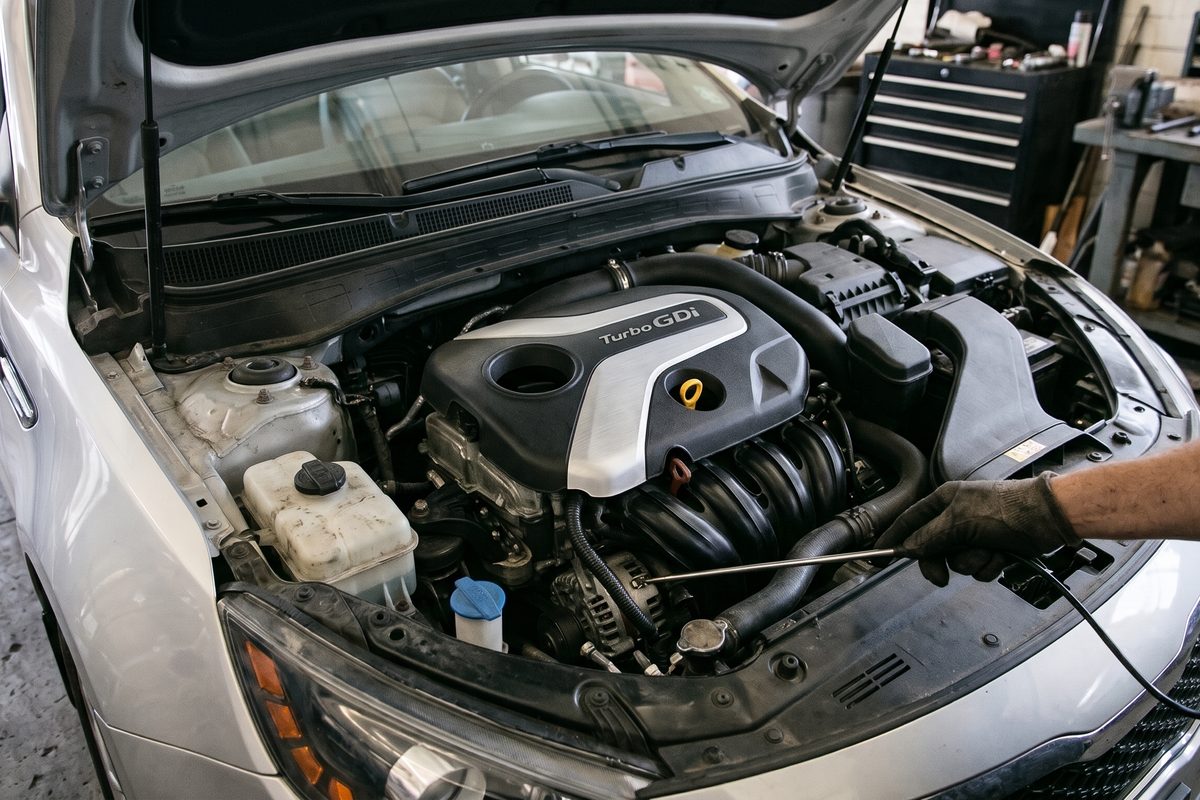
Hero image: illustration by Oil & Miles
How this was compiled
Each fact comes from a maker's, court's or NHTSA's own document, and the Sources list names each one. Causes that appear only on blogs and forums, such as carbon on the pistons or turbo faults, are left out because none of these documents names them.
What we didn't do
- Kia's Warranty Bulletin 2024-02 is a dealer document and isn't quoted here, so the Kia lifetime cover carries the limit its 2024 repair bulletin prints.
- We gave no failure rate, because complaint counts have no sales count to divide by.
This article is general information, not advice about your specific vehicle. See the disclaimer.