
Short answer
A timing belt that lives in the oil
A wet belt engine runs its timing belt, which keeps the valves in step with the pistons, inside the engine and bathed in oil. As the belt wears, shed rubber can clog the mesh screen the oil pump draws through, and an engine starved of oil can need replacing. Replacing the belt on schedule works out to about $1,201 to $1,280 in labor alone at the US average shop rate, before parts, and skipping it is what risks the engine.
engines broke a simple rule. For most of the last fifty years a timing belt was a toothed rubber belt on the front of the engine, behind a plastic cover, keeping the crankshaft the pistons turn and the camshafts that open the valves in step.
It was dry, it was easy to reach, and when it wore out you replaced it. Some carmakers moved it inside the engine and ran it in oil, a design the belt makers call belt-in-oil and everyone else calls a wet belt, or a wet timing belt.
It's why owners of some ordinary small cars and crossovers are being handed quotes for a replacement engine. Below is the design, why anyone built it, how it fails, what the belt job costs, and why the oil you put in matters more than almost anything else you do.
Where do you stand with a wet belt engine?
Buying one? Start with the three checks before you buy.
Why did anyone put a belt in the oil?
Because running it in oil cuts friction, quiets the engine and packages shorter, all at once. Gates, which makes belt-in-oil kits, says the original systems were built to meet emissions and fuel-economy standards, and each of the three gains of a wet belt engine is real:
- It cuts frictionA belt is quieter and draws less power than a chain, and lubricating it reduces losses further. When carmakers were chasing fractions of a percent in fuel economy tests, small gains across many parts added up to a meaningful number.
- It cuts noiseThree-cylinder engines are inherently less smooth than fours, and the small turbocharged three-cylinder became the standard European city-car engine in the 2010s. A belt running in oil is quieter than a chain, which helped these engines feel more refined than their size suggested.
- It saves spaceWith no external belt cover, the front of the engine can be shorter. That's useful in a small car whose engine sits sideways, where every inch of the engine bay is contested.

A belt that runs dry
On top of that, the carmakers expected the belt to outlast a dry one, because oil protects rubber from the ozone and heat cycling that harden an external belt. Ford originally specified a replacement interval of 150,000 miles for the 1.0 EcoBoost, effectively the life of the car for most owners.
What lets rubber live in oil at all is the belt makers' recipe: HNBR, a rubber made to resist oil and heat, wrapped around glass cords. The teeth get a tough fabric with a slippery PTFE (Teflon) skin.
A timing chain is metal, and oil is simply its lubricant. A belt is rubber and fabric, and what's in the oil can hurt it: Continental names hard crystals formed from dirt, and Ford names contaminants and poor oil quality.
The theory was sound; the problem was what the oil turned into. Three arrangements drive a camshaft, and they look identical from the driver's seat:
| Arrangement | Where it sits | Service | What oil does to it |
|---|---|---|---|
| Dry belt | Outside the engine | Replace on schedule, 60,000–105,000 miles or 7 to 10 years | Oil doesn't affect it |
| Timing chain | Inside, running in oil | No published interval. Normally never | Wears fast on neglected oil |
| Wet belt | Inside, submerged in oil | Replace on schedule. Ford cut its 1.0 to 100,000 miles, or 6 years | The oil is its environment |
Which one you have belongs to the engine, not to the model name. If you meet the British word cambelt, it means timing belt, so a "wet cambelt" is the same part under another name.
What the belt makers say 4 sources
- Dayco, belt-in-oil kitsGlass cord, an HNBR body, nylon or aramid tooth fabric with a PTFE skin. Dayco says it invented the design in 2007.
- Continental, CT1228 belt, June 25, 2020For Peugeot and Citroën 1.2 engines from late model year 2013: impurities in the oil can form hard crystals that damage the belt and, at worst, tear it.
- Gates, belt-in-oil systemsBuilt to meet emissions and fuel-economy standards; a kit holds the belt, tensioners, idlers, seals, gaskets and bolts.
- Ford 1.0 EcoBoost interval150,000 miles originally; 100,000 miles or 6 years under Ford program 26L02, August 25, 2026.
How do wet belt engines fail?
A dry timing belt fails in a way everybody understands: it snaps, the camshafts stop, and on an the valves meet the pistons. Dramatic, immediate, and at least obvious.
The failure the documents describe is quieter and worse. A wet belt sits in oil its whole life, and over time, especially on the wrong, old or fuel-thinned oil, its outer layer breaks down.
The belt doesn't snap first, it sheds. Small particles of degraded rubber come off the belt and go where everything in an engine eventually goes: into the oil pan.
At the bottom of the oil pan sits the oil pump pick-up, and over it a fine mesh screen whose whole job is to stop debris reaching the pump. The screen does exactly what it was designed to do: it catches the rubber, and then it keeps catching it.
As the mesh blinds over, oil flow falls, and oil pressure across the engine drops with it. The bearings, which survive only because a film of oil holds the metal apart, start to run marginal.
If the blockage becomes bad enough, lubrication falls below what the engine needs. The result is bearing damage, a bearing spinning in its housing, or an engine that seizes.
The National Highway Traffic Safety Administration (NHTSA), the federal safety regulator, described this route directly when it upgraded its investigation into Ford's 1.0-liter EcoBoost. It added that the screen can't be serviced: checking or cleaning it means taking the engine out of the car.
Step by step, it's the debris from a failing wet belt that does the damage, and this is the order it happens in, across the 5 steps below:
- The belt degrades. It sits in engine oil for its whole life, and sheds material as it goes.
- The debris reaches the oil pan. Shed rubber ends up where everything in an engine ends up.
- The pick-up screen blinds over. The mesh guarding the oil pump catches it, then keeps catching it.
- Oil pressure falls. Bearings that survive on a film of oil start running marginal.
- The engine goes. Bearing failure or seizure, and the fix is an engine rather than a belt.

Use this image
Free to republish under CC BY 4.0: credit Oil & Miles and link to this page. The snippet does both.
<a href="https://oilandmiles.com/articles/wet-belt-engines-explained"><img src="https://oilandmiles.com/assets/img/diagrams/wet-belt-debris-oil-pump.svg" alt="Wet belt engines failure route: the timing end of a Ford 1.0 EcoBoost with the cover ghosted, the wet timing belt shedding crumbs that sink into the cut-open oil pan, the separate oil pump belt running down from the crankshaft to the pump, and an enlarged view of the pump's mesh screen clogging with belt debris." width="1200" height="869"></a> <p>Diagram: <a href="https://oilandmiles.com/articles/wet-belt-engines-explained">Oil & Miles</a>, CC BY 4.0</p>Can a wet belt snap like a dry one?
Yes, though it's not the route the federal investigation describes: Continental, which makes these belts, says dirt in the oil can form hard crystals. Caught between the belt and its pulleys, they damage the teeth and, at worst, tear the belt.
A torn belt stops the camshafts just as a snapped dry belt does. We couldn't find a Ford document saying whether the 1.0 EcoBoost is an interference engine, so we don't promise the valves survive.
What are the warning signs?
You get very few, and they arrive late. NHTSA says complaints commonly describe the oil pressure light coming on just before the engine loses power, and some describe no warning at all.
Ford's program 26L02, the US notice that cut the belt interval, also accepts trouble codes as evidence of belt wear. They're P0016 to P0019, which mean the camshaft and crankshaft signals have drifted out of step, and P033F.
A failing dry belt can whine for weeks first, as our guide to timing belt symptoms describes. In the documents we read, a wet belt doesn't extend that courtesy.
What the investigation found 5 findings
- Ford 1.0 EcoBoost, NHTSA EA26004Opened July 31, 2026: belt material can degrade and clog the mesh oil pump pick-up screen, leading to a loss of motive power while driving.
- Failure mileage, EA26004An average of about 70,000 miles, with 98% of failures before the 150,000-mile belt interval.
- Oil care, EA26004Failures occurred despite evidence of proper and routine oil maintenance; the pick-up screen isn't serviceable.
- Warning, EA26004Complaints commonly allege a low oil pressure lamp immediately before the loss of power; some allege no warning.
- Trouble codes, Ford 26L02A repair order showing P0016, P0017, P0018, P0019 or P033F counts as evidence of belt wear for the program.
What owners report
Across the 2018 to 2020 EcoSport, 165 of the 1,567 complaints US owners filed name a belt alongside the timing drive or the oil pump. What's missing from them is any run-up. The sequence owners describe is compressed to almost nothing: a noise, or a light, and then a dealer teardown, and very few describe weeks of warning.
Compare that with an ordinary dry belt, where a failing tensioner bearing whines for weeks before it lets go. That noise is a gift. A wet belt rarely gives one, because what kills the engine is the material the belt sheds finding the oil pick-up.
What it does leave is evidence in the oil, for anyone who looks. Fine dark sediment on the drain plug magnet or in the bottom of the drain pan is worth a second look on these engines. It's one of the few chances to catch this before the oil pressure light settles the matter.
Counted from NHTSA's public complaints database in August 2026. It's owner-filed, not ours, and anyone can repeat the count.
Is there more than one belt in there?
Yes, on at least two of these engines, and the second belt is a different problem with a different bill. Ford's 1.0 EcoBoost and 2.0 EcoBlue both have one, and a quote that names one belt may say nothing about the other.
Ford's 1.0-liter EcoBoost has two belts running in oil, and each one fails in its own way, with its own Ford document behind it:
- The timing beltIt keeps the crankshaft and camshafts synchronized. This is the one whose debris can blind the .
- A separate oil pump drive beltIt drives the oil pump itself, and Ford's recall says its tensioner arm can fracture or separate, or the belt can shed pieces. Lose the drive to the oil pump and oil pressure doesn't fall gradually, it goes.
The distinction matters. Ford's US safety recall 23S64 is about the oil pump belt and its tensioner, while the federal investigation is about the timing belt and the debris it creates.
Treat the two belts as one thing and you'll look for the wrong recall, and possibly conclude your car is covered when it's not. We go through exactly which cars fall under which in the Ford 1.0 EcoBoost guide.
When either belt is due, the belt makers sell the job as a kit rather than a belt. Gates's larger kits for the 1.0 EcoBoost put the oil pump belt, seals and tensioner in the box with the timing belt, so one visit covers both.
Ford's two belts 3 documents
- Ford Safety Recall 23S64 (NHTSA 23V-905)1.0 EcoBoost with an automatic transmission: the oil pump drive belt tensioner arm may fracture, or the belt may shed pieces, causing a loss of oil pressure.
- 23S64 Supplement 4, June 22, 2026Its labor table replaces the oil pump belt, its tensioner and the timing belt in one job.
- Gates TechZone, January 30, 2025Timing belts T354HOB and T359HOB for the 1.0 EcoBoost; the super-kits add the oil pump belt, seals and tensioner, and the KP kits the water pump.
Which engines have a wet belt?
Wet belts aren't everywhere. Ford and Stellantis put one in writing on three engines: Ford's 1.0 EcoBoost gasoline engine and 2.0 EcoBlue diesel, and the 1.0 and 1.2 PureTech.
Two independent references place one in Honda's 1.0 VTEC Turbo, which never reached the US, but we found no Honda document saying so. The 1.5 diesel sold as the Ford EcoBlue and the Stellantis BlueHDi often turns up on lists, and it isn't belt-in-oil.
The full inventory, with what backs each entry and which brands turn out not to have one, is in which cars have wet belt engines. What matters here is the shape: small, downsized, turbocharged engines built for emissions figures, concentrated in Europe.
Don't take a list (including this one) as proof about your specific car. Carmakers changed designs mid-model-run, and the same badge on the trunk can hide a different engine.
The only reliable checks are your own vehicle's service schedule, the engine code on the emissions label under the hood, or a dealer looking up your VIN. Here's how to work out which of the three you have.
What backs each engine 4 engines
- Ford 1.0 EcoBoost, gasolineFord program 26L02 and NHTSA EA26004; in the US, Fiesta 2014-2017, Focus 2015-2018 and EcoSport 2018-2021.
- Ford 2.0 EcoBlue, dieselFord program 26L01, in Ford's words a wet timing belt that runs directly in the engine oil; Ranger, Everest and Transit outside the US, and Ford counts no US vehicles.
- Stellantis PureTech 1.0 and 1.2, gasolinePeugeot, Citroën and DS through the 2010s; Stellantis names premature degradation of the timing belt and covers it to 10 years or 112,000 miles.
- Honda 1.0 VTEC TurboTwo reference lists agree; no Honda document we could open, and no US car with it.
How did the wet belt story unfold?
Wet belt engines were fitted for economy, then quietly walked back, and this is how it unfolded, oldest first:
- From 2012Stellantis says the PureTech from PSA, the Peugeot group it now owns, launched in 2012, and Ford's 1.0 EcoBoost reached US Fiestas from the 2014 model year.
- 2014-2021The US years in Ford's program 26L02: Fiesta 2014-2017, Focus 2015-2018 and EcoSport 2018-2021.
- February 2023Stellantis announces the new-generation 1.2 PureTech hybrid with a timing chain, for "low maintenance costs".
- March 2024Stellantis extends cover: 100% parts and labor to 10 years or 112,000 miles, then a compensation route.
- June 2026Ford tells NHTSA it is cutting the 1.0 EcoBoost belt interval from 150,000 miles to 100,000 miles, or six years.
- August 2026Ford programs 26L02 and 26L01 put the new intervals in writing on August 25, and 26L02 offers to pay back some earlier engine repairs.
No carmaker recalled these engines for the timing belt itself, and Ford's one US recall, 23S64, is for the oil pump belt. What they did instead was shorten the interval and widen the warranty, which tells you how the design performed in service.
Why does the oil decide how long it lasts?
Because the belt lives in the oil, so everything that happens to the oil happens to the belt. On a dry belt engine the two live separate lives, and mediocre oil never reaches the belt.
Ford's own program says so, blaming poor oil quality, contaminants, rising oil acidity and irregular maintenance for the belt damage. Good oil care isn't a guarantee, though: NHTSA found failures even with evidence of proper, routine oil changes.
So the oil sets the odds rather than the outcome, and three things about the oil matter, in this order, from the bottle you buy to the calendar you keep:
1. The specification, not the viscosity
A wet belt engine needs the oil specification its maker names, and the thickness grade you see on the front of the bottle isn't enough. The approval code on the back, in small print, is the part the engine actually cares about.
People check the 5W-20 on the front, see that it matches, and buy it. Ford's US manual names its own specification first, and accepts a 5W-20 with the API certification mark only as the alternative.
We cover how to read those markings properly in how to read an oil bottle. There's also a dedicated guide to choosing oil for a wet belt engine, with each maker's code.
2. Fuel dilution
Small direct-injection turbo engines put a certain amount of unburned fuel past the rings and into the oil pan, especially on short cold trips. Gasoline in the oil thins it and weakens the additive package, as our guide to oil dilution explains.
On an engine whose timing belt sits in that oil, dilution amounts to a solvent bath. Ford's own program lists poor oil quality and a buildup of contaminants among the reasons its belts wear early, and fuel thinning the oil is that kind of contaminant.
It's the same mechanism behind the well-publicized trouble on Honda's 1.5 turbo, which we covered in the CR-V oil dilution guide. On the Honda it degrades the oil; on a wet belt engine it degrades the oil and the belt.
3. The interval
Stretching an oil change on a wet belt engine isn't the small economy it is on an older, simpler engine. Old oil has had longer to collect fuel and wear, and the belt sitting in it has nowhere to go.
The carmakers have moved on the belt itself too: Ford cut the 1.0's timing belt interval from 150,000 miles to 100,000 miles or six years. When a carmaker shortens its own interval by a third, that's an admission worth reading carefully.
Worth checking where your own car sits against the revised figure: the timing belt interval calculator does the arithmetic on both limits at once.
Ford's oil and interval 5 documents
- Ford program 26L02, August 25, 2026Reasons named: poor motor oil quality, buildup of oil contaminants, increased oil acidity and irregular maintenance; new timing belt and oil pump belt interval 100,000 miles or 6 years, whichever comes first.
- US oil, Motorcraft chart version 23WSS-M2C970-A1, a 5W-20, for the US 1.0 EcoBoost.
- 2018 EcoSport owner's manualThe earlier WSS-M2C945-A, with an API-certified 5W-20 as the alternative.
- WSS-M2C948-BAlso quoted for the 1.0; it's a different Ford code, and Ford's US chart doesn't list it for this engine.
What does a wet belt cost to replace?
Two very different numbers, and you'll want to be clear which one you're holding. One is the belt job done on time; the other is the engine after the belt has already done its damage.
What it costs
What this box shows
Prices for this repair, drawn from the sources named at the foot of the box. Each figure states whether it covers the part alone or parts and labor.
Repair cost for a wet timing belt
Labor for both belts, from Ford's own warranty hours and the US average rate.
| Labor alone9.1 to 9.7 hours at the $132 US average rate, before parts | $1,201 – $1,280Labor only, estimated |
|---|
Hours from Ford's recall 23S64 labor table, at the $132 national average from a survey of more than 10,000 shops. The belt kit, seals and oil come on top, and we haven't priced them. Ask which belt a quote covers: the oil pump belt and the timing belt can be quoted separately.
Replacement is a long job, close to a full working day. The belt is inside the engine, so you reach it only after far more work than a conventional timing belt needs.
What does that work out to in the US?
No American price survey exists for this job, even though Ford's program counts close to 147,000 affected cars here. What a Ford wet belt replacement costs can still be worked out with arithmetic anyone can repeat, starting from the hours Ford pays its own dealers.
Ford's recall labor table allows 9.1 hours on a Focus or Fiesta and 9.7 on an EcoSport, for both belts and the tensioner with the engine in the car. At the $132 national average rate used in what a timing belt replacement should cost, that's about $1,201 to $1,280 in labor alone, before the kit.
Treat that as a starting point rather than a quote, since those are the hours Ford pays its own dealers. A UK specialist that describes the full job quotes 10 to 12 hours, about $1,320 to $1,584 at the same rate, and other UK shops quote anywhere from 4 to 15.
A quote far below that range deserves one question before you agree: which belts does it cover, the timing belt, the oil pump belt, or both?
What if it has already failed?
This is a different order of magnitude: once debris has been through the oil system, replacing the belt fixes nothing. The bearings have already run starved.
Ford's recall instruction for an engine already ruined by its oil pump belt isn't a belt: the technician installs a new long block, the engine without its bolt-on parts. Ford allows 10.2 hours for that on a Focus or Fiesta and 11.8 on an EcoSport, about $1,346 to $1,558 in labor before the engine itself.
If you already paid for that kind of repair, Ford may pay you back. Program 26L02 reimburses earlier engine repair or replacement for timing belt wear, on the terms listed below.
A note on these figures: recall scope, investigation status and warranty terms in this article come from official documents and are cited at the end. The labor figures are our arithmetic from Ford's own warranty hours and the US average shop rate, because nobody publishes audited US pricing for this job.
Treat them as a sense of scale, not a quotation. The engine, the belt kit, the seals and the oil all come on top, and we haven't priced them.
Ford's labor hours 6 entries
- EcoSport, recall 23S64 (23S64K)Replace the oil pump drive belt, tensioner and timing belt on the existing engine, in the vehicle: 9.7 hours.
- Focus and Fiesta, recall 23S64 (23S64L)The same job: 9.1 hours.
- EcoSport, recall 23S64 (23S64H)Engine failed from the oil pump belt or tensioner: replace the long block, 11.8 hours.
- Focus and Fiesta, recall 23S64 (23S64J)The same engine replacement: 10.2 hours.
- Ford program 26L02 reimbursementRepair dated before September 14, 2026; vehicle under 10 years and 150,000 miles from warranty start; repair order showing an oil pressure issue from belt wear or P0016-P0019 or P033F; records of the last three oil changes with the correct oil.
- UK 1.0 EcoBoost specialistsThe one that describes the full timing belt job quotes 10 to 12 hours; others quote 4 to 6, 8, or 10 to 15.
What should you do if you have one?
A wet belt engine is no reason to panic, but it has one specific requirement that isn't optional. If you have a wet belt engine, work through the 6 steps below, in order:
- Find out what you have. Belt, chain, or wet belt. Check the service schedule or ask a dealer to confirm from the VIN.
- Use the exact oil specification. The right approval, named in your manual, matters more than the right viscosity.
- Change the oil on the severe-service schedule. Use it especially if the car does short journeys in cold weather, the trips that put fuel in the oil; our free oil change calculator works out the severe schedule.
- Treat the belt interval as a hard limit. On the Ford 1.0, program 26L02 now sets the timing belt and oil pump belt at 100,000 miles or 6 years, whichever occurs first.
- Check the recall and program status on your VIN. A dealer checks campaigns for free, and our free VIN decoder lists recalls for your model year.
- Keep every oil change receipt. Ford's reimbursement asks for the last three, with the right oil, before it pays for an engine.
Any of those steps can stall at the dealer or at the paperwork, and this is where to go when one does, with what to ask at each stop and what the documents say:
- The dealer can't say belt or chain from the VINRead the engine code on the emissions label under the hood, and look up the code rather than the model name. Our list of which cars have wet belt engines goes engine by engine.
- The VIN check shows no programFord's program 26L02 covers only the cars on its own VIN lists, so a clean result means that car isn't in it. Ask the dealer to confirm the check was run for 26L02 and for recall 23S64, by number.
- Your oil change receipts are incompleteProgram 26L02 asks for the last three oil changes before an engine repair, done on schedule and with the correct oil type. It doesn't say what happens when one is missing, so ask Ford before you count on the reimbursement.
One rule sits outside the list because it can't wait for a service: if the oil pressure light comes on, pull over and switch off as soon as it's safe. NHTSA says that light is commonly the last warning before the engine loses power.
And if you're shopping rather than owning, the calculation is different again: a wet belt car with paperwork is a very different proposition to one without. That's covered in buying a used wet belt car.
Use this image
Free to republish under CC BY 4.0: credit Oil & Miles and link to this page. The snippet does both.
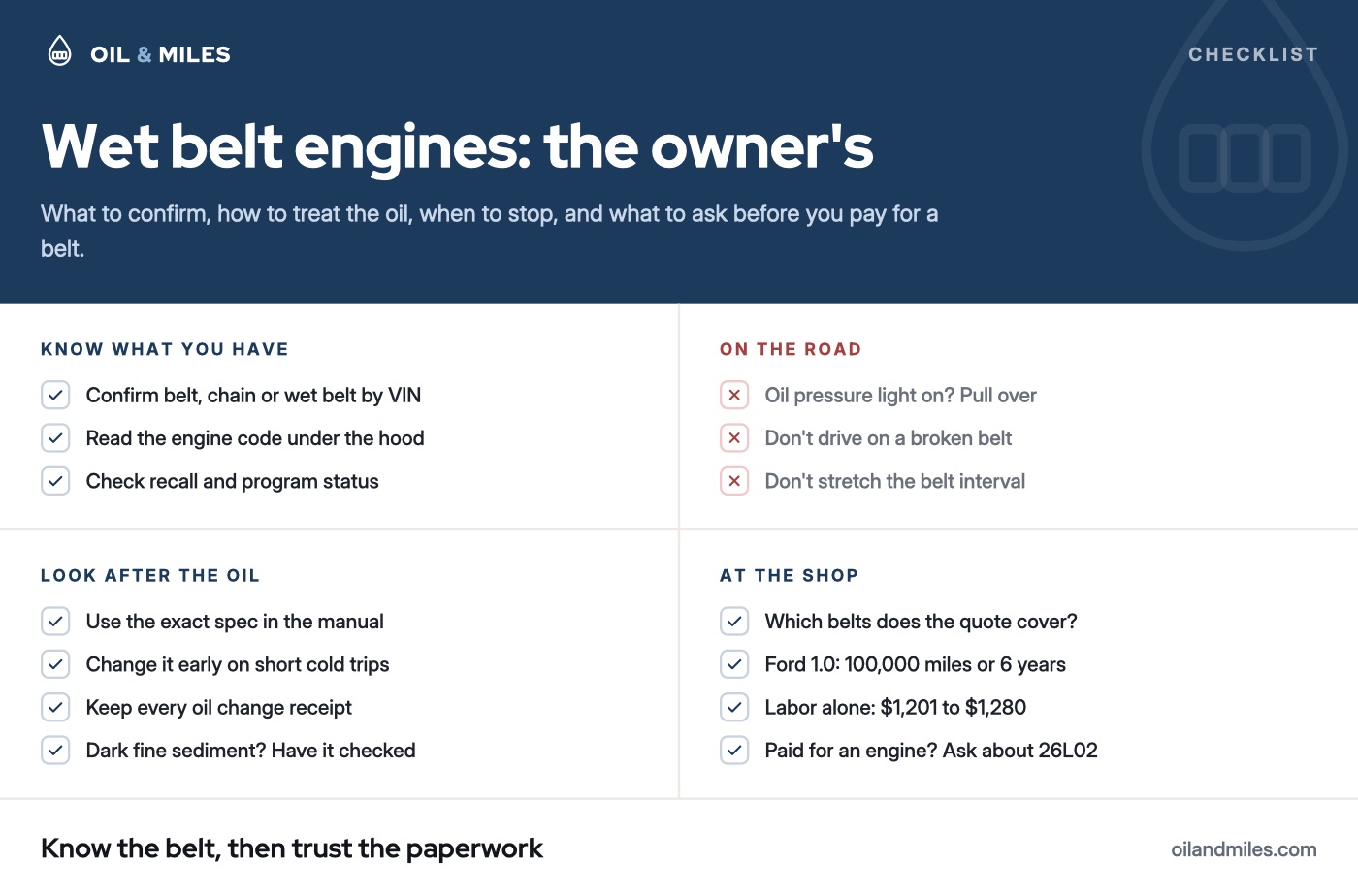
<a href="https://oilandmiles.com/articles/wet-belt-engines-explained"><img src="https://oilandmiles.com/assets/img/diagrams/wet-belt-engines-explained-checklist.jpg" alt="Checklist for a wet belt engine: confirm belt, chain or wet belt by VIN and engine code; use the exact oil spec, change it early and keep the receipts; pull over if the oil pressure light comes on; ask which belts a quote covers and whether Ford's program 26L02 can pay back an earlier repair." width="1200" height="792"></a> <p>Infographic: <a href="https://oilandmiles.com/articles/wet-belt-engines-explained">Oil & Miles</a>, CC BY 4.0</p>From the documents
What do the documents say about wet belts?
Three documents carry this page: one from the federal investigators and two from Ford. We read each one rather than the coverage of it, and each answers a different part of the wet belt question:
NHTSA, Engineering Analysis EA26004
ODI found that the timing belt material may degrade and create debris that clogs the mesh oil pump pick-up screen, resulting in reduced oil pressure in the engine.
Ford Motor Company, Program 26L02
Accelerated timing belt wear can lead to clogged oil-pump pick-up screens from delaminated timing belt material. This can result in a loss of oil pressure and eventually engine seizure. The new recommended timing belt interval is 100,000 miles or 6 years.
Ford Motor Company, Safety Recall 23S64
EcoSport: Replace oil pump drive belt/tensioner and timing belt on existing engine in-vehicle.
Together they tell one story from three sides. The investigation describes the failure, the program names the causes and the new interval, and the recall's labor table prices the cure in hours.
If you take one sentence to a dealer, take Ford's own from 26L02. It ties belt wear to clogged pick-up screens in the carmaker's own words, which is as close to an admission as a carmaker gets.
Conclusion
What a wet belt comes down to
A wet belt is a timing belt that lives in the engine oil, and the useful answer about one depends on where you're standing. Here's what a wet belt comes down to, from the carmakers' and NHTSA's documents and our own labor arithmetic:
- It sheds rather than snaps.A dry belt snaps, which at least is obvious; a wet belt sheds rubber that clogs the screen over the oil pump pick-up. You commonly get the oil pressure light as the first and last warning.
- Two carmakers confirm one.Ford and Stellantis say so in writing, on Ford's 1.0 EcoBoost and 2.0 EcoBlue and the 1.0 and 1.2 PureTech. Two independent references add Honda's 1.0 VTEC Turbo, which never reached the US.
- There can be two belts.Ford's 1.0 has a timing belt and a separate belt driving the oil pump, and each fails its own way. The US recall 23S64 is about the oil pump belt and its tensioner, so mixing the two up means looking for the wrong fix.
- The oil sets the odds.The exact approved oil, changed early on short trips, matters more than the thickness grade, because contaminants in the oil wear the belt. It lowers the risk rather than removing it: NHTSA found failures even with proper oil changes.
- Ask which belt a quote covers.Ford's own hours put the job at about $1,201 to $1,280 in labor at the US average rate, before parts. A much lower quote may cover only one of the two belts.
- Keep the receipts.Ford's program 26L02 pays back some earlier engine repairs for belt wear, but only with proof of the last three oil changes. Without them, the program has nothing to go on.
So find out which belt you have, and let the documents decide the rest. Each page here is built from documents rather than from forum memory, which is the only reason Oil & Miles is worth reading on this subject at all.
Common questions
Asked most often
What is a wet belt in an engine?
A timing belt that runs inside the engine, submerged in engine oil, instead of outside behind a plastic cover. Manufacturers used it to cut friction and noise. The trade-off is that the belt spends its whole life in whatever the oil becomes.
Which cars have wet belt engines?
Ford's 1.0 EcoBoost gasoline engine and 2.0 EcoBlue diesel, and the Stellantis PureTech 1.0 and 1.2 used by Peugeot, Citroën and DS. Model lists are unreliable because engines changed mid-production, so check your own service schedule or engine code.
How long does a wet belt last?
It depends on the engine and on how the car has been serviced. Ford originally specified 150,000 miles for the 1.0 EcoBoost, then cut that to 100,000 miles or six years in June 2026. Federal investigation data shows failures averaging around 70,000 miles on the old schedule.
Is a wet belt engine reliable?
It can last on the correct oil and a shortened interval, though NHTSA found failures even with proper oil changes. What makes it unforgiving is how short the warning is: NHTSA's investigation says complaints commonly describe the low oil pressure light coming on just before the failure.
Can a wet belt be converted to a chain?
Not from the carmaker. Aftermarket kits sold in Europe swap the PureTech's wet belt for a chain, but no carmaker endorses them, we found no kit for Ford's 1.0 EcoBoost, and nothing written says how one affects Stellantis's cover. Stellantis's own answer was a new 1.2 with a chain, a different engine rather than a part.
Can you drive with a broken wet belt?
No. A broken or shedding belt can starve the engine of oil, and NHTSA says the failure can cause a loss of power while driving. If the oil pressure light comes on, pull over and switch the engine off as soon as it's safe.
What people ask next
The full wet belt set
“Is a wet belt bad?” is really six different questions, and which one you need depends on where you're standing. Someone who already owns the car needs the oil spec. Someone about to buy one needs the paperwork. Someone who has just been handed a belt quote needs to know whether it's the real number.
- The list, built from manufacturer documents rather than forum memory. Start here if you aren't certain what your car has.
-
Four ways to tell which of the three you're looking at without taking anything apart, and why the bill differs so much between them.
Wet belt vs timing chain vs dry belt
-
The specification isn't a suggestion on these engines. What to use, what the approval codes mean, and why the wrong grade shortens the belt.
The right oil for a wet belt engine
- Two belts, two separate failures. Exactly which Fiesta, Focus and EcoSport years are covered, taken from Ford's own recall paperwork.
- The extended cover runs to ten years, but the terms carry conditions. What they say, and which model years to avoid.
-
Three checks before you hand over money. A wet belt car with service history is a different proposition to one without.
Buying a used wet belt car
Sources
- NHTSA vehicle complaints database, for every count in this article. US Department of Transportation, read August 2026
- Ford Safety Recall 23S64 technical instructions, for the oil pump belt and tensioner, filed with NHTSA as 23V-905, with Supplement 4 of June 22, 2026 for its labor hours. Ford Motor Company / NHTSA, read September 26 and October 2, 2026
- NHTSA opening resume for EA26004, for the debris and pick-up screen mechanism, in ODI's own words, the 70,000-mile average, failures despite routine oil maintenance, and the note that the screen isn't serviceable. NHTSA ODI, Engineering Analysis EA26004, read September 26, 2026
- Stellantis compensation policy for previous-generation PureTech 1.0 and 1.2 engines, May 7, 2025, for the PureTech cover terms. Stellantis Media, read September 30, 2026
- Stellantis press release on the new-generation 1.2 PureTech hybrid, February 16, 2023, for its timing chain. Stellantis Media, read September 29, 2026
- Motorcraft Oil Quick Reference Chart, Version 23, US, for WSS-M2C970-A1 on the US 1.0 EcoBoost, with the 2018 EcoSport owner's manual for WSS-M2C945-A and the API-certified alternative. Ford, read September 26, 2026
- Ford Customer Satisfaction Program 26L02, August 25, 2026, for the US interval and model years, the reasons Ford gives and the reimbursement terms. Ford Motor Company, filed with NHTSA, read September 26 and October 2, 2026
- Ford Customer Satisfaction Program 26L01, August 25, 2026, for the 2.0 EcoBlue's wet timing belt. Ford Motor Company, filed with NHTSA, read October 2, 2026
- Dayco Timing Belt-in-Oil (BIO) kits page, archived copy, for what the belt is made of. Dayco, read September 29, 2026
- Continental press release on the CT1228 timing belt, June 25, 2020, for the crystal damage route and the belt's materials. Continental, read September 29, 2026
- Gates TechZone, Belt-in-Oil kits for Ford EcoBoost, January 30, 2025, for the belts and what each kit holds. Gates, read September 29, 2026
- Labor time for the 1.0 EcoBoost belt, quoted by UK EcoBoost specialists, as a check on Ford's own hours. Redsmoke Automotive, TGPP Autocare, Approved Engines, read September 26, 2026
- Average auto repair labor rates by state, 2026, for the $132 national average, aggregated from more than 10,000 shops. Tekmetric, read September 18, 2026
How this was compiled
Where this article describes the failure route, that's published engineering. Where it describes a manufacturer's response, that's a document you can open. The two are kept apart on purpose, because only one of them is the maker's own account.
The complaint counts are filtered as the article describes. They're owner-filed records: what people reported, not what a workshop confirmed. The US labor estimate starts from Ford's own warranty hours, with UK specialists' quotes as a check, and it's labeled a calculation.
What we didn't do
We haven't stripped a wet belt engine, and we didn't price the engine, the belt kit or the seals, only the labor.
We didn't give a failure rate, because the counts above are shares of complaints, not of cars built. 165 of 1,567 EcoSport filings tells you what complaining owners complained about, and nothing about what fraction of engines fail.
We didn't find sales figures solid enough to turn one into the other, and a failure rate from complaint data alone would be invented.
Repair sites and AI answers also list a rattle on cold starts, rough idle and misfires as wet belt symptoms. We found no carmaker or federal document naming them, so they stay out of our warning signs.
Recall, investigation and warranty details are as published at the dates cited and can change, so always confirm current coverage for your own VIN with a franchised dealer. The US labor figures were compiled in October 2026 from Ford's published warranty hours and the US average shop rate. They aren't a quotation, and prices from $10 up are rounded to the nearest dollar. General information, not advice about a specific vehicle. See the disclaimer.
Wet belt
A toothed drive belt that runs submerged in engine oil rather than in dry air.
Interference engine
An engine in which the valves and pistons occupy the same space at different moments.