

Short answer
Yes, if the paperwork exists
A wet belt car with a documented belt change, correct-specification oil and a clean VIN check is a reasonable buy, often at a discount because other buyers are frightened. The same car with no history is a lottery ticket where the losing outcome is an engine.
The internet has decided that a used car with a wet belt engine is to be avoided, and that has done something useful to prices: cars that are perfectly sound are cheaper than they were. If you know what to check, that's an opportunity rather than a warning.
The trick is that the checks aren't the ones people usually do. Mileage and bodywork tell you very little here.
Paperwork and oil tell you almost everything.
If you're not sure whether the car you're looking at even has a , start with how to tell what you have. The badge on the back won't answer it.
Check one: the VIN, before you drive anywhere
Ask the seller for the VIN, which they can read off two places on the car itself, and run it past a franchised dealer, or the manufacturer's own recall lookup, before you spend an afternoon going to see the car.
Belt type is one filter. Which models fail expensively at all is another.
See high mileage cars to avoid.
You're looking for two different things. Recalls are safety actions the manufacturer must complete free of charge.
Campaigns and service actions are the softer category (customer satisfaction programs, extended coverage) and they're often where wet belt remedies live.
For a Ford 1.0 EcoBoost specifically, the recall and the open federal investigation cover different populations, and neither maps cleanly onto a model year. The details are in the Ford 1.0 EcoBoost recall, but the practical version is: don't reason from a list, check the VIN.
Check two: the belt receipt, and what's on it
"The belt's been done" is worth nothing without paper. What you want is an invoice showing the work, the date and the mileage.
Then read it properly, because two things on a wet belt service invoice change what it's worth:
- What was replaced. On an engine with both a timing belt and a separate oil pump belt, a job that covered one and not the other is a partial job. Ask which, and price the missing half against what a belt job should cost.
- Who did it and with what. A specialist using manufacturer-approved parts is a different proposition from the cheapest quote in town on a job where getting it wrong is expensive.
If you're being shown a stack of invoices, see reading a repair estimate. Look at what's itemized, not the total.
Check three: the oil, which tells you the truth
This is the check almost nobody does, and reading the oil on a used car with a wet belt engine tells you the most on the day, in five parts:
- Insist on a . Ask the seller not to warm the car up before you arrive. A seller who "just ran to the store" before your visit may be innocent, but you've lost your best diagnostic, and it's fair to say so and come back another day.
- Pull the dipstick and read the level. Above the full mark, with nothing recently added, points to fuel dilution.
- Smell it. Gasoline is unmistakable. On a wet belt engine, fuel in the oil is attacking the belt, not just the oil.
- Look at the oil filler cap and the oil itself. You're looking for a thin, watery consistency, or fine dark sediment.
- Ask what oil goes in it. If the seller can name the specification (on a US Ford 1.0 EcoBoost, Ford's current oil chart lists WSS-M2C970-A1) that tells you a great deal about how the car has been treated. Oil a wet belt needs is here.
Worth knowing
Service history on these cars gets judged by thickness, and thickness is the wrong measure. A book full of stamps from oil changes stretched to the maximum interval, on a car doing short cold journeys, is worse news than half as many stamps at sensible ones.
The useful thing to read is the gap between the mileages, not the number of entries. Two services 12,000 miles apart on a small turbo engine used for school runs tells you more about the car's future than any amount of paperwork volume.
A car with no oil-specification information anywhere isn't necessarily a bad car, but nobody was watching the one thing this engine needs watched.
Which used cars have a wet belt engine?
| If you're looking at | The specific question |
|---|---|
| Ford 1.0 EcoBoost (Fiesta, Focus and EcoSport in the US) | VIN in Ford program 26L02? Belt done at the old 150,000 miles or the revised 100,000 and six years? Our interval calculator settles it. |
| Stellantis PureTech 1.0 / 1.2 (Peugeot, Citroën, DS, Vauxhall/Opel) | Roughly 2014-2022 cars use the belt. Has any work been claimed under the extended coverage, and was servicing done to specification? |
| Ford EcoBlue diesel, including Transit | Commercial mileages arrive fast. Where is it against its interval, and does the history match the miles? |
On the Ford side there is a newer wrinkle, and it matters to a buyer more than to an owner. NHTSA upgraded its Ford 1.0 EcoBoost inquiry from a Preliminary Evaluation to an Engineering Analysis on July 31, 2026, covering about 135,551 Fiesta, Focus and EcoSport, and the failures it is looking at start from around 70,000 miles.
Read that against the interval. Ford cut the belt from 150,000 miles to 100,000 miles or six years, and the engines under investigation are letting go at 70,000.
A belt done on the revised interval is better than one done on the old figure, and it's still not a guarantee on this engine.
Ford's US program 26L02, dated August 25, 2026, puts that interval in writing for 146,945 cars and repays some earlier belt-related engine repairs, if the owner can show the last three oil changes were done on schedule with an approved oil. Ask the seller for those receipts before you ask about the belt.
For the PureTech cars there's a wrinkle worth knowing: Stellantis has extended coverage and opened a compensation route, but both depend on the car having been maintained to the manufacturer's plan. A car with gaps in its history may be outside help that a well-kept identical car qualifies for.
How to price it
Treat an outstanding belt as what it is: a known bill with a known rough size. In the US it runs roughly $1,200 to $2,300, worked out from the 8 to 12 hours UK specialists quote for the job against American shop rates.
In the UK, where most of these cars are, it commonly lands between about £1,000 and £2,000.
The belt is one line in a bigger bill. For what else falls due around the same point, and what each job runs, see what a high-mileage car costs to keep.
So the arithmetic is straightforward. A car that needs the belt within the next year should be cheaper than an identical car that's just had it, by roughly the cost of the job.
That's not a haggling trick; it's the actual difference in what you're buying.
What you shouldn't do is pay the price of a car with history for a car without it, on the strength of a verbal assurance.
When should you walk away?
Three combinations are reasons to walk away from a used car with a wet belt engine, and none of them is about the engine design itself:
- No service history, and past the belt interval. You're buying an unknown with a large bill attached.
- Oil level above full with a gasoline smell, especially with no explanation. Whatever the price, this is a car that needs diagnosis before purchase, not after.
- A seller who won't allow a cold start or an independent inspection. On this engine that refusal is expensive to indulge.
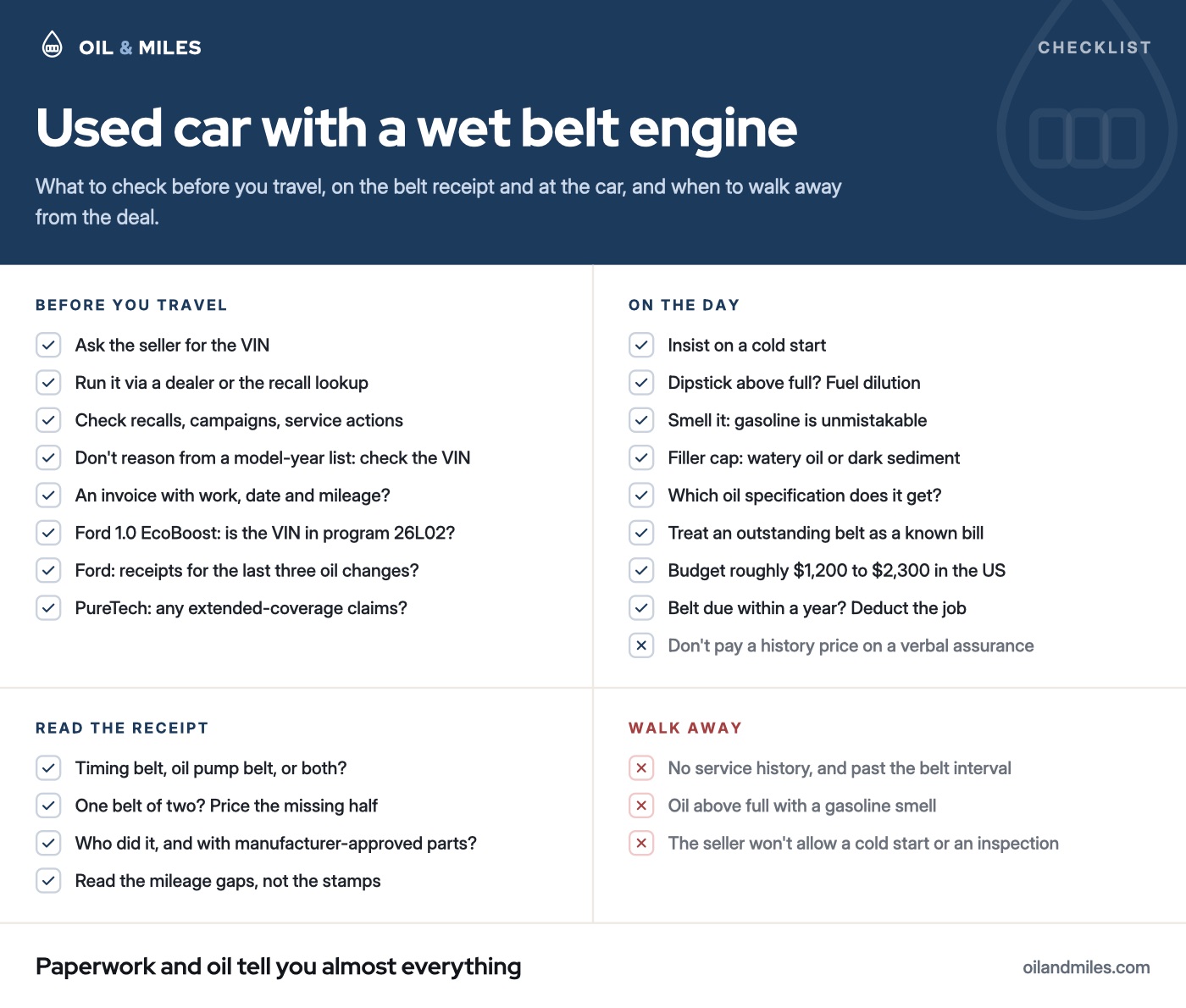
Use this image
Free to republish under CC BY 4.0: credit Oil & Miles and link to this page. The snippet does both.
<a href="https://oilandmiles.com/articles/buying-used-car-wet-belt-engine"><img src="https://oilandmiles.com/assets/img/diagrams/buying-used-car-wet-belt-engine-checklist.jpg" alt="Checklist: before you travel, run the VIN and ask the seller for the belt invoice and oil change receipts; read which belts the invoice covers and who did the work; on the day, insist on a cold start, read the oil and price any outstanding belt into the offer; walk away from three combinations." width="1200" height="1020"></a> <p>Infographic: <a href="https://oilandmiles.com/articles/buying-used-car-wet-belt-engine">Oil & Miles</a>, CC BY 4.0</p>Conclusion
What to do before you buy
Run the VIN before you travel, ask for the belt invoice and read what's on it, then insist on a cold start, pull the dipstick and ask what oil specification the car gets. Those are the three checks, and the move after them is arithmetic: price any outstanding belt into the offer.
Do those three and price the belt, and a wet belt car stops being a gamble and becomes an ordinary purchase with one extra line of homework. Often at a discount created by buyers who did none of it.
Every engine named on this page came from a document we opened, and the ones nobody could confirm say so. That's what Oil & Miles puts on a list instead of a rumour.
Common questions
Asked most often
Should I avoid buying a car with a wet belt engine?
Not on the design alone. Avoid the specific combination of no service history and a belt that's past its interval. A documented car is often cheaper than it should be, because other buyers avoid the whole category.
How do I know if the wet belt has been changed?
Ask for the invoice showing the date and mileage, and check what was replaced. Some engines have both a timing belt and a separate oil pump belt, and a job covering one isn't a job covering both.
How much does a wet belt replacement cost?
Budget roughly $1,200 to $2,300 in the US, or about £1,000 to £2,000 in the UK, depending on model and whether a dealer or an independent does it. Price any outstanding belt into your offer, because it's a known bill with a known rough size.
What should I check on the test drive?
Insist on a cold start. Then pull the dipstick: a level above full with a gasoline smell points to fuel dilution, which attacks the belt as well as the oil.
What people ask next
Sources
- Ford Safety Recall 23S64 technical instructions, for the scope and remedy. Ford Motor Company / NHTSA
- NHTSA opening resume for EA26004, for the upgrade from PE25020 and Ford's revised belt interval. NHTSA, re-checked August 31, 2026
- Ford Customer Satisfaction Program 26L02, dated August 25, 2026, for the US interval, the 146,945 vehicle count and the reimbursement conditions. Ford Motor Company, filed with NHTSA, read September 24, 2026
- Stellantis PureTech compensation policy and warranty extension, May 7, 2025, for the extended coverage and the compensation route. Stellantis Media
- Wet belt replacement cost data, for the UK marketplace averages. FixMyCar
How this was compiled
The three checks above are things you do, not things this page can do for you. Where the article says a service history looks right, that's a description of what to look for.
What we didn't do
We didn't inspect any of these cars, and we can't verify a receipt from a distance. None of these checks replaces a pre-purchase inspection by somebody who can put the car on a lift, and nothing here is a verdict on any particular car.
We couldn't read the text of NHTSA's EA26004 filing, because the PDF it publishes is a scan with no extractable text, so the upgrade date, the population and the failure mileage reach us through independent reports of that filing.
Recall and coverage terms vary by market and change over time, so confirm current status for a specific VIN with a franchised dealer before buying. Cost figures are UK ranges compiled in August 2026 and aren't a quotation. General information, not advice about a specific vehicle. See the disclaimer.
Wet belt
A toothed drive belt that runs submerged in engine oil rather than in dry air.
Cold start
The first minutes after the engine has sat long enough to cool all the way down, usually overnight.