
Short answer
A brake fluid leak costs $310 to $607 to repair.
A brake fluid leak costs $310 to $607 to repair, part and labor, for the two failures we could price end to end: a pair of front calipers, or the master cylinder. A hose job has no labor time we could read, and the hard-line figures, which run higher, we couldn't trace. Either way the cost is the second question: the first is whether the car is safe to drive to the shop, and often it isn't.
A brake fluid leak isn't like the other leaks on a car. Oil, coolant and transmission fluid leaks give you warning first, and they're priced in what each fluid leak costs to fix.
Brakes are sealed hydraulics, and they hold pressure until they don't: a pedal that stopped the car this morning can go to the floor this afternoon. The most dangerous leak leaves the driveway clean, because it's inside the master cylinder, and only the pedal shows it.
So this article does the costs, because you came for the costs, but the section you actually need is the pedal test, and it comes before them, right after how to tell brake fluid from other fluids. After the costs: why salt-belt cars cost more, and how the fix goes.
What does your brake pedal do?
Salt-belt car? Rusted lines fail along their whole length.
Is it brake fluid or something else?
But it isn't oil. Brake fluid on almost every car sold in the US is a glycol-ether hydraulic fluid, and the difference isn't pedantry: glycol ether pulls moisture out of the air, which is why brake fluid has a replacement interval and engine oil in a sealed line wouldn't, and why a leak that lets air in is a bigger problem than the puddle looks.
Brake fluid is clear to light yellow when fresh and dark brown when old, which unhelpfully puts it in the same color range as engine oil. Three things tell a brake fluid leak apart from an engine oil leak, and the last one is almost conclusive:
- FeelThin and slippery, closer to cooking oil. Engine oil is heavier and clingy.
- PositionJust behind a wheel, inboard of the tire, or along a line under the car. Engine oil lands under the middle of the engine bay.
- Stripped paintAlmost conclusive. A dulled or lifted streak down a painted surface is brake fluid and not much else.
One thing won't settle it, and that's smell. Two makers' own safety data sheets describe DOT 3 as a clear-to-amber liquid with a mild odor, which is close enough to engine oil that your nose can't separate them.
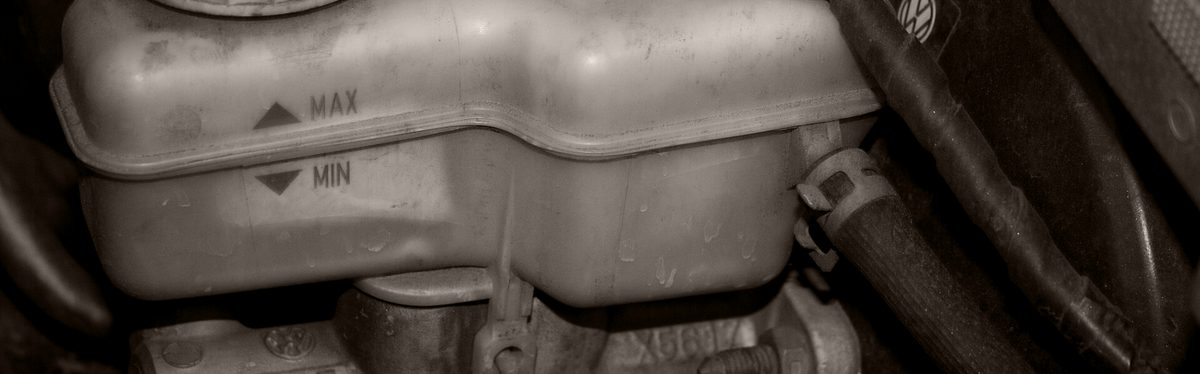
The fastest confirmation is the reservoir. Open the hood, find the brake fluid reservoir on the driver's side firewall, and look at the level against the MIN and MAX marks.
The level falls a little as brake pads wear, which is normal and expected, but it doesn't fall to MIN in a week. Plenty of people call it brake oil, and shops know exactly what you mean when you do.
What does the pedal test tell you?
A pedal that sinks under steady pressure means the leak is inside the master cylinder, and that's the one failure that leaves the driveway clean. The pedal test for a brake fluid leak is the 4 steps below, thirty seconds in total, and it tells you something the ground can't:
- Engine off, car parked. No need to run it. This is a static test of the hydraulics.
- Press the pedal firmly. Firm pressure, not a stamp. You're loading the system.
- Hold for about fifteen seconds. The pedal should stop somewhere and stay exactly there.
- If it sinks to the floor, stop driving it. Fluid is bypassing internally, and with nothing on the ground the leak is inside the master cylinder.
This is the failure the ground can't show you, and it's the dangerous one. A master cylinder has internal seals that can bypass, letting fluid slip past the piston instead of pushing it out to the wheels.
The reservoir stays full and the driveway stays clean. Nothing looks wrong, and the pedal quietly gets longer over weeks until one day there isn't enough travel left to stop the car.
Two more brake fluid leak symptoms show up in the pedal and the steering, and they're worth knowing while you're at it:
- A spongy or soft pedalUsually means air has entered the system, which on a leaking car means fluid has been leaving and air has taken its place.
- Pulling to one side under brakingMay mean one circuit has lost pressure. Brakes run on two separate circuits, front and rear on some cars and diagonal on others, so half the braking survives a single failure.
What the data says
Ford has recalled the same brake master cylinder four times in nine years, for the same fault each time: fluid leaking from the master cylinder into the brake booster, which puts nothing on the ground. NHTSA campaign 16V-345 covered 225,012 F-150s in 2016, 20V-332 covered 292,311 vehicles, a 2022 expansion covered 195,864 more, and a fourth in 2025 covered 123,611.
Between them they reach F-150s from the 2013 to 2018 model years and Expeditions and Navigators from 2016 to 2018, with three of the four campaigns naming the 3.5-liter engine. On a vehicle in any of them the master cylinder this page prices at $415 to $586 is replaced free, and the VIN is what settles that, not the model name.
Figures: NHTSA recall campaigns 16V-345, 20V-332, 22V-150 and 25V-236, Ford numbers 20S31, 22S11 and 25S37 for the last three, read September 16 and 28, 2026.
Worth knowing
A leak is also an opening. Brake fluid takes in water from the air by design, which is why it has a service life at all, so a system that has been leaking has been taking in moisture as well as losing fluid. That's why a competent shop will want to flush and bleed the whole system after the repair rather than just topping it back up, and why that line on the estimate isn't an upsell.
Can you drive with a brake fluid leak?
No, and the distance doesn't change the answer. A leak is a system losing the pressure it works by, and the failure isn't gradual: the difference between a long pedal and no pedal is one hard stop, which arrives whenever the next car pulls out in front of you rather than on a schedule you can plan around.
The reason it goes so suddenly is that fluid isn't the only thing crossing the opening. Air comes in as fluid goes out, and air compresses where fluid doesn't, so the pedal travels further and further to move the same pistons until one push moves them not at all.
Whether you can drive with a brake fluid leak depends on what the level is doing, and it decides between calling a tow truck and booking next week:
- Fluid on the ground, or a level that keeps droppingTow it. That feels excessive for what might be a hose, and a tow is still cheaper than the deductible on the accident it prevents.
- A level that fell a little and then held, with a firm pedalDrive it, and get the pads looked at. That's not a leak at all: the reservoir drops as pads wear because the pistons sit further out, and it's the single most common reason a driver thinks they have one.
The pedal test above is what separates those two, and it takes thirty seconds in a parking space. With nothing on the ground, a pedal that sinks under steady pressure is the master cylinder leaking inside; a firm pedal with a level that fell a little and then held is the pads.
What does a brake fluid leak cost?
Four parts leak, and the bills we can price run from a few hundred dollars to about $600. Brake fluid leak repair cost depends on which one it is, and these are whole jobs, part and labor together:
- Brake hose, the one we can't price end to endPerishes with age and cracks at the crimped fitting. No labor guide we could read gives a standalone time for one hose, so there's no whole job figure to give. The part alone is in the box below.
- Hard line section, no figure we can traceSteel lines corrode from the outside, and the usual repair is the affected section, not the whole run.
- Both front calipers, $310 to $607Not an estimate we found, one you can recompute: two calipers at the counter are $142 to $384, and a trade magazine's technical writer puts the average at 1.4 hours for both, which at $120 to $159 an hour is $168 to $223.
- Master cylinder, $415 to $586Same arithmetic. Part $175 to $268, labor 2.0 hours, the low end of the 2 to 2.5 hours one parts catalog gives, so $240 to $318, and more if the shop books 2.5.
- Full line replacement, no figure we can traceCars where road salt has taken the whole run, which is the next section.
Two things can legitimately raise a brake fluid leak quote, and they're worth asking about before the work starts:
- A caliper leak runs onto the pad and rotorSo a quote covering all three on that corner isn't necessarily padding.
- ABS adds hoursAir trapped in the pump has to be cleared with a , which a working mechanic quotes at 2.5 to 3.5 hours rather than the 2-hour job.
The parts on their own are a fraction of those figures, and the gap is the shop's time rather than a markup. One thing to know before reading the box: these are mail-order prices, and a shop buys nearer the counter, where the same master cylinder runs $175 to $268 rather than $53 to $157.
What it costs
What this box shows
Prices for this repair, drawn from the sources named at the foot of the box. Each figure states whether it covers the part alone or parts and labor.
Parts cost for a brake fluid leak
Parts only across three cars, mail order. No total: separate leak points.
| Brake hoseDorman on the F-150 up to Motorcraft on the F-150. One front hose; a wet patch behind a wheel.2017 Honda Accord 2.4L · $8.79 to $31, 2017 Ford F-150 3.5L EcoBoost · $6.71 to $42, 2018 Toyota Corolla 1.8L · $9.73 to $17, | $6.71 – $42Part only, mail order |
|---|---|
| Brake caliperCentric on the Accord up to Ultra-Power on the F-150, fronts only; reman adds a refundable core.2017 Honda Accord 2.4L · $27 to $100, 2017 Ford F-150 3.5L EcoBoost · $49 to $137, 2018 Toyota Corolla 1.8L · $34 to $90, | $27 – $137Part only, mail order |
| Brake master cylinderTop Notch on the Accord up to FVP on the Corolla. Shows as a sinking pedal.2017 Honda Accord 2.4L · $53 to $147, 2017 Ford F-150 3.5L EcoBoost · $72 to $151, 2018 Toyota Corolla 1.8L · $65 to $157, | $53 – $157Part only, mail order |
| Brake fluidLucas DOT 3 to Bosch ESI6, one quart; 12-ounce bottles cost more per quart. Needed after any repair here | $6.03 – $9.70Part only, mail order |
Every brand RockAuto lists for three cars, read September 25, 2026, the brake fluid row on September 16: a 2017 Honda Accord 2.4, a 2017 Ford F-150 3.5 EcoBoost and a 2018 Toyota Corolla 1.8. Three cars rather than one because a single car's catalog is a sample, and a compact, a midsize and a full-size truck bracket what most of this site's readers drive. These are mail-order prices, and the whole-job figures in the text above aren't built on them. Those use AutoZone counter prices for the same Accord, read September 1, 2026, because a shop buys nearer the counter than the mailbox: the same master cylinder is $175 to $268 there against $53 to $157 here. AutoZone's catalog couldn't be opened after September 16, so the counter reading can't be refreshed and is dated rather than dropped. A hard line has no row on either source, because a shop bends a section up from bulk line rather than buying a named part. Cheapest brand to most expensive, front parts only where a side is listed separately.
We give no figure for a hard line section or a full run. The numbers that circulate come from cost-estimator sites we couldn't open, and the flat-rate labor guides are paywalled, so ask the shop for the hours it books.
Why are salt-belt cars different?
Because road salt corrodes steel brake lines from the outside in, along their whole length rather than in one spot. On a car that has spent its winters on salted roads, the lines are a wear item on a clock you can't see.
The practical consequence is that replacing one rusted section on a badly corroded car often just moves the failure: the next section goes a few months later, then the one after that. Shops that work in these regions will sometimes recommend replacing the complete set for that reason, and on a ten-year-old car in Michigan or Ohio that recommendation is usually genuine rather than opportunistic.
Ask the shop to show you the lines, not just tell you about them. A rusted brake line is in one of four states, and you can tell them apart yourself once you're under there:
- CosmeticRust flakes off to reveal solid steel underneath. Normal on any car over a few years old. Leave it.
- Watch itPitted, rough to a fingernail. Corrosion has started into the wall. Ask to see it again next service.
- Structurally goneScaling, flaking away. Patching one section here just moves the next failure along the run.
- The full runMultiple sections in the same state. On a salt-belt car that recommendation is usually genuine.
How do you fix a brake fluid leak?
The leaking part is replaced, never patched, and the system is bled afterwards. That's the whole shape of it.
To fix a brake fluid leak, work through the 5 steps below in order, because the order decides whether you pay for a hose or for a tow plus a hose:
- Confirm it is a leak, not pad wear. Do the pedal test above. A level that fell a little while the pedal holds firm is normal on worn pads, and our guide to brake pad and rotor replacement cost covers what that job runs instead.
- Have it towed, not driven. Fluid on the ground or a level that keeps dropping. That feels excessive for what might be a hose, and it's the correct call anyway: the difference between a long pedal and no pedal is one hard stop.
- The part is replaced, not repaired. Hose, line, caliper or master cylinder, the failed component comes off. Nothing is taped, and no stop-leak additive belongs anywhere near a system that works at over a thousand psi.
- The system is bled, and how much depends on one thing. Only the line that was opened needs bleeding, unless the master cylinder ran dry, in which case all four corners do. That's worth knowing before you read the hours on a quote. On a car with ABS the pump also has to be cycled with a scan tool, which is the 2.5 to 3.5 hours rather than the 2-hour job.
- Expect a flush on the bill. A system open to air has been taking in moisture, and moisture lowers the boiling point exactly where you least want that. That line isn't an upsell.
Conclusion
The pedal decides before the price does
A pedal that sinks is a car that doesn't drive to the shop, whatever the repair costs. Here's what to do about a brake fluid leak, from the parts and labor we could trace:
- Do the pedal test first.With the engine off, press the pedal firmly and hold it for about fifteen seconds. A pedal that sinks toward the floor means stop driving it, even with a clean driveway.
- No distance is safe.As fluid leaves, air comes in, and air compresses where fluid doesn't, so the pedal travels further each time until one push moves nothing. Fluid on the ground or a level that keeps dropping means a tow, not a drive.
- A clean driveway proves nothing.A master cylinder can leak past its internal seals, so the reservoir stays full and nothing drips. The pedal slowly gets longer over weeks, and only the pedal test shows it.
- Two jobs we could price.A pair of front calipers runs $310 to $607 and a master cylinder $415 to $586, part and labor, both recomputed from counter prices and published labor estimates. A hose job we couldn't price end to end and the hard-line figures we couldn't trace, so read those as what you are likely to be quoted.
- Salt-belt lines go all at once.Road salt eats steel brake lines along their whole length, so patching one rusted section often just moves the failure a few months along. On a ten-year-old car from Michigan or Ohio, a quote for the full set is usually genuine.
So check the pedal before you look at a price. We priced the two failures we could follow end to end and said plainly that we couldn't trace the other two, which is the whole method Oil & Miles uses on a price.
Common questions
Asked most often
Can I just top off the brake fluid and keep driving?
Topping off hides the symptom without fixing the leak, and the level is the only warning the system gives you. It's reasonable to top off so the reservoir isn't empty while you arrange a tow. It's not a way to put the repair off.
My brake fluid is low but there's no puddle. What now?
Two likely explanations. Worn pads lower the level normally, so check pad thickness first. If the pads are fine, do the pedal test: a master cylinder leaking into the brake booster loses fluid with nothing reaching the ground, the fault Ford recalled four times.
Why does the shop want to replace all the brake lines?
On a salt-belt car, usually because the corrosion runs the length of the line rather than sitting in one spot, so patching one section just moves the next failure a few months down the road. Ask to see the lines before agreeing.
Is DOT 3 or DOT 4 fluid a factor in leaks?
Not in causing them. Use whatever the reservoir cap or manual specifies. The ratings differ in boiling point, and mixing down to a lower specification than your car calls for reduces the margin the system was designed with.
What people ask next
Sources
- AutoZone counter catalog, 2017 Honda Accord LX 2.4L, for the counter part prices behind the whole-job figures. AutoZone, read September 1, 2026
- Gary Goms, Tomorrow's Technician, December 2012, for the 1.4 hours he gives as the average caliper replacement. Tomorrow's Technician
- A mechanic's answer on 2CarPros, January 13, 2017, and a parts retailer's cost guide, for the 2.0 hours on the master cylinder. 2CarPros, PartCatalog
- A mechanic's answer on JustAnswer about a 2003 Chevrolet Silverado, for the 2.5 to 3.5 hours when a full bleed and a scan-tool ABS bleed are included, the wider scope described in the text. JustAnswer
- RockAuto catalog, for the parts box: every brand listed for a 2017 Accord 2.4, a 2017 F-150 3.5 EcoBoost and a 2018 Corolla 1.8. RockAuto, read September 25, 2026
- NHTSA recall campaigns 16V-345, 20V-332, 22V-150 and 25V-236, for the Ford master cylinder fault, the leak path into the brake booster and the number of vehicles. NHTSA recalls database, read September 16 and 28, 2026
- Prestone Brake Fluid DOT 3 (SDS 042, prepared January 10, 2025) and STP Brake Fluid DOT 3 safety data sheets, for the appearance and odor of brake fluid. Prestone and STP, read September 16, 2026
- Brake component manufacturer and parts-supplier technical documentation, for the failure modes, including internal master cylinder bypass with no external leak, and the diagonal split that preserves partial braking after a single circuit failure. Several manufacturers and parts suppliers
- Two write-ups of a brake line replacement, for what the repair involves. They agree on the sequence and on the detail that changes a quote. YourMechanic and HowStuffWorks, read September 2, 2026
How this was compiled
The two labor times are weighted differently and the page says which. The caliper hour comes from a trade publication citing a major guide; the master cylinder hour comes from two sources that agree with each other but name no guide, so it's the weaker of the two. What lets us use it at all is that the same mechanic's front-rotor time of 1.0 hour matches the trade publication exactly.
The caliper figure is two parts censused at an AutoZone counter plus the 1.4 hours; the master cylinder figure is the counter part plus 2.0 hours, from two sources that don't name the guide they quote, which is why it's weaker than the caliper line. We haven't been able to open AutoZone since September 16, so that counter reading is dated rather than refreshed. The parts box uses mail-order prices, not counter prices, and says so.
The hard line and full line figures that circulate across cost-estimator sites couldn't be traced, so the page prints none. The one flat-rate figure we found for a hose turned out to be air brakes on a commercial trailer, a different vehicle class. Those two, and the unnamed manufacturer and parts-supplier pages behind the failure modes, are the weakest sources on this page.
The per-hose and master cylinder ranges agree closely across the sources, which is why they're quoted as ranges rather than averaged into one figure.
What we didn't do
We didn't inspect, test or repair a leaking system for this article, and we didn't price it against a carmaker's own warranty labor times.
We give no figure for how long a leaking system stays drivable, because there isn't a reliable one. That's the whole point of the article, and any number offered for it would be invented.
Prices are ranges compiled in September 2026 for the US market and vary by region, vehicle and shop rate. Prices from $10 up are rounded to the nearest dollar, so $14.13 reads as $14 and $14.52 as $15. Below $10 they're exact. This article is general information, not advice about your specific vehicle. See the disclaimer.
Caliper
The clamp that presses the pads against the disc, driven by hydraulic pressure from the pedal.
Scan tool
The device that reads what the engine computer has stored, from a $20 dongle to a workshop tablet.
Brake hose
2017 Honda Accord 2.4L L4
| Brand | Part | Price |
|---|---|---|
| Dorman | H621918Front left | $8.79 |
| H621917Front right | $9.31 | |
| H622526Front right | $31 | |
| Top Notch | TN384080BHFront right | $9.30 |
| Beck/Arnley | 0731946Front right | $9.43 |
| Raybestos | BH384079Front left | $11 |
| BH384080Front right | $16 | |
| Sunsong | 2207482Front left | $11 |
| 2205651Front left | $12 | |
| 2205652Front right | $12 | |
| 2207696Front right | $12 | |
| 2207704Front left | $11 | |
| 2207697Front right | $13 | |
| Dynamic Friction | 35059107Front right | $15 |
| 35059106Front left | $15 | |
| 35059118Front left | $19 | |
| 35059119Front right | $19 |
Brake hose
2017 Ford F-150 3.5L V6 Turbocharged
| Brand | Part | Price |
|---|---|---|
| Dorman | H622472Front right | $6.71 |
| H622471Front left | $9.32 | |
| Sunsong | 2206664Front left | $11 |
| 2206665Front right | $11 | |
| 2207756Front right | $11 | |
| 2207755Front left | $11 | |
| Dynamic Friction | 35054467Front right | $20 |
| 35054466Front left | $21 | |
| Motorcraft | BRHF179Front right | $23 |
| BRHF178Front left | $42 | |
| Raybestos | BH384453Front left | $24 |
| BH384420Front right | $25 |
Brake hose
2018 Toyota Corolla 1.8L L4
| Brand | Part | Price |
|---|---|---|
| Sunsong | 2202987Front right | $11 |
| 2202986Front left | $11 | |
| Centric | 15044148Front left | $12 |
| 15044149Front right | $12 | |
| Dynamic Friction | 35076105Front right | $17 |
| 35076104Front left | $17 | |
| Top Notch | TN383326BHFront right | $9.73 |
| TN383327BHFront left | $9.73 | |
| Dorman | H621100Front left | $12 |
| H621099Front right | $14 |
Brake caliper
2017 Honda Accord 2.4L L4
| Brand | Part | Price |
|---|---|---|
| Raybestos | FRC12680CFront right | $35 |
| FRC11426CFront right | $35 | |
| FRC11425Front left | $39 | |
| FRC11426NFront right | $43 | |
| FRC12680NFront right | $43 | |
| FRC12679NFront left | $45 | |
| NuGeon | 9900943BFront right | $31 |
| 9900943AFront left | $31 | |
| 99P00943AFront left | $34 | |
| 99P00943BFront right | $34 | |
| 9901033AFront left | $35 | |
| 9901033BFront right | $35 | |
| 9901039AFront left | $66 | |
| 9901039BFront right | $66 | |
| 99P01033AFront left | $38 | |
| 99P01033BFront right | $38 | |
| 99P01039BFront right | $73 | |
| 99P01039AFront left | $84 | |
| Cardone | 19B2661Front right | $30 |
| 19B7458Front right | $53 | |
| 19B7107Front right | $37 | |
| 2C2661Front right | $80 | |
| FVP | BC182660Front left | $35 |
| BC182661Front right | $35 | |
| 14140134Front left | $42 | |
| BC187450Front left | $46 | |
| BC187451Front right | $46 | |
| BC187106Front left | $39 | |
| BC187107Front right | $39 | |
| Quality-Built | BC182660Front left | $37 |
| BC182661Front right | $37 | |
| ACDelco | 18FR2148CFront right | $50 |
| 18FR2147Front left | $51 | |
| 18FR12679CFront left | $54 | |
| 18FR12680CFront right | $60 | |
| 18FR12680NFront right | $95 | |
| 18FR12679NFront left | $100 | |
| Centric | 14140121Front right | $27 |
| 14140122Front left | $27 | |
| Wagner | CN11425SCFront left | $48 |
| CN11426SCFront right | $48 | |
| CN12679SCFront left | $61 | |
| CN12680SCFront right | $61 | |
| Top Notch | AK1513AFront left | $51 |
| AK2767AFront left | $51 | |
| AK2768AFront right | $51 | |
| AK1514AFront right | $53 | |
| AK3033DA | $66 | |
| SKP | SK19B2660Front left | $53 |
| SK19B2661Front right | $54 | |
| Dynamic Friction | 33159062Front right | $60 |
| 33159063Front left | $60 | |
| 33159094Front right | $63 | |
| 33159095Front left | $63 | |
| 33159098Front right | $70 | |
| 33159099Front left | $70 | |
| Power Stop | L7106Front left | $64 |
| L7107Front right | $64 | |
| L2660Front left | $69 | |
| L2661Front right | $69 | |
| S7106 | $87 | |
| S2660 | $94 | |
| Hella / Pagid | 355801432Front left | $74 |
| 355801442Front right | $74 | |
| Ultra-Power | 19B7106Front left | $100 |
| 19B7107Front right | $100 |
Brake caliper
2017 Ford F-150 3.5L V6 Turbocharged
| Brand | Part | Price |
|---|---|---|
| NuGeon | 9917980AFront right | $49 |
| 9917980BFront left | $49 | |
| 99P17980AFront right | $52 | |
| FVP | BC155405Front left | $51 |
| BC155404Front right | $51 | |
| Quality-Built | BC155404Front right | $52 |
| BC155405Front left | $53 | |
| Motorcraft | BRCF399Front left | $84 |
| BRCF398Front right | $86 | |
| NBRC42RMFront right | $101 | |
| Top Notch | AK2703DA | $62 |
| Wagner | CN12615SCXFront left | $62 |
| SKP | SK18B5405Front left | $67 |
| SK18B5404Front right | $68 | |
| Dynamic Friction | 33154244Front right | $87 |
| 33154245Front left | $87 | |
| Power Stop | L5405Front left | $95 |
| L5404Front right | $96 | |
| S5404 | $130 | |
| Ultra-Power | 18B5405Front left | $137 |
Brake caliper
2018 Toyota Corolla 1.8L L4
| Brand | Part | Price |
|---|---|---|
| Raybestos | FRC12167CFront left | $34 |
| FRC12168CFront right | $34 | |
| FRC12168Front right | $48 | |
| RC12167CFront left | $74 | |
| FRC12167NFront left | $44 | |
| Cardone | 19B3434Front left | $39 |
| 19B3435Front right | $40 | |
| Quality-Built | BC183434Front left | $47 |
| NuGeon | 9901710BFront right | $42 |
| 9901710AFront left | $43 | |
| 99P01710AFront left | $46 | |
| 99P01710BFront right | $46 | |
| FVP | BC183434Front left | $45 |
| BC183435Front right | $45 | |
| ACDelco | 18FR2717Front left | $51 |
| 18FR2718Front right | $53 | |
| 18FR2718CFront right | $58 | |
| 18FR2717NFront left | $79 | |
| 18FR2718NFront right | $90 | |
| Top Notch | AK2256AFront right | $44 |
| AK2255AFront left | $45 | |
| Ultra-Power | 19B3434Front left | $45 |
| 19B3435Front right | $45 | |
| SKP | SK19B3435Front right | $47 |
| SK19B3434Front left | $47 | |
| Wagner | CN12167SCFront left | $49 |
| CN12168SCFront right | $49 | |
| Dynamic Friction | 33176152Front right | $62 |
| 33176153Front left | $62 | |
| Power Stop | L3434Front left | $72 |
| L3435Front right | $72 |
Brake master cylinder
2017 Honda Accord 2.4L L4
| Brand | Part | Price |
|---|---|---|
| Top Notch | TN391484MC | $53 |
| Beck/Arnley | 0729961 | $91 |
| 0729922 | $109 | |
| Dorman | M630925 | $110 |
| Raybestos | MC391485 | $117 |
| MC391484 | $147 | |
| Quality-Built | NM55658 | $127 |
| NM55648 | $137 | |
| Dynamic Friction | 35558020 | $130 |
| 35559061 | $135 |
Brake master cylinder
2017 Ford F-150 3.5L V6 Turbocharged
| Brand | Part | Price |
|---|---|---|
| Dorman | M630952 | $72 |
| M630909 | $83 | |
| Dynamic Friction | 35554262 | $95 |
| 35554263 | $151 | |
| Quality-Built | NM4308 | $109 |
| NM4315 | $128 | |
| Raybestos | MC391525 | $134 |
Brake master cylinder
2018 Toyota Corolla 1.8L L4
| Brand | Part | Price |
|---|---|---|
| ADVICS | BMTU013 | $65 |
| BMTU012 | $66 | |
| Dorman | M631025 | $102 |
| Beck/Arnley | 0729882 | $130 |
| Quality-Built | NM55524 | $135 |
| FVP | NM55524 | $157 |