
Short answer
Access sets the bill, not the part.
The part is almost never what moves the transmission leak repair cost: a pan gasket costs $8 to $35 and an output shaft seal under $9 on the three cars we priced. What decides the bill is whether a technician reaches the leak from underneath, or has to take the transmission out, which one carmaker books at 7.2 to 17.6 hours for a leak at the converter housing.
Look up transmission leak repair cost and you get a wall of numbers that don't agree, some in the low hundreds and some in the thousands. Both kinds are right, because they price different jobs and call them the same thing.
We found seven places an automatic transmission leaks from. Four are reached from underneath with the transmission in place, two sit behind the , and three can need the transmission out before anyone touches the failed part.
So the useful question isn't what a transmission leak costs but which one do I have. You can narrow that down in your own driveway overnight, with a sheet of cardboard, starting with where the drip lands:
Where does the drip land?
Not sure it's transmission fluid? Start with the color.
How do you tell where a transmission is leaking from?
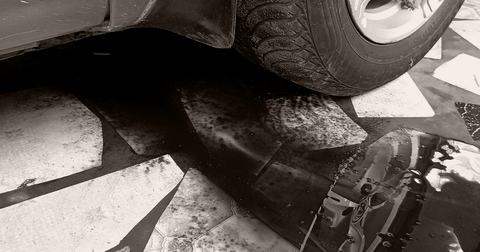
Park on level ground, slide a flattened cardboard box under the car overnight, and look at it in the morning. Two things matter: color, and position.
Five things it can be, and the color of the fluid narrows which system is leaking before anyone touches the car:
- Red or pink, slick between your fingersHealthy transmission fluid. The leak is mechanical and the fluid itself is fine.
- Brown, still slickOld transmission fluid. It's overdue a change as well as a repair, so mention both when you book.
- Dark and smells burntThe transmission has been running hot. Sealing the leak without asking why is treating the symptom, and this is the case where a fluid service becomes a real question rather than an upsell.
- Red, but well forward in the engine bayPower steering fluid is also red on many cars. Different system, different bill, so check that reservoir before you spend anything.
- Amber to black, clingy, smells like an oil changeEngine oil, not transmission fluid, and the oil pan gasket is the usual suspect. Our guide to every fluid leak, priced starts from the color.
Now position: stand at the front of the car looking back. The transmission bolts to the back of the engine and runs under the middle of the car, and where the drip lands maps roughly onto which seal has gone.
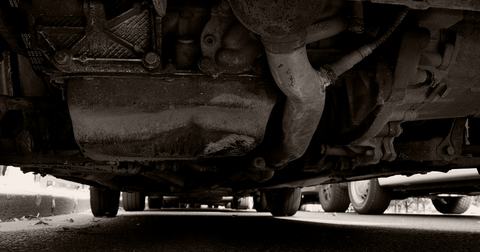
Position narrows it down but rarely settles it, because fluid runs along the underside of a car before it drops. What it does show is whether the transmission is likely to come out, and that's the part worth knowing before anyone quotes you.

Use this image
Free to republish under CC BY 4.0: credit Oil & Miles and link to this page. The snippet does both.
<a href="https://oilandmiles.com/articles/transmission-fluid-leak-repair-cost"><img src="https://oilandmiles.com/assets/img/diagrams/transmission-fluid-leak-repair-cost-6r80-bench.svg" alt="Transmission fluid leak: an automatic transmission with the pan and gasket leaks in orange, 1. The drain plug, 2. The pan gasket, 3. The pan itself, 4. The cooler lines, and the seal replacements in red, 1. Output shaft seals, 2. The torque converter seal, 3. The front pump seal." width="1200" height="1009"></a> <p>Diagram: <a href="https://oilandmiles.com/articles/transmission-fluid-leak-repair-cost">Oil & Miles</a>, CC BY 4.0</p>How much is a transmission pan or gasket leak?
A transmission pan or gasket leak is the cheap half: the parts run from a few dollars to about $166 on the three cars we priced, and the technician works from below with the transmission in place. Four of the seven leak points sit here:
1. The drain plug
If your transmission has one, an over-torqued or cross-threaded drain plug will seep, and it's the cheapest repair in the whole system. The fix is the plug or its washer, and the fluid that ran out.
None of the three cars we priced lists a transmission drain plug in the parts catalog, so ask whether yours has one before anyone quotes for it. Plenty of transmissions are drained by dropping the pan instead.
2. The pan gasket
The pan is the shallow steel tray bolted to the bottom of the transmission, holding the fluid, and its gasket hardens with heat and age until it weeps around the edge. Gasket makers' own guides put it first among transmission leaks, and it's the cheapest to fix after the plug.
The gasket is one of the cheapest parts in the box below. The job is often done with a fluid and filter service, because the pan has to come off anyway.
3. The pan itself
Steel pans rust through from the outside, particularly on cars that have spent winters on salted roads, and aluminum pans crack. Either way the pan is replaced rather than repaired.
On two of the three cars we priced the catalog sells the pan on its own, and the third lists none. A rusted pan usually comes with a new gasket and a refill, since all three happen at once.
4. The cooler lines
Transmission fluid runs through a cooler, often built into the bottom of the radiator, and the lines carrying it there corrode, most often right at the crimped fitting on each end. These are the ones people miss, because the puddle lands well forward of the transmission and looks like it came from the engine.
Sometimes the line was never pushed fully home at the factory, and reseating it is a short job rather than a new line. Carmakers have published bulletins for exactly that, listed below.
Every one of those four ends with fresh fluid going in. Dropping a pan empties the tray the fluid sits in, and opening a cooler line empties the circuit, so a refill is on the invoice whether or not the estimate breaks it out as its own line.
Ask which fluid, because that's where the money moves. A generic multi-vehicle automatic transmission fluid (ATF) and the fluid your transmission is specified for aren't the same purchase, and how to check transmission fluid covers which is which.
Leak bulletins, under the car 4 items
- Jeep Wrangler 4xe, 2021 (FCA bulletin 07-001-21)Fluid leaking from under the vehicle: cooler-line quick connects not engaged. Booked 0.8 hours to reconnect, 0.3 to refill, as warranty labor.
- Ram 1500 6.2L SRT, 2021 (FCA bulletin 09-003-21 REV. A)Fluid leaking under the vehicle: cooler lines not fully connected. Booked 0.6 hours to reseat them (0.2 if inspection finds them seated), as warranty labor.
- Ram 1500, 2023 (FCA bulletin 21-019-23)Fluid leaking toward the front: cooler lines not fully seated at the oil cooler. Booked 0.6 hours to reseat them (0.2 if inspection finds them seated), as warranty labor.
- Buick Encore GX, Chevrolet Malibu and Trailblazer CVT, 2019 to 2024 (GM bulletin PIP6032)A leak from the oil filter housing or the cooler lines; replace the housing or the damaged seals. Revision C adds the 2025 to 2027 Equinox and Terrain. No hours published.

The four cheap leaks, from underneath
What the data says
A transmission leak is named in 2,568 federal complaints for model years 2010 to 2025, counted once each. Ford carries 835 of them.
The Escape leads at 170, then the F-150 at 146 and the Focus at 145, with the Jeep Wrangler fourth at 109. The Escape, F-150 and Wrangler are the cars the parts box below prices.
NHTSA consumer complaints, FLAT_CMPL bulk file dated August 25, 2026, counted October 2, 2026, US Eastern, where the text names the transmission and a leak. Complaints count the people who filed, not a failure rate.
How much is a transmission seal replacement?
Transmission seal replacement cost is mostly access: an output shaft seal costs under $9 on the cars we priced, but the front pump seal can't be reached without taking the transmission out. Three of the seven leak points sit here:

Seven places this can leak
1. Output shaft seals
These sit where the driveshafts leave the transmission, including the rear transmission seal at the tail of a rear-wheel-drive truck. On many front-wheel-drive cars they can be replaced from underneath with the axle pulled out, and on others the transmission has to come out first.
They turn on the car rather than the part, which is why they're the one to ask about specifically. When a transmission comes out for other work, carmakers replace these seals as a matter of course, and one Ford bulletin's parts list carries an axle seal for exactly that reason.
2. The torque converter seal
Fluid that leaks at the torque converter shows up at the seam between engine and transmission, and the converter can't be reached with the transmission in place. One carmaker traced exactly this leak, at the converter housing, to pump bolts that weren't fully tightened at the factory.
Either way the transmission has to come out to reach it, and that removal is the bill, not the part. The hours that carmaker books for it are in the box below.
3. The front pump seal
This seals the input side of the transmission and lives behind the torque converter, so there's no way to reach it without separating the transmission from the engine. The seal is cheap and the access isn't.
What the bulletins do show is what taking a current automatic out costs in hours, and that's the floor under any honest quote for this job. The docpanel below quotes them.
Transmission-out bulletins 2 items
- Buick, Cadillac, Chevrolet and GMC crossovers, 2024 and 2025 (GM bulletin 25-NA-001)A fluid leak at the torque converter housing on 8T65/45 and 9T45-65 transmissions, caused by pump bolts not fully torqued. Booked 7.2 to 17.6 hours to replace the bolts, transmission out, by model and drive, as powertrain warranty labor for transmissions built between Julian dates 24160 and 24311.
- Ford Maverick, 2023 to 2025, 8F35 (Ford technical service bulletin 26-2058)A transmission-out overhaul whose parts list carries an axle seal, replaced because the unit is open.
Why does transmission leak repair cost vary so much?
Because two things move at once, and neither is the part. The first is the hourly rate, and on a job this close to pure labor, the rate decides the transmission leak repair cost:
- The national average is $132 an hourState averages run from $85 to $197, aggregated from more than 10,000 shops. Where the car is standing is the biggest variable after which leak it is.
- We price at $120 to $159The band this site uses throughout, a little above the national average, because it's the rate almost half of US shops charge in PartsTech's survey.
- The same job, the same hours, a different billNothing about the repair changes across that spread. Only the address does.
The same six-hour job therefore swings by nearly seven hundred dollars between the cheapest state and the dearest, before anyone discusses parts. That's the first of two things that move the labor line on a leak quote.
The second is your car. A transverse four-cylinder in a compact sedan gives a technician room to work, while a transmission wedged into an all-wheel-drive crossover, or one that requires the subframe to be dropped, adds hours that have nothing to do with what failed: the same mechanism that makes an oil pan gasket quote range on different cars.
Which is why the single most valuable question you can ask a shop isn't "how much" but "does the transmission have to come out for this?" The answer sorts the entire price range into two halves, and you can ask it on the phone.
What it costs
What this box shows
Prices for this repair, drawn from the sources named at the foot of the box. Each figure states whether it covers the part alone or parts and labor.
Parts and labor for a transmission leak
Parts for three cars at the counter, then the hours carmakers book, at $120 to $159.
| Pan gasketEvery brand listed for each car.2015 Ford Escape 2.5L L4 · $11 to $13, 2015 Ford F-150 5.0L V8 · $23 to $34, 2015 Jeep Wrangler 3.6L V6 · $8 to $35, | $8 – $35Part only, at the counter |
|---|---|
| Output shaft sealCheapest listing per brand; two of the three cars list one brand.2015 Ford Escape 2.5L L4 · $3.66 to $8.14, 2015 Ford F-150 5.0L V8 · $6.89, 2015 Jeep Wrangler 3.6L V6 · $7.08, | $3.66 – $8.14Part only, at the counter |
| Cooler lineSunsong up to Dorman, for the line between transmission and radiator.2015 Ford Escape 2.5L L4 · $25 to $166, 2015 Ford F-150 5.0L V8 · $33 to $100, 2015 Jeep Wrangler 3.6L V6 · $34 to $103, | $25 – $166Part only, at the counter |
| Transmission panSold on its own for two of the three cars; none listed for the Escape.2015 Ford F-150 5.0L V8 · $28 to $60, 2015 Jeep Wrangler 3.6L V6 · $26 to $94, 2015 Ford Escape 2.5L L4 · none listed | $26 – $94Part only, at the counter |
| Cooler line reseat laborBook hours at $120 to $159 an hour. FCA books 0.6 to 0.8 hours of warranty labor to reseat lines left loose at the factory. | $72 – $127Labor only, estimated |
| Transmission-out leak laborBook hours at $120 to $159 an hour. GM books 7.2 to 17.6 hours of warranty labor to take the transmission out for a leak at the converter housing; for the build dates it lists, that work is covered. | $864 – $2,798Labor only, estimated |
Parts are every brand RockAuto lists for each car: gaskets and seals read September 14, cooler lines and pans October 2, 2026, US Eastern. Labor is the time FCA and GM book in bulletins filed with NHTSA, times $120 to $159 an hour. The Escape and F-150 are the two cars named most in NHTSA complaints about a transmission leak, and the Wrangler is fourth.
What owners report
A cheap line can take the transmission with it. A 2011 Nissan Titan owner pulled over for smoke and found fluid everywhere, and the dealer stated the transmission cooler line split caused fluid to leak out that caused transmission to fail.
A 2010 Chevrolet Silverado owner saw the fluid leaking onto exhaust pipe and had the truck towed in. The transmission rebuild was covered under warranty but cooler lines where not, which is the cheap part and the expensive part arriving on one bill.
NHTSA complaint bulk download, file FLAT_CMPL, complaints 10542298 and 10525881, in the owners' own words, file dated August 25, 2026. Two accounts, not a sample.
How serious is a transmission leak?
Serious in proportion to how fast the level drops, not to the size of the puddle. You can keep driving briefly, and only if you watch it.
An automatic transmission is hydraulic. The fluid does more than lubricate: it carries power through the transmission and heat away from it.
Run the level low and the pump starts drawing air, pressure drops, clutches slip, and slipping clutches generate heat that destroys the friction material. That's how a cheap gasket becomes a rebuild.
A transmission leak is in one of four states, listed worst last, and how fast the level falls decides which one you're in:
- A stain on the driveway, level unchanged after a weekDrive it, and book the repair. This isn't an emergency.
- The level falls but tops back off and holdsCheck it every morning and get it seen this week.
- The level keeps falling after you top it offThe pump will start drawing air. Arrange the repair now.
- Shudder, hesitation before engaging, or slipping under accelerationStop driving. The transmission is already running low, and every mile from here is expensive.
Check the level properly while the decision is open: most transmissions are read warm, engine running, in park or neutral depending on the manual, which is the opposite of engine oil. Many newer cars have no dipstick at all, in which case checking the level is a job for a shop and topping it off yourself isn't an option.
Can a transmission leak be fixed with stop-leak?
Sometimes, and in exactly one way: it swells a hardened seal enough to slow a weep. It has one real use and a lot of misplaced ones.
Transmission stop-leak products work by swelling rubber seals. On a seal that has hardened and shrunk with age, that can slow a weep, enough to get a car through to a planned repair, or to make a low-value car usable for another year.
What it can't do is fix a gasket that has failed mechanically, a rusted-through pan, a corroded cooler line, or a cracked case, because there's no rubber there to swell. And on a transmission that's already slipping, it changes nothing about the clutch material that has already worn.
Treat it as a way of buying time on a seal, not a repair. Using it because the car is worth less than the job is a legitimate decision, but using it to avoid finding out which of the seven leaks it is gambles with the most expensive component in the car.
What should you do if your transmission is leaking?
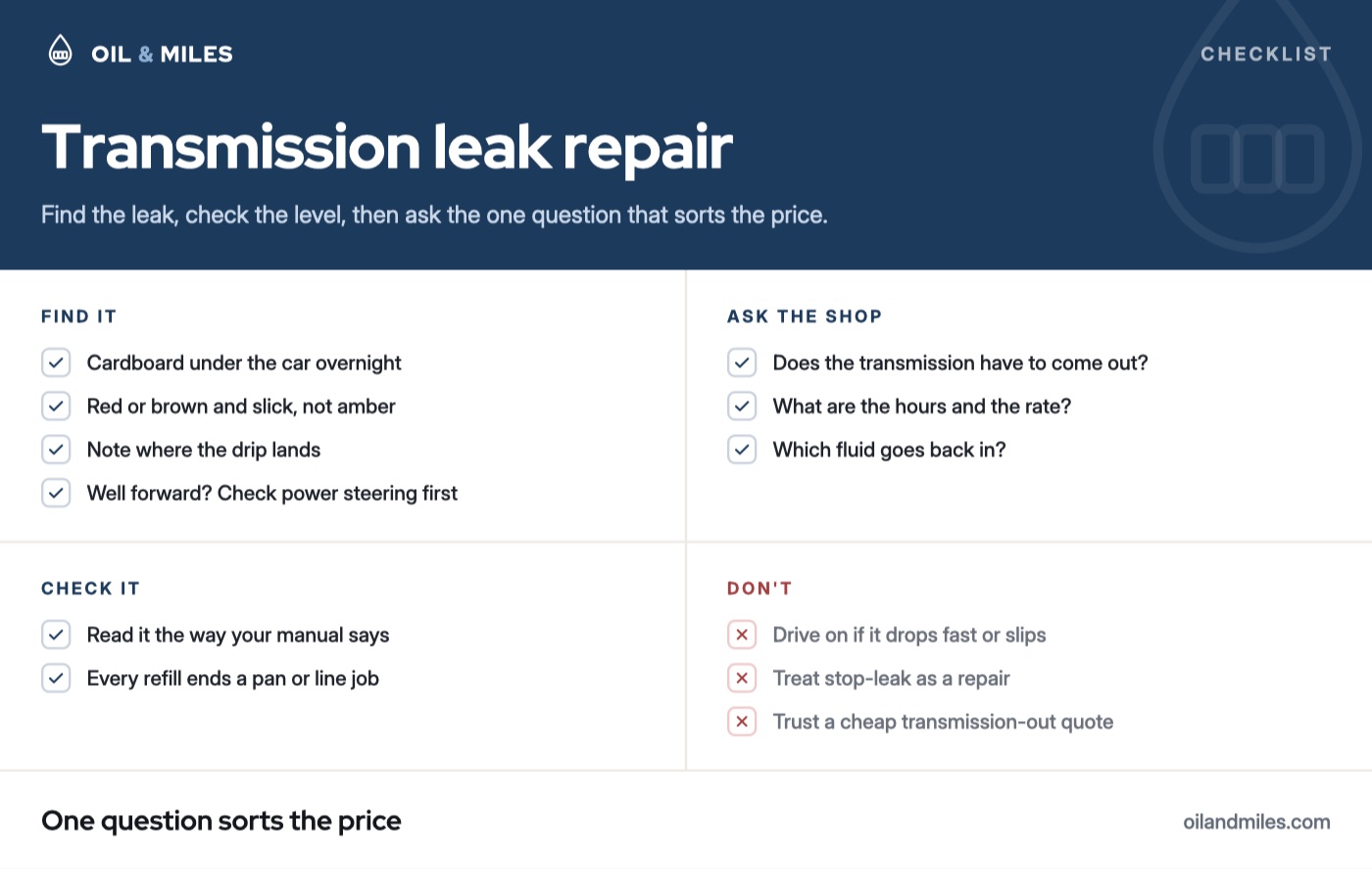
Work from the free checks to the paid ones, because each answer narrows what the next one costs. To deal with a transmission leak, work through the 4 steps below, in order:
- Put cardboard under the car overnight. Confirm the fluid is red or brown and slick, not amber, note where it lands relative to the middle of the car, and rule out power steering if it's well forward.
- Check the level. Read it the way your manual says, which for most automatics is warm with the engine running, and note it so the next reading has something to compare against.
- Ask two shops whether the transmission has to come out. Ask it before you ask about money. If the answer is no, you're in the cheap half and any competent independent shop can do it.
- Ask for the hours and the rate on the quote. Set them against the booked hours in the box above: a transmission-out leak quoted at a few hundred dollars of labor is below what GM books for that work under warranty, so ask the dealer first whether your car is covered.
If the level is dropping fast, or the car is shuddering or slipping, stop driving it: the leak is now the cheap part of the problem. Where a step can't be done as written, the documents still point somewhere:
- No dipstick to readThe level is read at a plug with the car on a lift, so ask the shop to read it while the car is up; checking without a dipstick explains why.
- The answer is yes, it comes outGet a second opinion before committing, and ask whether the leak was traced to its source. GM warns that filter-housing and seal leaks have been misread as case damage, leading to unnecessary transmission replacement.
- The car is worth less than the jobStop-leak can buy time on a hardened seal, as above, and that's a legitimate decision; it won't fix a rusted pan or a corroded line.
Use this image
Free to republish under CC BY 4.0: credit Oil & Miles and link to this page. The snippet does both.
<a href="https://oilandmiles.com/articles/transmission-fluid-leak-repair-cost"><img src="https://oilandmiles.com/assets/img/diagrams/transmission-fluid-leak-repair-cost-checklist.jpg" alt="Transmission leak repair cost checklist: put cardboard under the car overnight, confirm red or brown slick fluid, note where it lands and rule out power steering; check the level the way the manual says and stop driving if it drops fast or slips; ask whether the transmission has to come out, ask for the hours and rate; don't treat stop-leak as a repair or a cheap transmission-out quote as a bargain." width="1200" height="761"></a> <p>Infographic: <a href="https://oilandmiles.com/articles/transmission-fluid-leak-repair-cost">Oil & Miles</a>, CC BY 4.0</p>From the documents
What does a maker book for transmission work?
For one leak, a carmaker books the job itself: GM's bulletin for a converter-housing leak is the only booked leak repair we found that takes the transmission out. Carmakers publish hours for their own dealers, and NHTSA hosts those bulletins openly.
General Motors, bulletin 25-NA-001
Some technicians may comment on a transmission fluid leak coming from the torque converter housing.
Ford Motor Company, 22-2411
Labor Times: Diagnose And Replace The A-Clutch And Front Support Assembly (Do Not Use With Any Other Labor Operations), booked from 7.5 Hrs. on the 2022 Aviator RWD to 12.3 Hrs. across eleven operations.
Ford Motor Company, TSB 26-2058
Labor Times: Retrieve DTCs Replace The SOWC And Overhaul The Main Control Valve Body. 2023-2025 Maverick FWD 2.0L, 14.4 Hrs. Maverick AWD 2.0L, 16.5 Hrs.
Read the two Ford cards for what they are. Neither is a leak repair: one replaces a , the other overhauls a valve body.
What the two Ford bulletins show is what a transmission-out job books on a current automatic, the access plus the work inside: 7.5 to 18.2 hours, the top figure being the Bronco Sport's in the same bulletin as the Maverick. At $120 to $159 an hour, that's $900 to $2,894 in labor before any seal is bought.
They also settle a smaller thing this page asserts. Ford's own parts list for the Maverick transmission-out job requires a new axle seal, which is the argument on this page stated by the company that built the car: that seal is replaced because the unit is open, not because it failed.
What we couldn't find is a manufacturer's time for replacing a transmission seal on its own, so the hours here are for bigger jobs than a single seal, and a seal quote should sit below them, not above. They're still worth holding against a quote: one that puts a transmission-out repair at a few hundred dollars of labor is below what GM or Ford books for that work.
Conclusion
The numbers aren't wrong, they're unlabeled
The numbers that don't agree are both telling the truth, because every price here turns on whether the transmission comes out. Here's what they sort into:
- Two jobs share one name.Four of the seven leaks are reached from underneath, and three can need the transmission out. That one fact sorts every figure on this page.
- The outside leaks cost parts and a refill.A pan gasket is $8 to $35 and a cooler line $25 to $166 on the cars we priced, and a line left loose at the factory books under an hour of warranty labor to reseat.
- The inside leaks cost the access.The front pump seal and the converter seal need the transmission out, which GM books at 7.2 to 17.6 hours for one converter-housing leak.
- The shop rate moves the bill.State average hourly rates run from $85 to $197, nearly seven hundred dollars apart on a six-hour job.
- One question comes first.Ask whether the transmission has to come out before you ask the price, then ask for the hours behind the quote.
Ask it in one phone call and the wall of disagreeing numbers turns into two short lists. Oil & Miles sorts every price it publishes the same way, by what decides the bill, across repair costs and symptoms.
Common questions
Asked most often
My car is leaking red fluid. Is it definitely the transmission?
No. Power steering fluid is red on many cars and sits further forward in the engine bay. Check both reservoirs before assuming, because color alone won't separate them.
How much transmission fluid can I lose before it matters?
Less than you'd think. Any level below your manual's mark is too low, so top it off with the specified fluid and watch the level rather than waiting for symptoms.
How long does it take to fix a transmission leak?
A cooler line left loose at the factory books under an hour to reseat, while a leak that takes the transmission out books 7.2 to 17.6 hours on one carmaker's crossovers, so plan on a day or more for those.
Is a transmission oil leak the same as a transmission fluid leak?
Yes. They're two names for one thing. Automatic transmission fluid is an oil, and a transmission oil leak is what most people call it at the counter, so a shop will understand either. It's not the same as an engine oil leak, which is amber to black rather than red and comes from a different part of the car.
Is a transmission pan leak worth fixing on an old car?
Usually yes. The gasket is cheap and the transmission stays in the car, while topping off forever risks a run-low. If the car is also behaving strangely rather than merely dripping, start with the signs a transmission is going out.
Why is the leak worse after a fluid change?
Fresh fluid contains detergents that clean deposits off aged seals, and those deposits were partly sealing the gap. The leak was already there. It didn't start because of the service; it stopped being hidden by it.
What people ask next
Sources
- RockAuto catalog, for every brand listed as fitting a 2015 Ford Escape 2.5L, a 2015 Ford F-150 5.0L V8 and a 2015 Jeep Wrangler 3.6L. RockAuto, read September 14 and October 2, 2026, US Eastern
- GM bulletin 25-NA-001 and GM PIP6032, for the converter-housing leak and its booked hours, and the filter-housing and cooler-line seals. General Motors, via NHTSA, read October 2, 2026, US Eastern
- FCA bulletins 07-001-21, 09-003-21 REV. A and 21-019-23, for cooler lines not seated and the hours to reseat them. FCA US, via NHTSA, read October 2, 2026, US Eastern
- Two Ford service bulletins, TSB 22-2411 for the 10R60 and TSB 26-2058 for the 8F35, quoted in full above. Ford Motor Company, via NHTSA, read September 7, 2026
- NHTSA consumer complaints, FLAT_CMPL bulk file dated August 25, 2026, for the model year 2010 to 2025 complaints whose text names the transmission and a leak, counted once each. NHTSA, counted October 2, 2026, US Eastern
- Average auto repair labor rates by state, 2026, the source of the $132 national average and the state averages from $85 to $197, aggregated from more than 10,000 shops. Tekmetric, dated June 30, 2026, read October 2, 2026, US Eastern
- PartsTech's 2025 survey of 752 US shops, as reported by MOTOR, for the $120 to $159 hourly rate. MOTOR, read September 27, 2026
- Gasket manufacturer and parts-supplier technical pages, for the leak locations and the access requirement at each. Several manufacturers and parts suppliers
How this was compiled
Parts are every brand RockAuto lists for each car. Labor is a carmaker's booked time times $120 to $159 an hour, and it's shown only where a carmaker publishes the hours for a leak or for the access to one; no carmaker publishes them for a pan gasket, a drain plug or an output seal on these three cars.
The seven leak points rest on gasket-maker and parts-supplier technical pages, which agree on the seven and on which of them sit behind the torque converter, and they're the weakest source on this page. The complaint counts take each complaint once, by its NHTSA number, where the text names the transmission and a leak.
What we didn't do
We didn't price this against a commercial labor guide, because those aren't public; carmakers' times are, and the ones we found are above. None of them is a single seal, and the bulletin cars aren't the three we priced.
We censused the parts on three cars only. A quote outside these figures isn't automatically wrong, so ask what hours it is based on.
We didn't test any stop-leak product. The description above is of what the chemistry can and can't act on.
Prices are ranges compiled in September and October 2026 for the US market and vary by region, vehicle and shop rate. Prices from $10 up are rounded to the nearest dollar, so $14.13 reads as $14 and $14.52 as $15. Below $10 they're exact. This article is general information, not advice about your specific vehicle. See the disclaimer.
Torque converter
The fluid coupling between engine and automatic transmission, doing the job a clutch does on a manual.
Book time
The published number of hours a repair is deemed to take, from an industry labor guide.
Service bulletin
A written instruction a manufacturer sends its own dealers, naming a fault, the repair and who pays for it.
Clutch pack
The stacks of friction plates inside an automatic that fluid pressure clamps together to hold each gear.
Transmission pan gasket
2015 Ford Escape 2.5L L4
| Brand | Part | Price |
|---|---|---|
| ATP | FG254 | $11 |
| Mahle / Clevite | W32823 | $13 |
Transmission pan gasket
2015 Ford F-150 5.0L V8
| Brand | Part | Price |
|---|---|---|
| Fel-Pro | TOS18753 | $23 |
| Elring | 787160 | $25 |
| Victor Reinz | 711494500 | $27 |
| ATP | FG253 | $31 |
| Mahle / Clevite | W32828 | $34 |
Transmission pan gasket
2015 Jeep Wrangler 3.6L V6
| Brand | Part | Price |
|---|---|---|
| Fel-Pro | TOS18764 | $8 |
| Mahle / Clevite | W32819 | $14 |
| Mopar | 52108332AA | $35 |
Output shaft seal
2015 Ford Escape 2.5L L4
| Brand | Part | Price |
|---|---|---|
| WJB / InMotion Parts | WS710705 | $3.66 |
| National | 711057 | $6.03 |
| SKF | 22680A | $6.03 |
| Timken | SL260148 | $8.14 |
Output shaft seal
2015 Ford F-150 5.0L V8
| Brand | Part | Price |
|---|---|---|
| SKF | 15150A | $6.89 |
Output shaft seal
2015 Jeep Wrangler 3.6L V6
| Brand | Part | Price |
|---|---|---|
| SKF | 16521 | $7.08 |
Transmission cooler line
2015 Ford Escape 2.5L L4
| Brand | Part | Price |
|---|---|---|
| Sunsong | 5801821 | $25 |
| 5801831 | $25 | |
| 5801944 | $112 | |
| Dorman | 624976 | $28 |
| 624970 | $166 |
Transmission cooler line
2015 Ford F-150 5.0L V8
| Brand | Part | Price |
|---|---|---|
| Sunsong | 5801764 | $33 |
| 5801770 | $47 | |
| 5801773 | $55 | |
| 5801784 | $87 | |
| Dorman | 724605 | $100 |
Transmission cooler line
2015 Jeep Wrangler 3.6L V6
| Brand | Part | Price |
|---|---|---|
| Sunsong | 5801559 | $34 |
| 5801481 | $58 | |
| 5802095 | $86 | |
| SKP | SK624561 | $39 |
| Dorman | 624588 | $84 |
| 624561 | $99 | |
| 624628 | $103 |
Transmission pan
2015 Ford F-150 5.0L V8
| Brand | Part | Price |
|---|---|---|
| SKP | SK265854 | $28 |
| Dorman | 265854 | $34 |
| Spectra Premium | TP0854 | $60 |
Transmission pan
2015 Jeep Wrangler 3.6L V6
| Brand | Part | Price |
|---|---|---|
| SKP | SK265866 | $26 |
| Spectra Premium | TP0866 | $62 |
| URO Parts | 1402700812 | $63 |
| Mopar | 52108327AB | $94 |