
Short answer
A front brake job costs $230 to $896 an axle
Brake pad and rotor replacement costs roughly $230 to $618 an axle at an independent shop and $410 to $896 at a dealer. Pads alone, if the rotors still measure above their minimum thickness, run $150 to $300. Performance and large-diameter brakes sit well above all of that.
Brake pad and rotor replacement cost is the number most people have some feel for, and three measurements decide whether the quote in your hand is fair. A shop can read all three out in a minute, and the difference between a fair price and a padded one is mostly visible on the invoice.
It's also the repair where the dealer premium is hardest to defend: unlike a timing belt or a transmission, a front brake job on a mainstream car is the same procedure everywhere. An independent shop with a good parts supplier will do it identically for less.
One naming note first: a rotor and a brake disc are the same part, so a quote for front disc replacement and one for front rotors are quoting the same job. Below are the prices, when rotors really need replacing, how to tell worn pads by thickness, and which upsells are worth paying for.
What does your brake quote say?
Other add-ons on the quote? Two of four upsells are worth paying for.
What does a brake pad and rotor replacement cost?
Between $230 and $896 an axle, and what separates the two ends is the shop's hourly rate and its parts pricing rather than the work. The rows below break the job into the four things a shop charges for, priced one at a time, with the whole job at the bottom.
Two of those rows decide most of the gap in brake pad and rotor replacement cost, from the low end to the high one:
- The labor time is identical. Same car, same procedure, so the entire dealer premium sits in the hourly rate and the parts markup.
- The fluid flush is a meaningful chunk of the total, and it's often bundled in without being asked for.
What it costs
What this box shows
Prices for this repair, drawn from the sources named at the foot of the box. Each figure states whether it covers the part alone or parts and labor.
Parts and labor for a front brake job
Brake pads and rotors for one front axle. No total: mixed figure kinds, and the last row is the whole job.
| Brake pads$15 to $131 at the counter, four cars, DuraGo Semi-Metallic up to GM Genuine. Shops bill $40 to $90 aftermarket, $70 to $150 maker's own; dealers $90 to $180. Track pads to $82. One set does the axle.2017 Honda Accord 2.4L · $15 to $53, 2017 Honda Civic 2.0L · $15 to $53, 2017 BMW X3 2.0L · $19 to $64, 2017 Chevrolet Traverse 3.6L · $17 to $131, | $15 – $131Part only, at the counter |
|---|---|
| Brake rotors$42 to $176 the pair at the counter, four cars, FVP Painted up to Brembo Prime UV Coated. Shops bill $70 to $180, dealers $140 to $320. Drilled rotors to $157 each. Prices below are per rotor.2017 Honda Accord 2.4L · $21 to $52, 2017 Honda Civic 2.0L · $21 to $62, 2017 BMW X3 2.0L · $36 to $88, 2017 Chevrolet Traverse 3.6L · $31 to $79, | $42 – $176Part only, at the counter |
| Labor1.0 to 1.8 hours; $120 to $159 an hour independent, $180 to $220 dealer | 1.0–1.8 hoursLabor only, estimated |
| Brake fluid flushOnly if estimated: $80 to $130 independent, $120 to $190 dealer | $80 – $190Parts and labor, estimated |
| Pads and rotors fitted$230 to $618 independent, $410 to $896 dealer: the shop-billed rows above added. Counter parts, $56 to $288, don't subtract from it | $230 – $896Parts and labor, per axle |
We priced every brand RockAuto lists for the front axle of four cars, 397 listings, read September 7, 2026: a 2017 Honda Accord 2.4L, a 2017 Honda Civic 2.0L, a 2017 BMW X3 2.0L and a 2017 Chevrolet Traverse 3.6L. Clearance listings and track or drilled parts are excluded and named separately. Each car's brand list gives one listing per brand, the cheapest of that brand. The shop-billed parts, labor and rates are ours: a US compilation at , with the rate checked against Tekmetric's 2026 state survey, read August 18, 2026.
Published ranges for this job don't agree with each other. Two published estimates put one front axle at $200 to $500 and at $600 to $1,000, a fivefold spread on the same repair, and neither says where its figures came from.
That's why the rows above give the counter price, the car it was read on and the day it was read: a range you can't check is a range you can't argue with at the desk.
What is the average brake job cost?
There isn't a useful one, and the arithmetic is why. Our compiled figures run $230 to $896 an axle, so the middle of that band is about $563 - near the top of the independent range and in the lower half of the dealer range, so it matches neither kind of shop.
It describes a job nobody is actually quoted.
Two things decide your brake job cost instead, and both are printed on the estimate in front of you:
- The shop's hourly rate. The state averages in Tekmetric's own table run from $100 in West Virginia to $161 in Alaska, against a $132 national average.
- Whether the rotors are replaced or machined. One is a part on the bill, the other is labor on a part you already own.
An average is on neither line.
Where is the best place to get brakes done?
An independent shop, for a routine front job on a mainstream car: the same work, the same procedure, at a lower rate. The dealer is worth it in two situations.
If the car is under warranty and the brakes are being replaced as a warranty or claim, the dealer is the only route.
On cars with electronic parking brakes, the rear calipers must be retracted with a diagnostic tool rather than a wind-back tool. A well-equipped independent shop has that capability, but a smaller one may not, so ask before booking.
Brakes are one of several things that come due together on an older car. The full picture is in the 100k mile maintenance cost breakdown.
Do the rotors need replacing?
Often yes, sometimes no, and the answer's measurable rather than a matter of opinion.
Every rotor has a cast or stamped into it, usually on the hub face or the outer edge. A shop with a micrometer can tell you in under a minute what yours measure and what the limit is.
If a rotor is at or near the limit, it must be replaced: there's no repair, and machining it only takes more material away.
What changed over the past two decades is that rotors got thinner and cheaper, and machining them got less worthwhile. On a lot of modern cars a new rotor costs little more than the labor to skim an old one, and skimming a rotor that started thin leaves you with less metal to soak up heat, and what heat does to a rotor is in warped rotors.
That's why "pads and rotors together" has become the default rather than a scam.
It becomes a scam when nobody measures, and that's the line we'd draw rather than one about parts or price. If an estimate lists rotors and the shop can't tell you the measured thickness against the minimum, ask them to measure it in front of you.
A shop that's confident in its recommendation will do that happily.
How do you tell if brake pads are worn?
By thickness, and it's a number rather than a feeling. A new pad carries about 12 mm of friction material, and the replacement point Haynes says most manufacturers and mechanics use is 3 mm, which is roughly three quarters worn.

What you can see without taking anything off
That 3 mm is also where the car starts telling you itself. Most pads carry a small metal tab set to touch the rotor at about that depth, which is the high-pitched squeal, and GM and Nissan both say it can sound while you drive, not only when you brake.
On cars with an electronic sensor it's a dashboard light, and on some, such as GM's Silverado, the light and the squeal both.
That 3 mm is a service recommendation, but a pad worn past it can take the rotor with it, and two facts back that up:
- There's no US federal minimum we could find, so 3 mm is a service recommendation rather than a legal line.
- A pad worn past it doesn't fail gracefully. Below about 2 mm you're into the backing plate territory that scores the rotor, which turns a pad job into a pad and rotor job.
So when a shop says the pads are worn, the useful reply is one question: what did they measure? A number under 3 mm is the recommendation doing its job.
No number at all is a shop asking you to take its word for it.
Which brake pad material should you choose?
Three kinds get sold for ordinary cars, and the difference between brake pad materials is dust and noise rather than stopping power:
- Ceramic. Quiet, low dust, stable in normal driving. The default choice for most daily cars, and worth the small premium mainly for how clean the wheels stay.
- Semi-metallic. Better bite when hot, better for towing and heavy vehicles, at the cost of more dust, more noise and slightly faster rotor wear.
- Low-metallic and organic. Less common as a replacement choice. Fine for gentle use, not for load or heat.
Match the pad to your driving, not to the most expensive box. Someone commuting in traffic doesn't benefit from a track-oriented compound; they get noise, cold-brake grabbiness and dirty wheels.
Priced across every brand the catalog lists for one car, the material barely moves the number:
| Material | Listings | Range | Median |
|---|---|---|---|
| Ceramic | 16 | $18.85 – $63.99 | $34.29 |
| Semi-metallic | 11 | $21.79 – $43.79 | $30.79 |
| Low-metallic | 2 | $36.79 – $50.89 | $43.84 |
| Every brand RockAuto lists for this car, front axle, read September 7, 2026. Clearance and track parts left out. | |||
Ceramic carries the premium the paragraph above describes, and it's $3.50 at the median. The spread inside ceramic alone is $45, thirteen times that gap.
The material is the decision people agonize over; the brand is the one that moves the bill.
Worth knowing
Pads bought on price alone generate most of the complaints, and rarely because they can't stop the car. They can: it's dust and noise. Very cheap semi-metallic pads coat the wheels in black dust within two weeks and squeal when cold, and the owner concludes the brake job was botched.
The other thing worth knowing is that a set of pads isn't only pads. The box on a decent set includes new shims and often the abutment clips. Reusing rusted, flattened clips is where a lot of squeal and uneven wear comes from, and fitting the new ones takes a minute, so ask whether the hardware in the box got used.
Why do front brakes wear out first?
Front brakes do most of the work, because weight transfers forward when you slow down. Fronts typically last 30,000–70,000 miles and rears 40,000–90,000, though the gap has narrowed on cars with electronic stability systems that use the rear brakes more actively.

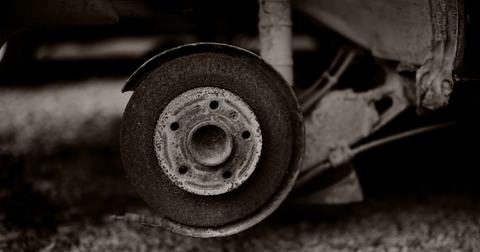
Brake pads and rotor, wheel off
Brakes are replaced per axle, in pairs, never one corner. Different friction levels left and right pull the car under braking, which is a safety problem rather than a comfort one.
If a shop quotes all four corners at once, that's not automatically an upsell (it's entirely possible for a car to need it) but it's worth asking for the measured pad thickness at each corner. Numbers are hard to argue with in either direction.
Which brake shop upsells are worth paying for?
Two of these four brake shop upsells are worth paying for, and the difference is whether the work prevents something or just adds a line:
- Brake fluid flush. Legitimate on a time basis. Brake fluid absorbs moisture from the air, and wet fluid boils at a lower temperature, which matters on a long descent. The two manuals at the foot of this page don't agree on the interval. Worth doing on schedule; not worth doing at every pad change. Whether a recommendation like that is real or an upsell usually comes down to what your manual says against what the counter says, which is the whole trick to reading an estimate.
- slide pin service. Cheap, quick, and genuinely prevents uneven pad wear and a stuck caliper later. Accept this one.
- New calipers. Only if one is seized or leaking. A seized caliper has clear evidence: one pad worn far more than its partner, or a wheel that's hot after a gentle drive. Ask to be shown it.
- Rotor machining as an add-on to new rotors. Makes no sense. New rotors don't need skimming.
What should you do before you pay?
Ask for three numbers before agreeing to anything: the measured pad thickness, the measured rotor thickness, and the manufacturer's minimum for that rotor. A shop that provides them without hesitation is a shop worth returning to.

What the shop measures
Then compare quotes on what's included rather than the total: pads, rotors, hardware, slide pin service, and whether a fluid flush has been quietly added. And if your steering wheel has been shaking under braking, read what actually causes that first, because it's frequently not the rotors at all and you may be about to pay for the wrong repair.
From the documents
What do the manuals say about the flush?
They don't agree, and the gap is the whole answer. The flush is the line on the estimate most often bundled in without being asked for, so we read what two makers actually print for their own owners.
What follows from the two is a question you can settle in your own glove box: if your maker prints a replacement interval, a flush is maintenance and belongs on the estimate. If it prints only an inspection, as Toyota does here at every service and never once an interval, then a flush on your estimate is somebody's recommendation rather than your car's schedule - and it's fair to ask which of the two it is.
2017 Honda Odyssey Maintenance Minder System
Independent of the Maintenance Minder information, replace the brake fluid every 3 years.
2023 Toyota Tacoma Warranty & Maintenance Guide
Inspect power steering fluid (if equipped) and brake fluid level/condition.
- One maker sets a clock, the other sets none. Honda's 2017 Odyssey schedule gives a flat three years; the 2018 ties it to the Maintenance Minder, with three years as the fallback. Toyota asks its dealers to inspect the level and condition at every service and never names a replacement figure.
- So the counter can't tell you it is due. Only your own book can, and the two above show how far apart two mainstream makers sit on the same fluid.
Conclusion
A brake quote isn't an opinion
A front brake job costs $230 to $896 an axle, and the shop's rate decides where you land, not the work. Here's how to check a brake pad and rotor quote, from the parts we priced and two makers' manuals:
- Ask for three numbers.The measured pad thickness, the measured rotor thickness, and the minimum thickness cast into the rotor. A shop that gives all three without hesitating is a shop worth going back to.
- Pads are due at 3 mm.A new pad has about 12 mm of friction material, and most agree it's due at 3 mm, where the wear tab starts to squeal. Below about 2 mm the backing plate scores the rotor, and a pad job becomes a pad and rotor job.
- Rotors are measured, not guessed.A rotor at or near its minimum thickness must be replaced, because machining only takes more metal off. If it still measures above the minimum, pads alone run $150 to $300.
- An independent charges less.A front brake job on a mainstream car is the same procedure everywhere, $230 to $618 an axle at an independent shop against $410 to $896 at a dealer. The rate and the parts pricing make the gap, not the work.
- Check a flush against your manual.Honda prints a flat three-year interval for brake fluid, while Toyota only asks its dealers to inspect it. If your book names an interval, the flush is maintenance; if not, it's a recommendation you can question.
So measure first, then compare quotes on what's included. A shop that measures is quoting and one that recommends without measuring is guessing, which is why every repair on Oil & Miles is priced by its numbers, with every repair we have costed in one place.
Common questions
Asked most often
How much do brake pads and rotors cost?
About $230 to $618 per axle at an independent shop and $410 to $896 at a dealer. Pads alone, where the rotors genuinely still measure within spec, run $150 to $300.
Is $300 for brakes good?
For one axle at an independent shop, yes: $300 sits near the bottom of the $230 to $618 above, and below every dealer figure on this page. What decides it is what the $300 covers, so ask whether it is pads only or pads and rotors, and whether a fluid flush has been added.
How much are brakes and rotors for all 4?
Two axle jobs rather than one, and not quite double: the front counter parts above run $56 to $288 across four cars, and the rear pads and rotors are smaller. We priced the front axle only, so ask for the two axles quoted separately rather than doubling ours.
What does a $99 brake special include?
Not a pad and rotor job, whatever else it is. At the $132 national average, one hour of labor alone passes $99, let alone $56 to $288 of parts. Ask which axle it covers, whether rotors are included, and what happens if yours measure under the minimum.
Do rotors need replacing with the pads?
Often, but it should be a measurement, not an assumption. Every rotor has a minimum thickness stamped on it. Ask for the measured figure against that limit.
How long do brake pads last?
Fronts typically 30,000–70,000 miles and rears 40,000–90,000, depending heavily on how and where you drive.
How long does it take to change brake pads?
About an hour to an hour and three quarters on one axle, which is the 1.0 to 1.8 hours the labor row above is built on. All four corners is two of those, so 2.0 to 3.6 hours of work.
Are ceramic or semi-metallic pads better?
Ceramic, for most drivers. It's quieter, it keeps the wheels clean, and it's stable in normal use. Semi-metallic only earns its place if you tow or carry weight, and it costs you dust, noise and faster rotor wear. Price isn't the tiebreaker: on the car we priced the two sit $3.50 apart at the median.
Is it brake pads or break pads?
Brakes with an a, and rotors with two o's. The misspellings are common enough to name: plenty of drivers type how much are break pads, roters or rotores. American shops and parts catalogs spell them brake pads and brake rotors, and that's the spelling on your invoice.
What people ask next
Sources
- Brake pad thickness. Haynes, the repair manual publisher, in its brake pad thickness guide, for the 12 mm new figure and the 3 mm replacement point. We found no US federal minimum, and say so rather than borrowing another country's legal figure. Haynes Manuals, named rather than linked, read September 25, 2026
- Oil & Miles fitted-range compilation, for the $230 to $618 independent and $410 to $896 dealer ranges, the sum of the shop-billed parts and labor rows in the cost box, built for the US market from typical retail parts pricing and book labor time. Oil & Miles, compiled August 2026
- RockAuto catalog, for front axle counter prices, every brand listed as fitting a 2017 Honda Accord 2.4L, a 2017 Honda Civic 2.0L, a 2017 BMW X3 2.0L and a 2017 Chevrolet Traverse 3.6L: 397 listings, the cheapest listing from each brand. RockAuto, read September 7, 2026
- Average auto repair labor rates by state, 2026, for the $132 national average and its state table, $100 to $161, from an index of more than 10,000 shops. Tekmetric
How this was compiled
Minimum rotor thickness is cast or stamped on the rotor by the manufacturer, so the figure that governs your car is on the part rather than in this article. Pad life ranges reflect ordinary mixed driving.
What we didn't do
We didn't survey shops. The ranges here are built from typical retail parts pricing and book labor times, not from a sample of real quotes, because no national brake job price survey exists that we could check.
We didn't price the rear axle: every counter figure above is the front, on four cars. Rear pads and rotors are smaller and cheaper, and we aren't going to tell you by how much without reading them.
We didn't measure regional spread ourselves. The state figures above are somebody else's index, and they stop at the state line: the same job in a coastal city and a small inland town inside one state still aren't the same bill.
Prices are ranges compiled in August and September 2026 for the US market and vary by region, vehicle and shop rate. Prices from $10 up are rounded to the nearest dollar, so $14.13 reads as $14 and $14.52 as $15. Below $10 they're exact. Braking systems are safety-critical. This article is general information, not instruction. See the disclaimer.
Book time
The published number of hours a repair is deemed to take, from an industry labor guide.
Goodwill
A manufacturer paying for a repair it's not contractually obliged to cover, usually to limit reputational damage from a known fault.
Minimum thickness
The thinnest a disc may be machined to and still go back on the car.
Caliper
The clamp that presses the pads against the disc, driven by hydraulic pressure from the pedal.
Brake pads, one axle set
2017 Honda Accord 2.4L L4
| Brand | Part | Price |
|---|---|---|
| DuraGo | BP914MS | $15 |
| Wagner | ES914 | $16 |
| Centric | 30109140 | $17 |
| Quality-Built | 10011860C | $17 |
| Bosch | BE914H | $20 |
| Dynamic Friction | 4000091400 | $22 |
| Raybestos | MGD914CH | $23 |
| FVP | FVC914 | $24 |
| Power Stop | 17914 | $24 |
| Top Notch | TN914H | $24 |
| Bendix | SBC1654 | $25 |
| ProSpec | PS1654 | $25 |
| Beck/Arnley | 0851698 | $28 |
| ACDelco | 14D1625CHF1 | $30 |
| Hella / Pagid | 355036331 | $33 |
| Brembo | P28035N | $40 |
| Advics | AD1654 | $43 |
| Akebono | ACT914A | $53 |
Brake pads, one axle set
2017 Honda Civic 2.0L L4
| Brand | Part | Price |
|---|---|---|
| DuraGo | BP914MS | $15 |
| Centric | 30109140 | $17 |
| Bosch | BE914H | $20 |
| Quality-Built | 10030914CC | $20 |
| Dynamic Friction | 4000091400 | $22 |
| Raybestos | MGD914CH | $23 |
| Power Stop | 17914 | $24 |
| Top Notch | TN914H | $24 |
| Wagner | ZX914A | $27 |
| FVP | FVM914A | $28 |
| ProSpec | PS914 | $28 |
| Beck/Arnley | 0851698 | $28 |
| Bendix | SBC914 | $31 |
| ACDelco | 14D914CHF2 | $33 |
| Hella / Pagid | 355043561 | $38 |
| Brembo | P28035N | $40 |
| Advics | AD0958 | $44 |
| Akebono | ACT914A | $53 |
Brake pads, one axle set
2017 BMW X3 2.0L L4
| Brand | Part | Price |
|---|---|---|
| Centric | 10515610 | $19 |
| Bosch | BE1561H | $22 |
| Quality-Built | 10031561C | $22 |
| Bendix | SBM1561 | $23 |
| DuraGo | BP1561C | $24 |
| Dynamic Friction | 4000156100 | $26 |
| Top Notch | TN1561H | $26 |
| Power Stop | 171561 | $29 |
| Raybestos | MGD1561MH | $31 |
| ProSpec | PS1561 | $32 |
| Wagner | OEX1561 | $32 |
| Beck/Arnley | 0852010 | $35 |
| Hella / Pagid | 355015781 | $37 |
| ACDelco | 17D1561MH | $40 |
| Brembo | P06075N | $46 |
| Akebono | EUR1561 | $64 |
Brake pads, one axle set
2017 Chevrolet Traverse 3.6L V6
| Brand | Part | Price |
|---|---|---|
| DuraGo | BP1169MS | $17 |
| Centric | 30011691 | $17 |
| Dynamic Friction | 4000116910 | $20 |
| Wagner | EC1169A | $21 |
| Quality-Built | 10031169AC | $24 |
| Bendix | SBC1169A | $25 |
| Top Notch | TN1169AH | $27 |
| ProSpec | PS1169A | $28 |
| Raybestos | MGD1169ACH | $28 |
| Hella / Pagid | 355047131 | $30 |
| Bosch | BE1169AH | $30 |
| Power Stop | 171169A | $31 |
| FVP | FVC1169A | $33 |
| ACDelco | 14D1169ACHF1 | $35 |
| Brembo | P10049N | $42 |
| Advics | AD1169A | $50 |
| Akebono | ACT1169A | $59 |
| GM Genuine | 19421474 | $131 |
Brake rotor, each
2017 Honda Accord 2.4L L4
| Brand | Part | Price |
|---|---|---|
| FVP | 12040036 | $21 |
| ProSpec | 20059061 | $22 |
| Quality-Built | BR74013G | $23 |
| DuraGo | BR901466 | $24 |
| Top Notch | TN96711GEO | $27 |
| AutoSpecialty | JBR1556 | $29 |
| Centric | 12140036 | $29 |
| Dynamic Friction | 60059034 | $29 |
| Bosch | 53011452 | $30 |
| ACDelco | 18A912A | $31 |
| Raybestos | 96711R2 | $31 |
| Power Stop | JBR1556SCR | $34 |
| Wagner | BD180583E | $41 |
| Bendix | PRT6206 | $42 |
| Brembo | 09793211 | $44 |
| Beck/Arnley | 0832725 | $52 |
| Advics | C6F083U | $52 |
Brake rotor, each
2017 Honda Civic 2.0L L4
| Brand | Part | Price |
|---|---|---|
| FVP | 12040036 | $21 |
| AutoSpecialty | JBR709 | $22 |
| ProSpec | 20059061 | $22 |
| DuraGo | BR901466 | $24 |
| Power Stop | JBR709SCR | $26 |
| Top Notch | TN982053GEO | $28 |
| Centric | 12140036 | $29 |
| Dynamic Friction | 60059061 | $29 |
| Bosch | 53011452 | $30 |
| ACDelco | 18A912A | $31 |
| Raybestos | 96711R2 | $31 |
| Wagner | BD180671E | $43 |
| Brembo | 09D88111 | $50 |
| Advics | C6F470U | $54 |
| Beck/Arnley | 0833668 | $62 |
Brake rotor, each
2017 BMW X3 2.0L L4
| Brand | Part | Price |
|---|---|---|
| Quality-Built | BR44539G | $36 |
| Centric | 12134134 | $37 |
| ProSpec | 20031151 | $37 |
| DuraGo | BR90105001 | $39 |
| FVP | BR90105001 | $44 |
| Dynamic Friction | 60031151 | $46 |
| Top Notch | TN980925GEO | $47 |
| AutoSpecialty | EBR1238 | $48 |
| Power Stop | EBR1238SCR | $56 |
| Raybestos | 980925FZN | $59 |
| ACDelco | 18A2837 | $63 |
| Hella / Pagid | 355119531 | $63 |
| Bendix | PRT6166 | $64 |
| Bosch | 15011497 | $64 |
| Zimmermann | 150349420 | $83 |
| Beck/Arnley | 0833596 | $84 |
| Brembo | 09B57011 | $88 |
Brake rotor, each
2017 Chevrolet Traverse 3.6L V6
| Brand | Part | Price |
|---|---|---|
| ProSpec | 20048054 | $31 |
| DuraGo | BR900322 | $33 |
| FVP | BR90032201 | $35 |
| Centric | 32066069F | $39 |
| Raybestos | 580560R2 | $40 |
| ACDelco | 18A2497A | $42 |
| Top Notch | TN580560GEO | $42 |
| AutoSpecialty | AR8696 | $43 |
| Dynamic Friction | 60048054 | $44 |
| Power Stop | AR8696SCR | $50 |
| Wagner | BD126467UC | $52 |
| Bosch | 25010696 | $53 |
| Bendix | PRT5748 | $58 |
| Brembo | 09C00511 | $75 |
| Motorcraft | PBRR18 | $78 |
| Advics | L6F176U | $79 |