
Short answer
Brake fluid can't wait; most other leaks can
Car fluid leak repair cost runs from $50 to $2,500, and engine oil alone spans $155 to $1,000. The part rarely makes the difference: what does is whether a mechanic can reach the failed seal or has to take something large apart first. Coolant can wait days, transmission fluid depends on how fast the level drops, and an oil leak can usually wait weeks or months.
The colors are the easy part of a car fluid leak. Red is transmission or power steering, green or orange is coolant, amber to black is engine oil, clear to brown is brake fluid.
The harder part is what happens next. You've identified the fluid.
Now you want to know whether you're looking at a $100 hose or a $2,500 steering rack, whether you can drive to work tomorrow, and whether the quote you've been given makes any sense.
Car fluid leak repair cost is what this page is about. Identification gets ninety seconds, and the rest is money.
What does the puddle look like?
Smells like a gas station? Stop and read this first.
How do you tell which fluid is leaking?
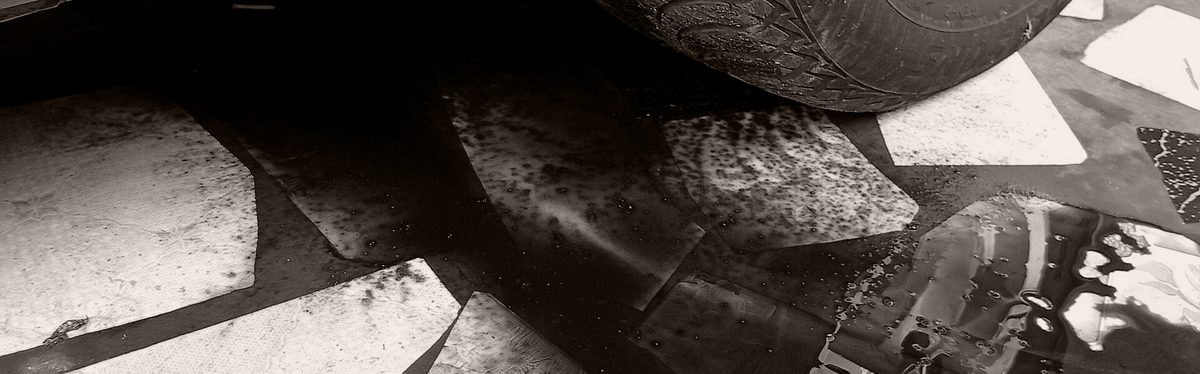
Park on level ground, slide a flattened cardboard box underneath, and leave it overnight. Cardboard beats concrete because it holds the color instead of soaking it gray.
Before the colors: if it smells like a gas station, stop here. Gasoline is clear to pale yellow and thin, close enough to two of the entries below to be mistaken for them, and it evaporates instead of pooling, so the smell, not the stain, is what identifies it.
A fuel leak isn't a cost question. Don't start the engine, don't leave the car in an attached garage, and have it towed.
Only brake fluid is as urgent; every other fluid on this page can wait for an appointment, and this one can't.
Then read what the cardboard caught, because the color, the feel and the spot tell you what fluid is leaking from your car:
- Amber to black, thick, clings to your fingers. Engine oil. Lands under the middle of the engine.
- Red or pink, thin, faintly sweet. Transmission fluid if it lands under the center of the car; power steering fluid if it's well forward in the engine bay. Both are red on many cars, and mixing them up is the single most common misdiagnosis here.
- Green, orange, pink or blue, watery, sweet-smelling, slightly sticky when dry. Coolant. Usually at the front, near the radiator.
- Clear to light yellow, or dark brown, thin and slippery. Brake fluid, appearing behind a wheel, inboard of the tire, or along a line under the car. If it has run down paint and dulled it, that's brake fluid; it strips paint, and little else on a car does.
- Clear and odorless, in a puddle at the front on a hot day. Water, from the air conditioning. Not a leak, just normal condensation, and it needs nothing.
Why is water leaking from my car, and is a clear puddle a leak?
Because the air conditioning drains its own condensation, nearly every time, and that costs nothing. Two normal things put clear liquid on the ground, and neither of them is a fault:
- Air conditioning condensation. The evaporator behind the dash pulls water out of the cabin air and drains it through a tube onto the road, under the middle or the passenger side of the front. It's heaviest on a humid day with the air conditioning working hard, and a car that never drips in summer is the odder one.
- Water from the exhaust. Burning gasoline produces carbon dioxide and water, which is the reaction the converter finishes. A cold pipe condenses that water and drips it out of the tailpipe, and it stops once the exhaust is hot.
What separates condensation from a real leak is the feel and the smell, not the color. Condensation is clear, odorless, and dries to nothing.
Coolant is dyed, smells sweet and dries slightly sticky; washer fluid smells of alcohol. If the puddle leaves anything on your fingers, it came out of a system rather than out of the air.
What is the car fluid leak repair cost, fluid by fluid?
Here's the car fluid leak repair cost for each of five fluids, priced as a shop bills the whole job:
- Engine oil: $155 to $1,000. The widest range of any fluid, and the range is entirely about location. A valve cover gasket at the top of the engine is $155 to $649 because the cover lifts straight off. An oil pan gasket underneath is $400 to $500 if the pan drops clear, and $1,000 or more if the subframe has to come down or the engine has to be lifted to get it out. Same oil, same kind of seal, more than six times the bill.
- Transmission fluid: $50 to $1,200. Same structure again: a drain plug is $50 to $250, a cooler line $100 to $600, and a pan gasket $150 to $750. A front pump seal sits behind the torque converter, which means the transmission comes out of the car, and that's $500 to $1,200 with the part.
- Coolant: $496 to $1,902. A radiator hose is $496 to $555, a thermostat $610 to $708, a water pump $888 to $1,139, a radiator $1,353 to $1,528, and a $1,370 to $1,902, though its parts cost less than a radiator's. Our breakdown of coolant leak repair cost prices each leak point on its own and shows how much of each bill is labor.
- Brake fluid: $310 to $607 for a pair. Both front calipers are $310 to $607 and a master cylinder $415 to $586, both built from counter parts and published labor estimates. A hose is quoted lower, though that figure we couldn't trace to a source we were able to read. Salt-belt cars needing the full run of lines replaced pass $1,000, but this is the tightest range of the five, and also the only one where the cost isn't the first question.
- Power steering: $100 to $2,500. A hose is $100 to $800 depending on which line it is and the car, and a replacement pump $400 to $950. This is the one fluid on the page we don't have a costed article behind, so we built it from cost publishers rather than from our own sourcing, and it's the range we would question first.
A replacement rack and pinion runs $700 to $2,500, past $2,400 on some cars. One Toyota forum thread on this subject is titled, accurately, "Power steering leak - $2,000 or $5?"
What it costs
What this box shows
Prices for this repair, drawn from the sources named at the foot of the box. Each figure states whether it covers the part alone or parts and labor.
Repair cost for a car fluid leak
By fluid, parts and labor. Five separate repairs, no total: one leak at a time.
| Engine oilValve cover gasket lifts off; oil pan gasket can mean subframe down, six times the bill | $155 – $1,000Parts and labor, estimated |
|---|---|
| Transmission fluidDrain plug or cooler line: cheap. Front pump seal: transmission out | $50 – $1,200Parts and labor, estimated |
| CoolantHose low, heater core high, though its parts cost less than a radiator's | $496 – $1,902Parts and labor, estimated |
| Brake fluidBoth front calipers, or a master cylinder. Tightest range; cost comes second | $310 – $607Parts and labor, estimated |
| Power steeringHose to rack, the most expensive on this page | $100 – $2,500Parts and labor, estimated |
Each figure comes from the article that works it through, and each of those names its own sources. What moves every one of these ranges isn't the part, it's how far into the car the seal sits.
What the data says
Two fluids are most of the record. Of 26,420 complaints filed with NHTSA for model years 2010 to 2025 whose own text names both a leak and a fluid, engine oil appears in 47.8% and coolant in 38.6%.
The other four the color charts give equal billing to are a long way behind: fuel 11.6%, brake fluid 5.6%, transmission fluid 3.3%, power steering fluid 1.3%. The shares add past 100 because 2,093 filings name more than one fluid, which is its own useful fact: a leak that soaks the underside doesn't always come from one place.
NHTSA consumer complaints, FLAT_CMPL bulk file dated August 25, 2026, scanned September 16, 2026. Counted as complaints whose text names a leak and that fluid, not as verified diagnoses, and complaints count the people who reported rather than a failure rate.
Worth knowing
Notice what the five ranges have in common. In every case the cheapest repair is a hose, a plug or a gasket that sits out in the open, and the most expensive sits behind or inside something that has to come off to reach it.
On most of these the gasket or seal itself is cheap. You aren't paying for the part that failed, you're paying for the hours of dismantling that stand between a technician and it.
Why is the same leak cheap on one car and expensive on another?
Because the part is rarely the bill; the access is. Once you see that, every quote you ever get for a leak becomes readable.
A transmission pan gasket can be fixed for $150, while a front pump seal runs to $1,200, because the transmission has to come out to reach it.
A valve cover gasket and an oil pan gasket are both cheap rubber and differ by more than six times. Nothing about the failed component explains that gap.
What explains it is whether the technician works from a lift for two hours or spends a day taking the car apart.
This gives you one question that is worth more than any price comparison, and you can ask it on the phone before you commit to anything:
"What has to come off to reach it, and how many hours is that?"
A shop that answers that clearly is telling you how they built the number. An estimate showing hours and a rate lets you divide one by the other and see the job.
Two shops quoting the same hours at $110 and $160 an hour aren't disagreeing about the repair, they're charging different rates, and on a long job that difference is worth hundreds of dollars on its own. Our guide to reading a repair estimate covers what else should be itemized on it.
What owners report
The identification question isn't settled for the person holding the quote. Three posts from the last month, each one a quote already in hand:
A Mazda CX-5 owner, quoted $2,000 for a front seal, asking the group: is this transmission fluid or engine oil? A 2020 Civic owner, quoted $2,500 for a rear main seal: They didn't clean off the oil or test to see. A Ford Fusion owner, quoted $2,000 for oil leaks: I've never noticed oil dripping on my garage floor.
All three are being asked to authorize four figures on a diagnosis they can't check. That's what the question further down this page is for, and none of them is an unreasonable customer.
Mazda CX-5 Owners, Honda Civic Problems & Solutions and Ford Fusion Owners groups, posts from August and September 2026. Read September 16, 2026. Quotes received, not repairs verified.
Which fluid leaks can wait?
They're genuinely different from each other, and treating them the same is how people either waste money or destroy something. How long a car fluid leak can wait depends on the fluid, and here's each of the five:
- Brake fluid: no. The only one on this list with no safe waiting period: hydraulic systems hold pressure until they don't, and there's no gradual version of that failure to warn you. If the pedal sinks under steady pressure, or fluid is reaching the ground, the car gets towed rather than driven.
- Coolant: days, not weeks. You have a temperature gauge, which is a real warning system and one of the three dashboard warning lights that mean stop rather than book it, but overheating warps heads and destroys head gaskets, and those are four-figure repairs. Top it off, watch the gauge, and get it seen quickly, and never open a hot cooling system.
- Transmission fluid: watch the level. A seep that doesn't move the dipstick over a week isn't urgent. Fluid you can watch leaving is, because low fluid means slipping clutches and slipping clutches destroy themselves, and shuddering or hesitation on engagement means stop.
- Engine oil: usually weeks or months. The most forgiving of the five, provided you check the level and nothing is dripping onto hot exhaust or onto rubber bushings and mounts. Plenty of high-mileage cars are run out this way deliberately.
- Power steering: uncomfortable, rarely dangerous. Losing assistance makes the car heavy but still steerable, and running the pump dry will ruin it, which turns a hose job into a pump at $400 to $950. Top it off and get the hose done.
| Fluid | Cheapest cause | Most expensive | Can it wait? |
|---|---|---|---|
| Brake fluid | Calipers, $310 | Full line run, over $1,000 | No. Tow it |
| Coolant | Hose, $496 | Heater core, $1,902 | Days |
| Transmission | Drain plug, $50 | Front pump seal, $1,200 | Watch the level |
| Engine oil | Valve cover, $155 | Oil pan, $1,000 | Weeks to months |
| Power steering | Hose, $100 | Rack, $2,500 | Top off, fix soon |
What should you do about the puddle?
Cardboard under the car overnight, and identify the fluid by color, texture and where it lands. If it is red, check the power steering reservoir before you assume transmission; that mix-up sends people to the wrong shop.
Check the level of whatever it is. The rate of loss matters more than the fact of a leak: a stain that has been there for a year and a level that hasn't moved is a different problem from a puddle that grows daily.

A brake fluid reservoir, level visible
Then, when you call a shop, ask what has to come off and how many hours it takes before you ask what it costs. That question puts you on the right half of every range on this page, and it's the one thing that turns a number you can't judge into one you can.
And if it's brake fluid, skip all of that and arrange a tow.
Conclusion
The color names the fluid. The access names the price
The color names the fluid, and the access names the price: every fluid has a cheap leak and an expensive one. Here's what to do about a car fluid leak, from the prices on this page:
- Brake fluid means a tow.It's the only leak here with no safe waiting period, because brake hydraulics hold pressure until they suddenly don't. If the pedal sinks under steady pressure or fluid reaches the ground, tow the car.
- Cardboard overnight.Park on level ground and slide a flattened cardboard box underneath overnight. It holds the color instead of soaking it gray, and shows where under the car the leak lands.
- A clear puddle is usually water.Clear, odorless water near the front on a hot day is the air conditioning draining condensation. It dries to nothing and needs no repair.
- Red? Check the power steering first.Both transmission and power steering fluid are red on many cars, and mixing them up is the most common misdiagnosis. Under the middle of the car it's usually transmission; well forward in the engine bay, power steering.
- Ask what has to come off.Ask what has to come off to reach the leak and how many hours that's booked at, before you ask the price. A transmission drain plug starts at $50, while a front pump seal behind the torque converter is $500 to $1,200.
So name the fluid, then ask about the access before the price. Oil & Miles prices a repair by what has to come apart, across repair costs.
Common questions
Asked most often
My car is leaking red fluid. Transmission or power steering?
Check both reservoirs; that settles it in a minute. As a rule of thumb, power steering fluid appears well forward in the engine bay, transmission fluid under the middle of the car. What its color does and doesn't tell you is a separate question.
There's a clear puddle under my car in summer. Should I worry?
Almost certainly not. Air conditioning produces condensation and drains it onto the ground, which is normal and by design. If it is clear, odorless and appears after running the AC, leave it alone.
Do stop-leak products work?
Sometimes, on one specific failure: a rubber seal that has hardened and shrunk with age, which the additive swells. They do nothing for a cracked pan, a corroded line, a warped flange or a failed silicone bead. Treat them as a way of buying time, not a repair.
Why did my leak start right after a service?
Fresh fluid contains detergents that clean deposits off aged seals, and those deposits were partly plugging the gap. The leak was already there; the service stopped hiding it rather than causing it.
Is it cheaper to fix several leaks at once?
Often yes, if they share access. Two leaks reached through the same dismantling are much cheaper together than separately. Ask the shop directly whether anything else is worth doing while they're already in there.
What is dripping from my car?
Put cardboard under it overnight and read the color, the texture and where it lands. Clear and odorless under the passenger side on a hot day is almost always air conditioning condensate. Anything with a color is a fluid, and red is the one to be careful with: transmission and power steering fluid are both red.
What people ask next
Sources
- RepairPal estimator national averages, archived July 7, 2026 and last updated June 18, for the coolant figures, the same figures used in our dedicated coolant article. RepairPal, archived June 2026
- "Power steering leak - $2,000 or $5?", an owner thread on Toyota Nation, quoted for its title. Toyota Nation forum
- Our own costed articles, for the engine oil, transmission and brake figures. Oil & Miles
- Component-level cost guides published in August 2026, for the power steering figures. Several cost publishers
- NHTSA consumer complaints, FLAT_CMPL bulk file dated August 25, 2026, for every model year 2010 to 2025 complaint whose text names both a leak and a fluid, 26,420 of them. NHTSA, scanned September 16, 2026
- Owner quotes posted publicly, Mazda CX-5 Owners, Honda Civic Problems & Solutions and Ford Fusion Owners, August and September 2026, for the three quotes. Owner groups, read September 16, 2026
How this was compiled
The complaint shares are counts of filings whose own text names a leak and that fluid. They aren't verified diagnoses, and the shares add past 100 because some filings name more than one fluid.
Every range on this page comes from publishers and shops that itemize by cause rather than giving a single average. Where two publishers disagree, we quote the one that can be checked.
Our own costed articles each name their own sources for the numbers they work through. The power steering figures come from six published cost guides, RepairPal, AutoNation and Jiffy Lube among them, read September 26, 2026, and they're the weakest source on this page. The owner quotes are quotes received, not repairs verified.
What we didn't do
We didn't compute any figure on this page ourselves: each comes from the costed article behind it, and only the brake figures there are recomputed from counter prices and published labor estimates. We didn't test any stop-leak product either.
We didn't price fuel after naming it at the top of the page. It's a safety instruction, not a repair to price, and putting a dollar range beside it would invite somebody to weigh the cost against towing the car.
We didn't give a per-model table for any of the five fluids. The variation between cars is the point of the article, and a table pretending to average it away would undo the argument.
Prices are ranges compiled in September 2026 for the US market and vary by region, vehicle and shop rate. Prices from $10 up are rounded to the nearest dollar, so $14.13 reads as $14 and $14.52 as $15. Below $10 they're exact. This article is general information, not advice about your specific vehicle. See the disclaimer.
Heater core
A small radiator inside the dashboard that heats the cabin.
Caliper
The clamp that presses the pads against the disc, driven by hydraulic pressure from the pedal.