
Short answer
An oil pan gasket job costs $400 to $1,000
Oil pan gasket replacement cost is $400 to $1,000, and the gasket itself is under $40 on every car we priced, so nearly all of it is labor. On some engines the subframe, a steel frame beneath the engine, has to be lowered first, or the engine lifted off its mounts. That's what can push a bill past $1,000.
The published figures for oil pan gasket replacement cost can't all be true, and they run from a few hundred dollars to four figures:
- Kelley Blue Book puts the job at $933 to $1,037.
- Two others put the same job at $400 to $500, with parts at $120 to $130, which is the gasket plus the oil and filter that go back in rather than the gasket alone, and labor making up the rest.
- On BimmerFest, an owner posted a dealer quote of $3,845 and asked the forum whether they were being robbed. We couldn't verify that invoice, so it sits on this page as an example of what gets quoted rather than as evidence of what the job costs.
Every one of those figures is real. They aren't contradicting each other about the price of a gasket.
They're describing completely different amounts of work, all filed under the same three words.
Which of those you've been quoted is what decides whether the number in front of you is fair. If the quote in your hand covers more than the pan, reading it column by column shows what you're paying for.
Ford publishes its own hours for this job, and five of its bulletins are read at the foot of this page.
What does your oil pan quote look like?
Why some pans cost more: the subframe and the mounts in the way.
How much does an oil pan gasket replacement cost?
$400 to $1,000 on most cars, and under $40 of that is the gasket.
Start with the part, because it clarifies everything else. An oil pan gasket is a shaped seal: cork, rubber, or in most modern engines a bead of silicone sealant applied as a liquid, which is why a shop may call the job a reseal rather than a gasket replacement.
The word changes, the bill doesn't: what you're paying for is the hours either way.
Parts pricing published alongside these jobs runs $120 to $130 at the retail end, and that figure usually includes the oil and filter that have to go back in, not just the gasket. The gasket alone is frequently under $40.
So on the $400 job, roughly 70% of what you pay is labor. At the top of the published range it is closer to 88%.
The part is a rounding error and arguing about it is wasted effort: the hours are the entire negotiation.
What it costs
What this box shows
Prices for this repair, drawn from the sources named at the foot of the box. Each figure states whether it covers the part alone or parts and labor.
Parts and repair cost for an oil pan leak
No total: one repair measured five ways, plus one owner's quote.
| GasketPrice moves with the car; every brand listed.2017 Honda Accord 2.4L · $4.10, 2015 Ford F-150 5.0L V8 · $8.92 to $35, 2013 BMW 328i 3.0L L6 · $9.47 to $36, | $4.10 – $36Part only, at the counter |
|---|---|
| Two-piece panSome engines have two pans, two gaskets; one of sixteen checked lists them apart.2017 Ford F-250 6.7L diesel · lower $12 to $22, upper $25 | $37 – $47Both parts, at the counter |
| Pan itselfWarped flange or cracked pan. SKP or Dorman up to Spectra Premium, or Rein on the BMW.2017 Honda Accord 2.4L · $62 to $127, 3 brands2015 Ford F-150 5.0L V8 · $55 to $107, 4 brands2013 BMW 328i 3.0L L6 · $128 to $374, 6 brands. The xDrive pan is a different part at $826 | $55 – $374Part only, at the counter |
| Pan drops straight downTwo to three hours, nothing structural in the way; two estimators price it so | $400 – $500Parts and labor, estimated |
| Published averagePriciest of five estimators; another says $380 to $830. | $933 – $1,037Parts and labor, estimated |
| One dealer quoteOne owner's BimmerFest invoice, over three times the priciest estimator's top | $3,845Parts and labor, one quote |
Gasket and pan prices are every brand RockAuto lists for those three cars, gaskets read September 3 and pans September 5, 2026. Job figures from Kelley Blue Book, RepairPal, ServiceBuddy, Jerry and TheCostGuys, with Athena and CarBrain for the straightforward job, read August 31 and September 1, 2026.
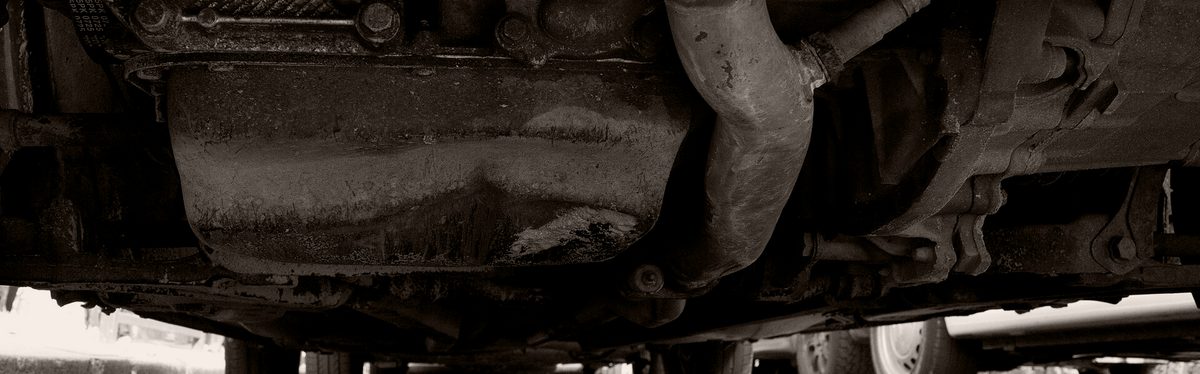
What buys those hours is access. The oil pan is the tray bolted to the bottom of the engine, holding the oil.
To replace its gasket, the pan has to come off, and whether that is straightforward depends entirely on what is in the way.
Why is the pan trapped on some engines?
Because on some engines the pan isn't the lowest thing under the car, and whatever is in the way has to come off first. On a well-packaged engine the pan is exposed.
Drain the oil, undo the bolts around the perimeter, drop the pan straight down, clean both surfaces, fit the new gasket, torque it back up. This is the $400 to $500 end.
Ford's own bulletins show the other kind. On its EcoBoost engines Ford books 2.5 to 4.1 hours for the pan, and the crossovers and sedans lower the subframe while the F-150 undoes the engine mounts and the front axle.

The crossmember the pan has to clear
On a great many cars, the pan can't come straight down, because something structural is underneath it. Three things usually trap the oil pan, and each one has to move before the pan clears:
- The subframe. The crossmember that carries the suspension and steering runs directly beneath the pan on many transverse-engine cars, and it has to be unbolted and lowered before the pan clears. That adds hours, and it often adds an alignment afterwards because suspension geometry has been disturbed.
- The engine itself. On some layouts there's no clearance at all, and the engine has to be lifted on a hoist, supported from above with the mounts undone and raised a few inches, to create the room. This is where four-figure quotes come from, and they aren't padding.
- An axle or crossmember passing through. On all-wheel-drive and some longitudinal layouts, a driveshaft or structural brace runs through the space the pan needs to move into, and it comes out first.
| What is under the pan | What it adds | What happens |
|---|---|---|
| Nothing. The pan drops straight down | 2 to 3 hours | Drain, unbolt, drop, clean, seal, torque. The straightforward job |
| The subframe runs underneath | Hours added | Unbolted and lowered first, and often an alignment afterwards |
| No clearance at all | Engine lifted | Supported from above, mounts undone, raised. Four-figure territory |
| An axle or brace passes through | It comes out first | Common on all-wheel drive and longitudinal layouts |
One more case sits outside that list, and it's about how many pans there are rather than what sits under them. A two-piece pan has an upper section bolted to the block and a lower one bolted to that, each with its own gasket.
It's rarer than its reputation suggests. We looked up sixteen engines in a parts catalog and only Ford's 6.7 Power Stroke listed the two as separate parts.
The Cummins 6.7, the Duramax 6.6, the earlier Power Strokes and a VW TDI all took one.
If a quote names an upper pan, it isn't the job the published figures describe.
None of this is exotic and none of it is the shop being awkward. It's packaging: engine bays got tighter as cars got safer and more efficient, and the oil pan lost the empty space underneath it.
Worth knowing
There's a second cost that appears on some cars. Many modern engines use cast aluminum pans rather than pressed steel, and an aluminum pan can warp at the sealing flange or crack.
A warped flange will still leak with a new gasket fitted, so a shop saying the pan needs replacing is naming a real failure mode rather than an upsell. Ask them to show you the flange.
How do you tell which job you have, before the quote?
You can narrow this down without a lift, and it's worth ten minutes.
The gasket is under $40 whichever job it turns out to be, and everything else is access. Five things tell you which oil pan gasket job you have before the quote arrives:
- Look up the labor time for your specific car. Not "oil pan gasket" in general: your engine, in your model year. Enthusiast forums for your make are the fastest route, because somebody has had this exact job done and posted the invoice.
- Search your model plus "oil pan gasket" and read what owners paid. This is the single most useful thing you can do, and it takes minutes.
- Ask the shop the direct question. "Does the subframe have to come down, or the engine have to be lifted?" A service advisor will answer that plainly, and the answer sorts you into one half of the price range before any money is discussed.
- Learn what the hours mean before you hear them. Ford books 2.5 to 4.1 hours for the pan on the engines it publishes times for. A quote at eight or ten hours is describing more than the pan, and what else is coming off is the question to ask. Then the number arrives and you already know which job you've been quoted, and if the hours are high and nobody has mentioned a subframe or a hoist, that's the question to ask.
- Ask whether the pan itself is being replaced. Aluminum warps, and a new gasket on a distorted flange leaks again.

The face the gasket has to seal
A high quote isn't automatically wrong. Four hours at $110 and at $170 an hour differ by $240, on identical work.
Is your quote reasonable?
Under $600, almost always yes. Over $2,000, almost never without a reason the shop can name.
| Quote | What it should mean | What to ask |
|---|---|---|
| Under $600 | Pan drops straight down, 2 to 3 hours | Nothing. This is the good outcome, and it covers every straightforward estimate we read |
| $600 – $1,100 | Awkward access, or a dealer rate | How many hours, and at what rate? |
| $1,100 – $2,000 | Subframe down, or the pan replaced too | Which is it, and is an alignment included? |
| Over $2,000 | Engine lifted, or a luxury or all-wheel-drive layout | Get a second quote from an independent |
A quote in the top band isn't automatically wrong. The BimmerFest owner may well have been quoted correctly for his car at dealer rates.
What makes a quote worth a second opinion isn't the size of the number. An independent shop charging $120 an hour instead of $160 prices the same hours very differently, and the parts are the same either way.
Should you fix it at all?
Not always, and that's what separates an oil pan gasket from a brake fluid leak, where the answer is always yes.
An oil pan gasket weep is usually slow. If the level drops less than a quart between oil changes, and there's nothing dripping onto the exhaust, topping it off is a defensible strategy, particularly on a car worth a few thousand dollars facing a $2,000 quote.
Plenty of high-mileage cars run out their lives that way.
The lines where that stops being sensible: oil dripping onto a hot exhaust component is a fire risk and a burning smell, and it ends the debate. Oil landing on rubber suspension bushings or engine mounts degrades them, turning one bill into three.
And a leak fast enough that you might run the engine low stops being a leak and becomes a countdown, because low oil is how an engine dies.
If you're weighing it up, the comparison that decides it is the quote against what the car is worth and how long you plan to keep it, not gasket versus nothing. That's the same arithmetic our guide to what maintenance costs after 100,000 miles works through.
| What the leak is doing | The call | Why |
|---|---|---|
| Under a quart between oil changes, nothing dripping hot | Live with it | Defensible on a car worth less than the quote |
| Oil reaching the exhaust | Fix it | A burning smell and a genuine fire risk. That ends the debate |
| Oil on suspension bushings or engine mounts | Fix it | Rubber soaked in oil fails early, and one bill becomes three |
| Fast enough to run the engine low | Fix it now | Not a leak any more. Low oil is how an engine dies |
What should you do about an oil pan gasket leak?
The first three cost nothing, and the fourth is the one that saves money. To judge the quote for an oil pan gasket leak, work through the 4 steps below, in order:
- Confirm it is engine oil, and that it comes from the bottom. Amber to black, heavier and clingier than transmission fluid, landing under the middle of the engine rather than behind a wheel. A valve cover gasket leaks the same oil from the top and runs down to drip in a similar place, so check whether the top of the engine is wet before you accept a pan diagnosis.
- Ask for the labor hours, not the total. Then ask the question that decides them: does the subframe come down, or does the engine lift? A shop that can't answer that hasn't looked yet.
- Look up what owners of your exact model paid. The same repair is a three-hour job on one engine and a much longer one on another, so a national average tells you less here than on almost any other repair.
- Get a second quote if you land in the top band. Not because the first shop is wrong, but because on a long job the hourly rate alone is worth several hundred dollars.
Together those tell you whether the number in front of you is the $500 version of this job or the $2,500 version, and whether the shop quoting it has understood which one your car needs.
From the documents
What does a manufacturer book for this job?
Five of Ford's own bulletins were opened for this page rather than the coverage of them. All five publish a parts list and a booked time, and 19-2332 is the one raised here:
Ford Motor Company, 19-2332
Inspect And Replace The Engine Oil Pan, booked at 3.2 to 3.5 hours in this bulletin and 2.5 to 4.1 hours across all five. Parts, alongside the pan, filter and oil pump gasket: Subframe Bolts (Package Contains 4 Pieces, 4 Pieces Required).
Ford's own booking for the oil pan job settles two things:
- The parts list calls for new subframe bolts. That is the access argument on this page, stated by the company that built the car rather than by anyone estimating what it charges.
- Every time Ford books for the pan itself lands between 2.5 and 4.1 hours. Those are engines fitted across a pickup, three crossovers and three sedans, and none of them is a straight drop.
What we couldn't find is a manufacturer's time for the worst case, an engine lifted out of the way on a hoist. Ford books its subframe and engine-mount jobs at 2.5 to 4.1 hours, plus up to 1.3 hours to check the wheel alignment afterwards, so the four-figure ranges on this page come from estimators rather than from Ford's hours.
So the hours quoted on this page are Ford's, and they cover Ford's engines only.
Conclusion
You aren't being quoted for a gasket
You aren't being quoted for a gasket: it's under $40, and the bill is the work of reaching it. Here's how to judge an oil pan gasket quote, from Ford's own hours and the prices we read:
- The gasket is under $40.On every car we priced, the gasket costs less than $40. On a $400 job roughly 70% of the bill is labor, and at the top of the range closer to 88%.
- Two jobs, one name.On some cars the pan drops straight down. On others the subframe has to be lowered or the engine lifted off its mounts first; Ford books those at 2.5 to 4.1 hours on its EcoBoost engines.
- Ask before the lift.Ask the shop directly: does the subframe have to come down, or the engine be lifted? A service advisor can answer over the phone, and the answer puts you in one half of the price range.
- Read the quote by band.Under $600 is almost always fair for this job. Over $2,000 is almost never fair without a reason the shop can name.
- A slow weep can wait.If the level drops less than a quart between oil changes and nothing drips on the exhaust, topping it off is defensible, especially on an older car. Oil on the hot exhaust is a fire risk, and oil on rubber mounts ruins them, so either one means fix it.
So ask which pan your car has before anyone quotes the job. Oil & Miles prices a repair by what decides the bill rather than by what averages well, across repair costs and symptoms.
Common questions
Asked most often
Can I drive with a leaking oil pan gasket?
Usually yes, if the loss is slow and nothing is dripping onto the exhaust. Check the level weekly rather than waiting for a warning light. Oil onto hot exhaust or onto suspension bushings changes the answer.
Will stop-leak fix an oil pan gasket?
Seal conditioners can slow a weep from a hardened rubber gasket by swelling it. They do nothing for a silicone bead that has failed mechanically, a warped flange, or a cracked pan. There's no rubber there to act on.
Why is the dealer quote three times the independent's?
Usually labor rate rather than a different job. Independents commonly charge $120 to $159 an hour and dealers more, and on a job measured in many hours that gap compounds. Confirm both quotes describe the same work first.
Is it worth replacing the pan while it's off?
Only if the pan is damaged: warped at the flange, cracked, or badly corroded. The labor is already paid for at that point, so replacing a genuinely bad pan then costs only the part, which ran $55 to $374 across the three cars we censused. Replacing a sound one isn't worth it.
What are the symptoms of a leaking oil pan gasket?
A puddle under the middle of the car, not behind a wheel, amber to black and heavier than transmission fluid, and the level dropping between changes. The catch is that a valve cover gasket leaks the same oil from above and drips in a similar place, so check the top of the engine is dry before accepting a pan diagnosis.
Is an oil gasket the same as an oil pan gasket?
Usually. "Oil gasket" is what many people call it, and on a car leaking from underneath it almost always means the oil pan gasket. The two it gets confused with are the valve cover gasket, on top of the engine and cheaper, and the rear main seal, between engine and transmission and far more expensive.
What people ask next
Sources
- RockAuto catalog, every brand it lists as fitting a 2017 Honda Accord 2.4L, a 2015 Ford F-150 5.0L V8 and a 2013 BMW 328i 3.0L L6, for both counter censuses. RockAuto, gaskets read September 3, pans September 5, 2026
- Kelley Blue Book and RepairPal's estimator, for the $933–$1,037 range, which is Kelley Blue Book's. KBB and RepairPal, read August 31 and September 1, 2026
- Athena and CarBrain, for the $400–$500 range and the parts and labor split. Athena and CarBrain, read August 31 and September 1, 2026
- ServiceBuddy, Jerry and TheCostGuys, the other three of the five estimators read for the job figures, for the $380–$830 range the cost box quotes and a spread up to $1,600 or more. ServiceBuddy, Jerry and TheCostGuys, read August 31 and September 1, 2026
- Ford Technical Service Bulletin 19-2332, for the parts list and the booked labor time on the 2.7L and 3.0L EcoBoost oil pan. Ford Motor Company, filed with NHTSA, read September 7, 2026
- A BimmerFest forum thread, for the $3,845 dealer quote. BimmerFest
- Parts-supplier and gasket-manufacturer technical material, for the access requirements: subframe removal, engine lifting and aluminum pan warping as standard reasons for extended labor on this job. Parts-supplier and manufacturer technical pages
How this was compiled
The published cost figures are quoted directly from the sources that gave them rather than blended into one range, because the gap between them is what this article is about.
The BMW xDrive uses a different pan and is left out of the census. Athena and CarBrain were cross-checked against each other; they and the parts-supplier technical pages, none of which are named here, are the weakest sources on this page.
What we didn't do
We didn't compute any of these figures from book labor times. Ford's own hours are quoted above and cover Ford engines only; Mitchell and Alldata times, which would cover the rest, aren't public. Every number here is a market range rather than a calculated cost.
We haven't verified the BimmerFest quote independently. It's cited as an example of what gets quoted, not as evidence of what the job should cost.
We don't give a per-model labor table, because we can't source one accurate across the range of engines this applies to. Looking up your specific model, as described above, is the reliable route.
Prices are ranges compiled in September 2026 for the US market and vary by region, vehicle and shop rate. Prices from $10 up are rounded to the nearest dollar, so $14.13 reads as $14 and $14.52 as $15. Below $10 they're exact. This article is general information, not advice about your specific vehicle. See the disclaimer.
Service bulletin
A written instruction a manufacturer sends its own dealers, naming a fault, the repair and who pays for it.
Oil pan gasket
2017 Honda Accord 2.4L L4
| Brand | Part | Price |
|---|---|---|
| Victor Reinz | 703141410 | $4.10 |
Oil pan gasket
2015 Ford F-150 5.0L V8
| Brand | Part | Price |
|---|---|---|
| SKP | SKOS30850R | $8.92 |
| Apex | AOP1320 | $13 |
| Elring | 851210 | $13 |
| 167390 | $35 | |
| Fel-Pro | OS30850R | $18 |
| Mahle / Clevite | OS32461 | $32 |
Oil pan gasket
2013 BMW 328i 3.0L L6
| Brand | Part | Price |
|---|---|---|
| URO Parts | 11137627512Sedan, 328i base model | $9.47 |
| 11137548031Convertible or coupe | $20 | |
| Apex | AOP944 | $24 |
| Victor Reinz | 713866900 | $26 |
| Mahle / Clevite | OS32357 | $30 |
| Fel-Pro | OS30869R | $33 |
| OS30925 | $36 |