
Short answer
The water evaporates; the antifreeze stays.
The water in coolant evaporates, but the ethylene glycol in antifreeze barely does: at room temperature, water's vapor pressure is roughly 300 times glycol's. In a car's sealed system neither should leave, so coolant that keeps going down is leaking, and the pressure cap, $12 or less on the three cars we priced, is the first part to check.
Does coolant evaporate, or does it only look that way when the tank keeps reading low and the driveway stays suspiciously dry? The water in it evaporates and the antifreeze barely does, but in a healthy engine neither gets the chance, because the system is sealed.
So a level that keeps dropping is a leak, even with no puddle. The GM, Ford and Honda manuals we read all treat it that way, and not one of the four owner's manuals we checked lists a warning for a low level.
That makes the tank your early warning, well before the temperature gauge. Below is what evaporates and what doesn't, where coolant goes with no puddle, when to stop driving, and what the first parts cost.
How is your coolant level going down?
A puddle under the car is an outside leak, and our coolant leak guide finds it. A spill on the ground? See spilled antifreeze.
Does coolant evaporate, or just the water in it?
Just the water, almost entirely. Coolant is antifreeze mixed with water, half and half in the premixed jugs, and the antifreeze is ethylene glycol, which boils at 388°F against water's 212°F.
So antifreeze barely evaporates, and coolant loses only its water. Vapor pressure measures how hard a liquid pushes to escape into the air, and the gap is wide:
Leave a jug of 50/50 coolant open and you lose none of its antifreeze. The jug loses water, which pushes to evaporate about three quarters as hard as plain water, and what's left gets stronger.
The glycol also pulls water back out of the air. That's why a glycol puddle stays wet and sticky long after water would have gone.
Can coolant evaporate from a sealed cooling system?
Not in any amount you'd notice, because the system is closed and runs under pressure behind a cap. Ford and GM both rate a 50/50 mix to boil at 265°F, and Ford adds the condition that decides it: with the vehicle's specified pressure cap in good condition.
Where that cap sits tells you which part of the system is under pressure. The manuals we read show three layouts:
| Layout | Pressure cap | The plastic tank |
|---|---|---|
| Honda CR-V, Accord | On the radiator | A separate reserve tank that takes what the radiator pushes out when hot |
| GM Silverado, Ford Escape | On the tank | A surge tank or degas bottle that is part of the pressurized system |
| Toyota Avalon | Caps on both | A reservoir Toyota warns may be under pressure when hot, like the radiator |
On the Honda layout the reserve tank has no pressure cap, so a little of its water may evaporate over the months. No manual we read says so or gives a rate, and Toyota tells owners not to open either cap while the engine is hot, because the system may be under pressure.
What the manuals agree on is the answer to a falling level: GM, Ford and Honda all write a low coolant level down as a leak.
Low level, in the manuals 3 makers
- GM, 2024 Chevrolet Silverado 1500Below the mark, "there may be a leak in the cooling system."
- Ford, 2020 Mustang owner's manual supplementAdding more than a quart a month means have the dealer check it, Ford's manual says, because the system could have a leak.
- Honda, 2024 CR-V and 2025 AccordBelow MIN, fill it to MAX and inspect the cooling system for leaks.
Does the coolant level drop when the engine is hot?
No, it rises: coolant expands as it heats, which makes a hot tank look healthier than it is. Ford's manual says a hot level can sit past the MAX mark and fall back as the engine cools.
A tank that's high after a drive and back at the line next morning is working. That's why Honda says to check it with the engine cool, and GM reads its fill level cold.
To check the coolant level cold, follow the 5 steps below, so each reading compares with the last one:
- Park on level ground. GM makes it the first line of its check.
- Wait until the engine is cold. Honda says the engine and radiator should be cool, and GM says to wait if the coolant in the tank is boiling.
- Leave the cap on while it's hot. GM's manual warns that steam and scalding liquid in the system are under pressure; wait until the system and the cap have cooled.
- Read it against the marks on the tank. On a Honda, look at the reserve tank first, and if it's completely empty, check the radiator too.
- Write it down. Note the date and how much you add. Honda recommends a look every time you fill up with fuel, which catches a slow loss before the gauge does.
How much coolant loss is normal?
None over time: a healthy cooling system doesn't use coolant the way an engine can use oil. The only number a manual gives is Ford's, where more than 1 quart a month means have the system checked.
The one drop carmakers document without a leak comes after a fill. Air trapped in the system works its way out, the level falls to take its place, and it can take a few top-offs to settle.
Some advice online calls a little evaporation normal and suggests parking in the shade. It gives no source and no rate, and none of the manuals we read agrees.
A level that settles after a coolant change or a repair fits the documents. One that keeps falling doesn't.
Air after a fill 3 documents
- GM, 2011 to 2014 Chevrolet Cruze 1.4LCustomer satisfaction program 14417A, a free fix outside a recall, for a low level with no external leak, from air trapped at the factory fill. Dealers inspected and filled it.
- Audi, 2015 A3Bulletin 19 15 56: the level can drop a few times as the air escapes, even past 15,000 miles. If no leak is found, top it off; no repair is necessary.
- Ford, 2013 EscapeThe manual says to check the level the next few times you drive after coolant has been added.
How do you know if your coolant is low?
Look at the tank, because the car may keep the news to itself. None of the four owner's manuals we read, from GM, Ford and Honda, lists a warning for a low level; each one warns only once the engine is already too hot.
Some cars do have a low-coolant light, and it can be wrong: carmakers' bulletins describe warnings that came on with the level normal. So check the tank before you trust or dismiss the light.
Other signs come later, once the level is well down: a temperature gauge that climbs, a sweet smell, or a heater that blows cool air when you want heat. Carmakers' documents list all three alongside low coolant, and Chrysler says a low level can cut the heater's output.
A hybrid can have a second coolant tank, for its electronics, with a warning of its own. Your owner's manual shows how many tanks your car has and which one a warning means.
Warnings and heat 7 documents
- Land Rover, 2022 to 2025 Range Rover and 2023 to 2025 Range Rover SportBulletin SSM 76361: low coolant warnings with the level in range and no visible leak, from electrical connections at the sensor or its ground.
- Mercedes-Benz, 2025 GLE and GLSBulletin LI20.30-P-078666: a coolant level warning caused by coolant wicking through the level sensor's electrical contacts.
- Chrysler, 2010 Ram, Dakota, Nitro and Liberty 3.7L and 4.7LOwner letter K20: engine operation with a low coolant level could cause engine damage or low cabin heater output.
- GM, 2013 Cruze and Sonic 1.4L turboBulletin PIE0275 lists low coolant, a coolant leak, coolant odor, a heater not working properly and overheating as the complaints that come together.
- Toyota, 2016 to 2019 Prius and 2017 to 2019 Prius PrimeBulletin T-SB-0135-19: low coolant and poor heater performance from coolant leaking at the exhaust heat exchanger.
- Hyundai, 2022 Tucson Hybrid and 2021 to 2022 Santa Fe HybridBulletin 22-HC-002H: a "Refill Inverter Coolant" warning with the blue reservoir for the inverter loop at its normal level; the cause was debris.
- Kia, 2021 to 2022 Sorento HybridBulletin ELE 281 replaces the label on the hybrid motor coolant reservoir cap.
Why is coolant low when there's no leak?
Because there is a leak, just not one that drips where you can see it. Coolant with no puddle leaves as steam, dries on hot metal, soaks into the cabin or goes into the engine, and the cheapest place to start is the pressure cap.
Here are the six ways coolant is lost with no leak in sight, starting with the cheapest:
1. A pressure cap that no longer holds
The cap keeps the system under pressure, and the pressure is what stops the coolant boiling. By our calculation from MEGlobal's constants, a 50/50 mix boils at about 225°F with no pressure on it, against the 265°F the makers rate it at under the cap.
So a cap that stops holding costs you about 40°F of margin. The coolant that boils leaves through the overflow as hot liquid or steam, rather than dripping under the car.

Use this image
Free to republish under CC BY 4.0: credit Oil & Miles and link to this page. The snippet does both.
<a href="https://oilandmiles.com/articles/does-coolant-evaporate"><img src="https://oilandmiles.com/assets/img/diagrams/coolant-three-readings.svg" alt="Schematic of one coolant reservoir three times: cold with the level between MIN and MAX, hot with the level above MAX, and with a failing cap, the level below MIN and steam rising from the cap" width="1040" height="660"></a> <p>Diagram: <a href="https://oilandmiles.com/articles/does-coolant-evaporate">Oil & Miles</a>, CC BY 4.0</p>The rating is stamped on the cap, and a new one with the same number is the cheapest test there is. The box below prices it for three cars.
2. A small leak that dries before it drips
On hot metal, a small leak can dry to a crust before a drop ever reaches the ground. The water pump is one place it starts: the pump has a small weep reservoir and a shaft seal that can seep onto the engine.
A cooling system pressure test finds a seep like this, because it holds the system at pressure until the coolant shows itself. Our coolant leak guide covers where it goes when the ground stays dry.
Water pump seep 1 document
- GM, 2011 to 2014 Chevrolet Cruze 1.4LSpecial Coverage 14371B for the water pump: a seep from its weep reservoir or shaft seal, onto the engine or the ground.
3. The heater core, into the cabin
The heater core is a small radiator behind the dashboard that warms the cabin with engine coolant. When it leaks, the coolant ends up in the car with you instead of under it.
None of the documents we read lists the signs of a leaking heater core, so we won't guess at them. If the tank keeps dropping and nothing shows under the car or the hood, ask the shop to include the heater core when it tests the system.
4. Coolant going into the engine
The head gasket seals the joint between the engine's top half, the cylinder head, and its block, and coolant runs through passages on both sides. When the gasket or a cracked head lets coolant into a cylinder, it burns off as white exhaust smoke, and when it reaches the oil side, it mixes with the oil.
Carmakers' bulletins name low coolant, white smoke, misfires and overheating as the signs. GM also documents a casting flaw in some V8 cylinder heads that loses coolant slowly with no leak found.
Milky oil is the classic warning sign, but Toyota and Mazda bulletins say short trips in freezing weather can make oil milky with no coolant in it at all. Both still tell the technician to test the cooling system first, so milky oil is a reason for a pressure test, not proof of a head gasket.
Check the underside of the oil filler cap for a milky film, and watch for white smoke that doesn't clear once the engine is warm. Either one means stop topping off and have it tested: our guide to white smoke tells what the smoke is, and the head gasket guide covers what comes next.
Coolant inside the engine 6 documents
- Ford, 2014 to 2019 Fusion and 2017 to 2019 Escape 1.5L EcoBoostBulletin 19-2139: low coolant, white exhaust smoke or a check engine light, from coolant intrusion into the cylinder; the fix replaces the short block, the engine's lower half.
- Honda, 2016 to 2017 Civic 1.5L turbo with CVTWarranty extension 26-099: the head gasket can cause overheating, coolant loss and misfires, and is replaced if coolant is leaking into the combustion chamber.
- GM, 2001 to 2006 V8 trucks and SUVs, and the 1998 to 2002 FirebirdBulletin 06-06-01-019C, covering the Silverado, Sierra, Tahoe and others with the 4.8L, 5.3L or 5.7L V8: a porosity crack, a flaw in the casting, in some cylinder heads causes gradual coolant loss with no leak found; technicians look for coolant seepage at the oil drain holes.
- Ford, 2019 to 2020 Edge, Escape, Nautilus and Corsair 2.0LSpecial service message 48345: an EGR cooler leaking coolant into the engine's intake and exhaust.
- Toyota, 2018 to 2024 models with the A25A or M20A engineBulletin T-SB-0104-21, covering the Camry, RAV4 and Corolla among others: milky oil in freezing weather from moisture, and "if ANY internal coolant system leaks are present, coolant can mix with oil and create a similar milky/discolored appearance."
- Mazda, 2025 to 2026 CX-50 HybridBulletin 01-006-25: milky oil from moisture after repeated short trips in extreme cold; the first test is a cooling system pressure check for internal leaks.
5. The engine oil cooler
Some engines run coolant through a small heat exchanger that cools the oil. When a seal or the cooler itself fails, oil and coolant can mix.
The sign to look for is in the coolant tank rather than the oil: an oily or milky film on the coolant. If you see one, tell the shop what you saw before it starts testing.
Oil cooler leaks 2 documents
- Chrysler, 2024 to 2025 Dodge Durango 5.7LBulletin 09-022-24: the engine overheats or the coolant recovery bottle holds milky fluid, among other signs, from erosion in the oil cooler.
- GM, 2017 to 2025 Silverado and Sierra HD 6.6L dieselBulletin 18-NA-098 on coolant consumption and a low coolant message lists the oil cooler's seals and the head gaskets among the places to check.
6. The intake manifold, on some engines
The intake manifold carries air into the engine, and on some engines coolant runs through it and its gasket too. Fel-Pro, a gasket maker, says a leak at an intake gasket that carries coolant can leave the level low, and MAHLE describes such leaks in the lifter valley, under the intake, on one Chrysler and Mitsubishi engine.
Some turbo engines add a coolant-filled cooler for the intake air inside the manifold. When it's damaged, coolant can end up inside the intake, and Ford's bulletin for that fault lists low coolant, white exhaust smoke and misfire codes.
No carmaker document we could read says an intake gasket leaks coolant into the oil, so treat it as a question for the shop rather than a diagnosis. The pressure test reaches the coolant passages in the intake too, and Ford's bulletin has the shop look inside the intake manifold for coolant.
Intake leaks 3 documents
- Ford, 2014 to 2017 Fusion and 2017 Escape 1.5L EcoBoostBulletin 17-0028, replacing 16-0130 and 16-0150: low coolant, white exhaust smoke and a check engine light from an intake manifold bolt backing out and damaging the charge air cooler; the fix replaces the intake manifold and the cooler, and the parts list includes the gasket.
- MAHLE, 1988 to 2000 Chrysler and Mitsubishi 3.0LService Solutions SS-GA-C-02: these engines "tend to develop coolant leaks in the lifter valley of the intake manifold gasket."
- Fel-Pro, intake gaskets that carry coolantA leak there "can result in low coolant levels and possible engine overheating."
How a shop finds a leak you can't see
The first test is the pressure test: the shop pressurizes the system and watches for a drop and for coolant appearing. When nothing shows outside, carmakers' own procedures go one of three ways: hold the pressure for hours, check the coolant for exhaust gas, or look into the cylinders with a camera.
Our coolant leak repair cost guide prices the test and what it finds.
Shop procedures 3 documents
- Ford, bulletin 19-2139 and message 48150Pressurize to 20 psi and hold for 5 hours; a drop of more than 4 psi means inspect the cylinders.
- Ford, 2015 to 2018 Edge, Fusion, Focus, MKZ, MKC and Escape 2.0L EcoBoostSpecial service message 47462: an extended pressure test and a check for combustion gases; if internal coolant loss is confirmed, the head gasket is investigated.
- Honda, 2016 to 2017 Civic 1.5L turboBulletin 26-099: run the engine with the pressure tester fitted, then a borescope, a camera on a probe, into every cylinder.
What the data says
Of the three cars we priced, one dominates the federal complaint record for coolant. Owners of the 2013 Ford Escape filed 2,744 complaints with NHTSA; 702 mention coolant, 282 describe it running low or being topped off, and 64 say no leak was found.
The 2014 Cruze has 44 complaints that mention coolant, 4 of them about a low level, and the 2015 Acadia none. A complaint count shows what owners reported, not how often it happens.
NHTSA complaints file dated August 25, 2026, counted by complaint number for the 2013 Ford Escape, 2014 Chevrolet Cruze and 2015 GMC Acadia. "Low" means the narrative describes low or falling coolant or topping it off; "no leak" means it says no leak was found or visible.
What owners report
The Escape owners describe the pattern this section is about. One wrote the car IS NOT LEAKING ON GROUND, and three trips to Ford and a local mechanic found nothing.
Another's system passed a pressure test, and after a new reservoir, cap and temperature sensor, NOTHING WILL FIX it. A third found where it went: diagnostics showed engine coolant is pooling on top of piston #2, the inside-the-engine path above.
NHTSA complaints 11384984, 11320300 and 11751203, 2013 Ford Escape, in the owners' own words, read September 29, 2026.
Is it safe to keep topping off coolant and driving?
For a few days while you get it looked at, yes, but not as a habit. White exhaust smoke that doesn't clear is the exception: our white smoke guide says stop and get it towed.
If the temperature warning comes on or the gauge reaches the red, the manuals we read come down to the 4 steps below, in this order:
- Pull over where it's safe. Ford, Honda and Toyota start here, and GM says to pull over as soon as possible when its temperature light comes on.
- Turn the A/C off. GM and Toyota both say so, and GM adds the heater on high to pull heat away from the engine.
- Stop the engine if there's steam or the warning stays. Honda says to turn it off at once when steam or spray is coming out, or when the cooling fan isn't running.
- Leave the cap alone until it's cool. Then check the level; Ford's steps end with getting the car to a dealer.
Top off with the coolant your car takes, premixed, because GM's manual warns that with plain water or the wrong mix, the engine could get too hot without an overheat warning. Ford says the mix shouldn't fall below 40% or go above 60% antifreeze.
Honda and Toyota allow plain water only as an emergency measure, to reach a shop. Our guide to which coolant your car needs covers the type.
After an overheat, ask whether the oil needs changing too: GM's manual says the engine's overheat protection mode leaves the oil severely degraded. And on some engines, driving low on coolant risks worse than overheating:
Recalls and warnings 3 documents
- Ford, recall 17V-209, 1.6-liter turboA cold start with the coolant well below the minimum could crack the cylinder head; the documents panel below has the models and the remedy. The 2013 Escape isn't on it.
- Ford, recall 12V-551, 2013 Escape and Fusion 1.6-liter80,057 vehicles: coolant leaks may cause the engine to overheat and leak flammable fluids. The remedy reprograms the engine computer with overheat software.
- GM, 2024 Chevrolet Silverado 1500Don't run the engine with a leak, the manual says, because all the coolant could leak out, and that could cause an engine fire.
Then run your VIN for an open recall at nhtsa.gov/recalls or with our free VIN checker, and see how long you can keep driving on a leak.
What do the cap, the reservoir and the coolant cost?
Each is a counter part under $75, and the cap, the one to try first, is $12 or less. The box prices the cap, the tank it screws onto and a gallon of coolant for the three models drivers ask about most, parts only, one car at a time.
What it costs
What this box shows
Prices for this repair, drawn from the sources named at the foot of the box. Each figure states whether it covers the part alone or parts and labor. The three cars priced are the three models searched most with coolant problems.
Parts cost when coolant keeps dropping
The cap, the reservoir and the coolant. Parts only, at the counter, so no total.
| Pressure capScrews onto the tank. Buy the pressure stamped on the old one.2014 Chevrolet Cruze 1.4L · $2.77 to $9.50, 2013 Ford Escape 1.6L · $3.96 to $11, 2015 GMC Acadia 3.6L · $4.53 to $12, | $2.77 – $12Part only, at the counter |
|---|---|
| Coolant reservoirThe tank the cap screws onto; replaced when it cracks.2014 Chevrolet Cruze 1.4L · $9.97 to $44, 2013 Ford Escape 1.6L · $15 to $74, 2015 GMC Acadia 3.6L · $27 to $66, | $9.97 – $74Part only, at the counter |
| CoolantOne gallon, premixed 50/50; the same jugs are listed for all three.2014 Chevrolet Cruze 1.4L · $6.42 to $13, | $6.42 – $13Part only, at the counter |
Part prices are every listing RockAuto shows for a 2014 Chevrolet Cruze 1.4L turbo, a 2013 Ford Escape 1.6L turbo and a 2015 GMC Acadia 3.6L V6, the three models searched most with coolant problems, read September 24, 2026. Left out after reading them: a snap-on Acadia cap that holds no pressure, and out-of-stock listings.
Buy the rating stamped on the old cap: 20 psi on the Cruze, 21 on the Escape, and 15 or 20 on the Acadia, whose listings carry both. If a new cap doesn't stop the loss, the pressure test above is the next step.
Does spilled antifreeze evaporate on the ground?
The water in it does, but the glycol stays and breaks down slowly. The federal Agency for Toxic Substances and Disease Registry says ethylene glycol in water and soil breaks down within several days to a few weeks, and in air in about 10 days.
Until then it's a sweet-tasting puddle, which is why antifreeze spilled on the ground has to be cleaned up, not left to evaporate:
- A small amount kills a petThe Merck Veterinary Manual gives 3 to 4 teaspoons for a dog and 1 to 2 for a cat.
- Clean it up at onceSoak it up, then cover the spot with cat litter, sawdust or another absorbent so a pet can't lick what's left, as Merck advises.
- Not down the drain or onto the groundThe EPA says never into a storm drain, and GM's manual says never on the ground or into a sewer. Take old coolant to a recycler.
- Don't count on the bitter tasteIn a December 2012 agreement, makers undertook to add a bittering agent to antifreeze sold to consumers in all 50 states. The agreement covers the consumer market, so it promises nothing about coolant sold to shops and fleets.
Does RV antifreeze evaporate?
Yes, most of it, because RV antifreeze is mostly water. The pink jug sold for winterizing a camper's plumbing is 20 to 30% propylene glycol in water, and Camco's safety data sheet lists its evaporation rate as similar to water.
Some brands use 10 to 15% ethanol instead, and Splash's sheet rates that kind a flammable liquid, with a flash point of 104°F. So an RV antifreeze spill mostly dries away, which engine coolant doesn't.
Use this image
Free to republish under CC BY 4.0: credit Oil & Miles and link to this page. The snippet does both.
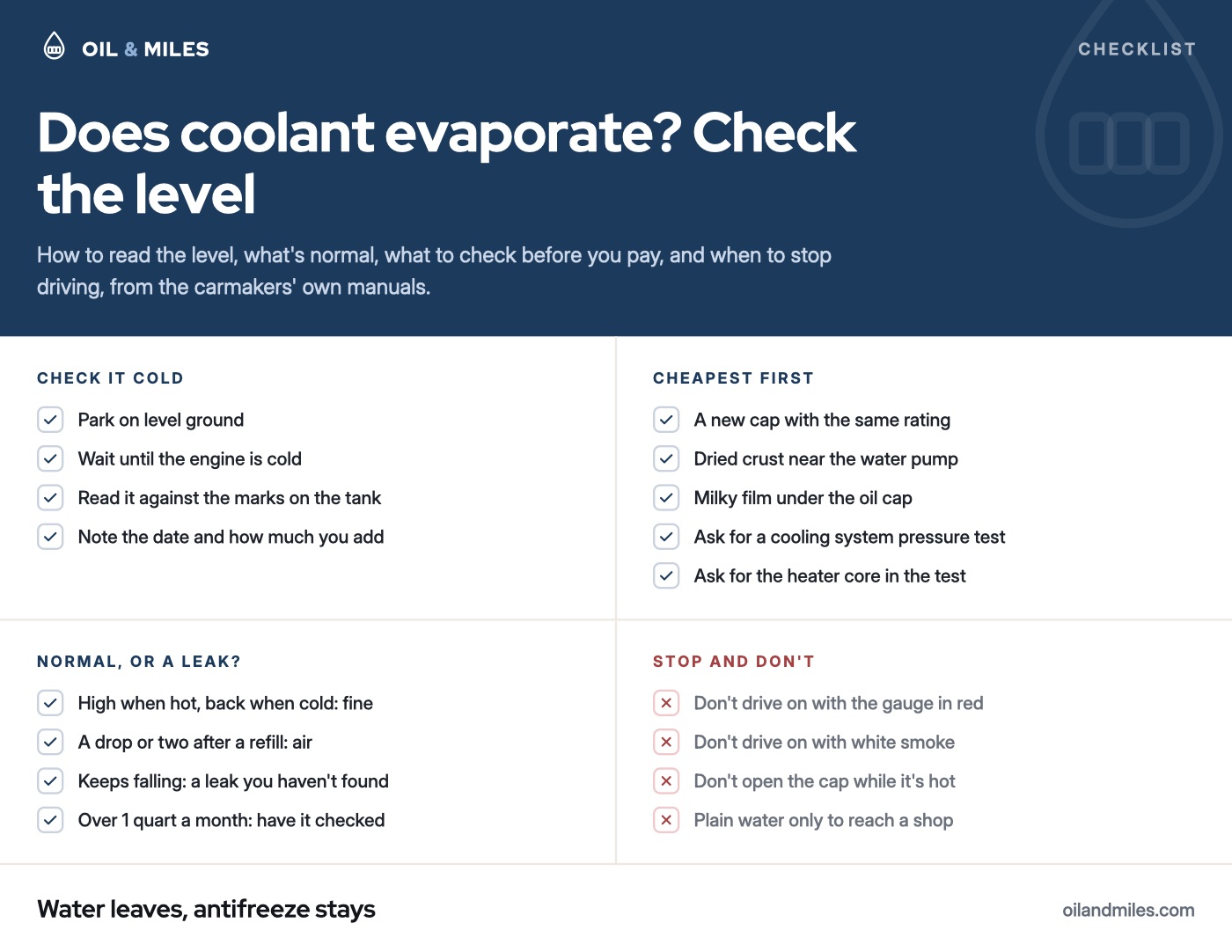
<a href="https://oilandmiles.com/articles/does-coolant-evaporate"><img src="https://oilandmiles.com/assets/img/diagrams/does-coolant-evaporate-checklist.jpg" alt="Coolant level checklist: park on level ground, wait until the engine is cold, read the tank marks and note what you add; a high level when hot is expansion, a drop or two after a refill is trapped air, a level that keeps falling is a leak, and more than 1 quart a month means have it checked; try a new cap with the same rating, look for a dried crust or a milky film under the oil cap, and ask for a pressure test that includes the heater core; don't drive on with the gauge in the red or white smoke, don't open a hot cap, and use plain water only to reach a shop." width="1200" height="928"></a> <p>Infographic: <a href="https://oilandmiles.com/articles/does-coolant-evaporate">Oil & Miles</a>, CC BY 4.0</p>From the documents
What GM, Ford and the ATSDR say
One carmaker explains a level that falls with no leak, one recalls an engine for running too low, and a federal agency says how long a spill lasts in the ground.
The first two are why a falling level needs an explanation rather than a jug.
General Motors Customer Satisfaction Program 14417A
A low engine coolant level may be observed in the coolant reservoir even though there are no external leaks present.General Motors, August 2014
Ford recall 17V-209, Part 573 report
…a coolant loss well below the minimum level in the coolant (de-gas) bottle at the time of a cool/cold start of the vehicle.Ford Motor Company, March 27, 2017
ATSDR ToxFAQs, Ethylene Glycol, CAS 107-21-1
Ethylene glycol in water and in soil will breakdown within several days to a few weeks.Agency for Toxic Substances and Disease Registry, June 2013
Conclusion
Water leaves, glycol stays, and a sealed system keeps both
Antifreeze barely evaporates, and in a sealed system neither half should leave. Here's what to know when coolant seems to evaporate, from the chemistry, the manuals and the bulletins:
- An open jug or a spill loses water, not glycol.At room temperature, water evaporates roughly 300 times as readily as the glycol in antifreeze. So what's left behind gets stronger.
- Read the level cold, on level ground.Coolant expands as it heats, so a hot reading sits high and tells you little. Never open the cap while it's hot.
- A drop after a refill is air leaving.Trapped air works its way out and the level falls to take its place, which GM and Audi both document. It can take a few top-offs to settle.
- A level that keeps falling is a leak you haven't found.Start with the pressure cap, the cheapest part. If a new one doesn't stop it, have the system pressure-tested.
- Milky oil or white smoke means stop topping off.Both can mean coolant is reaching the engine. Milky oil can also be cold-weather moisture, so let a test decide.
- Don't drive it low.A low level lets the engine overheat, and Ford recalled vehicles with its 1.6-liter turbo because the head could crack from a cold start with the coolant well below the minimum.
So check it cold, and treat any steady drop as a leak. Oil & Miles reads the manuals and the bulletins before it repeats what the forums say.
Common questions
Asked most often
Does antifreeze evaporate?
Barely. The ethylene glycol in antifreeze gives off almost no vapor at room temperature, so an open jug or a spill loses its water and keeps its glycol. In a car's sealed, pressurized system neither should leave, and a level that keeps falling is a leak.
Can coolant evaporate over time?
Not from a healthy cooling system. No owner's manual we read calls ongoing loss normal, and Ford says more than a quart a month means have it checked. The only documented normal drop comes once, after a refill, as trapped air escapes.
Why is my coolant low but there's no leak?
The manuals treat it as a leak you haven't found: a pressure cap letting it boil off through the overflow, a seep that dries on hot metal, the heater core, or coolant going into the engine through a gasket, the oil cooler or the intake. Check the cap first; it's the cheapest part.
What does low coolant mean?
That coolant has left a system built to keep it. The one normal exception is a drop or two after a refill, as trapped air works its way out; a level that keeps falling is a leak, outside where it drips or inside where it doesn't.
What causes coolant to be low?
A leak somewhere in the system. With no puddle, the paths the documents name are a pressure cap that lets it boil off, a seep that dries on hot metal, the heater core, and coolant going into the engine, its oil cooler or its intake. The cap is the cheapest part to try first.
Does my car have a low coolant light?
Maybe not. None of the four GM, Ford and Honda owner's manuals we read lists a low-coolant warning, so the marks on the tank are your early check. Where a light exists, bulletins show it can come on with the level normal.
Can I top off coolant with water?
Only in an emergency, to reach a shop, which Honda and Toyota allow. GM warns that with plain water the engine could overheat without an overheat warning, and Ford says the antifreeze share shouldn't fall below 40%.
How long does spilled antifreeze take to evaporate?
The water goes, but the ethylene glycol barely evaporates: the ATSDR says it breaks down within several days to a few weeks in soil. Clean it up and cover the spot, because a few teaspoons can kill a pet.
What people ask next
Sources
- GM Customer Satisfaction Program 14417A, August 2014, for the Cruze 1.4L level drop with no leak. Also GM Special Coverage 14371B for the Cruze water pump, and bulletins 06-06-01-019C, PIE0275 and 18-NA-098. NHTSA bulletin archive, read September 24 and 29, 2026
- NHTSA recall 17V-209, Ford Motor Company, March 27, 2017, for the models, the 208,584 vehicles, the fire reports and the remedy. Also recall 12V-551 for the 2013 Escape and Fusion. NHTSA, read September 24 and 29, 2026
- Bulletins on coolant inside the engine: Ford 19-2139 and messages 47462, 48150 and 48345; Honda 26-099; Toyota T-SB-0104-21; Mazda 01-006-25; Chrysler 09-022-24, for the signs, milky oil and the shop tests. NHTSA bulletin archive, read September 29, 2026
- Bulletins on warnings and heat: Land Rover SSM 76361, Mercedes-Benz LI20.30-P-078666, Chrysler owner letter K20, Toyota T-SB-0135-19, Hyundai 22-HC-002H and Kia ELE 281, for false warnings, heater output and hybrid coolant tanks. NHTSA bulletin archive, read September 29, 2026
- Intake manifold: Ford bulletin 17-0028 with 16-0130 and 16-0150, MAHLE Service Solutions SS-GA-C-02 and Fel-Pro's Leak Repair Engine Gaskets, for coolant leaking at or inside the intake. NHTSA bulletin archive, MAHLE and Fel-Pro, read September 30, 2026
- NHTSA complaints file, dated August 25, 2026, for the complaint counts and the three owners quoted. NHTSA, counted September 29, 2026
- ToxFAQs, Ethylene Glycol, for how long it lasts in air, water and soil. Agency for Toxic Substances and Disease Registry, June 2013, read September 24, 2026
- NIOSH Pocket Guide, Ethylene Glycol, PubChem and the NIST WebBook for water, for the boiling points and the vapor pressures of the glycols and water. CDC and NIH, read September 24, 2026
- Monoethylene Glycol Product Guide, for the vapor pressure constants of a 50% mix and for glycol taking up water from the air. MEGlobal, September 12, 2013, read September 24, 2026
- Motorcraft antifreeze protection chart, for the 265°F rating with the specified cap and the 40 to 60% range. Ford Motor Company, read September 24, 2026
- Owner's manuals: 2024 Chevrolet Silverado 1500 (GM 85516379, revisions C and D), Ford's 2020 Mustang supplement, 2013 Escape, 2024 Honda CR-V and CR-V Hybrid, 2025 Accord, 2021 Toyota Avalon, for the level check, warnings and overheating. GM, Ford, American Honda and Toyota, read September 24 and 29, 2026
- Audi bulletin 19 15 56, February 26, 2015, for the level dropping as trapped air escapes on the 2015 A3. NHTSA bulletin archive, read September 24, 2026
- Merck Veterinary Manual, Ethylene Glycol (Antifreeze) Poisoning, for the doses in dogs and cats and the cleanup. Merck, updated September 2024, read September 24, 2026
- Bittering agreement, Humane Society Legislative Fund and Consumer Specialty Products Association, December 13, 2012, and the EPA's Antifreeze Recycling sheet, for the bittering and the disposal. Read September 24, 2026
- RV antifreeze safety data sheets: Camco Easy Going, September 18, 2017, and Splash RV and Marine, April 21, 2021, for what's in the jug. Read September 24, 2026
- RockAuto catalog, every listing for the three cars. Read September 24, 2026
How this was compiled
The questions and their order come from what people type into search about coolant and antifreeze evaporating and about coolant running low. The three cars priced are the three models searched most with coolant problems.
The 50/50 vapor pressure and the 225°F boiling point without pressure are our own calculations from MEGlobal's published constants for a 50% mix by weight; coolant mixed 50/50 by volume is slightly stronger, so treat both as approximate. The 265°F is Ford's and GM's printed figure.
The complaint counts match words in each owner's narrative, so a few are misread. In a hand check of 12 low-coolant and 12 no-leak Escape complaints, 11 of each were right.
What we didn't do
We didn't measure evaporation from a reservoir. We found no carmaker or study that publishes a rate, so we give none.
We read one Toyota manual, for the 2021 Avalon, from our own copy; Toyota's site wouldn't open its hybrid manuals, so we can't say whether Toyota hybrids have a second coolant tank.
NHTSA's index lists an older Nissan bulletin that blames a leaking intake manifold gasket for coolant going into a cylinder, and older GM ones that tie the intake to low coolant, but no document we could read says so, so item 6 stops at what Ford's bulletin and the gasket makers say.
We didn't price labor or a pressure test here; the coolant leak repair cost guide does.
Prices are ranges compiled in September 2026 for the US market and vary by region, engine and shop rate. Prices from $10 up are rounded to the nearest dollar, so $14.13 reads as $14 and $14.52 as $15. Below $10 they're exact. This article is general information, not advice about your specific vehicle. See the disclaimer.
Pressure cap
2014 Chevrolet Cruze 1.4L L4 Turbocharged
| Brand | Part | Price |
|---|---|---|
| SKP | SK54218 | $2.77 |
| Calorstat | RC014420 psi | $4.53 |
| Autotecnica | GM071461920 psi | $5.29 |
| Motorad | T6220 psi | $5.42 |
| Gates | 3156920 psi | $8.88 |
| Dorman | 54218 | $9.50 |
Pressure cap
2013 Ford Escape 1.6L L4 Turbocharged
| Brand | Part | Price |
|---|---|---|
| URO Parts | 3136831121 psi | $3.96 |
| Motorad | T5721 psi | $4.16 |
| Calorstat | RC0150 | $4.35 |
| Gates | 3154921 psi | $11 |
Pressure cap
2015 GMC Acadia 3.6L V6
| Brand | Part | Price |
|---|---|---|
| Calorstat | RC014420 psi | $4.53 |
| RC014715 psi | $4.53 | |
| Autotecnica | GM061302015 psi | $5.07 |
| GM071461920 psi | $5.29 | |
| Motorad | T167 | $12 |
Coolant reservoir
2014 Chevrolet Cruze 1.4L L4 Turbocharged
| Brand | Part | Price |
|---|---|---|
| SKP | SK603383 | $9.97 |
| Autotecnica | CE0713621includes cap | $17 |
| Dorman | 603383 | $19 |
| GPD | 2411089 | $22 |
| TechPro | GM3014150includes cap | $36 |
| GM Genuine | 13465094 | $44 |
| Nissens | 996224 | $44 |
Coolant reservoir
2013 Ford Escape 1.6L L4 Turbocharged
| Brand | Part | Price |
|---|---|---|
| SKP | SK603382 | $15 |
| Autotecnica | FD0713622 | $21 |
| GPD | 2411088 | $22 |
| Various Mfr | FO3014109economy line; to 9-10-15 | $23 |
| FO3014110includes cap | $37 | |
| Dorman | 603382 | $26 |
| TechPro | FO3014109to 9-10-15 | $26 |
| FO3014110includes cap | $74 |
Coolant reservoir
2015 GMC Acadia 3.6L V6
| Brand | Part | Price |
|---|---|---|
| TechPro | GM3014148 | $27 |
| GPD | 2411185 | $31 |
| Various Mfr | GM3014148economy line | $31 |
| Dorman | 603138 | $38 |
| GM Genuine | 23159167 | $66 |
Coolant, one gallon premixed
2014 Chevrolet Cruze 1.4L L4 Turbocharged
| Brand | Part | Price |
|---|---|---|
| FVP | MV5050GALextended life, all makes | $6.42 |
| DEX5050GALorange OAT | $6.77 | |
| Prestone | AF3400orange OAT | $6.93 |
| AF3100Prime yellow, all vehicles | $7.66 | |
| AF2100all vehicles | $8.93 | |
| AF850Dex-Cool | $9.83 | |
| AFMAXMax universal | $12 | |
| Valvoline | 719009MaxLife high mileage, yellow | $7.42 |
| 888374American vehicle orange | $7.59 | |
| ZXEL1Dex-Cool orange | $7.66 | |
| Peak | PKP1GALall vehicles | $8.86 |
| PRAL53 | $9.69 | |
| BQA1GALBlue Mountain long life | $9.73 | |
| PXA1GALGlobal Lifetime | $11 | |
| ACDelco | 105027Dex-Cool | $12 |
| Aisin | ACD005orange OAT | $13 |