
Short answer
Only if it clears within a few minutes
Thin white vapor that clears within a few minutes of a cold start, with the coolant level steady, is condensation, and you can drive as far as you like. White smoke still there once the engine is warm is usually coolant burning, so drive only as far as a safe place to stop, because no carmaker document we read gives a safe number of miles.
Ask how long you can drive with white smoke from the exhaust and you'll be given a number: fifty miles, a hundred, or "you can make it home." Those answers come from people describing their own car, and their car isn't yours.
No owner's manual or carmaker bulletin we read gives a safe mileage, because distance isn't what does the damage. Heat and where the coolant ends up do, and neither of them runs on a mileage clock.
What there is instead is a cold-start test in your driveway that tells harmless vapor from coolant. Below is how far is too far, what to do if the smoke starts on the road, and that test.
What does your smoke do?
Smoke started while driving? What to do right now.
How long can you drive with white smoke from the exhaust?
If it's condensation, as long as you like; if it's coolant, only as far as the next safe place to stop. No carmaker document we read gives a safe number of miles, because the damage comes from heat and from where the coolant ends up, not from distance.
Coolant smoke means a breach inside the engine, usually a leaking and sometimes a cracked head or block. That breach can get worse in three ways, and none of them counts miles:
1. Overheating
Coolant leaving through the exhaust is coolant no longer carrying heat away from the engine. Run low enough, the cylinder head heats faster than it was built for and can crack, which turns a gasket job into a head job.
2. Coolant in the oil
The same breach can let coolant into the oil, and oil mixed with coolant stops protecting the bearings the crankshaft turns in. One carmaker warns that even a small amount can cause severe engine damage.
3. Coolant in a cylinder
Liquid doesn't compress, so enough coolant in one cylinder can stop the piston dead, which mechanics call hydro-lock. How the coolant gets there, and the tests that prove it, are on our blown head gasket symptoms page.

Use this image
Free to republish under CC BY 4.0: credit Oil & Miles and link to this page. The snippet does both.
<a href="https://oilandmiles.com/articles/driving-with-white-smoke-from-exhaust"><img src="https://oilandmiles.com/assets/img/diagrams/head-gasket-leak-paths.svg" alt="See-through view of an inline four-cylinder engine pulled apart, with the head gasket in color between the cylinder head and the block, and four numbered leak paths: 1, coolant into a cylinder, causing white exhaust smoke and coolant loss; 2, combustion gas into the coolant, causing bubbles in the reservoir and overheating; 3, coolant into the oil, causing milky oil; 4, a leak to the outside, with coolant or oil weeping at the seam between head and block." width="1000" height="731"></a> <p>Diagram: <a href="https://oilandmiles.com/articles/driving-with-white-smoke-from-exhaust">Oil & Miles</a>, CC BY 4.0</p>So the honest answer to "how long" is far enough to get off the road and somewhere you can leave it. Every mile after that, we'd call a bet on which of the three above is furthest along.
A small leak won't always stop the car, and Fel-Pro, the gasket maker, reckons thousands are being driven with one right now. They're driving on luck, and luck doesn't come with a warranty.
Carmakers have written up all three for their dealers:
Engine damage documents 5 documents
- Ford, recall 17V-209Some 2013 to 2015 models with the 1.6 turbo engine, among them the Escape, Fusion and Fiesta ST: started cold with coolant well below the minimum, the cylinder head can heat fast enough to crack.
- Mercedes-Benz, LI01.10-N-079275Coolant mixed into engine oil, even in small amounts, can cause severe engine damage.
- Detroit Diesel, SIB 9-12-14The lower-end bearings are replaced once coolant has got into the oil.
- GM, PIP58462022 Silverado and Sierra heavy-duty 6.6 diesels: a hydro-locked engine from coolant entering the cylinders.
- Ford, program 21N122017 to 2019 Escape and Fusion 1.5-liter: coolant getting into the cylinders could lead to engine damage.
What should you do if white smoke starts while you're driving?
Get off the road, turn the air conditioning off, and leave the radiator cap alone until the engine has cooled. The owner's manuals we read agree on that much, and they differ mainly on whether to leave the engine idling.
Any of these signs means stop now, not at the next exit:
- The gauge climbing, or an overheat warningAn engine that's overheating shouldn't be driven on. Nissan's manual puts it in one line: don't continue to drive.
- Steam from under the hoodCoolant is boiling out. Hyundai, Toyota and Nissan all say to switch the engine off once there's steam, and our car smoking under the hood page covers what to do next.
- A strong coolant smell with the smokeA diesel truck maker lists it, with white smoke from the engine or exhaust, as a sign of overheating.
- A low coolant warning lightThe level has already fallen far enough for a sensor to notice, and more is going out of the tailpipe.
Once you've stopped, work through the 6 steps below, in order:
- Pull over where it's safe. Shift to Park or Neutral and set the parking brake.
- Turn the air conditioning off. It's a step in every manual we read.
- If there's steam or coolant running out, switch the engine off. Don't lift the hood until the steam has stopped.
- If there's no steam, watch the gauge. GM's manuals idle the engine for three to five minutes and switch it off if the gauge stays high, while Toyota's switches it off straight away, so follow your own car's manual.
- Leave the radiator cap alone while it's hot. The cooling system is under pressure, and the manuals warn against opening it until it has cooled.
- Check the coolant level cold, then call for a tow. A big drop means a leak, and Nissan, Toyota and Hyundai all point you to a dealer rather than back onto the road.
While you wait, run the VIN, the 17-character number on your registration. Carmakers sometimes cover coolant getting into the cylinders under an owner program, and our free VIN checker shows open recalls.
What the five manuals say, in their own order:
Owner's manuals 5 manuals
- Chevrolet Equinox, 2020Air conditioning off, heater to its highest setting, pull off and idle for three minutes if there's no steam. Switch off if the gauge stays in the overheat zone.
- Chevrolet Silverado HD, 2022The same steps with five minutes of idling. An overheat message with a low coolant condition can indicate a serious problem.
- Hyundai Sonata, 2023Switch off if coolant is running out or steam is coming from the hood, and never remove the cap while the engine is hot.
- Toyota Avalon, 2021Stop in a safe place, air conditioning off, then stop the engine. Lift the hood only after the steam subsides.
- Nissan Altima, 2020Don't continue to drive an overheating car. Keep the engine running unless steam or coolant is escaping.
How do you tell what the white smoke is?
Do a : start the car after it has sat for hours, let it idle, and watch the tailpipe for a few minutes. Condensation clears as the exhaust heats up, and coolant smoke keeps coming once the engine is warm.
Three questions settle most cases:
1. Does it clear?
Water collects inside the exhaust while the car sits, and the first minutes of running turn it into thin vapor that's gone once the pipe is hot. It's the exhaust clearing its throat, and it's worse on cold, damp mornings.
Coolant smoke is thicker and it lasts. One carmaker describes it on its trucks and SUVs as white smoke for an extended period of time at cold start.
2. Does it smell?
Water vapor has no smell, and burning coolant does. A gasket maker calls it white, sweet-smelling smoke, and carmakers list a coolant odor from the exhaust beside it.
A sharp fuel smell points somewhere else, usually a diesel's unburned fuel, covered below.
3. Is the coolant level dropping?
Check the expansion tank with the engine cold, note the level, and look again in a few days. A level that falls with no puddle underneath points inside the engine, and coolant loss with no leak covers what comes next.
No smoke doesn't clear the engine, either. A small combustion leak can be burned off in the catalytic converter before anything shows at the tailpipe.
One more to rule out is a puff of smoke at every cold start with the oil level dropping. That can be worn valve stem seals, the small seals that keep oil from running down the valves into the engine, and it's an appointment rather than a tow.
Where each of those signs is written down:
Cold-start smoke documents 4 documents
- GM, PIP5498MTrucks, SUVs and sports cars from 2014 to 2020 with 4.3, 5.3 and 6.2-liter engines, such as the Silverado and Tahoe: white smoke or a coolant odor from the exhaust at cold start, from coolant getting into the cylinders.
- Ford, TSB 20-2100 and 19-2346Some Escapes, Fusions and Edges with the 1.5 and 2.0 EcoBoost: white smoke with a falling coolant level.
- Fel-Pro, can you drive with a blown head gasketWhite, sweet-smelling smoke from the tailpipe, which the catalytic converter can burn off before it's seen.
- BMW, SI B11 08 15V8 5 and 7 Series: smoke at start-up, with high oil use, from leaking valve stem seals.
Why do diesels make white smoke?
Because unburned diesel makes a white haze of its own, so on a diesel white smoke isn't automatically coolant. It has a sharp fuel smell rather than a sweet one.
A cold engine is the usual time for it, which is why many diesels carry an intake air heater. A diesel truck maker says that heater reduces the white smoke from a warming engine, and that revving a cold engine hard with no load can make it excessive.
Beyond a cold start, the usual causes are the injectors, the injection timing or low compression. Fuel smoke is a running problem to diagnose and coolant smoke is a structural one, so the smell test is worth doing carefully.
What the diesel manual says:
Diesel manual 1 manual
- Ram 2500 and 3500 with the Cummins, 2023The intake air heater improves starting and reduces white smoke from a warming engine. High-speed, no-load running of a cold engine can result in excessive white smoke.
What do the other smoke colors mean?
White that clears is water, white that stays is coolant, blue is oil and black is too much fuel. Only white that stays changes the answer from booking it in to stopping the car.
Here's each color and what to do about it:
- White, thin, gone in minutesCondensation. Normal, and worse on a cold, damp morning.
- White, thick, still there once warmCoolant getting into a cylinder. Stop driving it.
- White or gray with a fuel smell, on a dieselUnburned fuel. A running problem to diagnose, not a structural one.
- BlueOil being burned, from valve stem seals, worn rings or a failing turbo seal. An appointment, not a tow.
- BlackToo much fuel rather than a leak, from sensors, the air filter or injectors. Also an appointment.
How much blue smoke and oil use is normal is a longer answer than it looks, and our guide to oil burning at high mileage has it.
What does the repair cost?
If the smoke is coolant, the likely repair is a head gasket, and most of that bill is shop time rather than the gasket. Prices by engine, warranty cover and when it stops being worth fixing are in our head gasket replacement cost guide.
Don't reach for a sealer bottle first, because several owner's manuals say not to add cooling system sealers. Our coolant stop leak article covers when they help, and can you mix coolant colors covers what goes back in.
Use this image
Free to republish under CC BY 4.0: credit Oil & Miles and link to this page. The snippet does both.
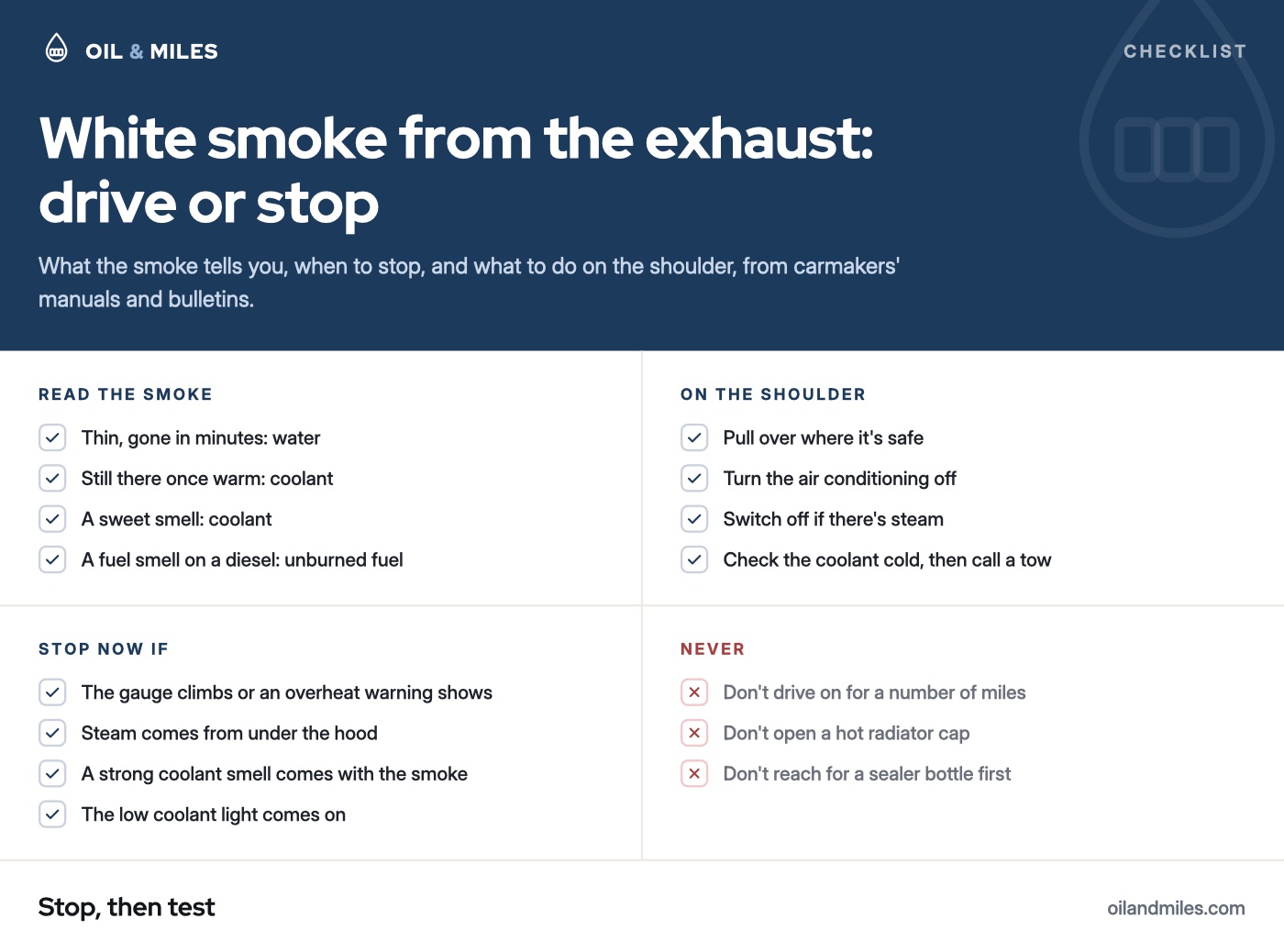
<a href="https://oilandmiles.com/articles/driving-with-white-smoke-from-exhaust"><img src="https://oilandmiles.com/assets/img/diagrams/driving-with-white-smoke-from-exhaust-checklist.jpg" alt="White smoke from the exhaust checklist: thin smoke gone in minutes is water, thick smoke still there once warm is coolant, a sweet smell is coolant, and a sharp fuel smell on a diesel is unburned fuel; stop for a climbing gauge, steam, a strong coolant smell or a low coolant light; on the shoulder pull over, turn the air conditioning off, switch off if there's steam, and call for a tow; don't drive on for a number of miles, don't open a hot radiator cap, and don't reach for a sealer bottle first." width="1200" height="890"></a> <p>Infographic: <a href="https://oilandmiles.com/articles/driving-with-white-smoke-from-exhaust">Oil & Miles</a>, CC BY 4.0</p>From the documents
What GM and Ford tell their dealers
Three dealer documents describe coolant smoke from three sides: what the driver sees, what causes it, and how far it can go.
Each covers the carmaker's own engines, but the signs are the ones any engine gives once coolant reaches a cylinder.
GM Preliminary Information Bulletin PIP5498M
White smoke and/or coolant odor may come from exhaust for an extended period of time at cold start as well.General Motors, August 2020
Ford Customer Satisfaction Program 21N12
In some of the affected vehicles the 1.5L EcoBoost engine may exhibit a low coolant level, white exhaust smoke and/or may run in a rough conditionFord, June 2022
GM Preliminary Information Bulletin PIP5846
This condition may be caused by coolant entering one or more cylinders causing a hydro-lock.General Motors, March 2022
All three trace the smoke to the same place: coolant inside a cylinder, which is why the answer on this page is to stop rather than to count miles.
Conclusion
Distance was never the question
White smoke that clears in minutes is water, and white smoke that stays once warm is coolant, which has no safe mileage. Here's what to take from this page about driving with white smoke from the exhaust:
- No mileage is safe on coolant.Heat and where the coolant goes do the damage: a cracked head, worn-out bearings or a locked engine. Drive only far enough to stop safely.
- Stop at once for these.A climbing gauge, steam, a strong coolant smell or a low coolant light. Pull over, turn the air conditioning off, and leave the radiator cap alone while it's hot.
- Run the cold-start test.Condensation clears within a few minutes and leaves the coolant level alone. Coolant smoke lasts, and the level drops over a few days.
- On a diesel, smell it.A white haze with a sharp fuel smell is unburned fuel, most often from a cold engine. It needs a diagnosis, not a tow.
- Blue and black are appointments.Blue is oil and black is too much fuel. Neither is a reason to stop on the shoulder.
So give the tailpipe a few minutes before you decide anything. Oil & Miles reads the carmakers' manuals and bulletins before it tells you to drive on.
Common questions
Asked most often
How far can I drive with white smoke from the exhaust?
If it clears within a few minutes of a cold start and the coolant level holds, as far as you like, because that's condensation. If it doesn't clear, far enough to stop safely and no further, because the damage is driven by heat and by where the coolant goes, not by distance.
Is a little white smoke from the exhaust normal?
Yes, if it's thin, has no smell and clears within a few minutes. Water condenses inside the exhaust while the engine is off and turns to vapor as the exhaust heats up, and it's more noticeable the colder and damper it is.
Can a car smoke from sitting too long?
Yes, and it's usually water: moisture collects in the exhaust while the car sits, and the first start turns it into vapor. If the smoke keeps coming once the engine is warm, treat it as coolant.
My temperature gauge is normal, does that mean it's fine?
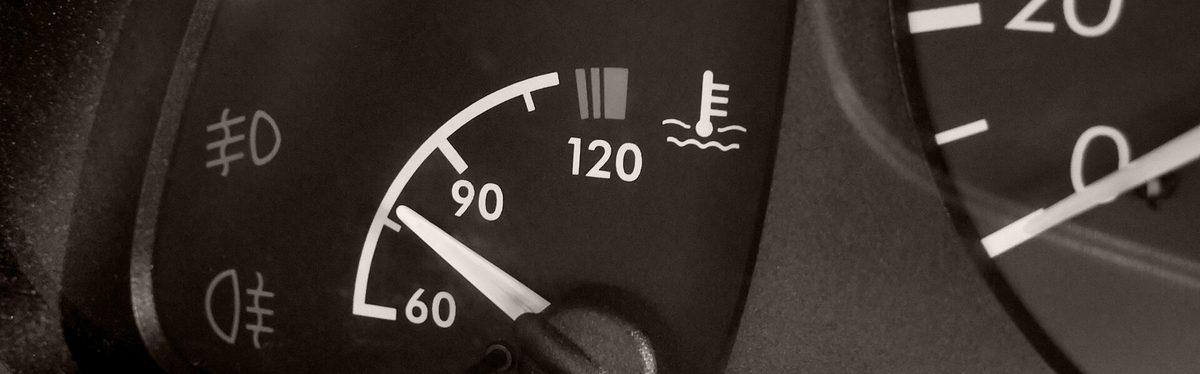
Not on its own. Ford's owner's guide describes an engine that keeps running after its coolant supply is depleted, with the gauge moving into the red only once the engine begins to overheat, so a falling coolant level is the earlier warning.
Can a head gasket leak without white smoke?
Yes. A small combustion leak can be burned off in the catalytic converter before anything shows at the tailpipe, so a coolant level that keeps falling is often the first sign you'll get.
What people ask next
Sources
- White exhaust smoke: causes and what to do, for the difference between cold-start condensation and coolant. The AA
- White smoke from exhaust: what it means, for the smoke-color triage. Edmunds
- GM PIP5498M, white smoke and coolant odor at cold start from coolant in the cylinders. General Motors, read September 26, 2026
- Ford TSB 20-2100 and 19-2346, white smoke with low coolant on the 1.5 and 2.0 EcoBoost, and the pressure and combustion gas test. Ford, read September 26, 2026
- Ford program 21N12, coolant intrusion on the 1.5 EcoBoost Escape and Fusion. Ford, read September 26, 2026
- BMW SI B11 08 15, start-up smoke from leaking valve stem seals. BMW, read September 26, 2026
- Recall 17V-209, the 1.6 EcoBoost head cracking when coolant runs low. Ford, read September 26, 2026
- Mercedes-Benz LI01.10-N-079275 and Detroit Diesel SIB 9-12-14, engine and bearing damage from coolant in the oil. Read September 26, 2026
- GM PIP5846, hydro-lock from coolant in the cylinders on the 6.6 diesel. General Motors, read September 26, 2026
- Owner's manuals: 2020 Chevrolet Equinox, 2022 Chevrolet Silverado HD, 2023 Hyundai Sonata, 2021 Toyota Avalon and 2020 Nissan Altima (overheating), 2023 Ram 2500 with the Cummins (diesel smoke), 2013 Ford E-Series (the gauge, sealers). Read September 26 and 30, 2026
- Can you drive your vehicle with a blown head gasket?, for sweet-smelling smoke and a leak the catalytic converter hides. Fel-Pro, read September 30, 2026
How this was compiled
The roadside steps are the ones the five owner's manuals share, and where they disagree, on idling or switching off, we say so rather than pick one.
The damage and smoke documents are carmakers' bulletins, programs and recalls filed with NHTSA, read at source.
What we didn't do
We haven't stripped the engine in your car, and no article can tell you which of the three failure routes yours is on.
We found no document that gives a safe distance or time for driving on coolant smoke, so there's no number here, and we didn't find one giving how long valve seal smoke lasts either.
This article is general information, not advice about your specific vehicle. See the disclaimer.
Head gasket
The seal between the cylinder head and the block, holding back combustion pressure, coolant and oil at the same joint.
Cold start
The first minutes after the engine has sat long enough to cool all the way down, usually overnight.