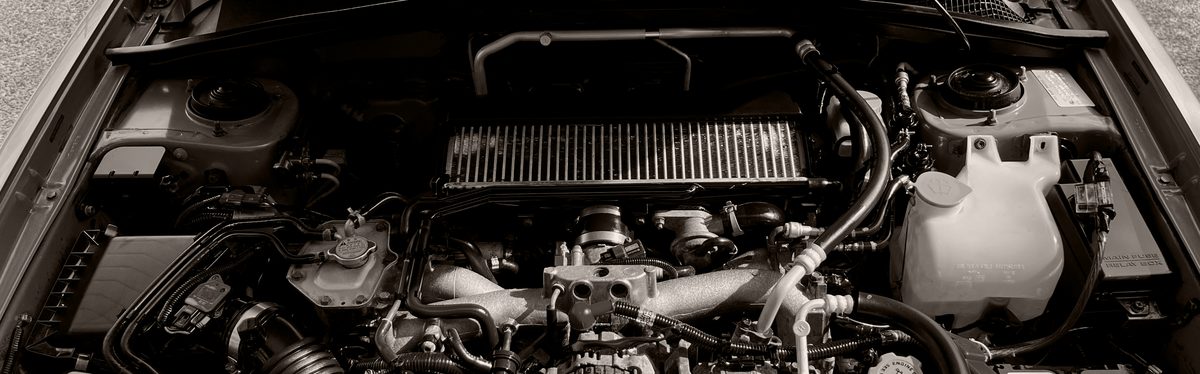

Short answer
Ignore the color. Match the chemistry.
Two coolants of the same color can be chemically incompatible, and two of different colors can be identical. In a genuine emergency, top off with distilled water rather than guessing at a bottle, and if the level keeps falling, you have a leak rather than a mixing question. Then get the system drained and refilled with the correct type.
Can you mix coolant colors? There's no international body deciding that green means one thing and orange means another.
The dye is chosen by whoever bottled it, partly for tradition, partly so a leak is easy to spot on the driveway, which is its own subject with a price by leak point, and partly so the bottle stands out on a shelf.
Manufacturers have changed the color of the same product, and different manufacturers have used the same color for completely different chemistry. So the question "can I mix green and orange" can't be answered as asked.
The real question is what additive package is in each one.
If you landed here because coolant is disappearing and you can't see where it goes, the exhaust is worth checking first: white smoke that won't clear means it is leaving through a cylinder.
What are the three types of coolant?
Coolant is mostly ethylene glycol (or propylene glycol) and water, and that part handles freezing and boiling. The interesting part is the corrosion inhibitor package, which stops the mixed metals in your engine from eating each other.
There are three broad families.
| Type | Inhibitors | Typical life | Commonly found in |
|---|---|---|---|
| IAT, Inorganic Additive Technology | Silicates, phosphates | 2 years / 30,000 miles | Older vehicles, classic engines |
| OAT, Organic Acid Technology | Organic acids, no silicates | 5 years / 150,000 miles | GM Dex-Cool, VW G12/G13, many modern cars |
| HOAT, Hybrid | Organic acids plus a traditional inhibitor; Toyota's and Honda's are silicate-free | 5 years / 150,000 miles | Many European and Asian makes, Ford, Chrysler |
The service lives in that table are the typical published figures for each family, not something we measured. Read them as typical figures, not your car's interval.
Within HOAT there are further splits (phosphate-free variants for European engines, silicate-free variants favored by several Japanese manufacturers) which is exactly why "just buy the orange one" fails as a strategy.
Can you mix coolant colors? What goes wrong when you do
Mixing incompatible types doesn't produce a chemical explosion. What it produces is quieter, and more expensive.
Mixing different coolant types makes three things go wrong instead, and none of them is fast:
- The inhibitors cancel each other. Silicates and some organic acid packages interact, and both end up less effective than either alone. The coolant still looks like coolant and still stops the engine freezing. It simply stops protecting the metal.
- Gelling. Certain combinations drop out of solution into a thick, gritty sludge. That blocks the narrow passages first (, radiator tubes, thermostat) and the first symptom is often heating that has gone cold on one side, or a temperature gauge that climbs in traffic.
- Accelerated corrosion. Aluminum heads, iron blocks, copper cores, solder and rubber all in one loop is only stable because the inhibitor package keeps it that way. Once it's compromised, you get pinhole leaks in the radiator, a seal that starts weeping, and eventually electrolysis pitting.
None of this happens in a week. It happens over a year or two, and by the time it shows up nobody connects it to the liter of the wrong stuff added at a service station.
Worth knowing
The question nearly always arrives framed the same way: mine is pink, is this pink one the same? It's a reasonable assumption and the wrong test, and Ford's manual says why in one line: coolant “may change color from orange to pink or light red” in normal service, without anything being wrong with it.
The question that works is what the car is and what the manual specifies, because the useful information is the manufacturer's coolant standard: a code like G12evo, or a Toyota Super Long Life, or a Ford or Chrysler spec number. That code appears on the correct bottle. The color appears on every bottle.
Is universal coolant safe to use?
These exist, they're sold everywhere, and the claim has something behind it. Many are formulated to be compatible with a wide range of chemistries, and for an older vehicle out of warranty with a simple cooling system, a reputable universal product is a reasonable choice.
Which of them genuinely crosses all three families isn't something we could test, so what follows is the chemistry rather than a verdict on any brand.
Even a reputable universal coolant comes with two cautions, though:
- "Compatible with" isn't "meets the specification of." It is the same distinction that matters on an oil bottle. If your manufacturer names a coolant specification, a universal product that doesn't carry it may not satisfy a warranty claim.
- It dilutes whatever protection was already there. Mixing a universal product into an existing charge is a top-off solution; it doesn't replace the right fluid.
Do you have to dilute coolant concentrate?
Yes, if the bottle says concentrate, and no if it says ready-mixed. Getting that backwards causes as many problems as getting the type wrong.
Concentrate must be diluted, normally to a 50/50 mix, and normally with distilled or deionized water. Coolant isn't the only fluid where topping off in a hurry ends badly: mixing engine oils has a cleaner answer, and a different reason for it.
Pouring neat concentrate into the system isn't “extra protection”. Undiluted glycol actually transfers heat worse than a proper mix, and can run hotter.
Ready-mixed is already diluted and goes straight in. Diluting it again with water weakens both the freeze protection and the inhibitor concentration.
And use distilled water, not tap. Minerals in tap water leave scale in the narrowest, hottest passages, which is precisely where you don't want deposits.
How bad is it if you already mixed coolant?
No need to panic, and no need to ignore it either. If you already mixed coolant, take these four steps in this order:
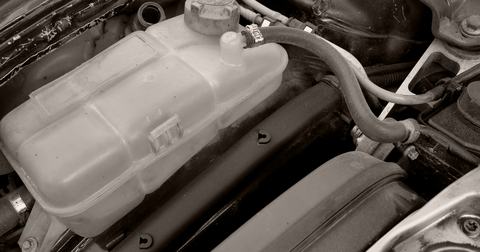
- Look in the expansion tank. Clear liquid of a consistent color is a good sign. Cloudy, brown, oily, or with visible particles or a jelly-like film isn't.
- If it looks normal, book a drain and refill at your convenience rather than treating it as an emergency. A single small top-off of the wrong type in an otherwise healthy system is a manageable problem.
- If it looks like sludge, or the heater has stopped working properly, or the gauge is climbing, get it looked at now. A flush is far cheaper than a heater core, and a heater core is far cheaper than a .
- Ask for a proper drain and refill (not a top-off) using the coolant specification named in your manual. If a shop tells you the color is all that matters, that tells you something useful about the shop.
Coolant isn't the only thing people pour into a cooling system in a hurry. If a leak is what put you here, stop leak carries what Ford and GM say, and it's a larger one than mixing two approved coolants.
One thing worth settling before any of this: the two words on the front of the jug. Antifreeze and coolant aren't the same word for the same thing, and the coolant chart shows which specification your car is owed either way.
How do you fix mixed coolant?
Find the coolant specification for your car once, write it down, and buy that. It will be a code, not a color, the same lesson the oil aisle teaches: what an oil bottle is telling you is on the label, not in the look of the jug.
Keep a sealed bottle of the correct ready-mixed coolant in the trunk if you drive long distances, so that a roadside top-off never becomes a guess.
| What goes in | How safe | Why |
|---|---|---|
| The manufacturer's specification | Best | The code in the manual, not the color in the bottle |
| A coolant with the same OEM approval | Fine | Different brand, same specification, no problem |
| Distilled water, a small amount | Safe enough | It dilutes the protection but mixes with anything. Get it corrected soon |
| Universal or all-makes coolant | Risky | It can't be compatible with every chemistry at once |
| Whatever is in the garage | No | This is how coolant turns to sludge |
And if you're ever stuck with a leak, an empty tank and nothing correct available: distilled water will get you home. It gives you no freeze protection and no corrosion protection, so it's a temporary measure to be drained out afterwards, but it's a far better temporary measure than a liter of unknown chemistry.
From the documents
Four makers put it in writing, and two name a color
Read the four together and notice what they share. None describes an explosion, and the two that name a color do it to tie it to their own coolant:
Ford owner manual, Engine Coolant Check, Maintenance chapter, served for a US vehicle variant
DO NOT MIX different colors or types of coolant in your vehicle. Make sure the correct coolant is used. Mixing of engine coolants may harm your engine's cooling system. The use of an improper coolant may harm engine and cooling system components and may void the warranty.
2020 Nissan Altima owner manual, Engine coolant
Mixing any other type of coolant, or the use of non-distilled water, may reduce the life expectancy of the factory fill
Subaru maintenance schedule, 2023
To prevent cooling system leaks, always add Genuine Subaru Cooling System Conditioner whenever the coolant is replaced
2022 Honda Civic owner manual, Recommended coolant
Specified coolant: Honda Long Life Antifreeze/Coolant Type 2. This coolant is premixed with 50% antifreeze and 50% water. Do not add any straight antifreeze or water
Nissan and Honda both warn that other coolant can damage or corrode the system, and Nissan adds a shorter service life. Ford bans mixing colors, and Ford is also the maker whose own manual says the fluid changes color in normal service.
So the one document that bans mixing colors is the same document telling you the color isn't what you think it is.
Conclusion
The color is the one thing on the bottle that decides nothing
Two coolants of one color can be incompatible, and two of different colors identical. Ford's manual says the fluid can drift from orange to pink in normal service, and that the change doesn't mean it has degraded as long as it stays clear.
What settles it is the specification code your manual names, which appears on the correct bottle and on no other.
So write what went in on a sticker in the engine bay, because the next person to top it off has no other way to know. Oil & Miles reads the manufacturer's own wording rather than the label, across oil and fluids.
Common questions
Asked most often
Can I mix different colored coolant?
Color tells you nothing. Two coolants of the same shade can be chemically incompatible, and two different shades can be identical. Match the specification code in your manual instead.
What happens if you mix the wrong coolant?
Not an explosion. Something quieter. The inhibitors can cancel each other out, or the mixture can gel and block the heater core and radiator, and corrosion protection quietly disappears.
Can I top off coolant with water?
In an emergency, distilled water will get you home. It gives no freeze or corrosion protection, so it's a temporary measure to be drained afterwards, but far better than a liter of unknown chemistry.
What is the difference between OAT and HOAT?
OAT uses organic acids with no silicates; HOAT blends organic acids with a traditional inhibitor, silicate in some brands, while Toyota's and Honda's are silicate-free. Both typically last around five years, and they aren't freely interchangeable.
What people ask next
Sources
- Three manufacturer manuals, read at source: the 2020 Nissan Altima, Subaru's 2023 warranty and maintenance booklet, and the 2022 Honda Civic Sedan. Each names its own product: Nissan and Honda warn against other coolants, and Subaru adds a conditioner. Manufacturer owner manuals, read August 26, 2026 and September 6, 2026
- The Ford owner manual, Engine Coolant Check in the Maintenance chapter, read at source for a US vehicle variant: the instruction not to mix colors or types, the warranty warning, and the line that coolant may change color from orange to pink or light red in normal service. The copy we read is headed 2019 Mustang Owner's Manual Supplement. Manufacturer owner manual, read September 16, 2026
How this was compiled
The failure modes described here are the established chemistry of inhibitor incompatibility rather than results we produced, and the article says which is which at each claim. IAT, OAT and HOAT are the industry's own additive-technology categories, and the service lives are typical published figures that vary by product.
What we didn't do
We haven't laboratory-tested mixtures. We give no brand recommendation, because the correct coolant is the one carrying the specification your manufacturer names, which is a code rather than a color or a brand.
General information about engine coolant. Coolant specifications vary by manufacturer and by model year, so always follow the specification in your own owner's manual. Never open a cooling system while it's hot. See the disclaimer.
Heater core
A small radiator inside the dashboard that heats the cabin.
Water pump
The pump that circulates coolant, driven by the timing belt or chain on most engines.
Head gasket
The seal between the cylinder head and the block, holding back combustion pressure, coolant and oil at the same joint.