
Short answer
Most often a misfire, then an overheat.
Blown head gasket symptoms follow the leak: coolant in a cylinder causes misfires and white smoke, gas in the coolant causes overheating, and coolant in the oil turns it milky. In 2,957 federal complaints that name a head gasket, 41% mention a misfire or a check engine light and only 8% mention white smoke.
The first sign is rarely dramatic: the engine stumbles at a light, or the coolant tank reads low a week after you topped it off. A head gasket has four ways to leak, and it seldom picks the one everyone warns you about.
What most pages lead with, white smoke and milky oil, is what owners report least. We counted every complaint filed with federal regulators for the 2010 to 2025 model years that names a head gasket, and white smoke shows up in fewer than one in ten.
Below: each of the bad head gasket symptoms and what it tells you, what causes it, the tests that prove it, the look-alikes, and whether you can keep driving. The earlier you catch it, the more likely the bill stays a gasket bill.
What are you seeing?
Already proven it's the gasket? Our head gasket replacement cost page has the price by car.
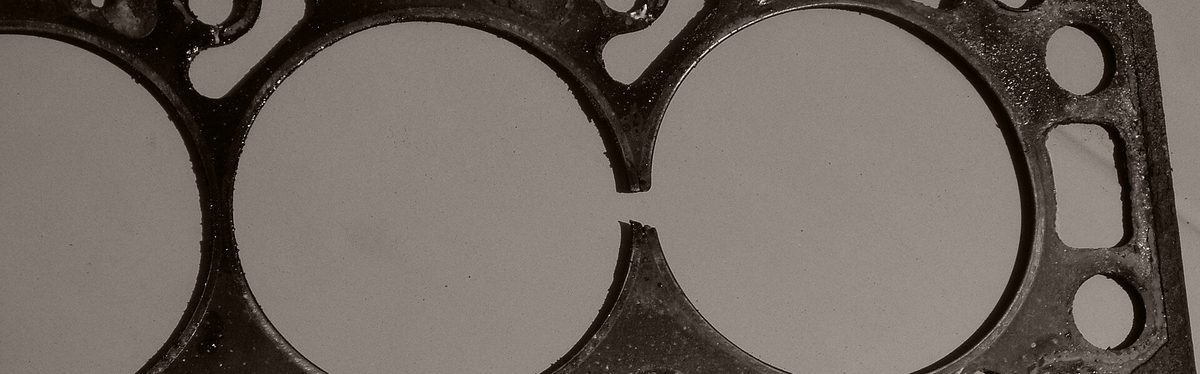
What are the symptoms of a blown head gasket?
The signs of a blown head gasket depend on where it leaks, because one seal keeps three things apart: the burning gas in the cylinders, the coolant, and the oil. A breach between any two of them, or out to the open air, gives its own set of signs.

Use this image
Free to republish under CC BY 4.0: credit Oil & Miles and link to this page. The snippet does both.
<a href="https://oilandmiles.com/articles/blown-head-gasket-symptoms"><img src="https://oilandmiles.com/assets/img/diagrams/head-gasket-leak-paths.svg" alt="See-through view of an inline four-cylinder engine pulled apart, with the head gasket in color between the cylinder head and the block, and four numbered leak paths: 1, coolant into a cylinder, causing white exhaust smoke and coolant loss; 2, combustion gas into the coolant, causing bubbles in the reservoir and overheating; 3, coolant into the oil, causing milky oil; 4, a leak to the outside, with coolant or oil weeping at the seam between head and block." width="1000" height="731"></a> <p>Diagram: <a href="https://oilandmiles.com/articles/blown-head-gasket-symptoms">Oil & Miles</a>, CC BY 4.0</p>Which path opens first decides what you notice, and it's rarely the dramatic one. You can look up complaints for your own car, and here's how often owners mention each sign across all 2,957 federal complaints that name a head gasket:
Misfires lead because a small leak into a cylinder upsets the engine's running long before it shows anywhere else. White smoke comes late, and Fel-Pro, which makes replacement gaskets, notes that the catalytic converter can burn off a small amount before you'd ever see it.
The signs below run from the most reported to the least, and each one tells you where the head gasket is leaking:
1. Misfire or Check Engine Light
Coolant that seeps into a cylinder smothers the fire there, so that cylinder misfires, shaking at idle and stumbling as you accelerate. The check engine light comes on or flashes, and it's often worst on a cold start, since a small leak can happen on a cold engine and stop once it warms up.
The car's OBD-II computer stores a misfire code, P0300 for a random misfire or P0301 and up for one cylinder, and our P0300 page explains them. A misfire has plenty of other causes, so it's a reason to test, not a verdict.
2. Overheating
When combustion gas leaks into the coolant, it heats it and pushes it out of the system, so the temperature gauge climbs toward H, often on a hill or in traffic. Overheating is also what blows a gasket in the first place, so one overheat can set up the next.
Pull over and shut the engine off once the gauge reaches the red. Don't open the radiator cap on a hot engine: the system may be under pressure, and Fel-Pro's advice is to leave it closed.
3. Loss of Power
A gasket that fails between two cylinders lets them leak into each other, and both lose compression, the squeeze that makes power. The car feels weak on hills and slow to merge, and some owners describe limp mode, a reduced-power setting the computer uses to protect the engine.
Owners describe it in about one complaint in five, often in the same complaint as a misfire.
4. Coolant Loss With No Leak
Coolant that burns in a cylinder leaves no puddle, so the tank reads low again and again over a dry driveway. Fel-Pro describes this as coolant that seems to disappear, and the leak can happen on a cold engine and stop once it warms up.
Check the level only with the engine cold, against the same mark each time. Our page on whether coolant evaporates explains what a normal level looks like over time.
5. White Exhaust Smoke
Coolant burning in a cylinder makes thick white smoke with a sweet smell that keeps coming after the engine is warm. Thin white vapor on a cold morning that clears in a few minutes is just water, and our white smoke page tells the two apart.
It's in fewer than one complaint in ten, because a small leak doesn't make enough to see. By the time the smoke is obvious, the leak usually isn't small anymore.
6. Bubbles in the Coolant Tank
Combustion gas forced into the cooling system rises as bubbles in the coolant tank with the engine running, and the pressure can push coolant out of the overflow. Fel-Pro says it can get strong enough to burst a hose or crack the radiator's plastic tanks.
Watch the tank through its side with the cap on, never by opening a hot cap. A steady stream of bubbles is what a block test, below, confirms.
7. Milky Oil
Coolant that leaks into the oil turns it milky, and a milky film can form under the oil filler cap. It's the sign people fear most, and in owners' complaints it's the rarest, at 2%.
It's also the least reliable, because short winter trips can make the same milky film from condensation alone, as the look-alikes section explains.
8. Oil or Coolant at the Seam
A gasket can also leak outward, leaving wet streaks of oil or coolant down the line where the cylinder head meets the block. It's the one sign you can see with the hood up.
Wipe the seam clean and look again after a drive: Fel-Pro describes this leak as streaks running down from the gasket itself.
What causes a blown head gasket?
A head gasket is the flat seal between the engine block and the cylinder head, and it's "blown" once it stops sealing. The cause Fel-Pro names first is heat: an overheat makes the head and block expand too much for the gasket, and the seal gives.
Gasket makers' guides name these causes of a blown head gasket, starting with the one they put first:
- OverheatingLow coolant or a cooling system fault lets the engine run hot. The head and block swell, and the seal between them lets go.
- DetonationFuel that explodes instead of burning smoothly, often heard as knocking, hammers the fire rings, the metal rings that seal each cylinder, until pressure gets past them.
- Coolant at the wrong level or mixFel-Pro's first rule for preventing a blown gasket is keeping the coolant at the right level and mixture for your car.
- Head boltsThe bolts clamp the head down, and many are made to be used once. Bolts reused when they shouldn't be, or tightened wrong after an earlier repair, can let the seal lift.
Some engines also fail more often by design, and their makers have extended the warranty on the gasket. Our warranty section lists which, so check it before you pay for anything.
How do you tell if your head gasket is blown?
You can narrow it down at home, but no single sign proves a blown head gasket, and only a test does. The 6 steps below start with what you can check on a cold engine and end with the tests a shop runs, in order:
- Check the coolant cold. Mark the level on the tank with the engine cold, drive for a few days, and check it cold again. A drop with no puddle and no wet hoses points inside the engine.
- Look under the oil cap and at the dipstick. A milky film under the cap or milky oil on the dipstick means water in the oil, from coolant or from condensation.
- Watch the exhaust once the engine is warm. Thick white smoke with a sweet smell after the engine reaches temperature is coolant burning; thin vapor that clears is water.
- Run a block test. A tester draws air from above the coolant through a blue fluid, which turns yellow on a gasoline engine, or green on a diesel, when it finds combustion gas. The maker of one such tester says even a small leak shows up.
- Have the cooling system pressure tested. A shop pumps the system up and watches the gauge. A drop with no outside leak points inside the engine, and pressure that climbs fast as the engine warms up usually means a gasket leak or a cracked head.
- Ask for a borescope look or a compression test. With the spark plugs out, a small camera can show coolant in a cylinder, and a compression test can show the compression lost when the leak runs between two cylinders. A leak-down test goes one step further: it pumps air into one cylinder, and bubbles in the radiator mean that air is escaping into the coolant.
A changed-color block test or a failed pressure test is the proof a fair shop shows you before it quotes the job. Fel-Pro also describes pressurizing the cooling system overnight and checking every cylinder with the camera in the morning.
Cracked Head or Blown Gasket
The tests show gas or coolant where it shouldn't be, not which part let it through, and a cracked head gives the same signs. Fel-Pro says the only definitive answer is to take the head off, and a crack often needs a machine shop's pressure test to find.
That's why a quote can change once the engine is apart. Before you agree to one, ask what happens to the price if the head turns out cracked or warped.
What can be mistaken for a blown head gasket?
Every sign has a cheaper cause, which is why the test matters more than the symptom. Here's what can be mistaken for a blown head gasket, sign by sign:
- Milky oil cap: condensationShort trips in freezing weather let moisture condense in the oil and leave a milky film under the cap. One carmaker's bulletin traces it to exactly that, and still has the cooling system pressure tested first.
- Coolant going missing: an ordinary leakA hose, the pressure cap, the reservoir, the water pump or the thermostat can leak. Some leaks land on the hot engine and dry before they drip. Our coolant leak page covers all five.
- White vapor: water in the exhaustThin white vapor on a cold morning that's gone once the engine warms up is condensation burning off.
- Misfire: a plug, coil or injectorA worn spark plug or a failed ignition coil gives the same stumble and the same codes as coolant in a cylinder.
- Overheating: low coolant from somewhere elseAn engine with a perfect gasket overheats just the same when an ordinary leak has run the level down.
If a sign clears up after the cheaper fix, it was never the gasket. If it comes back, the block test is the next step.
Can you drive with a blown head gasket?
Not for long, and not far. A small leak may not stop the car, and Fel-Pro says many cars are being driven with one, but every mile risks turning a gasket job into an engine job.
The damage builds three ways: an overheat can damage the aluminum head and block beyond repair, coolant in the exhaust coats the oxygen sensors and catalytic converter, and trapped pressure can burst a hose. How far you can get with white smoke is on our white smoke page.
If you have to move the car, keep the trip short, watch the temperature gauge, and stop the moment it starts to climb.
Use this image
Free to republish under CC BY 4.0: credit Oil & Miles and link to this page. The snippet does both.
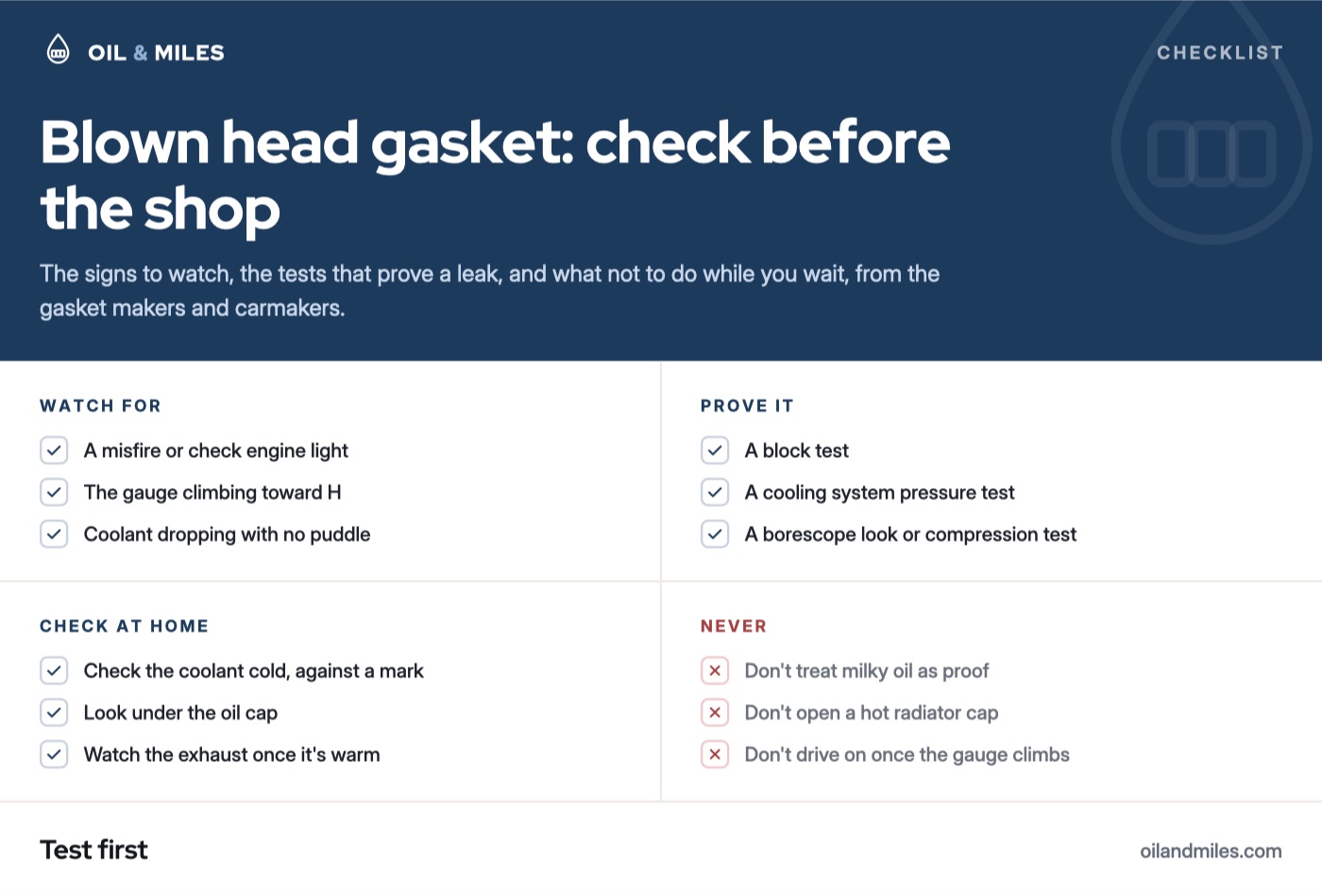
<a href="https://oilandmiles.com/articles/blown-head-gasket-symptoms"><img src="https://oilandmiles.com/assets/img/diagrams/blown-head-gasket-symptoms-checklist.jpg" alt="Blown head gasket checklist: watch for a misfire or check engine light, overheating, and coolant that drops with no puddle; check the coolant cold against a mark, look under the oil cap, and watch the exhaust once warm; ask for a block test, a pressure test, and a borescope or compression test; don't treat milky oil as proof, don't open a hot radiator cap, and don't keep driving once the gauge climbs." width="1200" height="814"></a> <p>Infographic: <a href="https://oilandmiles.com/articles/blown-head-gasket-symptoms">Oil & Miles</a>, CC BY 4.0</p>From the documents
What Honda, Ford and Toyota tell their dealers
Three bulletins written for dealers describe the same leak from three sides: what the driver notices, what the dealer tests, and what can fool both.
Each covers the carmaker's own engines, but the signs they list are the ones any head gasket gives.
Honda Service Bulletin 26-003
Under certain conditions, the cylinder head gasket effectiveness may be reduced which may cause vehicles to experience overheating, coolant loss, misfire and/or DTCs P0300 thru P0304 stored.American Honda, August 2026
Ford Customer Satisfaction Program 17B32
A leaking cylinder head gasket may exhibit noticeable white smoke and/or low engine coolant level without an external leak.Ford, program 17B32
Honda Service Bulletin 26-003
If cylinder head or engine block warpage is detected, replace the cylinder head and/or the engine short block as dictated by the inspection process.American Honda, August 2026
Toyota Service Bulletin T-SB-0104-21
Moisture from blow-by gases condenses and accumulates in the engine oil during short trips in extreme cold weather.Toyota, revised February 2024
Conclusion
Catch it while it's still a gasket
A head gasket can leak four ways, and the way it leaks decides the signs. Here's what to take from this page about blown head gasket symptoms:
- Misfires come first.Owners mention a misfire or a check engine light more than any other sign. White smoke and milky oil come late, or not at all.
- Watch the cold coolant level.A level that keeps falling with no puddle points inside the engine. Check it cold, against the same mark each time.
- Every sign has a cheaper cause.Condensation, an ordinary leak or a worn plug can look the same. Rule them out before you rule the engine out.
- A test is the proof.A block test or a pressure test shows the leak without opening the engine. Ask for the result before you agree to a quote.
- Stop before it overheats.An overheat can take the head with it. Keep any trip short, with the gauge in view.
So test first, and act while it's still a gasket. Oil & Miles reads the carmakers' bulletins and owners' complaints before it names a sign.
Common questions
Asked most often
What are the first signs of a blown head gasket?
Usually a misfire or rough idle, worst on a cold start, a check engine light, or coolant that needs topping off with no leak in sight. White smoke and milky oil tend to come later, once the leak is bigger.
Can a head gasket be blown without overheating?
Yes. A small leak into a cylinder can cause misfires and coolant loss while the gauge may stay normal, because the cooling system can absorb the little heat and pressure it adds, as Fel-Pro explains.
How long can you drive with a blown head gasket?
There's no safe number, and no source we read gives one in miles. A small leak can go on for a while with the coolant topped off, but once the engine overheats, the damage can go past the gasket to the head and block.
Can milky oil be something other than a blown head gasket?
Yes, short trips in freezing weather can leave a milky film under the oil cap from condensation alone. A cooling system pressure test tells the two apart.
How can you prevent a blown head gasket?
Keep the coolant at the right level and mix for your car, have any coolant leak checked, and act the first time the gauge runs hot. That's the prevention advice Fel-Pro, which makes the gaskets, gives.
How much does it cost to fix a blown head gasket?
Owners reported $1,200 to $5,500 in federal complaints, and most of it is labor. Our head gasket replacement cost page breaks it down by car.
Sources
- NHTSA complaints file, model years 2010 to 2025, every complaint whose text names a head gasket, for how often owners mention each sign. NHTSA, read September 30, 2026
- Fel-Pro Gaskets 101: Signs of a Blown Head Gasket and Can You Drive Your Vehicle with a Blown Head Gasket?, for the signs, causes, prevention, the overnight borescope test and the damage from driving on. Fel-Pro (DRiV), read September 30, 2026
- Fel-Pro, Cracked Head vs. Blown Head Gasket, for why only removing the head settles it. Fel-Pro (DRiV), read September 30, 2026
- Honda bulletin 26-003, August 2026, for the signs Honda lists. NHTSA bulletin archive, read September 30, 2026
- Ford program 17B32, for white smoke and coolant loss without an outside leak. NHTSA bulletin archive, read September 30, 2026
- Toyota bulletin T-SB-0104-21, revised February 2024, for milky oil from condensation. NHTSA bulletin archive, read September 30, 2026
- CPS Products, combustion leak tester instructions, for how a block test works and what a color change means. Read September 30, 2026
- FJC, cooling system pressure tester instructions, for what a falling or fast-rising pressure means. Read September 30, 2026
- Hagerty, "Identifying Cracked Heads and Blown Head Gaskets", The Hack Mechanic column, March 15, 2021, for a leak-down test that showed bubbles in the radiator. Read September 30, 2026
- Victor Reinz, "Cylinder-head Bolts and Cylinder-head Installation", for head bolts made to be used once. Victor Reinz (Dana), read September 30, 2026
How this was compiled
The questions and their order come from what drivers type into search about a blown head gasket. The signs and how often they come up are our own count of NHTSA's complaints file: every complaint for the 2010 to 2025 model years whose text names a head gasket, each counted once.
We flagged each sign with a word search, then read a random sample of every flag by hand. A flag for leaks to the outside failed that check, because half its matches were coolant leaking into a cylinder, so it's left out of the chart.
What we didn't do
We didn't confirm that each complaint was a head gasket failure; the count is what owners wrote. We found no source for the sound a blown head gasket makes, or for how many miles you can drive on one, so we give neither.
Some guides and AI answers also list oil floating in the coolant tank. We found no gasket maker's or carmaker's document that describes it, so it isn't among the signs above.
We didn't run a block test or a pressure test ourselves, and we didn't price the tests, since no maker or carmaker we read gives a figure.
Figures are compiled in September 2026 for the US market. The shop behind this site is real and isn't in the United States; engine mechanics carry across markets. This article is general information, not instruction. See the disclaimer.