
Short answer
Fluid or wiring is burning on a hot part
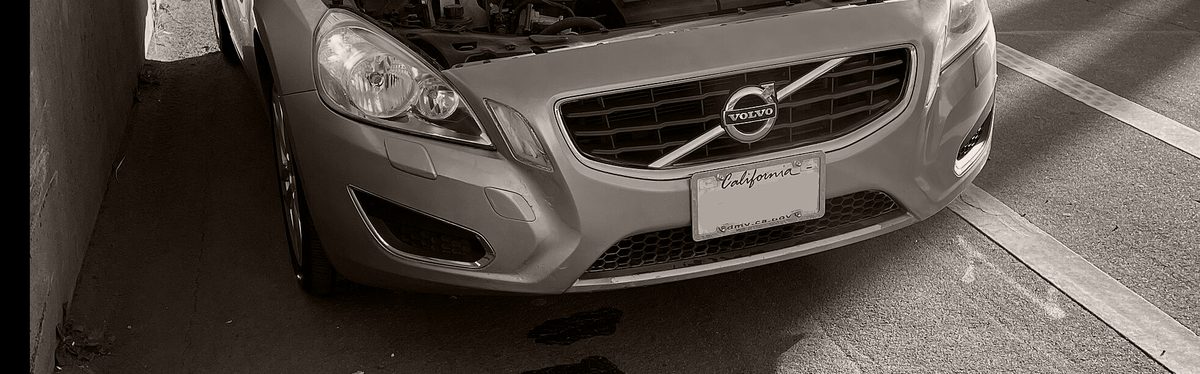
A car smoking under the hood means coolant, oil or another fluid is landing on a hot engine part, or wiring is overheating, and the parts behind it cost $5.04 to $879 on the cars we priced. Pull over and switch the engine off, because wiring insulation and engine-bay fluids are the two things national fire reports most often name as the first to catch fire in a vehicle fire.
Smoke curling out from under the hood gets every driver's full attention, and it should. A car smoking under the hood means something is landing on a part hot enough to cook it: coolant, oil, another fluid, or the plastic coating on a wire.
Here's what the guides we read leave out: in one carmaker's recalls, an oil fire started with low coolant. The warning signs it gave owners were a coolant leak, an overheat message and a coolant tank that kept needing a top-off, all before any smoke.
So the color, the smell and what happened last week, an oil change or a coolant top-off, tell you which kind of smoke you have. This page covers how to tell them apart, when to stop, what causes each one and what the parts cost.
What is coming from under your hood?
Just want the price? See what the parts cost.
Why is my car smoking under the hood?
Your car smokes under the hood because a fluid lands on a hot part, or because an electrical part gets hot enough to burn its own insulation. The hot parts named in carmakers' fire recalls are the exhaust manifold, the catalytic converter and the turbocharger, the metal the hot exhaust gas passes through.
That gives three families of smoke, and each one points to different parts. Here's what burns when a car smokes under the hood, with the parts the documents name:
- Coolant, which makes steamCoolant is the water and antifreeze mix that carries heat away from the engine. A split hose, a cracked radiator or a leaking coolant tank sprays it onto hot metal, where it boils into a white cloud.
- Oil and other fluidsOil seeping from a gasket on top of the engine runs down onto the exhaust and burns. Power-steering fluid and transmission fluid do the same when a hose leaks near the exhaust.
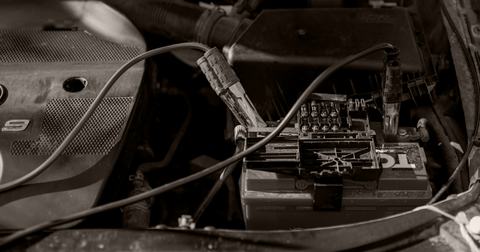
- Wiring and electrical partsA short circuit heats the wire's plastic coating until it smokes. Carmakers' recalls also name a failing alternator, the part that charges the battery, and a battery that shifted and shorted.

Use this image
Free to republish under CC BY 4.0: credit Oil & Miles and link to this page. The snippet does both.
<a href="https://oilandmiles.com/articles/car-smoking-under-hood"><img src="https://oilandmiles.com/assets/img/diagrams/car-smoking-under-hood-suv-bench.svg" alt="Diagram of the front of an engine bay drawn see-through with the hood off, numbered by where a car smoking under the hood starts: 1 the valve cover gasket and 2 the exhaust manifold, the hot metal the oil lands on, in orange; 3 a radiator hose and the coolant tank in blue; 4 the battery and its wiring and 5 the alternator in red." width="1200" height="903"></a> <p>Diagram: <a href="https://oilandmiles.com/articles/car-smoking-under-hood">Oil & Miles</a>, CC BY 4.0</p>Smoke coming from the tailpipe, not the hood, is a separate question with its own answer on our white smoke from exhaust page. A smell with no visible smoke is covered on our burning smell page.
What the data says
We counted 3,263 complaints to NHTSA, the federal safety agency, that describe smoke or steam at the hood or engine on 2010 to 2025 models. In 1,818 of them, NHTSA's own record marks a fire.
Where the complaint names a source, wiring and electrical parts come up in 897, oil in 667 and coolant or steam in 604. A complaint can name more than one, and 1,386 name none of them.
Figures: NHTSA complaint files, counted October 2, 2026. A complaint counts when a word for smoke or steam sits within 120 characters of under the hood, from the hood, hood area, engine compartment, engine bay, from the engine or under the engine, each complaint once.
Is it safe to drive with smoke coming from the hood?
No: pull over as soon as it's safe and switch the engine off. Smoke means something is burning or boiling, and no carmaker document we read gives a distance you can drive with it.
The risk is a fire: US fire departments responded to about 215,096 vehicle fires a year from 2018 to 2022. In fires on the road, the items that most often catch fire first are wiring insulation, at 26%, and flammable liquid in or from the engine, at 18%.
Those two are exactly what smokes under a hood, and NHTSA marked 1,818 of the federal complaints we counted as involving a fire. Nothing you can see from the driver's seat tells a harmless wisp from the start of one, so stop the car at once in any of these cases:
- Steam with a temperature gauge in the redToyota's owner's manual lists steam from under the hood as an overheating sign and says to stop the car and switch off.
- Smoke from the wiring, battery or alternatorWire insulation is the item most often first to burn in fires on the road, so smoke there with no fluid to explain it is a reason to stop.
- Smoke that gets thicker, or any flameThe US Fire Administration says to get everyone out, move at least 100 feet away and call 911.
If the gauge sits in the middle and the smoke stops once the car is parked, you have a little time to look. You still don't have a diagnosis, and the steps below come before any decision to drive on.
Fire figures3 sources
- NFPA, Vehicle Fires, November 2024An estimated 215,096 vehicle fires a year, 2018 to 2022 annual average, page 1; in highway vehicle fires the item first ignited was electrical wire or cable insulation in 26% and flammable liquid or gas in or from the engine in 18%, Supporting Tables, Table 13a.
- US Fire Administration, Topical Fire Report v19i2, July 201862% of highway vehicle fires started in the engine, running gear or wheel area, 2014 to 2016 annual average, page 1.
- 2019 Toyota Camry owner's manual, publication OM06142UOverheating signs include "Steam comes out from under the hood"; the steps are to stop in a safe place, turn off the air conditioning, then stop the engine, page 534.
What should you do when smoke comes from under the hood?
Stop, switch off and keep the hood shut until the smoke or steam has stopped. Opening it can make a fire grow, the US Fire Administration warns, and lets out a blast of steam if the coolant is boiling.
The documents we read put the first minutes in a clear order: stop, switch off, check for fire, then leave the hood and caps alone until it cools. Here's what to do when smoke comes from under the hood, in the 6 steps below, in order:
- Pull over where it's safe. Get off the road and away from traffic, then stop the car; Toyota's manual says to stop in a safe place.
- Turn the air conditioning off, then the engine. That's the order in Toyota's manual for an overheating car, and it stops the engine feeding heat and fluid to the problem.
- Look for flame or thickening smoke. If you see either, get everyone out, move at least 100 feet away and call 911, as the US Fire Administration advises.
- Leave the hood shut while steam is coming out. Toyota's manual says to lift it only after the steam has stopped, because the engine compartment may be very hot.
- Never open the radiator cap or coolant tank cap hot. Toyota warns that steam or coolant at high temperature can spray out of either one.
- Look before you drive anywhere. With the hood up and the engine cool, check the coolant tank level, wet hoses, oil on the engine and puddles under the car, then decide with the next section.
If the steam won't stop, wait it out with the hood shut. If the coolant tank is empty or you can't see a cause, call for a tow rather than restart a car that may be low on coolant.
If the smoke came from a fresh oil spill and stopped on its own, that's the one case where the documents point to a simple cause. The oil-change section below shows how to tell a spill from a leak.
How do you tell steam from oil smoke from electrical smoke?
Look under the car once it's parked, because the puddle is the clearest clue. None of the documents we read sorts smoke by its color, but Fel-Pro, a gasket maker, publishes the fluid colors, and coolant has a sweet smell.
Match what you find to the smoke you saw. Here's how to tell what is smoking under your hood from the puddle and the smell, one source at a time:
- Steam with a sweet smellCoolant boiling on a hot part. The puddle is green, yellow or orange, and the coolant tank reads low once the engine has cooled.
- Smoke with brown oil underneathOil on the exhaust; look for wet oil on the engine too. The puddle, if any, is light brown when the oil is new and dark brown when it's old.
- Smoke with red fluid underneathPower-steering or transmission fluid. Fel-Pro places a power-steering leak toward the front of the car and a transmission leak near the front or middle.
- Smoke with no puddle at allPossibly wiring or an electrical part. There's no puddle to find, and a battery saver warning light may come on, as one alternator recall describes.
A puddle of clear water on a hot day is the air conditioning dripping, Fel-Pro notes, which makes it the one puddle on this page that's good news. Laying a sheet of white cardboard under the engine overnight shows the color better than dark pavement does.
Fel-Pro warns that coolant's sweet smell and taste make it dangerous to pets, so clean up any green or orange puddle. Our coolant leak guide shows where coolant escapes and how to find it.
Fluid colors1 guide
- Fel-Pro, Car Leak Color GuideBrown is motor oil, "light brown" new and "dark brown" old; red is transmission or power steering; orange or amber is extended-life coolant; green is antifreeze, which is "poisonous and dangerous to your pets because it has a sweet smell and taste"; clear water on a hot day is air conditioning condensation; white cardboard under the car shows the color.
Why is my car smoking under the hood but not overheating?
A car smokes with a normal gauge because a leak, not a boiling engine, is putting fluid on hot metal. The documents point to fluid landing on the hot exhaust from outside the engine, and these are the leaks they name:
1. Valve cover gasket
The valve cover is the lid on top of the engine, and a gasket seals it. Fel-Pro calls this gasket perhaps the most common source of engine oil leaks, because the gasket loses its elasticity over time and the lid can warp.
The leaking oil runs down onto the exhaust manifold and burns before it reaches the ground, so you smell it and see smoke without finding a puddle. Fel-Pro warns against tightening the lid's bolts to stop it, because that can bend the lid and make the leak worse.
2. A coolant leak the gauge hasn't caught
A small split in a hose or a crack in the coolant tank can spray coolant onto hot metal while there's still enough left to keep the engine cool. The steam can show up before the gauge moves.
That makes the coolant tank level the thing to check, not the gauge. Ford's recall warning signs for its 1.6-liter engine include a low level in the coolant tank and repeatedly refilling it, as the low-coolant section below explains.
3. Power-steering or transmission fluid
Both fluids travel through hoses, and where a hose passes close to a hot part, a leak lands right on it. General Motors (GM) recalled one sedan because a power-steering hose could touch the catalytic converter, melt and spill fluid onto it.
GM's fix on those cars was to check the hose's routing, replace it if it was misrouted and add a protective sleeve. On any car, a wet hose near the exhaust and red fluid underneath are the things to point out to the shop.
A slipping drive belt gives off a hot-rubber smell without the engine running hot. That's one of the smells on our burning smell page, along with the rest of the engine-bay smells.
Leaks onto hot parts4 documents
- Fel-Pro, Causes of Oil LeaksThe valve cover gasket is "perhaps the most common source of engine oil leaks"; "we recommend against trying to tighten the cover's fasteners."
- 2012 Chevrolet Impala, built April 19 to July 29, 2011"Heat from the catalytic converter may melt the power steering hose," and the fluid on the converter could start a fire; 10,344 cars, GM bulletin 11224, recall 11V-398, August 2011.
- 2014 Escape, 2013 to 2014 Fusion, 2014 to 2015 Fiesta ST, 2013 to 2015 Transit Connect, 1.6LWarning signs include "repeatedly refilling coolant, or a low level in the coolant bottle," Ford recall 17V-209, March 2017, page 3.
- 2012 to 2016 Kia Soul 1.6LAn overheating catalytic converter could damage a piston until "Engine oil that contacts a hot exhaust surface may result in a fire"; warning signs are the check engine light or engine knocking; 378,967 vehicles, Kia recall 19V-120, February 2019, pages 1 and 2.
Why does a car smoke under the hood after an oil change?
A car smokes after an oil change because oil ran down the outside of the engine during the fill, a small extra the engine never asked for, now burning off the hot exhaust. A little smoke that fades with each drive is the spill; smoke that keeps coming, or gets heavier, means oil is still escaping or collecting somewhere hot.
The collecting is the less obvious part. GM recalled the Chevrolet Cruze compact after oil and other hot fluid dripped into the plastic shield under the engine and pooled there, starting about 30 fires.
GM traced most of those fires to the way the oil change was done or the parts used. So after an oil change, smoke that doesn't fade is worth a second visit, and the shop should check both:
- Spilled oil on the engine and in the shieldOil spilled during the change can sit in the plastic belly pan under the engine, as it did in the recalled Cruzes, and keep smoking until it's cleaned out.
- The filter and drain plug fittedAsk whether both are the right parts for your engine and whether either is weeping oil after a drive.
Nothing we read puts a number of days on how long a spill should smoke, so judge by direction: less each drive is a spill, the same or more is a leak. Our oil change light page covers what the reminder on your dash is counting.
Oil-change fires1 recall
- 2011 to 2012 Chevrolet Cruze, US-builtThe engine shield "can 'catch' oil or other hot fluids," and "GM engineers are aware of about 30 fires – most traced to improper oil change procedures and parts"; 413,148 cars, fix about 30 minutes to modify the shield, GM recall 12V-288, 2012, pages 1 and 2.
Can low coolant start an engine fire?
Yes, on some engines, and none of the smoke guides we read mention it. Low coolant lets part of the engine overheat; if the metal cracks, oil can escape under pressure onto hot parts and catch fire.
Ford documented exactly that on its 1.6-liter turbo engine, recalling it twice. Its finding was that the engine had to be badly low on coolant when started cold, and the cylinder head, the top of the engine, could then heat fast and crack.
The useful part for every driver is the warning list, because it comes long before smoke. Ford named these signs that low coolant could lead to overheating, which you can watch for on any car:
- A visible coolant leakDrips or a crust of dried coolant around hoses, the radiator or the tank.
- An engine overheat warningA message or light on the dash, even if it goes away after a while.
- Refilling the coolant again and againCoolant shouldn't disappear between services, so a tank that keeps needing a top-off has a leak somewhere.
- A low level in the coolant tankBelow the MIN mark when the engine is cold is the point Ford told dealers to pressure-test the system.
A coolant tank that keeps drifting low is easy to shrug off, since the car drives exactly the same. The recalls show why it's worth not shrugging off: the smoke can come later, and from a different fluid.
Coolant runs in a sealed loop, so a level that keeps falling means it's escaping somewhere. Our page on whether coolant evaporates explains why it shouldn't go down.
Ford 1.6L recalls2 recalls
- 2013 Ford Escape 1.6L"Localized overheating of the engine cylinder head may cause the cylinder head to crack causing an oil leak that may result in a fire in the engine compartment"; 139,917 vehicles; owners told to keep the coolant level up, and dealers to pressure-test any tank below "MIN"; Ford recall 13V-583, November 2013 and January 2014.
- 2014 Escape, 2013 to 2014 Fusion, 2014 to 2015 Fiesta ST, 2013 to 2015 Transit Connect, 1.6LRequires "a coolant loss well below the minimum level" at a cold start; "26 reports of underhood fires with a cracked cylinder head" by March 17, 2017; 208,584 vehicles; Ford recall 17V-209, March 2017, page 3.
How much does it cost to fix smoke from under the hood?
The parts behind the smoke on this page cost $5.04 to $879 on the seven cars we priced, from a valve cover gasket to an alternator. The cars are the six models with the most federal complaints about smoke from the hood, each at its peak model year, plus the Cruze from GM's oil-change fire recall.
What it costs
What this box shows
Prices for this repair, drawn from the sources named at the foot of the box. Each figure states whether it covers the part alone or parts and labor. The cars priced are the six models with the most federal complaints about smoke from the hood, plus the 2011 to 2012 Cruze from GM's oil-change fire recall.
Car smoking under hood: parts cost by car
One failed part, part only, so no total. Labor depends on the car and the part.
| Valve cover gasketOil smoke: the lid's seal leaks onto the exhaust.2011 Sonata 2.4L · $9.66 to $22, 2013 Optima 2.4L · $7.83 to $22, 2014 Escape 1.6L turbo · $5.04 to $25, 2016 Sorento 2.4L · $13 to $76, 2014 Soul 1.6L · $12 to $45, 2012 Grand Cherokee 3.6L, one side or set · $8.55 to $68, 2012 Cruze 1.4L turbo · $8.96 to $31, | $5.04 – $76Part only, at the counter |
|---|---|
| Radiator hoseSteam: a split hose sprays coolant. Upper and lower differ.2011 Sonata 2.4L · $17 to $29, 2013 Optima 2.4L · $17 to $29, 2014 Escape 1.6L turbo · $27 to $68, 2016 Sorento 2.4L · $23 to $34, 2014 Soul 1.6L · $14 to $30, 2012 Grand Cherokee 3.6L · $13 to $34, 2012 Cruze 1.4L turbo · $20 to $43, | $13 – $68Part only, at the counter |
| Coolant tankSteam: a cracked tank leaks coolant. Not priced for the Soul.2011 Sonata 2.4L · $15, 2013 Optima 2.4L · $15, 2014 Escape 1.6L turbo · $15 to $26, 2012 Grand Cherokee 3.6L · $23 to $111, 2012 Cruze 1.4L turbo · $10 to $44, | $10 – $111Part only, at the counter |
| AlternatorElectrical smoke. Rebuilt units add a refundable core charge.2011 Sonata 2.4L · $143 to $269, 2013 Optima 2.4L · $143 to $269, 2014 Escape 1.6L turbo · $162 to $311, 2016 Sorento 2.4L · $78 to $310, 2014 Soul 1.6L · $146 to $245, 2012 Grand Cherokee 3.6L, Mopar at the top · $160 to $879, 2012 Cruze 1.4L turbo · $148 to $285, | $78 – $879Part only, at the counter |
Part prices are every listing RockAuto shows for each car and part, read October 2, 2026. Left out: listings out of stock, which is every coolant tank listed for the 2016 Sorento, and closeouts.
The cheapest part on that list is a valve cover gasket, and the dearest is an alternator from the carmaker's own parts brand. A V6 like the Grand Cherokee's has two valve covers, so its listings mix gaskets for one side with sets that may cover both.
We didn't find carmaker book times, the hours a carmaker allots for a job, for these repairs in the documents we read, so labor isn't in the box. Ask the shop for its diagnosis fee and the labor hours before work starts, and check our valve cover gasket cost page for that job in detail.
A recall repair costs you nothing at a dealer, and several of the fires on this page led to one. Our free VIN decoder reads the vehicle identification number on your dash and lists the recalls NHTSA has for your model year.
Use this image
Free to republish under CC BY 4.0: credit Oil & Miles and link to this page. The snippet does both.
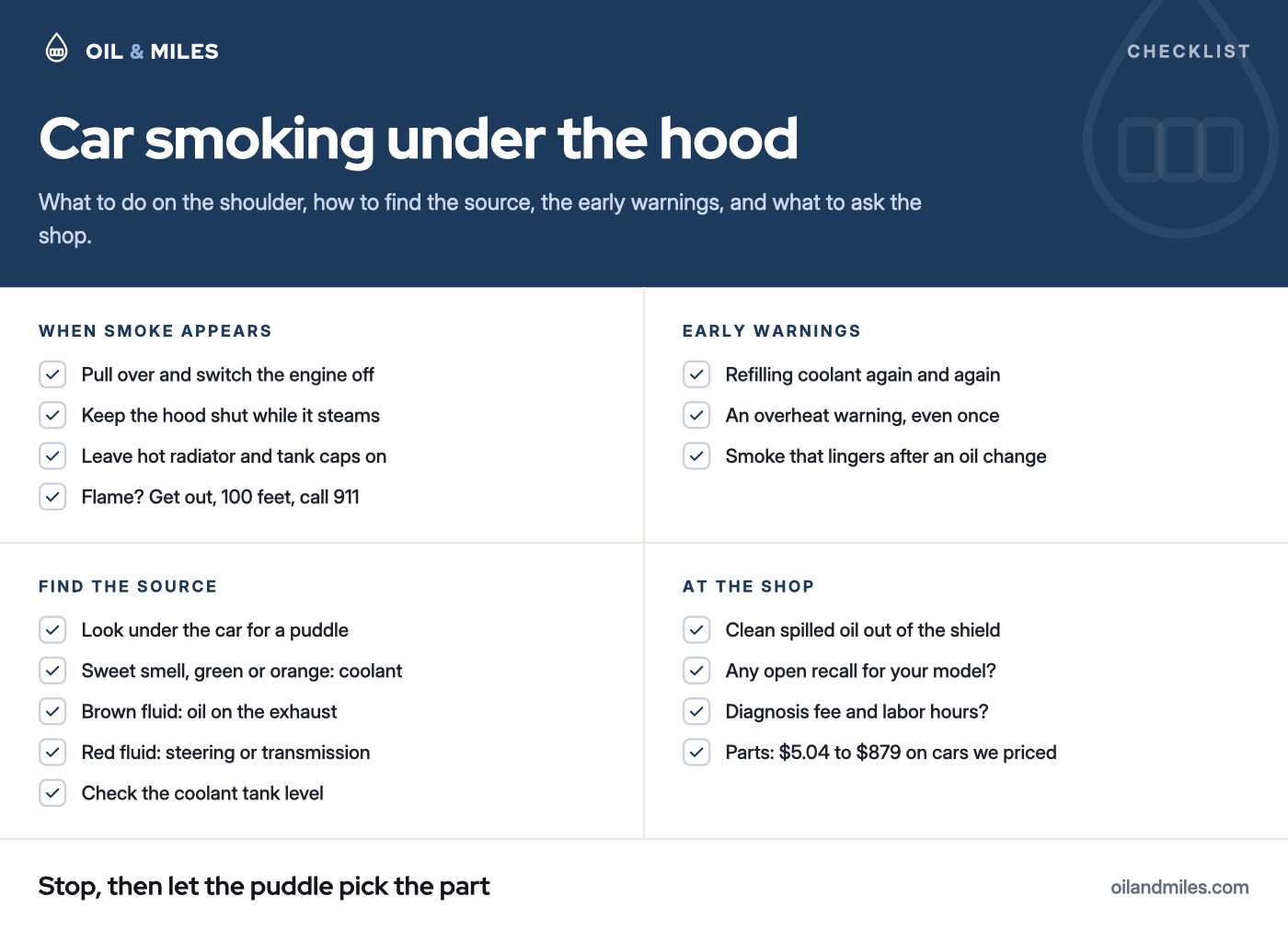
<a href="https://oilandmiles.com/articles/car-smoking-under-hood"><img src="https://oilandmiles.com/assets/img/diagrams/car-smoking-under-hood-checklist.jpg" alt="Checklist for a car smoking under the hood: pull over and switch off, keep the hood and hot caps shut, get out and call 911 if there's flame; read the puddle color and check the coolant tank once cool; watch for a dropping coolant tank, an overheat warning and smoke that lingers after an oil change; ask about recalls, cleaning out spilled oil and the labor hours." width="1200" height="868"></a> <p>Infographic: <a href="https://oilandmiles.com/articles/car-smoking-under-hood">Oil & Miles</a>, CC BY 4.0</p>From the documents
What carmakers' recalls say about smoke from under the hood
Three recalls show the three routes to an engine-bay fire, and each one started with a sign a driver could notice. Each was written for particular models, so the details are examples.
Ford recall 17V-209
A cracked cylinder head can result in a pressurized oil leak.Ford Motor Company, March 2017
GM recall 12V-288
This occurs most often if an oil change is done improperly or improper parts are used.General Motors, 2012
FCA recall 17V-435
Failed diodes may also develop a resistive short circuit that can result in heat, smoke and/or fire originating within the alternator.FCA US, July 2017
We read all three as one message: the smoke is the late sign. A dropping coolant tank, a recent oil change and, on some of the recalled cars, a battery saver warning light came first.
Conclusion
Read the smoke, then stop
Smoke from under the hood is a fluid or a wire meeting heat, and the documents agree on stopping first. Here's what to take from this page about a car smoking under the hood:
- Pull over and switch off at once.No document we read gives a distance you can drive, and wiring and engine-bay fluids are what catch fire first most often.
- Keep the hood shut while it steams or smokes.Toyota says to wait for steam to stop, and the US Fire Administration says not to open a hood with a fire under it.
- The puddle names the fluid.Coolant smells sweet, and the colors tell the rest: green or orange for coolant, brown for oil, red for steering or transmission fluid.
- A dropping coolant tank is an early warning.Ford's recalls tie low coolant to cracked heads and oil fires, well before any smoke appears.
- Parts run $5.04 to $879 on the cars we priced.A valve cover gasket sits at the bottom of that range and an alternator at the top.
So stop, smell and look, then let the color of the puddle pick the part. Oil & Miles reads the carmakers' recalls so you know what to ask the shop.
Common questions
Asked most often
Is it normal for a car engine to steam?
Not when the gauge is hot. Toyota's owner's manual lists steam from under the hood as a sign of overheating, so stop, switch off and keep the hood shut until it stops.
Can low oil cause smoke under the hood?
What smokes is the oil that escaped, dripping onto the hot exhaust, so a low level and smoke together point to a leak. Find where it's going before you add more.
What does white smoke from the hood mean?
A white cloud with a sweet smell is coolant boiling on a hot part. Check the coolant tank once the engine is cold, and don't open the radiator or tank cap while it's hot.
Can I drive my car if it's steaming?
Not until you know why. If the coolant tank is empty or you can't find the leak, have it towed, because Ford found an engine badly low on coolant can overheat enough to crack the cylinder head.
Is my engine ruined if it overheats?
Not necessarily, and none of the documents we read says one overheat ruins an engine. The damage Ford documented came from driving with coolant far below the minimum, which cracked the cylinder head.
Why is there smoke coming from under my hood after I parked?
Fluid that leaked onto the exhaust keeps burning until the metal cools, so smoke can drift out after you stop. The smell and the puddle color tell you which fluid it is.
What people ask next
Sources
- Ford recall 17V-209, March 2017, for the low-coolant fire chain, the warning signs and the 26 fires, and Ford recall 13V-583 with its January 2014 update, for the 2013 Escape and the coolant check. NHTSA recall archive, read October 2, 2026
- GM recall 12V-288, owner questions and answers, for the Cruze engine shield, the 30 fires and the 30-minute fix. NHTSA recall archive, read October 2, 2026
- GM bulletin 11224, recall 11V-398, August 2011, for the Impala power-steering hose. NHTSA recall archive, read October 2, 2026
- FCA recall 17V-435, July 2017, for the alternator short circuit and the vehicles covered, and Toyota recall 23V-734, November 2023, for the battery that shifted and shorted. NHTSA recall archive, read October 2, 2026
- Kia recall 19V-120, February 2019, for the Soul engine oil fire, and Kia recall 20V-750, December 2020, for its list of warnings. NHTSA recall archive, read October 3, 2026
- 2019 Toyota Camry owner's manual, publication OM06142U, pages 534 to 536, for the overheating signs and steps and the warnings on the hood and caps. Read October 3, 2026
- US Fire Administration, Vehicle Fire Safety, for what to do if there's a fire, and its Topical Fire Report v19i2, July 2018, for where vehicle fires start. Read October 2, 2026
- NFPA, Vehicle Fires and its Supporting Tables, November 2024, for the 2018 to 2022 annual average and the items first ignited. NFPA, read October 2, 2026
- Fel-Pro, Car Leak Color Guide and Fel-Pro, Causes of Oil Leaks, for the fluid colors and the valve cover gasket. Read October 2, 2026
- NHTSA complaint files, for the 3,263 complaints about smoke or steam at the hood and the 1,818 marked as a fire. Downloaded October 2, 2026
- RockAuto, every listing for the parts and cars in the cost box. Read October 2, 2026
- Repair shop and dealer blogs, a parts seller's blog and owner forums that rank for these searches, read to see what drivers are told; nothing in this article is taken from them. Read October 2, 2026
How this was compiled
The sections cover what the smoke means, whether to drive, what to do, smoke with a normal gauge and smoke after an oil change. The cars priced are the six models with the most federal complaints about smoke from the hood, plus the 2011 to 2012 Cruze from GM's oil-change fire recall.
Every price is a part price at the counter, one listing at a time. The complaint count was made by a script we kept, so it can be run again on newer files.
What we didn't do
We didn't inspect or test a car. The causes, warnings and steps come from carmakers' recalls, an owner's manual, federal fire reports and a parts maker's guides, and none of them gives a number of miles you can safely drive with smoke from the hood.
We didn't price labor, because none of the documents we read prints a book time for the repairs priced here; the recall documents list only the dealer's time for the recall fix. Kia's recall 20V-750 lists smoke and a burning smell as warnings for several models, but Kia names no single cause, so we left it out of the causes here.
The Mazda CX-5 shows a cluster of oil-smoke complaints for 2018 and 2019, and fuel comes up in 95 of all the complaints we counted, but we found no recall or bulletin behind either, so neither is named as a cause.
Prices are ranges compiled in October 2026 for the US market and vary by region, engine and shop rate. Prices from $10 up are rounded to the nearest dollar, so $14.13 reads as $14 and $14.52 as $15. Below $10 they're exact. This article is general information, not advice about your specific vehicle. See the disclaimer.
Valve cover gasket
2011 Hyundai Sonata 2.4L L4
| Brand | Part | Price |
|---|---|---|
| APEX | AVC1335S | $9.66 |
| HYUNDAI | 224412G710 | $13 |
| MAHLE / CLEVITE | VS50554 | $14 |
| VS50723 | $22 | |
| BECK/ARNLEY | 0362007 | $15 |
| AJUSA | 11123800 | $16 |
| VICTOR REINZ | 151077201 | $16 |
Valve cover gasket
2013 Kia Optima 2.4L L4
| Brand | Part | Price |
|---|---|---|
| ULTRA-POWER | VS50554 | $7.83 |
| APEX | AVC1335S | $9.66 |
| HYUNDAI | 224412G710 | $13 |
| FEL-PRO | VS50869R | $14 |
| MAHLE / CLEVITE | VS50554 | $14 |
| VS50723 | $22 | |
| BECK/ARNLEY | 0362007 | $15 |
| AJUSA | 11123800 | $16 |
| VICTOR REINZ | 151077201 | $16 |
| ELRING | 527170 | $17 |
Valve cover gasket
2014 Ford Escape 1.6L L4 Turbocharged
| Brand | Part | Price |
|---|---|---|
| APEX | AVC1332 | $5.04 |
| FEL-PRO | VS50872R | $8.49 |
| VICTOR REINZ | 713772700 | $11 |
| MAHLE / CLEVITE | VS50746 | $12 |
| VS50748 | $25 |
Valve cover gasket
2016 Kia Sorento 2.4L L4
| Brand | Part | Price |
|---|---|---|
| BECK/ARNLEY | 0362097 | $13 |
| AJUSA | 11123800 | $16 |
| 11166000 | $35 | |
| ELRING | 527170 | $17 |
| APEX | AVC1397 | $19 |
| MAHLE / CLEVITE | VS50892 | $26 |
| HYUNDAI | 224412GGB0 | $76 |
Valve cover gasket
2014 Kia Soul 1.6L L4
| Brand | Part | Price |
|---|---|---|
| ELRING | 547460 | $12 |
| 650350 | $15 | |
| 329910 | $17 | |
| BECK/ARNLEY | 0362010 | $14 |
| APEX | AVC1326S | $23 |
| MAHLE / CLEVITE | VS50736 | $42 |
| FEL-PRO | VS50818R | $45 |
Valve cover gasket
2012 Jeep Grand Cherokee 3.6L V6
| Brand | Part | Price |
|---|---|---|
| VICTOR REINZ | 711035900 | $8.55 |
| 711035800 | $8.59 | |
| 151048901 | $68 | |
| ULTRA-POWER | VS50805R | $27 |
| APEX | AVC1312S | $30 |
| AJUSA | 56058300 | $47 |
| 56058400 | $47 | |
| BECK/ARNLEY | 0362047 | $54 |
| MAHLE / CLEVITE | VS50657 | $54 |
| FEL-PRO | VS50805R | $60 |
Valve cover gasket
2012 Chevrolet Cruze 1.4L L4 Turbocharged
| Brand | Part | Price |
|---|---|---|
| ULTRA-POWER | VS50807R | $8.96 |
| APEX | AVC1198S | $10 |
| VICTOR REINZ | 151042101 | $13 |
| 711781300 | $22 | |
| FEL-PRO | VS50807R | $14 |
| MAHLE / CLEVITE | VS50710 | $15 |
| ELRING | 691370 | $23 |
| 773410 | $31 | |
| GM GENUINE | 25198753 | $24 |
| AJUSA | 11125100 | $31 |
Radiator hose
2011 Hyundai Sonata 2.4L L4
| Brand | Part | Price |
|---|---|---|
| CONTINENTAL | 66660 | $17 |
| 66691 | $27 | |
| DAYCO | 72559 | $18 |
| 72558 | $27 | |
| GATES | 23901 | $19 |
| 23906 | $29 | |
| ACDELCO | 27087X | $20 |
| 27092X | $27 |
Radiator hose
2013 Kia Optima 2.4L L4
| Brand | Part | Price |
|---|---|---|
| CONTINENTAL | 66660 | $17 |
| 66691 | $27 | |
| DAYCO | 72559 | $18 |
| 72558 | $27 | |
| GATES | 23901 | $19 |
| 23906 | $29 | |
| ACDELCO | 27087X | $20 |
| 27092X | $27 |
Radiator hose
2014 Ford Escape 1.6L L4 Turbocharged
| Brand | Part | Price |
|---|---|---|
| DORMAN | 626743 | $27 |
| DAYCO | 72784 | $35 |
| 72783 | $47 | |
| GATES | 24414 | $36 |
| 24399 | $49 | |
| CONTINENTAL | 67109 | $46 |
| 67098 | $55 | |
| MOTORCRAFT | KM5130 | $46 |
| KM5127 | $68 |
Radiator hose
2016 Kia Sorento 2.4L L4
| Brand | Part | Price |
|---|---|---|
| DAYCO | 72937 | $23 |
| 72938 | $28 | |
| CONTINENTAL | 66605 | $25 |
| GATES | 24866 | $29 |
| 24649 | $34 |
Radiator hose
2014 Kia Soul 1.6L L4
| Brand | Part | Price |
|---|---|---|
| CONTINENTAL | 62874 | $14 |
| 66887 | $16 | |
| 62659 | $21 | |
| GATES | 24909 | $16 |
| 24910 | $26 | |
| 24880 | $27 | |
| DAYCO | 72925 | $24 |
| 72890 | $29 | |
| 72924 | $30 |
Radiator hose
2012 Jeep Grand Cherokee 3.6L V6
| Brand | Part | Price |
|---|---|---|
| GATES | 23687 | $13 |
| 23690 | $15 | |
| CONTINENTAL | 66838 | $13 |
| 66837 | $13 | |
| DAYCO | 72538 | $14 |
| 72539 | $14 | |
| ACDELCO | 24691L | $20 |
| 27024X | $21 | |
| MOPAR | 55038121AD | $32 |
| 55038022AB | $34 |
Radiator hose
2012 Chevrolet Cruze 1.4L L4 Turbocharged
| Brand | Part | Price |
|---|---|---|
| CONTINENTAL | 67291 | $20 |
| 66629 | $26 | |
| ACDELCO | 22835M | $23 |
| 13251435 | $29 | |
| 22705L | $33 | |
| 13291779 | $43 | |
| DAYCO | 72767 | $24 |
| 72714 | $34 | |
| GATES | 24337 | $26 |
| 23800 | $35 |
Coolant tank
2011 Hyundai Sonata 2.4L L4
| Brand | Part | Price |
|---|---|---|
| TECHPRO | HY3014110 | $15 |
Coolant tank
2013 Kia Optima 2.4L L4
| Brand | Part | Price |
|---|---|---|
| TECHPRO | HY3014110 | $15 |
Coolant tank
2014 Ford Escape 1.6L L4 Turbocharged
| Brand | Part | Price |
|---|---|---|
| SKP | SK603382 | $15 |
| AUTOTECNICA | FD0713622 | $21 |
| GPD | 2411088 | $22 |
| VARIOUS MFR | FO3014109 | $23 |
| DORMAN | 603382 | $26 |
| TECHPRO | FO3014109 | $26 |
Coolant tank
2012 Jeep Grand Cherokee 3.6L V6
| Brand | Part | Price |
|---|---|---|
| GPD | 2411301 | $23 |
| VARIOUS MFR | CH3014133 | $32 |
| TECHPRO | CH3014133 | $32 |
| DORMAN | 603630 | $61 |
| MOPAR | 5165708AA | $111 |
Coolant tank
2012 Chevrolet Cruze 1.4L L4 Turbocharged
| Brand | Part | Price |
|---|---|---|
| SKP | SK603383 | $10 |
| AUTOTECNICA | CE0713621 | $17 |
| DORMAN | 603383 | $21 |
| GPD | 2411089 | $22 |
| TECHPRO | GM3014150 | $36 |
| NISSENS | 996224 | $43 |
| GM GENUINE | 13465094 | $44 |
Alternator
2011 Hyundai Sonata 2.4L L4
| Brand | Part | Price |
|---|---|---|
| FVP | 15598plus $44 core charge | $143 |
| TERREPOWER | 11491plus $34 core charge | $150 |
| N11491 | $216 | |
| PURE ENERGY | 15598plus $72 core charge | $150 |
| 15598N | $171 | |
| REMY | 11066plus $73 core charge | $157 |
| 94343 | $210 | |
| BOSCH | AL4102Xplus $62 core charge | $192 |
| HL MANDO | 11A1351 | $198 |
| ACDELCO | 3342709plus $54 core charge | $205 |
| VALEO | 849101 | $249 |
| WAI GLOBAL | 11491N | $269 |
Alternator
2013 Kia Optima 2.4L L4
| Brand | Part | Price |
|---|---|---|
| FVP | 15598plus $44 core charge | $143 |
| TERREPOWER | 11491plus $34 core charge | $150 |
| N11491 | $216 | |
| PURE ENERGY | 15598plus $72 core charge | $150 |
| 15598N | $171 | |
| REMY | 11066plus $73 core charge | $157 |
| 94343 | $210 | |
| BOSCH | AL4102Xplus $62 core charge | $192 |
| HL MANDO | 11A1351 | $198 |
| ACDELCO | 3342709plus $54 core charge | $205 |
| DENSO | 2116030 | $240 |
| VALEO | 600878 | $246 |
| WAI GLOBAL | 11491N | $269 |
Alternator
2014 Ford Escape 1.6L L4 Turbocharged
| Brand | Part | Price |
|---|---|---|
| TERREPOWER | 12884plus $34 core charge | $162 |
| 11636plus $34 core charge | $165 | |
| REMY | 23026plus $67 core charge | $167 |
| 23025plus $73 core charge | $173 | |
| FVP | 10256plus $44 core charge | $180 |
| 11636plus $44 core charge | $185 | |
| PURE ENERGY | 10256plus $50 core charge | $181 |
| 11636plus $50 core charge | $186 | |
| ACDELCO | 3343119plus $50 core charge | $184 |
| BOSCH | AL7683Xplus $56 core charge | $184 |
| AL7585Xplus $75 core charge | $222 | |
| TYC | 212884 | $206 |
| WAI GLOBAL | 11636N | $240 |
| 12884N | $250 | |
| VALEO | 501823 | $244 |
| MOTORCRAFT | GL8672plus $75 core charge | $275 |
| GL8785plus $75 core charge | $311 |
Alternator
2016 Kia Sorento 2.4L L4
| Brand | Part | Price |
|---|---|---|
| ACDELCO | 3343086plus $47 core charge | $78 |
| SKP | SK10275 | $141 |
| TYC | 211953 | $166 |
| TERREPOWER | 42064plus $34 core charge | $194 |
| N42064 | $246 | |
| PURE ENERGY | 10275plus $50 core charge | $209 |
| BOSCH | AL4118Xplus $50 core charge | $210 |
| AL4118N | $262 | |
| FVP | 10275plus $44 core charge | $216 |
| REMY | 94476 | $279 |
| WAI GLOBAL | 11953N | $310 |
Alternator
2014 Kia Soul 1.6L L4
| Brand | Part | Price |
|---|---|---|
| TERREPOWER | 11609plus $34 core charge | $146 |
| 11608plus $34 core charge | $150 | |
| TYC | 211609 | $150 |
| REMY | 11086plus $73 core charge | $151 |
| 11079plus $73 core charge | $157 | |
| PURE ENERGY | 10136plus $50 core charge | $158 |
| FVP | 10136plus $44 core charge | $164 |
| WAI GLOBAL | 11609N | $180 |
| ACDELCO | 3343026plus $47 core charge | $201 |
| BOSCH | AL4094N | $221 |
| VALEO | 616144 | $239 |
| HL MANDO | 11A1089 | $245 |
Alternator
2012 Jeep Grand Cherokee 3.6L V6
| Brand | Part | Price |
|---|---|---|
| TYC | 211592 | $160 |
| 211598 | $160 | |
| TERREPOWER | 11598plus $34 core charge | $185 |
| 11572plus $34 core charge | $188 | |
| 11592plus $34 core charge | $196 | |
| N11572 | $240 | |
| N11592 | $276 | |
| REMY | 11075plus $73 core charge | $196 |
| 11069plus $45 core charge | $199 | |
| 11070plus $73 core charge | $206 | |
| 94188 | $293 | |
| 94189 | $313 | |
| BOSCH | AL6490Xplus $75 core charge | $203 |
| AL6483Xplus $55 core charge | $222 | |
| AL6491Xplus $111 core charge | $242 | |
| FVP | 11598plus $44 core charge | $206 |
| 11572plus $44 core charge | $209 | |
| 11592plus $44 core charge | $218 | |
| PURE ENERGY | 11598plus $40 core charge | $207 |
| 11572plus $40 core charge | $210 | |
| 11592plus $40 core charge | $219 | |
| DENSO | 2101227plus $73 core charge | $229 |
| 2101226plus $73 core charge | $258 | |
| 2101183plus $73 core charge | $278 | |
| WAI GLOBAL | 11598N | $246 |
| 11572N | $281 | |
| 11592N | $297 | |
| ACDELCO | 3342973plus $29 core charge | $258 |
| 3343120plus $50 core charge | $373 | |
| MOPAR | 4801779AGplus $75 core charge | $486 |
| 4801778AFplus $75 core charge | $629 | |
| 4801865ACplus $75 core charge | $879 |
Alternator
2012 Chevrolet Cruze 1.4L L4 Turbocharged
| Brand | Part | Price |
|---|---|---|
| TERREPOWER | 11654plus $34 core charge | $148 |
| REMY | 22034plus $73 core charge | $153 |
| TYC | 211654 | $164 |
| FVP | 11654plus $44 core charge | $167 |
| PURE ENERGY | 11654plus $50 core charge | $173 |
| SKP | SK211654 | $199 |
| ACDELCO | 3342979plus $46 core charge | $205 |
| GM GENUINE | 13597227 | $231 |
| WAI GLOBAL | 11654N | $240 |
| BOSCH | AL8852Xplus $50 core charge | $285 |