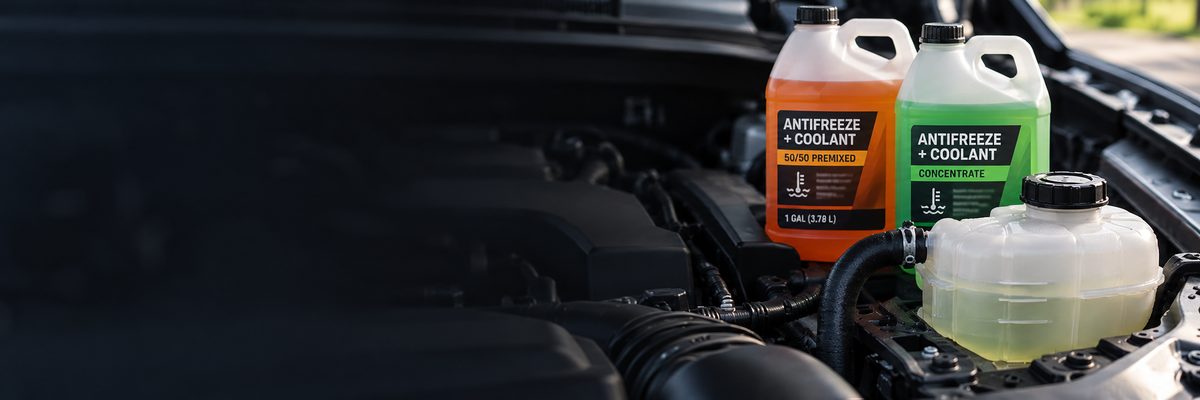

Coolant chart by carmaker
What each carmaker's own manual names, and where it says so.
| Maker | Coolant to look for, and where it's written |
|---|---|
| Toyota | Toyota Super Long Life Coolant Named in: 2012 Toyota Camry owner's manual |
| Honda | Honda Long Life Antifreeze/Coolant Type 2 Named in: 2025 Honda Pilot owner's manual |
| Chevrolet/ |
DEX-COOL meeting GM Standard GMW3420 Named in: 2020 Chevrolet Equinox owner's manual, p. 284, and GM bulletin PIP4482C |
| Ford | WSS-M97B code in the manual (Motorcraft Yellow today: WSS-M97B57) Named in: Ford coolant usage chart (Oct 22, 2025) and the owner's manual |
| Chrysler/ |
OAT coolant meeting MS.90032 Named in: 2015 Jeep Wrangler and 2022 Ram 2500 owner's manuals |
| Hyundai | Phosphate-based ethylene glycol Named in: 2025 Hyundai Tucson owner's manual |
| Kia | Phosphate-based ethylene glycol Named in: 2024 Kia Sportage owner's manual |
| Mazda | FL22, named on the cooling system cap Named in: Mazda bulletin 01-002/16 and the 2024 Mazda3 maintenance schedule |
| Nissan | Genuine Nissan Long Life Antifreeze/Coolant (blue) or equivalent Named in: 2020 Nissan Altima owner's manual |
| Subaru | Subaru Super Coolant only, top-ups included Named in: 2024 Subaru Forester owner's manual, pp. 464–465 |
| Volkswagen | G12evo today, and VW says it suits and mixes with every earlier VW coolant (except Routan). Older cars were filled with G13, G12++, G12+, G12 or G11. Named in: Volkswagen bulletin 19-17-01 |
A year, make and model lookup can miss what coolant your car needs. Ford sells two different coolants in the same yellow, and its chart splits a single F-150 model year by the day the truck was built.
What coolant does my car need and where is it written?
Your car's coolant is named in the owner manual and at the dealer parts desk, and the two aren't equally reliable. Start with the manual and treat the parts desk as a check on it.
1. The owner manual
The capacities and specifications chapter names a code or a licensed name, and Ford's maintenance page says as much: add prediluted coolant "meeting our specification," then see that chapter. Write that code on a card for the glove box, and take it to the parts counter with your VIN.
No paper manual in the car? Most carmakers publish the same book free online by model year, as the section on a missing specification shows.
2. The dealer parts desk, with your VIN and build date
Give the parts desk your VIN, the car's 17-character vehicle identification number, and the build date from the door jamb sticker. A year, make and model menu can't see the build date, and on Fords that date can change the allowed coolants.
Ask for the coolant specification, not just a part number. Then you can check any jug against it, wherever you buy it.
Worth knowing
The additives in the jug are what you're paying for. General Motors' 2012 Cruze manual warns that a coolant other than DEX-COOL "can cause premature engine, heater core, or radiator corrosion" and may need changing after 24 months instead of five years.
Do diesels and hybrids need anything extra?
Sometimes. The Ford chart says its coolant "applies to all engine types (e.g., gasoline and diesel)," so a diesel takes the same base fluid as the gasoline version.
On older Fords, the diesel also needs an additive kept topped off. Ford lists a diesel cooling system additive for its green and Gold coolants, marks it "No" for the current Yellow, and lists a test kit to use as recommended.
On several hybrids, the coolant runs past the electronics as well as the engine. Toyota's maintenance guide lists an "Engine/Inverter/Intercooler Coolant," Hyundai's lists engine and inverter coolant, and BMW's plug-in hybrids carry two reservoirs.
A 2015 General Motors bulletin on the Volt, Spark EV and Cadillac ELR describes such a loop, with very small passages. On these cars the manual is the only document that knows, so don't skip it.
Coolant chart: what coolant does each carmaker name?
Each carmaker names its own coolant, as a code, a product name or, for Hyundai and Kia, a coolant type. Their manuals and bulletins also say what water to use and when the first change is due.
Match the jug to the code or name, never to the color, because two different coolants can be sold in one color. Where the chart says to ask, the manual or a dealer parts desk has the product name.
| Maker | Coolant to look for | Water | First change |
|---|---|---|---|
| Toyota | Toyota Super Long Life Coolant | Premixed with deionized (purified) water, add none | 100,000 miles or 120 months |
| Honda | Honda Long Life Antifreeze/Coolant Type 2 | Premixed, add no water | When the Maintenance Minder shows item 5 |
| GM | DEX-COOL meeting GM Standard GMW3420 | Premixed, or mix 50/50 with clean, drinkable water | 5 years or 150,000 miles |
| Ford | The WSS-M97B code in your manual (Motorcraft Yellow today, WSS-M97B57) | A2 is premixed, A1 is concentrate | Varies by model, a 2019 Escape is 6 years or 100,000 miles |
| Chrysler, Jeep, Ram, Dodge | OAT coolant meeting MS.90032 | You mix it, at least 50% coolant, with distilled or deionized water | 10 years or 150,000 miles |
| Hyundai | Phosphate-based ethylene glycol. Ask your manual or a dealer for a product name | You mix it with deionized, distilled or soft water, never hard water. 50/50 is easiest | 120,000 miles or 120 months |
| Kia | Phosphate-based ethylene glycol. Ask your manual or a dealer for a product name | Deionized or soft water, never hard water. 35–60% antifreeze, 50/50 down to −31°F | 120,000 miles or 120 months |
| Mazda | FL22, named on the cooling system cap | Premixed, add no water | 120,000 miles or 120 months |
| Nissan | Genuine Nissan Long Life Antifreeze/Coolant (blue) or equivalent | Premixed | 105,000 miles or 7 years |
| Subaru | Subaru Super Coolant, top-ups included | Not stated in the 2024 Forester manual | 11 years or 137,500 miles |
| Volkswagen | G12evo, older cars included, and VW says it mixes with every earlier VW coolant (except Routan) | Not stated in bulletin 19-17-01 | Lifetime when used alone, says VW |
| BMW | See your owner manual | Not stated | No interval, changed only during cooling repairs |
From each maker's own owner manual, bulletin or maintenance schedule, listed in the sources. Check your own manual, since a model can differ from its maker's usual fill or schedule.
Can you find your coolant by VIN?
Not straight from the VIN, but the VIN pins down the car, and that car's manual names the coolant. The VIN encodes the model, the engine and the model year, but no build month and no coolant.
The build month is on the label on the driver's door jamb, which also carries the VIN. Read it before you buy. On a Mazda, the VIN itself can settle it, because Mazda's bulletin starts its FL22 coolant at a VIN serial number inside a model year. Mazda adds that a car filled with FL22 has it marked on the cooling system cap label.
Ford, Subaru and VW (from 2023) find your manual by VIN on their owner sites, and Mopar does after you sign in. Nissan, Hyundai and Chevrolet go by year and model, and either way that manual names the coolant.
Why can two cars of the same model year follow different coolant rules?
Two cars of the same model year can follow different rules because the Ford chart splits model years by build date, on nearly every page. On the F-150, one model year allows yellow, orange or both before a build date and yellow only after it.
The two don't clash, since Ford's bulletin approves Yellow for cars filled with Orange at the factory. Only the list of coolants you're allowed to use changes, and older rows show bigger splits.
A counter lookup asks year, make, model and engine, so it can't see the split. If your car was built in the month of a change, ask a Ford dealer to look it up by VIN.
How do you find and buy the right coolant?
Open the reservoir or radiator cap only when the engine is off and cold. Kia's 2024 Sportage manual warns that hot coolant or steam can cause serious injury if the cap comes off while the engine is running or hot.
Keep coolant away from children and pets. For ethylene glycol coolant, Chrysler's 2017 Pacifica manual says not to leave it in open containers or puddles, and to get emergency help at once if a child or pet swallows any.
Every step hangs on one code. To find what coolant your car needs and get the right jug off the shelf, work through the 6 steps below, in order:
- Find the code in the owner manual. Look in the capacities and specifications chapter, or the maker's free online manual.
- Keep the code where you'll need it. A card in the glove box beats searching a parking lot with a dead phone.
- Give the parts desk your VIN. Add the build date from the door sticker: on Fords it can change which coolants are allowed.
- Make the jug state the code or product name. A label that only says it meets or exceeds a list is making a claim, not showing an approval.
- Find the leak before you top off again. Topping off to chase a loss builds an unknown mixture, and finding the leak keeps the fluid question simple.
- If a coolant your maker doesn't allow went in, drain, clean and refill. Diluting a mixture nobody can identify fixes nothing.
If the counter can't produce a jug that states your code, order one. Waiting a day costs nothing, while a cooling system full of the wrong chemistry can cost a radiator.
What to say to the shop
At the parts counter or a shop's front desk, ask:
- Which coolant specification does my VIN call for?
- Does my build date change which coolants are allowed?
- Does this jug state that code on its label?
“Here's my VIN and the build date from the door sticker. Which coolant specification does my car call for, and can you show me a jug that states that code on its label?”
Is topping off different from a refill?
Yes. A small top-off of the wrong coolant dilutes the right one, while a refill with the wrong one replaces most of it.
For a big emergency fill of plain water, Ford's manual gives the remedy: drain, clean the system chemically and refill. Honda's manual asks for a flush and refill with its own coolant as soon as possible after a temporary non-Honda fill.
The water you add matters too, and the makers don't agree on it. Their manuals ask for anything from clean drinkable water to distilled only or none at all.
If you're stranded and the choice is the wrong coolant or an overheating engine, General Motors' warning applies: plain water or the wrong mix can overheat with no warning. Get it to a shop, stop as soon as the temperature gauge climbs, and tell whoever does the work what went in.
What do the words on a coolant jug mean?
Less than the front of the jug suggests. A code is specific, and every maker has its own shape: Ford uses WSS-M97B with a number and a letter, General Motors asks for DEX-COOL meeting GMW3420, and Volkswagen labels its coolants G12evo, G13 and so on.
The rest of the label describes the blender's own product. Each common phrase promises one thing and leaves another unsaid.
| Label says | What it promises | What it doesn't |
|---|---|---|
| "Meets or exceeds" | The blender says its coolant matches a list of specifications | An approval. The label gives you no way to check the claim. |
| "Universal" or "all makes" | One jug for many cars | That it suits yours. Ford advises against it. |
| OAT, HOAT or IAT | The family of additives inside | Your code. Chrysler says coolants of different technologies aren't interchangeable. |
| P-HOAT | A HOAT with a phosphate additive and no silicates, a kind sold for some Asian cars | Which maker's specification it meets. |
| Concentrate | Straight coolant, to be mixed with water before use | Ready to pour. Mix it with water first. |
| 50/50 or prediluted | Coolant already mixed with water, ready to pour | That you can add water. Honda and Mazda say to add none to their premixed coolant. |
| "For Asian vehicles" | The blender's own group of makers | One formula. Prestone sells red, blue and green Asian coolants for different makers. |
| "For European vehicles" | The same kind of group, for European makers | One formula. Valvoline sells separate G30, G40, G48 and HT-12 coolants for European cars. |
From Ford's position statement, Chrysler's 2012 coolant bulletin and the jug makers' own product pages.
Read your own jug against the table: find the line that names a code, such as WSS-M97B57 or GMW3420, and treat the rest of the label as the blender's claim. A jug with no code line hasn't told you it suits your car.
Ford's own coolant chart, revised October 22, 2025, is the worked example. Motorcraft Yellow (WSS-M97B57) and Motorcraft Gold (WSS-M97B51) are two different specifications, and both are sold in yellow.
The two look the same in a reservoir, and they aren't interchangeable. Ford's own bulletin says Yellow isn't approved for a car filled at the factory with any other Motorcraft coolant, Orange and Specialty Green excepted, so Yellow doesn't go into a Gold-filled car.
Why can two coolants of the same color be different?
Because a color is a dye, and a specification is a chemistry. Ford's owner manual says coolant "may change color from orange to pink or light red" in normal service. So the color in your reservoir isn't even reliably the color it started as.
A code is specific and a color name isn't. A jug either meets a code like WSS-M97B44-D2 or it doesn't, the same way the approval on an oil bottle settles what the viscosity can't.
What do OAT, HOAT and IAT mean on a coolant?
They name the additive package that protects the metal, and your maker's code picks one. Chrysler's 2012 bulletin moved its 2013 models to an Organic Additive Technology (OAT) coolant, sold in purple, from the HOAT it filled before in pink or orange.
The same bulletin says coolants of different technologies aren't compatible or interchangeable, OAT, HOAT or IAT, and that mixing them can speed up corrosion. Silicate and phosphate are two of the metal-protecting additives: GM's DEX-COOL has no silicate, and some coolants sold for Asian cars add phosphate instead.

The words on a coolant jug
How do you check a jug against the code?
The jug has to state your code, or the product name your manual or dealer gives, not resemble it or claim a family it belongs to. On Ford's Yellow, A1 is the concentrate and A2 the prediluted version of the same coolant.
Whether the label says antifreeze or coolant settles nothing. Ford titles its own chart Engine Antifreeze/Coolants and Nissan sells Long Life Antifreeze/Coolant, so either word can be on the jug your car needs.
Ford doesn't recommend so-called universal coolants, because "no one coolant has been proven to work in all vehicles," and its manual says "DO NOT MIX different colors or types of coolant in your vehicle." Which families can meet safely is a separate question, answered in mixing coolant colors.
What if you can't find the specification?
Start with the maker's free online manual, found by model year, since most carmakers publish one and BMW keeps its manual in the car and its app. If that fails, call a dealer parts desk with your VIN and build date, and ask which coolant specification the car takes.
Honda allows another major brand of non-silicate coolant as a temporary fill when its own isn't available, then a flush and refill with Honda coolant as soon as possible. That's a maker's own plan B, and what we wouldn't do is guess from the color and pour.
How often does coolant need changing?
Coolant needs changing on the maker's own schedule, which runs to years and six-figure mileages on most cars. The coolant chart's last column gives each maker's first change for the model in Sources, and Toyota, Hyundai, Kia, Mazda and Subaru shorten the interval after that.
Honda leaves it to the Maintenance Minder, which shows item 5 when the coolant is due. BMW sets no interval and changes coolant only during cooling repairs, and Volkswagen calls its coolant lifetime when used alone.
How much does the right coolant cost?
Premixed coolant runs $8.34–$18 a gallon at a large retailer, with no labor. A jug of concentrate starts at $12 at the counter and makes two gallons once mixed, so it costs less per usable gallon. Our coolant flush guide covers what a shop charges to change it.

Use this image
Free to republish under CC BY 4.0: credit Oil & Miles and link to this page. The snippet does both.
<a href="https://oilandmiles.com/articles/what-coolant-does-my-car-need"><img src="https://oilandmiles.com/assets/img/diagrams/what-coolant-does-my-car-need-checklist.jpg" alt="What coolant does my car need checklist: find the code in the owner manual's capacities and specifications chapter and write it on a card. Give the parts desk your VIN. The jug must state your code, and meets or exceeds is only a claim. Don't identify coolant by color. Use the water your maker names, and on a Honda add no water. If the wrong type went in, drain, clean and refill." width="1200" height="1378"></a> <p>Infographic: <a href="https://oilandmiles.com/articles/what-coolant-does-my-car-need">Oil & Miles</a>, CC BY 4.0</p>From the carmakers
What do the carmakers' own documents say about coolant?
They all name a code, a product or a coolant type, never just a color, and no two say it the same way. So carry the code from your own manual.
Coolant usage chart Rev. Oct 22, 2025
Yellow-colored engine coolant approved to Ford specification WSS-M97B57-A1 or WSS-M97B57-A2.
Owner's manual 2020 Equinox, page 284
…is filled with DEX-COOL engine coolant mixture.
Owner's manual 2020 Altima
Genuine NISSAN Long Life Antifreeze/Coolant (blue) or equivalent.
Owner's manual 2025 Tucson
…phosphate-based ethylene glycol coolant to prevent corrosion and freezing.
Conclusion
What to do next about your car's coolant
Find the code in your owner manual's specifications chapter, and give the parts desk your VIN. Buy the jug that states that code, never one picked by color, and mix it only with the water your maker names.
Oil & Miles checks the carmakers' own manuals before it names a coolant.
Common questions
Asked most often
Is "meets or exceeds" good enough?
It's the blender's claim about its own product rather than a tested approval to a named standard. It may be accurate, but the label gives you no way to check, and Ford says no one coolant has been proven to work in all vehicles.
What happens if I use the wrong coolant?
Possibly nothing you notice at first. Ford says problems "may not arise immediately," and General Motors warns the wrong coolant can corrode the engine, heater core or radiator early.
Is it okay to drive with low coolant?
Stop as soon as the temperature gauge climbs. Let the engine cool before you open the cap, since Kia warns that hot coolant or steam can cause serious injury, then top off with the coolant your manual names and find the leak.
How much antifreeze does my car need?
Your manual gives the whole system's capacity, and a drain-and-refill takes less because some coolant stays in the engine. Mixed, concentrate is half coolant and half water, using the water your maker names, while Honda's premixed coolant takes no water.
What people ask next
Sources
- Motorcraft Engine Antifreeze/Coolants Usage Chart, revised October 22, 2025, for Ford's specifications, colors and build-date splits. Ford Customer Service Division, read September 16 and October 2, 2026
- Ford's Motorcraft Yellow backward compatibility bulletin and its position statement on universal coolants, for what Yellow may replace and the warnings on universal coolants. Ford Customer Service Division, read October 2, 2026
- Ford 2019 Mustang owner manual, Engine Coolant Check, and Ford's maintenance page, for "DO NOT MIX", the color change in service and "meeting our specification". Ford, read August 26 and September 2026
- Ford 2019 Edge owner's manual, page 289, for the remedy after a big fill of plain water: drain, chemically clean and refill with engine coolant. Ford, read November 4, 2026
- Owner manuals: the 2020 Chevrolet Equinox, 2019 Silverado and 2012 Cruze, 2020 Nissan Altima, 2023 Hyundai Sonata, 2012 Toyota Camry, 2025 Honda Pilot, 2015 Jeep Wrangler and 2022 Ram 2500, for each maker's coolant, water and mixing rules. Manufacturers, read August 26 and October 2, 2026
- Maintenance guides: Toyota 2025 Corolla and 2026 Camry, Subaru 2023, BMW 2026, for change intervals and hybrid coolant loops. Manufacturers, read October 2, 2026
- Kia's 2024 Sportage US web owner's manual, Normal maintenance schedule, Engine coolant and Checking the coolant level, for the Kia coolant change, water and mix and the hot-cap caution. Kia, read October 29, 2026
- Motorcraft Yellow coolant product pages, for WSS-M97B57-A1 as the concentrate and A2 as the prediluted coolant. Ford, read October 29, 2026
- Owner manuals and schedules for the maker tables: 2025 Hyundai Tucson, 2024 Kia Sportage, 2024 Subaru Forester, BMW X3 (2023 online edition), 2020 Buick Enclave, 2021 Dodge Durango and 2024 Chrysler Pacifica, and Mazda's 2024 Mazda3 scheduled maintenance, for each maker's coolant, mix and first change. Manufacturers, read October 14 and 15, 2026
- 2017 Chrysler Pacifica owner's manual, for keeping ethylene glycol coolant away from children and pets. Chrysler, read November 4, 2026
- Volkswagen bulletin 19-17-01, Identifying and Mixing Volkswagen Engine Coolants, for the G-number colors. Volkswagen of America, filed with NHTSA, read October 2, 2026
- 49 CFR 565.15 and 49 CFR 567.4, for what each VIN position encodes and the build month on the door-jamb certification label. Code of Federal Regulations, read October 3, 2026
- NHTSA vPIC VIN decoder, for the engine fields a VIN returns and its only cooling field, air- or water-cooled. NHTSA, read October 3, 2026
- Carmakers' owner sites: Ford, Subaru, VW, Mopar, Nissan, Chevrolet and Hyundai, for which ones look up a manual or schedule by VIN, rechecked for Nissan and Mopar. Manufacturers, read October 3, 2026
- Mazda bulletin 01-002/16 and Kia bulletin PS621, for Mazda's FL22 coolant split by VIN serial, its cap label and no-water rule, and Kia's green and blue coolants. Mazda and Kia, filed with NHTSA, read October 3, 2026
- Chrysler bulletin 07-004-12 and Stellantis case S2207000001, for the purple OAT and pink or orange HOAT coolants and the color changing with ambient conditions. Chrysler and Stellantis, filed with NHTSA, read October 3, 2026
- GM bulletin PIP4482C, for DEX-COOL sold as a 50/50 premix. General Motors, filed with NHTSA, read October 3, 2026
- Valvoline Zerex Asian Vehicle Green and G48 product pages, Valvoline's European coolant range and Prestone's coolant chart PA1969, for what the Asian, European and phosphate HOAT labels describe. Valvoline and Prestone, read October 15, 2026
- Walmart and Target online coolant prices, premixed and concentrate, per gallon. Walmart and Target, read October 2, 2026
AI illustration by Oil & Miles
How this was compiled
Each maker's row quotes that maker's own manual, maintenance guide or bulletin, never a coolant brand's lookup page. The maker list rests on one or two current US documents per maker, read from August to November 2026.
A color appears only where the maker's own document states one. Jug prices are per gallon, premixed and concentrate, from two large retailers' online listings read on one day.
What we didn't do
We didn't read every model's manual: the maker list quotes one or two current US documents per maker, and your own manual overrides it. Where a maker's manual states no color, we give none.
Prices and specifications are for the US market and were checked in October 2026. Prices from $10 up are rounded to the nearest dollar, so $14.13 reads as $14 and $14.52 as $15. Below $10 they're exact. This article is general information, not advice about your specific vehicle. See the disclaimer.