
Short answer
The approval code on the back decides, not the front.
Reading an oil bottle starts on the back: the front sells the oil, and the back tells you whether it fits your engine. The line that decides is the manufacturer approval your owner's manual names, such as dexos1, while the round API donut and any European ACEA code only narrow the choice. "Meets or exceeds" is the blender's own claim, not an approval.
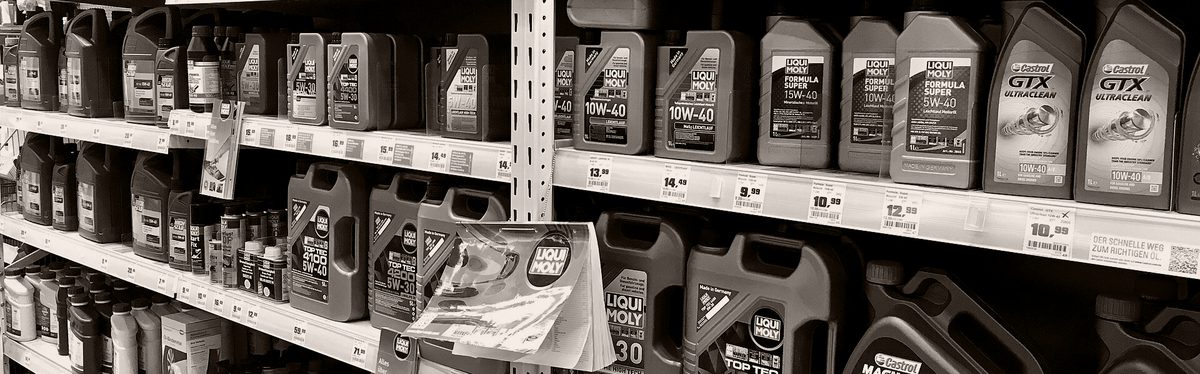
Most people buy oil by two things: the thickness grade, like 5W-30, and the word "synthetic." Both are printed on the front in the largest type, and neither is where the real information lives, so how to read an oil bottle comes down to turning it around.
The back label lists the standards the oil was tested against, and they cover what quietly decides engine life: deposits, the and particulate filter in the exhaust, and a kind of knock in modern turbo engines. And the carmakers don't agree on which standard counts: General Motors ignores the industry ones and asks for a code of its own.
None of that's visible in "5W-30". Below, a real label read line by line and four owner's manuals that disagree with each other, starting with the two symbols you can check in about thirty seconds.
What does your bottle say?
Deciding on synthetic? "Full synthetic" covers more than you'd think.
1. What is the API donut?
The API service symbol, which everyone calls the donut, is a circle split into three parts. It's the most widely used marking on a bottle and the easiest to check, with one piece of information in each of its three parts:
- Top segment, service category. Two letters starting with S for gasoline engines: API SQ is the newest, licensed since March 31, 2025, preceded by SP and SN, and some SN oils added SN PLUS as an extra classification. Diesel categories start with C, such as CK-4.
- Center, the viscosity grade. It's the same number as on the front.
- Bottom line, "Resource Conserving" if the oil passed the extra tests that go with it: fuel economy, protection for the emission system and the turbocharger, and engines running on ethanol blends up to E85.

Use this image
Free to republish under CC BY 4.0: credit Oil & Miles and link to this page. The snippet does both.
<a href="https://oilandmiles.com/articles/how-to-read-an-oil-bottle"><img src="https://oilandmiles.com/assets/img/diagrams/api-donut-anatomy.svg" alt="Diagram of the API service donut split into service category, viscosity grade and Resource Conserving, alongside the ILSAC starburst, with each part labeled" width="1280" height="800"></a> <p>Diagram: <a href="https://oilandmiles.com/articles/how-to-read-an-oil-bottle">Oil & Miles</a>, CC BY 4.0</p>The letters run alphabetically, and later categories are generally backwards compatible. API SP in an engine that asked for SN is normally fine and often better.
The reverse (an older category in an engine that requires SP) is the case to avoid, because the low-speed pre-ignition protection that modern small turbo engines depend on arrived with SN PLUS, and SP kept it and added a timing-chain wear test.
The grade on the front is the other half of the label, and the numbers behind it are set by SAE J300. We lay those limits out beside each other in 0W-20 vs 5W-30.
2. What is the ILSAC starburst?
A starburst on the front usually reading "API Certified." It signals that the oil meets an ILSAC standard: GF-7A since March 31, 2025, and GF-6A before that.
The very thin 0W-16 oils meet GF-7B, or GF-6B before it, and carry a shield-shaped mark instead of the starburst.
The starburst is a fuel-economy-oriented standard, so it appears on thinner oils and generally not on heavy-duty or high-performance European grades. Its absence isn't automatically a fault.
An ACEA C3 oil for a European diesel won't carry it, and shouldn't.
3. What do ACEA codes mean?
European classification, written as a letter and a number. These matter if you drive a European car or if your manual quotes them.
| Code | Meaning | Typically for |
|---|---|---|
| A3/B4 | Full-viscosity, high-performance gasoline and diesel | Older European engines, long drain intervals |
| C2 | Mid-SAPS, fuel economy oriented | Cars with particulate filters, thinner grades |
| C3 | Mid-SAPS, higher HTHS | Very common on European gasoline and diesel with DPF |
| C5 / C6 | Mid-SAPS, improved fuel economy | Newer engines specifically designed for thin oil |
SAPS means sulfated ash, phosphorus and sulfur, and HTHS is high temperature, high shear viscosity: how thick the oil stays when it's hot and under load. Low- and mid-SAPS oils exist to protect diesel particulate filters (DPF) and catalytic converters, which is why putting a high-SAPS oil into a car with a DPF is a genuine mistake rather than a preference.
4. Which manufacturer approval decides it?
The one your own manual names, and nothing else on the bottle overrules it. This is the part people skip, and the part that matters most: car makers publish their own specifications, and many engines require them by name.
Four manuals from three makers, read at source, show how little the makers agree with each other. Two of the makers name API and ILSAC categories; the third ignores both in favor of a code of its own:
- 2023 Hyundai Sonata: SAE 0W-20, API SN PLUS or SP, or ILSAC . The 0W-20 is for the 1.6 turbo and the 2.5, the 2.5 turbo takes 0W-30, and a footnote asks for full synthetic, API SN PLUS or above.
- 2020 Nissan Altima: two answers, not one. The same car ships with two engines. The 2.5 calls for 0W-20 SN and the 2.0 turbo for Ester 5W-30 SN, each with a synthetic of its own grade allowed as the substitute.
- 2020 Equinox and 2022 Silverado HD: dexos1. General Motors ignores API and ILSAC in favor of a code of its own, so the general categories tell you nothing here.
Look at what that does to a shopper. A bottle that satisfies the Nissan says nothing about the Chevrolet, because the Chevrolet isn't asking the same question.
That's the whole reason this page exists.
| Approval | Belongs to |
|---|---|
| dexos1 Gen 3 | General Motors gasoline engines |
| VW 504.00 / 507.00, 508.00 / 509.00 | Volkswagen Group |
| MB 229.51, 229.52, 229.71 | Mercedes-Benz |
| BMW Longlife-01, LL-04, LL-17FE+ | BMW |
| Ford WSS-M2C-series codes | Ford |
| Porsche C20, C30, C40 | Porsche |
| STJLR-series codes | Jaguar Land Rover |
If your manual names one of these, treat it as a requirement rather than a suggestion. These approvals exist because a manufacturer wants its own engines tested for something the general standards don't cover, or don't push as far.
The general standards have caught up in places: API 1509 now requires SP and GF-6 oils in most grades to pass timing chain wear and low-speed pre-ignition tests.
5. Is "meets or exceeds" an approval?
No, and it's the single most useful distinction to learn from a bottle.
There's a real difference between an oil that is licensed or approved to a specification and one whose label says it "meets or exceeds the requirements of" that specification. The first has been tested and registered with the body that owns the standard, and the oil appears on their published list.
The second is the blender's own claim about its own product.
Sometimes the claim is perfectly true and the blender simply chose not to pay for licensing. Sometimes it's not.
You can't tell from the bottle, which is the point.
Where the wording matters most is on an engine with a named manufacturer (OEM) approval: a VW 507.00 diesel, a GM engine that calls for dexos1, a modern BMW. If the manufacturer requires the approval and the bottle only claims to meet it, you're relying on a marketing sentence rather than a test result.
That's a poor trade for the few dollars saved.
Worth knowing
Two mistakes are easy to make when reading an oil bottle, and both are label problems rather than oil problems:
- Buying on the front of the bottle. Right viscosity, wrong specification, entirely confident. The number that got checked was the one that mattered least.
- Paying more to be safe. A more expensive oil isn't automatically the safer choice. A premium high-SAPS oil poured into a car with a particulate filter is a worse decision than a cheaper oil carrying the correct mid-SAPS approval. Price isn't a specification.
6. What does "full synthetic" actually mean?
The definition is looser than most buyers assume, and it varies by market. In much of the world an oil made from severely hydrocracked mineral base stock (Group III) can be sold as full synthetic, alongside oils built on true synthetic PAO (polyalphaolefin) or ester base stocks.
Both are legitimate and Group III oils are good; the point is only that the phrase doesn't tell you which one you've bought.
Why that word is allowed to cover so much ground goes back to a 1999 advertising ruling, which our guide to synthetic and conventional oil explains.
So don't use "full synthetic" alone as a decision. Use the approvals, and where your manual asks for full synthetic, as GM's and Hyundai's do, take that as part of the requirement.
We say the definition varies by market rather than giving you one, because we couldn't find a single legal definition that holds across the US and Europe at once.
A Group III oil carrying the exact approval your engine requires beats a more exotic base oil that doesn't.
7. How to read an oil bottle: which line settles it?
The manufacturer approval settles it, and the other four lines only narrow things down. Five things can be printed on a container, and they don't carry equal weight:
| What is printed | What it settles | Why |
|---|---|---|
| 1. Manufacturer approval | The one that decides | A code like WSS-M2C970-A1 or dexos1. If your manual names one, nothing else overrides it |
| 2. ACEA sequence | European shorthand | A3/B4, C2, C3. Tells you the additive class the engine needs, especially low- and mid-SAPS |
| 3. API donut | A floor, not a match | Says the oil meets a general standard. Almost every oil on the shelf passes |
| 4. Viscosity on the front | The least useful number | 0W-20, 5W-30. Necessary, but two oils of the same grade can be one right and one wrong |
| 5. “Meets or exceeds” | Not an approval | A claim the blender makes about itself. An approval is a code the car maker granted |
Read the bottle back to front: the front is mostly marketing and viscosity, and the back carries the code your engine was designed around. To read an oil bottle, work through the 4 steps below in that order:
- Find what your engine requires. Owner's manual first. The maintenance section, not the filler cap. Note both the viscosity and any named approval.
- Read the back of the bottle for that exact approval, and check the wording: approved and licensed, or merely "meets".
- If it names an OEM approval, verify it. Many manufacturers publish an approved oils list, and the major blenders publish product data sheets with the approvals on them. Two minutes of checking gives you a brand to buy. Approvals get superseded quietly, so repeat the check now and then rather than trusting it for the life of the car.
- Check the viscosity last. It's the constraint that's hardest to get wrong and easiest to correct, see 0W-20 vs 5W-30.
Two things can stop those steps, and each has a way around it:
- No manual in the glove box. Makers post owner's manuals free on their own sites. The 2020 Altima manual quoted in section 4 is a free download from Nissan USA.
- A dexos approval to check. GM lists the licensed dexos brands on its own dexos site, and says a licensed oil carries the dexos icon on the front and an 11-character license number on the back. Without both, GM doesn't count it as dexos.
Two questions come up once you're standing at the shelf, and each has an answer on another page:
- The bottle doesn't match what's in the engine. Mixing synthetic and conventional oil is safe, and the reason why is more useful than the reassurance.
- The shelf doesn't carry your grade. That has a ranked answer rather than a yes or no: what to use instead of 0W-20 puts 5W-20 first, because once the engine is warm the two oils have to meet the identical requirement, and explains what each of the others actually changes.
One real label, read line by line
Everything above is easier to see on a bottle than in a list, and the meaning of each line on this one is set out underneath it. Below is the back of a bottle of Motul H-TECH 100 Plus, photographed on a shelf, carrying four of the lines this article has described.
It's not a US-market bottle: it's sold by the liter, and the small print runs through Chinese, Malay, Indonesian and Thai. That changes nothing about the lesson, because the two standards it carries, API and ILSAC, are printed the same way on a quart bottle in Ohio.
API and ILSAC are international standards, and that's the point of them.

Four lines, and they aren't equal
Read it from the bottom up, because the useful part is underneath.
Start here: the ILSAC standard this bottle was made to, with a test program behind it. GF-6A was the current one until GF-7A replaced it on March 31, 2025.
It also marks the oil as made for fuel-economy work; GF-6B was the separate category for the very thin 0W-16 oils.
The API category this bottle carries: SP, the newest until API SQ arrived on March 31, 2025, so one generation back rather than wrong. The small print says the oil is made "to meet" SP, so check the API directory before you call it licensed.
If your manual asks for SP or anything earlier, a licensed SP oil satisfies it.
The viscosity grade, and the thing most people buy on. Another 5W-30 on the same shelf with no SP and no GF-6A is the same grade and a different product.
Not regulated in the US. It tells you nothing about which base stock is in the bottle, and it's printed larger than the two standards that actually say something about the oil.
What this label does not carry is a named manufacturer approval: no dexos1, no WSS-M2C970-A1, no VW code. For an engine whose manual asks only for API SP or ILSAC GF-6A in a 5W-30, that absence costs you nothing.
For an engine whose manual names a code, this bottle isn't the one, however good the oil is.
The same method transfers to the other fluid people buy by the color of the jug: coolant is chosen by specification too.
Conclusion
What should you do at the shelf?
The approval code on the back decides, not the front: write your grade and your engine's approval on a card for the glove box. Here's how to read an oil bottle, from a real label and four owner's manuals:
- The manufacturer approval decides.Your owner's manual names it, such as dexos1 on a GM or a WSS code on a Ford, and nothing else on the bottle overrules it. The rest of the label only narrows the choice.
- "Meets or exceeds" isn't an approval.An approved oil has been tested and registered with the body that owns the standard. "Meets or exceeds" is the blender's own claim about its product, sometimes true and impossible to check from the bottle.
- API and ILSAC are a floor.The API donut and the ILSAC starburst say the oil passed a general industry standard, not the one your engine was built around. GM ignores both and asks for a code of its own.
- "Full synthetic" isn't a standard.Oils refined from crude and oils built from true synthetic base stocks can both carry the words. The phrase doesn't tell you which one you bought, though some manuals, GM's and Hyundai's among them, ask for it by name.
- The grade is necessary, not enough.Check the approval on the back first, then the thickness grade on the front. Write both on a card for the glove box and read them out when you book a service.
So carry the card: it takes a minute, and it stops the confident purchase of a wrong bottle that looks right. The label here was read off a real bottle and the requirements off four real manuals, which is the difference Oil & Miles is trying to be worth.
Common questions
Asked most often
What does API SP mean?
It's the API service category for gasoline engines licensed from May 1, 2020, one step before API SQ arrived on March 31, 2025. Later categories are generally backwards compatible, and SP carries the protection against the low-speed pre-ignition that damages modern small turbo engines, first added with SN PLUS.
What is the difference between API and ILSAC?
The API donut states the service category and viscosity. The ILSAC starburst signals the oil also meets a fuel-economy-oriented standard, which is why it appears on thinner oils and not on heavy European grades.
What does "meets or exceeds" mean on an oil bottle?
It's the blender's own claim rather than a tested, registered approval. Sometimes true, sometimes not, and you can't tell from the bottle, which is why a named manufacturer approval matters.
Is full synthetic always better?
Not necessarily. The definition is looser than most buyers assume, and an oil carrying the exact approval your engine requires beats a more exotic base oil that doesn't.
What people ask next


Sources
- Four manufacturer manuals, for the specifications quoted above: the 2023 Hyundai Sonata, the 2020 Nissan Altima, the 2020 Chevrolet Equinox and the 2022 Silverado HD, the last two requiring the dexos1 approval by name. Manufacturer owner manuals, read August 26, 2026
- Manufacturer engine oil specifications reference, for the approval codes in section 4. oilspecifications.org
- GM dexos licensing page, for how a licensed dexos oil is marked. General Motors, read September 24, 2026
- API 1509, 23rd edition, for API SQ and ILSAC GF-7A and GF-7B from March 31, 2025, the grades eligible for the starburst, and the low-speed pre-ignition and timing chain tests. American Petroleum Institute, read September 24, 2026
- ACEA Oil Sequences 2023, light-duty engines, for the SAPS level of each C sequence. ACEA, read September 24, 2026
How this was compiled
Every code in this article was checked against a published specification reference rather than against each manufacturer's own current list, which is one step removed from the source and is said here rather than left to be assumed. The four manuals were read at source, and the date the specification reference was read wasn't recorded.
What we didn't do
We didn't test any oil.
We didn't check each approval against the manufacturer's own current list, and approvals get superseded quietly and without announcement. Your owner's manual and the maker's current approved-oils list outrank this page whenever they disagree with it.
General information about oil specifications. Approval names and standards change over time; always check your own owner's manual and the manufacturer's current approved oils list. See the disclaimer.
Catalytic converter
An exhaust component that converts carbon monoxide, unburned fuel and nitrogen oxides into less harmful gases, using platinum group metals as the catalyst.
API service category
The letter code in the round API mark showing which performance standard the oil meets.
ILSAC GF-7
The starburst standard covering fuel economy and engine protection for gasoline engines.