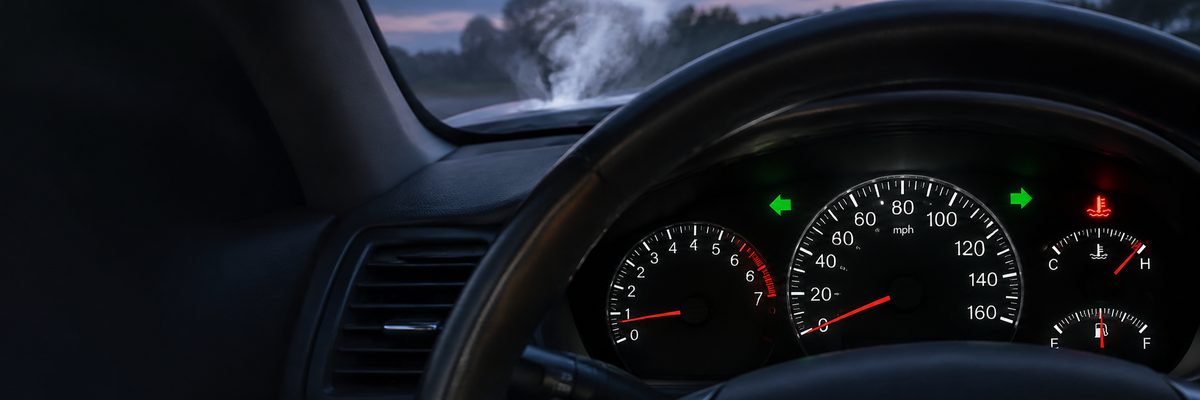

An engine overheats when the cooling system can't carry heat away as fast as the engine makes it. What you do in the first few minutes decides whether it's a small fix or a big one.
What should you do when your car overheats?
Pull off the road safely, turn the A/C off and watch for steam. What comes next depends on what you see and on the message your dash shows, because the carmakers don't all give the same steps.
- Get off the road safely. Turn the A/C off as you slow down. GM has you set the heater to full heat and full fan before you pull off, and Nissan does the same with the windows open once you're stopped.
- Park and look for steam. If steam or coolant is coming out, switch the engine off and stay away from the front of the car. Don't open the hood while steam is coming out, and our guide to smoke or steam under the hood shows how to tell the two apart.
- No steam? Follow your dash message. Nissan, Hyundai and Mazda keep the engine idling while the fan runs, and switch it off if the fan doesn't run. Ford's own steps stop the engine and switch the ignition off.
- Keep your hands clear of the fan. It can start at any time, even with the engine off, as Mazda and GM both warn.
- Leave the cap shut until it's cool. Never open the radiator or reservoir cap on a hot engine, because pressurized hot coolant can spray out. Cooling takes a while, so it's a good time to call for roadside help.
There's no safe shortcut to cool down a car engine quickly. Adding cold coolant to a hot engine too fast can damage it, as Toyota and Kia both warn, so let it cool first.
Can you drive an overheating car?
Not while it's overheating. Driving on can damage the engine or even start a fire, Nissan warns, and Hyundai and Kia also tell you not to keep driving with an overheated engine.
Once it has cooled, GM is the one carmaker here that says how to drive on. If the gauge has left the overheat zone or the warning has gone, you can drive slowly for about 10 minutes, and if the warning comes back you pull over and park right away.
GM's overheat protection mode, which keeps some of its cars moving with a hot engine, is only for reaching a safe place, so avoid long drives and towing a trailer in it. Ford's fail-safe mode is the same, and the engine can shut off without warning and take the power steering and brake assist with it.
A gauge that goes back to normal doesn't mean the problem has gone. The fault that heated it is still there, so keep to that short, slow drive to a shop and pull over if the gauge climbs again.
Call for a tow instead of driving if any of these is true:
- Steam or coolant keeps coming out. Mazda and Hyundai both say to stop the engine and call for help.
- The fan doesn't run. Stop the engine and call for help. Mazda and GM both rule out running it like this.
- The pump belt is broken or missing. Stop the engine at once, as Kia's manual has it.
- It overheats again after a top-off. A second overheat means the cooling system needs a dealer or a shop.
Is there a temporary fix for an overheating car?
Yes, but only to get the car to a shop. A cool-down, a slow top-off and the heater on full can get you there slowly, with GM's 10-minute check, but call a tow if it overheats again, there's steam or a leak, or the fan doesn't run.
- Heater on full. It carries some heat out of the engine while you find a place to stop. Pull over, switch off and call a tow if the gauge keeps climbing.
- A full cool-down. Hyundai has you wait until the engine temperature is back to normal before you add anything.
- A slow top-off. Add coolant only once it's cool, and slowly. Kia warns that adding it suddenly to an engine low on coolant can crack the engine.
- Water in an emergency. Toyota and Ford both allow water if you have no coolant, but only to reach a shop. Ford then has the system drained, cleaned and refilled with coolant, because water alone can cause damage from corrosion, overheating or freezing.
How do you check and add coolant safely?
Only on a cool engine, and slowly. Hyundai has you wrap a thick rag or towel around the cap and turn it slowly counterclockwise, so any pressure left escapes before the cap comes off, and the cap is never turned while the system is hot.
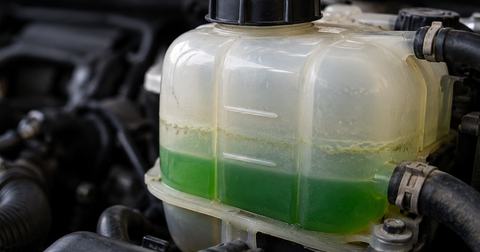
Check the level against the marks on the reservoir, then add the coolant your manual names, a little at a time. Low coolant alone can make an engine overheat, and our guide to what coolant your car needs lists the type by maker.

Check it cold
How do you know if your car is overheating?
The signs are a needle climbing toward H or into the red, the warning light, steam, a loss of power or a coolant smell. The gauge runs from C for cold to H for hot, and once the engine is warm the needle sits in the middle.
In Ford's manual it stays in the center section at normal temperature, and in Nissan's the reading moves with the outside air and how you drive. A needle that stays on C after a long drive isn't overheating.
It points the other way, to an engine that never gets warm enough, which is what a P0128 code means, and a thermostat stuck open is one cause. A needle climbing toward H or into the red is the warning, and when the warning light, a thermometer standing in wavy lines, comes on with the needle near H, the engine has overheated, so stop in a safe place right away.
The other signs are ones you feel, see, hear or smell. Nissan, Mazda and Hyundai all list a loss of power, and Mazda and Hyundai add a loud knocking or pinging.
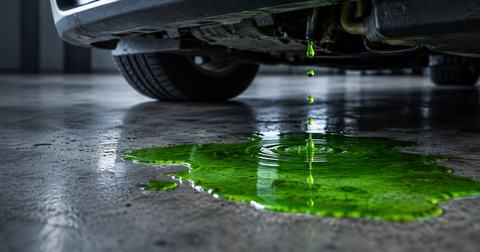
A coolant smell counts too, and Kia names it next to a needle near H in a bulletin for its 3.3L V6. Steam from under the hood means hot coolant is escaping, and coolant under the car means a leak.
What does "engine coolant over temperature" mean?
"Engine coolant over temperature" is Ford's message for coolant that's excessively hot, in the Edge manual's words, and its steps match the red gauge, so stop as soon as you safely can, switch off and let it cool. Toyota's message puts it plainly, Engine Coolant Temp High, Stop in a Safe Place.
GM shows ENGINE OVERHEATED STOP ENGINE or ENGINE OVERHEATED IDLE ENGINE. With either one and no steam, GM has you turn the A/C off and the heater to full for a minute or so, then pull off the road and let the engine idle.
The 2.7L four-cylinder shuts itself off at STOP ENGINE. If the warning is still there, turn the engine off and get everyone out until it cools.
Why is my car overheating?
What causes a car to overheat is a cooling system that can't move heat out fast enough. That comes down to too little coolant, the wrong coolant, coolant that isn't circulating, or air that isn't getting through the radiator.
On the cars I see, the most common cause is plain water used in place of coolant, then low coolant. GM's manual backs the first point, saying that with plain water or the wrong mix the engine can get too hot with no overheat warning at all.
Low coolant usually means a leak, and our coolant leak guide shows where to look, while the fan, the thermostat, the water pump and the radiator come after that, as the parts that move the coolant and the air. A thermostat that sticks shut keeps the coolant from reaching the radiator, and a failing pump can leak or whine first, as our bad water pump symptoms page explains.
A few smaller parts can do it too:
- The radiator cap. A cap that no longer holds pressure lets the coolant boil sooner, and in Ram's manual any cap other than the one specified can damage the engine.
- Bugs and leaves. Debris on the front of the radiator blocks the air, which is why Nissan and Ram both have you clean it off.
- A fan clutch. On trucks with a fan the engine drives, a failed fan clutch can overheat the engine, as an Isuzu bulletin documents.
- A new thermostat. A replacement can be faulty too. Jaguar Land Rover traced overheating warnings after thermostat changes to a manufacturing issue with two of its own part numbers.
- A hybrid's cooling. On some hybrids, such as the 2025–2026 Civic Hybrid, an electric pump moves the coolant, and Honda updates its software. The inverter has its own coolant loop, and on some Hyundai and Kia hybrids a Refill Inverter Coolant message means a dealer flush, the fix in their bulletins.
If your car keeps running hot, or it started overheating all of a sudden, when it happens is the best clue. In GM's manual an engine can get a little too hot on a long climb on a hot day, towing a trailer or after a long idle in traffic, so a truck pulling a trailer is the first to show a weak cooling system.
The heater warms the cabin with engine coolant, so a heater blowing cold while the engine runs hot points to low coolant or air in the system. Shops report this, but no carmaker manual or bulletin mentions it.
Why does a car overheat at idle?
An engine that overheats at idle or in slow traffic but cools off at speed points to the fan. At speed, air is forced through the radiator, and at a standstill only the fan pulls it through, so a failed fan, relay or fan controller shows up first in traffic.
The A/C makes it worse, because its condenser sits in front of the radiator and the fan has to cool both. A car overheating only with the A/C on is still worth a fan check, which is why the manuals have you switch the A/C off first.
Why does a car overheat while driving?
Overheating at highway speed, up a long hill or with a load points to coolant flow or a radiator blocked by debris. A radiator clogged inside, a weak water pump or a thermostat that won't open far enough can keep up around town and fall behind when the engine works hard.
Old coolant can cause it too. Ford found that deposits from its Orange coolant got trapped in the radiator of some Transit and E-Series vans and blocked the flow, and the fix was a flush, a new radiator and a different coolant.

Air has to get through
Why does a car overheat when the coolant is full?
A full reservoir with an overheating engine means the coolant isn't moving, or isn't carrying the heat away. The usual suspects are a thermostat stuck shut, a water pump that no longer pumps, an air pocket after recent work, or a fan that doesn't switch on.
Sometimes it's a sensor. GM found that on some of its newest three-row SUVs a temperature sensor sent wrong readings, so the engine computer closed off coolant flow to the radiator and the engine overheated with no trouble codes stored.
If it keeps overheating after you add coolant, the top-off only hid the problem, because the coolant went somewhere or the fault that stopped it moving is still there. Hyundai and Mazda both say to have the cooling system inspected when it overheats again, and our page on whether coolant evaporates explains why the level shouldn't drop on its own.
Did overheating damage your engine?
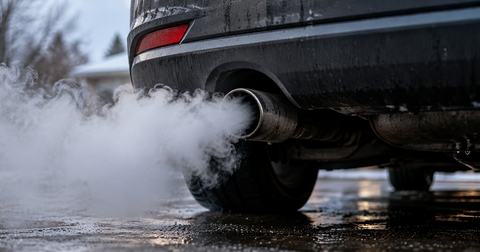
Not necessarily, but white exhaust smoke, milky oil or coolant that keeps dropping with no leak you can see point to damage. If you made it home and wonder whether the engine is OK, or it's fixed now and you wonder whether it's still reliable, these are the signs to watch for.
Coolant getting into the engine is the main sign of lasting damage, from a head gasket or a cracked head, and our blown head gasket symptoms guide covers the checks. Ford's bulletins for some EcoBoost engines describe white exhaust smoke and low coolant with no leak you can see, and GM's bulletin for its 3.6L V6 names oil mixing into the coolant, while white smoke from the exhaust has its own page.
Milky oil, or a milky film in the coolant tank, can mean coolant and oil are mixing, through a gasket, an oil cooler or a crack. Oil can also turn milky in freezing weather with no coolant fault, so let a test decide.
There's one more thing to do after a serious overheat. After driving in GM's overheat protection mode the engine oil is severely degraded, so have the oil changed before you rely on the car again.
Why won't a car start after overheating?
An overheating engine can shut itself off to protect itself, and once the temperature cools, Ford allows a restart. GM's 2.7L four-cylinder shuts down automatically when its stop message comes on, so a car that died hot may simply need time to cool.
If it still won't start once it has cooled, don't keep cranking it, and have it checked. On many engines one belt drives both the water pump and the alternator, so a broken belt can overheat the engine and leave the battery flat.
Past the battery, shops name three causes:
- A blown head gasket or a warped head. The engine cranks but won't start, because too little compression is left.
- Coolant in a cylinder. The engine won't crank, or turns and won't fire. Stop trying to start it and have it towed.
- A seized engine. It won't turn over at all, and shops tie it to an engine that ran out of coolant or oil.
Owners and shops report this, but no carmaker manual or bulletin mentions it. The shutdown itself is in the carmakers' manuals, but an engine that still won't start after it cools has no carmaker or federal document, so have a shop run a compression test before anyone fits new parts.
How does a shop find and fix why a car overheats?
A good shop tests before it replaces parts. It reads the temperature sensors on a scan tool and compares them with each other, as GM's bulletin does, pressure-tests the system for leaks, checks that the fans switch on and runs a block test or a cylinder leakage test for a head gasket, and the only permanent fix is to repair whatever stopped the coolant doing its job.
A sensor fault can fool a shop that only reads codes, as GM's bulletin shows. Ask what the tests found and which one points at the part they want to replace before you agree, and when the fix is a leaking hose, pump or radiator, our coolant leak repair cost guide prices it car by car.
From the carmakers
What do carmakers say about overheating and free fixes?
The cards below show a free recall repair and a free fix for a term, and the rest are info only. Every quote is from the document itself, and the carmakers agree on the warning signs but not on whether to keep the engine running, as three of the manuals here leave it idling while the fan works, Ford's stops it, and GM's idles it first, though its 2.7L shuts itself off.
Of the federal complaints we read that mention overheating, the 2017 Ford Escape had 337, the 2018 Escape 310 and the 2014 Escape 287, and the 2013 Chevrolet Cruze had 63, the 2023 Jeep Wagoneer 20 and the 2024 Chevrolet Traverse 13. These are owner reports, not a failure rate.
A bulletin isn't a free repair by itself. Our free VIN decoder lists your model year's recalls, and the dealer can tell you in writing whether a bulletin applies to your VIN and who pays.
Recall 17V-209
…the engine cylinder head … overheat, crack and leak oil.
Service bulletin ENG254
…may overheat and become further damaged.
Special coverage 14371B
…could lead to engine overheating.
Service bulletin 07-006-26 Rev. A
Vehicle overheating. Temperature gauge is reading hot. Overheat symbol is illuminated.
Service bulletin 24-NA-224
…a temperature sensor sending incorrect information to the Engine Control Module … closing off coolant flow to the radiator creating the overheat condition.
Service bulletin 09-006-25 Rev. A
Engine overheating with “Engine Overheated” message.
Service bulletin 20-2150
This condition may be due to deposits from the engine coolant becoming trapped in the radiator preventing coolant flow.
Service bulletin 22-NA-240
…engine oil mixing into the coolant from the main oil gallery to a water jacket through block porosity or thin wall-casting …
Conclusion
What to do next about an overheating car
To stop a car from overheating again, keep the right coolant at the right level and fix the cause the first time. Use the coolant type in your manual rather than plain water, check the level only when the engine is cold, and have it flushed on the manual's schedule, which our coolant flush guide compares with what shops charge.
After any repair, watch the gauge for the first few drives. A bottle of stop leak isn't a repair, as our coolant stop leak guide explains, and a car that keeps overheating needs its cooling system inspected before the engine is seriously damaged.
Oil & Miles checks each step here against the carmakers' manuals and bulletins and NHTSA's records.
Common questions
Asked most often
How far can you drive once the engine overheats?
Not at all while it's overheating, because the engine can be damaged or catch fire. Once it has cooled and the gauge is back to normal, GM has you drive slowly for about 10 minutes, and a warning that returns, a leak or a fan that doesn't run means a tow.
Does turning on the heater cool the engine?
It helps as a stopgap, since the heater draws its warmth from the engine coolant. It won't fix whatever made the engine overheat.
Can a bad water pump cause overheating?
Yes, a pump that leaks or stops moving coolant lets the engine overheat. GM gave the 2011–2014 Cruze 1.4L special coverage for a water pump leak that could cause overheating.
Can a bad thermostat cause overheating?
Yes, if it sticks shut, because the coolant can't reach the radiator, and Ram and Jeep have bulletins for that on some newer trucks and SUVs. A thermostat stuck open does the opposite and the engine runs cold, which usually sets a P0128 code.
What people ask next
Sources
- 2020 Nissan Altima Owner's Manual (US), pages 6-11, 6-12, 2-6 and 502, for what to do when it overheats, the gauge and cleaning the radiator. Nissan, read November 5, 2026
- 2025 Mazda CX-5 Owner's Manual (US), section 8, "Overheating", for the signs, the steps and the fan. Mazda, read November 5, 2026
- 2023 Hyundai Sonata Owner's Manual (US), pages 7-6 and 4-6, for the steps, the cap and the gauge. Hyundai, read November 5, 2026
- 2023 Kia Sportage Owner's Manual (US), "If the engine overheats", for the belt check and adding coolant slowly. Kia, read November 5, 2026
- 2021 Toyota Avalon Owner's Manual (US), pages 436 and 471–473, for the warning light, the warning message, emergency water and adding coolant. Toyota, read November 5, 2026
- 2020 Chevrolet Silverado Owner Manual, pages 131 and 344–349, for the gauge, plain water, the two messages, driving on and the protection mode. General Motors, read November 5, 2026
- 2025 Chevrolet Equinox Owner's Manual, page 100, for the coolant temperature warning light. General Motors, read November 5, 2026
- 2004 Honda Odyssey Owner's Manual, page 122, for the heater running on engine coolant. Honda, read November 5, 2026
- Federal Motor Vehicle Safety Standard 101 (49 CFR 571.101), Table 1, for the engine coolant temperature symbol. US government, read November 5, 2026
- 2019 Ford Edge Owner's Manual (US), pages 91, 94, 115 and 289–290, for the gauge, the warning lamp, the over temperature message, emergency water and fail-safe mode. Ford, read November 5, 2026
- 2013 Ford E-Series Owner's Manual, pages 212–213, for fail-safe cooling and the engine shutting down. Ford, read November 5, 2026
- 2022 Ram 2500/3500 Owner's Manual, pages 360–361, for the pressure cap and debris on the radiator. Ram, read November 5, 2026
- Ford service bulletins 20-2150 (May 2020), 19-2346 (December 2019) and 20-2100 (April 2020), for coolant deposits in Transit and E-Series vans and coolant loss on some EcoBoost engines. Ford via NHTSA, read November 5, 2026
- GM service bulletins 22-NA-240 (January 2024) and 24-NA-224 (October 2024), and special coverage 14371B (January 2015), for oil in the coolant, the sensor fault and the Cruze water pump. General Motors via NHTSA, read November 5, 2026
- Stellantis service bulletins 09-006-25 Rev. A (October 2025) and 07-006-26 Rev. A (September 2026), for the Wagoneer and Ram thermostats. Stellantis via NHTSA, read November 5, 2026
- Kia service bulletin ENG254 (June 2024), for the 3.3L V6 head gasket coverage and the coolant smell. Kia via NHTSA, read November 5, 2026
- Ford special service messages 48106 and 49982, and Stellantis bulletin 9100458, for the pressure test, the fan check and the block and cylinder leakage tests. Ford and Stellantis via NHTSA, read November 5, 2026
- Isuzu bulletin IB26-J-001 (March 2026) and Jaguar Land Rover bulletin SFCC_FEB2024_35, for a failed fan clutch and faulty new thermostats. Isuzu and Jaguar Land Rover via NHTSA, read November 5, 2026
- Honda service bulletin 26-089 (August 2026), Hyundai bulletin 25-01-065H (September 2025) and Kia bulletin SA515, for the hybrid electric water pump and the inverter coolant loop. Honda, Hyundai and Kia via NHTSA, read November 5, 2026
- FCA service bulletin 09-022-24 Rev. A (December 2024), Ford bulletin 23-2274 and special service message 51754, and Toyota bulletin T-SB-0104-21, for coolant and oil mixing and milky oil in freezing weather. Stellantis, Ford and Toyota via NHTSA, read November 5, 2026
- NHTSA recall 17V-209 (March 2017), for the 1.6L EcoBoost coolant level sensor. NHTSA, read November 5, 2026
- NHTSA complaint records, complaints that mention overheating, running hot or the temperature gauge, and owner reports of an engine that wouldn't start after an overheat. NHTSA, read November 5, 2026
- Underhood Service (Bob Dowie, February 2005), YourMechanic mechanics' answers (2016–2017), Mechanics Stack Exchange answers (2017 and 2024), Firestone Complete Auto Care, Esty's Auto Center, Bertini's and Wilton Auto & Tire, for what shops report when an engine won't start after overheating and when the heater blows cold. Shop and mechanic sources, read November 5, 2026
AI illustration by Oil & Miles
How this was compiled
The steps come from each carmaker's US owner's manual, and the bulletins from NHTSA's archive of carmaker service documents. The complaint counts are NHTSA complaints whose text mentions overheating, running hot or the temperature gauge. The items marked as what owners and shops report come from a sweep of shop pages, mechanics' answers and NHTSA owner reports on November 5, 2026, and each one needed at least three independent sources.
What we didn't do
We didn't run a test of our own for this page. We didn't rank the causes by complaint counts, because owners rarely know the cause when they report an overheat.
This article is general information, not advice about your specific vehicle. See the disclaimer.