

Key takeaways
- Safety: If you see smoke or a dry dipstick, switch the engine off and have the car towed. If the car loses drive or stalls while moving, steer to a safe spot, stop and call for help.
- On many cars the transmission warning reports hot fluid, not a low level, so read the level itself.
- Add a little fluid at a time and recheck, because reading it cold and overfilling makes it shift badly.
- Run the VIN before paying for a leak repair, because some leaks are free recall fixes.
A delay into gear, slipping and a whine are the usual signs of low transmission fluid, and a red spot under the car is often the leak behind them. A worn transmission can show the same signs, as our bad transmission symptoms guide shows, so the level check comes before anyone sells you a part.
What are the symptoms of low transmission fluid?
A delay into gear, slipping, slow or harsh shifts, jerking and a whine are the main signs of low transmission fluid. The reason is what the fluid does: it oils the moving parts, carries heat away, and gives the pressure that works the clutches inside.
Here are the eight signs, what each one feels like and what to do next:
1. A delay into Drive or Reverse
You'll shift into Drive or Reverse and wait a moment before the car engages. It's one of the first signs drivers notice. It may need gas before it catches, or drop out of gear. Either way, have the level checked first.
2. Slipping
You'll notice the engine revs rise while the car doesn't speed up to match. That's the clutches inside slipping, because there isn't enough fluid pressure to hold them.
Slipping makes heat, and heat makes more slipping, which is why slipping gets worse as you drive. Have the level checked before it goes further.
3. Slow or harsh shifts
You'll notice the gears change late, or with a jolt under hard acceleration. A low level can cause both, and so can a transmission that left the factory under-filled.
4. Jerking or hesitation
You'll notice the car jerks when accelerating or hesitates, and the check engine light may come on. A leak can drop the fluid pressure enough to cause this, so have the leak found.
5. Vibration and a warning light
You'll feel a slight vibration, and a warning light may come on. On a CVT it can mean fluid is leaking out, through a loose hose for example, so the pressure drops.
6. A leak under the car
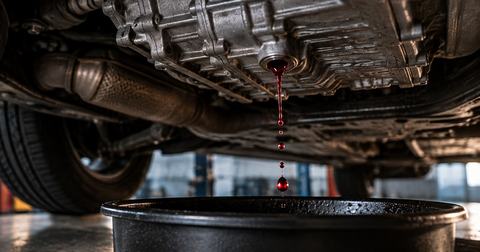
You'll see a red or brown spot where you park, because the fluid that's missing has to go somewhere. It's the one sign you can check without opening anything.
Other fluids can look alike, and power steering fluid is red on many cars too, so note where the spot sits. No spot doesn't rule out a leak, and even a small drip keeps lowering the level, so the leak itself is what to chase.

Use this image
Free to republish under CC BY 4.0: credit Oil & Miles and link to this page. The snippet does both.
<a href="https://oilandmiles.com/articles/low-transmission-fluid-symptoms"><img src="https://oilandmiles.com/assets/img/diagrams/low-fluid-where-it-leaves.svg" alt="Schematic of an automatic transmission's fluid loop: the pan with its fluid below the FULL mark, the pump drawing from it, the clutches it pressurizes and the cooler it is sent to, with three leaks marked at the pan gasket, a cover and a cooler line" width="1600" height="900"></a> <p>Diagram: <a href="https://oilandmiles.com/articles/low-transmission-fluid-symptoms">Oil & Miles</a>, CC BY 4.0</p>7. A whine
You'll hear a whine from the transmission as you drive, or a clunk or grind once it's in gear. Low fluid is one cause of pump whine, and our guide to a whining noise when accelerating covers the other sources.
8. A burning smell
Fluid that runs low gets too hot, and hot fluid can smell burnt after a drive. Treat a burning smell or smoke as a reason to stop, as the safety section explains.

A spot on cardboard
How long can you drive with low transmission fluid?
Not far, and not at all if the dipstick is dry. Don't drive with a dry dipstick at any temperature. Ford's manual says so above 50°F.
With some fluid showing, get it checked soon, since no carmaker gives a safe distance. Our transmission slipping guide shows what waiting costs, from a top-off caught early to a rebuild caught late.
A leak can grow until the car loses drive, which several recalls warn about. Running under-filled also wears the transmission out early and can damage it. It could stop moving in traffic. If the car loses drive or stalls while moving, steer to a safe spot, stop and call for help.
A burning smell after a drive is the sign to stop and look, and our burning smell guide shows which ones mean stop now. For a leak you can see, the leak guide's four stages say how long it can wait.
If you have to stop, leave the road as soon as it's safe and turn on your hazard lights. If you see smoke or a dry dipstick, switch off and call a tow.
If a hot transmission warning comes on, follow your manual, which may tell you to let it cool at idle. If the warning comes back, treat it like smoke or a dry dipstick.
How do you check transmission fluid?
Check the level with the method for your car, because that's the only way to know it's low. How you check depends on which of three kinds of transmission you have:
- A dipstick you can read. Most older automatics and many trucks, and you can check it yourself with the steps below.
- A sealed unit with no dipstick. Many need no owner check at all, and the dealer checks the level with a special procedure.
- A CVT. A continuously variable transmission, with no fixed gears. On many, the dealer checks and changes the fluid, not the owner.
A shop checks the level and the fluid's condition first, then looks under the car at the pan, the cooler lines and the seals. That's where most leaks start.
What to say to the shop
“Before you top it off, can you find the leak, check the level the right way for my car, and look up my VIN for recalls?”
How to check transmission fluid with a dipstick
If your car has a dipstick, you can check the transmission fluid level yourself in 6 steps, in this order:
- Check your manual first. It gives your car's own steps and says whether the engine should be running or off for the reading.
- Warm it up first. Drive until the engine reaches the temperature your manual gives, because the marks on the stick assume warm fluid. If it slips badly, won't move or leaks heavily, don't drive it to warm it up.
- Park on level ground with the parking brake on. A car on a slope reads wrong.
- Shift through the gears. With your foot on the brake and the engine running, move the shifter through each gear and back to Park, then leave it idling.
- Find the right stick, then pull, wipe and push it back. Make sure it's the transmission dipstick, not the engine oil one, and push it all the way back in.
- Pull it again and read it. The fluid should sit between the warm marks. A cold mark is only a rough guide, so recheck once it's warm.
If the dipstick shows no fluid at all, don't drive, and the safety section explains why. Our full guide to checking transmission fluid with a dipstick walks through each step.
Color is a separate question from level, and dark fluid isn't necessarily bad. Our guide to transmission fluid color explains what each shade means.
How to check transmission fluid without a dipstick
On a sealed transmission or a CVT, the level is read at a set fluid temperature with the carmaker's procedure, so on many cars it's a dealer or shop job. Don't open a plug to look, since the level only reads right at that temperature.
If your manual has no owner check, book a level check with the dealer or a transmission shop. Our guide for a car without a dipstick shows the three ways it gets done.
Can you just add transmission fluid if it's low?
Only if your manual lets owners top it off, and only with the fluid type it names. The fluid went somewhere, so the leak still needs finding even after the level is right.
Reading the level cold can make it look low, and adding fluid then overfills it, so the car shifts badly. Add a little at a time, such as Ford's 8 fluid ounces, and our guide covers how much to add between readings.
Can transmission fluid be low without a leak?
Rarely. The exceptions to the leak rule are few, and each leaves a clue, such as a recent fluid service or a very hot transmission. A few heavy-duty pickups push fluid out of the dipstick tube when hot, and a few cars left the factory under-filled.
A fluid service can leave the level wrong too, because a level set at the wrong temperature ends up too low or too high. If the symptoms started right after a service, tell the shop.
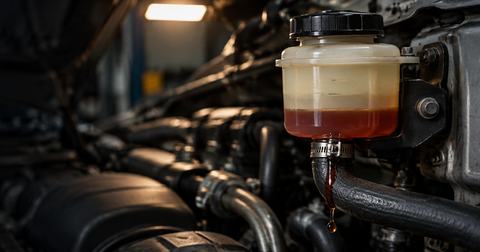
Most leaks come from the pan gasket, the cooler lines or the seals. Our leak guide shows where it's leaking from and what the repair costs.

A wet cooler line
Is there a warning light for low transmission fluid?
Few cars have a light or symbol for low transmission fluid. On Dodge and Ram models, for one, the transmission warning, one of the dashboard warning lights, reports temperature, not level, and tells you to stop and let it idle to cool.
A hot warning can still follow from low fluid, because less fluid carries less heat away and runs hotter. Low fluid can also show as the check engine light with a low fluid pressure code such as P0868, and no warning at all doesn't mean the level is fine.
Can too much transmission fluid cause the same symptoms?
Yes: a level above the safe range can cause shift and engagement problems and may lead to transmission failure. The extra fluid can foam, spill out of the vent, or make the pump draw bubbles instead of fluid. Some crossovers left the factory overfilled, and the carmaker checked them for free.
Does a CVT or a manual show low fluid differently?
A CVT shows low fluid much like an ordinary automatic, with jerking and a vibration, and the difference is mostly who can check it. On many CVTs you can't check it yourself. Each CVT maker names its own fluid, so never top one off with a generic one. Our CVT guide covers a failing CVT.
A manual transmission is checked through a fill plug on the side of the case, which some owners can reach at home. The guide to checking fluid without a dipstick walks through it.

Use this image
Free to republish under CC BY 4.0: credit Oil & Miles and link to this page. The snippet does both.
<a href="https://oilandmiles.com/articles/low-transmission-fluid-symptoms"><img src="https://oilandmiles.com/assets/img/diagrams/low-transmission-fluid-symptoms-checklist.jpg" alt="Low transmission fluid checklist: warm the engine, park level, follow your manual, use the transmission dipstick, pull, wipe and read it between the warm marks. Stop for a dry dipstick, let a hot transmission cool, and switch off for smoke. Add a little at a time, don't overfill, and don't open a plug to look. Ask where it is leaking, whether the level was checked the right way, and run your VIN for a recall." width="1200" height="1570"></a> <p>Infographic: <a href="https://oilandmiles.com/articles/low-transmission-fluid-symptoms">Oil & Miles</a>, CC BY 4.0</p>From the carmakers
Is a transmission fluid leak covered by a recall?
Only on the cars a recall names. Nissan, GM and Ram have fixed transmission leaks free by recall, from a driveshaft not fully seated in the transmission to a cover missing its bolts.
A recall repair is free at a dealer, but only on cars whose VIN is on it, so check yours before you pay for a transmission repair. Each of these recalls also says who pays for the fix.
Recall 24V-304
Transmission fluid could leak resulting in reduced transmission fluid pressure, potential transmission jerking and/or hesitation, and illumination of the Malfunction Indicator Lamp (MIL).
Recall 26V-410
The front left-side driveshaft may not be fully seated in the continuously variable transmission (CVT) assembly, which can cause a transmission fluid leak and loss of drive power.
Recall 22V-835
Leaking transmission fluid may contact an ignition source within the engine compartment, increasing the risk of a fire.
Recall 20V-668
Missing bolts on the start-stop accumulator endcap could result in a transmission oil leak and may progress to a loss of propulsion, increasing the risk of a crash.
Recall 14V-152
If the line is not securely seated and transmission oil leaks from the fitting, the oil could contact a hot surface and cause a vehicle fire.
Conclusion
What to do next about low transmission fluid
If the level is low, have the leak found rather than only topping it off, because a transmission doesn't use up fluid. If the dipstick is dry or the car loses drive, stop driving and have it towed.
Oil & Miles checks each step here against the carmakers' manuals, bulletins and recalls and NHTSA's records.
Common questions
Asked most often
What happens when transmission fluid is low?
The transmission slips and runs hot, and running under-filled wears it out early and can damage it. Left long enough, it can lose drive altogether.
Can low transmission fluid cause slipping?
Yes, and the fluid level is the first thing to check when a transmission slips.
Can low transmission fluid cause overheating?
Yes: less fluid carries less heat away, and slipping adds more. Many cars have a transmission hot warning, but not a light for a low level.
What people ask next
Sources
- GM bulletin 21-NA-169, April 2022, PIP5275A and 24-NA-264, February 2025, for a delay into gear and a whine. NHTSA bulletin archive, read October 21, 2026
- GM and Ford owner's manuals, 2020 Chevrolet Equinox, 2022 Silverado HD, Ford's 2013 and 2014 E-Series and 2014 and 2019 Super Duty, for why fluid is low, when to stop and the warnings. General Motors and Ford, read September 24, 2026, and the 2014 E-Series October 21, 2026
- Hyundai, Honda and Nissan owner's manuals, 2023 Sonata, 2023 Accord and Honda's older automatics, 2020 Altima, for checking the level and the CVT fluid. Hyundai, Honda and Nissan, read September 24, 2026
- Jeep and Ford owner's manuals, 2011 Grand Cherokee page 512, 2016–2017 Explorer and 2017 Escape page 102, for slipping as the reason to check the level and the malfunction message. The 2017 Escape and 2011 Grand Cherokee also for their transmission hot warnings. Chrysler and Ford, read October 21, 2026
- Parts and shop guides: AutoZone, Phillips Toyota, Advanced Transmission, AAMCO Tempe, Monster Transmission and Gil's Garage, on what transmission fluid does, the dipstick check, the burning smell, clunks and grinding, dropping out of gear, code P0868 and a car that won't move. Read October 21, 2026
- Independent shops: A-Affordable Transmissions (Englewood and Thornton, Colorado), Express Lube & Car Care (Arlington, Texas) and Rohnert Park Transmission & Auto Repair (Rohnert Park, California), on the first signs drivers notice, how a shop checks and the common leak points. Read October 21, 2026
- Dodge and Ram owner's manuals, 2016 Grand Caravan and 2016 Ram 1500, for the transmission temperature light and what to do when it comes on. FCA US, read October 21, 2026
- Toyota 2023 Tacoma Warranty and Maintenance Guide, for inspecting a sealed transmission for leaks. Toyota, read September 25, 2026
- GM service bulletin 15667, August 2015, for what under-filling and over-filling do. NHTSA bulletin archive, read September 25, 2026
- NHTSA recall 24V-304, Nissan, and recall 16V-548, Mitsubishi, for the symptoms each maker describes. NHTSA, read September 25 and October 23, 2026
- NHTSA recalls 13V-234, 14V-152, 20V-668 and 09V-436, for the leak paths, the units, loss of drive and fire. NHTSA, read September 25 and October 23, 2026
- NHTSA recalls 26V-410 (Nissan), 26V-376 (Ford) and 22V-835 (Ram), for the newer leaks and fire risks. NHTSA recall records, read October 21 and 23, 2026
- Chrysler bulletin 21-046-15, July 2015, and Ford program 21B55, September 2021, for a factory under-fill and overfill. NHTSA bulletin archive, read October 21, 2026
The symptoms come from carmakers' owner's manuals, bulletins and recall reports.
AI illustration by Oil & Miles
This article is general information, not advice about your specific vehicle. See the disclaimer.