
Short answer
Yes on your manual's interval, rarely on a shop's.
Whether a transmission flush is necessary depends on the car in front of you: routine on one serviced to schedule, an upsell on a car whose shop invented its own interval, and a decision to think through on a neglected transmission with no service history. At one national chain the two services cost about the same: Jiffy Lube lists a fluid change at $80 to $250 and a flush at $125 to $250.
If the reason one is being offered is that the fluid looked dark on the dipstick, check that against what fluid color actually tells you first.
Whether a transmission flush is necessary gets a different answer depending on who is selling. Fluid makers sell fluid, quick-lube chains sell the flush, and parts retailers sell both, and most of them say yes, though not all: two dealerships we read called a routine flush important, while an independent shop said manufacturers advise against the chemicals.
For most cars that yes is right. What changes it is which of three situations your car is in, and in two of them the right advice is to hold off.
Below are those three situations, what the two services cost, and where the short shop interval comes from. The document that settles which situation you're in is already in your glove box, and four of the six schedules we read schedule no normal-driving change at all:
Where does your car stand?
Offered a flush because the fluid looked dark? Check what fluid color tells you first.
Flush and fluid change aren't the same job
They get used interchangeably on estimates, but they're different services. One drains part of the fluid and changes the filter, the other pushes nearly all of it through a machine.

Use this image
Free to republish under CC BY 4.0: credit Oil & Miles and link to this page. The snippet does both.
<a href="https://oilandmiles.com/articles/transmission-flush-necessary"><img src="https://oilandmiles.com/assets/img/diagrams/transmission-flush-necessary-6r80-bench.svg" alt="Drain and fill vs flush, the same transmission twice, with new fluid in red and the old fluid that stays in in brown. A drain and fill removes the pan, usually replaces the filter and the pan gasket, and changes 20 to 40% of the fluid using 5 to 7 quarts, while a large share stays in the torque converter and the cooler lines; a flush connects a machine to the cooler lines and exchanges close to all of it, 12 to 22 quarts by Jiffy Lube's count." width="1200" height="981"></a> <p>Diagram: <a href="https://oilandmiles.com/articles/transmission-flush-necessary">Oil & Miles</a>, CC BY 4.0</p>A drain and fill, sometimes called a pan drop or a fluid change, removes the transmission pan, drains what comes out, usually replaces the filter and the pan gasket, and refills. The catch is that a large share of the fluid never leaves: it sits in the and the cooler lines.
How much leaves depends on the transmission. Jiffy Lube's own guide puts a pan drain at 20 to 40% of the fluid, using 5 to 7 quarts.
A flush, also sold as a fluid exchange, connects a machine to the cooler lines and pumps new fluid through while the old fluid is pushed out, exchanging close to all of it. It uses far more fluid, 12 to 22 quarts by the same chain's count, though its published prices for the two services overlap.
That fluid is the checkable part of the bill, and some transmissions take only their maker's own fluid. That's why the box below prices it by car rather than as one figure.
Neither one is automatically better. A drain and fill changes less fluid but replaces the filter, while a flush changes nearly all the fluid; whether it also changes the filter depends on the shop, since one chain's own guide includes it and another shop says flushes skip it, so ask.
The fullest version of this service is both: drop the pan, change the filter, then exchange the rest. Ask for it by name, because it's neither a plain drain and fill nor a plain flush on the menu.
What your manual actually says
This is the number that matters, and it's in the glove box. There's no single band and the spread is wide, so we read six schedules at source rather than repeating a range.
Notice what isn't in the table below. Not one of the six schedules sets a normal-driving change near the 24,000 to 36,000 miles a shop chain publishes, and four of the six don't schedule one at all under normal driving.
The shortest number anywhere in it is a severe-service figure for Subaru's continuously variable transmission (CVT). It's in the table, and it applies only under severe driving.
The old shorthand, that automatics want fluid every 60,000 to 100,000 miles, is close enough to be quoted everywhere and wrong at both ends. Ford goes to 150,000.
Hyundai and Honda publish no normal-driving mileage at all, which isn't the same as saying never. Honda lets the car's Maintenance Minder raise it.
| The car | Normal driving | What the schedule says |
|---|---|---|
| 2023 Hyundai Sonata | No service | No check and no service required. Severe service every 60,000 miles |
| 2020 Honda Civic | No mileage given | The car raises it itself, as Maintenance Minder sub item 3 |
| 2025 Toyota Corolla | Inspect only | Inspected every 30,000 miles, and replaced at 60,000 and 120,000 only under special operating conditions |
| 2020 Nissan Altima | No normal-driving change | Only with a car-top carrier or on rough or muddy roads: inspect every 60,000 miles, or change it at 60,000 if not inspected |
| 2023 Subaru · All models | Inspect only | CVT fluid inspected rather than replaced. The 24,855-mile figure quoted from it is severe service |
| 2023 Ford F-150 | 150,000 miles | Fluid and filter together, the longest normal interval of the six |
The same six schedules sit on one mileage axis below, next to the interval one shop chain publishes. Every mark on it comes from the table above or from the shop list further down.

Use this image
Free to republish under CC BY 4.0: credit Oil & Miles and link to this page. The snippet does both.
<a href="https://oilandmiles.com/articles/transmission-flush-necessary"><img src="https://oilandmiles.com/assets/img/diagrams/transmission-flush-intervals.svg" alt="Transmission fluid interval chart: on one mileage axis from 0 to 150,000 miles, Firestone publishes 24,000 to 36,000 for a fluid exchange; the 2023 Hyundai Sonata has no normal service, with severe service at 60,000; the 2020 Honda Civic gives no mileage and its Maintenance Minder raises it; the 2025 Toyota Corolla is inspected every 30,000 and replaced at 60,000 and 120,000 only under special conditions; the 2020 Nissan Altima has no normal-driving change, with 60,000 only for a car-top carrier or rough roads; the 2023 Subaru is inspect only, with 24,855 as a severe-service figure; the 2023 Ford F-150 changes fluid and filter at 150,000." width="1200" height="1066"></a> <p>Diagram: <a href="https://oilandmiles.com/articles/transmission-flush-necessary">Oil & Miles</a>, CC BY 4.0</p>Read the severe-service definition in your own manual before you dismiss it, though. Ford's list for the F-150 includes short trips, extreme temperatures, dust, idling and towing, so ordinary driving can qualify, and then the shorter interval in your manual is the one that applies, still the manual's number rather than the shop's.
Fluid rules from the documents 2 items
- Ford F-150, 2023 (normal scheduled maintenance)Change fluid and filter every 150,000 miles; severe conditions are listed separately (short trips, extreme temperatures, dust, idling, towing).
- Mazda CX-30 and Mazda3 2023 to 2026, CX-5 2024 and 2025, CX-90 and CX-70 (Mazda bulletin SA-040-25a)No interchangeability between ATF-A7 and ATF-FZ; check the mark on the dipstick, and a malfunction from any other fluid won't be covered by warranty.
Worth knowing
Sealed doesn't mean never. Transmissions with no dipstick still have fluid that ages; they just make checking the level a job for a shop.
Where the short flush interval comes from
Not from your manufacturer. The FTC's Auto Repair Basics guidance warns that some repair shops create their own maintenance schedules, which call for more frequent servicing than the manufacturer's recommendations.
Its advice is to compare the shop's schedule against the one in your owner's manual, and ask the shop to explain why it is recommending service beyond it. Chains publish their own shorter intervals too, which is the readable version of the same thing, and the data list below quotes one.
You aren't accusing anyone of anything by asking it, and a shop with a real reason will have one: a fluid sample that looks bad, a specific known issue with your transmission, a driving pattern that fits severe service. A shop with no answer beyond its own interval has told you what you needed to know.
One more right worth knowing, from the FTC's page on auto warranties: a dealer can't legally deny your warranty coverage because you had routine maintenance done somewhere else. Keep records of repairs and maintenance, because you don't need to have the work done at the dealership to stay covered.
Shop interval, as published 1 item
- Firestone Complete Auto Care, FAQ blog"Every 24,000 to 36,000 miles or every two-to-three years", for a transmission fluid exchange.
Is a transmission flush necessary on a high-mileage car?
Not on mileage alone, and that's the one thing both sides agree on. Here's where opinion splits in two, and where we're going to be careful.
The mechanic's warning runs like this: in a transmission that has never had its fluid changed, worn clutch material is suspended in the old fluid, and that debris is helping tired clutches grip. Flush it out and the clutches, now running on clean slippery fluid, no longer bite, so the transmission that was limping along starts slipping within a few hundred miles and the flush gets the blame.
The counter-argument is that this is correlation dressed up as causation: a transmission that has gone far past its schedule without a fluid change is already worn. On that view, the flush happened to be the last thing done before a failure that was arriving anyway, and the owner, understandably, blames the service.
We couldn't find a controlled study settling this. What we can report is where both sides agree, which is more useful than picking a winner:
The risk factor is neglect, not mileage. A 150,000-mile transmission serviced every 60,000 miles isn't in this conversation at all: change its fluid on schedule and nothing surprising happens.
The car people are actually arguing about is the one with high mileage, no documented service history, and fluid that has never been changed. Both camps agree that is the risky case, and disagree only about whether the risk is caused or merely revealed.
Which, for your decision, doesn't matter much: if your transmission is in that state, it's fragile either way. The table below sorts the cases.
| Where you are | What it calls for | Why |
|---|---|---|
| Serviced on schedule, any mileage | Routine | Do it at the interval in your manual. There's nothing here to debate |
| The shop's interval is shorter than your manual's | Ask why | The FTC recommends asking. Either a real reason exists or it doesn't |
| High mileage, records exist, fluid looks normal | Proceed | A serviced transmission isn't part of the argument at all |
| High mileage, no records, fluid dark and burnt | Diagnose first | Ask for an inspection before a service. Heat damage is the real finding |
What each service costs
The flush isn't reliably the dearer job. At the one chain whose own prices we could read, the two overlap almost completely, as the box shows.
What you can check yourself is the parts, because fluid, filter and gasket are sold by the piece. If a shop quotes a flush at drain-and-fill prices, ask how much fluid is going in.
What it costs
What this box shows
Prices for this repair, drawn from the sources named at the foot of the box. Each figure states whether it covers the part alone or parts and labor.
Parts and shop prices for a transmission fluid service
Parts for three cars at the counter; labor is the shop's hours at $120 to $159, or one chain's menu.
| Transmission fluidPriced by the quart; a flush uses several times what a drain and fill does.2017 Honda Accord 2.4L · $7.52 to $22 a quart of CVT fluid, 2015 Ford F-150 5.0L V8 · $6.19 to $13 a quart, 2013 BMW 328i 3.0L L6 · $6.19 to $26 a quart, | $6.19 – $26Part only, at the counter |
|---|---|
| Transmission filterReplaced in a drain and fill; ask whether a flush includes it.2017 Honda Accord 2.4L · $4.32 to $42, 2015 Ford F-150 5.0L V8 · $18 to $32, 2013 BMW 328i 3.0L L6 · $15 to $121, | $4.32 – $121Part only, at the counter |
| Pan gasketReplaced whenever the pan comes off.2017 Honda Accord 2.4L · $8.40 to $14, 2015 Ford F-150 5.0L V8 · $23 to $34, 2013 BMW 328i 3.0L L6 · $14 to $34, | $8.40 – $34Part only, at the counter |
| Chain menu: fluid changeOne national chain's own guide: pan drained, filter and gasket replaced, 5 to 7 quarts. | $80 – $250Parts and labor, one quote |
| Chain menu: flushOne national chain's own guide: all the fluid exchanged by machine, 12 to 22 quarts. | $125 – $250Parts and labor, one quote |
Parts are every brand RockAuto listed for each car, read September 5, 2026. The two shop rows are Jiffy Lube's own published ranges, read October 2, 2026, US Eastern; no carmaker publishes hours for a routine fluid service on these cars, so ask the shop for its hours at $120 to $159 an hour.
What to do about a flush offer
The schedule in your manual decides most of this, and the rest is two questions for the shop. To answer a flush offer, work through the 4 steps below, in order:
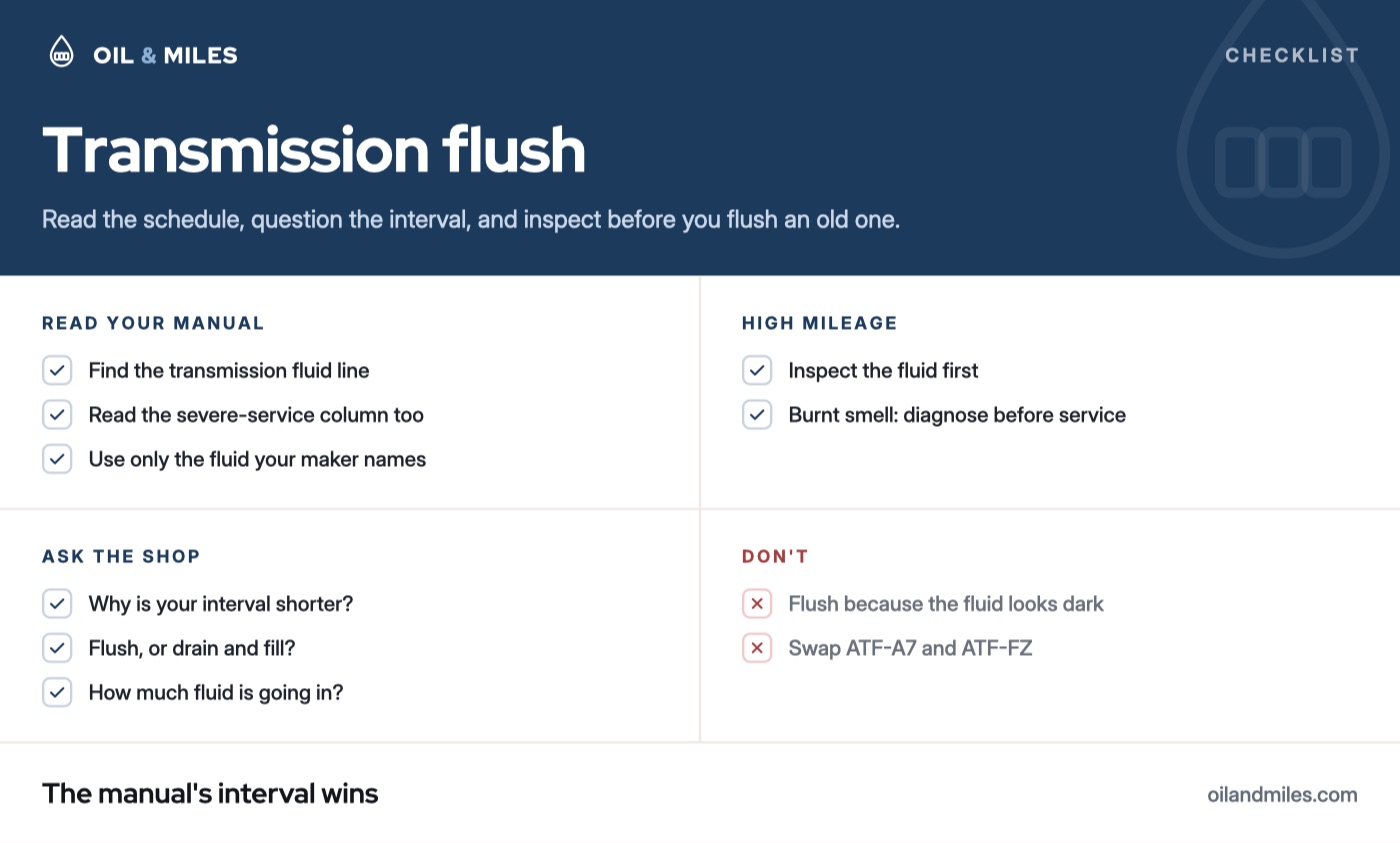
- Open the glove box before you open your wallet. Find the maintenance schedule and the transmission fluid line, and read both the normal and severe-service columns.
- Ask why the shop's interval is shorter, if it is. Use those words: the FTC recommends asking, and a shop with a real reason will name it.
- Ask which service is being quoted, and how many quarts. A drain and fill and a flush are priced alike at one chain, but its own guide puts 5 to 7 quarts in the first and 12 to 22 in the second.
- On high miles with no records, ask for an inspection first. A burnt smell is the better witness than the shade, as our fluid color guide explains, and it's a diagnosis to have before a service.
Where a step doesn't settle it, the documents and the questions above still point somewhere, case by case:
- The manual has no numberHyundai and Honda publish none for normal driving; Honda lets the Maintenance Minder raise it, so follow the car rather than the shop.
- The shop has no answer to "why"That's the answer, and it's the same question that sorts out the other services your car doesn't need.
- The shop won't say how many quartsThen it can't say which service it is quoting; ask for the service in writing by name before agreeing to a price.
- The car may not be worth keepingThe fluid question belongs with the rest of the arithmetic, which what starts costing money after 100,000 miles works through.
Use this image
Free to republish under CC BY 4.0: credit Oil & Miles and link to this page. The snippet does both.
<a href="https://oilandmiles.com/articles/transmission-flush-necessary"><img src="https://oilandmiles.com/assets/img/diagrams/transmission-flush-necessary-checklist.jpg" alt="Is a transmission flush necessary checklist: find the transmission fluid line in your maintenance schedule and read the severe-service column, use only the fluid your maker names; ask why a shop's interval is shorter, which service is quoted and how much fluid goes in; on high miles with no records inspect the fluid first; don't take a flush because the fluid looks dark or swap ATF-A7 and ATF-FZ." width="1200" height="723"></a> <p>Infographic: <a href="https://oilandmiles.com/articles/transmission-flush-necessary">Oil & Miles</a>, CC BY 4.0</p>From the documents
The two ends of six schedules, and the one with no number
Nothing in any of the six schedules puts a normal-driving change anywhere near the figure a flush is sold on. The spread between them is the reason there's no one interval to give you:
2023 Hyundai Sonata owner manual, maintenance schedule
No check, No service required
2023 Ford F-150 scheduled maintenance, normal schedule
Change fluid and filter every 150,000 mi
2020 Honda Civic owner manual, Maintenance Minder
If you regularly drive your vehicle under these conditions, have the transmission fluid changed every 25,000 miles (40,000 km).
Read the three together and the shape of the disagreement is the useful part. One maker asks for nothing, one asks at 150,000 miles, and one lets the car decide under normal driving; a shop quoting far shorter isn't reading any of them.
Conclusion
The number is already in your glove box
The interval in your manual is the answer, and six schedules read at source don't put a normal-driving change near the shorter intervals a flush is sometimes sold on. Here's what that comes down to:
- The schedules disagree with each other, not with you.Four ask for no normal-driving change, Ford's is 150,000 miles, and Honda lets the car raise it.
- The two services cost about the same.Jiffy Lube lists a fluid change at $80 to $250 and a flush at $125 to $250; the parts behind them are sold by the piece.
- The wrong fluid costs more than the service.Mazda says ATF-A7 and ATF-FZ can't be swapped, and a malfunction from the wrong one isn't covered.
- Neglect, not mileage, is the risk.On a high-mileage car with no records, have the fluid inspected before anyone flushes it.
So ask which service is being quoted and what interval it is being sold against. Oil & Miles takes the interval from the maker's own schedule and labels any shop menu price as one, across owner guides.
Common questions
Asked most often
Is a transmission flush ever actually necessary?
Yes, at the interval in your manual. The argument is about the interval and the method, not about whether fluid needs changing at all.
When to change transmission fluid if it's "lifetime"?
Lifetime doesn't mean never. Ford's schedule for the 2023 F-150, for one, still lists a fluid and filter change at 150,000 miles, so if you plan to keep a car that long, have the fluid inspected rather than assuming.
Will a flush damage my high-mileage transmission?
On a car with a service history, no. The genuine debate is about neglected transmissions that have never had the fluid changed, and even there the two sides disagree about whether the flush causes failure or reveals one that was already coming.
Drain and fill or flush, which should I ask for?
On schedule, either works, and a drain and fill also gets you a new filter. Overdue, two drain and fills a few thousand miles apart replace more of it gradually. Offered as the answer to a symptom rather than as maintenance, check the signs a transmission is going out first.
Can I be denied warranty coverage for using an independent shop?
No. The FTC is explicit that a dealer can't deny warranty coverage because routine maintenance was done elsewhere. Follow the manufacturer's schedule and keep your receipts.
What people ask next
Sources
- Auto Repair Basics, for the shop-schedule warning and the advice to compare against your owner's manual, and Auto Warranties and Auto Service Contracts for the warranty right. Federal Trade Commission
- Six manufacturer schedules, read at source: Hyundai 2023 Sonata, Honda 2020 Civic, Toyota 2025 Corolla guide, Nissan 2020 Altima, Subaru 2023 booklet (its CVT row covers the range except the BRZ and Hybrid), Ford 2023 F-150. Read August 26, 2026
- Jiffy Lube, transmission flush vs. transmission exchange, the chain's own guide, for its price ranges, quarts and the share of fluid a pan drain replaces. Jiffy Lube, read October 2, 2026, US Eastern
- Mazda service alert SA-040-25a, for ATF-A7 versus ATF-FZ and the warranty warning. Mazda, via NHTSA, read October 2, 2026, US Eastern
- RockAuto catalog, for every brand listed as fitting a 2017 Honda Accord 2.4L, a 2015 Ford F-150 5.0L V8 and a 2013 BMW 328i 3.0L L6. RockAuto, read September 5, 2026
- Firestone Complete Auto Care, transmission FAQ, for its published 24,000 to 36,000 mile exchange interval. Firestone, read September 27, 2026
- PartsTech's 2025 survey of 752 US shops, as reported by MOTOR, for the $120 to $159 hourly rate. MOTOR, read September 27, 2026
How this was compiled
The two positions on high-mileage flushing are reported where they agree and left standing where they don't, because every confident answer we read on either side was published by someone with a commercial interest in that answer.
Parts are priced from the catalog for three cars. The only shop prices are one chain's own published ranges, named as such, because no carmaker publishes hours for a routine fluid service on these cars and we don't quote estimator sites.
Two of the six schedules sit outside the 60,000 to 100,000 mile band often quoted for automatics: Hyundai's is no check, no service required
and Ford's is 150,000 miles.
What we didn't do
We didn't resolve the high-mileage flush argument, because we couldn't find a controlled study that settles it.
We didn't give a single interval figure of our own. The number that governs your car is in your manual, and any figure we invented to replace it would be exactly the thing this article warns about.
Prices are ranges compiled in September and October 2026 for the US market and vary by region, vehicle and shop rate. Prices from $10 up are rounded to the nearest dollar, so $14.13 reads as $14 and $14.52 as $15. Below $10 they're exact. This article is general information, not advice about your specific vehicle. See the disclaimer.
Torque converter
The fluid coupling between engine and automatic transmission, doing the job a clutch does on a manual.
Transmission fluid, per quart
2017 Honda Accord 2.4L L4
| Brand | Part | Price |
|---|---|---|
| Aisin | ATFHCVContinuously Variable Transmission Fluid; 2nd Generation CVT | $7.52 |
| Valvoline | VV3246Not applicable for California | $7.54 |
| 804751Not applicable for California | $11 | |
| ZF | 5961308626Honda trans.; OE 08200-HCF2 / HCF-2 | $17 |
| Lubegard | 68112 | $18 |
| Liqui Moly | 20036 | $22 |
Transmission filter
2017 Honda Accord 2.4L L4
| Brand | Part | Price |
|---|---|---|
| Various Mfr | PT99442 | $4.32 |
| PT99453Internal | $42 | |
| Beck/Arnley | 0440383Cartridge Type | $7.60 |
| 0440430Internal Filter | $20 | |
| SKP | SK0440430Internal Filter | $16 |
| ATP | B536Automatic CVT trans. | $22 |
Transmission pan gasket
2017 Honda Accord 2.4L L4
| Brand | Part | Price |
|---|---|---|
| Fel-Pro | TOS18791Automatic CVT trans. | $8.40 |
| Vaico | V260297Fits SE Model or Automatic CVT trans.; EX/EX-L/LX/LX-S/Sport | $14 |
Transmission fluid, per quart
2015 Ford F-150 5.0L V8
| Brand | Part | Price |
|---|---|---|
| Lucas Oil | 11255 | $6.19 |
| Valvoline | VV3246 | $7.54 |
| 822405 | $7.98 | |
| Mobil | 126505 | $8.14 |
| Motorcraft | XT10QLVCMERCON LV, the Ford fluid | $8.42 |
| ACDelco | 109243 | $8.67 |
| Lubegard | 69032 | $12 |
| Liqui Moly | 20032 | $13 |
Transmission filter
2015 Ford F-150 5.0L V8
| Brand | Part | Price |
|---|---|---|
| Hastings / Baldwin | TF222 | $18 |
| Wix | WL10377 | $19 |
| ATP | B400Filter only | $23 |
| B399Filter and gasket | $32 | |
| Motorcraft | FT188 | $32 |
Transmission pan gasket
2015 Ford F-150 5.0L V8
| Brand | Part | Price |
|---|---|---|
| Fel-Pro | TOS18753 | $23 |
| Elring | 7871606R60/6R75/6R80/6R100 | $24 |
| Victor Reinz | 71149450021 bolt | $26 |
| ATP | FG253 | $31 |
| Mahle / Clevite | W328286R60/6R75/6R80, 6-speed | $34 |
Transmission fluid, per quart
2013 BMW 328i 3.0L L6
| Brand | Part | Price |
|---|---|---|
| Lucas Oil | 11255GA6-L45R; 6 speed | $6.19 |
| Valvoline | VV3246GA6-L45R | $7.54 |
| 822405GA6-L45R | $7.98 | |
| Mobil | 126505xDrive; GA6HP19Z or GA6-L45R | $8.14 |
| 126411xDrive N52 GA6-L45R or base GA6 | $8.67 | |
| ACDelco | 109243GA6-L45R | $8.67 |
| Lubegard | 69032 | $12 |
| Liqui Moly | 20032GA6-L45R | $13 |
| Vaico | V600131OEM grade; coupe/convertible | $26 |
Transmission filter
2013 BMW 328i 3.0L L6
| Brand | Part | Price |
|---|---|---|
| SKP | SK0440368 | $15 |
| SKB408GA6HP19Z | $67 | |
| ATP | B424xDrive; GA6-L45R | $25 |
| B408GA6HP19Z or GA6-L45R | $121 | |
| Vaico | V201017GA6-L45R or N51B30A | $26 |
| V200586N52; GA6HP19Z | $110 | |
| Hengst | EG942HD479GA6-L45R | $44 |
| Beck/Arnley | 0440368N51B30A or N52; GA6-L45R | $48 |
| 0440352N52; GA6HP19Z | $96 | |
| Dorman | 265853F8 speed; only with Dorman pan 265-853 | $49 |
| 265851FGA6HP19Z; only with Dorman pan 265-851 | $54 | |
| Raybestos Powertrain | 515987BGA6HP19Z | $81 |
| Mahle / Clevite | HX154 | $112 |
Transmission pan gasket
2013 BMW 328i 3.0L L6
| Brand | Part | Price |
|---|---|---|
| Elring | 1864008-speed automatic | $14 |
| URO Parts | 24117571235Coupe/convertible; GA6HP19Z | $16 |
| Fel-Pro | TOS18785GA6-L45R | $30 |
| Vaico | V201018N51B30A or N52; GA6-L45R | $34 |