
Short answer
Ask one question
Not one of the eleven services below is on a normal maintenance schedule at the mileage it gets sold. One sentence at the counter sorts every line on the estimate: is that the manufacturer's schedule, or your recommendation? Three of them carry a dealer menu price of $70 to $300 apiece, and that one question is worth every one.
A list of services your car doesn't need is only half useful without what each one costs, because the cost is the entire reason you would care.
So the prices here are taken from what dealers and shops actually charge, and the list is split by where the sale happens. Because the pitch at the service counter and the pitch at the sales desk are different animals, and they need different answers.
A recommendation and a requirement are different things, and the document telling you which is which is already in your glove box. When the pitch arrives as a written quote instead, reading it column by column does the same work.
Why it happens at 30,000 miles
It's not random. The pitch arrives when your car leaves its first scheduled-maintenance period and the free or prepaid servicing runs out, commonly somewhere between 30,000 and 36,000 miles.
One dealership-facing account puts the sweet spot at around 33,000: past the honeymoon, still under warranty, and the owner is now paying for everything themselves for the first time.
At that point a shop has a choice about what to put on the estimate, and the Federal Trade Commission has written down what happens next. Its Auto Repair Basics guidance names the practice in one sentence, quoted at the foot of this article, and advises comparing the shop's schedule against your owner's manual and asking why anything beyond it is being recommended.
That's a federal consumer agency describing this as a known practice, and it doesn't require anyone to be lying.
A service adviser paid on what the shop sells will recommend more than an engineer writing a maintenance schedule. Both can be acting in good faith and still give you different answers.
What the data says
Two California agencies have put numbers on this, and they're the only counts we found anywhere that measure unnecessary work rather than describe it.
The state's Attorney General acted against 22 Midas shops in 2009 after roughly 30 undercover visits. Brake specials advertised at $79 to $99 were followed by another $110 to $130 in rotor resurfacing the state found unnecessary, and across those visits the shops charged undercover agents an average of nearly $300 in work that didn't need doing. It settled the next year for $1.8 million.
The scale behind it is the second number. California's Bureau of Automotive Repair oversees 34,093 registered shops and has recovered more than $27 million for consumers across five fiscal years in refunds, corrected repairs and adjusted bills. Undercover operations are routine there, not exceptional.
One state, and a case now old. Neither figure is a national rate and neither says how likely this is for you. What they establish is that it happens often enough for a state to staff against it.
California Attorney General, June 30, 2009; California Bureau of Automotive Repair via the State Assembly's sunset review background paper, read August 26, 2026.
Eight unnecessary car services to question
Every one of these is a real procedure that a competent shop can carry out properly, so the question is never whether it exists. The question is whether your car is due for it, and that answer sits in the thirteen manufacturer documents below rather than on the menu board.
1Fuel injection or induction service: $195 to $300
Real quoted examples: $174 at a Toyota dealer on a RAV4 at 80,000 miles, $189 at a Ford dealer, and $400 on a Ram at 33,000 miles. We looked for it in thirteen manufacturer documents covering eight makes, two of them diesel pickups, and it's in none of their maintenance schedules.
Nissan goes past silence into a warning: its manual says the company doesn't recommend aftermarket fuel additives at all, naming fuel injector cleaner, octane booster and intake valve deposit removers, because they “may contain active solvents or similar ingredients that can be harmful to the fuel system and engine.”
The exceptions are narrow: Hyundai's schedule adds a bottle of fuel additive where TOP TIER gasoline isn't available, and Toyota's chart lists an EFI tank additive using “Toyota genuine fuel injector cleaner or equivalent” and marks it island use only.
That's a bottle poured into the tank in Hawaii, not a $174 shop procedure. Worth doing if the car hesitates on light acceleration, misfires, or has thrown a check engine light.
Not worth doing because the car reached a round number.
2Engine flush
Sold as removing sludge. Sludge takes years of neglected oil changes to form, and a car serviced anywhere near its schedule doesn't have it.
If your engine genuinely is sludged, a flush is a real procedure with real risk attached, loosened deposits have to go somewhere, and that's a diagnosis, not a menu item, and not one of the 36 services the largest national quick-lube chain publishes.
Worth noticing who doesn't sell it: the largest quick-lube chain in the country publishes 36 services on its own site, and an engine flush isn't one of them.
3Power steering flush: $125 to $205
Of the eight makes we read, only the two heavy-duty pickups, the Silverado HD and the Ram, still have hydraulic power steering. The Equinox manual says Electric Power Steering, Hyundai calls its system Motor Driven Power Steering, and the Altima never uses the phrase power steering fluid once.
Toyota hedges inside its own chart: “Inspect power steering fluid (if equipped).” On the Silverado HD, GM writes that regular checks aren't necessary unless a leak is suspected or an unusual noise is heard.
Only Ram schedules a flush, at 97,500 miles on its diesel. On most cars sold today this is a service for a system the car doesn't have.
4Coolant flush, sold early
Ford's F-150 schedule puts the first coolant change at 200,000 miles or ten years, then every 100,000. Toyota's Corolla chart says 100,000 miles or 120 months, then every 50,000.
Honda publishes no mileage at all and lets the car raise it.
A flush pitched at 40,000 is a service the manufacturer says you don't need yet.
What one costs when it genuinely is due is in our coolant flush cost breakdown. Check the interval in your own manual before agreeing, and if you do have it done, our guide to mixing coolant colors covers what has to go back in.
5Transmission flush at a short interval
The classic version is 12,000 miles against manuals that mostly schedule no normal-driving change at all. Ford's F-150 sits further out than either: fluid and filter at 150,000 miles.
This one has enough going on that it has its own article, including the part where flushing a neglected high-mileage transmission is genuinely argued about.
6Fuel filter replacement on a gasoline car
Hyundai puts the answer in a footnote to its own maintenance chart: “The fuel filter is considered to be maintenance free.” Nissan's fuel filter row carries no interval mark at any mileage, and the footnote against it reads, in full, “Periodic maintenance is not required.”

The fuel filter people picture
Toyota's guide never uses the phrase, and on the Equinox every mention of one belongs to the diesel. Subaru is the single exception, and it qualifies itself: its chart does schedule one fuel filter replacement, with a note attached saying the job isn't required to keep the emission warranty.
Four of the five say no, and the fifth says optional.
On a diesel the answer reverses completely: the Ram's manual carries a full replacement procedure with a water drain valve and a filter cartridge, and skipping it is real neglect. Same service name, opposite answer, and the fuel in your tank decides which one you're being sold.
7Differential or transfer case service, with no reason given
Ford's F-150 manual is unusually blunt: the transfer case and both axles don't require normal scheduled maintenance, and changing or checking the lubricant isn't necessary unless the unit has been submerged, shows signs of leakage, or the car displays a message asking for service.
Toyota inspects sealed differentials for leakage rather than scheduling a change. And on a front-wheel-drive car there may be nothing back there to service at all: dealer summaries of Honda's Maintenance Minder list a sub item 6 for rear differential fluid that doesn't exist in the Civic's own US table, which runs 1, 2, 3, 4, 5 and 7.
8A/C recharge as routine maintenance
No maintenance chart we read schedules one. Toyota's warranty singles it out, covering an air conditioning recharge for 12 months or 12,000 miles where everything else gets 36 months or 36,000, which is how a manufacturer classifies an adjustment rather than maintenance.
Subaru's warranty excludes lost refrigerant outright unless a covered defect caused the loss.
The reason is the one you would work out yourself: refrigerant isn't burned off, so a system that is low has lost it somewhere. The EPA says plainly that neither topping off nor recharging fixes that, in the wording quoted at the foot of this article.
Worth doing once the leak has been found and repaired.
| The service | Why it fails | What the documents say |
|---|---|---|
| Fuel induction service | Not scheduled | $150 to $300, and in none of the twelve. Nissan warns that injector cleaners can harm the fuel system |
| Engine flush | Not scheduled | Sludge takes years of skipped oil changes, and the largest chain doesn't sell one |
| Power steering flush | No fluid to flush | $125 to $205 on dealer menus. Six of the eight makes use electric steering, and only Ram's diesel schedules a flush, at 97,500 miles |
| Coolant flush at 40,000 | Far too early | Ford's first change is 200,000 miles. Toyota's is 100,000 |
| Early transmission flush | Far too early | Sold at 12,000 miles. Ford schedules fluid and filter at 150,000 |
| Fuel filter on a gasoline car | Maintenance free | Hyundai's own word. Nissan: periodic maintenance isn't required |
| Differential or transfer case | Needs a trigger | Ford: they don't require normal scheduled maintenance unless leaking or submerged |
| A/C recharge as maintenance | Find the leak first | EPA: recharging doesn't permanently fix refrigerant leaks |
That same chain's page for fuel system cleaning says the service is performed based upon customer request
, and every one of its service pages tells customers to follow the manufacturer's recommendations for intervals. That's a company declining, in writing, to recommend the thing it sells you.
Nobody is hiding it; they're waiting to be asked.
How much do the services you don't need cost?
$70 to $300 each for the three we could price from dealer menus. Eight of the eleven carry no figure here, because no source we could read priced them credibly.
What it costs
What this box shows
Prices for this repair, drawn from the sources named at the foot of the box. Each figure states whether it covers the part alone or parts and labor.
Shop price for services you don't need
Cheapest first, dealer menu prices. Eight of the eleven services here carry no figure.
| Nitrogen in the tiresAir is already 78% nitrogen; you pay for the other 22% | $70 – $249Parts and labor, estimated |
|---|---|
| Power steering flushMost cars have no interval for it | $125 – $205Parts and labor, estimated |
| Fuel injection or induction service$174 at a Toyota dealer, $189 at a Ford dealer, $400 on a Ram | $195 – $300Parts and labor, estimated |
Dealer service menus read through the Internet Archive, with Les Schwab and Edmunds for nitrogen and Kelley Blue Book for power steering, read September 26, 2026. Undercoating and paint protection carry no price here, because no source we could read priced them credibly.
The figures matter less than the question that sorts them, set out below: is the service on your car's schedule at this mileage, or is it a recommendation? Every line in the box is one the book doesn't call for at that mileage, so each can be turned down on its own.
At the sales desk: three dealer upsells to avoid
These are sold when you buy the car, not when you service it, and they're a different proposition: high margin, sold under time pressure, and nearly impossible to evaluate on the spot.
9Rustproofing or undercoating
Modern cars leave the factory with galvanized panels and cavity wax. Aftermarket undercoating adds little, and applied badly it can trap moisture against metal and make corrosion worse rather than better.
This is the one where the price and the benefit are furthest apart.
10Paint protection
Your car already has a clearcoat, which is paint protection. Washing it and waxing it occasionally does the rest.
Nothing applied at a dealership desk changes that arithmetic.

What paint protection really is
11Nitrogen in the tires: $70 to $249
The air you're replacing is already about 78% nitrogen. The remaining benefit, slightly slower pressure loss, is real and is worth essentially nothing to someone who checks their tire pressure occasionally, which is the actual solution and is free.
Worth knowing
The eleven unnecessary car services split three ways, and the split tells you which sentence to use:
- Real procedures offered at the wrong time. A fuel induction service is a legitimate repair for a car that is misfiring, and coolant genuinely is due, at 100,000 to 200,000 miles depending on the make rather than 40,000. Ask when it's due.
- Hardware your car may not have at all. Six of the eight makes we read use electric power steering, and a front-wheel-drive car has no rear differential to service. Ask what your car actually has.
- Solutions to problems the car doesn't have. The three sold at the finance desk. Say no.
Services your car does need, and when
A list of things to refuse is only useful if it also says what to accept, and there's a real cost to reflexive suspicion: people skip brake fluid because they read an article like this one. Here's the other list, taken from the same twelve documents.
1Engine oil and filter, when the car asks
On Honda's system this is the main item, the letter A or B, rather than one of the numbered items, and every numbered job hangs underneath it.
Ford's Intelligent Oil-Life Monitor picks the interval and sets one hard limit, which isn't to exceed one year or 10,000 miles. Toyota replaces oil and filter every 10,000 miles, or every 5,000 on dirt and dusty roads.
Subaru is the outlier in the other direction, dropping to every 3,000 miles or 3 months under what it calls severe conditions, one of which is simply repeated short-distance driving.
2Tire rotation
Ford does it at every oil change. Toyota marks it perform every 5,000 miles.
Subaru marks it at every single column of its chart, which means every 6,000 miles for eleven years, and Honda makes it sub item 1.
Four makers, four schedules, and not one of them leaves it out. Tire rotation is also the cheapest thing on this list and the one people skip most.
3Cabin and engine air filters, but look at the price
Ford replaces the cabin filter every 20,000 miles and the engine filter every 30,000. Subaru replaces its air cleaner element four times across the same chart and its cabin filter eleven times, roughly once a year.
Both are genuinely due. The issue is markup: a shop charging $40 or more for a cabin filter is charging mostly for a five to seven minute job that on many cars is done behind the glove box with no tools.
Buy the filter, watch a video for your model, and decide.
4Brake fluid, at the manual's interval
This is the one where the makers agree and the number is short. Ford schedules it flatly, every three years, with no mileage attached.
Hyundai inspects it every 8,000 miles and replaces it every 48,000 miles or 48 months.
Subaru replaces the fluid four times across its eleven-year chart, and cuts that to every 15,000 miles in humid or mountainous areas. Honda makes it sub item 7.

A brake fluid level, read in seconds
Brake fluid absorbs water out of the air by design, and water lowers its boiling point exactly where you least want that. This is scheduled maintenance, not an upsell, and it's one of the cheapest safety items on a car.
5Spark plugs
Hyundai replaces them every 96,000 miles on the 2.5, and every 48,000 on its turbo engines. Ford at 100,000, or 60,000 under severe use; Nissan's iridium plugs at 105,000.
Subaru schedules two changes across its chart, and Honda pairs them with a valve clearance inspection as sub item 4.
Read that spread rather than an average. The same job falls due more than twice as often on the Hyundai as on the Nissan, so “plugs are a 100,000 mile item” is true of most of these and wrong about one of them.
The only interval that governs your car is the one in your own book. What none of the five supports is a tune-up sold at 30,000 miles.
6Coolant and transmission fluid, when they're actually due
Both appear on the question list above because of when they get sold, not because the service is fake. Read those entries the other way round.
Subaru puts the first coolant change at 137,500 miles or eleven years, then every 75,000. Ford says 200,000 miles or ten years, and Toyota says 100,000.
Whichever of those governs your car, when it arrives, do it.
7The brake service and the big inspection
Honda's main item B is the largest entry in its US table: an oil and filter change and front and rear brakes inspected, plus an inspection of tie rod ends, steering transmission and boots, suspension components, driveshaft boots, brake hoses and lines including ABS, all fluid levels and condition, the exhaust system, and the fuel lines.
Subaru splits the same work across three numbered rows, brake lines and parking brake operation, disc pads and axle boots, and steering and suspension, and inspects all three every 12,000 miles or 12 months. It's the entry that is mostly labor and mostly safety.
8Differential and transfer case fluid, if something triggers it
First, check that you have one: a front-wheel-drive car has no rear differential and no transfer case.
If you do have them, three makers say the same thing in three ways. Ford gives a trigger list rather than an interval: submerged in water, signs of leakage, or a service message on the cluster, and schedules an actual change at 150,000 miles.
Toyota inspects sealed differentials for leakage, and Subaru marks its front and rear differential gear oil inspect rather than replace.
If a shop names one of those triggers, that's a different conversation from “you're due.”
9Alignment, when there's a reason
Not one of the twelve documents puts a wheel alignment on a schedule, and that's the point rather than an omission.
Honda gives the trigger in its tire section instead: “Uneven tread wear. Have a dealer check the wheel alignment.” Toyota, tellingly, covers alignment under warranty for 12 months rather than the usual 36, the same short window it gives an A/C recharge, because both are adjustments rather than parts.
After a serious pothole, after suspension work, or when tires are wearing unevenly, those are reasons. “You're here anyway” isn't.
| The service | Say yes? | Where the interval comes from |
|---|---|---|
| Engine oil and filter | Yes, when the car asks | Honda's main item A or B. Ford caps it at one year or 10,000 miles |
| Tire rotation | Yes | Ford at every oil change, Toyota every 5,000 miles, Honda sub item 1 |
| Cabin and engine air filters | Yes, but check the price | Ford: 20,000 and 30,000 miles. $40 for a five-minute job is the markup |
| Brake fluid | Yes, every three years | Ford schedules it by time rather than mileage, because it absorbs water by design |
| Spark plugs | Yes, at 48,000 to 105,000 | Hyundai 48,000. Ford 100,000. Nissan 105,000. None of them 30,000 |
| Coolant and transmission fluid | Yes, when due | The same two entries as the question list, read the other way round |
| Brake service and the big inspection | Yes | Honda's main item B, its largest entry |
| Differential fluid | Only if triggered | Ford's own list: submerged, leaking, or a message on the cluster |
| Alignment | Only with a reason | After a pothole, after suspension work, or uneven tire wear |
The expensive mistake isn't paying for one service you didn't need. It's refusing brake fluid for six years because you decided everything was a scam.
What to say at the counter
You don't need to argue, know the part, or accuse anyone of anything. One question does the work, and it's the one the FTC recommends:
"Is that in the manufacturer's schedule for this mileage, or is it your shop's recommendation?"
It's polite, it's answerable, and it sorts every item on the estimate into two piles. A service adviser with a real reason will give you one: dark fluid, a specific known issue with your engine, a driving pattern that meets the severe-service definition.
An adviser who says "we recommend it at 30,000" has answered you precisely.
Three questions at the counter sort the services your car doesn't need from the ones it does, and the first does most of it:
- Is that in the manufacturer's schedule for this mileage, or is it your shop's recommendation? The main one, and the question the FTC itself suggests. It splits the estimate in two.
- Can you show me? For anything described as dirty, worn or leaking. A real finding survives being looked at.
- What happens if I leave it until next service? This separates the genuinely due from the merely available today.
Our guide to reading a repair estimate covers what else should be itemized before you agree to any of it.
What to do before you agree
Find the maintenance schedule in your owner's manual before your next service, not during it. Photograph the page for your mileage and keep it on your phone.
That single photograph is the whole defense, and it takes two minutes.
At the counter, ask the schedule question on every line you didn't book. At the desk, decline the three add-ons outright; none improves with negotiation, because the product is the margin.
And if anyone hints that servicing elsewhere voids your warranty, the FTC says plainly that it doesn't: follow the schedule, keep the receipts, and where the work was done is your business.
And don't let the list make you skip real maintenance. The expensive mistake isn't paying $174 for a fuel induction service you didn't need.
It's refusing a brake fluid change for six years because you decided everything was a scam.
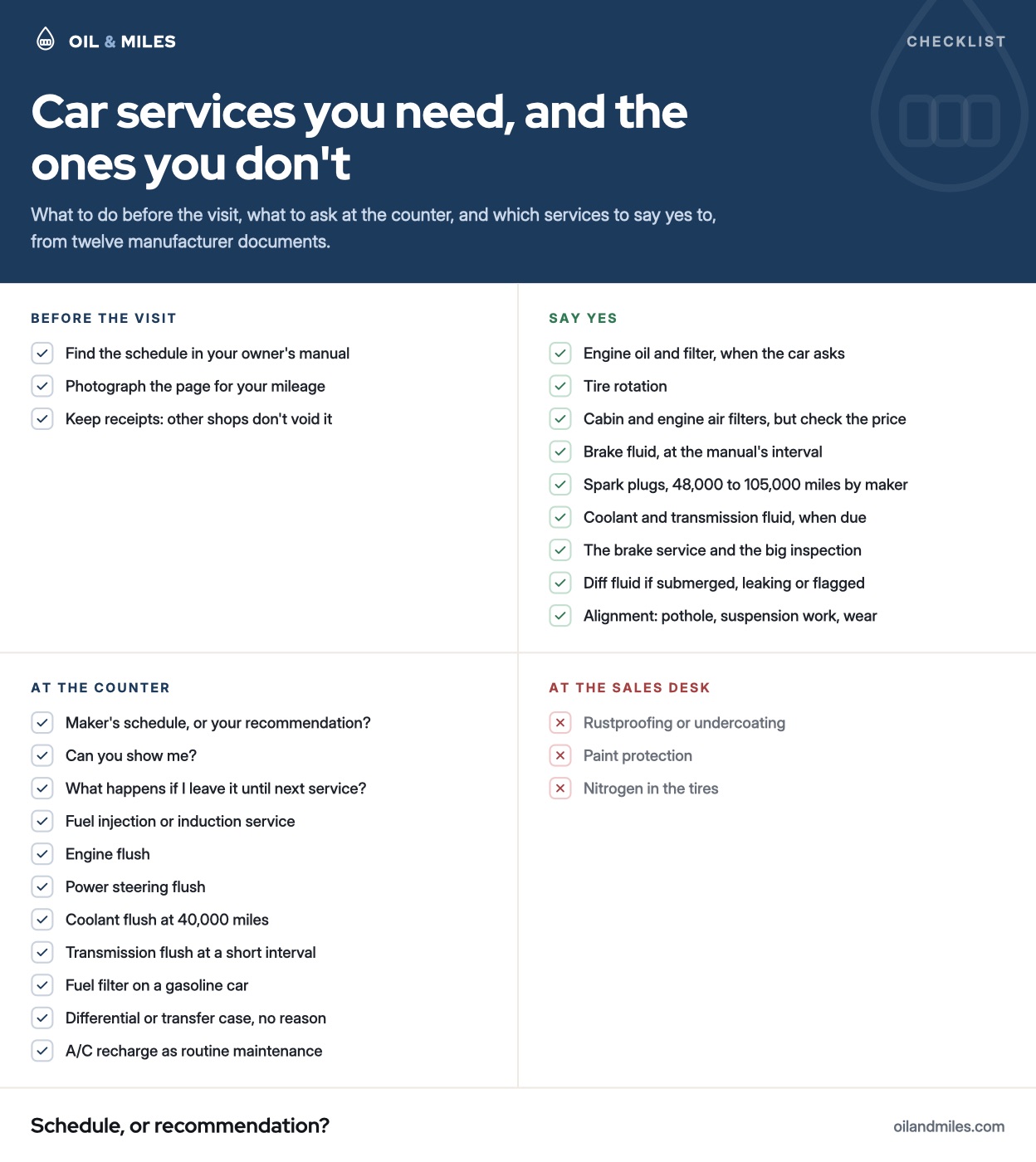
Use this image
Free to republish under CC BY 4.0: credit Oil & Miles and link to this page. The snippet does both.
<a href="https://oilandmiles.com/articles/services-your-car-doesnt-need"><img src="https://oilandmiles.com/assets/img/diagrams/services-your-car-doesnt-need-checklist.jpg" alt="Checklist: before the visit, find and photograph your maintenance schedule; at the counter, ask whether each service is on the manufacturer's schedule and question eight common upsells; say yes to scheduled maintenance such as brake fluid and tire rotation; decline three sales-desk add-ons." width="1200" height="1346"></a> <p>Infographic: <a href="https://oilandmiles.com/articles/services-your-car-doesnt-need">Oil & Miles</a>, CC BY 4.0</p>From the documents
Two federal pages, and what each one settles
One names the practice; the other prices the promise. Both re-read at source this week:
Federal Trade Commission, Auto Repair Basics
Some repair shops create their own maintenance schedules, which call for more frequent servicing than the manufacturer's recommendations.
Environmental Protection Agency, Options for Recharging Your Air Conditioner
Topping off or recharging a system should improve cooling the passenger compartment, but neither service permanently fixes refrigerant leaks.
Read together they cover both halves of the upsell: a schedule nobody at the manufacturer wrote, and a service that leaves behind the fault it was sold to fix. Neither page is hard to find, and neither is quoted at the counter.
Conclusion
Schedule, or recommendation?
One question sorts every line: schedule, or recommendation? Not one of the eleven services here sits on a normal maintenance schedule at the mileage it gets sold, and the three we could price from dealer menus run $70 to $300 each.
A photograph of your own schedule page, taken before the visit rather than during it, is the whole defense.
And don't let the list talk you out of real maintenance: the expensive mistake isn't paying $174 for a fuel induction service, it's refusing a brake fluid change for six years because you decided everything was a scam. Oil & Miles prices what a service costs before it argues about whether you need it, across repair costs.
Common questions
Asked most often
Will refusing these void my warranty?
No. Warranty requires following the manufacturer's schedule, and these services aren't on it, which is the point. The FTC is also explicit that a dealer can't deny coverage because routine maintenance was done elsewhere, so keep your receipts.
Is a fuel injection service ever worth it?
Yes, as a repair rather than as maintenance. If the car hesitates on light acceleration, misfires, or has a check engine light, cleaning injectors is a legitimate step. On a car running normally at 30,000 miles, it's treating a problem that hasn't appeared.
The dealer says my coolant is dirty. Are they wrong?
Not necessarily, so ask to see it. Coolant that is brown or has debris in it is a real finding and worth acting on. Coolant that is simply not brand new at 40,000 miles on a 100,000-mile fluid isn't.
Is dealer undercoating ever worth it?
Very rarely, and not as a one-off spray at signing. If you live somewhere with heavy road salt and plan to keep the car a decade, a specialist annual oil-based treatment is a different product from a one-off dealership spray. The dealership version is the one to decline.
What if I have no idea what my manual says?
Most manufacturers publish the maintenance schedule free on their owner site, searchable by VIN. If you can't find it, tell the shop you'll confirm the interval and book it afterwards. Nothing on this list is urgent enough to need a decision that day.
What people ask next


Sources
- Twelve manufacturer manuals: Toyota 2025 Corolla, 2023 Tacoma; Chevrolet 2020 Equinox, 2022 Silverado 2500/3500 HD; Hyundai 2023 handbook, 2023 Sonata; Ram 2023 and 2026 2500/3500; Nissan 2020 Altima; Subaru 2023 booklet, 2023 Outback; Honda 2020 Civic, two of them diesel pickups, for the intervals and the quoted lines. The manufacturers, read at source August 26, 2026
- Ford's 2023 F-150 scheduled maintenance, for the oil-life limit, the brake fluid and coolant intervals, and the axle wording. fordservicecontent.com, read August 26, 2026
- Jiffy Lube's published service menu, all 53 service pages, for what a national chain offers and how it words each one. jiffylube.com, read August 26, 2026 and re-checked August 31, 2026
- Federal Trade Commission, Auto Repair Basics, for the shop-schedule warning. Federal Trade Commission, re-read at source September 17, 2026
- Environmental Protection Agency, Options for Recharging Your Air Conditioner, for the wording on topping off. epa.gov, re-read at source September 17, 2026
- California Attorney General, June 30, 2009, on the action against 22 Midas shops, for the undercover figures quoted above. oag.ca.gov
- California Bureau of Automotive Repair, via the State Assembly's sunset review background paper, for the shop count and the sum recovered. California State Assembly, read August 26, 2026
- Our own article on transmission flushes, where the interval figures are worked through against their sources. Oil & Miles
How this was compiled
The list of services comes from what shops publish themselves, not from memory. The verdict against each one comes from the manufacturer documents, quoted rather than summarized, because a dealer page about a manual and the manual itself have already turned out to disagree: dealer summaries of Honda's Maintenance Minder list a rear differential item that's not in the Civic's table.
Prices are quoted as each owner reported them, with vehicle and mileage attached, rather than averaged, because the gap between what a menu says and what a customer is actually charged is the thing this article is about. We couldn't open a dealership menu to close that gap ourselves: two dealer price pages returned an access denial on August 27, 2026 from two browsers, so none is a measured average. Where two manufacturers disagree, as Nissan and Toyota do about injector cleaner, both are given rather than the convenient one.
Ford's schedule was read as the published manual page because we couldn't download its PDF. Both quoted Jiffy Lube lines still stood at the re-check. The FTC's warranty point isn't on the Auto Repair Basics page, and we couldn't reach the FTC page that carries it.
What we didn't do
We didn't read every manufacturer. Twelve documents across eight makes is enough to say a service is missing from all of them, and not enough to say it is missing from all cars; yours is the one that governs your car. We give no per-model schedule either, because the interval that governs your car is in your manual, and substituting our number for it would be exactly the behavior this article is about.
We didn't use customer reviews. They can't be verified, they name businesses that get no right of reply here, and one angry review isn't evidence; the regulator figures above measure the same thing and can be checked by anyone. We didn't test whether aftermarket undercoating worsens corrosion. That claim is reported as made by others, and we couldn't find a controlled study either way, so it's stated as a risk rather than a finding.
We left out the best story we found. A 1992 undercover investigation into a national chain was reported by UPI in 1992 as the state finding unnecessary repairs in 34 of 37 cases, an allegation the chain denied. We couldn't open the state's own document, so it's not in the article.
Prices are ranges compiled in August 2026 for the US market and vary by region, vehicle and shop rate. Prices from $10 up are rounded to the nearest dollar, so $14.13 reads as $14 and $14.52 as $15. Below $10 they're exact. This article is general information, not advice about your specific vehicle. See the disclaimer.