
Short answer
Smoke shows the leak. Check the oil cap first.
Carmakers find a vacuum leak with a smoke test: with the engine off, smoke fills the sealed intake and drifts out wherever outside air gets in. Before paying a shop $100 to $200 in labor for one, make sure the oil filler cap and dipstick are seated, and keep spray cleaners off a running engine, because their makers label them extremely flammable.
What to do now
- Free to check yourself: the oil cap, the dipstick and the plastic tubes on top of the engine. The free checks
- Don't spray carb cleaner or WD-40 around a running engine to hunt for the leak. Why the sprays are out
- Then a smoke test, at home with a machine or at a shop for a diagnostic fee. How a smoke test works
Knowing how to find a vacuum leak comes down to one question: where is air getting into the engine without passing the sensor that measures it? You can check for vacuum leaks by eye and ear for free, and a vacuum leak test with smoke or a scan tool narrows it down when that turns up nothing.
Carmakers' own technicians work the same way, from the simple checks to smoke pushed in with the engine off. One carmaker tells its technicians, in capital letters, never to put shop air into the engine's crankcase, the oil-filled space around the crankshaft.
Engine off matters, because the home method that forum and DIY guides repeat, spraying cleaner around a running engine, puts an extremely flammable aerosol next to hot parts and live wiring. The free checks come first, and the spray cans stay on the shelf.
What do you have to work with?
Want a shop to do it? See what a smoke test costs.
How do you check for a vacuum leak at home?
Without a smoke machine or any tool, start with the engine off and check the oil filler cap, the dipstick and the plastic and rubber tubes on top of the engine. A cap or tube that isn't fully home is the cheapest leak there is, and GM's technicians are told to check these early.
Then start the engine and listen: a leak can hiss, but not every hiss is a leak, so the noise tells you where to look rather than what to replace. Our vacuum leak symptoms page covers the sounds, the parts carmakers' bulletins blame and whether you can drive with one.
Work through the 4 steps below to check for a vacuum leak at home, in order, before you buy anything:
- Check the oil filler cap and dipstick, engine off. Both should be pushed or twisted fully home; GM tells its technicians to check both when the trouble began right after an oil change.
- Tug each plastic breather tube at both ends. These PCV (positive crankcase ventilation) tubes carry fumes from inside the engine to the intake; one that comes loose wasn't clicked in, and GM's fix is to press it in until it clicks.
- Look for oil leaks and cracked hoses. GM notes that an oil leak can let the engine draw in air through the same breather system, so a wet, oily seam is worth pointing out to a shop.
- Listen for a hiss with the engine idling. Note where it is loudest and point a shop there; the noise tells you where to look, not which part to buy.
On GM's 1.4L engines in the Encore, Cruze, Sonic, Trax, Volt and ELR, GM adds two checks at the PCV valve with the engine idling. A hiss there that fades when you pull the dipstick, together with a tissue at the valve's vent that is sucked flat and held instead of fluttering, points to a torn valve diaphragm.
Each check can come up empty, so here's what to do when the free checks find nothing:
- Cap and dipstick are tight. Move on to the tubes; GM's list goes on to the breather system and then a smoke test.
- No tube moves and nothing hisses. The next step is smoke or a fuel-trim reading.
- A hiss, but your engine isn't one of those. The tissue and dipstick tests come from one carmaker's engine, so on other engines ask a shop to smoke test the intake.
- The hiss is loud but the engine runs fine. On at least one engine, GM lists a rushing noise at the PCV tube as normal and says not to replace the tube for noise alone.
Free checks in GM papers4 documents
- 2011 Buick LaCrosse and Regal, Chevrolet Equinox, GMC Terrain 2.4L. Inspect for oil leaks that "may allow the engine to draw in unmetered air through the PCV system"; after an oil change, check the oil fill cap and dipstick are seated, GM PIP5028C, November 2012, page 1.
- 2019 to 2020 Chevrolet Silverado 1500 and GMC Sierra 1500 5.3L. Rough idle, whistle and P0171 or P0174 from a PCV tube not installed correctly; tug the tube ends and press the tube in "until it clicks," GM PIP5686, October 2019, page 1.
- Buick Encore, Chevrolet Cruze, Sonic, Trax, Volt and Cadillac ELR with the 1.4L engine. Listen at the PCV valve, check whether the noise "gets quieter or disappears with the engine oil dipstick removed," then the tissue test at the vent, GM 19-NA-114, May 2019, page 2.
- 2020 Chevrolet Corvette 6.2L. Hiss from the PCV tube is "normal air flow"; the tube "should not be replaced due to only noise," GM PIP5723, April 2020, pages 1 and 2.
How do you smoke test for a vacuum leak?
A smoke test fills the engine's intake with a dense vapor, engine off, and the vapor leaks out wherever the intake isn't sealed. It's the vacuum leak test GM's bulletins send technicians to, and the one time you want to see smoke coming out of an engine.
The machine only pushes the vapor in, so the intake opening has to be sealed first. Otherwise the smoke simply drifts back out of the air filter end.
Here's a smoke test for a vacuum leak in the 5 steps below, from the tool maker's manual and GM's bulletin:
- Engine off, in a place without drafts. The machine's maker says all testing is done with the engine off, and a breeze carries thin smoke away.
- Seal the intake opening. Cap plugs, a latex glove or plastic wrap over the air filter end; GM says every one of its leak tests works much better with the throttle body (the air valve the gas pedal opens) covered.
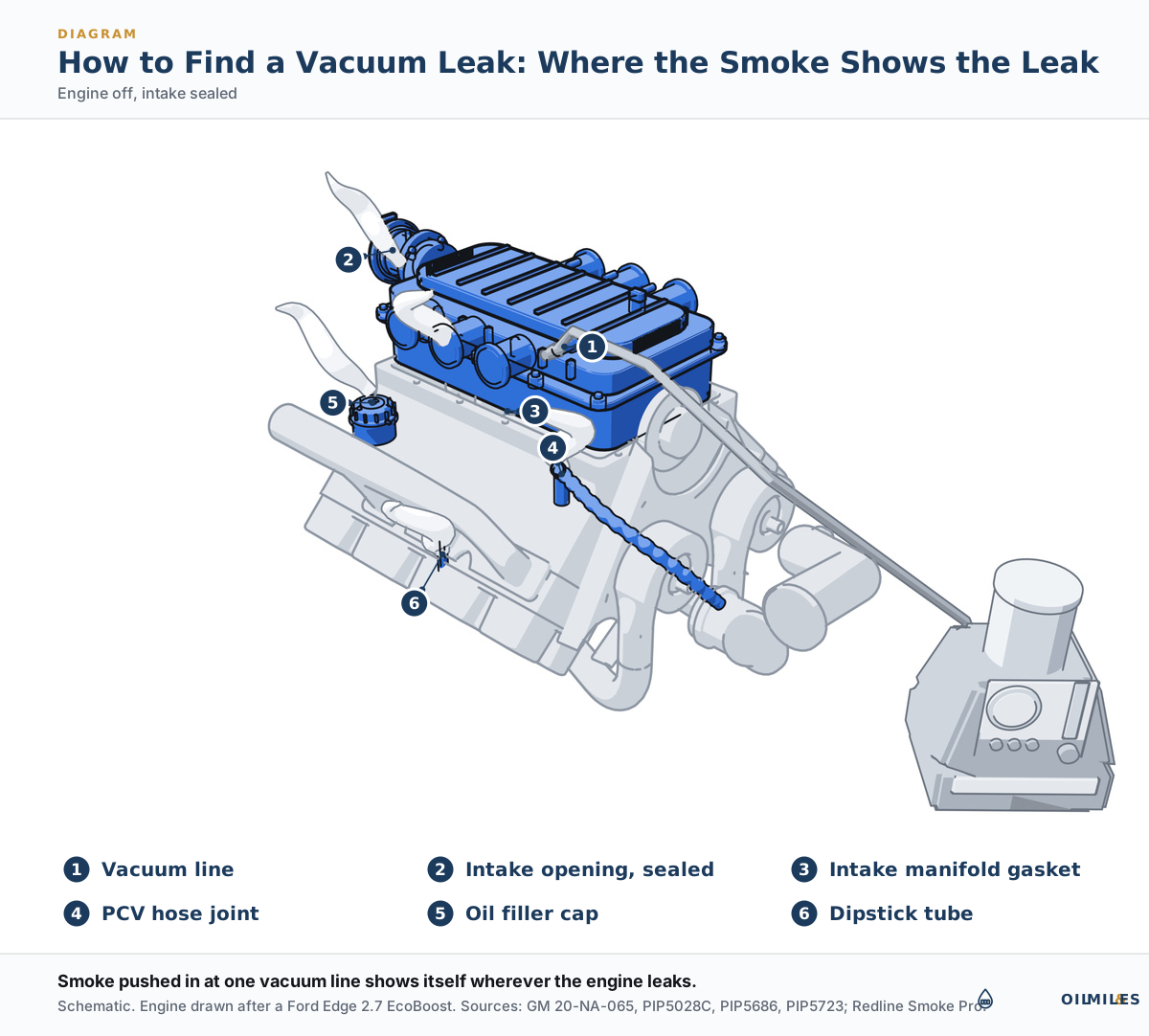
- Put the smoke in. GM uses the brake booster hose (the line to the round drum behind the brake pedal) or the oil dipstick tube; the machine's maker also names the duct after the air filter, or a booster supply line before its one-way valve.
- Run the smoke cycle and watch the flow. The machine's flow meter shows whether air is escaping at all, before you see where.
- Search with the light. Look along hoses, the intake manifold gasket (the seal where the intake bolts to the engine), the PCV tubes and every connection until a wisp shows the gap.
Each step can stall, so here's what to do when a smoke test doesn't settle it:
- No smoke machine. Book a shop test and use the questions in the cost section.
- Smoke at the brake booster. That's a brake part as well as an engine one; see the box below.
- No smoke, but the fuel trim is high. Try the fuel-trim check, which tests the vacuum-line parts.
- No smoke, normal trim, code returns. The code may not come from a leak at all; see a leak code with no leak.
- Smoke at a spot meant to vent. Ask the shop whether the carmaker lists that spot as normal before anything is replaced.
The machine we read puts out half a pound per square inch, that tool's figure, and Volkswagen says its smoke machine limits the crankcase path through the dipstick tube to 2 pounds. A Mercedes-Benz bulletin for a diesel van allows far more: its technicians smoke test the intake, charge air system and exhaust from the exhaust pipe end, at no more than 26 pounds per square inch.
A little smoke in a spot the carmaker expects isn't a leak. On one GM engine, a small puff from the secondary air pump, which blows fresh air into the exhaust, is listed as normal, so ask the shop where the smoke came out and whether that spot is meant to vent.
Use this image
Free to republish under CC BY 4.0: credit Oil & Miles and link to this page. The snippet does both.
<a href="https://oilandmiles.com/articles/vacuum-leak-test"><img src="https://oilandmiles.com/assets/img/diagrams/vacuum-leak-test-smoke-bench.svg" alt="Vacuum leak test on a V6 engine with the engine off: smoke goes in through a vacuum line at the intake, with the intake opening sealed, and leaks show at the PCV hose joint, the oil filler cap, the dipstick tube and the intake manifold gasket." width="1200" height="1082"></a> <p>Diagram: <a href="https://oilandmiles.com/articles/vacuum-leak-test">Oil & Miles</a>, CC BY 4.0</p>Where the smoke goes in5 documents
- GM gasoline cars and trucks, 2000 to 2020. "For an intake leak, the smoke can be introduced into the brake booster hose or the oil dipstick tube"; tests are "much more effective if the throttle body is covered/sealed," GM 20-NA-065, March 2020, page 2.
- Redline Smoke Pro (tool maker's manual). Output pressure 0.5 PSI; "All diagnostic work should be performed with the engine off"; inject at the intake duct or "a brake booster supply line before the check valve"; seal with "Cap Plugs, a latex glove, or plastic wrap"; test "in a draft-free area," operation manual, model 95-0051, PDF pages 3, 5 and 10.
- 2008 to 2014 Volkswagen Tiguan, Passat, CC, Jetta, Golf, Eos. Smoke through the dipstick tube "will limit pressure to 2 PSI"; "DO NOT apply shop air to the dipstick tube or the crankcase," Volkswagen TT 01-14-01, January 2014, updated October 2014.
- 2011 Buick LaCrosse and Regal, Chevrolet Equinox, GMC Terrain 2.4L. "It is normal to see a small amount of EVAP smoke escape from the AIR pump during this test," GM PIP5028C, November 2012, page 1.
- Mercedes-Benz Sprinter (Model 907) with the OM654 diesel. For a leak in the intake or charge air system, "Perform a Pressurized Smoke Test"; "Apply pressure (not exceeding 26 psi) from the exhaust pipe end while sealing the system at the clean air line near the air filter housing," Mercedes-Benz LI09.40-N-079144, version 5, June 2026, pages 1 and 2.
What the data says
Smoke that comes out at the brake booster, the round drum behind the brake pedal, is a brake question as well as an engine one. Only two recalls on NHTSA's file for 2010 to 2025 models name a vacuum leak, both on brake boosters, and neither concerns an engine intake.
The larger, 23V-410, covers 98,944 Kia Sportage SUVs from the 2023 model year, where a misaligned booster diaphragm could leak vacuum and cut the power assist to the brakes. Our brake assist page covers what that feels like at the pedal.
NHTSA recall file (FLAT_RCL), our copy saved September 24, 2026, model years 2010 to 2025, searched for "vacuum leak", October 5, 2026.
Can you use soapy water to find a vacuum leak?
Yes, alongside a smoke machine: spray it on the seams while smoke is pushed into the sealed intake. GM lists it for the gasket, the seams and every vacuum nipple, the small spigots vacuum hoses push onto.
By our reasoning, it bubbles where the smoke escapes, which helps when a wisp is too thin to see. On its own it has nothing pushing air out, because a running engine pulls air in through the leak instead.
Do-it-yourself guides and forums also teach misting plain water over hoses on a running engine and listening for the idle to change. We found no carmaker or tool-maker document that describes it, so we can't tell you how reliable it is.
GM's soapy water method1 document
- GM gasoline cars and trucks, 2000 to 2020. For an intake leak, smoke goes into the brake booster hose or the dipstick tube, then "Soapy water can be sprayed near the gasket and seams and all vacuum nipples," GM 20-NA-065, March 2020, page 2.
Can you use WD-40 or carb cleaner to find a vacuum leak?
Not on a running engine. The makers of both label them extremely flammable aerosols and tell you to keep them away from hot surfaces, sparks and equipment that's switched on, which describes an idling engine bay rather well.
The idea behind the spray test, as forum guides teach it, is that the engine sucks the spray in through the leak and the idle changes. Here's what each can's safety sheet says, before you reach the fine print:
- Carb cleaner. Extremely flammable, and not to be sprayed while equipment is switched on.
- WD-40. Extremely flammable, with vapor that can travel along surfaces to a spark and flash back; it says nothing about leak testing either way.
- Brake cleaner. The same maker gives it the same two warnings: extremely flammable, and not while equipment is switched on.
- Propane. An extremely flammable gas, to be kept away from sparks and hot surfaces.
Some guides suggest these sprays, and we don't recommend any of them near a running engine. Use smoke, soapy water alongside the smoke, or the fuel-trim check below instead.
What the labels say4 safety sheets
- CRC Carburetor and Choke Cleaner, safety data sheet. "Extremely flammable aerosol"; "Keep away from heat/sparks/open flames/hot surfaces"; "Do not apply while equipment is energized," CRC Industries, No. 401924, revised October 4, 2017, page 1.
- WD-40 Multi-Use Product Aerosol, US safety data sheet. "DANGER! Extremely Flammable Aerosol"; "Keep away from heat, hot surfaces, sparks, open flames, and other ignition sources"; "Vapors are heavier than air and may travel along surfaces to remote ignition sources and flash back," WD-40 Company, November 13, 2024, pages 1 and 2.
- CRC Brakleen Brake Parts Cleaner, safety data sheet. "Extremely flammable aerosol"; "Keep away from heat/sparks/open flames/hot surfaces"; "Do not apply while equipment is energized," CRC Industries, revised March 21, 2023, page 1.
- Propane, safety data sheet. "Extremely flammable gas"; "Keep away from heat/sparks/open flames/hot surfaces," Worthington Cylinder Corporation, sheet WC002, revised September 9, 2022, page 1.
Can a scan tool help find a vacuum leak?
Yes, if your scan tool shows live data, which lets you test for vacuum leaks without any smoke. The long-term fuel trim, the extra fuel the engine computer adds to make up for air its sensor never measured, climbs when air leaks in.
Fuel trim reads as a percentage on the scan tool. A vacuum leak can set a lean code as well, such as P0171 or P0174, and GM's bulletin names P0171 "Fuel Trim System Lean."
GM's version of the check runs in the 4 steps below:
- Park with the engine at a hot idle. GM runs the check with the engine fully warm and idling.
- Read the long-term fuel trim. GM's check applies when it sits in the mid-teens or higher.
- Plug the vacuum lines. GM names the lines to the brake booster and the fuel vapor purge valve, among others.
- Watch whether the trim drops to 10% or less. If it does, GM says the engine may be drawing in unmetered air through one of those parts.
Each step can stall, so here's what to do when the fuel-trim check doesn't settle it:
- No live data on your scanner. Book a shop test and use the questions in the cost section.
- Trim never reaches the mid-teens. GM's check doesn't apply, so smoke test the intake.
- Trim doesn't fall with them plugged. The air is getting in somewhere else, so smoke test the intake; if smoke already found nothing, see a leak code with no leak.
Another carmaker reads crankcase vacuum, the slight suction inside the engine's oil space, with a gauge on the dipstick tube at idle, and compares it with a healthy car of the same model. A lower reading sent its technicians looking for an oil leak between the engine and the transmission.
Fuel trim and lean codes4 documents
- 2011 Buick LaCrosse and Regal, Chevrolet Equinox, GMC Terrain 2.4L. "LT Fuel Trims in the Mid-Teens or Greater" at hot idle: plug the vacuum lines (brake booster, EVAP purge pipe); if the trims "decrease to 10% or less," the engine "may be drawing in unmetered air through the related component," GM PIP5028C, November 2012, page 1.
- GM gasoline cars and trucks, 2000 to 2020. Fuel trim and oxygen sensor codes, P0171 and P0174 among them, with a leak check when normal diagnosis finds nothing, GM 20-NA-065, March 2020, pages 1 and 2.
- Buick Encore, Chevrolet Cruze, Sonic, Trax, Volt and Cadillac ELR with the 1.4L engine. P0171 from a torn PCV diaphragm, GM 19-NA-114, May 2019, page 1.
- 2008 to 2014 Volkswagen Tiguan, Passat, CC, Jetta, Golf, Eos. P0171 and P119A, lean fuel trim: "check crankcase vacuum at idle" with a gauge on the dipstick tube, compared with a known good vehicle, Volkswagen TT 01-14-01, January 2014.
How much does a vacuum leak smoke test cost?
A smoke test for a vacuum leak runs $100 to $200 at the four US shops whose own pages price one for intake or vacuum leaks, before any repair. That's labor for finding the leak, with no parts in it.
Only one of the four prices a "vacuum leak diagnosis" by that name, two give a starting price, and one includes the test in a diagnostic fee. A fifth shop bills diagnosis at $200 an hour, labor only, and names intake smoke testing as a step without a flat price.
What it costs
What this box shows
Prices for this repair, drawn from the sources named at the foot of the box. Each figure states whether it covers the part alone or parts and labor.
Vacuum leak smoke test at a shop
Published shop prices for a smoke test that covers intake or vacuum leaks, before any repair. Labor only, no total: the rows are two ways shops bill it.
| Smoke test or leak diagnosisA named vacuum leak diagnosis in California, and starting prices in Kansas and New York. | $125 – $200Labor only, as published |
|---|---|
| Diagnostic fee with oneA Colorado shop's first diagnostic tier, whose lean-code example includes a smoke test. | $100Labor only, as published |
Four US shops' own pages that price a smoke test for intake or vacuum leaks, read October 5 and 6, 2026, US Eastern. No estimator sites. $199.99 rounded to $200.
Some shops credit the fee toward the repair: three of the seven smoke-test and diagnostic pages we read say so, one of them only "typically." Ask about that credit before the test, so you know whether you're paying for the search on top of the repair.
Once the leak is found, the part and the labor to fix it are a separate bill, priced part by part in our vacuum leak repair cost breakdown. The test fee pays for the search, not for the fix.
What to say to the shop
When a quote names a part before any test has run, ask:
- Will you smoke test the intake first?
- What does the test cost?
- Does that fee count toward the repair?
“Before you replace anything, can you smoke test the intake, tell me the fee, and show me where the smoke came out?”
A good answer: a fee of $100 to $200 in labor, credited toward the repair if they do it, and a look at where the smoke came out.
Shop prices we read5 shops
- Chico, California. "Vacuum leak diagnosis (smoke test + fuel trim analysis): $199.99."
- Hutchinson, Kansas. A "Smoke & leak testing" tile "starting at $125" for "EVAP leaks, intake and vacuum leaks, and select exhaust leaks."
- Staten Island, New York. Smoke test "starting at $150," vacuum and intake leak detection listed.
- Englewood, Colorado. Tier one diagnostic "$100," whose worked lean-code example includes a smoke test.
- Oakland Park, Florida. "Diagnostic labor is billed at $200 per hour," with "smoke machine pressure testing on intake manifold" as a step; no flat price, so it's not in the box.
What tools do you need to find a vacuum leak?
For a vacuum leak test at home, the free checks need only your hands, your ears and a tissue, and the fuel-trim check a scan tool that shows live data. The smoke machine and the ultrasonic tester are mostly shop tools.
Here's what each tool for finding a vacuum leak does, from what you already own to shop tools:
- Tissue and a flashlight. The tissue shows suction at a vent, and the light shows cracks and loose tubes.
- Spray bottle of soapy water. Bubbles at a seam, but only while smoke is going in.
- Scan tool with live data. Reads long-term fuel trim, so you can watch it fall when you plug the vacuum lines.
- Vacuum gauge. Reads crankcase vacuum, the slight suction inside the engine's oil space, at the dipstick tube, compared with a healthy car of the same model.
- Smoke machine. Fills the sealed intake with vapor at the machine's own pressure, engine off, so the leak shows itself.
- Ultrasonic leak tester. Listens for the hiss of escaping air at a pitch too high to hear; GM lists it beside its leak detector and soapy water.
GM's own preferred tool is a variable-pressure leak detector that it lends to its US dealers through a loaner program. An independent shop uses its own smoke machine, which is what the fees above pay for.
Use this image
Free to republish under CC BY 4.0: credit Oil & Miles and link to this page. The snippet does both.
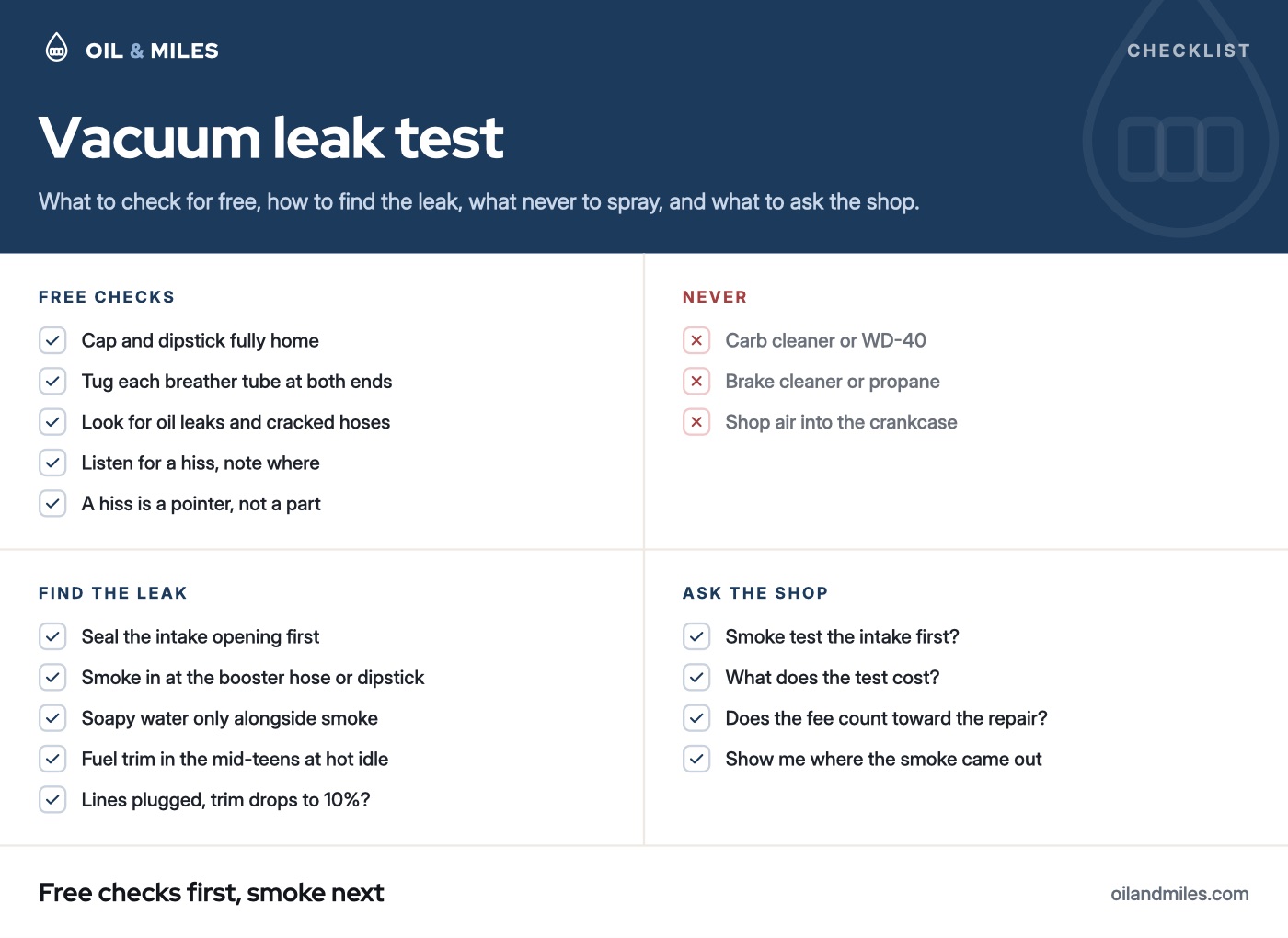
<a href="https://oilandmiles.com/articles/vacuum-leak-test"><img src="https://oilandmiles.com/assets/img/diagrams/vacuum-leak-test-checklist.jpg" alt="Vacuum leak test checklist: with the engine off, check the oil filler cap, the dipstick and the breather tubes, then listen for a hiss at idle; find the leak with a smoke test into the sealed intake, soapy water alongside the smoke, or the fuel trim on a scan tool; never spray carb cleaner, WD-40, brake cleaner or propane near a running engine, and never shop air into the crankcase; ask the shop to smoke test the intake first, what it costs, whether the fee counts toward the repair and where the smoke came out." width="1200" height="875"></a> <p>Infographic: <a href="https://oilandmiles.com/articles/vacuum-leak-test">Oil & Miles</a>, CC BY 4.0</p>From the carmakers
What carmakers tell technicians about finding vacuum leaks
Three service documents decide how a vacuum leak should be hunted. One says what makes every test work, one sets a hard limit on pressure, and one says a smoke test comes before a new part.
Each was written for particular engines, so read them as the carmaker's method rather than a fault your car must have. If your car is listed, take the number to your shop.
Service bulletin 20-NA-065
All of these tests are much more effective if the throttle body is covered/sealed.
Preliminary information PIP5686
If tube is installed correctly it will be necessary to smoke test and confirm there are no leaks.
Tech Tip TT 01-14-01
DO NOT apply shop air to the dipstick tube or the crankcase.
Conclusion
Free checks first, smoke next, flammable sprays never
When you check for vacuum leaks, the order matters: the free things first and the risky things never, like this:
- Check the cap, dipstick and tubes first. They cost nothing, and GM's technicians check them too.
- Treat a hiss as a pointer. GM calls a PCV hiss normal on at least one engine, so confirm before replacing anything.
- Read the fuel trim if you have a scan tool. A trim that drops with the vacuum lines plugged points to the parts on them.
- Let smoke find the rest, engine off. Intake sealed, the machine's own pressure, and never shop air into the crankcase.
- Leave the spray cans out of it. Their own safety sheets rule out a running engine.
A shop test runs $100 to $200 at the shops we read, labor only, and some shops credit it toward the fix. Oil & Miles reads the bulletins carmakers file with NHTSA, so each step above comes from a document you can open.
Common questions
Asked most often
What is the easiest way to find a vacuum leak?
Check that the oil filler cap and dipstick are seated and that every plastic breather tube is clicked in, with the engine off. If that finds nothing, a smoke test is next, the test GM's bulletins send technicians to.
Where do carmakers' bulletins most often find a vacuum leak?
In the eight bulletins behind our vacuum leak page that trace the signs to a part, five blamed PCV or crankcase vapor parts, which is why the free checks start on top of the engine. That counts what the bulletins describe, not every leak on the road.
Will a smoke test find a vacuum leak?
Yes, if the intake is sealed and the engine is off, because the smoke escapes wherever outside air could get in. It can't find a leak that isn't there, though: a bad sensor connection or the engine computer itself can set a leak code with nothing leaking.
Can you find a vacuum leak with the engine running?
Partly: listening, the tissue test at a PCV vent and the fuel-trim check all need the engine running. The smoke test itself is done with the engine off.
How do you make a homemade smoke machine?
We don't give a recipe, because we found no carmaker or tool-maker document for one. The pressure matters: the commercial machine we read runs at half a pound per square inch, that tool's figure, and one carmaker bans shop air in the crankcase outright.
Will a vacuum leak throw a code?
It can: GM's documents list lean codes such as P0171 and P0174 when air gets in that the engine's sensor never measured. A scan tool's long-term fuel trim shows how much extra fuel the computer is adding.
What people ask next
Sources
- GM bulletin 20-NA-065, March 2020, for where the smoke goes in, the sealed throttle body, soapy water and the leak detectors. NHTSA bulletin archive, read October 5, 2026
- GM PIP5028C, November 2012, for the cap and dipstick, oil leaks, the fuel-trim check and the normal puff from the air pump. NHTSA bulletin archive, read October 5, 2026
- GM bulletin 19-NA-114, May 2019, for the PCV listening and tissue tests. NHTSA bulletin archive, read October 5, 2026
- GM PIP5686, October 2019, and GM PIP5723, April 2020, for the PCV tube that must click home and the normal PCV tube hiss. NHTSA bulletin archive, read October 5, 2026
- Mercedes-Benz LI09.40-N-079144, version 5, June 2026, for the Sprinter diesel smoke test and its pressure. NHTSA bulletin archive, read October 6, 2026
- Volkswagen TT 01-14-01, January 2014, for the vacuum gauge, the 2 PSI limit and the shop air warning. NHTSA bulletin archive, read October 5, 2026
- Redline Detection Smoke Pro Air operation manual, model 95-0051, hosted by Bosch Service Solutions, for the smoke machine's pressure, engine-off testing, the injection points and sealing the intake. Redline Detection, read October 5, 2026
- CRC Carburetor and Choke Cleaner safety data sheet, No. 401924, revised October 4, 2017, for the flammability warnings. CRC Industries, read October 5, 2026
- WD-40 Multi-Use Product Aerosol safety data sheet, November 13, 2024, for the flammability warnings and the vapor that flashes back. WD-40 Company, read October 5, 2026
- CRC Brakleen safety data sheet, revised March 21, 2023, and the Worthington propane safety data sheet WC002, revised September 9, 2022, for their warnings. Read October 6, 2026
- NHTSA recall file (FLAT_RCL), model years 2010 to 2025, for the two recalls that name a vacuum leak, 23V-410 on the Kia Sportage and 23V-415 on the Hyundai Palisade. NHTSA, read October 5, 2026
- US shops' own price pages: Tedious Auto Repair (CA), S&K Auto (KS), Fix Service (NY), Motor Medicine (CO) and Front Line Auto (FL) for the prices; Perry's Quality Auto (CA), Network Automotive (AZ) and Green's Garage (FL) for the credit. Shop websites, read October 5 and 6, 2026
What we didn't do
- We didn't test any method on a car ourselves; the steps come from the documents above, and the what-to-do-next lines are our own reading of them.
- We found no carmaker or tool-maker document for the plain water spray or for a homemade smoke machine.
- We read GM, Mercedes-Benz and Volkswagen documents; we found no Ford or Toyota bulletin that describes a smoke test, and didn't read Honda's or Stellantis's, so a step marked as one carmaker's may differ on your car.
- The smoke test prices are shops' published fees, not quotes we collected, and only one prices a vacuum leak diagnosis by that name.
Prices are ranges compiled in October 2026 for the US market and vary by region, engine and shop rate. Prices from $10 up are rounded to the nearest dollar, so $14.13 reads as $14 and $14.52 as $15. Below $10 they're exact. This article is general information, not advice about your specific vehicle. See the disclaimer.