
Short answer
Read the stamp first
Every rotor carries a minimum thickness cast or stamped into it. If machining would take yours under that figure, you can't resurface brake rotors at any price. Only when it clears the number does the cost comparison start, and by then the answer is often to replace anyway: machining runs about $40 to $65 a rotor against a counter price that starts near $21.
Ask whether to resurface brake rotors and you usually get a price comparison. Resurfacing runs about $40 to $65 a rotor and budget aftermarket rotors $35 to $80 each, so a new rotor is frequently cheaper than machining the old one, and that's where the usual answer stops.
Fitted with pads, the whole job has its own range. It's also the wrong place to start, because the number stamped on the rotor decides first.
There's a physical test that comes before the money, it takes two minutes, and it can rule resurfacing out completely, in which case the cheaper option was never on the table. Every guide to this question we read was published by a company that sells rotors, sells the machining, or both.
Where are you with your rotors?
Pedal shakes when you brake? Warped brake rotors.
Which rotor thickness spec actually decides it?
The , the only one of the three that is a legal limit. That's where the confusion lives, and it explains why two shops can look at the same rotor and disagree.
| Specification | Where it comes from | What it means |
|---|---|---|
| Nominal thickness | The service manual, not the rotor | What the rotor measured when it was new |
| Machine-to, sometimes labeled | Cast on the rotor | The thinnest a lathe may cut it to and still return it, roughly 0.050 to 0.060 inch under nominal. Below it, no machining |
| Discard thickness | Cast on the rotor | Where it comes off and is scrapped, machined or not. About 0.015 inch below machine-to, which is the whole working margin |
We should say where those two gaps come from: they're trade guidance, repeated consistently across brake and machining references, not a single published standard we could point you at. The figure cast into your own rotor is the one that governs, and it's the only one of the three we would argue with nobody about.
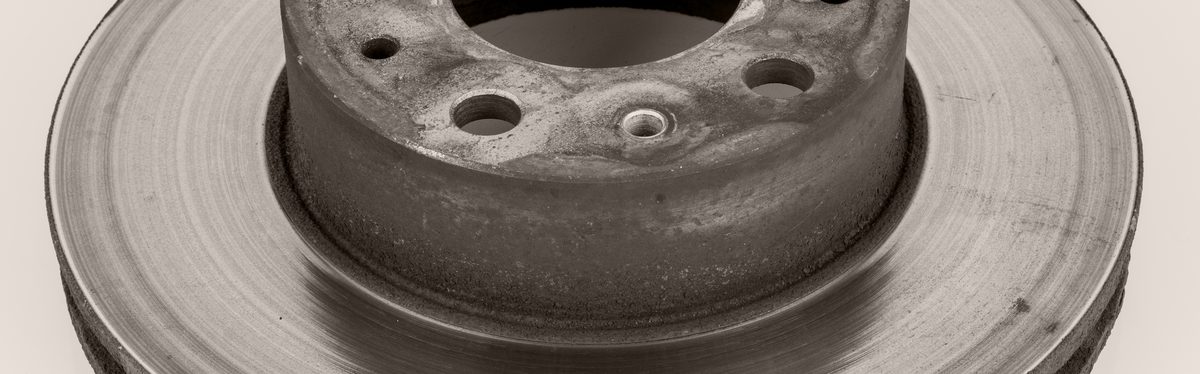
The number you need is on the rotor itself. Look near the hat, the raised center section, or around the outer edge, marked MIN, MIN TH, or discard, cast or stamped in so it survives the rust.
How do you measure a brake rotor?
You need a micrometer, and specifically not a normal one. A has one flat anvil and one pointed anvil.
The point is the whole reason it exists: a worn rotor is scored with grooves, and a flat-to-flat measurement bridges across them and reads the high spots, a thickness the rotor doesn't actually have anywhere. The pointed anvil reaches into a groove and returns the real minimum.
Measure at eight points around the circumference, not one. You're looking for two separate things: the thinnest reading anywhere, which is what you compare against the stamp; and the spread between readings, which is thickness variation and is the thing that makes a steering wheel shake under braking.

Use this image
Free to republish under CC BY 4.0: credit Oil & Miles and link to this page. The snippet does both.
<a href="https://oilandmiles.com/articles/resurface-or-replace-brake-rotors"><img src="https://oilandmiles.com/assets/img/diagrams/rotor-measuring.svg" alt="Left: eight measuring points spaced evenly around a rotor's friction band. Right: a rotor in cross-section scored by worn pads, with a flat anvil resting on the ridges and reading too thick, and a pointed anvil reaching into a groove and reading true" width="1000" height="700"></a> <p>Diagram: <a href="https://oilandmiles.com/articles/resurface-or-replace-brake-rotors">Oil & Miles</a>, CC BY 4.0</p>Worth knowing
If your complaint is a pulsing pedal or a wheel that shakes when you brake, the spread between those eight readings is the measurement that matters, not the average. A rotor can be comfortably above its minimum thickness and still be unusable because it's thicker in some places than others. That's a different fault from a worn-out rotor, and it's covered in why a steering wheel shakes when braking.
Why is a thin rotor a worse rotor?
Because a rotor is a heat sink, and a thinner one holds less of the heat a stop produces. Stopping a car converts its momentum into heat, and the rotor's job is to absorb that heat and shed it into the air, and how much it can absorb before the temperature climbs is a function of how much metal there is.
Machining removes metal, so a resurfaced rotor runs hotter for the same stop than it did when new, and a hotter rotor fades sooner, wears its pads faster, and is more prone to the uneven thickness that produces the shake in the first place. The saving is real and so is the trade.
There's a second effect that has changed the answer over the last two decades. Rotors have been made progressively lighter and thinner by design: better for fuel economy, cheaper to produce, and easier to cool when new.
The consequence is that many modern rotors simply have no spare material to give. They weren't engineered with a machining allowance, and on a lot of cars the first time the pads wear out is also the moment the rotor is finished.
That's the fuller version of the industry's advice. Machining isn't bad practice; the margin it depends on has been engineered out of the part.
What does each option actually cost?
| Option | Typical cost | What you get |
|---|---|---|
| Resurfacing, per rotor | $40 – $65 | A flat surface, on a thinner rotor |
| Budget aftermarket rotor | $35 – $80 | Full thickness, full heat capacity |
| OEM or premium rotor | higher | Same, to the maker's own spec |
Read those first two rows together and the economics are plain: on a mainstream car, a new rotor often costs the same as machining the old one or less. Aftermarket rotor prices have fallen for years while machining is labor, and labor hasn't.
What a rotor costs at the counter
Those first two rows are the whole argument, so here's what one rotor actually costs, every brand a catalog lists for one common car:
What it costs
What this box shows
Prices for this repair, drawn from the sources named at the foot of the box. Each figure states whether it covers the part alone or parts and labor.
Parts cost for a new brake rotor
Single rotors at the counter, parts only, no labor.
| Front rotorOne rotor, not a pair.2017 Honda Accord 2.4L · $18 to $71, 2017 Honda Civic 2.0L · $20 to $62, 2017 BMW X3 2.0L · $34 to $88, 2017 Chevrolet Traverse 3.6L · $30 to $92, | $18 – $92Part only, each |
|---|---|
| Rear rotorOne rotor, not a pair.2017 Honda Accord 2.4L · $15 to $47, 2017 Honda Civic 2.0L · $12 to $55, 2017 BMW X3 2.0L · $26 to $87, 2017 Chevrolet Traverse 3.6L · $25 to $127, | $12 – $127Part only, each |
Every brand RockAuto lists as fitting a 2017 Honda Accord 2.4L, a 2017 Honda Civic 2.0L, a 2017 BMW X3 2.0L and a 2017 Chevrolet Traverse 3.6L, the same four cars as our brake pad census, read September 25, 2026. Single rotors, parts only. Closeouts and drilled, slotted or performance rotors are left out.
Now the part that settles it: the labor is the same either way. A trade guide quotes an on-car rotor refinish at 1.0 hours for both rotors, and replacing both front rotors at 1.0 hours as well.
A second technical resource puts off-car resurfacing of two rotors at 0.8 hours. At the $120 to $159 an hour almost half of independents charge, you pay roughly the same labor whichever you choose.
So the decision comes down to the parts line alone. Machining is quoted at $40 to $65 a rotor, the figure the usual comparison starts from.
A new front rotor starts at $18 to $34 on the four cars priced here, and a rear at $12 to $26. You're being asked to pay more to have metal removed from a part you already own than a new one costs, and to end up with less of it.
Which is why the trade has drifted toward replacement, and also why you should be slightly skeptical of the enthusiasm. Every source we found giving that advice sells rotors.
When can you still resurface brake rotors?
It hasn't stopped making sense everywhere, and the table below shows where it still does:
| The rotor in front of you | The call | Why |
|---|---|---|
| Expensive performance or luxury rotor, with material left | Resurface | $50 of machining against a casting that runs into the hundreds changes the arithmetic completely |
| Thick rotor, comfortably above the machine-to figure | Resurface | A heavier vehicle with a genuine machining allowance is exactly what the lathe is there for |
| Good rotor, bad surface: glazed, lightly scored, or uneven pad material transfer | Resurface | None of that is a worn-out rotor, and cutting it clean is the correct repair |
| Flat rotor, worn-out pads | Leave it | New pads need a flat surface. They don't need a thinner rotor |
| Close to the machine-to figure | Replace | Fifteen thousandths of an inch isn't worth a second labor charge later |
| Cracked or heat checked | Replace | No amount of metal removed makes a cracked casting safe again |
Every row starts from a measurement. Price only decides the cases where both options are still physically allowed.
What should you do at the counter?
Ask first whether the rotors need touching at all. The question in the headline offers two answers and there's a third, the one technicians reach for most often: a rotor above its machine-to figure that runs true, isn't badly scored and gives no pulse goes back on the car untouched, and you pay for pads only, the most-upvoted answer among mechanics in the threads we read and the cheapest outcome here.
Then ask for the measurement, not an opinion: "What did the rotors measure, and what is the minimum on them?" Two figures, and a shop that took the brakes apart has both.
If the measurement is close to the machine-to figure, replace. The margin between machine-to and discard is around fifteen thousandths of an inch, and buying a few months of a thinner rotor isn't worth a second labor charge later.
If you're doing the work yourself, buy the rotor micrometer rather than borrowing a regular one. It's inexpensive, and on a scored rotor a flat-anvil reading will tell you the rotor is fine when it's not.
And whichever way you go, price it as a corner rather than a part: pads, rotor and labor together, which our guide to brake pad and rotor replacement cost breaks down. If the shop is also quoting a , a brake fluid leak may be the real reason that corner needs work at all.
Conclusion
The stamp decides before the price does
Machining is only an option while the rotor still clears its own discard figure. Three numbers are involved and only one of them is cast into the disc as a limit, so the question isn't what you would prefer but what is left between where the rotor measures now and where it has to be scrapped, and on a modern rotor built light that margin is about fifteen thousandths of an inch.
So ask whether the rotor needs touching at all, then ask for the measurement, at eight points on each face, and which of the three numbers it is being compared against. Oil & Miles prices both options at a counter before it recommends either, across repair costs.
Common questions
Asked most often
Can warped rotors be fixed by resurfacing?
Sometimes, and the word "warped" is usually wrong. What people call warping is normally uneven thickness or pad material deposited unevenly, and machining does correct that, provided the rotor still clears its minimum afterwards. A genuinely distorted or cracked rotor is scrap.
Do new brake pads require the rotors to be machined?
No. New pads need a flat, clean surface, so if the rotor is already flat and within spec, machining it removes metal for no gain; if it's scored or has uneven deposits, that's a reason. The surface decides it, not the calendar.
Where is the minimum thickness marked?
Cast or stamped on the rotor, near the hat or around the outer edge, labeled MIN, MIN TH or discard. It's on the part itself, so it applies to that rotor regardless of what a generic spec sheet says.
Can I measure it with a normal micrometer or calipers?
You'll get a number, and on a scored rotor it will be too high. Flat jaws bridge the grooves and read the ridges between them. A rotor micrometer has a pointed anvil that reaches into the scoring, which is the only way to get the true minimum.
How long does it take to resurface rotors?
About an hour of booked labor either way, which isn't the same as time at the shop. A trade guide quotes on-car refinishing of both rotors at 1.0 hours and replacing both front rotors at 1.0 hours; a second publication puts off-car resurfacing of two at 0.8 hours.
How many times can you resurface rotors?
It isn't a count. A rotor can be machined as long as the finished cut still sits above the machine-to figure cast on it, and that whole margin is roughly 0.050 to 0.060 inch under nominal. On many modern rotors nothing is left by the first pad change, so the answer is none.
Is on-car or off-car better, and what does turning rotors cost?
On-car machining cuts the rotor in place, so it trues the surface to that hub rather than to the lathe, which removes any error from the hub itself. Where a shop has the equipment it is the better job. It doesn't change the thickness question at all.
What people ask next
Sources
- Trade brake-service guidance published for technicians, for the three-specification structure, the gaps between nominal, machine-to and discard, and the eight-point measuring method with a rotor micrometer. Technician trade guidance
- Rotor manufacturers' and parts suppliers' technical pages, for the marking location and labels. Several manufacturers and parts suppliers
- RockAuto, every brand listed as fitting a 2017 Honda Accord 2.4L, Honda Civic 2.0L, BMW X3 2.0L and Chevrolet Traverse 3.6L, for the rotor prices, single rotors, parts only. RockAuto, read September 25, 2026
- Gary Goms in Tomorrow's Technician, December 2012, and Know Your Parts, for the labor times. Tomorrow's Technician, Know Your Parts
- Brake retailer and cost-guide pages, for the machining price per rotor. Several publishers, not named
- Brake manufacturers and technician training material, for the heat-capacity argument and the observation that modern rotors are built lighter with no machining allowance. Manufacturer and training publications
How this was compiled
Every specification here is quoted as the trade guidance states it, not converted or rounded, because the whole argument turns on the gap between two numbers only a few thousandths of an inch apart.
Both labor sources cite an aftermarket labor guide without naming it. The $40 to $65 a rotor for machining is the figure that circulates on brake retailer and cost-guide pages; we couldn't trace it to a shop price list we were able to read, so it's the weakest number here. The marking location rests on manufacturer and parts-supplier technical pages we don't name, the next weakest source.
What we didn't do
We give no minimum thickness for any specific vehicle. The figure that governs your car is cast into your rotor, and a number we published could only be wrong. We haven't reproduced the 22–24 mm front and 8–10 mm rear figures that circulate as guidance either, because they're typical values from one source.
We didn't test whether machining measurably shortens rotor life. The heat-capacity reasoning is sound and widely stated, but we found no controlled comparison, and every party publishing on it sells one of the two options.
Prices are ranges compiled in September 2026 for the US market and vary by region, vehicle and shop rate. Prices from $10 up are rounded to the nearest dollar, so $14.13 reads as $14 and $14.52 as $15. Below $10 they're exact. This article is general information, not advice about your specific vehicle. See the disclaimer.
Discard thickness
The dimension at which a disc must come off and be scrapped, machined or not.
Minimum thickness
The thinnest a disc may be machined to and still go back on the car.
Rotor micrometer
A micrometer with one flat anvil and one pointed anvil.
Caliper
The clamp that presses the pads against the disc, driven by hydraulic pressure from the pedal.
Front rotor
2017 Honda Accord 2.4L L4
| Brand | Part | Price |
|---|---|---|
| Top Notch | TN96711GEO | $21 |
| TN982053GEO | $22 | |
| TN981022GEO | $25 | |
| TN982055GEO | $28 | |
| TN96711 | $18 | |
| TN982053 | $20 | |
| TN981022 | $22 | |
| Quality-Built | BR74013G | $23 |
| BR74031G | $29 | |
| ProSpec | 20459061 | $28 |
| 20459034 | $29 | |
| 20459039 | $29 | |
| 20459063 | $36 | |
| 20059034 | $23 | |
| 20059061 | $23 | |
| 20259034 | $24 | |
| 20259061 | $24 | |
| 20059039 | $24 | |
| 20259039 | $25 | |
| 20059063 | $28 | |
| 20259063 | $29 | |
| Bosch | 53011452 | $30 |
| 26011547 | $39 | |
| 26011577 | $44 | |
| 53011684PH | $52 | |
| Dynamic Friction | 60459061 | $33 |
| 60459034 | $34 | |
| 60459039 | $35 | |
| 60459063 | $41 | |
| 60059034 | $29 | |
| 60059061 | $29 | |
| 60059039 | $31 | |
| 60059063 | $37 | |
| ACDelco | 18A82053 | $35 |
| 18A912AC | $35 | |
| 18A82053AC | $37 | |
| 18A82055C | $39 | |
| 18A81022AC | $44 | |
| 18A82055AC | $71 | |
| 18A912A | $31 | |
| 18A912 | $47 | |
| Power Stop | JBR1556EVC | $39 |
| JBR1571EVC | $51 | |
| JBR1730EVC | $54 | |
| JBR1556SCR | $34 | |
| JBR1571SCR | $47 | |
| JBR1730SCR | $47 | |
| Raybestos | 981022FZN | $42 |
| 982055FZN | $46 | |
| 96711R2 | $31 | |
| 982053R | $31 | |
| 981022R2 | $38 | |
| 982055R2 | $42 | |
| 982055R | $43 | |
| Brembo | 09793211 | $44 |
| 09D88111 | $49 | |
| 09D28011 | $58 | |
| Wagner | BD180671PR | $46 |
| BD180583E | $42 | |
| BD180671E | $43 | |
| BD180560E | $45 | |
| BD180670E | $53 | |
| FVP | 12040036 | $21 |
| 6620991 | $27 | |
| BR90146601 | $28 | |
| BR90118601 | $29 | |
| BR90117801 | $30 | |
| 12040094 | $32 | |
| 6621926 | $34 | |
| 6621548 | $35 | |
| BR90161801 | $36 | |
| 6621903 | $40 | |
| 12040086 | $44 | |
| DuraGo | BR901178 | $22 |
| BR901466 | $24 | |
| BR901186 | $25 | |
| BR90146601 | $25 | |
| BR90118601 | $26 | |
| BR901618 | $26 | |
| BR90146602 | $29 | |
| BR90118602 | $30 | |
| BR90117802 | $31 | |
| BR90161801 | $32 | |
| BR90161802 | $38 | |
| AutoSpecialty | JBR1556 | $29 |
| JBR1571 | $39 | |
| JBR1730 | $41 | |
| Centric | 12140036 | $29 |
| Bendix | PRT6206 | $40 |
| Beck/Arnley | 0832725 | $51 |
| 0833668 | $62 | |
| 0833571 | $67 | |
| ADVICS | C6F083U | $52 |
| C6F470U | $54 | |
| C6F097U | $60 | |
| C6F468U | $66 |
Front rotor
2017 Honda Civic 2.0L L4
| Brand | Part | Price |
|---|---|---|
| Top Notch | TN982053 | $20 |
| TN982053GEO | $22 | |
| FVP | 12040036 | $21 |
| BR90146601 | $28 | |
| 6621926 | $34 | |
| AutoSpecialty | JBR709 | $22 |
| ProSpec | 20059061 | $23 |
| 20259061 | $24 | |
| 20459061 | $28 | |
| DuraGo | BR901466 | $24 |
| BR90146601 | $25 | |
| BR90146602 | $29 | |
| Power Stop | JBR709SCR | $26 |
| JBR709EVC | $31 | |
| Centric | 12140036 | $29 |
| Dynamic Friction | 60059061 | $29 |
| 60459061 | $33 | |
| ACDelco | 18A912A | $31 |
| 18A912 | $47 | |
| 18A82053 | $35 | |
| 18A912AC | $35 | |
| 18A82053AC | $37 | |
| Raybestos | 96711R2 | $31 |
| 982053R | $31 | |
| Wagner | BD180671E | $43 |
| BD180671PR | $46 | |
| Beck/Arnley | 0833668 | $62 |
| Quality-Built | BR31257G | $21 |
| Bosch | 53011452 | $30 |
| Brembo | 09D88111 | $49 |
| ADVICS | C6F470U | $54 |
Front rotor
2017 BMW X3 2.0L L4
| Brand | Part | Price |
|---|---|---|
| DuraGo | BR901050 | $34 |
| BR90105001 | $41 | |
| BR90105002 | $49 | |
| Centric | 12134134 | $37 |
| 32034134H | $45 | |
| ProSpec | 20031151 | $37 |
| 20231151 | $37 | |
| 20431151 | $46 | |
| FVP | BR90105001 | $46 |
| 6621370 | $52 | |
| 12034134 | $58 | |
| Dynamic Friction | 60031151 | $46 |
| 90031151 | $60 | |
| 60431151 | $55 | |
| AutoSpecialty | EBR1238 | $48 |
| Power Stop | EBR1238SCR | $56 |
| EBR1238EVC | $64 | |
| Beck/Arnley | 0833596 | $84 |
| Raybestos | 980925R | $84 |
| 980925FZN | $59 | |
| Bendix | PRT6166 | $64 |
| Hella / Pagid | 355119531 | $63 |
| 355119532 | $80 | |
| Quality-Built | BR44539G | $36 |
| Top Notch | TN980925GEO | $36 |
| ACDelco | 18A2837 | $58 |
| Bosch | 15011497 | $64 |
| Zimmermann | 150349420 | $82 |
| Brembo | 09B57011 | $88 |
Front rotor
2017 Chevrolet Traverse 3.6L V6
| Brand | Part | Price |
|---|---|---|
| Top Notch | TN580560 | $30 |
| TN580560GEO | $33 | |
| ProSpec | 20048054 | $31 |
| 20248054 | $33 | |
| 20448054 | $38 | |
| DuraGo | BR900322 | $33 |
| BR90032201 | $33 | |
| BR90032202 | $39 | |
| FVP | 12166069 | $37 |
| BR90032201 | $37 | |
| 6620713 | $41 | |
| 12066069 | $45 | |
| Raybestos | 580560R2 | $40 |
| 580560R | $61 | |
| 580560FZN | $46 | |
| Wagner | BD126467UC | $40 |
| BD126467E | $56 | |
| BD126467PR | $59 | |
| ACDelco | 18A2497A | $42 |
| 18A2497 | $57 | |
| 18A2497AC | $59 | |
| 18A2497SD | $92 | |
| AutoSpecialty | AR8696 | $43 |
| Dynamic Friction | 60048054 | $43 |
| 60448054 | $49 | |
| Centric | 12166069 | $45 |
| 32066069F | $39 | |
| Power Stop | AR8696SCR | $50 |
| AR8696EVC | $57 | |
| Bendix | PRT5748 | $58 |
| GM Genuine | 1771150 | $59 |
| Motorcraft | PBRR18 | $78 |
| Bosch | 25010696 | $48 |
| Brembo | 09C00511 | $75 |
| ADVICS | L6F176U | $79 |
Rear rotor
2017 Honda Accord 2.4L L4
| Brand | Part | Price |
|---|---|---|
| Quality-Built | BR44594G | $15 |
| Centric | 32040068F | $18 |
| 12140068 | $15 | |
| 12040068 | $25 | |
| ProSpec | 20459032 | $19 |
| 20059032 | $15 | |
| 20259032 | $16 | |
| Top Notch | TN980577GEO | $21 |
| TN980577 | $18 | |
| Dynamic Friction | 60459032 | $22 |
| 60059032 | $21 | |
| Bosch | 26011451 | $27 |
| Power Stop | JBR1167EVC | $27 |
| JBR1167SCR | $25 | |
| ACDelco | 18A2546AC | $33 |
| 18A2546A | $29 | |
| Brembo | 08D32611 | $42 |
| DuraGo | BR900520 | $15 |
| BR90052001 | $16 | |
| BR90052002 | $21 | |
| FVP | BR90052001 | $18 |
| 661781 | $20 | |
| 12040068 | $20 | |
| AutoSpecialty | JBR1167 | $18 |
| Raybestos | 980577R2 | $27 |
| Bendix | PRT6208 | $29 |
| Beck/Arnley | 0833159 | $44 |
| ADVICS | C6R109U | $47 |
Rear rotor
2017 Honda Civic 2.0L L4
| Brand | Part | Price |
|---|---|---|
| ProSpec | 20059059 | $12 |
| 20259059 | $13 | |
| 20459059 | $15 | |
| DuraGo | BR901460 | $12 |
| BR90146001 | $13 | |
| BR90146002 | $15 | |
| FVP | BR90146001 | $14 |
| 12040089 | $15 | |
| 6612170 | $18 | |
| Dynamic Friction | 60059059 | $17 |
| 60459059 | $18 | |
| Centric | 12040089 | $17 |
| 32040089F | $15 | |
| AutoSpecialty | JBR1728 | $17 |
| Raybestos | 982073R2 | $19 |
| 982073FZN | $21 | |
| Power Stop | JBR1728SCR | $20 |
| JBR1728EVC | $23 | |
| Bendix | PRT6830 | $23 |
| Wagner | BD180680E | $26 |
| BD180680PR | $28 | |
| Beck/Arnley | 0833669 | $55 |
| Quality-Built | BR74033G | $13 |
| Top Notch | TN982073GEO | $13 |
| Bosch | 53011503 | $19 |
| ACDelco | 18A82073C | $29 |
| ADVICS | C6R408U | $34 |
Rear rotor
2017 BMW X3 2.0L L4
| Brand | Part | Price |
|---|---|---|
| Centric | 12134139 | $28 |
| 12534139 | $26 | |
| 32034139H | $34 | |
| ProSpec | 20031152 | $29 |
| 20231152 | $30 | |
| 20431152 | $37 | |
| Raybestos | 980924R | $30 |
| 980924FZN | $48 | |
| DuraGo | BR90105201 | $33 |
| BR90105202 | $39 | |
| Dynamic Friction | 60031152 | $35 |
| 90031152 | $47 | |
| 60431152 | $41 | |
| FVP | BR90105201 | $37 |
| 6621371 | $39 | |
| 12034139 | $44 | |
| AutoSpecialty | EBR1240 | $39 |
| Bendix | PRT6167 | $46 |
| Power Stop | EBR1240SCR | $46 |
| EBR1240EVC | $53 | |
| Beck/Arnley | 0833597 | $87 |
| Hella / Pagid | 355119542 | $61 |
| Quality-Built | BR44538G | $27 |
| Top Notch | TN980924GEO | $27 |
| Bosch | 15011498 | $50 |
| ACDelco | 18A2836 | $56 |
| Brembo | 09B56911 | $59 |
| Zimmermann | 150349520 | $70 |
Rear rotor
2017 Chevrolet Traverse 3.6L V6
| Brand | Part | Price |
|---|---|---|
| Top Notch | TN580569 | $25 |
| TN580569GEO | $27 | |
| ProSpec | 20048055 | $28 |
| 20248055 | $28 | |
| 20448055 | $33 | |
| DuraGo | BR900378 | $29 |
| BR90037801 | $30 | |
| BR90037802 | $35 | |
| FVP | BR90037801 | $33 |
| 6620811 | $37 | |
| 12066070 | $39 | |
| Wagner | BD126503UC | $33 |
| BD126503E | $40 | |
| BD126503PR | $43 | |
| Dynamic Friction | 60048055 | $36 |
| 60448055 | $41 | |
| Raybestos | 580569R2 | $37 |
| 580569R | $56 | |
| 580569FZN | $41 | |
| 580569 | $72 | |
| AutoSpecialty | AR8675 | $38 |
| ACDelco | 18A2543A | $40 |
| 18A2543 | $65 | |
| 18A2543AC | $72 | |
| 18A2543SD | $73 | |
| Power Stop | AR8675SCR | $44 |
| AR8675EVC | $50 | |
| Bendix | PRT5749 | $44 |
| GM Genuine | 1771115 | $127 |
| Motorcraft | PBRR21 | $78 |
| Centric | 32066070F | $32 |
| Quality-Built | BR41233G | $37 |
| Bosch | 25010701 | $43 |
| ADVICS | L6R188U | $83 |
| Brembo | 09C02010 | $70 |