

Short answer
Brake power assist has a fault. The brakes still work
Service Brake Assist is a General Motors (GM) message that means your power brake assist has a fault, so the pedal can turn hard and your stops can take longer. Parts for the common causes cost about $13 to $134, and GM covers a failing truck vacuum pump for free on many 2014 to 2018 models.
The message tends to turn up on an ordinary day: a Chevrolet, GMC, Buick or Cadillac starts, and the dash says SERVICE BRAKE ASSIST. The car still stops, but the pedal may feel stiff, like pushing on a block of wood instead of a sponge.
Here's the part that's easy to miss: it's about the everyday power assist behind every stop you make, not the emergency Brake Assist feature. And on GM's 2014 to 2018 full-size trucks, the part behind it is covered for 10 years or 150,000 miles.
That difference decides how urgent it is for you, what the fix costs and who pays. Below are the five causes GM's own bulletins name, how safe it is to keep driving, the parts prices for three common GM models, and the free repairs to ask about first.
What else is your vehicle showing?
Just want the price? See what the parts cost.
What does Service Brake Assist mean?
Service Brake Assist means the power brake assist has a fault. Power assist is the help that lets your light push on the pedal stop a two-ton vehicle.
Without it the brakes still work, but your leg does more of the job, so the pedal feels heavy and the vehicle takes longer to stop.
GM builds that help in one of two ways: a round vacuum booster on the firewall, the wall between the engine and your seat, fed by a vacuum pump on some engines. Newer models use an electric booster that pushes on the brake fluid instead.
The name confuses people, because GM owner's manuals also describe a separate feature called Brake Assist. That one adds braking force in a panic stop until the anti-lock brakes (ABS) take over.
So the message and the feature share two words and little else. Your manual lists the message beside the other brake messages, and it treats them very differently:
- SERVICE BRAKE ASSISTThe everyday power assist has a problem. The pedal can get harder, and the dealer should check it.
- Brake Assist (the feature)Works only in a panic stop, adding force until the anti-lock brakes take over. GM describes it as a feature, not a warning.
- BRAKE FLUID LOWA separate message in the same manual, so low fluid shows up under its own name. Check the reservoir anyway; it costs nothing.
- The red BRAKE lightLow brake fluid or a fault in the brake system itself. It's the more serious warning; our brake warning light page covers it.
It's sometimes called the brake assist light, though GM shows it as a text message on the dash. While it's on, the manual says you may hear the assist motor run and feel the pedal pulse, and both are normal.
What GM's manuals say3 manuals
- 2017 Chevrolet Malibu owner's manual"This message may be displayed when there is a problem with the brake boost assist system." The boost motor "might be heard operating", the pedal may pulse, and "this is normal under these conditions". Take the vehicle to your dealer.
- 2019 Chevrolet Silverado 1500 owner's manual"The Brake Assist feature assists in stopping or decreasing vehicle speed in emergency driving conditions." It uses the brake control module to detect a quick, forceful press.
- 2020 Chevrolet Equinox owner's manualIf the engine stops, "there will be some power brake assist but it will be used when the brake is applied." After that, stops take longer and the pedal is harder to push.
Is it safe to drive with Service Brake Assist?
You can drive carefully to a shop, because the brakes still work without the assist. GM's own documents say so: the hydraulic brakes stay functional but may need more pedal force, and stopping distance can grow.
What gets you is the surprise, because a hard pedal takes more leg than you expect. GM says it's more noticeable at low speed with a gentle press, the way you'd ease up to a stop sign.
None of the GM documents we read gives a safe number of miles or days to keep driving with the message on, so we don't either. What the documents do support is this short list, and it tells you when to stop driving with Service Brake Assist on:
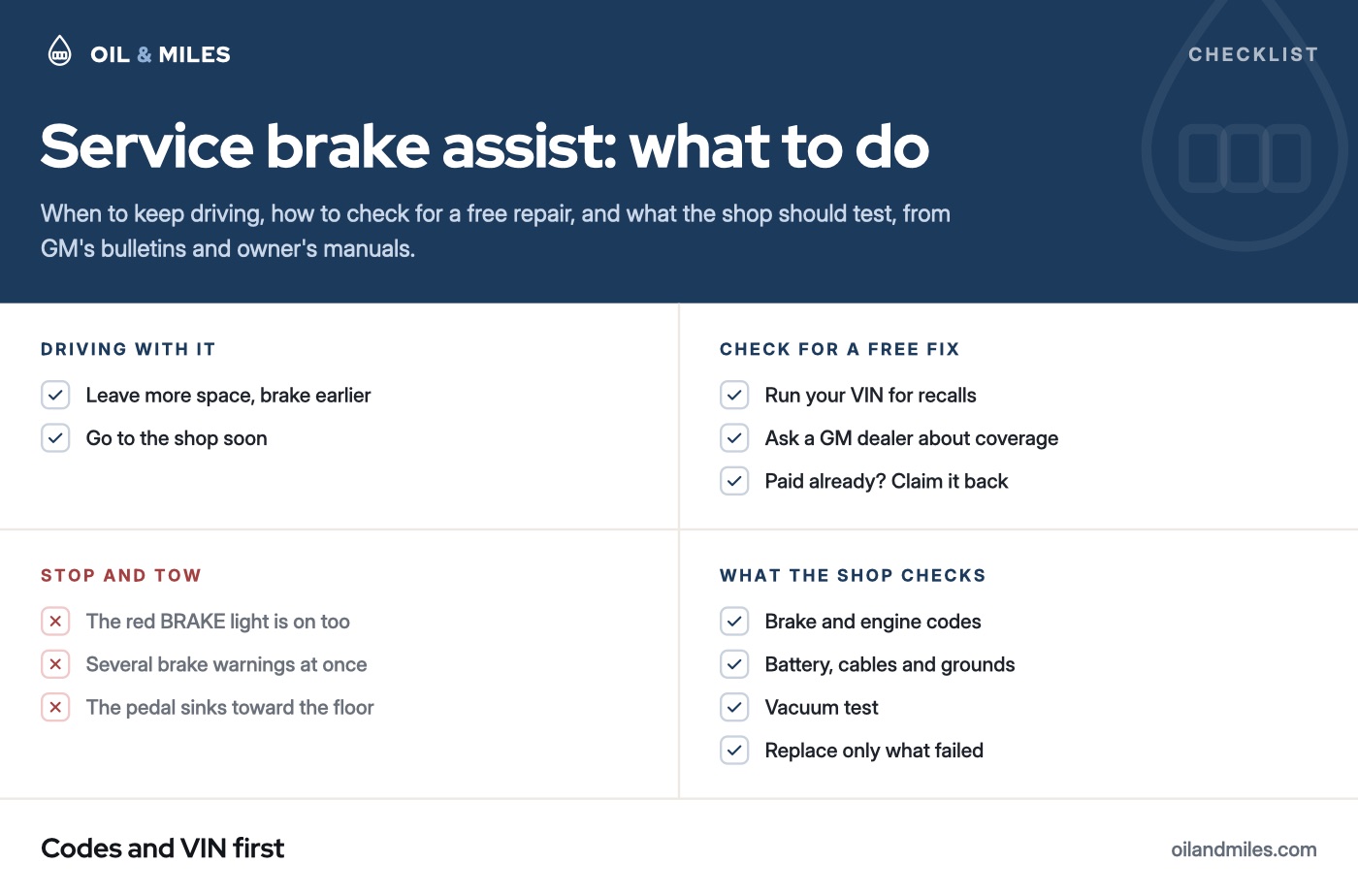
- Drive it to the shop if the pedal feels close to normal.Leave more space to the car ahead, brake earlier, and press firmly. Go soon, not next month.
- Stop and call for a tow if the red BRAKE light is on too.GM's manuals say to pull off the road and stop carefully when the brake system warning light stays on, and to have the car towed.
- Don't drive if several brake and stability warnings appear at once.For 2019 Silverado and Sierra 1500 trucks showing Service Brake Assist, Service ESC (electronic stability control) and Brake System Failure together at start, GM told owners not to drive.
- Treat a pedal that sinks as urgent.GM's manuals pair a pedal that goes closer to the floor with the red brake light, so treat it the same way.
Safety documents4 documents
- GM Special Coverage N182202780, October 2019Increased pedal effort, a hard pedal and possibly longer stops, "more prevalent at low speed when softly applying the brakes". The hydraulic brake system "remains functional but may require additional pedal force."
- NHTSA investigation PE18-012, closed April 10, 20222014 to 2016 GM pickups and SUVs: 4,126 complaints, 206 crashes or fires and 47 injuries, no deaths, counted across NHTSA's and GM's reports.
- GM recall 20V-055, January 20202019 Silverado and Sierra 1500: with several brake and stability warnings at start, owners "should be advised NOT to drive the vehicle in this condition."
- 2020 Chevrolet Equinox owner's manualBrake system warning light: the pedal may be harder or go closer to the floor, and the car should be towed if the light stays on.
What the data says
NHTSA, the federal safety agency, opened its investigation into GM's pickups and SUVs in November 2018 with 111 complaints and 9 crashes. By the time it closed in April 2022, the count across NHTSA's and GM's reports had reached 4,126 complaints and 206 crashes or fires, with 47 people hurt and no deaths.
NHTSA closed the case after GM's recall reprogrammed the brake module, so the assist now fades gradually and the warning comes sooner.
Across all vehicles, 353 complaints in NHTSA's database quote the Service Brake Assist message. All but five name a GM brand, and four of those five are the Acura ZDX and Honda Prologue, which use GM's electric booster.
NHTSA Office of Defects Investigation, PE18-012 opening and closing summaries, 2018 and 2022; NHTSA complaints file downloaded September 2, 2026, searched October 1, 2026.
What owners report
Owners describe the low-speed pattern GM's coverage names. One 2016 Silverado 1500 owner wrote that THE BRAKES BECAME REALLY HARD TO PRESS AND I ALMOST CRASHED INTO MY GARAGE, and that it seemed to happen only at slow speeds.
A 2018 Equinox owner found the brakes EXTREMELY HARD (LIKE PUSHING ON A BRICK) once the message appeared. Another Equinox owner saw it come and go DOZENS OF TIMES WHEN STARTING THE VEHICLE, along with the check engine light, much like the sensor faults in GM's bulletins.
NHTSA complaints 11165980 (2016 Chevrolet Silverado 1500), 11354409 and 11292216 (2018 Chevrolet Equinox), in the owners' own words, read October 1, 2026.
Why is Service Brake Assist on?
The message comes on because the brake control module, or the engine computer, sees too little assist or loses track of it. GM's bulletins name five ways that happens, and the vehicle you drive decides which Service Brake Assist cause is likely:
1. A weak engine-driven vacuum pump
Some full-size trucks and SUVs have a small pump on the side of the engine that makes vacuum for your brakes, driven by its own short belt. Engine oil lubricates it through a fine screen, and sludge in old oil can clog that screen, so the pump wears and makes less vacuum.
When vacuum stays low for two to five minutes, the message appears. You may also hear a tick from the engine, like an exhaust leak, or feel the pedal vibrate.
GM says skipped oil changes "could contribute", which makes this a cause your maintenance habits can help prevent.
On GM's own full-size pickups and SUVs, GM replaces this pump and belt for free under a special coverage. More on that in the coverage section.

Use this image
Free to republish under CC BY 4.0: credit Oil & Miles and link to this page. The snippet does both.
<a href="https://oilandmiles.com/articles/service-brake-assist"><img src="https://oilandmiles.com/assets/img/diagrams/service-brake-assist-system.svg" alt="Ghosted V8 engine bay with the brake assist system in color: a belt-driven vacuum pump low on the front of the engine, a vacuum line with a sensor running back to the round brake booster on the firewall, and the master cylinder bolted to the booster." width="1200" height="869"></a> <p>Diagram: <a href="https://oilandmiles.com/articles/service-brake-assist">Oil & Miles</a>, CC BY 4.0</p>2. A vacuum line or sensor fault
A sensor on the booster or its vacuum line tells the computer how much assist is stored. If that sensor or its wiring misreads, you can see the message while the brakes feel fine, and the check engine light may join it with code P0557 or P0558.
GM found two versions of this. On some Equinox, Terrain and Envision models with auto stop-start, the sensor misread during the restart, and a newer pipe with a tougher sensor fixed it.
On some Traverse, Enclave, Acadia, Blazer and Cadillac crossovers, a loose terminal at the sensor was to blame. So ask the shop for the codes before any part is ordered, because a sensor code points at a cheap pipe or a wiring repair, not a booster.
3. Low voltage when the engine starts
The brake control module needs steady power, and starting the engine pulls the battery's voltage down for a moment. GM found that on some newer Silverado and Sierra 1500 trucks, a dip during cranking could make the brake module drop the assist and light up several warnings.
GM's fix starts with the cheapest checks: clean and tighten the battery cables, test the battery and charging system, then load new brake module software. A tired battery is worth testing first; our page on battery or alternator problems shows how to tell them apart.
4. Brake module software
Some messages come from the software, not a broken part. On some GM models with the electric booster, the brake module could flag a fault that wasn't there, change the pedal feel and show the message.
Your fix here is a software update at the dealer, about 0.3 hours of book time. The same kind of update is the remedy in GM's big truck recall, where it lets the brake module add hydraulic pressure when the vacuum pump falls behind.
5. An electric booster fault
Newer vehicles use an electric booster, a motor that builds brake pressure without any vacuum. GM calls its version eBoost, and when it fails, the messages NHTSA describes are Service Brake System and Brake System Failure, with the speed limited.
Owners of the Acura ZDX and Honda Prologue, which share GM's eBoost, have quoted Service Brake Assist itself in federal complaints, so the message can point here too.
NHTSA opened an engineering analysis of eBoost failures in August 2026, covering about 1.16 million newer vehicles, including the Honda Prologue and Acura ZDX that share the system.
It was still open when we read it on October 1, 2026, so no defect had been confirmed and no recall fix existed. If your newer GM shows one of those messages, ask the dealer whether it falls under this investigation.
GM's bulletins, by cause8 documents
- 2014 to 2018 Silverado and Sierra 1500; 2015 to 2018 Tahoe, Suburban, Yukon; 2015 to 2017 EscaladeEngine-driven vacuum pump output may drop; sludge can block its oil screen; alert 2 to 5 minutes after vacuum drops. Recall 19V-645 and Special Coverage N182202780.
- 2014 to 2016 Silverado and Sierra 1500; 2015 to 2016 Tahoe, Suburban, Yukon, EscaladeHard pedal and a tick that may sound like an exhaust leak; the pump is "belt-driven and mounted to the side of the engine block". GM bulletin PIT5361B.
- 2017 to 2021 Equinox, Terrain, Envision with stop-startMessage with check engine light and P0557; the sensor misreads during the restart; replace the booster vacuum pipe. GM bulletin 21-NA-107.
- GM crossovers up to the 2020 model year: Traverse, Enclave, Acadia, Blazer, XT5, XT6Message with P0557 or P0558; poor terminal tension at the booster vacuum sensor; new hose and harness. GM bulletin 20-NA-071.
- 2022 to 2024 Silverado and Sierra 1500Loss of brake assist after starting, from a voltage drop during cranking; clean battery cables, test the battery, reprogram. GM bulletin PIT6474A.
- 2019 Silverado and Sierra 1500, 2019 CT6Brake module software falsely detects a fault; message with service engine soon light and longer pedal travel. GM service update N192210460.
- 2019 to 2020 Silverado, Sierra, Blazer, Acadia, CT6, XT5, XT6Loss of brake assist with dashboard messages and brake module codes; reprogram, 0.3 hours. GM bulletin 20-NA-073.
- 2023 to 2026 GM eBoost models, Honda Prologue, Acura ZDXOpen NHTSA engineering analysis EA26006: loss of brake assist, a Brake System Failure or Service Brake System message, speed limited to 43 mph.
Is there a recall or free repair for Service Brake Assist?
Yes, if you drive one of the trucks and SUVs with the largest recall behind this message. GM pays for a new vacuum pump and belt on 2014 to 2018 Silverado and Sierra 1500 pickups, 2015 to 2018 Tahoe, Suburban and Yukon, and 2015 to 2017 Escalade.
NHTSA's closing summary says GM added the 2018 Escalade and 2019 Tahoe in October 2020. The coverage lasts 10 years or 150,000 miles from the day the vehicle was first put in service, whoever owns it now.
A separate recall loads new brake module software on the same vehicles, free to you and with no parts. Because the 10 years run from that first day, the oldest trucks have already aged out, so check before you assume either way.
Here's how to find out what your vehicle has, cheapest first, in the 3 steps below to check for a free Service Brake Assist repair:
- Run your VIN at NHTSA. The NHTSA recall search shows open recalls, such as 19V-645, for your vehicle. Our free VIN checker also shows open recalls for your model year.
- Ask a GM dealer about special coverage. Coverages like N182202780 aren't recalls, so the NHTSA search won't show them. The dealer sees them by VIN.
- Keep your receipt if you already paid. GM's coverage bulletin says owners who paid for the covered repair can claim reimbursement.
Recalls and coverage3 documents
- Special Coverage N182202780, revised October 2019Vacuum pump 12696313 and belt kit 12643517, no charge; 10 years or 150,000 miles "from the date the vehicle was originally placed in service, regardless of ownership". Earlier paid repairs can be reimbursed.
- Recall 19V-645, September 20193,456,719 trucks and SUVs: 2014 to 2018 Silverado and Sierra 1500, 2015 to 2018 Tahoe, Suburban and Yukon, 2015 to 2017 Escalade. Brake module software so the hydraulic boost helps when vacuum is low; no parts, about 0.3 hours.
- Recall 20V-603, 2020The same software fix for 14,620 more 2018 models with the 5.3L and 6.2L engines.
How much does it cost to fix Service Brake Assist?
The parts for the common causes cost you about $13 to $134. That's because the fixes in GM's bulletins are a pump, a belt, a sensor, a pipe or software, and only one combined job, on 2014 to 2016 trucks, adds a new booster.
A booster is the big-ticket exception, and even that runs from $69 to $722 depending on the vehicle and the brand.
Labor is the other half of your bill, and GM's own warranty times keep it modest. The box below prices the parts for three common GM models; the table after it turns GM's book times into a labor cost.
What it costs
What this box shows
Prices for this repair, drawn from the sources named at the foot of the box. Each figure states whether it covers the part alone or parts and labor. The three vehicles priced are the models search suggestions name first with the message.
Service Brake Assist parts cost, by vehicle
One part per fix, parts only, so no total. Labor is in the table below.
| Vacuum pumpEngine-driven on the trucks, and free under GM's coverage on 2014 to 2018 full-size models. The Equinox and Malibu pumps are different parts, outside that coverage.2016 Chevrolet Silverado 1500 5.3L · $91 to $134, 2018 Chevrolet Equinox 1.5L · $66 to $71, 2015 Chevrolet Malibu 2.5L · $66, | $66 – $134Part only, at the counter |
|---|---|
| Pump beltThe short belt that turns the truck pump; GM's coverage replaces it with the pump. Priced for the Silverado only, since we didn't check a separate belt for the other two.2016 Chevrolet Silverado 1500 5.3L · $13 to $51, | $13 – $51Part only, at the counter |
| Vacuum sensor or pipeOn the Equinox the sensor comes built into the vacuum pipe, so the pipe is the part.2018 Chevrolet Equinox 1.5L · $27 for the pipe, 2016 Chevrolet Silverado 1500 5.3L · $78 for the sensor, 2015 Chevrolet Malibu 2.5L · $39 for the sensor, | $27 – $78Part only, at the counter |
| Brake boosterNew or remanufactured. A reman adds a refundable core charge of $30 to $70 until the old unit goes back; the $722 top is GM's own new booster for the Malibu.2018 Chevrolet Equinox 1.5L · $69 to $73, 2016 Chevrolet Silverado 1500 5.3L · $84 to $135, 2015 Chevrolet Malibu 2.5L · $146 to $722, | $69 – $722Part only, at the counter |
Part prices are every listing RockAuto shows for the three vehicles, read October 1, 2026. Left out: closeouts and listings with no price. Reman prices are before the core charge.
Your labor is the carmaker's book time, the hours a dealer is paid for the job, times what an independent shop charges you. Almost half of 752 US shops in a 2025 industry survey charged $120 to $159 an hour, so that's the rate used here.
| Job | Hours | Labor |
|---|---|---|
| Brake module software update | 0.3 h | $36 – $48 |
| Vacuum pipe with sensor, base engine (Equinox, Terrain) | 0.3 h | $36 – $48 |
| Vacuum pipe with sensor, 2.0L turbo (Equinox, Terrain) | 2.0 h | $240 – $318 |
| Vacuum pump and belt (full-size truck) | 1.3 h plus a 0.1 to 1.0 h test | $156 – $207 plus the test |
| Pump, belts, hose, booster and master cylinder (2014 to 2016 truck) | 2.8 h | $336 – $445 |
| Booster alone (other carmakers' times) | 1.3 – 2.4 h | $156 – $382 |
The last row isn't a GM figure: GM's bulletins tell dealers to use the published time for a booster without printing it, so it comes from Ford, Mitsubishi and Mercedes warranty times and is a guide, not a quote. To see that split for your own area, our free fair price calculator prices the part and the labor separately.
Where the hours come from6 documents
- GM Special Coverage N182202780Vacuum pump replacement 1.3 hours, plus the brake system vacuum source test at 0.1 to 1.0 hours.
- GM bulletin 21-NA-107Power brake booster vacuum pipe: 0.3 hours on the Envision and base Equinox or Terrain, 2.0 hours with the 2.0L turbo (LTG).
- GM recall 19V-645 and bulletin 20-NA-073Brake module reprogramming, 0.3 hours.
- GM bulletin PIT5361B, 2014 to 2016 trucksVacuum pump, belts, pump-to-booster hose, booster and master cylinder in one job, 2.8 hours.
- Ford Edge and MKX booster program; Mitsubishi recall 14V-560New brake booster: 1.3 hours (2010 Edge), 2.0 hours (2011 to 2014 Edge), 2.4 hours (2011 Outlander Sport).
- Mercedes-Benz recall 22V-315About 2 hours to replace the booster and pedal kit after a 1-hour inspection.
How do you fix or reset Service Brake Assist?
You fix it by fixing what's behind it. If you clear the message without a repair, you only hide it, and it returns if the fault is still there when the system checks itself again.
A good shop works from the cheap checks to the expensive ones. Use the 5 steps below to fix Service Brake Assist as your checklist at the counter; they're built from GM's bulletins and a pump maker's test guide:
- Check for recalls and coverage by VIN. Free fixes first; if nothing is open, go on to step 2. See the coverage section.
- Read the codes from the brake and engine modules. GM's bulletins list codes from both, and only the engine's codes turn on the check engine light, so ask for a scan of each.
- Test the battery, cables and grounds. GM's bulletin for 2022 to 2024 trucks starts here, because a voltage dip at start can set the fault.
- Measure the vacuum. GM calls this the brake system vacuum source test. Hella, a pump maker, adds listening for an electric pump to run and reading booster pressure in the scan data.
- Replace only what failed, then update the software. A pump, a pipe with its sensor, a wiring repair or a module update, and the booster only when the tests point at it.
Is there a reset you can do yourself? Only one GM document gives one, for a software glitch at start on some Silverado and Sierra 1500 trucks, and GM's own words call it "not a long-term fix" because the real fix is new software from the dealer.
The reset and the tests3 documents
- GM recall 20V-055, 2019 Silverado and Sierra 1500Park, turn the ignition off, lock the doors with the key fob, wait 3 minutes, unlock and start with the fob or ignition, not remote start. Boosted brakes should return.
- Hella, an electric vacuum pump makerCauses: supply voltage faults, outside damage, a failed motor, damaged or dirty vacuum lines. Test: warm engine, press the pedal, listen for the pump, read pressure and codes.
- GM bulletin PIT6474AClean and tighten all battery cable connections, test the battery and charging system, then reprogram the brake module.
Do other cars show a brake assist warning?
Other carmakers use the same power assist and can lose it the same way, but none of the non-GM owner's manuals we read shows a Service Brake Assist message. They warn with the brake system light instead, red or yellow, sometimes with a chime, and the advice is to stop or see a dealer.
A few owners of the GM-built Acura ZDX and Honda Prologue do quote the message in complaints, since those two share GM's eBoost. On any other car, a hard pedal with a brake light may be the same assist failure under a different name, and the manuals below show each maker's warning.
Other makers' manuals7 manuals and documents
- 2024 Honda PrologueBrake system warning light; the manual says "The brake system has electric brake boost." Pull off and stop carefully; speed may be limited and the pedal harder; tow if the light stays on.
- 2016 Toyota Highlander Hybrid and Prius cRed brake light with a buzzer: "Immediately stop the vehicle in a safe place and contact your Toyota dealer." Yellow light: the regenerative or electronic brake system.
- 2015 Lexus CT200hThe same red and yellow brake lights and advice; Lexus covers the booster and booster pump under a support program.
- 2018 Mercedes-Benz C-ClassRed brake light with the message "The brake boosting effect is malfunctioning": pull over, stop and don't keep driving.
- 2018 Nissan Rogue HybridYellow electronically controlled brake light; a later recall says a failed booster motor shows the brake light with a buzzer and a hard pedal.
- 2017 Mitsubishi i-MiEVBrake warning light, sometimes with a buzzer; pedal effort "may significantly increase". The electric vacuum pump's sound is normal.
- 2016 to 2018 BMW 330eBMW extended the warranty on the brake servo's electric vacuum pump to 15 years or 150,000 miles; we couldn't read the owner's manual.
Use this image
Free to republish under CC BY 4.0: credit Oil & Miles and link to this page. The snippet does both.
<a href="https://oilandmiles.com/articles/service-brake-assist"><img src="https://oilandmiles.com/assets/img/diagrams/service-brake-assist-checklist.jpg" alt="Service brake assist checklist: drive gently to a shop if the pedal feels close to normal, leaving more space and braking earlier; stop and get a tow if the red brake light comes on too, several brake warnings appear at once or the pedal sinks; run the VIN for recalls, ask a GM dealer about special coverage and keep receipts for reimbursement; at the shop check recalls, read brake and engine codes, test the battery and cables, measure the vacuum and replace only what failed." width="1200" height="792"></a> <p>Infographic: <a href="https://oilandmiles.com/articles/service-brake-assist">Oil & Miles</a>, CC BY 4.0</p>From the documents
What GM's manual and bulletins say about Service Brake Assist
Three GM documents settle the questions owners ask in search: what the message means, why the truck pump fails, and why a sensor can set it. Each was written for particular models, so the details are examples.
2017 Chevrolet Malibu owner's manual
This message may be displayed when there is a problem with the brake boost assist system.General Motors, 2016
GM Special Coverage N182202780
Failure to follow recommended oil change intervals could contribute to this condition.General Motors, October 2019
GM Bulletin 21-NA-107
Replace the power brake booster vacuum pipe with the later version, containing a sensor more robust against in-rush variation during STOP/START crank events.General Motors, June 2021
We read all three as one message: find out which assist system your vehicle has, then check the cheap, documented causes before anyone sells you a booster.
Conclusion
Hard pedal, real fault, maybe a free fix
Service Brake Assist doesn't mean the brakes have failed, but it does mean every stop takes more of you. Here's what to take from this page about Service Brake Assist:
- It's the power assist, not the panic-stop feature.The brakes still work, but the pedal can be harder and stops longer, most of all at low speed.
- Drive gently to a shop, and stop if the red BRAKE light joins it.A sinking pedal or several brake warnings at once means a tow, not a drive.
- Your vehicle points to the cause.An engine vacuum pump on full-size trucks, a sensor or pipe on crossovers, voltage or software on newer models.
- Check for free repairs first.Run the VIN for recalls, then ask a dealer about special coverage, which covers the truck pump for 10 years or 150,000 miles.
- Check the cheaper parts before a booster.Parts run about $13 to $134 for the common causes, and GM's book times for them run from 0.3 to 2.8 hours.
So read the codes and run the VIN before you buy a part. Oil & Miles reads the carmakers' bulletins so you know what to ask for at the counter.
Common questions
Asked most often
Is it safe to drive with Service Brake Assist?
Far enough to reach a shop, carefully, in the cases GM describes, because the brakes still work without the assist. Stop and get a tow if the red brake light comes on too, the pedal sinks, or several brake warnings appear together.
How much does it cost to fix Service Brake Assist?
Parts for the common causes run about $13 to $134, and a booster $69 to $722 depending on the vehicle. On many 2014 to 2018 GM trucks and SUVs the vacuum pump and belt are free under GM's special coverage.
How do you reset Service Brake Assist?
By fixing the cause; clearing the message alone doesn't last. GM gives one temporary reset, for 2019 Silverado and Sierra 1500 software glitches: ignition off, lock the doors, wait 3 minutes, then start with the key fob or ignition, not remote start.
Can you drive without brake assist?
The brakes work without it, but you need much more pedal force and stops take longer. GM's manuals describe the same effect when the engine stops while driving.
What does Service Brake Assist mean on a Chevy?
The power brake assist has a problem: a weak vacuum pump, a vacuum sensor or pipe, low voltage, software or the electric booster. It isn't the emergency Brake Assist feature described in the same manuals.
Can I turn brake assist off?
The GM manuals we read describe no switch for the power assist or for the Brake Assist feature; both are part of how the brakes work.
What people ask next
Sources
- GM Special Coverage N182202780, revised October 2019, for the vacuum pump condition, the 10-year coverage, reimbursement and the 1.3-hour labor time. NHTSA bulletin archive, read October 1, 2026
- GM recall 19V-645, Part 573 report and dealer bulletin, for the 3,456,719 vehicles, the sludge mechanism, the 2-to-5-minute alert and the software remedy. NHTSA, read October 1, 2026
- GM recall 20V-603, for the added 2018 models; the 14,620 count and the engines are from NHTSA's recall record. NHTSA, read October 1, 2026
- NHTSA investigation PE18-012, opening summary, and its closing summary of April 10, 2022, as reproduced by Wolters Kluwer's VitalLaw, for the complaint, crash and injury counts. Read October 1, 2026
- GM bulletin PIT5361B, June 2016, for the pump location, the ticking noise and the 2.8-hour combined job. NHTSA bulletin archive, read October 1, 2026
- GM bulletin 21-NA-107, June 2021, for the stop-start sensor fault and the vacuum pipe labor times. NHTSA bulletin archive, read October 1, 2026
- GM bulletin 20-NA-071, April 2020, for the sensor terminal fault on GM crossovers. NHTSA bulletin archive, read October 1, 2026
- GM bulletin PIT6474A, February 2026, for the cranking voltage fault on 2022 to 2024 trucks. NHTSA bulletin archive, read October 1, 2026
- GM bulletin 20-NA-073 and service update N192210460, for the software faults and the 0.3-hour reprogram. NHTSA bulletin archive, read October 1, 2026
- GM recall 20V-055 owner questions, January 2020, for the do-not-drive advice and the temporary reset. NHTSA, read October 1, 2026
- NHTSA engineering analysis EA26006, opened August 21, 2026, for the eBoost population, messages and speed limit. NHTSA, read October 1, 2026
- GM owner's manuals: 2017 Malibu (brake messages), 2019 Silverado 1500 (Brake Assist), 2020 Equinox (brakes and warning lights). GM, read October 1, 2026
- Other makers' owner's manuals: 2024 Honda Prologue, 2016 Toyota Highlander Hybrid and Prius c, 2015 Lexus CT200h, 2018 Mercedes-Benz C-Class, 2018 Nissan Rogue Hybrid, 2017 Mitsubishi i-MiEV; and BMW service bulletin SIB 01 13 24. Makers' sites and copies filed with NHTSA or dealers, read October 1, 2026
- GM bulletin 23-NA-144, for GM's "Use Published Labor Operation Time" on booster replacement. NHTSA bulletin archive, read October 1, 2026
- Ford Edge and MKX booster program, Mitsubishi recall 14V-560 and Mercedes-Benz recall 22V-315, for booster labor times. NHTSA, read October 1, 2026
- Testing an electric vacuum pump, Hella, for the causes and the test steps. Hella, read October 1, 2026
- Holley Motor Life, a parts maker's guide to GM's Gen V engines, for the pump's place at the front of the block on the driver's side, used for the drawing. Read October 1, 2026
- PartsTech's 2025 survey of 752 US shops, as reported by MOTOR, for the $120 to $159 hourly rate. MOTOR, read September 27, 2026
- RockAuto catalog, every listing for the three vehicles priced, closeouts and out-of-stock listings left out. Read October 1, 2026
How this was compiled
The questions and their order come from what drivers type into search about Service Brake Assist, read from a US connection: what it means, whether it's safe, the cause, the cost and how to reset it. The three vehicles priced are the models search suggestions name first with the message.
Every price is a part price at the counter, one listing at a time. Labor is GM's book time where GM prints one, times a surveyed shop rate, and the booster's hours come from other carmakers because GM doesn't print them.
What we didn't do
We didn't test a vehicle. The causes and fixes come from GM's bulletins, recalls and owner's manuals, NHTSA's investigations and a pump maker's guide.
We couldn't read the Acura ZDX or BMW 330e owner's manuals, and the Lexus and Toyota manuals came from dealer-hosted copies of the makers' files. We didn't price the electric eBoost unit.
NHTSA's eBoost investigation was open when we read it, so nothing here says a defect was found.
Prices are ranges compiled in October 2026 for the US market and vary by region, engine and shop rate. Prices from $10 up are rounded to the nearest dollar, so $14.13 reads as $14 and $14.52 as $15. Below $10 they're exact. This article is general information, not advice about your specific vehicle. See the disclaimer.
Brake vacuum pump
2016 Chevrolet Silverado 1500 5.3L V8
| Brand | Part | Price |
|---|---|---|
| SKP | SK904861type not stated | $91 |
| GM Genuine | 12696313FLEX fuel or gas; type not stated | $115 |
| Dorman | 904861mechanically driven | $132 |
| Standard Motor Products | VCP178type not stated | $134 |
Brake vacuum pump
2018 Chevrolet Equinox 1.5L L4 turbo
| Brand | Part | Price |
|---|---|---|
| GM Genuine | 25204337type not stated | $66 |
| Standard Motor Products | VCP184type not stated | $71 |
Brake vacuum pump
2015 Chevrolet Malibu 2.5L L4
| Brand | Part | Price |
|---|---|---|
| GM Genuine | 12686657mounting hardware included; type not stated | $66 |
Vacuum pump belt
2016 Chevrolet Silverado 1500 5.3L V8
| Brand | Part | Price |
|---|---|---|
| SKP | SK030293stretch fit, tool required; note Vacuum Pump | $13 |
| ACDelco | 12643517GM original equipment; note Vacuum Pump; RockAuto partsearch lists it with 12658179 | $31 |
| 3K293SFProfessional/Gold, stretch fit; note Vacuum Pump | $51 | |
| Gates | K030293SFstretch fit, tool required; note Vacuum Pump | $35 |
| Dayco | 3PK773EEstretch; note Vacuum Pump | $42 |
Booster vacuum pipe with sensor
2018 Chevrolet Equinox 1.5L L4 turbo
| Brand | Part | Price |
|---|---|---|
| GM Genuine | 84974392LHD; includes vac sensor and connector; RPO BVS | $27 |
Booster vacuum sensor
2016 Chevrolet Silverado 1500 5.3L V8
| Brand | Part | Price |
|---|---|---|
| Standard Motor Products | BST168 | $78 |
Booster vacuum sensor
2015 Chevrolet Malibu 2.5L L4
| Brand | Part | Price |
|---|---|---|
| Standard Motor Products | BST158 | $39 |
Brake booster
2018 Chevrolet Equinox 1.5L L4 turbo
| Brand | Part | Price |
|---|---|---|
| GM Genuine | 84667588New; L, LS, LT, Premier | $69 |
| 1780987New; order with retainer and pedal push rod | $73 |
Brake booster
2016 Chevrolet Silverado 1500 5.3L V8
| Brand | Part | Price |
|---|---|---|
| SKP | SK1780911New; JD9 7700 lb | $84 |
| GM Genuine | 1780911New; JB1 7700 lb | $103 |
| Cardone | 5471523Reman; remanufactured, no master cylinder, JD9; core $30 | $90 |
| Quality-Built | B1707Reman; remanufactured, no master cylinder; core $45 | $135 |
| Prior | 7700735Reman; Remanufactured, w/o master cylinder, JD9 brake code; core $36 | $126 |
Brake booster
2015 Chevrolet Malibu 2.5L L4
| Brand | Part | Price |
|---|---|---|
| GM Genuine | 1780880New | $722 |
| Quality-Built | B1524Reman; remanufactured, no master cylinder; core $70 | $146 |