
- Safe to drive?
- Only if it runs smoothly. A failing pump can cut out and may not restart. When to stop
- Free fix?
- Maybe, for up to 15 years. Toyota, Subaru and Audi cover some failed pumps that long. Recalls and warranties
- Before a new pump
- Test the cheap parts. A relay, fuse, module or regulator can act the same. Lookalikes
- Pump quote?
- Ask for the pressure reading. A pump quoted with no number is the one to question. Tests
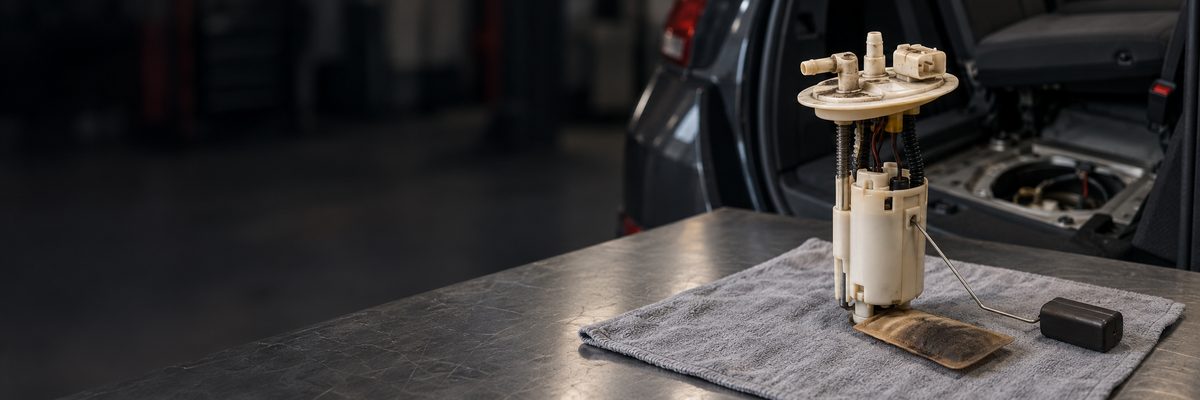
Most bad fuel pump symptoms trace back to one problem: the engine gets too little gasoline. The car stalls, cranks without starting or loses power when you ask for it.
A relay, a fuse or a control module can cause the same signs, so test those before you buy a new pump. The answers here come from carmakers' bulletins, recalls, owner's manuals and owners' complaints to NHTSA, the federal safety agency.
What is your car doing right now?
Can you drive with a bad fuel pump?
Only a short way, and only if the engine still runs smoothly. A failing pump can cut out with no warning, and the engine may not restart.
The big pump recalls all warn about the same danger: the engine can stall while you drive, which raises the risk of a crash. In owners' complaints to NHTSA about a failed or suspected pump, almost half say the engine quit while the car was moving.
Pull over as soon as it's safe if you notice any of these signs. Each one points to a stall, a fuel leak or a car that won't restart:
- The engine stalls or shuts off while you're moving. Steer to the shoulder and brake normally, without pumping the pedal, as GM's manual advises. Ford's manual adds that braking and steering take more effort with the engine off.
- Power fades, or the engine stumbles and surges. Ford's recall notice names running rough and reduced engine power among the signs of the same pump fault that stalls the engine.
- You smell raw gasoline. Ford and Audi recalled pumps with cracked flanges, and Honda recalled one whose cover wears out and leaks. NHTSA's notices warn that a fuel leak near an ignition source can start a fire.
- The car won't restart after a stall. Don't keep cranking it on a busy road. Our car won't start page takes it from there.
Is there a fuel pump recall on your car?
There may well be, because the biggest pump recalls cover millions of cars from several makers. Enter your VIN, the car's serial number, on NHTSA's recall lookup, and it shows whether a recall on your car is still open.
Each recall lists its own models and years, so a match on the model alone isn't enough. These recalls cover the pump itself, and each one fixes it free, with a new pump or, on most of the Fords, a software update:
- Honda and Acura. About 2.5 million vehicles, including the Accord, CR-V and Odyssey (2013–2023), HR-V (2018–2023), Civic (2016–2021) and Pilot (from 2015), plus Acura models such as the MDX, RDX and TLX (2013–2020). It expands two earlier pump recalls.
- Toyota and Lexus. Camry, Avalon, Corolla, Tundra and Sequoia (2018–2020), Tacoma and Sienna (2017–2020), Highlander (2017–2019), RAV4 (2019–2020), some 4Runner and Land Cruiser years, the FJ Cruiser (2014) and many Lexus models, from the ES and RX to the LS and LX.
- Ford and Lincoln. Bronco, Explorer, Super Duty trucks and Lincoln Aviator (2021–2023), F-150, Mustang and Lincoln Navigator (2021–2022), and Expedition (2022). Super Duty trucks get a new pump, and the rest get a software update.
- Subaru. Impreza, Legacy and Outback (2018–2020), Ascent (2019–2020), BRZ and WRX (2018–2019) and Forester (2018), plus the Toyota 86 (2018–2019).
- Mazda. Some Mazda3 and Mazda6 (2018), CX-5, CX-9 and MX-5 (2018–2019), CX-3 (2019) and Mazda2 (2019–2020).
Not on the list? Run your VIN anyway, because a recall can cover some cars of a model year and not others, and NHTSA's recall lookup shows whether yours is one of them.
Even without an open recall, your pump may still be covered: Toyota, Subaru and Audi extended the warranty to 15 years on certain cars, and Kia did the same for a leaking pump part on the 2018–2019 Sorento. The documents panel near the end of this page lists each one.
How does a car act when the fuel pump is going out?
A car with a failing fuel pump acts like it's running out of gas, even with a full tank. The engine may stall, crank without catching, or lose power just when you need it, and some cars also set a warning light.
The signs below follow how often owners report them to NHTSA, from stalling down to noise. A whine from the tank comes last because owners rarely mention one.
1. Stalling or shutting off
Your engine needs a steady flow of fuel, so a pump that can't keep up lets it die. A relay or a fuse that cuts the pump's power can stall it the same way, and the lookalikes below cover both.
Stalling is the sign the big pump-failure recalls name. If yours stalled, run your VIN before anything else, and get the car to the shop on a tow rather than another test drive.

A car stalled on the shoulder
2. Won't start, or cranks a long time
The starter spins the engine, but without fuel pressure it doesn't catch. A weak pump can also take several seconds of cranking to build pressure, so the car starts late rather than not at all.
A long crank can have another cause, though. On some Dodge and Jeep SUVs it was the fuel pressure regulator, which the lookalikes below cover.
3. Loss of power, hesitation or sputtering
When the pump can't keep up with the engine, your car may feel fine around town and then fall flat when you need more power. It can feel like a misfire or a surge.
Ford's recall notice for one truck lists running rough, a check engine light and reduced engine power as signs of the same pump fault. Our car jerks when accelerating page covers the other causes of that feeling.
4. Check engine light or a warning message
Some cars watch the fuel pump circuit and set a code when it misbehaves, but a code points at a circuit, not straight at the pump. Owners who complain to NHTSA mention codes such as P0087 (low fuel rail pressure) and P2635 (fuel pump flow performance).
They also mention a lean code such as P0171 or a misfire code such as P0300, because a pump that can't keep up starves the engine of fuel. The P0171 page covers a Toyota bulletin in which a pump that lost pressure set that code.
Carmakers' documents show why a code alone isn't proof. Their bulletins send technicians to the fuse and the plug at the pump before the pump itself, as the lookalikes below explain.
5. A whine, a hum, or no sound at all
A working pump hums from the tank when you turn the key on, and Chrysler's tip has technicians listen for it. Owners rarely report a noise, though: 25 of the 3,300 complaints that name the pump mention a noise from the pump or the tank.
Not every tank noise is a fault: Mercedes describes a slurping sound from the tank at about half full as an operating noise, which a new pump module won't stop. Lexus fixed a buzzing pump on two sports models with a software update rather than a new part.
Silence can tell you more than noise. If you hear no hum at all when you turn the key on, the pump may not be getting power, so check the relay, fuse and wiring before the pump.
Ford notice and tank noise 3 documents
- Ford PT-26.11.7 (July 2026), recall 25S75. F-150, 2021: loss of fuel pressure and flow from pump failure can stall the engine while driving. It's more likely with low fuel or hot fuel, and the signs are running rough, a check engine light and reduced power.
- Lexus L-SB-0031-16 (July 2016). RC F, 2015–2016, and GS F, 2016: buzzing from the low-pressure pump, fixed by reprogramming the engine computer in 0.4 hours.
- Mercedes-Benz LI47.10-P-079604 (July 2026). Gasoline models in the 214 and 206 series: a slurping noise from the tank at about half full is an operating noise of the tank's suction jet pump, and a new tank or pump module doesn't stop it.
What the data says
About 6 in 10 owners' complaints to NHTSA that describe a failed or suspected fuel pump say the engine stalled or shut off. Almost half say it happened while driving, and about 1 in 3 ended with a tow.
More than a third describe a car that wouldn't start or took a long time to start. About 3 in 10 mention lost power or hesitation, and about 3 in 10 a warning light.
About 1 in 7 say there was no warning before the car quit. Fewer than 1 in 100 of the complaints that name the pump mention a noise from it.
From NHTSA complaints on 2010–2025 gasoline models. One complaint can describe several signs, and a complaint is an owner's account, not a confirmed failure.
What owners report
Owners describe the failure as sudden. A Nissan Pathfinder owner wrote: Vehicle stalled and the engine quit twice trying to enter the highway. A Jeep Grand Cherokee owner wrote: Vehicle lost power and stalled on major highway during rush hour traffic.
A Tacoma owner described the slower kind of failure in a few words: Long crank start. Loss of power. Stalling.
NHTSA complaints 11541860 (2023 Nissan Pathfinder), 11554398 (2021 Jeep Grand Cherokee) and 11751581 (2022 Toyota Tacoma), in the owners' own words, read October 14, 2026.
What can be mistaken for a bad fuel pump?
A bad relay, a blown fuse, a failed control module or a faulty pressure regulator can all mimic a bad fuel pump. Each one cuts the pump's power or the fuel pressure, and carmakers' own documents name all four.
Owners' complaints show the same thing: in some, a new pump didn't fix the car, and the real fault was a relay, a fuse box or a power module. That's a costly way to find out it was never the pump.

Use this image
Free to republish under CC BY 4.0: credit Oil & Miles and link to this page. The snippet does both.
<a href="https://oilandmiles.com/articles/bad-fuel-pump-symptoms"><img src="https://oilandmiles.com/assets/img/diagrams/bad-fuel-pump-symptoms-lookalikes-bench.svg" alt="Bad fuel pump symptoms can come from four other parts around the pump: the fuel pump relay, the fuse and plug at the pump, the fuel pump control module and the fuel pressure regulator." width="1200" height="1082"></a> <p>Diagram: <a href="https://oilandmiles.com/articles/bad-fuel-pump-symptoms">Oil & Miles</a>, CC BY 4.0</p>For each lookalike, run its test before you buy the part it names. A new pump doesn't fix any of them:
| Cause and clue | Test this first | Don't replace yet |
|---|---|---|
| Fuel pump relayNo hum at key-on, or a crank with no start. | Check the relay and its terminals, and the fuse box it sits in. | The fuel pump. |
| Fuse or wiring at the pumpA blown fuse, a melted plug, or a relay code stored. | Inspect the pump fuse, then the plug on top of the pump. | The pump or a control module. |
| Fuel pump control moduleA no-start or stall on a car that powers the pump through a module. | Run the VIN, then a module and circuit check. | The fuel pump. |
| Fuel pressure regulatorA long crank after the car has sat. | A fuel pressure and leak-down test. | The pump module. |
The rows follow the order the carmakers' bulletins use: check the power to the pump first, then test the pressure. The bulletins behind each row are in the documents panel near the end of this page.
1. Fuel pump relay
The relay is an electric switch that turns the pump on when the computer asks, so a relay that sticks open leaves a healthy pump with no power. Your car then cranks without starting, or stalls.
Chrysler recalled some Dodge and Jeep SUVs because the relay inside their power module could fail and stall the car. GM fitted a low-profile relay on two of its sedans after it found the rear seat frame pressing on the old one.
2. Fuse or wiring at the pump
A blown fuse or a loose, burnt plug cuts the pump's power just like a dead pump would. It's also the easiest thing on this list to check.
Nissan's bulletin for a relay code on three of its models says to check one fuse before replacing a module. Chrysler tells technicians to look for bent or pushed-out terminals at the pump's plug before they replace the fuel module.
3. Fuel pump control module
Some cars power the pump through a small computer, called a fuel pump control or driver module. If that module fails, your pump stops even though nothing is wrong with it.
GM is replacing this module on some of its 2022–2023 models, mostly trucks and SUVs, because a failure can interrupt the fuel flow. Volkswagen recalled two sedans for the same kind of fault, and Mercedes recalled SUVs where water could reach the pump's control unit.
4. Fuel pressure regulator
The regulator holds the fuel pressure at the right level. On some SUVs, Chrysler traced a long crank to a faulty regulator, found with a test of how well the system holds pressure.
That bulletin calls for a pressure and leak-down test, then a new regulator if it fails. A later tip tells dealers plainly not to replace the fuel delivery module for this.
Two more things can cut off the fuel without a failed pump. Ask about both before you approve a new one:
- A software update. Chrysler tells dealers to update the engine computer before replacing the pump module for rough idle or hard starting on some Ram trucks.
- A crash shut-off. Ford's manual says a moderate to severe collision can trigger a fuel pump shut-off, and the car can be restarted afterwards.
Relays, modules, regulator 9 documents
- Chrysler recalls 14V-530, 15V-115 and 19V-813. Dodge Durango and Jeep Grand Cherokee, 2011–2013: the fuel pump relay inside the TIPM-7 power module may fail and stall the car.
- GM bulletin 15-NA-051 (August 2016). Buick Lucerne and Cadillac DTS, 2008–2011: no-start or stalling from the seat bottom pressing on the fuel pump relay, fixed with a low-profile relay.
- Nissan NTB21-009 (January 2021). Altima 2019–2021, Kicks 2018–2021 and Versa 2020–2021: code B12A3-72, a fuel pump relay stuck open. Check the fuse, then replace the IPDM.
- Chrysler tech tip 9100833 (July 2026). Jeep, Ram, Dodge and Chrysler models, 2020–2027: check the pump plug for bent or pushed-out terminals, then listen over 3 key cycles.
- GM emission recall N262558690 (2026). Some 2022–2023 Buick, Chevrolet and GMC models, mostly trucks and SUVs: a new fuel pump power control module.
- Recalls 17V-509 and 22V-955. Volkswagen CC 2009–2016 and Passat 2006–2010: power to the fuel pump control module. Mercedes-Benz ML and GLE 2012–2020: water damaging the pump control unit.
- Chrysler bulletin 14-004-25 Rev. B (August 2025) and tip 9100858. Dodge Durango 2021–2025 and Jeep Grand Cherokee 2021–2022, 3.6L and 5.7L: long crank from the fuel pressure regulator. Testing and replacing it takes 2.3 hours, and the bulletin says not to replace the fuel delivery module.
- Chrysler tech tip 9003784 (September 2017). Ram 1500, 2017: update the engine computer before replacing the pump module for rough idle or hard starting.
- Ford F-150 owner's manual (2015). A fuel pump shut-off stops the fuel after a moderate to severe collision, and the truck can be restarted.
How do you tell if the fuel pump is bad?
A weak pump, a bad relay and a blown fuse can feel alike from the driver's seat. To tell them apart, test in order, from the free checks up to a pressure test against the number your carmaker lists.

A fuel pressure gauge on the fuel rail
Start with the free checks and finish with a fuel pressure test, because one done to your carmaker's procedure is the check that points at the pump. Work through the 5 steps below, in order:
- Run your VIN for a recall. Enter it on NHTSA's recall lookup. An open pump recall means the dealer fixes it free.
- Listen at key-on. Turn the key to on a few times without starting the engine, and listen for a hum from the tank. Chrysler's tip asks technicians to cycle the key three times, and says a pump that's heard doesn't need replacing.
- Check the fuse and relay. Find the fuel pump fuse and relay in the owner's manual, and look for a blown fuse or a loose or burnt relay.
- Read the codes. A scan tool shows any stored code, such as a relay or fuel pressure code. A code tells the shop where to start looking, not which part to buy.
- Have the fuel pressure tested. Ask for a pressure and leak-down test done to your carmaker's procedure, and compare the result with its specification.
If you hear no hum in step 2, your pump may still be fine, since a fuse, relay or plug can leave it without power. If it hums but the engine won't start or keeps stalling, the pressure test in step 5 tells a weak pump from a leak.
If step 1 finds no open recall, check the warranty extensions in the documents panel, because some cover pumps for 15 years. If step 4 finds no code, the pump isn't cleared, since only some cars watch the pump circuit closely enough to set one.
Ask the shop how it ran the pressure test, because the method changes the reading. On its Atlas SUVs, Volkswagen tells technicians that pressure read with the engine running can vary and isn't, by itself, a reason to call the pump failed.
What to say to the shop
When a quote names a fuel pump before any test has run, ask:
- What did the fuel pressure test read?
- Did you check the fuse, the relay and the plug at the pump?
- Is there an open recall or extended warranty on this VIN?
“Before I approve a pump, can I see the fuel pressure reading against the spec, and the checks on the fuse, relay and wiring?”
A good answer gives the pressure as a number next to the carmaker's figure, and says what the fuse, relay and wiring checks found. If the answer names a pump with no number, that's the one to question.
If the shop says no test is needed, ask what shows the pump is at fault rather than the relay or the fuse. A good shop can name the test or the reading behind its answer.
Which cars have the most fuel pump complaints?
The Honda Accord, Jeep Grand Cherokee and Chevrolet Equinox top the list of owner complaints to NHTSA that name the fuel pump. For the Accord, CR-V, Pilot, Grand Cherokee and F-150, half of the ten, the complaints peak in model years that a pump or relay recall covers, so a high count can point to a free fix.
About half of the Ford Focus complaints also mention the purge valve or the fuel tank, so on that car the pump may be only part of a bigger repair. Whatever you drive, run the VIN before you pay for a pump.
Why do fuel pumps fail?
Fuel pumps fail because parts inside them wear out, dirt in the fuel builds up on them, or heat and low fuel strain them, according to the recalls. Electrical faults that only look like a dead pump are covered in the lookalikes above.
Mazda's recall says the impeller, the small wheel that pushes the fuel, can crack and deform until the pump fails. One Honda recall says particles in the fuel can stick to the pump's insides and cut its output.
Heat and low fuel play a part on some vehicles too. Ford's recall notice says its pump failure is more likely with low fuel or hot fuel in the tank, so on those vehicles it pays not to run the tank low.
Worn motor brushes and bearings
Underhood Service, a trade magazine for repair shops, describes a pump that truly fails as one whose motor brushes, or the bearings that hold the motor, have worn out. Then the pump simply stops turning.
The same article says that wear often starts with what's in the tank and the lines around the pump. That's why the causes below matter as much as the pump itself.
Dirt and rust in the fuel tank
Grit that gets past the strainer damages the parts inside the pump. Underhood Service says the strainer on a typical pump is built to trap particles of about 50 to 100 microns, so finer grit still reaches the pump.
Tomorrow's Technician, a magazine for automotive students, says sediment, rust and debris collect in the tank over a car's life. If a pump has failed, ask whether the tank was inspected and cleaned before the new one went in.

A clean strainer next to a clogged one
A clogged fuel filter or strainer
A restricted filter or strainer makes the pump turn faster to hold the same pressure. Underhood Service notes that the pressure can look fine at idle while the engine starves for fuel under load.
Tomorrow's Technician adds that an old filter makes a new pump work harder and run hotter, so it fails sooner. Ask for the filter and strainer to be replaced along with the pump, where your car has them.
A bad connection or ground
A fuel pump draws a lot of current, and a connection with high resistance can make it run slowly or not at all. Underhood Service points to corrosion at the plug where the pump meets the wiring, which a voltage drop test finds.
Melted plastic at that plug means the connector and harness need replacing too. Tomorrow's Technician warns that a bad ground left in place can kill the new pump as well.
What other causes do repair guides name?
Repair guides name two more causes that the documents on this page don't back in general. Treat them as possibilities, not findings:
- Running the tank low as a habit. Often blamed for overheating the pump, but the only document behind it on this page is Ford's recall notice for its own vehicles, above.
- Age and mileage. Guides often give a lifespan in miles, but we found no carmaker or pump-maker document that does.
From the carmakers
What the carmakers say about fuel pumps
Honda, Toyota, Ford, Subaru and Mazda have recalled pumps that can fail and stall the engine, and those recalls replace the pump or fix it free. Other documents extend pump warranties to 15 years, or tell dealers to check a relay, module or regulator before they replace the pump.
Each quote below comes from the carmaker's or NHTSA's own document. Run your VIN on NHTSA's recall lookup to see whether any of these recalls is still open on your car.
Emission recall N262558690
If this were to occur, fuel flow to the engine could be interrupted.
Recall 25V-455
The low-pressure fuel pump may fail, which can result in an engine stall while driving.
Recall 23V-858
Fuel pump failure can cause an engine stall while driving, increasing the risk of a crash.
Recall 21V-875
The impeller inside the low-pressure fuel pump may crack and deform, potentially causing the fuel pump to fail.
Recall 21V-587
The low-pressure fuel pump inside the fuel tank may fail.
Recall 20V-682
If the fuel pump fails, the engine can stall while driving, increasing the risk of a crash.
Recall 19V-813
The fuel pump relay inside the Totally Integrated Power Module (TIPM-7) may fail, causing the vehicle to stall without warning.
Warranty extension Denso fuel pump
Labor and part cost for the related repair will be covered under this extension.
Bulletin FUE064
If the inspection paper remains dry and no visible fuel leak is present (OK), then no further action is required.
Customer support program 23TE05
This coverage will be applicable for 15 years from the date of first use, regardless of mileage.
Warranty extension AWA-22-05
The warranty, as extended, is fully transferable to subsequent owners.
Bulletin LI47.10-P-079604
These noises may sound like slurping.
Tech tip 9100833
If the pump is heard replacement is not necessary, any replacement will function in the same way.
Bulletin 14-004-25 Rev. B
This bulletin involves performing a fuel pressure test and possibly replacing the fuel pressure regulator.
Bulletin NTB21-009
inspect the model specific fuse first. If the fuse is not open replace the IPDM.
Conclusion
Check the recall and the cheap parts first
A bad fuel pump most often shows up as stalling, then as a no-start, a long crank or lost power. Here's what the recalls, bulletins, manuals and complaints tell you to do:
- Don't drive far on it. A failing pump can stall the engine while you drive, and the brakes and steering get heavy when it does.
- Run the VIN first. Honda, Toyota, Ford, Subaru and Mazda recalls replace or fix pumps on millions of cars.
- Listen at key-on. No hum points at the power to the pump, so check the fuse and relay before the pump.
- Ask for a pressure test. A reading compared with the carmaker's figure is the best evidence that the pump is weak.
Rule out the free and cheap fixes first, and let a pressure test done to the carmaker's procedure point at the pump. The documents panel above lists the recalls and warranty extensions to ask the dealer about.
Common questions
Asked most often
How does a car act when the fuel pump is going out?
It acts like it's running out of gas. In owners' complaints about a failed pump, stalling or shutting off comes up most, followed by a no-start or long crank, then lost power or hesitation.
What can be mistaken for a bad fuel pump?
A failed fuel pump relay, a blown fuse or burnt plug at the pump, a failed fuel pump control module and a faulty fuel pressure regulator can all mimic a bad fuel pump. Carmakers' bulletins name each of them, and some tell dealers not to replace the pump.
Does a fuel pump give warning before it goes out?
It can, as a long crank, hesitation or a warning light. But about 1 in 7 owners who describe a failed pump to NHTSA say there was no warning before the car quit.
Will a bad fuel pump throw a code?
It can, on cars that watch the pump circuit or the fuel pressure, but a code points at a circuit, not at the pump, so bulletins check fuses, relays and plugs first. Owners mention fuel codes such as P0087 and P2635, and lean or misfire codes such as P0171 and P0300 when the engine runs short of fuel.
What does a bad fuel pump sound like?
Owners who mention a noise describe a whine, hum or buzz from the tank, but few mention one at all, and hearing no hum at key-on can tell you more. Mercedes says a slurping sound at half a tank is an operating noise, not a failing pump.
Can you drive with a bad fuel pump?
Only as far as a safe place to stop or a nearby shop, because the engine can stall while you drive. Recall notices say that stall raises the risk of a crash, and the brakes and steering take more effort once the engine stops.
What kills a fuel pump?
Recalls name wear inside the pump, such as a cracked impeller, and dirt in the fuel, and Ford adds low fuel or hot fuel in the tank for its own vehicles. Repair trade magazines add rust in the tank, a clogged filter or strainer, and a bad connection or ground.
Can a bad fuel pump relay cause a no-start?
Yes. A relay that fails leaves the pump without power, so the engine cranks but won't start, or stalls. Chrysler recalled some 2011–2013 Durango and Grand Cherokee models for exactly that relay fault.
Sources
- NHTSA recall 23V-858, Honda's fuel pump recall, with 21V-215 and 20V-314, and 19V-060 for the V6 models. NHTSA, read October 14, 2026
- NHTSA recall 20V-682, Toyota's expansion of 20V-012. NHTSA, read October 14, 2026
- NHTSA recall 25V-455, Ford recall 25S75, and Ford PT-26.11.7, its remedy notice for the 2021 F-150. NHTSA and Ford, read October 14, 2026
- NHTSA recalls 20V-218 and 21V-587 (Subaru), 21V-875 (Mazda), 22V-955 (Mercedes-Benz), 17V-509 (Volkswagen) and 19V-813 (Chrysler). NHTSA, read October 14, 2026
- NHTSA recalls 16V-777 (Ford), 16V-660 (Audi) and 14V-112 (Honda), for fuel leaks at the pump. NHTSA, read October 14, 2026
- GM emission recall N262558690, the fuel pump power control module. GM via NHTSA, read October 14, 2026
- Warranty documents: Toyota customer support program 23TE05, Subaru's Denso fuel pump warranty extension, Kia bulletin FUE064 and Audi AWA-22-05. Toyota, Subaru, Kia and Audi via NHTSA, read October 14, 2026
- Chrysler documents: tech tip 9100833, bulletin 14-004-25 Rev. B, tech tip 9100858 and tech tip 9003784. FCA US via NHTSA, read October 14, 2026
- Nissan bulletin NTB21-009, the fuel pump relay code, and GM bulletin 15-NA-051, the Lucerne and DTS relay. Nissan and GM via NHTSA, read October 14, 2026
- Volkswagen tech tip 20-25-01TT, fuel pressure testing. Volkswagen via NHTSA, read October 14, 2026
- Mercedes-Benz LI47.10-P-079604, tank noise at half full, and Lexus L-SB-0031-16, buzzing from the low-pressure pump. Mercedes-Benz and Lexus via NHTSA, read October 14, 2026
- Intermittent And Chronic Fuel Pump Failures, for worn motor brushes and bearings, grit and the strainer, a restricted filter and high-resistance connections. Andrew Markel, Underhood Service, January 25, 2023, read October 14, 2026
- A Clean Fuel Tank Improves A Fuel Pump's Diet, for sediment and rust in the tank, an old filter that makes a new pump run hotter, and bad grounds. Andrew Markel, Tomorrow's Technician, September 22, 2014, read October 14, 2026
- Owner's manuals: 2010 Chevrolet Malibu (brakes and steering if the engine stops), 2013 Ford Escape (braking and steering effort with the engine off) and 2015 Ford F-150 (fuel shutoff after a collision). GM and Ford, read October 14, 2026
- NHTSA complaint files, complaints on 2010–2025 gasoline models about the fuel pump. NHTSA, files dated September 2 and October 3, 2026
How this was compiled
The sections follow what a driver needs once a fuel pump is suspected: whether to drive, whether a recall pays, how it shows, what else looks the same and how to test it. The recalls come from NHTSA's recall file, and the bulletins come from the carmakers' own documents.
The complaint figures come from NHTSA's complaint files for 2010–2025 gasoline models: complaints about the fuel pump, leaving out high-pressure pumps and diesels. The shares of each sign come from complaints that describe a failed, suspected or replaced pump.
What we didn't do
We didn't test a car, we haven't priced fuel pumps on this page, and high-pressure pumps on direct-injection engines are left for another page. We found no carmaker document on a clogged fuel filter or faulty injectors acting like a bad pump, so neither is a lookalike here. The filter appears above as a cause of pump failure, from the trade magazines.
What people ask next



Compiled in October 2026 for the US market. This article is general information, not advice about your specific vehicle. See the disclaimer.