
- Ask the shop
- Ask where the coolant trail starts. Questions
- Slow or hidden leak?
- Ask for a cooling system pressure test. Questions
- No puddle?
- Ask about an internal pump or an electric pump code. Hidden pumps
- Before you pay
- Check your VIN and ask a dealer about warranty extensions. Documents
A quiet water pump isn’t proof of a healthy one, because a leak or a pump inside the engine can fail with no sound at all. Look for where the coolant goes before you listen for a sound.
Bad water pump symptoms
A failing water pump shows up in seven ways, starting with leaks and overheating. Each one below says what to check next.
1. Coolant at the front of the engine
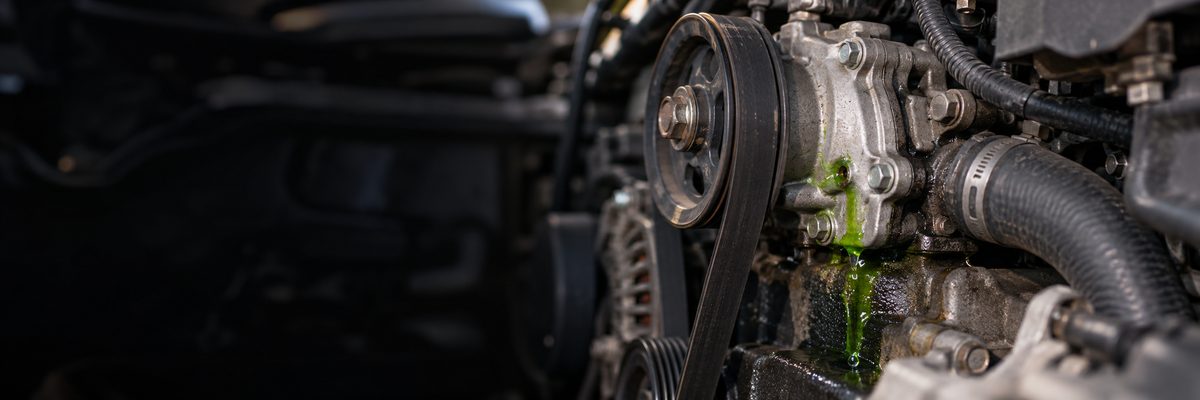
A water pump leaking coolant leaves a wet streak or drips under it. The coolant is often green, orange or pink and smells sweet.
A trail down the front of the engine is a leak, while light, dry crust at the weep hole is normal. The weep hole section shows how to tell them apart.
2. Overheating or steam
The gauge climbs toward red, a warning light comes on or steam rises from under the hood. That happens because coolant isn’t moving through the engine.
A stuck thermostat, a radiator leak or a slipping belt can do the same, and the lookalike table gives the test for each. Once it overheats, stop, as the safety section explains.
3. Coolant that keeps running low
You top off every week, yet there’s no puddle, so the coolant may be drying on the hot engine or leaking inside it. A pump inside the engine can leak into the oil, and so can a head gasket, so the shop tests for both.
4. Cold air from the heater
The heater gets its warmth from the same coolant the pump moves around the engine. Weak heat while the gauge reads hot points to poor flow.
A leaking heater core shows up differently, as a wet passenger floor or a sweet smell inside the car. The lookalike table covers it.
5. A warning light or a code
An electric pump can set the check engine light with no leak and no sound. It has its own motor and control, so it fails differently.
A code alone doesn’t prove the pump is bad, since one carmaker fixed this with a software update. The electric pump section has the details.
6. A squeal, rattle or grind
A worn bearing squeaks or rattles at the front of the engine, pump maker GMB says. A loose belt or a cracked pulley whines instead, and a noise with no coolant loss still points the shop to the bearing or the belt.
7. A pulley that wobbles or turns rough
Toyota has technicians check the pump pulley for excessive play or rough turning. It’s a check for a shop, done with the belt off.
A pulley that fails that check is a reason for a new pump in Toyota’s procedure. Dry crust alone isn’t, as the weep hole section shows.
Can you drive with a bad water pump?
Not once the engine overheats, because driving on can damage the engine, from a warped head to a blown head gasket. Stop somewhere safe, switch off, and never open a hot radiator or coolant cap, since scalding coolant can spray out. Check the level only once the engine is cold, and if the coolant drops fast or the gauge climbs again, have the car towed.
A slow seep with a steady temperature gauge is a reason to book a check soon, watching the gauge and the coolant level on the way. Our guide to a coolant leak covers how far you can go on one.
On an engine with the pump inside, coolant that keeps dropping with no puddle is a reason to stop and have it towed in if the gauge climbs. Owners of these engines describe ones that shut off with no warning.
Is it the water pump or something else?
Several cheaper parts can leak, overheat or squeal like a bad pump. The table puts the test that tells them apart next to each one:
| Cause and clue | Test this first | Don’t replace yet |
|---|---|---|
| Thermostat Overheating with no leak, or a slow warm-up with code P0128. | A thermostat check. Our P0128 code page covers the slow warm-up. | The water pump. |
| Radiator or hose The wet trail starts at the radiator or a hose, not the pump. | A cooling system pressure test, to find where coolant escapes. | The water pump. |
| Belt, tensioner or pulley A squeal or whine, or a frayed or glazed belt. | Spin the pump and the tensioner by hand with the belt off, as GMB tells parts counters. | The water pump. |
| Pinched O-ring A leak at the pump on an engine with a bypass O-ring. | Inspect the bypass O-ring, which can be sold on its own. | The pump, which often tests fine. |
| Heater core A wet passenger floor or a sweet smell inside the car. | Look under the dash, as our coolant leak guide shows. | The water pump. |
| Head gasket Coolant loss with white exhaust smoke or milky oil. | A combustion leak test, which our blown head gasket guide explains. | The water pump. |
The rows follow what carmakers and pump makers tell technicians: find where the coolant starts before blaming the pump. A leak under the front of the car can run along a hose or bracket and drip well away from where it began.
Water pump weep hole: normal seep or a leak?
Most water pumps have a small weep hole below the shaft seal, and a little coolant is meant to seep out of it. Light, dry crust there is normal, and a wet streak, drips or a heavy buildup isn’t.
To tell them apart, press a dry paper towel on the crust, a test Toyota gives its technicians. On Toyota's non-electric pumps, a towel that stays dry means the pump stays and a wet one means it's replaced. Other carmakers draw the line in their own documents below, and Mazda calls some crust at the bleed hole normal.
A new pump can seep more at first while the seal settles, so a fresh replacement can look worse than the old one. A weep hole can’t be plugged to stop the seep either, because the seal needs it to work.

A dry weep hole next to a dripping one
When the water pump is inside the engine
A pump that sits inside the engine can leak into the oil instead of onto the ground, so there’s no drip to see. What you notice instead is coolant that keeps dropping, milky oil or overheating.
On Ford's 3.5 and 3.7 V6, as in the Explorer, Edge, Taurus and Flex, the pump sits inside, turned by the timing chain. A pump hidden there can fail into the oil, so the coolant level can drop with no puddle on the driveway.
Owners describe coolant that keeps disappearing, milky oil, overheating and engines that shut off while driving. If a shop finds milky oil, ask it to rule out a head gasket as well, since both put coolant where the oil should be.

Milky sludge under the oil cap
Electric water pumps warn with a light
An electric water pump has its own motor and control, so it can fail without a drip or a sound. The first sign is often a warning light, a stored code or overheating.
An electric pump can set the check engine light with a pump-speed code, and one carmaker fixed that with an engine computer update, not a new pump. A code from an electric pump is a reason to test it, not proof it failed.
Electric pumps can leak too, from the pump body or its plug. The cards in the documents section name the cars each one covers.
What to ask the shop before a new pump
Work through the 5 steps below with the shop, so the water pump is shown to be bad before it’s replaced:
- Ask where the coolant starts. Wet residue, drips or a heavy buildup at the pump points to a leak, and light dry crust doesn’t, as the weep hole section shows.
- Ask for a pressure test. It shows where coolant escapes when the leak is slow or hidden.
- Ask about the thermostat, radiator and belt. Each can act like a bad pump, as the table above shows.
- If the pump sits inside the engine, ask about the oil. Coolant in the oil points inside the engine, and a head gasket test rules out the other cause.
- Ask what’s covered. Our free VIN decoder lists the recalls on your model year, and NHTSA’s recall lookup confirms which apply to your VIN. Warranty extensions and campaigns don’t show there, so ask a dealer about those by VIN.
Each step can stall, so here’s what to do when a check hits a wall:
- No visible leak. Ask about an internal pump or an electric pump code, the two failures that leave the ground dry.
- The quote is for dry crust. Ask to see the wet residue, drips or heavy buildup that carmakers count as a leak.
- No document for your car. Our documents stop there, so go by the signs in the first section.
What to say to the shop
When a quote names a new water pump, ask:
- Where does the coolant start, and is it wet or only dry crust?
- Did a pressure test show the leak?
- Is there a recall or warranty extension for the pump on my VIN?
“Before I approve a water pump, can you show me where the coolant leaks and check my VIN for a warranty extension?”
If the pump does need replacing, our timing belt replacement cost page explains when the pump and belt are best done together. Our coolant leak repair cost page covers the leak itself.

Use this image
Free to republish under CC BY 4.0: credit Oil & Miles and link to this page. The snippet does both.
<a href="https://oilandmiles.com/articles/bad-water-pump-symptoms"><img src="https://oilandmiles.com/assets/img/diagrams/bad-water-pump-symptoms-checklist.jpg" alt="Bad water pump checklist: if it overheats, stop and switch off and never open a hot cap; light dry crust at the weep hole is normal while a wet streak or drips mean a leak; ask for a pressure test and have the thermostat, radiator and belt checked; ask where the coolant starts and whether a warranty extension covers the pump." width="1200" height="1562"></a> <p>Infographic: <a href="https://oilandmiles.com/articles/bad-water-pump-symptoms">Oil & Miles</a>, CC BY 4.0</p>From the carmakers
What do carmakers say about water pumps and warranty extensions?
These documents tell dealers when a water pump is bad and when it isn’t, and VW’s extensions still pay toward a new pump on some cars. If your car is on one, take its number to your shop.
Warranty extension VWP-26-07
…the New Vehicle Limited Warranty will be extended to cover 80% of the replacement of the Water Pump or Water Pump Gasket…
Warranty extension FAQ VWP-22-06
…the repair or replacement of a failed … Primary Engine Water Pump (“Water Pump”), Thermostat and/or Thermostat Housing…
Service alert SA-014-26
This is a normal condition and does not require water pump replacement.
Tech tip 9100723
These traces are not necessarily signs of a leak. Continuous dripping of coolant, however, indicates a malfunction.
Service bulletin T-SB-0103-20 Rev1
Water pump replacement is NOT necessary for a temporary leak condition. The water pump should be replaced for an active leak condition.
Warranty extension, ended for most SIB 01 13 21
…may have a qualifying electrical engine coolant pump on a … replaced up to the first 7 years/84,000 miles…
Warranty extension, ended for most VWP-19-08
…the New Vehicle Limited Warranty will be extended to cover repair or replacement (by an authorized Volkswagen dealer) of a failed Primary Engine Water Pump…
Service bulletin T-SB-0323-17
…may exhibit a MIL “ON” condition with Diagnostic Trouble Code (DTC) P26CB71 (Electric Water Pump Speed Stuck).
Tech tip 9003633
Water pumps are found TNF but the water pump bypass o-ring was pinched resulting in a coolant leak that looks like a failed pump.
Preliminary information PI1041B
If the water pump is not leaving a trail of coolant going down the front of the engine nothing further should be done.
Conclusion
What to do next about a bad water pump
If you see only light, dry crust, the carmakers we read call it normal, while wet residue or drips are their usual reason for a new pump. If the coolant falls but the floor stays dry, ask whether the pump sits inside the engine or is electric.
Oil & Miles checks each normal-or-not rule here against the bulletins carmakers file with NHTSA, so every one names the document behind it.
Common questions
Asked most often
Can a water pump go bad and not leak?
Yes. An electric pump can fail with only a warning light, and a pump inside the engine can leak into the oil, so the ground stays dry.
Will a bad water pump throw a code?
An electric pump can, because it has its own control, though a code is a reason to test it, not proof it failed. A belt-driven pump shows up through the signs at the top of this page instead.
Is it the thermostat or the water pump?
A thermostat stuck shut overheats the engine with no leak, and one stuck open makes it warm up slowly, often with code P0128. A bad water pump more often leaks at the front of the engine.
What happens when a water pump goes out while driving?
Coolant can stop moving, the engine overheats and the gauge or a warning light tells you. Some owners describe the engine shutting off while they drove.
What makes a water pump go bad?
A worn bearing, a bent shaft or a damaged seal, pump maker GMB says. The wrong coolant, or two kinds mixed, can damage the seal, so tell the shop what’s been added.
What people ask next

Sources
- 2019 Toyota Camry owner’s manual, publication OM06142U, pages 534 to 536, for the overheating signs and steps and the warnings on the hood and caps. Read October 3, 2026
- Ford recall 13V-583, November 2013, for the 2013 Escape 1.6 and cylinder head overheating, and Ford recall 17V-209, March 2017, for the 1.6 turbo whose head can overheat and crack when it runs low on coolant. NHTSA recall archive, read October 2 and 20, 2026
- GM preliminary information PI1041B, March 2014, pages 1 to 3, for normal seepage and when to replace the pump on the Cruze 1.4 and its siblings. NHTSA, read October 20, 2026
- GM special coverage 14371A and 14371B, January 2015, for the Cruze and Sonic 1.4 leak from the weep reservoir or shaft seal, as summarized in NHTSA’s bulletin index. NHTSA, read October 20, 2026
- Mazda service alert SA-014-26, March 2026, page 2, for the seal, the green crust and when to replace. NHTSA, read October 20, 2026
- FCA tech tip 9100723, November 2025, for the weeper chamber and when dripping means a fault. NHTSA, read October 20, 2026
- FCA tech tip 9003633, November 2016, for the pinched bypass O-ring. NHTSA, read October 20, 2026
- Toyota service bulletin T-SB-0103-20 Rev1, June 2024, pages 5 to 7, for temporary and active leaks and the pulley play check. NHTSA, read October 20, 2026
- Toyota service bulletin T-SB-0323-17, December 2017, for code P26CB71 on the 2018 Camry, and tech tip T-TT-0614-20, May 2020, for leaks from the 2020 Camry’s electric pump, as summarized in NHTSA’s bulletin index. NHTSA, read October 20, 2026
- BMW service information SIB 01 13 21, May 2021, for the electric coolant pump coverage and the cars it covers. NHTSA, read October 20, 2026
- Volkswagen bulletin VWP-19-08, December 2019, the VWP-22-06 dealer FAQ, June 2022, and VWP-26-07, July 2026, for the three water pump warranty extensions. NHTSA, read October 20, 2026
- Volkswagen maintenance schedule update for the Jetta, February 2017, for the coolant pump belt check at 150,000 miles, as summarized in NHTSA’s bulletin index. NHTSA, read October 20, 2026
- AISIN University, Understanding Water Pump Weep Holes, October 15, 2025, for why a weep hole can’t be sealed. Shop Owner, read October 20, 2026
- GMB, Explaining Water Pump Noises, for which noise comes from the bearing, the belt or the pulley. GMB, read October 20, 2026
- NHTSA consumer complaint database, files dated September 2 and October 2, 2026, for complaints that name the water pump on 2010–2025 models. Read October 20, 2026
How this was compiled
We read the water pump bulletins NHTSA holds for the Ford Explorer family, Cruze, Escape, BMW, Grand Cherokee, Camry and Volkswagen, and the documents on normal seepage from GM, Mazda, Jeep and Toyota. We also read the NHTSA complaints that name the water pump on 2010–2025 models.
The section on pumps inside the engine rests on owners’ complaints, because we found no carmaker bulletin on that kind of pump in NHTSA’s index.
What we didn’t do
We didn’t inspect pumps or collect shop quotes. GM’s special coverage letter for the Cruze was read from NHTSA’s index, not opened.
Compiled in October 2026 for the US market. This article is general information, not advice about your specific vehicle. See the disclaimer.