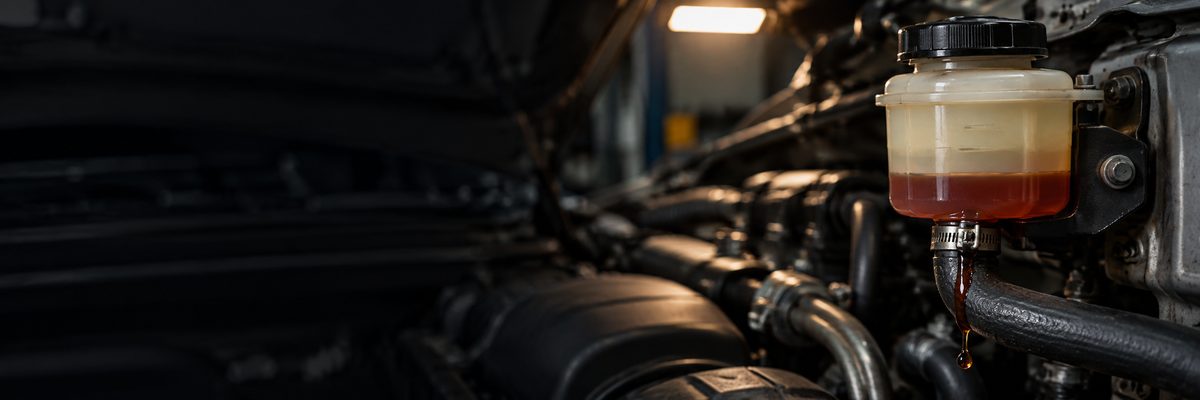

- Check the level
- Check it before each drive until the leak is fixed. Safety
- Topping off?
- Use only the fluid your manual or the cap names. Which fluid
- Before you pay
- Look for a recall before you pay for a repair. Recalls
- Quote for a rack?
- Ask where it leaks and how the shop confirmed it. What to ask
Where the fluid sits decides the bill. A wet fitting or clamp points to a seal or a hose, a repair that can take under an hour of labor.
Fluid pouring from the rack's rubber boot is the usual sign a power steering fluid leak is in the rack itself. That's the priciest part, so ask to see it before you approve one.
Is it safe to drive with a power steering fluid leak?
Only to a shop, and how far depends on how the steering feels. For each sign, here's what to do with a power steering leak, mildest first:
- Level below the MIN mark. Top off with the fluid your manual or cap names, and check it before each drive until the leak is fixed. If it drops fast or the reservoir runs empty, have the car towed.
- Whine, or the wheel is harder to turn. Drive only to the nearest shop and have the system serviced before the assist goes.
- All assist is gone, the brake pedal is hard to press, or you see smoke. Stop and have the car towed rather than driven.
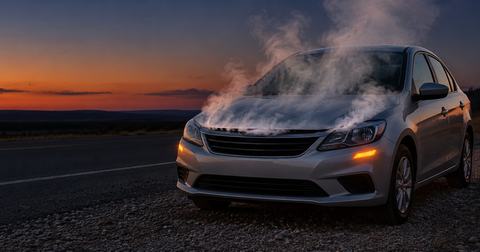
On some trucks and vans the same fluid powers the brake assist, so a big leak can make the pedal hard to push too. Leaking fluid can also burn: on a hot catalytic converter it makes smoke and a burning smell, and it can start an under-hood fire.
Cars with an electric power steering pump carry a different fire risk, in the pump's wiring. On some recalled Jeeps, that wiring can overheat even when the car is parked, so park those outside until the recall repair is done.
Some recalls fix these leaks and fire risks free. The carmakers' documents below list them, so run your VIN before you pay.
How long can you drive with a power steering leak?
No carmaker document we read gives a distance. Check the level before each drive, and go straight to a shop if it whines or gets hard to turn.
What happens if power steering fluid runs out?
The assist fades and the wheel gets heavy, worst at slow speeds. Driving with the level below the MIN mark can also damage the power steering system, so keep it at the mark until the shop visit and have the car towed once all assist is gone.
Can you keep adding fluid until it's fixed?
For a short time, with the fluid your manual or cap names, but topping off doesn't find or fix the leak. Every drop that escapes can land on a hot exhaust, so book the shop soon.
How do I know if my power steering fluid is leaking?
The surest test is the reservoir: if its level falls while the spot grows, the fluid is from the steering. Check these neighbors before you blame a power steering leak:
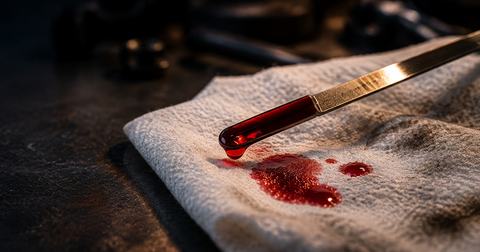
- Red fluid under the middle of the car. It can be the transmission. Our transmission fluid leak page covers that one.
- A whine that rises with engine speed. If it follows the engine rather than the steering, see our whining noise when accelerating page.
- A burning smell after a drive. It can be fluid on a hot exhaust. Read our burning smell page before you drive again.
- A puddle you can't name yet. The car fluid leak page sorts it by color and place.
Three things look like a power steering leak and aren't, so rule them out before you pay for a repair. Each can leave a wet or stained spot with no power steering leak behind it:
- Grease in the rack boot. A stained boot can be normal, and on some Nissans with a Hitachi rack, yellow grease there means the rack isn't leaking.
- An electric steering gear on some Jeeps. Jeep says the gear on its 2022–2024 Wagoneer and Grand Wagoneer holds no oil or grease that could leak, so fluid on it comes from elsewhere.
- Oil from an electric steering column. Amber oil on a floor mat can come from the column, not from a fluid system.
If the only wet spot is one of these, there may be no leak to fix. Check the reservoir level each month to be sure.

Grease on the boot, fluid at the fitting
How much does it cost to fix a power steering leak?
Fixing a power steering leak costs $223 to $2,191 at a shop, parts and labor, on the Impala, the SRX and the Murano's rack in the first box below. A hose job sits at the low end, and a new rack sets the top.
Here are receipts for cars with carmaker hours, then the part prices for cars owners complain about:
Priced on the 10 cars below, not every model and year. Yours may cost more or less.
Power steering leak repair cost
Covered $0 at the dealer recall or warranty
Not covered $223–$2,191 hose or rack replaced, parts and labor
Check your VIN first, since a recall or a warranty extension can make the repair free.
Hose replaced Parts and labor $223–$419
Three cars with carmaker hours
| Car | Parts | Labor | Total |
|---|---|---|---|
| 2012 Impala 3.6 · Pressure hose 22943230 · may be free, recall 11V-398 | $168–$172 | 1.0 h | $268–$345 |
| 2010 SRX 2.8T · Pressure hose 22792606 (replaces 20953778) | $83 | 1.4 h | $223–$325 |
| 2010 SRX 3.0 · Pressure hose 22792605 (replaces 20893352) | $76 | 1.9 h | $266–$419 |
High-pressure hose, Murano Parts and labor $242–$550
One car with carmaker hours, kept out of the hose range above because the dealer's list price for the recall kit tops the other hoses
| Car | Parts | Labor | Total |
|---|---|---|---|
| 2013 Murano 3.5 · High-pressure hose D9720-1AN5A (recall kit: hose, washers, O-ring) · may be free, recall 17V-184 | $132–$194 | 1.1 h | $242–$550 |
Steering rack replaced Parts and labor $1,041–$2,191
Two cars with carmaker hours
| Car | Parts | Labor | Total |
|---|---|---|---|
| 2013 Murano 3.5 FWD rack · Rack and pinion | $815–$1,368 | 3.0 h | $1,115–$1,785 |
| 2013 Murano 3.5 AWD · Rack and pinion 49001-1UM0A (S, SL and SV) | $661–$1,403 | 3.8 h | $1,041–$2,191 |
Pump replaced Parts and labor $525–$948
Two cars with carmaker hours
| Car | Parts | Labor | Total |
|---|---|---|---|
| 2011 Traverse 3.6 FWD · Power steering pump 19540637 (was 20954812) | $295 | 2.3 h | $525–$615 |
| 2011 Traverse 3.6 AWD · Power steering pump 19540637 (was 20954812) | $295 | 4.7 h | $765–$948 |
Other cars, hose Part only $31–$389
Three more cars, the hose alone, no carmaker time printed
| Car | Independent shop |
|---|---|
| 2011 Honda Accord, automatic | $98–$153 |
| 2011 Honda Accord, manual | $105–$282 |
| 2012 Chevrolet Traverse | $31–$308 |
| 2014 Jeep Grand Cherokee | $105–$389 |
Buying the part yourself, known brands from one large online catalog: $19–$210, part only.
Other cars, pump Part only $159–$1,476
Three more cars, the pump alone, no carmaker time printed
| Car | Independent shop |
|---|---|
| 2011 Honda Accord | $190–$409 |
| 2012 Chevrolet Traverse | $159–$376 |
| 2014 Jeep Grand Cherokee, electric | $514–$1,476 |
Buying the part yourself, known brands from one large online catalog: $99–$868, part only.
Other cars, rack Part only $213–$1,549
Three more cars, the rack alone, no carmaker time printed
| Car | Independent shop |
|---|---|
| 2011 Honda Accord | $364–$877 |
| 2012 Chevrolet Traverse | $213–$901 |
| 2014 Jeep Grand Cherokee | $501–$1,549 |
Buying the part yourself, known brands from one large online catalog: $132–$911, part only.
Labor is the carmaker's own time at $100–$139 an hour at an independent shop and $128–$173 at a dealer. The top of each total is the dealer's: the carmaker's own part at list price plus its labor. Parts are known brands from one large online catalog at a typical shop markup. Before tax, shop fees, an alignment and diagnosis. Prices read October 19, 2026. How we price repairs
Why your quote may be higher
- Shops price parts with a markup matrix, about 1.7 to 2.75 times what the part cost them.
- Shops bill labor from third-party time guides, which allow much more than the carmaker's warranty time, so your bill may show more hours than ours.
- A diagnosis fee, shop supplies and sales tax come on top.
Which power steering fluid does your car use?
The one your manual or the reservoir cap names, because carmakers use different ones. Some cars use none at all, and on others the fluid changes after a new rack:
| Carmaker | Fluid | Document |
|---|---|---|
| Ford 2023–2026 F-Super Duty | Mercon LV or a clear fluid, and Ford's bulletin calls the two interchangeable | SSM 54311 |
| GM 2008–2012 Enclave 2009–2012 Traverse 2007–2012 Acadia 2007–2010 Outlook | Dexron VI after a new rack, with a tag on the reservoir, on cars built before July 1, 2011 | PI0620A |
| GM 2007–2025 models on the bulletin's list | Pentosin CHF202, for the cold-weather flush only | Bulletin 13-02-32-001H |
| Honda 2015 Pilot | Honda Power Steering Fluid | Owner's manual |
| Jeep 2022–2024 Wagoneer and Grand Wagoneer | None: electric steering gear | Tech tip 9100169 |
| Toyota 2012–2014 Camry 2013–2014 Avalon 2009–2013 Corolla | None: electric steering column | T-TT-0242-13 |
| Mazda 2016–2019 CX-3 | None: grease only, in the motor | Bulletin 06-004/19 |
Ford's two factory fluids look different, one like transmission fluid and one clear, so color alone won't tell you what's in the system.
Carmakers differ on when to check the level, so follow your manual. Some want the engine off and cool, some want the fluid warm after a drive, and some only ask for a check when you suspect a leak. On many GM cars the dipstick sits on the cap, with ADD and FULL or MAX and MIN marks, and the wrong fluid may not be covered by the warranty.
Does electric power steering use fluid?
Not when a motor does the steering work. Many newer cars steer electrically and use no power steering fluid, like the Jeep, Toyota and Mazda rows in the table above, so first look for a reservoir under the hood.
A car with an electric pump is different. The pump runs on electricity, but the system still holds fluid and can leak.
Why is my power steering fluid leaking?
Power steering fluid leaks because a seal, an O-ring or a hose wears out or comes loose. Of the 17 carmaker bulletins we read, which aren't a national count, 10 put it at a hose, a line or a seal at a joint, and just 1 at the rack. The rest point at the brake booster, the reservoir or cold damage, or found no leak at all.
Check them in the order below, from the smallest repair, a pair of seals, to the only cause that needs a new rack:
| Cause | Test this first | Don't replace yet |
|---|---|---|
| Hose joint at the rack A wet fitting where the hose meets the rack. | The two seals at the joint, a carmaker's own fix on some trucks. | The rack, which that fix leaves in place. |
| O-ring at the pump Fluid around the pump's inlet pipe. | The O-rings on that pipe. | The pump, which can be fine. |
| Hose or line A wet hose, worst at the clamps. | The clamps and the flexible section of the hose. | The pump or the rack. |
| Reservoir A wet, cracked or warped reservoir. | Ask what overheated it, because hot fluid warps it. | The reservoir alone, if the fluid got too hot. |
| Rack seals Fluid, not grease, pours from the rubber boot. | The boot test, per carmaker: a squeeze on Nissan's Hitachi racks, over a tablespoon on GM's large crossovers. | Nothing: this one is the rack. |
The sections below take each cause in that order, with what the carmaker found and what it replaced. Only the last one, the seals inside the rack, usually calls for a new rack.
1. A seal at the hose joint
On some full-size trucks and SUVs, the hose can seep where it meets the rack. The carmaker's fix is two small seals at that joint, and the rack stays.
So before a shop quotes a rack, ask it to check that joint first, because a wet rack nearby isn't proof the rack failed. That fix takes about half an hour of labor.
2. An O-ring at the pump
A wet pump can be a good pump with a bad seal. On one sedan, the carmaker traced the fluid to a poor seal between the pump and its inlet pipe, and the pump stayed.
If the fluid sits around the pump's inlet pipe, ask whether new O-rings will do before you pay for a pump. The Impala receipt in the cost section shows that job's time.
3. A hose or a line
Hoses leak at their clamps and where they flex. A hose can also drip onto other parts, and on some crossovers it soaked an oxygen sensor's wiring and set a check engine light.
Look for fresh fluid at each clamp and bend. On some heavy-duty trucks, a second clamp at the cooler is the carmaker's fix instead of a new hose.
4. The reservoir
Fluid that gets too hot can warp the reservoir. One named cause is holding the wheel turned all the way for more than 5 seconds with the engine above 1,500 rpm.
In that case the pump, the reservoir and the hoses get replaced together. So ask what overheated the fluid before a shop swaps the reservoir alone.
5. Seals inside the rack
A rack that really leaks pushes fluid into its rubber boots. On Nissans with a Hitachi rack, the test is to squeeze the boot and see whether red fluid comes out.
A wet boot looks guilty, but on its large crossovers GM wants more than a tablespoon of fluid from the boot before it condemns the rack. That test is for a car losing fluid with no leak in sight, so ask to see it before you approve a rack, the priciest part on this page.
How do you fix a power steering leak?
Find the leak first, then replace only what leaks. Some truck leaks take two seals and some sedan pump leaks take O-rings, not a new rack or pump.

A wet hose fitting at the rack
Some cars switch to a different fluid after a rack replacement, with a tag on the reservoir. So read the cap before you pour.
What to say to the shop
When a quote names a new rack or pump for a leak, ask:
- Where exactly is it leaking, and how did you confirm it?
- Is it fluid or grease in the rubber boot, and how much came out?
- Is there a recall or bulletin for this leak on my VIN?
“Before I approve a rack or a pump, can you show me where the fluid comes from and check my VIN for a recall?”
Labor on the receipts above is the carmaker's hours at $100 to $139 an hour, a rate that nearly half of independent shops charge. Our guide to reading a repair estimate shows where the hours sit, and our car repair quote checker scales them to your state.
Can I fix a power steering leak myself?
Topping off with the named fluid is yours to do, and so is watching the level until the shop visit. Finding the leak is the shop part: a careful shop cleans the area and checks every possible leak before it replaces a part, and one carmaker's test adds a fluorescent dye to the fluid, then turns the wheel to each stop to show the source.
Does power steering stop leak work?
On worn seals, by its makers' own claims. Lucas Oil guarantees its Power Steering Stop Leak to stop seal leaks or your money back, and also claims to correct rack and pinion problems. Bar's Leaks says its Power Steering Repair restores seal size and flexibility.
Neither maker's page claims to fix a hose, a fitting or a crack, and no carmaker document we read mentions stop-leak at all. So find the leak first, because a cracked hose or a loose clamp needs the part.

Use this image
Free to republish under CC BY 4.0: credit Oil & Miles and link to this page. The snippet does both.
<a href="https://oilandmiles.com/articles/power-steering-fluid-leak"><img src="https://oilandmiles.com/assets/img/diagrams/power-steering-fluid-leak-checklist.jpg" alt="Power steering fluid leak checklist: check the level and top it off with the fluid your manual or cap names, check it before each drive, look for fresh fluid at each clamp and bend, and rule out grease in the rack boot. Drive only to a shop, and have it towed once all assist is gone. Find the leak first and replace only what leaks, and run your VIN for a recall. Ask where it is leaking, whether it is fluid or grease in the boot, and to see the test before you approve a rack." width="1200" height="1474"></a> <p>Infographic: <a href="https://oilandmiles.com/articles/power-steering-fluid-leak">Oil & Miles</a>, CC BY 4.0</p>From the carmakers
Which power steering leaks do carmakers fix for free?
Recalls pay for some leaks, such as loose clamps or misrouted hoses that risk a fire or the brake assist. GM's 10-year coverage on its 2007–2011 large crossovers paid for worn pumps, but in its own words not for leaks.
Each quote below comes from the carmaker's or NHTSA's own document. Run your VIN on NHTSA's recall lookup before you pay for any of these repairs.
Recall 26V-363
The electric hydraulic power steering pump wiring may overheat and cause a vehicle fire, even when the vehicle is parked…
Recall 24V-097
A sudden loss of power steering fluid can result in a loss of power steering and power brake assist, increasing the risk of a crash.
Recall 17V-184
The power steering hose clamp may not adequately secure the hose, allowing the hose to detach and leak power steering fluid.
Recall 15V-878
If the power steering fluid return hose detaches, it would leak fluid and increase the risk of a fire.
Recall 14V-339
A loss of power steering fluid could result in a loss of power steering assist and power brake assist, increasing the risk of a crash.
Recall 12V-222
If this occurs, power steering fluid can leak onto a hot catalytic converter, leading to smoke and possibly an under-hood fire.
Recall 11V-398
Heat from the catalytic converter may melt the power steering hose.
Bulletin 13-02-32-001H
…the power steering fluid may thicken, and the power steering system pressures may rise, causing damage to various components.
Tech tip 9100169
If fluid is noticed on the gear, the gear itself is not the source of the fluid leak.
Special coverage 14329B
…any leaks in the system causing low fluid level should be brought to the attention of the customer, but it is not covered…
Bulletin NTB14-023
…it may appear the steering rack is leaking when actually, it’s not.
Bulletin 12-02-32-004A
This staining should be considered normal, especially for the RH boot, which is closest to the exhaust.
Conclusion
What to do next about a power steering fluid leak
If the quote names a rack, ask to see fluid, not grease, coming out of the rubber boot. If you haven't run your VIN, do it with our VIN check tool before you pay, because recalls fix some leaks free.
Oil & Miles checks each fix here against the bulletins and recalls carmakers file with NHTSA, so every one names the document behind it.
Common questions
Asked most often
Can I drive with leaking power steering fluid?
Yes, as far as a shop: the nearest one once it whines or turns harder, and on a tow truck once all assist is gone. Top it off with the named fluid first.
What is the most common cause of a power steering leak?
Of the 17 carmaker leak bulletins we read, 10 put it at a hose, a line or a seal where two parts join, and 1 at the rack. A wet rack boot can be just grease.
What can I put in power steering to stop a leak?
Only the fluid your manual or the cap names, which keeps the level up but doesn't stop the leak. Stop-leak bottles claim to help seals, not hoses or fittings, and no carmaker document we read backs them.
What people ask next
Sources
- Ford: How do I add power steering fluid?, for electric steering, the monthly check, the signs that need service and lost assist. Ford, read October 17, 2026
- Owner letters: Mazda recall 10V-374, steering with the assist gone, and Honda recall 12V-222, fluid on a hot converter. Mazda and Honda via NHTSA, read October 17, 2026
- NHTSA recalls 14V-339, 22V-089 and 24V-097, for lost steering and brake assist, and 11V-398, 15V-878 and 17V-184, for leaks that risk a fire. NHTSA, read October 17, 2026
- NHTSA recall 26V-363, Jeep Wrangler and Gladiator power steering pump wiring. NHTSA, read October 17, 2026
- NHTSA investigation PE12-020, Grand Cherokee power steering hoses, closed without a recall, with Chrysler's response on its electric pump. NHTSA and Chrysler, read October 2, 2026
- GM documents: bulletin 12-02-32-001A, 12-02-32-004A, PI0939, PI0671A, PIP5516A, 13-02-32-001H, PI0620A and special coverage 14329B, PI0750 and recall 10V-450, with the rest of the 17 bulletins listed in the causes data. GM via NHTSA, read October 2 and 17, 2026
- Other carmakers: Chrysler tech tip 9100169, Stellantis STAR S2419000001, Nissan NTB14-023 and NTB12-078a, Toyota T-TT-0242-13, Toyota T-SB-0030-14, Mazda 06-004/19, Ford SSM 54311 and SSM 52524. The carmakers via NHTSA, read October 2 and 17, 2026
- Stop-leak makers' own product pages: Lucas Oil Power Steering Stop Leak and Bar's Leaks High Mileage Power Steering Repair, for what they claim to fix. Lucas Oil and Bar's Leaks, read October 17, 2026
- Honda 2015 Pilot owner's manual, for Honda Power Steering Fluid. Honda, read October 2, 2026
- Owner's manuals: Ford 2011 F-150 and 2011 and 2013 Edge on not driving below the MIN mark, and Chevrolet 2011 Traverse, 2012 Impala and 2014 Silverado and Nissan 2013 Murano on checking the level, the dipstick marks and the warranty on the wrong fluid. Ford, GM and Nissan, read October 29, 2026
- RockAuto catalog, the known brands listed for the 2012 Traverse, 2014 Grand Cherokee and 2011 Accord, and for the parts the carmakers' hours replace on the 2011 Traverse, 2012 Impala, 2013 Murano and 2010 SRX, closeouts left out. RockAuto, read October 17, 2026
- GM's own parts store and dealer parts sites, for the carmakers' list prices (MSRP): the 2012 Impala hose, the 2010 SRX hoses, the 2013 Murano hose and all-wheel drive rack, and GM's 2011 Traverse pump, now discontinued. GM Parts and dealer parts sites, read October 17, 2026
- PartsTech's survey of US repair shops, taken September 2025 among about 700 independent shops and reported by Ratchet+Wrench, for the $100 to $139 an hour that nearly half of them charge. Ratchet+Wrench, read October 17, 2026
- Reynolds and Reynolds' Fixed Operations Golden Metrics 2026, as reported by Car Dealership Guy News, for the $128 to $173 an hour that dealer service departments collect per billed hour on average, rural to big city. Car Dealership Guy News, read October 17, 2026
- PartsTech, Parts Markup Matrix, a sample matrix with the Institute for Automotive Business Excellence, and PartsTech, How To Mark Up Automotive Parts (March 29, 2024), for the 38% to 42% average parts margin. PartsTech, read October 17, 2026
- WickedFile, Parts Matrix Explained: Dealer vs. Standard vs. List (April 23, 2026), for shops that price carmaker parts from the list price. WickedFile, read October 17, 2026
- Bass Sox Mercer, The Expanding Trend of Third-Party Time Guide Warranty Reimbursement (June 30, 2026), for warranty labor times much lower than the time guides shops use for customer pay, and Minnesota Statutes 80E.041, which pays dealers' warranty work at the customer-pay time guide. Bass Sox Mercer and the Minnesota Legislature, read October 17, 2026
- AAA Repair Cost Estimator, for the diagnosis, tax and fees an estimate leaves out. AAA, read October 17, 2026
- New York's TB-ST-40, Auto Repair and Body Shops, and California's Publication 25, for sales tax on repairs: New York taxes parts and labor, and California taxes parts but not labor listed separately. New York and California tax agencies, read October 17, 2026
- NHTSA complaint files, owners' reports of power steering leaks on 2010–2025 models. NHTSA, file dated October 2, 2026
How this was compiled
The sections follow what a driver needs once fluid shows up: whether to drive, what leaks, whether the car uses fluid at all, what it costs and how it's fixed. The recalls come from NHTSA's recall file, and the bulletins from the carmakers' own documents.
The Other cars box lists the catalog prices in known brands for three cars from owners' NHTSA complaints about power steering leaks. The receipts add eight versions of four models, the Impala, SRX, Murano and Traverse, whose carmakers publish repair hours: an independent shop's part price is the catalog price times a common parts markup (PartsTech), held at the carmaker's list price, and a dealer's is the carmaker's list price, with the longer carmaker time at the shop rates above.
What we didn't do
We didn't test a car. No bulletin we read gives hours for the three part-only cars, so only the six receipt cars with carmaker hours get a parts and labor total. We found no carmaker list of which models steer electrically, so the page names only the cars a document covers.
Prices are ranges compiled in October 2026 for the US market and vary by region, engine and shop rate. Prices from $10 up are rounded to the nearest dollar, so $14.13 reads as $14 and $14.52 as $15. Below $10 they're exact. This article is general information, not advice about your specific vehicle. See the disclaimer.