
Key takeaways
- Safety: If the red oil pressure light comes on while you drive, stop somewhere safe right away and switch the engine off.
- Your manual names the oil as a grade and a standard or approval, and both have to match.
- The same model can take different oil by engine, so know your engine before you buy.
- A VIN shows your engine, not your oil.
- When you top off, add the same type of oil slowly and don't overfill.
Your car takes the oil written in its owner's manual. A VIN won't give you the oil and a filler cap gives only the grade, so your manual is the one place that has the whole answer.
What oil does my car take?
Your manual names two things: the viscosity grade, such as 0W-20, and the standard or approval the oil has to meet. The same model can take different oil by engine, so know your engine before you buy, because a bottle that fits one version of a model can be wrong for another.
The grade alone isn't enough. On a 2018 Jeep Wrangler, oil that lacks either the certification mark or the right SAE grade shouldn't go in. If you aren't sure an oil qualifies, ask the dealer or your shop.
The 2022 Chevrolet Equinox, for example, needs SAE 0W-20 full synthetic oil with the dexos1 approved mark, and the bottle has to show both. A bottle with only one of them doesn't qualify.
Example: 2022 Chevrolet Equinox owner's manual
Viscosity grade
SAE 0W-20
Viscosity grade
SAE 0W-20
Standard or approval
dexos1
Standard or approval
dexos1 approved
To find it, in this order:
- Know your engine. A VIN shows which engine yours has.
- Open the manual's oil section. Find the line for your engine.
- Match the grade. The viscosity grade, such as 0W-20, has to be the one your manual names.
- Match the standard or approval. The bottle has to carry the mark the manual asks for, such as dexos1 approved.
Where is the oil written?
In your owner's manual, in the oil section. On Jeep and Ram the oil filler cap also shows the viscosity grade. A cap gives only the grade, and the oil must also carry the certification mark the manual requires.
The mistake I see in the shop is people picking oil by price instead of spec, skipping the manual and putting in an oil far from what the carmaker recommends. If you can't find the exact oil, I tell them to use the closest spec, or an aftermarket oil with the same spec as the factory fill and the manual.

The cap gives the grade only
Can I find what oil my car takes by VIN?
A VIN tells you the car's make, model line, engine type and model year, not the oil. Use it to find your engine, then look up that engine's oil in the manual. If you need the number, the VIN sits in a few standard places, and the VIN decoder reads it for you.
The characters that describe the car sit in positions four through eight of the VIN, and for a passenger car they cover the make, line, series, body type and engine type. The oil isn't one of them, so the manual's line for your engine is still the answer.
What does the oil have to match?
The oil has to match the viscosity grade and the standard or approval your manual names. The grade and the marks are printed on the bottle. On GM cars, the oil should carry the dexos1 approved mark, so look for the logo on the bottle.
A newer API category covers the older ones for gasoline engines, so where the manual wants SN, an SP oil gives full protection. The grade and any carmaker approval your manual names still have to match, because the API category alone doesn't qualify an oil.
API SQ is the current category. The current passenger-car standards are ILSAC GF-7A and GF-7B, and GF-7A oils carry the API Starburst while GF-7B oils carry the API Shield.
Does my car need synthetic oil?
Your manual decides. Some engines are specified for full synthetic oil, and on others synthetic is allowed as long as it carries the right seal and the grade your manual names.
For instance, the 2022 Chevrolet Equinox needs full synthetic oil with the dexos1 mark, and the 2018 Jeep Wrangler 2.0L turbo takes full synthetic 5W-30. On a Honda, synthetic is allowed if it carries the API Certification Seal and the specified grade.
How much oil does my car take?
The amount is in your manual's capacity table, listed with a filter change and without one, and the two figures differ. A top-off adds only what the dipstick says is missing.
When you top off, use the same type of oil already in the engine, add it slowly and recheck the dipstick. Don't overfill, because too much oil can damage the engine. You don't need an oil additive: on Ford engines, additives are unnecessary and could lead to engine damage.
The red oil pressure light isn't designed to show a low oil level, so use the dipstick to check it. If the red oil pressure light comes on while you drive, stop somewhere safe right away and switch the engine off. If the level is low, add oil to the proper level and restart, and if the light stays on, switch the engine off and don't drive on until it's repaired.

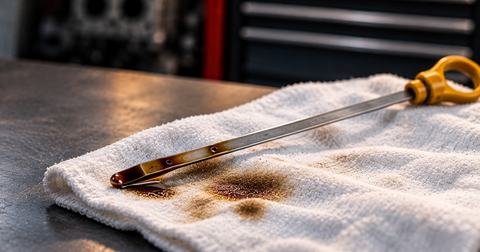
Check the level with the dipstick
What happens if the wrong oil goes in?
Oil other than the one your manual names can cause engine damage the warranty won't cover. I've seen a car on the wrong oil where the engine sounded different and lost performance, and I advised going back to the original spec. If the wrong grade has already gone in, 0W-20 versus 5W-30 shows what that means for the engine.
Having your oil changed somewhere other than the dealer doesn't void the warranty. The dealer can still deny coverage if it proves an aftermarket part caused the damage, so keep your oil-change records.
What oil does each carmaker name?
Carmakers name their oil in different ways, and some add their own spec number to the grade. Your own manual still decides for your car and engine:
| Carmaker (example cars) | Viscosity grade | Standard or approval |
|---|---|---|
| GM Equinox 2022, Terrain 2016. | 0W-20 on the Equinox and 5W-30 on the Terrain. | The dexos1 approved mark. |
| Ford F-150 2018, Escape 2020. | 5W-20, 5W-30 or 0W-20, by engine. | A Ford spec number next to the grade. |
| Stellantis (Ram, Jeep) Ram 1500 2016, Wrangler 2018. | 5W-20 or 0W-20. The Wrangler 2.0L turbo takes 5W-30. | MS-6395, and MS-13340 on the Wrangler 2.0L turbo. |
| Honda CR-V 2019, Accord 2018, Civic 2016. | 0W-20. | The API Certification Seal. |
| Toyota Camry 2018, RAV4 2019, Tacoma 2019. | 0W-16 on the Camry 2.5L and the RAV4, 0W-20 on the Camry V6 and the Tacoma. | API SN/RC on the Camry 2.5L and ILSAC GF-5 on the Camry V6. |
| Nissan Rogue 2018, Altima 2018. | 0W-20. | API or ILSAC certification. |
| Hyundai Elantra 2022, Tucson 2019. | 0W-20 on the Elantra and 5W-20 on the Tucson. | API SN PLUS/SP or ILSAC GF-6 on the Elantra, API Latest on the Tucson. |
| Volkswagen Tiguan 2021 2.0L turbo. | 0W-20. | VW 508 00, synthetic oil. |
A manual can allow a stand-in. On a Toyota that takes 0W-16, 0W-20 is allowed when 0W-16 isn't available, and the oil goes back to 0W-16 at the next oil change.
From the carmakers
What do the carmakers and agencies say about engine oil?
Owner's manual Engine oil
Engine oils that have been approved by GM as meeting the dexos1 specification are marked with the dexos1 approved logo.
Owner's manual Engine oil
Do not use supplemental engine oil additives because they are unnecessary and could lead to engine damage not covered by your vehicle warranty.
Owner's manual Engine oil
If SAE 0W-16 is not available, SAE 0W-20 oil may be used. However, it must be replaced with SAE 0W-16 at the next oil change.
Standards page API oil categories
For automotive gasoline engines, the latest engine oil service category includes the performance properties of each earlier category.
Agency page Auto warranties and service contracts
It's illegal for a dealer to deny your warranty coverage because you had routine maintenance or repairs done by someone else.
Service bulletin 21TiguanSrvXprs
VW 508 00 Use synthetic oil SAE 0W-20.
Conclusion
What to do next about the oil your car takes
If you're about to buy oil, match the bottle to the grade and the standard in your manual's oil section, and if you don't know your engine, find it before you pick a grade. The oil change calculator shows when your next change is due.
Oil & Miles checks each step here against the carmakers' own manuals and the federal and API pages.
Common questions
Asked most often
How do I know what engine oil to use?
Read the oil section of your owner's manual. It names the grade and the standard or approval the oil must meet.
Can I use any 5W-30?
Only if your manual names 5W-30 and the bottle carries the standard or approval it asks for. A newer API category covers older ones, but the grade must still match.
Is it better to use 5W30 or 10W30?
Neither is better in general, so use the grade your manual names for your engine. The page on 0W-20 versus 5W-30 shows what a grade mix-up means.
Can I use a different brand of oil?
Yes, if it carries the grade and the standard or approval your manual names. Changing oil somewhere other than the dealer doesn't void the warranty.
What oil does my car take by VIN?
A VIN shows the engine, not the oil. Find the engine from it, then look up that engine's oil in the manual.
Do I need an oil additive?
No. On Ford engines, additives are unnecessary and could lead to engine damage.
What people ask next
Sources
- API, Oil Categories, for the rule that a newer category covers the older ones. API, read November 10, 2026
- API 1509, Engine Oil Licensing and Certification System, twenty-fourth edition, for API SQ, ILSAC GF-7A and GF-7B. API, read November 10, 2026
- 49 CFR 565.15, VIN requirements, for what the VIN positions encode. eCFR, read November 10, 2026
- FTC, Auto Warranties and Auto Service Contracts, for the warranty rule and the records. FTC, read November 10, 2026
- 2022 Chevrolet Equinox, 2016 GMC Terrain and 2014 Chevrolet Silverado 1500 Owner's Manuals (US), PDF pages 264, 207 and 382, for the dexos1 approval, the grade and full synthetic. GM, read November 10, 2026
- 2018 Ford F-150 and 2020 Ford Escape Owner's Manuals (US), PDF pages 356, 437, 440, 442, 320, 387 and 394, for the Ford spec numbers, the additives and the recheck. Ford, read November 10, 2026
- 2016 Ram 1500, 2015 Jeep Grand Cherokee and 2018 Jeep Wrangler Owner's Manuals (US), PDF pages 806 to 809, 873, 606, 607 and 441, for MS-6395, the filler cap and the certification mark. Stellantis, read November 10, 2026
- 2019 Honda CR-V, 2018 Honda Accord and 2016 Honda Civic Owner's Manuals (US), PDF pages 572, 575, 615, 616, 618 and 494, for 0W-20, the API seal and adding oil slowly. Honda, read November 10, 2026
- 2018 Toyota Camry, 2019 Toyota RAV4, Tacoma and 4Runner Owner's Manuals (US), PDF pages 543, 544, 661, 631, 357 and 358, for 0W-16, 0W-20 and the capacity. Toyota, read November 10, 2026
- 2018 Nissan Rogue and Altima, 2012 Altima Owner's Manuals (US), PDF pages 504, 508, 434, 89 and 377, for 0W-20 and the oil pressure light. Nissan, read November 10, 2026
- 2022 Hyundai Elantra and 2019 Tucson Owner's Manuals (US), PDF pages 26, 100 and 529, for the grade and the API or ILSAC level. Hyundai, read November 10, 2026
- Volkswagen Service Bulletin 21TiguanSrvXprs, for VW 508 00 on the 2021 Tiguan 2.0L turbo. Volkswagen, read November 10, 2026
The oil names come from the owner's manuals, the API and the federal pages named above, all US editions.
AI illustration by Oil & Miles
This article is general information, not advice about your specific vehicle. See the disclaimer.