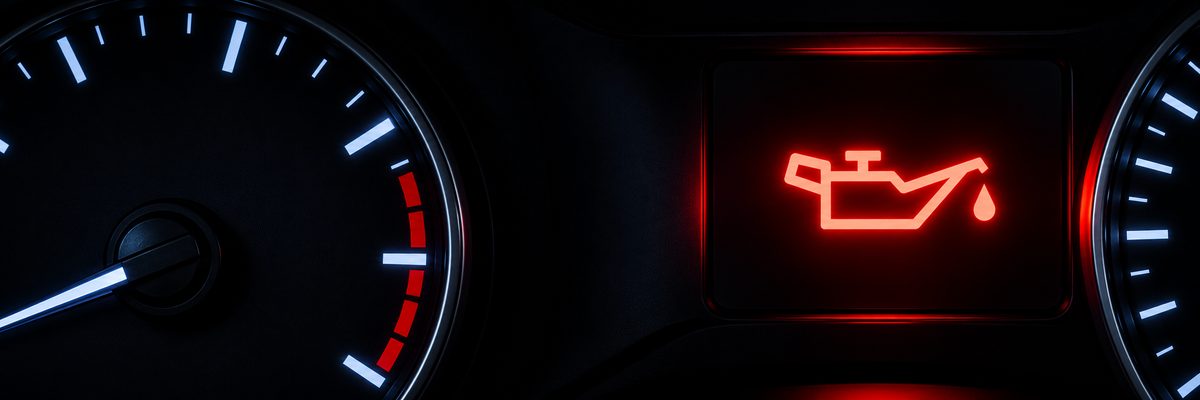

What the light means depends on which of two lamps you're looking at, and they look similar in a list of dashboard symbols. Mistaking one for the other is how an engine gets driven until it stops.
What does the oil light mean?
A red oil light means the oil pressure is low, so stop and switch off, while an amber percentage or change-oil message means a service is due. Most cars have two separate warnings, and reading the emergency as a calendar entry can cost the engine.
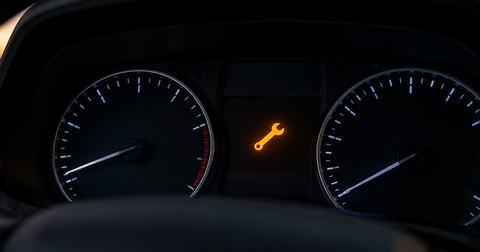
The reminder goes by several names: on a General Motors car it is the message CHANGE ENGINE OIL SOON. On a Ford it is a percentage, OIL LIFE, that counts down and resets when the oil is changed.
Whatever the wording, an amber message with a percentage or “change oil soon” is the reminder. It's a schedule, and it waits for you, while an amber low oil level warning means check the dipstick soon, as your manual says.
When the reminder appears, book a routine oil change and keep driving. Our guide to the oil change light covers what the percentage means and how to reset it.
The red oil pressure lamp is the other warning, and it doesn't wait. A pressure switch feeds it, so it reports a fault in the oil supply, not a date on the calendar.
What to do when the oil light comes on
When the red oil light comes on, stop first, before anything you can check:
- If it is red, stop and switch off. Not at the next exit, at the first safe place. An engine run without oil pressure gets damaged fast, and Nissan puts the damage at almost immediate.
- Check the level after it's parked and off, and read it carefully. If it is low, add oil, and if the light stays on or comes back, switch off and get a tow.
- Get the pressure read mechanically before assuming a sensor. A shop can tell a real pressure loss from a failed switch with a gauge. Assuming the sensor and being wrong is the expensive mistake, because the engine is what is at stake.
Right after an oil change, the level or the filter may be wrong. If it's the red lamp, stop and call the shop that did the work.
Can you drive with the oil light on?
No, not with the red oil pressure light, because an engine run without oil pressure can seize, and most carmakers' manuals tell you to stop. GM's 2020 Equinox manual only says check the level and see your dealer, and that's no reason to drive on.
Nissan says the damage can happen almost immediately and isn't covered by warranty. The amber reminder is different, and you can keep driving to an appointment.
Why is the oil light on when the oil is full?
Don't drive on, because a full dipstick doesn't clear a red lamp. It feels like a false alarm and it's the opposite, since you check the dipstick, the level is right, and the light is still on.
The problem is between the oil and the engine rather than a simple shortage. Ford is explicit about this exact situation, and tells you not to resume the journey when the lamp stays on with the level correct, but to have the system checked instead.
A full dipstick rules out the cheapest cause and leaves the ones that need a shop. When the oil light comes on but the oil is full, these are the usual causes:
- A worn oil pump. It can no longer build pressure, however much oil is sitting in the pan.
- A pickup screen starved by sludge or debris. The pump is fine, but what reaches it isn't.
- A failed pressure sensor. It reports a fault that isn't there, the one cause that doesn't hurt the engine, and you can't know it's that without a gauge.
- Oil that is too thin. Either the wrong grade, or the right grade diluted by fuel.
Telling a real pressure loss from a dead sensor takes a shop and a mechanical gauge. The test is worth paying for, because the engine is what's at stake.
Why does the oil light flicker?
A light that flashes, or that shows only at idle or as you brake to a stop and clears once you speed up, means pressure is falling when the engine turns slowly. Pressure is lowest at idle with a hot engine.
Coming on as you turn or brake hard and clearing on a straight means the oil is likely low enough to slosh away from the pickup. The pickup is the inlet the pump draws oil through.
So a flicker means the same causes, such as low oil, a worn pump or thin oil, caught early at idle. Ford's manual covers it in one line: if the warning stays on or continues to come on with the engine running, contact a dealer as soon as possible.
Treat a flicker like the steady lamp: stop, check the level, and add oil if it's low. If it keeps coming on with the level correct, have the pressure read mechanically rather than assuming the switch.
What does the oil pressure light measure?
The oil pressure light doesn't read the oil level. It reads oil pressure, through a switch that closes when the pressure falls below a set point.
That pressure keeps a film of oil between the moving parts, and without it metal rubs on metal. Several makers label the lamp simply Engine Oil, an oil can with a drop, though it reports pressure and a low level is only one way pressure falls.

Why do carmakers' manuals disagree about the oil light?
Because each manual is written for its own car, and seven carmakers give six different instructions. Some never send you to the dipstick, and some send you there first.
Three don't treat it as a level gauge: two tell you flatly that it has nothing to do with oil level, and the third never sends you to the dipstick at all, while the other four tell you to check the level. Every one of them reads its own car correctly, and the trouble is that an owner who learned the rule on one brand is driving another.
- The lamp means
- Oil pressure is too low
- It tells you to
- Stop in a safe place immediately and contact the dealer. The manual never sends you to the dipstick.
- The lamp means
- Pressure, and it's “not designed to indicate a low oil level”
- It tells you to
- Stop as soon as it is safe. Damage can be almost immediate, and the warranty excludes it.
- The lamp means
- “Does not indicate how much oil is in the engine”
- It tells you to
- “Do not operate the vehicle until the cause is corrected.” A chime sounds with the lamp.
- The lamp means
- A malfunction. The lamp is labeled “Engine Oil”
- It tells you to
- Stop and check the level. Don't resume if the level is correct.
- The lamp means
- Low pressure, often from a lack of engine oil
- It tells you to
- Drive to the nearest safe place and stop, then check. Engine power is cut for you.
- The lamp means
- Low pressure, often from a lack of engine oil
- It tells you to
- The same, and see a dealer if the light stays on after adding oil.
- The lamp means
- Oil is “not flowing through the engine properly”
- It tells you to
- Check the level as soon as possible, add if needed and see your dealer. A warranty exclusion is named.
When does the oil light mean the engine is failing?
When the oil pressure really drops, as on one recalled Ford engine. NHTSA's list for Ford recall 23S64 (23V-905) covers the 2018–2022 EcoSport and 2016–2018 Focus with the 1.0-liter EcoBoost and an automatic. Ford's own list starts the EcoSport at 2017 and adds the 2017–2018 Fiesta.
Before you pay for an engine on one of these, our free VIN decoder lists the recalls for your model year, and NHTSA's VIN search shows which are still open on yours. On these cars a failure of the oil pump belt and its tensioner drops the oil pressure directly. Our guide to the Ford 1.0 EcoBoost wet belt explains how that belt works.
A service bulletin is written for dealers, not owners, so nobody mails you about one. Ford's, SSM 48093, describes that failure as a loss of engine oil pressure with an illuminated oil pressure warning lamp that may require an engine replacement.
From the driver's seat, oil starvation looks exactly like an oil pressure light. That's why a car with a documented oil-supply fault files the most of these complaints. If you're shopping used, our guide to wet belt engines covers which cars to check.
What does the federal complaint record show?
NHTSA publishes every complaint US owners file, which shows how often the oil pressure light comes up and on which cars. Across model years 2010–2025, 1,171 complaints name an oil pressure light or warning, across 37 makes.
Ford cars draw the most of these complaints, but the count shows who filed a report, not how often a part failed. It's large partly because Ford sold a great many of the cars involved, and partly because one of those cars has a known, recalled fault that sets this light off.
Take that one model out and Ford sits much closer to the rest. The complaint file is a record of what owners reported, and it points at a single car.
Break the record down by model and one car separates from every other: the Ford EcoSport accounts for 311 of the 1,171 complaints, more than a quarter of the entire file on its own. The next model, the Ford Focus, sits at 58.
Whose oil pressure light
Complaints naming an oil pressure light or warning, 2010–2025, top six of 37 makes
Not adjusted for how many of each car were sold. Filed by owners who had a problem, so this is what they reported, not a failure rate. NHTSA complaints, model years 2010–2025.
Use this image
Free to republish under CC BY 4.0: credit Oil & Miles and link to this page. The snippet does both.
<a href="https://oilandmiles.com/articles/oil-light"><img src="https://oilandmiles.com/assets/img/diagrams/oil-light-by-make-card.svg" alt="Complaints naming an oil pressure light by make, 2010–2025: Ford 457, Kia 168, Hyundai 137, Jeep 88, Chevrolet 55, BMW 44, out of 37 makes" width="1000" height="590"></a> <p>Chart: <a href="https://oilandmiles.com/articles/oil-light">Oil & Miles</a>, CC BY 4.0</p>What the data says
Ford leads with 457 complaints, then Kia at 168 and Hyundai at 137. The count measures who filed a report, not how often a part failed, so this ranking isn't a reliability table.
NHTSA's consumer complaint database, model years 2010–2025. Counts complaints whose narrative names an “oil pressure light”, “oil pressure warning” or “oil pressure lamp”. Read August 27, 2026.
From the carmakers
What do owner's manuals say about the red oil light?
Seven owner's manuals disagree about what to check, and six of the seven say to stop. Three of the seven are quoted in their own words.
Owner's manual Pages 436 and 448
Stop the vehicle in a safe place immediately and contact your Toyota dealer
Owner's manual Page 113
Do not operate the vehicle until the cause is corrected. This light does not indicate how much oil is in the engine.
Owner's manual Pages 78 and 86
Do not resume your journey if it illuminates despite the level being correct. Have the system checked by your authorized dealer.
Conclusion
What to do next about an oil light
Stop for the red lamp, because oil has stopped circulating under pressure and an engine run that way gets damaged fast. The amber one is a countdown to a service that says nothing about what is in the oil pan.
Where a red lamp stays on with the level correct, have the pressure read mechanically rather than assuming the switch. Oil & Miles checks each step here against the carmakers' own manuals.
Common questions
Asked most often
Does the oil light mean I am low on oil?
Not directly: the oil light reports oil pressure, not oil level. Low oil is one way pressure drops, so checking the level is the right first move, but a full dipstick doesn't clear the light.
How much oil is left when the oil light comes on?
There's no set amount, because the light reads pressure and not level. Check the dipstick once the engine is off to find out.
Is the oil light the same as the oil change light?
No: the oil pressure light is red and means stop now. The oil change or oil life reminder is amber and only means book a routine service.
What people ask next
Sources
- 2022 Hyundai Elantra owner's manual, pdf page 99, for adding oil and a light that stays on. Hyundai, read November 2, 2026
- NHTSA's consumer complaint database, for every count on this page: 1,171 complaints across 37 makes, of which the Ford EcoSport is 311. nhtsa.gov, read August 27, 2026
- Ford recall 23S64 (NHTSA 23V-905) and Ford service bulletin SSM 48093, retrieved from static.nhtsa.gov, for the EcoSport scope and the oil-pressure mechanism. NHTSA document library, read August 27, 2026
- Nissan Altima 2020 owner's manual, page 107, for “not designed to indicate a low oil level” and the warranty exclusion for damage caused by driving with the light on. Nissan owner's manual, read August 27, 2026
- Ram 2500/3500 2023 owner's manual (Cummins), page 113, for “does not indicate how much oil is in the engine” and “do not operate the vehicle until the cause is corrected”. Ram owner's manual, read August 27, 2026
- Hyundai Sonata 2023 owner's manual, pages 102–103, and the Kia Soul 2020 owner's manual, page 161, for the low-level framing and the engine power limit. Hyundai and Kia owner's manuals, read August 27, 2026
- Chevrolet Equinox 2020 (pages 122 and 126) and Silverado HD 2022 (page 112) owner's manuals, for the GM wording, the CHANGE ENGINE OIL SOON reminder as a separate message, and the named warranty exclusion. GM owner's manuals, read August 27, 2026
- Ford E-Series 2013 owner guide, pages 78 and 86, for the Engine Oil warning lamp instruction and for the OIL LIFE reminder as the separate scheduling message. Ford owner guide, read August 27, 2026
- Ford Edge 2011 owner's manual, the OIL PRESSURE message, for “if the warning stays on or continues to come on with your engine running, contact your authorized dealer as soon as possible”. Ford owner's manual, read October 6, 2026
- Toyota Avalon 2021 owner's manual, pages 436 and 448, for “stop the vehicle in a safe place immediately and contact your Toyota dealer” and the display text, with no instruction to check the level. Toyota owner's manual, read August 27, 2026
AI illustration by Oil & Miles
How this was compiled
The complaint figures cover the 2010–2025 model years and the complaints whose narrative contains oil pressure light
, oil pressure warning
or oil pressure lamp
.
The manufacturer instructions are quoted from the owner's manuals at source, each attributed to its own make and model year.
What we didn't do
We didn't read every manufacturer's manual. Seven marques are quoted here, six manufacturer groups, chosen to span the disagreement, and another maker may phrase the lamp differently again. We didn't adjust the complaint counts for how many of each car were sold: a popular or recalled model attracts more reports, so the ranking isn't a failure rate.
We give no repair price, because the cause behind a low-pressure light ranges from a sensor to a new engine and a single figure would mislead more than it helped. We didn't diagnose your specific car. A mechanical pressure test on the vehicle is what names the cause.
Figures are drawn from US federal complaint data and US-market owner's manuals, compiled in November 2026. This article is general information, not advice about your specific vehicle. See the disclaimer.